
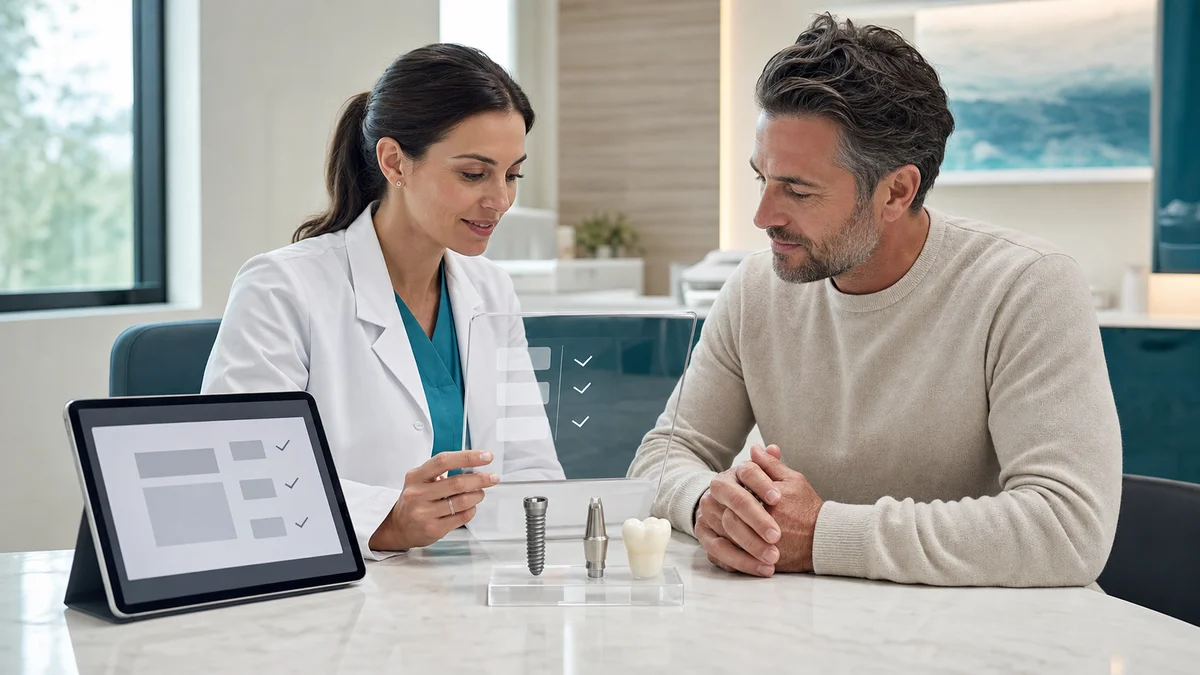
A search for gentle dental implant cost can mean two different things. You may be looking for the price at a practice that uses “Gentle Dental” in its name, or you may want implant treatment delivered with extra attention to comfort and anxiety. Those are not interchangeable questions. Several unrelated dental businesses use similar names, and fees can differ by office, clinician, treatment design, insurance contract, and the condition of the mouth.
This independent guide does not quote, represent, or promise a price for any Gentle Dental office. It shows you how to identify the exact provider, request a written itemized estimate, and compare like with like. A responsible gentle dental implant cost discussion should include the implant body, abutment, final crown, diagnostics, possible preparatory care, comfort choices, aftercare, and financial terms. The safest starting point is a clinical examination, because a website or phone quote cannot establish candidacy.
Quick answer: Gentle dental implant cost is not one universal fee. Ask the exact office for an itemized written estimate covering examination, imaging, extraction or grafting if needed, implant body, abutment, crown, temporary tooth, sedation, follow-up, insurance adjustments, and possible additional care. Compare scope, clinician, materials, safety planning, and total repayment—not just the headline number.
Patient-safety note: This article provides general education, not a diagnosis or a personal treatment recommendation. New swelling, fever, uncontrolled bleeding, rapidly increasing pain, difficulty swallowing or breathing, or a loose implant needs prompt professional assessment. Emergency symptoms require urgent local care.
Throughout this guide, gentle dental implant cost means the total patient-facing plan, not a claim about one company or a promise that every person needs the same procedure. Keeping that definition in view prevents a partial surgical fee from being mistaken for complete care.
1. Confirm Which “Gentle Dental” You Mean Before Comparing Cost
The phrase gentle dental implant cost is unusually easy to misunderstand because “Gentle Dental” is used by more than one practice or group. Start with the clinic’s full legal or trading name, street address, city, telephone number, and website. If you found an advertisement, confirm that the consultation, surgery, restoration, and follow-up will all occur at the named location. A fee shown by one organization should never be assumed to apply to another organization with a similar name.
For example, the official Gentle Dental site for its Massachusetts and New Hampshire locations describes dental implants and says coverage varies by insurance plan; it does not establish one universal implant price. The practical lesson is broader than one chain: the only meaningful quote is the written estimate issued for your proposed care by the office that will deliver it. Redent Klinik is not affiliated with the providers discussed in this explanatory guide.
- Save the office address and the name of the clinician responsible for surgery.
- Ask whether the final crown is made and fitted at the same practice.
- Confirm which location handles complications or weekend concerns.
- Check whether an advertised amount is a complete treatment fee, a starting fee, or only one stage.
2. Why Gentle Dental Implant Cost Cannot Be One Universal Number
No ethical clinician can determine your final treatment from a keyword alone. The gentle dental implant cost for one missing tooth may differ from another patient’s estimate because the site, bone volume, gum health, bite, neighboring teeth, medical history, restorative material, and need for temporary replacement are different. Geography and the practice’s operating model also affect fees. Even two implants in the same person may require different approaches.
A low headline price can be legitimate but incomplete. It may refer only to placement of the implant body, excluding the connector and visible tooth. It may assume ideal bone and gum conditions, omit imaging or anesthesia, or require a particular financing agreement. A higher estimate may include several of those elements. The fair comparison is therefore not “Which number is smallest?” but “Which clinically appropriate services, materials, responsibilities, and follow-up are included?”
For that reason, write each gentle dental implant cost figure next to its exact inclusions rather than ranking bare totals.
3. Gentle Dental Implant Cost Starts With Three Prosthetic Components
The US Food and Drug Administration explains that a dental implant system generally includes an implant body placed in the jawbone and an abutment secured to it; the replacement tooth or crown is then attached above. Some systems also use an abutment fixation screw. When reviewing gentle dental implant cost, look for all three functional layers: implant body, abutment, and crown. A quote describing only “the implant” is not sufficiently precise.
Ask whether the abutment is standard or customized, what crown material is planned, and whether laboratory work is included. Material selection should follow clinical needs, the position of the tooth, bite forces, aesthetic goals, repairability, and compatibility—not a promise that one material is universally best. Also request the implant manufacturer and model for your records. The FDA advises patients to keep brand and model information so future clinicians can identify the system.
4. Examination and Imaging Belong in a Complete Estimate
Before surgery, the team must understand the mouth and the person attached to it. A complete gentle dental implant cost estimate may include a comprehensive examination, periodontal assessment, diagnostic X-rays, photographs, digital scans or impressions, and three-dimensional imaging when clinically indicated. A cone-beam CT is not automatically necessary for every dental question, but detailed three-dimensional assessment is often used in implant planning to evaluate anatomy and available bone.
The medical history matters as well. Tell the dentist about medicines, allergies, bleeding problems, diabetes, immune conditions, osteoporosis treatment, tobacco or nicotine use, pregnancy, previous head or neck radiotherapy, sleep apnea, and earlier complications with anesthesia. Do not stop or change prescribed medication without instructions from the prescribing professional and dental team. The FDA notes that overall health is an important factor in healing and implant duration, so a bargain that skips proper assessment is not a safer bargain.
The diagnostic portion of gentle dental implant cost should be proportionate to your case and explained before you consent.
5. Extraction, Infection Control, and Site Preparation Can Change Cost
If a damaged tooth is still present, the plan may include extraction. Some patients can have extraction and implant placement at one visit; others benefit from healing first. The decision depends on infection, bone walls, soft tissue, primary stability, aesthetic risk, and general health. When comparing gentle dental implant cost, ask whether extraction, socket preservation, medication, and follow-up are included or separate.
Active gum disease should be managed before an elective implant proceeds. That may mean hygiene instruction, professional cleaning, periodontal treatment, and reassessment. This is not an unnecessary upgrade: healthy tissues and effective daily plaque control are foundations for long-term implant care. A clinician may also recommend treatment of decay or infection in nearby teeth when it could affect the site. Your written sequence should explain what must happen before placement and what would cause postponement.
6. Bone Grafting and Sinus Procedures Need Their Own Line Items
An implant needs an appropriate three-dimensional foundation. If the ridge is too narrow, too short, or irregular, grafting may be proposed before or during placement. Upper back-tooth sites may sometimes need a sinus-related augmentation. These are distinct procedures, not automatic parts of every implant, and they can materially alter gentle dental implant cost, healing time, risks, and the number of visits.
Ask why augmentation is recommended, whether a simpler alternative exists, what graft material is proposed, when implant placement would occur, and how healing will be checked. The team should also explain what happens if the actual anatomy differs from the scan or if the implant does not achieve suitable stability. A transparent estimate states whether graft material, membranes, fixation devices, imaging, and follow-up are included. Avoid interpreting a website illustration as proof that you personally require grafting.
7. Temporary Teeth and the Final Crown Are Different Expenses
During healing, some people want or need a temporary tooth for appearance, speech, or function. Options can include a removable temporary, a tooth attached to adjacent teeth, or—in selected circumstances—a temporary restoration supported by the implant. Immediate loading is not appropriate for everyone. Bone quality, implant stability, bite forces, the number of implants, and adherence to instructions influence the decision.
Ask whether the gentle dental implant cost estimate includes a temporary tooth, repairs or adjustments to it, the final crown, laboratory fees, shade characterization, try-in visits, and bite refinement. Clarify what happens if the temporary breaks or needs relining while tissues change. The final restoration should not be confused with the temporary solution, and a quote for one should not be presented as a quote for both.
This distinction can substantially change the apparent gentle dental implant cost even when both clinicians recommend a similar final result.
8. Surgery, Anesthesia, and Comfort Options Affect Gentle Dental Implant Cost
“Gentle” should describe respectful care, not a guarantee of zero discomfort. Local anesthesia is commonly used for implant placement. Additional anxiety-management options may range from communication techniques and planned breaks to inhalation sedation, oral medication, or intravenous sedation where clinically appropriate and lawfully provided. The safest choice depends on health, anxiety, procedure complexity, transport arrangements, fasting requirements, and the clinician’s training and monitoring setup.
When reviewing gentle dental implant cost, ask whether local anesthesia is included, which optional comfort methods carry separate fees, who administers and monitors sedation, and whether a responsible adult escort is required. Request written pre- and post-treatment instructions. Sedation reduces awareness or anxiety but does not replace local pain control, careful technique, or informed consent. No provider should promise that treatment will be completely sensation-free or risk-free.
- Tell the team about previous difficult dental or anesthesia experiences.
- Ask for a stop signal, step-by-step explanations, and realistic appointment length.
- Confirm fasting, medication, escort, and driving restrictions in writing.
- Know whom to contact after hours and which symptoms are urgent.
9. One Tooth, an Implant Bridge, and a Full Arch Are Not Comparable
A single missing tooth may be restored with one implant and crown, but several missing teeth might be treated with individual implants, an implant-supported bridge, or a removable implant-retained prosthesis. A full-arch fixed restoration involves a different number of implants, components, laboratory stages, maintenance needs, and contingency planning. Comparing these treatments by price per “tooth” can be misleading.
A clear gentle dental implant cost proposal identifies the intended outcome: one crown, a multi-unit bridge, an overdenture, or a fixed full-arch prosthesis. It should state the number of implants and replacement teeth, the temporary phase, final material, hygiene access, and what is removable by the patient or only by a clinician. Ask about non-implant alternatives too, such as a conventional bridge or removable denture, including their effect on neighboring teeth, maintenance, and likely future work.
10. Implant Brand, Components, and Laboratory Work Matter
Implant systems are not generic screws. Components must fit the selected platform, and access to compatible parts matters if a restoration later needs repair. For a meaningful gentle dental implant cost comparison, request the implant brand and model, component type, crown material, and the identity or location of the dental laboratory. Ask whether digital planning, a surgical guide, customized abutment, or advanced laboratory characterization is included and why it is recommended.
Costlier does not automatically mean better, and cheaper does not automatically mean unsafe. The relevant questions are regulatory status, documented system history, clinician familiarity, component availability, proper case selection, and traceable records. Keep copies of the implant label, dates, site, and restorative information. If you travel for treatment, make sure a local clinician can access records and obtain compatible components without avoidable delay.
A well-documented gentle dental implant cost proposal makes future identification and maintenance easier, wherever later care occurs.
11. Insurance Benefits Can Reduce Payment Without Setting the Treatment Plan
Dental insurance language can make gentle dental implant cost seem simpler than it is. “Covered” rarely means the plan pays the full amount. Coverage may depend on network status, deductible, coinsurance, waiting period, annual maximum, missing-tooth clause, frequency limits, preauthorization, or exclusions for grafting and sedation. An insurer’s allowance may also differ from the practice’s fee.
Ask the office to submit a pre-treatment estimate when available, but remember it is not a payment guarantee. Confirm benefits directly with the insurer using the exact procedure codes and provider location. Determine whether separate oral-surgery, prosthetic, and laboratory stages fall in different benefit years. If a claim is denied, request the written reason and appeal instructions. Treatment decisions should remain clinical and preference-sensitive; insurance helps fund care but does not determine what is safe or suitable.
12. Original Medicare Usually Does Not Cover Routine Implant Care
For patients in the United States, Medicare status deserves specific verification. Medicare’s official dental services page says Original Medicare generally does not cover routine dental care or items such as dental implants and dentures. There are narrow circumstances in which dental services that are inextricably linked to certain covered medical treatment may qualify. Medicare Advantage benefits vary by plan, network, authorization, and benefit limits.
Do not assume that a medical diagnosis makes routine gentle dental implant cost payable by Medicare. Ask the practice and plan for written confirmation, including which parts are covered and which remain your responsibility. A plan benefit advertised as “dental” might still exclude implants or cover only a limited allowance. If you have other dental coverage, ask how benefits coordinate before scheduling.
13. Self-Pay Patients Can Ask for a Written Good Faith Estimate
In the United States, federal No Surprises Act guidance generally gives uninsured or self-pay patients a right to a written good faith estimate for scheduled care or upon request. CMS guidance states that dental providers are generally included. Timing and dispute rights have specific rules, so use the current CMS information rather than relying on a social-media summary. A good faith estimate is valuable for organizing gentle dental implant cost, but it is not the same as a guarantee that anatomy or clinical needs cannot change.
Ask the office to identify each provider or facility expected to bill, the service descriptions and codes, and what could reasonably create an additional charge. CMS states that a patient-provider dispute process may be available when a final bill is at least $400 above the estimate, subject to eligibility and deadlines. Keep the estimate, consent documents, invoices, and communications together. Outside the United States, consumer and billing rights differ; request the equivalent written documentation under local rules.
14. Financing Changes Cash Flow, Not the Clinical Value
Monthly payments can make treatment easier to budget, but they can also obscure the total. When financing gentle dental implant cost, compare the cash price, deposit, financed amount, annual percentage rate, promotional period, deferred-interest condition, fees, late-payment consequences, and total repayment. A “zero-interest” offer may become expensive if its terms are not met. Financing approval should never be confused with clinical suitability.
Ask whether refunds follow the lender’s rules if treatment changes or stops, and who receives any unused funds. Avoid signing while sedated, rushed, or unsure which services are included. Consider whether staged treatment, insurance timing, a health savings account, or a second opinion changes the plan. The best financial choice preserves room for necessary maintenance and unexpected care rather than spending the entire budget on the initial surgery.
Record both the clinical total and the financed total when comparing gentle dental implant cost proposals.
15. Follow-Up and Maintenance Belong in Lifetime Cost
Implants are not maintenance-free. The European Federation of Periodontology identifies poor oral hygiene, a history of periodontitis, and smoking as important risk factors for peri-implant disease. Tissues around an implant can become inflamed, and progressive disease may involve supporting bone. The FDA likewise emphasizes regular follow-up and careful daily cleaning. A realistic gentle dental implant cost conversation therefore extends beyond the day of placement.
Ask how many surgical and restorative checks are included, when routine professional maintenance begins, which cleaning aids suit the restoration, and how the team monitors tissue and bone health. Report bleeding, swelling, persistent bad taste or odor, pus, increasing discomfort, bite changes, or mobility promptly. Teeth grinding, tobacco use, uncontrolled disease, and poor plaque control may require additional risk management. No implant can be guaranteed for life, but prevention and early assessment improve the chance of detecting manageable problems.
16. Compare Gentle Dental Implant Cost With This Decision Table
Use the table below for each written proposal. The goal is not to make every estimate identical; it is to reveal legitimate differences. A sound gentle dental implant cost comparison pairs the fee with the clinical scope, responsible provider, records, safety arrangements, and aftercare. Mark “not applicable” only after the clinician explains why.
| Decision item | What the written plan should state | Question to ask |
|---|---|---|
| Provider and location | Exact office and surgical/restorative clinicians | Who owns each stage and urgent follow-up? |
| Diagnostics | Exam, X-rays, scans, photographs and planning | Which tests are included and why? |
| Site preparation | Extraction, periodontal care, graft or sinus procedure | Is it required, optional, or conditional? |
| Implant system | Body, abutment, screw if used, brand and model | Will I receive traceable component records? |
| Restoration | Temporary option, final crown or prosthesis, laboratory | Are repairs and adjustments included? |
| Comfort and safety | Local anesthesia, optional sedation, monitoring and escort | Who provides it and what instructions apply? |
| Aftercare | Number and timing of checks; maintenance plan | What is included and what is billed later? |
| Payment | Insurance estimate, patient share, financing terms | What is the total repayment and what can change? |
Questions to Ask at a Gentle Dental Implant Cost Consultation
Bring a written list and take notes. If the terminology is confusing, ask the clinician to point to each component on a model or scan. A careful consultation should make uncertainty visible rather than hiding it. Before accepting a gentle dental implant cost plan, ask:
- What diagnosis and treatment goals support this recommendation?
- What alternatives are reasonable, including no immediate treatment?
- Which items are included now, excluded, optional, or dependent on findings?
- Who places the implant, who makes the crown, and who manages complications?
- What implant system and restorative materials are planned?
- What risks are most relevant to my health, site, bite, and habits?
- What will I experience during healing, and what symptoms need an urgent call?
- What insurance assumptions were used, and are they guaranteed? (Usually they are not.)
- What is the cash total and, if financed, the total repayment?
- What records will I receive if I move or seek care elsewhere?
If you are comparing local care with treatment abroad, include travel, accommodation, time away from work, staged return visits, insurance limitations, and the plan for urgent or restorative care at home. Redent Klinik can discuss a patient-specific pathway through its English contact page; general clinic information is also available on the Redent Klinik English homepage. A remote conversation may help organize questions, but definitive planning still requires suitable clinical records and assessment.
Red Flags in a Gentle Dental Implant Cost Advertisement
Marketing becomes unsafe when it replaces examination, informed consent, or transparent scope. Treat a gentle dental implant cost advertisement cautiously if it guarantees lifelong success, claims everyone is suitable, pressures immediate payment, hides the provider’s identity, or refuses to itemize the visible tooth and connector. A dramatic discount is not proof of poor care, but the reason and full terms should be understandable.
- A single price is promoted without saying whether it covers the implant, abutment, and crown.
- Grafting or extraction is described as always necessary—or never necessary—before assessment.
- “Pain-free” or “risk-free” language is presented as a certainty.
- The implant brand, responsible clinician, or after-hours contact cannot be identified.
- Financing is emphasized while the cash price and total repayment remain unclear.
- There is no plan for maintenance, complications, component records, or treatment changes.
A second opinion is especially reasonable for complex grafting, full-arch treatment, a plan that removes multiple restorable teeth, or a recommendation you do not understand. The purpose is not to shop for a predetermined answer; it is to compare diagnoses, alternatives, risks, and scope.
Bring the original gentle dental implant cost estimate to that visit so differences can be discussed accurately.
Frequently Asked Questions About Gentle Dental Implant Cost
Is gentle dental implant cost the price from one national company?
No. The wording can refer to different practices that share similar names, and it can also be a general search for comfortable implant care. Confirm the exact clinic address and website. The official Gentle Dental practice site cited below covers specific locations in Massachusetts and New Hampshire, but this article is independent and does not state a price on its behalf. Your gentle dental implant cost must come from the office treating you after appropriate assessment.
Does one implant price normally include the crown?
Not necessarily. “Implant” may be used narrowly for the body in bone or broadly for the whole replacement. Ask for separate lines for the implant body, abutment, fixation screw if used, temporary tooth, and final crown, plus surgery and laboratory work. A useful gentle dental implant cost quote defines every included stage in plain language.
Can I receive an exact gentle dental implant cost by phone?
A practice may explain ranges or standard components, but an exact personal plan usually requires examination and suitable imaging. Bone and gum conditions, infection, anatomy, bite, health history, and restorative design can change the work. Treat a phone amount as preliminary unless the office clearly states otherwise. Ask when you will receive a patient-specific written estimate and which findings could alter it.
Will dental insurance pay all of gentle dental implant cost?
Full payment is uncommon and cannot be assumed. Your plan may apply a deductible, coinsurance, annual maximum, waiting period, network allowance, missing-tooth rule, or exclusion. Grafting, sedation, or temporary restorations may be handled separately. Get a pre-treatment estimate, verify it directly with the insurer, and retain enough financial flexibility because benefit verification is not a guarantee of claim payment.
Does Medicare cover gentle dental implant cost?
Original Medicare generally does not cover routine dental services or dental implants, according to Medicare’s official guidance. Limited dental services may be covered when they are inseparably connected to specific covered medical treatment. Medicare Advantage benefits vary. Ask the plan and provider to confirm coverage in writing for each service; do not rely on the word “dental” in a plan summary alone.
Is bone grafting always part of gentle dental implant cost?
No. Grafting is based on site anatomy and the proposed implant position, not simply on wanting an implant. It may occur before or during placement, and some plans may use a different restorative approach. Ask the clinician to show why grafting is recommended, describe alternatives, and identify graft material, timing, risks, and every related charge in the estimate.
Does sedation make implant treatment completely painless?
No method can ethically guarantee a completely sensation-free experience or eliminate risk. Local anesthesia is used to control procedural pain; sedation can help selected patients with anxiety or awareness. Post-treatment soreness and swelling vary. Discuss medical suitability, monitoring, escort rules, instructions, and separate fees. Report severe or worsening symptoms rather than assuming they are normal.
What happens if the implant does not integrate?
Ask before treatment. The response depends on the reason, timing, infection status, bone, implant stability, health, and provider policy. Management may involve observation, removing the implant, treating infection or tissue problems, healing, grafting, replacement, or choosing another restoration. A gentle dental implant cost estimate should state which remedial services are included and which could generate additional fees; no clinician can guarantee integration.
How do I compare a low offer with a higher estimate?
Use the same checklist for both: diagnosis, imaging, site preparation, implant body, abutment, crown, temporary tooth, anesthesia, laboratory, clinician responsibilities, follow-up, maintenance, complication policy, insurance assumptions, and total financing cost. The cheapest headline may be a good option or merely incomplete. Compare documented scope and a safe, appropriate plan—not price alone.
What records should I receive after implant treatment?
Request the implant brand, model, size and site; placement date; component and restorative details; relevant images; treatment notes; and maintenance instructions. Keep these records accessible, especially if you relocate or seek emergency care. The FDA specifically advises retaining implant system information. Records are a small but important part of long-term value when assessing gentle dental implant cost.
Bottom Line: Compare Scope, Safety, and Total Responsibility
The most reliable answer to gentle dental implant cost is an individualized written plan from the exact treating office. It should show what is known, what remains conditional, and who is responsible at each stage. Confirm that the implant body, abutment, crown, diagnostics, preparation, temporary restoration, comfort choices, aftercare, and financial terms are either included, excluded, or marked not applicable.
Price matters, but it is one dimension of a long-term medical-device decision. Sound diagnosis, cleanable design, informed consent, traceable components, realistic risk communication, and a maintenance pathway are also valuable. Give yourself permission to pause, ask for plain-language explanations, verify insurance or financing independently, and obtain a second opinion when the plan is complex. That is a more dependable route to comfortable care than any universal online number.
Sources and Further Reading
- Gentle Dental — official practice website and location information
- Gentle Dental — official dental implants service page
- US Food and Drug Administration — Dental Implants: What You Should Know
- European Federation of Periodontology — Peri-implant diseases
- Centers for Medicare & Medicaid Services — Rights for people without insurance or who self-pay
- Centers for Medicare & Medicaid Services — Good Faith Estimate FAQ, including dental providers
- Medicare — Dental services coverage
- American Dental Association — oral-health information and professional resources
- World Health Organization — Oral health fact sheet
Sources were checked on 31 July 2026. Insurance benefits, consumer-protection rules, provider locations, and clinical guidance can change; verify current details with the relevant official body, insurer, and treating clinician.