
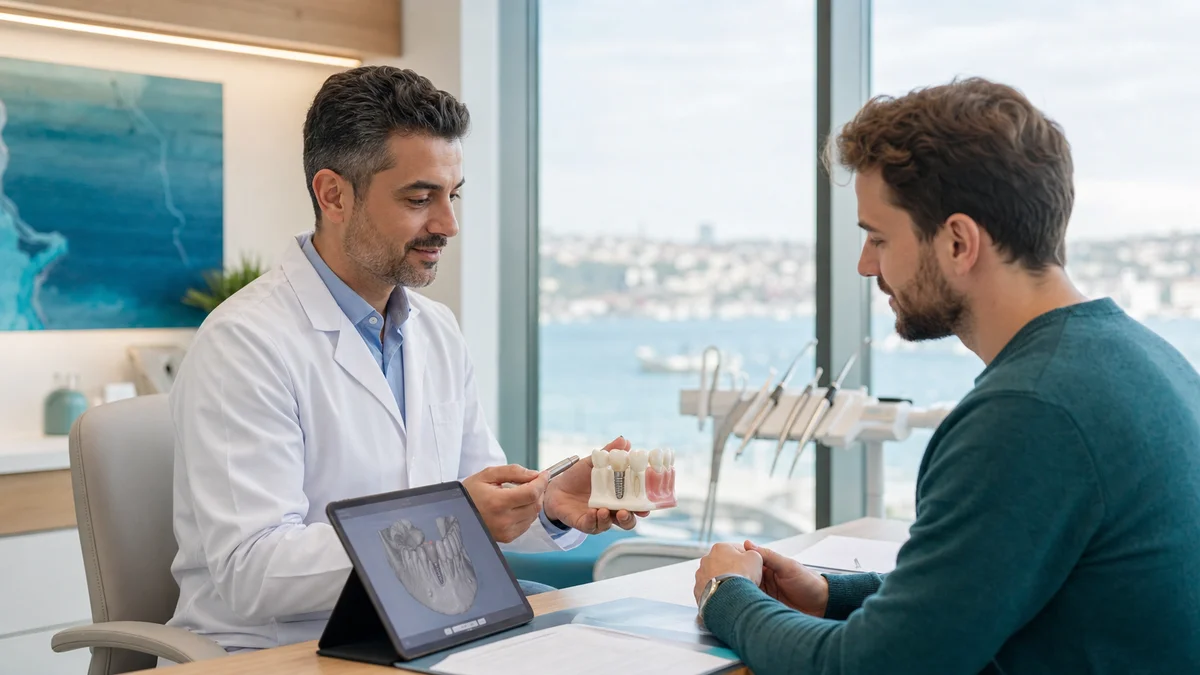
Quick answer: getting dental implants in turkey can be considered only after a proper clinical assessment and a written, staged plan. Verify the authorised facility, treating dentist, implant brand and model, diagnostic records, full costs, healing timetable and named aftercare provider. Budget for complications and do not treat a remote quote, package holiday or digital preview as a diagnosis or result guarantee.
People researching getting dental implants in turkey often begin with a price comparison. Price matters, but it cannot show whether an implant is appropriate, how many surgical stages are required, whether bone or gum treatment is needed, or who will manage a problem after the patient flies home. Two proposals that use the same number of implants may have different diagnostic work, components, temporary restorations, laboratory materials and follow-up responsibilities. A headline package price can therefore compare unlike treatment.
A dental implant is a medical device placed in the jaw to support a crown, bridge or removable restoration. The US Food and Drug Administration advises patients to discuss benefits and risks, disclose their health history, ask for the implant system’s brand and model, and retain those details. It also notes that healing may take months or longer and that complications can occur early or late. This is why getting dental implants in turkey should be planned as healthcare with travel attached, not as a short holiday with dentistry added.
This guide does not diagnose implant suitability, quote a fixed price or recommend a particular treatment configuration. It is designed to help an international patient ask verifiable questions. A safe decision requires an in-person examination, appropriate imaging, informed consent and a realistic follow-up pathway. No ethical provider can promise permanent success, completely painless care or an identical result for every patient.
1. Start with the clinical question, not the destination
Before comparing clinics for getting dental implants in turkey, clarify why a tooth or several teeth need replacement. A missing tooth can sometimes be managed with an implant, a tooth-supported bridge, a removable option or, in selected situations, no immediate replacement. Each choice has benefits, limitations and maintenance needs. Natural teeth that can predictably be treated should not be removed merely to fit a standard package. Seek an independent local assessment if the proposed plan involves extracting multiple teeth.
For getting dental implants in turkey, send a complete and recent record set only through a secure channel. Photographs and scans can support preliminary discussion, but they cannot fully reveal gum condition, mobility, bite forces, tenderness, soft-tissue findings or every feature relevant to surgery. A remote proposal should remain provisional until the treating clinician examines you in person.
Ask the provider to state the goal of getting dental implants in turkey in plain language. Is the plan replacing one tooth, stabilising a denture, supporting a fixed bridge or reconstructing a full arch? Is the priority chewing, speech, appearance, hygiene access or several of these? If the goal is vague, the number of implants and the final restoration cannot be evaluated properly.
2. Who may or may not be a candidate?
Overall health affects surgical risk, healing and long-term maintenance when getting dental implants in turkey. The FDA specifically highlights general health, smoking and oral hygiene as relevant considerations. Diabetes control, immune conditions, previous head or neck radiotherapy, bleeding risk, allergies and medicines that affect bone or clotting may alter the plan. Disclose all prescriptions, non-prescription products and supplements. Never stop anticoagulants, osteoporosis medicines or other treatment without instructions from the responsible clinicians.
getting dental implants in turkey may require coordination with a physician at home before travel. That does not mean a medical condition automatically excludes implants; it means risk must be assessed individually. Active gum disease, uncontrolled decay or infection may need treatment first. Adequate bone and soft tissue must be considered, but a scan alone does not determine the entire plan.
- Provide a current medical history, medicine list, allergies and previous surgical complications.
- Describe smoking or nicotine use honestly, including vaping and nicotine replacement.
- Report clenching, grinding, previous gum disease and difficulties cleaning your teeth.
- Ask whether your condition needs a local physician’s letter or laboratory tests.
- Discuss pregnancy, recent illness and planned operations before booking flights.
- Request an explanation of why an implant is preferable to realistic alternatives.
An online form that accepts every applicant for getting dental implants in turkey without clinical questions is not meaningful screening. Conversely, asking for health information does not prove that a clinic has interpreted it correctly. The treating dentist should explain how your individual factors change timing, anaesthesia, restoration design or follow-up.
3. Verify the facility’s current authorisation
Turkey regulates international health tourism. The Ministry of Health’s Health Tourism Department publishes current lists of facilities and intermediary organisations holding the relevant authorisation; its site reported an update to facility lists on 2 July 2026. For getting dental implants in turkey, search the legal facility name rather than relying on a social-media trading name. Confirm the address and authorisation immediately before booking because lists can change.
Authorisation is an important minimum check, not an endorsement of a specific dentist or guarantee of outcome. A brokerage or travel coordinator is not the treating healthcare professional. Ask which entity provides the clinical care, which entity takes payment, and whether hotel, transfer or translation services are supplied by a separate authorised intermediary. The names on the quote, invoice and consent documents should be understandable.
If the provider’s status cannot be confirmed, pause. Screenshots, badges and influencer videos can be copied or become outdated. Use the Turkish Ministry of Health’s own source or contact the relevant authority. Patients planning getting dental implants in turkey should also check current travel advice for their nationality and destination; health-authorisation checks do not replace ordinary entry, security and insurance planning.
4. Identify the dentist who will examine and operate
Marketing teams may answer logistical questions about getting dental implants in turkey, but diagnosis, consent and surgery belong to appropriately qualified clinicians. Ask for the full name and professional role of the dentist who will examine you, place implants and fit the restoration. Clarify whether more than one clinician is involved and who leads the plan. A clinic brand’s case volume does not reveal an individual operator’s training or your expected risk.
When getting dental implants in turkey, request a direct clinical discussion before paying a non-refundable balance. Ask who interprets three-dimensional imaging, who manages bone or soft-tissue grafting, who designs the prosthesis, and who is available if the original operator is absent. “Our team will decide” is not enough when responsibility is unclear.
Experience with getting dental implants in turkey should be discussed without invented success rates. A clinician can explain the types of cases they manage, their planning workflow and how complications are audited, but no personal result can be guaranteed from an aggregate percentage. Professional communication includes limits: sometimes the safest decision after examination is to change or postpone the remote proposal.
5. Understand the diagnostic records
A clinical examination for getting dental implants in turkey commonly assesses teeth, gums, bite, hygiene, smile line and available restorative space. Imaging is selected according to the clinical question. Three-dimensional imaging can help evaluate anatomy for implant planning, but it still requires appropriate interpretation and radiation justification. Intraoral scans and impressions record the teeth and soft tissues; photographs document appearance and communication.
Ask whether records are included in the quote and whether you will receive copies. With getting dental implants in turkey, portable records matter if follow-up is later provided in another country. Files should identify the date, facility and patient. A digital animation of the proposed smile is not the same as a diagnostic report, and a stock image is not evidence of your anatomy.
If another clinic performed recent imaging for getting dental implants in turkey, ask whether it is diagnostically suitable before repeating it. Do not demand fewer records merely to reduce cost; equally, ask what question each exposure answers. The final treatment plan should be confirmed only after the treating team reviews the complete clinical picture.
6. Separate the implant, abutment and final tooth
When getting dental implants in turkey, “implant” is often used loosely for the entire replacement, but the system has several parts. The implant body sits in bone; an abutment or intermediate component connects it to a crown, bridge or denture. Screws, temporary components and restorative materials may also be involved. A quote for getting dental implants in turkey should say which components and restorations are included.
Ask for implant manufacturer, system, model, dimensions and lot or reference information after placement. The FDA recommends retaining brand and model details. An implant passport or equivalent record can help a future dentist identify compatible components, although it does not oblige that dentist to provide treatment. If the proposed system has limited distribution in your home country, maintenance or repairs may be harder.
The final crown or bridge in getting dental implants in turkey also needs description: material, number of units, screw-retained or cemented design, temporary versus definitive status, and hygiene access. A premium-sounding material name does not establish good fit or bite. Design should reflect anatomy, function and maintenance rather than a one-style package.
7. Decision table for getting dental implants in turkey
Use this table to compare written proposals line by line. “Included” should refer to a named service, not an undefined promise. If the clinical scope differs, the totals are not directly comparable.
| Decision point | Question to ask | Reassuring evidence | Reason to pause |
|---|---|---|---|
| Authorisation | What is the legal facility name and current status? | Matches the Ministry’s current list and address | Only a logo or screenshot is offered |
| Treating clinician | Who examines, places and restores the implants? | Named roles and direct clinical discussion | Operator unknown until arrival |
| Diagnosis | Which findings support each extraction and implant? | Clinical and imaging findings explained | Fixed package based only on photographs |
| Device | What brand, model and components are planned? | Identifiable system and records promised | “German” or “premium” with no model |
| Restoration | What temporary and final teeth are included? | Material, unit count and retention specified | Implant count used as the whole description |
| Timing | What must heal before the next stage? | Conditional stages and review criteria | Instant permanent teeth guaranteed to all |
| Aftercare | Who manages pain, repair and maintenance at home? | Named contacts and funded contingency plan | Patient told any local dentist must fix it |
| Cost | Which clinical and travel costs can change? | Itemised assumptions and change-control process | Urgent deposit for an undefined package |
8. Read the quote as a treatment map
A useful quote separates consultation, imaging, extractions, grafting, sedation or anaesthesia, implant components, temporary teeth, laboratory work, final restoration and scheduled reviews. It also distinguishes clinical fees from flights, accommodation, transfers and translation. getting dental implants in turkey may appear less expensive when important later stages are omitted.
For getting dental implants in turkey, do not assume “all inclusive” covers treatment changes discovered after examination. Ask what happens if fewer or more implants are appropriate, an extraction proves complex, grafting is advised, healing delays the final restoration, or the temporary appliance breaks. Any material change should be explained and authorised before it proceeds, except when urgent care is necessary.
Request the cancellation and refund terms for getting dental implants in turkey before paying. Personalised devices and laboratory work may have different rules once manufacturing begins. Identify the payment recipient, currency, tax treatment, card charges and exchange-rate risk. A low deposit does not solve an unclear final liability, and financing terms should be assessed separately from clinical quality.
9. One trip, two trips and immediate loading are not interchangeable
getting dental implants in turkey can be staged over more than one visit because the implant body must heal before the final restoration. In selected circumstances, a temporary restoration may be attached sooner. Terms such as “same-day teeth” or “immediate loading” describe timing, not a universal indication and not a guarantee that the first teeth are definitive. The decision depends on stability, bone, bite, number and position of implants, and other clinical factors.
For getting dental implants in turkey, ask what will be placed on each trip. A patient may receive implants and a temporary bridge first, then return for reassessment and the definitive bridge after healing. Another plan may require extraction healing or grafting before implant placement. Your itinerary must remain flexible enough for the plan to change safely after examination.
Do not compress healing for getting dental implants in turkey simply to match a return flight. The FDA notes that implant healing may take several months or longer. Exact timing varies and should be described as a clinical range with review criteria. Booking non-changeable travel before the in-person plan is confirmed creates pressure that can distort decision-making.
10. Build a safe travel plan around the procedure
For getting dental implants in turkey, the CDC Yellow Book 2026 advises people considering medical tourism to discuss plans with their usual healthcare professional and consider destination-specific travel health advice in advance. Travellers should carry enough regular medicine, maintain routine vaccinations as appropriate, and arrange follow-up. National advice may differ, so check the official travel-health and foreign-travel resources relevant to your passport and medical history.
getting dental implants in turkey is not a conventional holiday. Alcohol, strenuous exercise, swimming, sun exposure and long tours may conflict with postoperative instructions. Leave recovery time, stay near the treating facility initially, and avoid building a tightly scheduled sightseeing programme. Ask when the clinician considers air travel reasonable for your specific procedure, especially if sinus work or sedation is involved.
- Buy insurance only after confirming whether planned dental care and related complications are excluded.
- Keep the clinic, local emergency service, insurer and home dentist contact details offline.
- Carry medicines in original packaging with required documentation and enough supply.
- Arrange an adult escort when sedation or the individual procedure makes one necessary.
- Choose changeable flights and accommodation where possible.
- Know that the European or Global Health Insurance Card is not valid in Turkey for UK travellers.
For UK travellers getting dental implants in turkey, the Foreign, Commonwealth & Development Office advises ensuring the destination can provide needed care and obtaining suitable insurance, including possible evacuation. It also directs patients to Turkey’s official list of approved medical providers. This advice is not a judgement on one country; it is a reminder that complications can happen anywhere and cross-border coordination adds complexity.
11. Infection prevention and medication safety
All surgery, including getting dental implants in turkey, carries infection risk. The CDC publishes basic expectations for infection prevention in dental settings, including instrument reprocessing, environmental cleaning, hand hygiene and safe care systems. A patient cannot audit every technical process, but can ask how instruments are sterilised, how single-use items are handled and who is responsible for infection control. A visibly luxurious reception is not evidence of clinical sterilisation.
When getting dental implants in turkey, antibiotics should not be viewed as a substitute for aseptic technique or appropriate diagnosis. Do not use leftover or shared antibiotics and do not demand them solely because of travel. The treating clinician should explain any prescription, dose, duration, allergies and interactions. Antimicrobial resistance is a global concern, and the CDC notes that unusual resistant infections can complicate medical tourism.
Tell clinicians about previous antibiotic reactions and medicines that interact with pain relief or sedation. Obtain written prescriptions and generic medicine names. If you develop symptoms after returning home, disclose the procedure country, dates, implanted device and antibiotics to the clinician assessing you.
12. Know normal recovery and urgent warning signs
Some pain, swelling, bruising or minor bleeding may occur after getting dental implants in turkey, but only the treating team can define expected recovery for the procedure. Ask for written instructions on eating, cleaning, medicines, temporary teeth and contact thresholds. Compare what happens each day with the clinic’s stated pattern rather than with an influencer’s experience.
Increasing swelling after initial improvement, fever, pus, a bad taste with worsening pain, uncontrolled bleeding, a loose implant or restoration, persistent numbness, difficulty opening the mouth, or marked deterioration needs prompt clinical advice. Breathing or swallowing difficulty, rapidly spreading swelling, collapse, chest pain or another severe symptom warrants emergency care. Patients getting dental implants in turkey should know the local emergency number and should not wait for a social-media reply.
After returning home, seek timely local care if concerned. A remote clinic can provide context but cannot palpate swelling, assess airway risk or take new imaging from another country. Do not glue a restoration, tighten a screw or place chemicals on the wound yourself.
13. Design aftercare before you pay
After getting dental implants in turkey, implants need long-term professional review and daily plaque control. FDA guidance recommends following hygiene instructions, attending regular visits and reporting looseness or pain. The final restoration must be cleanable; patients need demonstrations using tools suited to the design. Smoking, untreated gum disease and poor hygiene can adversely affect outcomes.
Before getting dental implants in turkey, ask a dentist at home whether they can provide routine reviews and what records they require. They are not automatically responsible for another provider’s work and may not have compatible components. Budget for examinations, hygiene care, imaging, repair or specialist referral at home. Travel insurance and ordinary dental insurance may exclude planned-treatment complications.
Clarify what the Turkish provider can manage remotely, what requires a return visit, who pays for travel, and what happens if you cannot fly. A video call may help triage but does not replace an indicated examination. A sound aftercare plan allocates responsibility rather than simply promising “lifetime support”.
14. Collect a complete treatment record
Before leaving after getting dental implants in turkey, request clinical notes or a treatment summary, relevant images, implant passport, manufacturer and component details, lot information where provided, prescriptions, laboratory information, consent documents, invoices and postoperative instructions. The Turkish international health-tourism framework includes requirements concerning invoicing and itemised information; ask the facility how your documents will be supplied in a language you and future clinicians can use.
Records are especially important when getting dental implants in turkey because the next clinician may work in a different system. Save encrypted digital copies and a concise paper summary. Ensure the implant positions match the recorded product information. A marketing certificate is not a substitute for patient-specific device data.
Ask how long the clinic retains digital scans and whether you can obtain standard file formats. Confirm the secure method for future transfer. If a component fails years later, accurate records can reduce uncertainty, although availability and compatibility can still change.
15. Interpret warranties without mistaking them for guarantees
A commercial warranty may cover a replacement component under defined conditions. It cannot guarantee biological integration, gum health, pain-free healing or a permanent restoration. Read who provides the warranty, what it covers, what it excludes, required maintenance visits and whether labour, travel and accommodation are excluded. A “lifetime” label may refer only to a product and may end if conditions are not met.
For getting dental implants in turkey, ask how a claim is made from abroad and whether the original clinic must confirm the problem. If a replacement implant body is supplied without charge, surgery, grafting, temporary teeth and travel may still cost money. Obtain the terms before treatment, not after a complication.
Clinical consent and warranty are separate. Consent explains risks, alternatives and expected care; warranty states commercial obligations. Neither removes the need for maintenance or proves that negligence occurred when a complication arises. Avoid providers who use warranty language to minimise genuine surgical risk.
16. Compare local care and Turkey fairly
A local plan can offer shorter journeys and easier urgent review. A Turkish plan may have different fees, laboratory workflows, scheduling or language support. Country alone does not determine quality, and neither a high nor low price proves appropriateness. Compare the same diagnostic scope, implant system, restoration, number of stages and follow-up obligations.
getting dental implants in turkey also adds flights, accommodation, time away from work, an escort, meals, insurance and possible return travel. Add a complication reserve rather than spending the entire budget on the advertised package. If the plan requires two visits, cost both. If it assumes immediate final teeth, ask what happens if the clinical findings require staged healing.
Redent Klinik’s English website provides information about dental treatment options in Istanbul. You can use the Redent Klinik contact page to ask what records are needed for a preliminary review. Any remote response remains provisional until an in-person examination, and this article does not promise eligibility, a fixed price or a particular result.
Frequently asked questions about getting dental implants in turkey
Is getting dental implants in turkey automatically cheaper?
Not automatically. Clinic fees may differ from those at home, but totals depend on examinations, grafting, implant components, temporary and final teeth, laboratory work, travel, accommodation, insurance and follow-up. Compare itemised plans with the same scope and include a reserve for extra care or another trip.
Can a clinic confirm my implant plan from photographs?
Photographs can support a provisional discussion, but they cannot replace palpation, gum assessment, bite examination and appropriately selected imaging. The final plan should follow an in-person examination by the treating clinician. Be prepared for the number or timing of procedures to change safely after arrival.
How long should I stay in Turkey after implant surgery?
There is no safe universal number. It depends on the operation, grafting, anaesthesia, healing response and scheduled review. Ask the treating clinician to specify the earliest review milestone rather than designing treatment around a fixed flight. Keep travel arrangements flexible.
Can implants and permanent teeth be completed in one visit?
Some selected patients may receive an immediate temporary restoration, but immediate loading is not appropriate for everyone and “teeth in a day” does not necessarily mean definitive teeth. Final restoration often depends on healing and review. Ask exactly what material and stage you will have when you fly home.
What should an implant passport contain?
Useful records identify the implant manufacturer, system or model, size, position and date, with relevant component or lot information where available. Also retain radiographs, restoration details, prescriptions and treatment summary. The FDA specifically advises patients to ask for brand and model information and keep it.
Does a Ministry authorisation guarantee clinical quality?
No. Current authorisation is an essential regulatory check for international health-tourism activity, but it does not guarantee that one clinician or plan suits you. Verify the treating professional, diagnosis, infection-control approach, device, consent and aftercare separately.
What if my implant hurts after I return home?
Contact the treating clinic and arrange timely local assessment. Increasing pain, swelling, fever, pus, looseness or numbness should not be managed only through messaging. Breathing or swallowing difficulty, rapidly spreading swelling or severe systemic symptoms require emergency care. Tell the local clinician about the overseas procedure and medicines.
Will travel insurance cover complications?
Many policies exclude planned treatment, existing conditions or complications of elective care. Read the policy and obtain written confirmation before travel. Consider emergency treatment and medical evacuation, but do not assume a general holiday policy covers implant-related costs.
Can my home dentist maintain implants placed in Turkey?
Possibly, but never assume it. Ask before travelling. The dentist may require complete records and access to compatible components, and may choose to refer complex work. Routine maintenance and management of another clinic’s treatment are different responsibilities and may create additional costs.
Final checklist before committing
A careful plan for getting dental implants in turkey should answer six questions without ambiguity: why each implant or extraction is proposed; who is responsible; which device and restoration are used; what happens on each visit; what every cost includes; and who provides urgent and long-term aftercare. If any answer depends on a verbal promise, ask for a dated written document.
Verify the facility through Turkey’s current official list, discuss travel and health risks with your usual clinicians, and keep a complete medical and dental record. Choose flexible travel and maintain funds for changed treatment or complications. Most importantly, allow the treating dentist to revise or postpone the remote proposal if the in-person findings make that safer. That approach turns getting dental implants in turkey from a package purchase into an informed healthcare decision.
Sources and official checks
- US Food and Drug Administration: Dental implants—what you should know
- US Centers for Disease Control and Prevention: Yellow Book 2026—medical tourism
- CDC: Infection prevention and control in dental settings
- UK Foreign, Commonwealth & Development Office: Turkey health and medical-tourism advice
- Republic of Türkiye Ministry of Health: Health Tourism Department and current authorisation lists
- Republic of Türkiye Ministry of Health: healthcare providers authorised by the Ministry
- American Dental Association: professional and patient information
- World Health Organization: Oral health fact sheet
Links and time-sensitive regulatory information were checked on 3 August 2026. Provider lists, travel advice and insurance terms can change; re-check the relevant official source immediately before booking and travel.