
Quick answer: guardian dental implant coverage depends on the exact employer or individual policy, state, plan tier, service codes, waiting period, network, and implant maximum. Guardian offers plans that include implant benefits and plans that do not. Obtain the current policy, itemized codes, provider verification, and a written predetermination before treatment; “covered” never automatically means paid in full.
Searching for guardian dental implant coverage can produce several apparently contradictory answers. Guardian’s public materials say that higher-level plans can help with implant costs, and current individual plan summaries show plan tiers with different implant benefits. Other policy documents exclude implants unless the policy specifically provides the benefit. All of those statements can be true because “Guardian dental insurance” is not one contract.
The member may have an employer-sponsored group plan, a directly purchased individual policy, a Marketplace arrangement, a PPO, or another plan design. Guardian dental implant coverage benefits and limitations can vary by state. The sponsoring employer can select features that differ from a retail plan, and an online summary cannot override the policy. The only reliable answer joins the right member, policy, treatment codes, service dates, and providers.
An implant is also a course of treatment rather than one billable item. It may involve examination, imaging, extraction, grafting, the implant body, an abutment, a temporary restoration, a final crown or denture, anesthesia, and maintenance. Guardian dental implant coverage can treat these parts differently. This guide shows how to decode the benefit without promising payment, a fixed price, a diagnosis, or a treatment result.
1. Identify the exact Guardian policy first
Begin with the full policy and plan name, group or policy number, plan sponsor, covered person’s effective date, benefit year, state, and network. Ask whether the coverage comes through work, Guardian Direct, an exchange, an association, or another channel. The member-services contact and policy documents should match the card you will use. A coworker’s benefits or a different state’s brochure cannot establish guardian dental implant coverage for you.
Guardian’s public individual-plan page currently displays several guardian dental implant coverage levels. Some list a separate lifetime implant maximum, while another listed option says implants are not covered. The same page explains that implants and associated services are excluded unless a policy specifically provides the benefit. This is direct evidence that plan selection matters more than the brand name.
For employer coverage, request the current certificate, schedule of benefits, amendments, and summary from the benefits administrator. Ask whether an implant rider or option was elected. If a state-specific document modifies waiting periods, maximums, or covered services, obtain that version. Record the date and source of every answer, because a generic sales page may describe available features rather than the sponsor’s actual selection.
- Policy, plan tier, sponsor, and coverage channel.
- Group or policy number and member identifier.
- State and current benefit year.
- Effective date and any prior continuous coverage.
- Exact PPO, network, or managed-care arrangement.
- Current certificate, schedule, amendments, exclusions, and riders.
2. Find the implant benefit and every attached limit
Search the policy for “implant,” “abutment,” “prosthodontic,” “major services,” “lifetime maximum,” “waiting period,” “missing tooth,” “replacement,” “upgrade,” “alternate treatment,” and “predetermination.” Read definitions, footnotes, limitations, and exclusions. A check mark beside implants is only the first step in understanding guardian dental implant coverage.
Current Guardian individual materials demonstrate several guardian dental implant coverage mechanisms. Certain plan tiers publish an implant benefit with a lifetime maximum; a state-specific summary may also impose a yearly implant sublimit and waiting period. Another plan can exclude implants. These figures and structures are plan-specific, so never transfer a limit from an online example to your own policy.
Ask whether the implant maximum is separate from or included in the overall annual maximum. Determine whether the lifetime maximum applies per person, per tooth, per site, per arch, or across all implant services. Ask whether prior Guardian payments count toward it and whether an insurer that previously covered you used part of a transferable limit. Only the plan can answer those contract questions.
A service can be listed yet still be ineligible because of timing, necessity, frequency, replacement, or documentation rules. Conversely, a noncovered implant may still be performed on a self-pay basis if clinically appropriate. Insurance eligibility and clinical suitability are different decisions and should remain visibly separate.
3. Split guardian dental implant coverage into procedure codes
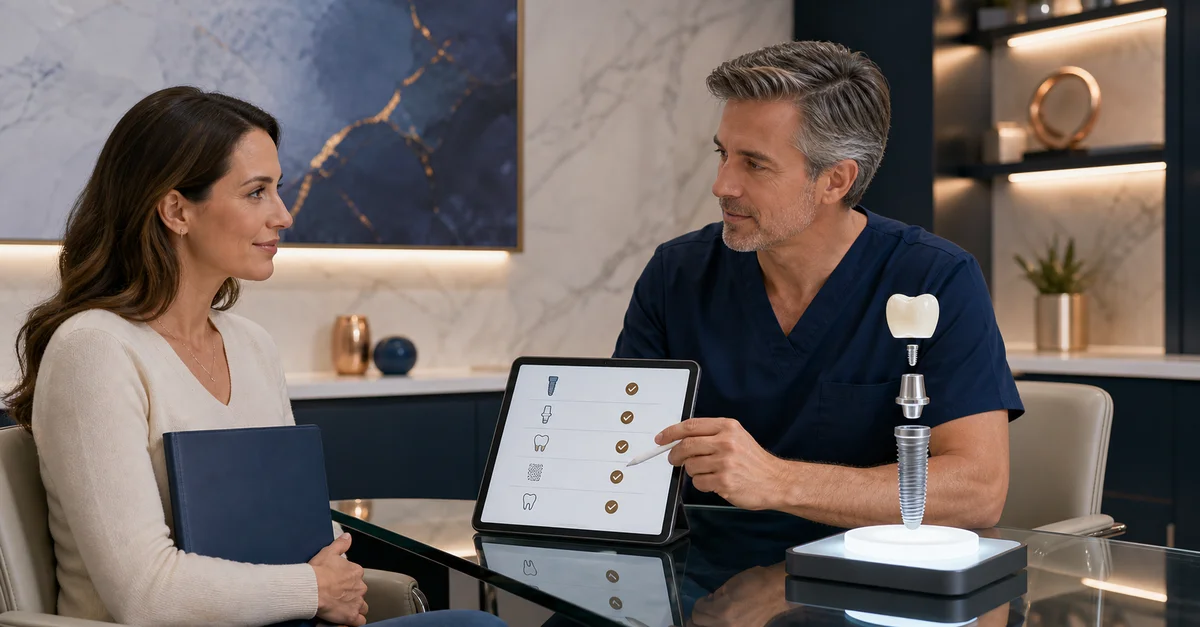
The FDA describes a dental implant system as an implant body placed in the jaw, an abutment, and often an abutment fixation screw that supports the artificial tooth. A crown, bridge, or denture then restores function and appearance. This anatomy explains why guardian dental implant coverage should be checked component by component rather than with one broad question.
Ask the dental office for an itemized treatment plan before requesting guardian dental implant coverage. It should show the tooth or arch, current procedure code, description, treating provider, location, proposed date, and fee. If more than one dentist is involved, identify who will submit each claim. Guardian determines benefits from the actual service and contract, so a clinic’s informal “implant package” is not detailed enough.
- Comprehensive or focused examination and clinically justified imaging.
- Extraction, infection control, or periodontal treatment when indicated.
- Bone or soft-tissue grafting, membrane, or sinus-related procedures when indicated.
- Surgical placement of the implant body and healing components.
- Prefabricated or custom abutment and fixation components.
- Temporary restoration and definitive crown, bridge, or denture.
- Anesthesia or sedation when clinically necessary and eligible.
- Postoperative review, imaging, hygiene, repair, and maintenance.
Ask about guardian dental implant coverage for every line. A plan may cover implant placement but not a graft, or it may cover an implant-supported restoration while excluding a temporary appliance. The provider should use accurate current codes and clinical descriptions. Do not request a different code merely because it appears more likely to be paid.
4. Decode waiting periods, maximums, and timing
A guardian dental implant coverage waiting period is the time after coverage begins during which the plan does not pay benefits for specified services. Guardian’s individual-plan information says that some plans apply waiting periods to major work such as implants, while the exact period varies by plan and state. Prior coverage may or may not affect it. Confirm the applicable start date in writing before scheduling elective treatment.
For realistic guardian dental implant coverage, separate at least four figures: the general annual maximum, any implant lifetime maximum, any implant yearly sublimit, and the remaining balance after pending claims. Then identify the deductible, plan payment percentage, network allowance, and noncovered amount. “Guardian pays 50%” never means the company automatically pays half of the dentist’s entire quote.
The plan may first determine that a code is covered and necessary, apply an allowed or contracted fee, subtract the deductible, calculate coinsurance, enforce annual and lifetime caps, and coordinate other coverage. An out-of-network provider may charge above the amount Guardian uses to calculate benefits, leaving the patient responsible for the difference in addition to coinsurance.
Implant treatment often spans months. Ask which service date controls the implant body, abutment, and restoration; when a multi-visit procedure is considered complete; and whether a new benefit year changes deductibles or maximum balances. Clinical healing must guide timing. Do not delay infection control or accelerate restoration solely to manipulate guardian dental implant coverage.
5. Check missing-tooth, replacement, and upgrade rules
Many guardian dental implant coverage policies limit replacement of teeth that were already missing when coverage began. Guardian publishes state- and plan-specific documents with missing-tooth provisions, and the exact exception or look-back rule can differ. Provide the true extraction date, prior coverage information, and previous prosthesis history. An estimate built on an inaccurate date is unreliable.
Replacement rules can also matter when a crown, bridge, denture, or implant already exists. Ask how long the prior restoration must have been in service, whether it is unserviceable, and whether damage or a new necessary extraction creates an exception. Guardian dental implant coverage may not pay to replace a usable bridge or denture merely because the patient prefers an implant.
Guardian’s individual-plan materials list upgrading from one prosthesis to another—such as replacing a bridge with an implant—among possible exclusions. The wording and applicability must be confirmed in your policy. A dentist can still explain whether an implant is clinically reasonable, but insurance may calculate no benefit or a lower benefit if the change is considered an upgrade.
Ask the dental office to document why a prior restoration cannot be repaired or made serviceable, if that is clinically true. Include dates, photographs, radiographs, and narrative when requested. The purpose is accurate adjudication, not a guarantee. The plan decides contractual eligibility; the dentist decides whether replacement is clinically indicated.
6. Verify the dentist and specialist network
Implant care may involve a restorative dentist, oral surgeon, periodontist, prosthodontist, anesthesiology professional, or imaging facility. Verify every relevant provider under the exact guardian dental implant coverage network and location. “Accepts Guardian” can mean only that the office will submit a claim; it does not necessarily mean the provider is contracted for your plan.
Guardian’s current individual-plan page says network dentists submit claims and generally cannot charge more than the contracted rate for applicable services. It also explains that out-of-network dentists may use regular rates while Guardian pays a standard benefit amount, leaving the member responsible for the difference. Network status can therefore change the practical value of guardian dental implant coverage.
Ask Guardian and the office to confirm participation near the service date. Use the provider’s name, address, tax identifier or national provider identifier when available. Check the surgeon and restorative dentist separately. If a facility fee, anesthesia professional, or imaging center may bill, ask how that claim is treated rather than assuming the primary dentist’s network status extends to everyone.
When a plan excludes an implant code, ask whether a contracted discount still applies to that noncovered service. The answer can depend on the provider agreement, plan, and state law. Obtain the allowed or negotiated estimate in writing. Never assume a network discount is an insurance payment.
7. Request a guardian dental implant coverage predetermination
A predetermination is an advance estimate of how the plan may process a proposed course of treatment. Guardian’s provider toolkit encourages predetermination for more costly care, and Guardian’s implant guidance recommends working with the dentist to obtain one. It is the most useful bridge between the itemized clinical plan and guardian dental implant coverage.
The office should submit current guardian dental implant coverage codes, tooth or arch, fees, provider details, clinical narrative, diagnostic-quality images, periodontal findings, dates of missing teeth, and prior prosthesis information as required. If grafting, anesthesia, a temporary tooth, or a final prosthesis is expected, include it. A response that omits a code cannot reliably predict that code’s final payment.
Review the predetermination line by line. Note services marked covered, excluded, limited, alternate, pending, or requiring more information. Confirm the deductible, coinsurance, allowed amount, annual maximum, implant maximum, and patient estimate. Ask how long the response remains valid and whether plan or treatment changes require resubmission.
A predetermination is not an irrevocable guarantee. Final payment can change because of eligibility, service dates, other claims, benefit balances, code changes, network status, missing records, or final adjudication. The clinic should reconcile the response with its own fees and give you an updated written estimate identifying covered, noncovered, and uncertain amounts.
8. Use this guardian dental implant coverage decision table
| Policy field | Evidence to request | What can go wrong | Next step |
|---|---|---|---|
| Implant benefit included | Policy section, rider, or state-specific schedule | A plan name may exist in tiers with and without implants | Get a member-specific written answer |
| Waiting period satisfied | Effective date and continuity rule | Treatment can occur before benefits become payable | Confirm eligibility for each service date |
| Implant maximum available | Lifetime and yearly balances plus prior payments | A separate cap can limit payment below the general maximum | Recheck after pending claims process |
| Every code eligible | Itemized predetermination | Placement, graft, abutment, and crown may differ | Match the response to the dentist’s complete plan |
| Missing-tooth rule cleared | Extraction date and prior coverage | A tooth missing before coverage may be limited | Submit accurate history and policy evidence |
| Replacement or upgrade permitted | Prior prosthesis date and condition | A usable appliance may not qualify for an implant upgrade | Document why replacement is clinically necessary |
| All providers in network | Plan and office confirmations | Different clinicians may have different status | Verify each provider and location separately |
| Clinical documentation complete | Notes, images, tooth history, and narrative | Missing information can delay or change review | Ask what attachments remain outstanding |
Complete this table from your own guardian dental implant coverage file. Mark a missing answer “unverified”; do not replace it with a guess. An online quote, a family member’s explanation of benefits, or last year’s certificate is not proof of current payment. The table should be updated if the treatment, provider, eligibility, or benefit year changes.
9. Keep the clinical decision ahead of financing
Guardian dental implant coverage should be checked only after the clinical question is understood. The FDA advises patients to discuss implant candidacy, benefits, risks, and alternatives with a dental provider. Overall health can affect healing. Smoking may reduce long-term success. Complications can include infection, injury to nearby structures, altered bite, difficulty cleaning, screw loosening, nerve symptoms, or implant failure. Regular hygiene and professional review remain important after treatment.
A dentist should evaluate active disease, periodontal health, bone, bite, adjacent anatomy, medical conditions, medications, tobacco exposure, prior radiation, and maintenance capacity. Imaging should be clinically justified. Insurance approval for guardian dental implant coverage does not prove that an implant is the safest or most suitable choice for a particular person.
Discuss realistic alternatives, which may include preserving a restorable tooth, a fixed bridge, a removable prosthesis, an implant-supported option, or no immediate replacement in selected situations. Ask about treatment stages, healing, temporary teeth, expected limitations, home care, professional maintenance, repairability, and what happens if integration or the restoration does not proceed as planned. No ethical provider can guarantee a lifetime result.
The American Dental Association has emphasized that financing discussions for complex implant care should follow a comprehensive examination and discussion of treatment alternatives. Do not let a credit deadline determine the clinical plan. A favorable guardian dental implant coverage estimate should inform consent, not replace it.
10. Coordinate other coverage without double counting
If you have two dental plans, identify which is primary and which is secondary before estimating guardian dental implant coverage. Guardian’s current supplemental coverage guidance explains that secondary benefits consider what the primary plan paid. Coordination does not necessarily mean the two plans will pay 100%, and it does not convert an excluded service into a covered one. Ask both carriers to explain their coordination method.
Submit the primary explanation of benefits to the secondary plan when required. Check whether each plan has a separate implant lifetime maximum, missing-tooth rule, network, waiting period, and alternate-treatment provision. The safest guardian dental implant coverage estimate is based on written responses from both plans using identical codes and service dates.
Original Medicare generally does not cover routine dental implants, although narrowly defined dental services directly linked to certain covered medical treatment may qualify. A Medicare Advantage plan may have its own dental benefit. Medical necessity does not automatically create a Guardian dental benefit, and a Guardian dental denial does not establish whether a medical plan has a separate responsibility. Ask each plan under its own rules.
11. Review a denial or unexpected payment carefully
Compare the final explanation of benefits with the predetermination, policy, and itemized treatment. Identify whether the issue is an excluded code, waiting period, lifetime maximum, annual maximum, deductible, network status, missing-tooth rule, replacement rule, upgrade exclusion, alternate treatment, documentation gap, or coding error. Ask for the exact policy provision supporting the guardian dental implant coverage decision.
The dental office can correct a factual error and submit requested clinical information. Only Guardian can reconsider a guardian dental implant coverage decision. Obtain the member appeal or review instructions, deadline, address or portal route, and authorization requirements. State the disputed line, cite the policy language, attach relevant evidence, and keep proof of submission.
Never ask a provider to change a truthful code, service date, tooth, or diagnosis solely to obtain payment. If the service is noncovered, request a written self-pay estimate, clinically reasonable alternatives, and clear payment, cancellation, and refund terms. Financial stress is important, but it should be addressed transparently.
12. Build a guardian dental implant coverage record
Keep the policy, schedule, amendments, itemized treatment plan, images submitted, clinical narrative, predetermination, network confirmations, call notes, portal messages, clinic estimates, claims, explanations of benefits, receipts, and appeal correspondence in one folder. Record dates and reference numbers. This guardian dental implant coverage record makes inconsistencies easier to spot.
Recheck eligibility, provider status, and remaining maximum before every major stage. Implant treatment may span benefit years, and other dental claims can reduce available benefits. If surgery or restoration is delayed, ask whether the predetermination expires. Keep the implant brand and model in your clinical records as the FDA recommends.
For an independent clinical discussion, explore replacement options through Redent Klinik’s English-language dental services. If you are considering staged or international care, use the Redent Klinik contact page to request an individualized assessment. Redent Klinik can explain a treatment pathway, while Guardian must determine guardian dental implant coverage under your exact policy.
Frequently asked questions about guardian dental implant coverage
Does Guardian dental insurance cover implants?
Some Guardian plans include implant benefits and others do not. Current individual-plan information shows tiers with separate implant maximums and at least one option without implant coverage. Employer plans may be configured differently. Check the policy, state-specific schedule, waiting period, codes, and current benefit balances.
Does guardian dental implant coverage pay the whole cost?
No. “Covered” means eligible for calculation under the contract. Deductibles, coinsurance, network allowances, annual maximums, implant lifetime maximums, yearly sublimits, and noncovered components can leave a substantial balance. A code-level predetermination and clinic estimate are more useful than a headline percentage.
Is there a waiting period for Guardian implant benefits?
Some plans apply a waiting period to implants or other major services, and the period can vary by plan and state. Prior continuous coverage may matter only if the policy says so. Confirm the effective date and eligibility for each planned service before beginning elective treatment.
What is an implant lifetime maximum?
It is the most the policy will pay for covered implant services over the applicable lifetime period, subject to all other rules. Ask whether the maximum is per person, whether it sits inside or outside the annual maximum, what prior payments count, and whether a yearly implant sublimit also applies.
Will Guardian cover a graft and implant crown?
Possibly, but grafting, implant placement, abutment, and restoration are separate services. A policy may cover one and exclude another. Submit every code with appropriate clinical documentation. Do not infer coverage for a graft or temporary restoration from approval of the implant body.
Can a missing-tooth rule affect guardian dental implant coverage?
Yes. Some policies limit replacement of teeth that were already missing when coverage began, with plan-specific exceptions. Provide accurate extraction dates, prior coverage, and prosthesis history. Ask Guardian to cite the exact provision and explain whether it applies to your implant and restoration codes.
Is a Guardian predetermination guaranteed?
No. It is an advance benefit estimate based on current information. Final payment may change because of eligibility, service dates, other claims, altered treatment, missing records, network status, maximum balances, or final adjudication. Ask how long it remains valid and update it when the clinical plan changes.
Does using a network dentist still help if implants are excluded?
It may, because some provider agreements extend negotiated fees to certain noncovered services, but the answer depends on the plan, agreement, and state law. Ask Guardian and the dentist in writing. A network discount is not the same as an insurance benefit and should not be described as plan payment.
What should I submit with a Guardian implant appeal?
Include the disputed explanation of benefits, relevant policy section, predetermination, itemized codes, clinical narrative, diagnostic records, missing-tooth and prior-restoration history, provider information, and a concise reason you believe the decision should change. Follow the member appeal deadline and keep delivery proof.
Final policy-decoding checklist
Before consenting to irreversible treatment, make sure your guardian dental implant coverage file answers every item below. An unanswered question is a reason to verify, not proof that the service is approved or denied.
- I have the exact current policy, plan tier, state schedule, and effective date.
- I confirmed that an implant benefit is included rather than merely available in another plan.
- I know the waiting period and whether it is satisfied for every service date.
- I know the annual maximum, implant lifetime maximum, yearly sublimit, and remaining balances.
- I have an itemized clinical plan covering the implant body, abutment, restoration, and related services.
- I checked missing-tooth, replacement, upgrade, alternate-treatment, and necessity rules.
- I verified every treating provider and location in the correct network.
- The predetermination contains all expected codes and requested records.
- I have a written clinic estimate for covered, noncovered, and uncertain amounts.
- I understand the clinical risks, alternatives, maintenance, and follow-up plan.
- I know how other coverage coordinates without assuming double payment.
- I know the appeal route and deadline if the final determination differs.
Used carefully, guardian dental implant coverage becomes a transparent policy-decoding exercise rather than a guess based on a brand. The strongest answer connects the correct contract, accurate codes, complete records, verified providers, and current maximum balances. Your dentist recommends treatment based on health; Guardian applies the policy; and you decide only after both the clinical and financial uncertainties are understandable.
Authoritative sources
- Guardian — current individual and family dental plan benefits, limitations, waiting periods, and implant maximums
- Guardian — choosing dental insurance that covers implants
- Guardian — implant procedure and predetermination guidance
- Guardian — dental provider toolkit and predetermination resources
- Guardian — covered services, missing-tooth, and replacement limitations
- U.S. Food and Drug Administration — dental implant components, benefits, risks, and patient guidance
- American Dental Association — comprehensive examination, alternatives, and financing guidance
- World Health Organization — oral health fact sheet