
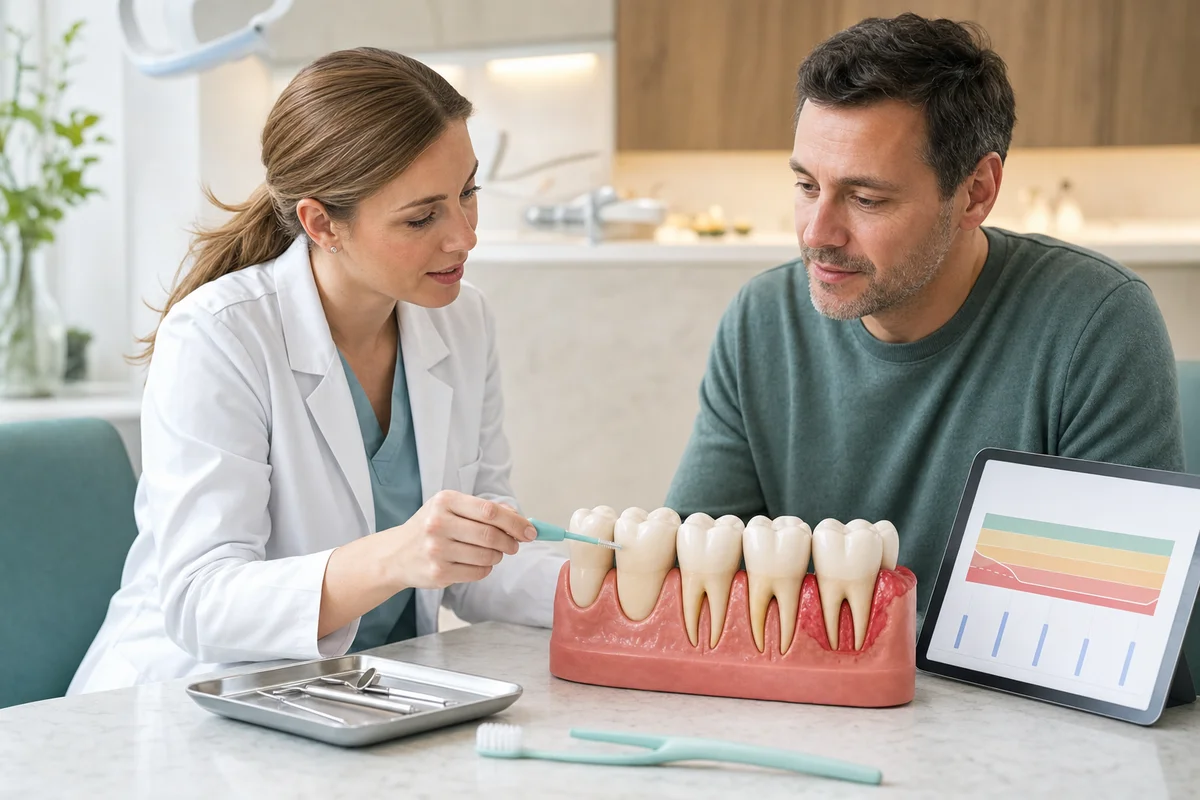
Quick answer: the gum disease treatment best option depends on whether you have reversible gingivitis or periodontitis with attachment and bone loss. Professional assessment comes first. Treatment may combine individualized brushing and interdental cleaning, professional plaque and calculus removal, scaling and root planing, risk-factor control, reassessment, and supportive maintenance. Surgery, local medicines, systemic antibiotics, or extraction are reserved for selected findings.
Searching for a gum disease treatment best option can produce contradictory claims: one source promotes mouthwash, another recommends “deep cleaning,” and another presents laser or surgery as the universal answer. Gum disease is not one identical condition. Gingivitis affects the gums and can be reversible, while periodontitis involves loss of the tissues and bone that support teeth. The choice depends on diagnosis, severity, distribution, risk, response, and patient priorities.
A safe gum disease treatment best option begins with controlling the cause and measuring the disease. Plaque biofilm, hardened calculus, smoking, diabetes, medicines, dry mouth, oral-hygiene access, restoration contours, tooth position, and individual susceptibility can all matter. No rinse, device, supplement, or one-time procedure can replace examination and long-term plaque control.
This guide explains staged periodontal care without diagnosing you remotely or promising regrowth, a cure, or tooth survival. It can help you ask informed questions and compare reasonable pathways. For broader patient education, visit Redent Klinik’s English dental resources before requesting an individualized periodontal assessment.
1. Why there is no universal gum disease treatment best option
The Centers for Disease Control and Prevention distinguishes gingivitis from periodontitis. Gingivitis is inflammation limited to the gums and is largely preventable and treatable with routine oral hygiene and professional cleaning. Periodontitis is a chronic inflammatory condition with destruction of supporting tissues and bone. It cannot simply be reversed to the original anatomy, but professional treatment can slow and manage it.
Therefore, the gum disease treatment best option for bleeding gums with no attachment loss can differ from care for deep pockets, mobility, furcation involvement, vertical bone defects, or recurrent disease after earlier treatment. Even within one mouth, one area may need only improved cleaning while another needs subgingival instrumentation, specialist review, or surgery.
The National Institute of Dental and Craniofacial Research states that the main treatment goal is infection control and that the number and types of treatments vary with disease extent. It also emphasizes daily home care and behavior change such as smoking cessation. A gum disease treatment best option is thus a coordinated plan, not a branded product.
2. Diagnosis and periodontal charting come before treatment
Red, swollen, tender, or bleeding gums can indicate gingival inflammation, but appearance alone does not establish severity. A clinician reviews symptoms, dental and medical history, tobacco exposure, diabetes status, medicines, previous treatment, home-care technique, and restorative factors. The mouth is examined for plaque, calculus, bleeding, recession, mobility, tooth position, bite, and areas that are difficult to clean.
Periodontal probing measures the space around teeth and records bleeding and other findings. NIDCR notes that healthy pockets are commonly between 1 and 3 millimeters and that deeper measurements can be a sign of periodontal disease. Measurements must be interpreted with inflammation, attachment level, recession, tooth anatomy, and radiographs rather than used as an isolated internet cutoff.
Appropriate dental radiographs help assess the pattern and amount of bone support and identify other conditions. The clinician may diagnose gingivitis, periodontitis, a gum abscess, recession without active periodontitis, inflammation around an implant, or another problem. This differentiation defines the gum disease treatment best option and prevents unnecessary “deep cleaning” for everyone with bleeding. A documented chart makes the gum disease treatment best option traceable to findings rather than sales language.
Seek assessment if you notice:
- gums that bleed repeatedly during brushing, flossing, or eating;
- persistent redness, swelling, tenderness, or bad breath;
- gum recession, teeth that look longer, or new root sensitivity;
- pus, a bad taste, or a localized swelling near a tooth;
- new spaces, drifting teeth, mobility, or a changed bite;
- pain when chewing or a partial denture that fits differently.
3. Gingivitis: professional cleaning plus daily plaque control
For plaque-induced gingivitis without attachment or bone loss, the gum disease treatment best option generally focuses on removing plaque and calculus and making daily cleaning effective. The NHS advises oral-hygiene instruction, interdental cleaning, smoking cessation, and professional cleaning in early disease. The plan should address the locations where plaque persists rather than give generic advice alone.
Professional cleaning removes deposits that a toothbrush cannot remove, especially hardened calculus. The clinician or hygienist can demonstrate brushing at the gumline and select floss, interdental brushes, or another device based on space and dexterity. Crowded teeth, fixed bridges, implants, orthodontic appliances, and overhanging restorations may require adapted techniques.
Bleeding can initially make patients avoid the area, but gently effective cleaning is usually essential. Excessive force can traumatize gums and abrade exposed roots, so “scrub harder” is not the answer. A soft brush, fluoride toothpaste, correct angulation, and daily interdental cleaning form the basis of the gum disease treatment best option for early plaque-related inflammation.
Improvement should be reviewed. Persistent bleeding after good plaque control may reflect remaining deposits, inaccessible contours, inconsistent technique, dry mouth, smoking, medication effects, uncontrolled diabetes, or another diagnosis. Review keeps the gum disease treatment best option tied to response. Do not assume that every persistent symptom means you need antibiotics or surgery.
4. Periodontitis: scaling and root planing as initial therapy
When periodontitis has created pockets and subgingival deposits, regular supragingival polishing alone may not be enough. The ADA describes scaling and root planing as deep cleaning below the gumline. Scaling removes plaque and calculus above and below the gumline; root planing instruments contaminated root surfaces so the tissues can heal against a clean surface.
The ADA evidence-based guideline advises clinicians to consider scaling and root planing without adjuncts as an initial treatment for chronic periodontitis. In modern terminology and practice, the exact instrumentation plan is adapted to the patient and sites. Local anesthetic may be used, and treatment can be completed by quadrant, side, or full mouth depending on clinical and practical factors.
For many periodontitis patients, the initial gum disease treatment best option combines:
- individualized oral-hygiene instruction and correction of technique;
- supragingival and subgingival plaque and calculus removal;
- scaling and root surface instrumentation where indicated;
- management of plaque-retentive restoration contours when possible;
- smoking-cessation support and coordination of diabetes care;
- reassessment after an appropriate healing interval;
- a tailored supportive periodontal maintenance schedule.
The gum disease treatment best option is not “the most aggressive cleaning.” Instrumentation should be thorough but tissue-preserving. Treatment can cause temporary tenderness, bleeding, sensitivity, or the appearance of increased recession as swelling resolves. Consent should explain expected changes, limitations, and how discomfort will be managed.
5. Reassessment decides whether initial treatment was enough
Initial therapy is followed by healing and reevaluation, not by an automatic jump to surgery. The clinician reassesses plaque control, bleeding, pocket depths, suppuration, tissue tone, mobility, symptoms, and sites that remain difficult to clean. Comparing standardized records helps determine whether disease is stable, improving, or still active. This checkpoint turns a procedure into a measurable gum disease treatment best option.
A gum disease treatment best option may remain nonsurgical if pockets reduce, bleeding is controlled, and the patient can maintain the sites. Residual deep pockets, persistent bleeding, complex root anatomy, furcation involvement, vertical bone defects, or inaccessible calculus may justify additional instrumentation, specialist assessment, or surgery.
Reassessment also tests whether the home-care plan is realistic. A theoretically ideal device that the patient cannot use is not the gum disease treatment best option. The dental team can adjust brush size, interdental aids, timing, grip, and sequence. For patients with limited dexterity, a powered brush, handled interdental aid, caregiver support, or simplified routine may improve consistency.
6. Mouthwash, local medicines, and antibiotics are adjuncts
Antiseptic mouthwash can be useful for selected short-term indications, but it does not remove hardened calculus or replace mechanical plaque disruption. Some products can cause staining, taste change, irritation, or other effects. The product, concentration, duration, timing, and reason should be specified. The NHS advises not to use mouthwash immediately after brushing because it can wash away concentrated fluoride from toothpaste.
Local antimicrobial or host-modulating products may be considered at selected sites. Their additional benefit, cost, side effects, and evidence should be discussed. The ADA guideline evaluates scaling and root planing with and without adjuncts; this does not mean every adjunct is required. The underlying instrumentation and daily plaque control remain central to a gum disease treatment best option.
Systemic antibiotics are not a substitute for debridement and should not be prescribed simply because gums bleed. They may be considered for particular clinical presentations, spreading infection, or selected periodontal cases after weighing allergy, interactions, adverse effects, antimicrobial resistance, and diagnostic findings. A gum disease treatment best option avoids routine antibiotic use without a clear indication.
7. When periodontal surgery or regeneration may be considered
If active deep sites remain after good nonsurgical therapy and home care, surgery can provide access for root debridement, reshape tissues for cleansability, reduce selected pockets, or attempt regeneration in suitable defects. Options can include access flap surgery, resective approaches, bone or tissue grafting, guided regeneration, and mucogingival procedures. They are not interchangeable.
The gum disease treatment best option for one residual defect depends on tooth prognosis, defect anatomy, remaining bone, root shape, furcation involvement, gum thickness, recession, appearance, smoking, diabetes control, plaque control, and patient preference. Regenerative materials cannot guarantee that lost bone or attachment will return, and surgery cannot compensate for uncontrolled plaque or tobacco exposure.
A periodontist may be appropriate for advanced, rapidly progressing, complex, recurrent, or treatment-resistant disease, and for selected surgical procedures. Referral is not evidence that a tooth is hopeless; it provides specialist diagnosis and treatment options. Referral can therefore be part of a gum disease treatment best option, not a sign that initial care failed. Ask what objective finding the proposed surgery addresses, what alternatives exist, and what maintenance will be required afterward.
8. Extraction is sometimes appropriate, but not the first slogan
Some teeth have insufficient support, uncontrolled infection, an untreatable fracture, non-restorable decay, or anatomy that makes predictable maintenance impossible. In those cases, extraction may be discussed. The decision considers the tooth, the rest of the dentition, chewing function, appearance, patient health, finances, and replacement options.
Removing all affected teeth is not a universal gum disease treatment best option. Natural teeth with a maintainable prognosis should not be sacrificed solely to simplify a plan or sell implants. Implants can also develop inflammatory disease and require meticulous cleaning and maintenance. Conversely, repeatedly treating a tooth with a hopeless prognosis can prolong discomfort and cost.
If extraction is proposed, ask whether replacement is necessary and compare no immediate replacement, a removable denture, a tooth-supported bridge, and implant treatment where suitable. Stabilize active periodontal disease before complex replacement when possible. A treatment plan should state which teeth are maintainable, questionable, or hopeless and why.
9. Decision table: matching findings to a treatment pathway
The table below organizes how a clinician may reason about a gum disease treatment best option. It is educational, not a prescription for an individual mouth.
| Finding or stage | Usual initial focus | What is reviewed | Possible next step if unresolved |
|---|---|---|---|
| Plaque-induced gingivitis without attachment loss | Oral-hygiene coaching and professional plaque/calculus removal | Bleeding, plaque, tissue appearance, and daily technique | Identify retained deposits, local factors, or another diagnosis |
| Periodontitis with accessible subgingival deposits | Scaling and root planing, risk control, and home care | Pockets, bleeding, suppuration, plaque, and symptoms | Repeat site-specific instrumentation or specialist review |
| Residual deep or complex sites | Reassessment of anatomy, debridement, risk, and prognosis | Cleanability, furcation, defect shape, mobility, and response | Access surgery, resective or regenerative care when suitable |
| Localized acute swelling or pus | Prompt diagnosis, drainage or local treatment as indicated | Spread, fever, tooth vitality, periodontal and endodontic causes | Urgent referral, medication, or extraction according to findings |
| Tooth with a hopeless prognosis | Control infection and discuss extraction | Restorability, support, strategic value, and patient goals | Replacement planning after disease stabilization |
| Stable treated periodontitis | Supportive periodontal maintenance and daily plaque control | Recurrence, new attachment loss, risk-factor changes | Site-specific retreatment when disease reactivates |
The gum disease treatment best option can change over time. A patient may move from active therapy to maintenance, or a previously stable site may need retreatment. Decisions should be based on recorded response, not on completing a predetermined package.
10. Daily home care is treatment, not an optional extra
Professional treatment reduces bacterial deposits and creates a maintainable environment, but plaque begins forming again. NIDCR recommends brushing twice daily with fluoride toothpaste, regular interdental cleaning, routine dental care, and smoking cessation. The NHS similarly advises brushing with fluoride toothpaste and cleaning between teeth every day.
The gum disease treatment best option uses tools matched to the mouth. Floss can suit tight contacts; interdental brushes can be effective in open spaces; special brushes or threaders may be needed around bridges, implants, or braces. A water flosser can be useful for some patients, but it should be selected and demonstrated rather than assumed to replace all interdental cleaning.
Do not try to remove calculus with sharp home instruments. They can injure gums, scratch roots, or miss deposits below the gumline. Baking soda, peroxide, salt, oils, herbal products, or “detox” mixtures cannot diagnose pocket depth or regenerate lost support. Some may irritate tissues or delay effective care.
A practical home plan should specify the brush, interdental device sizes, sequence, frequency, and difficult sites. At review, bring the tools you use. Demonstrating the routine on your own teeth allows the clinician to refine the gum disease treatment best option without blaming the patient.
11. Smoking, diabetes, medicines, and whole-person care
Smoking increases gum-disease risk and can impair healing and treatment response. The CDC states that people who smoke have twice the risk of gum disease compared with nonsmokers and that quitting helps gums heal after treatment. Smoking can also mask bleeding, so the absence of visible bleeding does not necessarily mean healthy tissues.
Smoking cessation support is part of a gum disease treatment best option, not a moral judgment. A clinician can discuss local cessation services, nicotine-replacement options, or coordination with medical care. Vaping and smokeless tobacco should also be disclosed because they may affect oral tissues and treatment planning.
Diabetes and periodontal health influence one another. The CDC notes that gum disease is more common in people with diabetes and that high blood sugar can impair defense against infection and healing. Tell the dental team about diabetes, recent control, medicines, and complications, and continue the medical plan prescribed by your diabetes clinician. Do not alter medication based on dental internet advice.
Dry mouth, immune conditions, hormonal changes, stress, nutrition, and medicines with oral side effects can affect risk or comfort. A gum disease treatment best option integrates these factors without claiming that periodontal treatment cures diabetes, heart disease, or another systemic condition.
12. Maintenance determines whether improvement lasts
Periodontitis is a chronic disease that can reactivate. After active treatment, supportive periodontal maintenance includes risk review, plaque assessment, reinforcement of home care, periodontal measurements as appropriate, and professional instrumentation of sites that need it. Supportive care is part of the gum disease treatment best option, not an optional finish. The interval is individualized rather than automatically every six months.
The gum disease treatment best option may use shorter maintenance intervals for a patient with advanced previous disease, persistent pockets, smoking, diabetes, rapid recurrence, complex restorations, or difficulty controlling plaque. As stability improves or risk changes, the interval can be reconsidered. Missing maintenance visits can allow inflammation and deposits to return without obvious pain.
Keep copies of periodontal charts, radiographs, treatment summaries, and maintenance recommendations, especially when moving or receiving treatment abroad. Through the Redent Klinik English contact page, you can ask which records are needed for an initial review; a final diagnosis still requires examination and appropriate imaging.
Gum disease treatment best option: frequently asked questions
Can gingivitis be reversed?
Plaque-induced gingivitis is generally reversible when plaque and calculus are controlled and daily cleaning becomes effective. Professional cleaning and individualized home care are commonly central. Persistent inflammation needs reassessment for deposits, technique, restoration contours, smoking, diabetes, medicines, or another diagnosis.
Is deep cleaning the gum disease treatment best option for everyone?
No. Scaling and root planing is intended for periodontitis or sites needing subgingival instrumentation, not automatically for every person with bleeding gums. Gingivitis without attachment loss may respond to professional cleaning and home care. Periodontal examination, charting, and radiographs determine the appropriate level of treatment.
Can mouthwash cure gum disease?
Mouthwash can be a short-term adjunct for selected situations, but it cannot remove calculus or replace brushing, interdental cleaning, and professional treatment. Product choice and duration matter because adverse effects can occur. Do not use a rinse to delay assessment of swelling, pus, mobility, or persistent bleeding.
Are antibiotics the gum disease treatment best option?
Usually not as stand-alone care. Mechanical control of plaque and calculus is fundamental. Antibiotics may be indicated for selected infections or periodontal presentations after clinical evaluation. Unnecessary use can cause side effects and contribute to antimicrobial resistance, so a prescription should have a documented reason.
Does laser treatment replace scaling and root planing?
“Laser treatment” covers different devices and protocols. It should not be accepted as a universal substitute based on marketing alone. Ask what diagnosis and site the device addresses, what conventional care is included, what added benefit is expected, what evidence supports it, and what risks and costs apply.
Can lost gum and bone grow back?
Gingival swelling can resolve, but periodontitis-related attachment and bone loss do not simply return with cleaning. Selected defect shapes may be candidates for regenerative procedures, yet results vary and cannot be guaranteed. Stabilizing disease and creating maintainable conditions remain the first priorities.
What is the gum disease treatment best option if teeth are loose?
Mobility requires prompt assessment of inflammation, remaining support, bite, trauma, root problems, and restorability. Treatment may include infection control, periodontal therapy, temporary stabilization, bite management, specialist care, or extraction for a hopeless tooth. Mobility alone cannot identify the correct option online.
How quickly should bleeding gums improve?
Some people notice less bleeding within weeks of effective plaque control, but timing varies with severity, deposits, technique, smoking, diabetes, and treatment. Do not use a fixed deadline as a diagnosis. If bleeding persists or worsens, arrange review rather than repeatedly changing products.
When is gum swelling an emergency?
Prompt dental care is needed for localized swelling, pus, severe pain, fever, rapidly increasing mobility, or difficulty opening the mouth. Seek urgent medical help for rapidly spreading facial or neck swelling, difficulty breathing or swallowing, confusion, or serious systemic illness.
Final perspective: the best option is staged and measurable
A trustworthy gum disease treatment best option starts with diagnosis, controls plaque and risk factors, uses the least invasive effective treatment, and measures healing before escalation. For gingivitis, professional cleaning and reliable daily plaque removal may be sufficient. For periodontitis, scaling and root planing, risk control, reassessment, and maintenance commonly form the foundation.
Residual disease may justify site-specific retreatment, specialist care, surgery, regenerative therapy, or extraction after alternatives and prognosis are discussed. The most expensive technology and the most aggressive procedure are not automatically best. A high-quality plan explains why each step is needed, how success will be measured, what uncertainty remains, and how recurrence will be prevented.
This article is general education and cannot diagnose or prescribe treatment. A dentist or periodontist who examines you can determine the gum disease treatment best option for your findings. Do not delay professional care for persistent bleeding, recession, mobility, pus, swelling, or pain.
Authoritative sources
- National Institute of Dental and Craniofacial Research: Periodontal (Gum) Disease — diagnosis, treatment goals, daily care, and referral.
- US Centers for Disease Control and Prevention: About Periodontal Disease — gingivitis, periodontitis, symptoms, risks, and prevention.
- American Dental Association: Nonsurgical Treatment of Periodontitis Guideline and MouthHealthy scaling and root planing guidance — initial nonsurgical treatment and patient aftercare.
- NHS: Gum disease — current symptoms, severity-based treatment, prevention, and urgent advice.
- CDC: Smoking, Gum Disease, and Tooth Loss and CDC: Oral Health and Diabetes — smoking, diabetes, healing, and coordinated self-care.
- World Health Organization: Oral health fact sheet — periodontal disease burden, prevention, shared risks, and access to care.