
If you are researching modern orthodontic solutions, you are probably asking the same question as millions of others: how do invisaligns work? Invisalign is one of the most advanced and patient-friendly orthodontic systems available today, designed to straighten teeth without the discomfort and appearance of traditional metal braces. This guide is written to fully answer that question in a clear, detailed, and trustworthy way, helping you understand the science, the process, and the real-life experience behind Invisalign treatment 😊.
At its core, Invisalign uses a series of custom-made, clear plastic aligners that gradually move your teeth into their ideal positions. Instead of brackets and wires, each aligner is precisely shaped to apply gentle, controlled pressure to specific teeth. To truly understand how do invisaligns work, it is important to know that the treatment is digitally planned from start to finish before you even wear your first aligner.
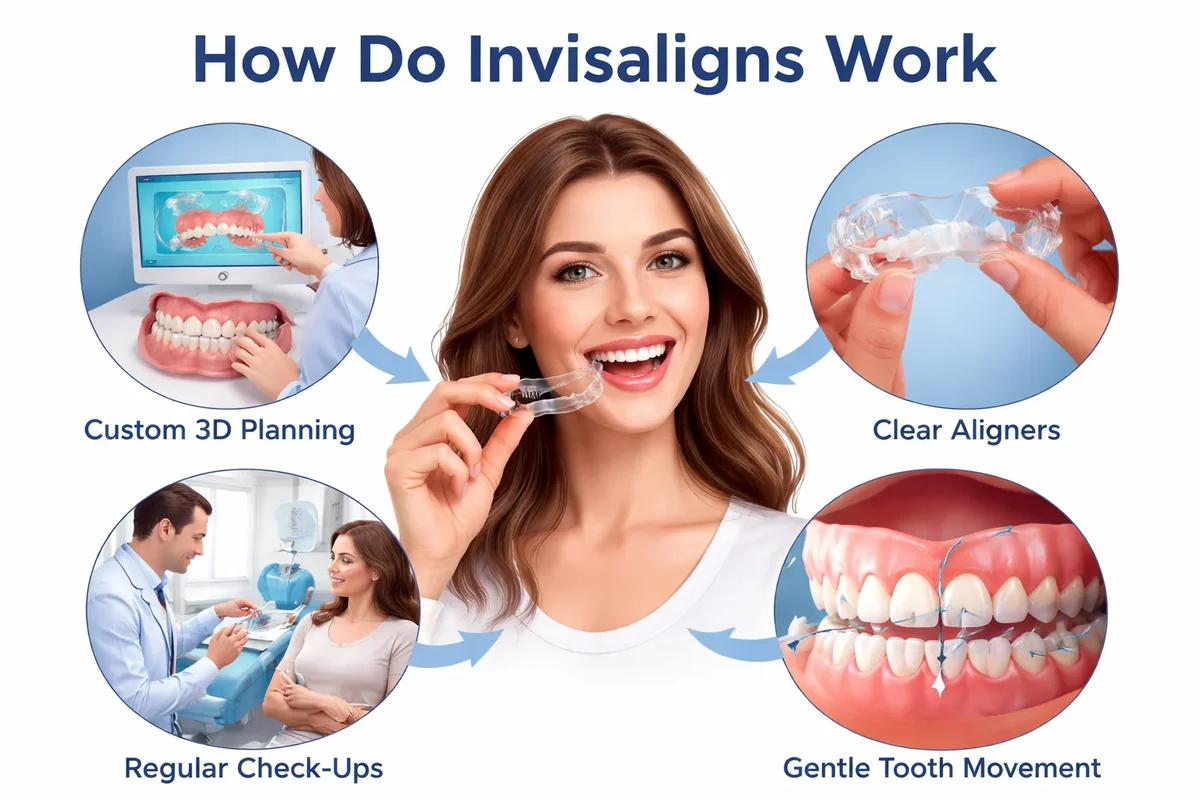
The Invisalign journey begins with a professional dental assessment. Your dentist or orthodontist uses advanced 3D scanning technology to capture an exact digital model of your teeth. This scan replaces traditional messy impressions and allows your provider to map out every tiny movement your teeth will make during treatment. Thanks to this digital planning, Invisalign is not guesswork; it is a carefully engineered system. This is one of the key reasons patients trust Invisalign when asking how do invisaligns work so predictably and safely.
Once the digital plan is complete, a series of aligners is created specifically for you. Each aligner is worn for about one to two weeks, depending on your treatment plan. When you switch to the next aligner, your teeth move slightly closer to their final positions. Over time, these small movements add up to a straighter, healthier smile. This step-by-step progression is central to understanding how do invisaligns work without causing unnecessary pain or damage.
One major advantage of Invisalign is that the aligners are removable. You take them out when eating, drinking anything other than water, brushing, and flossing. This flexibility makes oral hygiene much easier compared to traditional braces. From a health perspective, cleaner teeth and gums reduce the risk of cavities and gum disease during orthodontic treatment. Dental authorities such as the American Dental Association emphasize the importance of proper oral hygiene, which aligns perfectly with the Invisalign approach.
Another important aspect of how do invisaligns work is consistency. For best results, aligners must be worn 20 to 22 hours per day. This ensures that the planned forces are applied continuously, allowing teeth to move efficiently. Skipping wear time or forgetting aligners can slow progress and affect results. Invisalign’s success depends on both advanced technology and patient commitment 💪.
Comfort is another reason many patients choose Invisalign. The aligners are made from smooth, medical-grade plastic, reducing irritation to cheeks and gums. There are no sharp wires or emergency visits for broken brackets. While some pressure is normal—especially when switching to a new aligner—it is generally mild and temporary. This gentle force application explains how do invisaligns work so effectively while remaining comfortable for daily life.
Invisalign is also designed with aesthetics in mind. The clear aligners are nearly invisible, making them ideal for adults and teens who want discreet treatment. Whether you are at work, school, or social events, most people will not notice you are wearing them. This visual advantage often becomes a deciding factor when patients ask how do invisaligns work compared to metal braces.
From a medical standpoint, Invisalign is not just about appearance. Properly aligned teeth improve bite function, reduce uneven wear, and can help prevent jaw discomfort over time. Straighter teeth are also easier to clean, contributing to long-term oral health. If you are considering Invisalign and want personalized guidance, you can reach out through the Redent Klinik Contact Page to speak with a dental professional.
In summary, how do invisaligns work can be explained in three simple principles: digital precision, gradual tooth movement, and patient-friendly design. By combining advanced technology with comfort and flexibility, Invisalign has transformed orthodontic care. Understanding this process empowers you to make an informed decision about your smile and your dental health 😁.
What Is Invisalign and Why Is It Different from Braces?
To fully understand how do invisaligns work, it is essential to first understand what Invisalign actually is and how it differs from traditional braces. Invisalign is an orthodontic treatment system that uses a series of clear, removable aligners instead of metal brackets and wires. These aligners are custom-designed for each patient and are created using advanced digital technology. Unlike conventional braces, Invisalign focuses on comfort, aesthetics, and flexibility while still delivering effective tooth movement 🦷.
Traditional braces rely on fixed components that apply constant pressure through metal wires and brackets. Invisalign, on the other hand, works through controlled, staged movements using aligners that are replaced regularly. This fundamental difference is often the first thing patients notice when asking how do invisaligns work compared to braces.
What Exactly Are Invisalign Aligners?
Invisalign aligners are made from a patented, medical-grade thermoplastic material designed specifically for orthodontic use. Each aligner is slightly different from the previous one, allowing for gradual tooth movement over time. The aligners are transparent, which makes them nearly invisible when worn. This discreet appearance is one of the most appealing reasons patients choose Invisalign when exploring how do invisaligns work in real life.
Because the aligners are removable, patients can maintain their normal oral hygiene routines. Brushing and flossing are much easier compared to braces, where food can easily get trapped around brackets and wires. This removability supports better gum health and lowers the risk of cavities during treatment.
How Invisalign Differs Structurally from Braces
One of the clearest distinctions between Invisalign and traditional braces is the absence of metal components. Braces use brackets glued to each tooth, connected by wires that are periodically tightened. Invisalign eliminates these elements entirely. Instead, each aligner fits snugly over the teeth and applies gentle pressure only where needed. This targeted force application explains how do invisaligns work with such precision.
Another key difference is adjustability. With braces, adjustments are made manually by an orthodontist during office visits. With Invisalign, most adjustments happen automatically when you switch to the next aligner in the series. This reduces the number of emergency visits and makes treatment more predictable and convenient.
Comfort and Lifestyle Differences
Comfort is a major factor when comparing Invisalign to braces. Metal braces can cause irritation, mouth sores, and discomfort due to sharp edges and protruding wires. Invisalign aligners are smooth and custom-fitted, significantly reducing irritation. While some pressure is expected—especially when starting a new aligner—it is usually mild and temporary.
From a lifestyle perspective, Invisalign offers far more freedom. There are no food restrictions because aligners are removed while eating. With braces, sticky or hard foods can damage brackets and wires. Invisalign allows patients to eat normally, which often improves overall treatment satisfaction 😊.
Effectiveness: Invisalign vs Traditional Braces
A common question linked to how do invisaligns work is whether they are as effective as braces. The answer depends on the complexity of the dental issue. Invisalign is highly effective for mild to moderate cases, including crowding, spacing, overbites, underbites, and crossbites. Advances in aligner technology now allow Invisalign to treat many cases that previously required braces.
However, very complex orthodontic cases may still benefit more from traditional braces. This is why professional evaluation is critical. A qualified dentist or orthodontist can determine whether Invisalign is suitable for your specific needs.
Aesthetics and Confidence During Treatment
Appearance plays a significant role in orthodontic choices, especially for adults. Invisalign aligners are almost invisible, allowing patients to smile, speak, and interact confidently during treatment. This psychological comfort is often underestimated but deeply impacts patient compliance and satisfaction.
When people ask how do invisaligns work so seamlessly in social and professional settings, the answer lies in this discreet design. Most people will not notice the aligners unless they are very close.
Why Many Patients Prefer Invisalign Today
Modern patients prioritize convenience, aesthetics, and oral health. Invisalign meets all three criteria. Fewer in-office visits, better hygiene, reduced discomfort, and a nearly invisible appearance make Invisalign a popular alternative to braces worldwide.
In summary, Invisalign differs from braces in structure, comfort, appearance, and daily usability. Understanding these differences helps clarify how do invisaligns work not just as a medical treatment, but as a lifestyle-friendly orthodontic solution. This combination of technology and patient-centered design is what sets Invisalign apart in modern dentistry 😁.
How Do Invisaligns Work Step by Step?
When patients search for how do invisaligns work, they are usually looking for a clear, structured explanation of the entire process from start to finish. Invisalign is not a single device but a carefully planned orthodontic journey made up of multiple precise steps. Each step builds on the previous one, ensuring controlled, safe, and predictable tooth movement. Below is a detailed, step-by-step breakdown designed to fully satisfy that search intent and explain exactly how do invisaligns work in real-world practice 🦷.
Step 1: Initial Consultation and Dental Evaluation
The Invisalign process always begins with a comprehensive dental consultation. During this appointment, a dentist or orthodontist examines your teeth, bite, jaw alignment, and overall oral health. X-rays, photographs, and digital scans are often taken to assess whether Invisalign is suitable for your case. This step is critical because not every orthodontic issue can be treated with aligners alone.
At this stage, patients often ask how do invisaligns work differently depending on their specific dental problem. The provider evaluates crowding, spacing, overbite, underbite, or crossbite issues and determines if Invisalign can effectively address them. Only after this clinical approval does the process move forward.
Step 2: Digital 3D Scanning and Treatment Planning
Once you are approved for Invisalign, a detailed 3D scan of your teeth is created using advanced digital imaging technology. This scan replaces traditional dental impressions and captures the exact shape and position of every tooth. The digital model allows the provider to plan the entire treatment from beginning to end.
This planning stage is one of the most important answers to how do invisaligns work. Specialized software simulates how your teeth will move week by week. Every rotation, shift, and alignment adjustment is mapped out before your first aligner is even made. This ensures predictability and minimizes surprises during treatment.
ClinCheck Simulation: Seeing Your Future Smile
Many Invisalign patients are shown a digital preview of their expected results. This simulation demonstrates how your smile will change over time and what the final outcome should look like. This transparency helps build confidence and motivates patients to stay compliant with aligner wear.
Step 3: Custom Manufacturing of Invisalign Aligners
After the digital treatment plan is finalized, a series of custom aligners is manufactured specifically for you. Each aligner is slightly different, designed to apply controlled pressure to certain teeth. This gradual force application is central to understanding how do invisaligns work safely and effectively.
The aligners are made from smooth, BPA-free, medical-grade plastic. They are trimmed to fit comfortably along the gum line, reducing irritation. Each aligner is labeled in sequence, making it easy to follow the treatment plan exactly as prescribed.
Step 4: Wearing the Aligners Daily
Patients typically wear each aligner for one to two weeks, depending on their treatment plan. Aligners must be worn for 20 to 22 hours per day to achieve optimal results. This consistent wear ensures that the planned forces are applied continuously, guiding teeth into their new positions.
Many people underestimate this step when asking how do invisaligns work. Invisalign is highly effective, but only when patients follow the wear schedule. Removing aligners too often or skipping days can delay progress and affect final results.
Daily Routine with Invisalign
Aligners are removed when eating, drinking anything other than water, brushing, and flossing. This flexibility allows patients to maintain excellent oral hygiene and enjoy their normal diet. However, aligners should always be reinserted promptly after meals to stay on track.
Step 5: Progression Through Aligner Series
As you move from one aligner to the next, your teeth gradually shift. Each new aligner represents a small step forward. Over time, these tiny movements accumulate into significant alignment changes. This staged progression is a defining feature of how do invisaligns work without overwhelming the teeth or surrounding bone.
Regular check-ups, often every 6 to 8 weeks, allow the provider to monitor progress and make adjustments if necessary. These visits are usually shorter and less frequent than traditional braces appointments.
Step 6: Refinements and Final Adjustments
In some cases, additional aligners—called refinements—are needed to perfect the results. If certain teeth need further movement, a new digital scan may be taken, and extra aligners are created. This fine-tuning phase ensures the best possible outcome.
This step highlights another advantage of Invisalign and reinforces how do invisaligns work with precision rather than force.
Step 7: Retention After Invisalign Treatment
Once treatment is complete, retainers are used to maintain the new tooth positions. Teeth naturally try to shift back, so retention is essential. Most patients wear retainers at night to protect their investment and preserve their smile.
In conclusion, how do invisaligns work can be understood as a carefully engineered, step-by-step process that combines digital planning, custom aligners, and patient cooperation. Each phase plays a vital role in achieving a straight, healthy smile while prioritizing comfort, aesthetics, and long-term dental health 😁.
The Science Behind Invisalign Technology
To truly understand how do invisaligns work, it is important to look beyond the surface and explore the science and technology that make this system effective. Invisalign is not simply a set of clear trays; it is a sophisticated orthodontic solution built on biomechanics, material science, and advanced digital modeling. Every movement your teeth make during Invisalign treatment is based on precise scientific principles designed to protect your oral health while delivering predictable results 🧠.
Many patients assume that teeth simply slide into place, but the reality is far more complex. Teeth move through a biological process called bone remodeling, and Invisalign technology is carefully engineered to work in harmony with this natural process. This is a key reason why dentists emphasize understanding how do invisaligns work rather than viewing them as cosmetic devices alone.
Biomechanics: How Teeth Actually Move
Teeth are anchored in the jawbone by periodontal ligaments, which act like tiny shock absorbers. When gentle, controlled pressure is applied to a tooth, these ligaments compress on one side and stretch on the other. This triggers bone resorption where pressure is applied and new bone formation where space is created. Invisalign aligners are designed to apply this pressure in a highly controlled way.
This controlled force application explains how do invisaligns work without damaging roots, gums, or bone. Unlike sudden or excessive force, which can cause pain or complications, Invisalign uses gradual movement that allows the body to adapt naturally.
SmartForce Features and Attachments
One of the most important technological innovations behind Invisalign is the use of SmartForce features. These are small, tooth-colored attachments that may be temporarily bonded to certain teeth. While they are subtle, they play a major role in guiding complex movements such as rotation, intrusion, or vertical alignment.
Attachments give the aligners something to grip, allowing more precise control over tooth movement. This is particularly important when explaining how do invisaligns work in cases that involve more than simple spacing or crowding. Without these attachments, certain movements would be far less predictable.
Why Attachments Improve Accuracy
Attachments are strategically placed based on your digital treatment plan. They are not random and are customized for your unique dental anatomy. By working together with the aligners, they help ensure that each tooth moves exactly as planned in the virtual simulation.
Material Science: What Aligners Are Made Of
Invisalign aligners are made from a proprietary, multi-layer thermoplastic material designed specifically for orthodontic use. This material is engineered to deliver consistent force over time, resisting deformation while remaining comfortable. The aligners are smooth, flexible, and durable, reducing irritation to soft tissues.
The material itself plays a major role in how do invisaligns work so efficiently. Unlike generic plastic trays, Invisalign aligners are designed to maintain force throughout the wear period, ensuring continuous tooth movement rather than uneven pressure.
Digital Precision and 3D Treatment Planning
One of the strongest scientific advantages of Invisalign is digital treatment planning. Using advanced 3D imaging and software, dentists plan every stage of tooth movement before treatment begins. This allows for micro-adjustments measured in fractions of a millimeter.
This digital precision answers a common concern about how do invisaligns work so predictably compared to older orthodontic methods. Because the entire process is mapped in advance, outcomes are more consistent and timelines are easier to estimate.
Artificial Intelligence and Predictive Modeling
Invisalign technology incorporates data from millions of completed cases worldwide. This data is used to refine predictive models that help dentists anticipate how teeth will respond to certain forces. In simpler terms, Invisalign improves over time by learning from real-world results.
This use of large-scale data further strengthens how do invisaligns work as a modern, evidence-based treatment rather than a trial-and-error approach.
Biological Safety and Oral Health Considerations
Safety is a critical aspect of Invisalign science. The forces applied are carefully calibrated to avoid root resorption, gum recession, or bone damage. Regular check-ups ensure that teeth are responding as expected and that oral health remains stable throughout treatment.
Because aligners are removable, patients can maintain excellent oral hygiene, reducing inflammation and bacterial buildup. This biological compatibility is another reason dental professionals trust Invisalign when explaining how do invisaligns work in a health-focused context.
Why Science Matters for Long-Term Results
The science behind Invisalign does not stop once the aligners are removed. Proper retention and follow-up ensure that bone remodeling stabilizes around the new tooth positions. This long-term approach protects results and minimizes relapse.
In summary, how do invisaligns work is rooted in biomechanics, material science, digital modeling, and biological safety. Invisalign succeeds because it respects how the human body naturally moves teeth, using technology to guide that process gently and precisely. This scientific foundation is what makes Invisalign one of the most trusted orthodontic systems available today 😊.
Who Is a Good Candidate for Invisalign Treatment?
One of the most common follow-up questions after learning how do invisaligns work is whether Invisalign is the right solution for a specific person. While Invisalign is a highly advanced and versatile orthodontic system, it is not a one-size-fits-all treatment. Determining candidacy depends on dental alignment issues, oral health status, lifestyle habits, and patient commitment. Understanding these factors helps clarify how do invisaligns work most effectively for the right individuals 😊.
Dental Conditions Invisalign Can Treat
Invisalign is designed to correct a wide range of orthodontic problems, particularly mild to moderate alignment issues. These include crowded teeth, gaps between teeth, overbites, underbites, crossbites, and mild bite misalignments. Advances in aligner technology now allow Invisalign to handle increasingly complex cases that once required traditional braces.
When patients ask how do invisaligns work for these conditions, the answer lies in controlled, targeted force. Each aligner is engineered to move specific teeth at precise times, allowing Invisalign to correct alignment gradually without overwhelming the jaw or supporting structures.
Cases That May Require Additional Evaluation
Severe bite problems, significant jaw discrepancies, or complex skeletal issues may still require traditional orthodontic treatment or a hybrid approach. In such cases, Invisalign may be used in combination with other orthodontic techniques. This is why a professional evaluation is essential before deciding how how do invisaligns work applies to an individual case.
Age Considerations: Teens vs Adults
Invisalign is suitable for both teenagers and adults, but candidacy considerations differ slightly between age groups. Adults often choose Invisalign for its discreet appearance and lifestyle convenience. Their jawbones are fully developed, which can make tooth movement more predictable.
Teenagers can also benefit greatly from Invisalign, especially with systems designed specifically for younger patients. These versions may include wear indicators to help track compliance. Regardless of age, the principles of how do invisaligns work remain the same: consistent wear, gradual movement, and professional monitoring.
Oral Health Requirements Before Starting Invisalign
Good oral health is a prerequisite for Invisalign treatment. Patients must have healthy gums and teeth free from untreated cavities or active periodontal disease. Any existing dental issues should be addressed before aligner therapy begins.
This requirement exists because how do invisaligns work depends on the teeth being firmly supported by healthy bone and gum tissue. Attempting orthodontic movement in the presence of infection or inflammation can lead to complications and compromised results.
Importance of Gum Health
Healthy gums respond better to orthodontic forces and reduce the risk of recession or discomfort. Invisalign’s removable design supports better hygiene, but patients must already have a stable oral foundation before starting treatment.
Lifestyle and Commitment Factors
Invisalign requires a high level of patient responsibility. Aligners must be worn 20 to 22 hours per day to achieve optimal results. Patients who frequently forget to wear their aligners or remove them for extended periods may not be ideal candidates.
This is a critical point when explaining how do invisaligns work successfully. Unlike braces, which are fixed in place, Invisalign relies heavily on patient compliance. Those who are disciplined and motivated tend to achieve the best outcomes.
Professional Evaluation: The Final Decision
Ultimately, the best way to determine candidacy is through a professional consultation. A dentist or orthodontist evaluates dental anatomy, bite mechanics, and overall oral health to decide if Invisalign is appropriate. Digital scans and treatment simulations further support this decision-making process.
Understanding candidacy helps patients form realistic expectations about how do invisaligns work for their unique situation. When Invisalign is matched with the right patient profile, the results can be both functionally and aesthetically outstanding.
Why the Right Candidate Gets the Best Results
In summary, a good Invisalign candidate typically has mild to moderate alignment issues, healthy teeth and gums, and the commitment to wear aligners consistently. Age is rarely a limiting factor, but lifestyle habits and oral health play a major role.
Knowing who Invisalign is designed for helps demystify how do invisaligns work in practice. With proper case selection and professional guidance, Invisalign can deliver predictable, comfortable, and long-lasting orthodontic results that support both oral health and confidence 😁.
The Invisalign Treatment Timeline Explained
After understanding how do invisaligns work in theory, many patients want to know what the real-life timeline looks like. Invisalign treatment is not instant, but it is highly structured and predictable. The timeline varies depending on individual dental needs, case complexity, and patient compliance. However, Invisalign is designed to be efficient, often delivering results faster than traditional braces when used correctly 😊.
Knowing the timeline helps patients set realistic expectations and stay motivated throughout the process. Each phase of treatment plays a specific role in ensuring teeth move safely and accurately, which is a key part of understanding how do invisaligns work over time.
Average Duration of Invisalign Treatment
On average, Invisalign treatment lasts between 6 and 18 months. Mild cases, such as small gaps or slight crowding, may be completed in as little as 6 months. More moderate cases often take 12 to 18 months. Complex cases may require additional refinements and slightly longer timelines.
When people ask how do invisaligns work so efficiently, the answer lies in digital planning and controlled staging. Because every tooth movement is planned in advance, unnecessary delays are minimized.
Why Invisalign Can Be Faster Than Braces
Traditional braces rely on periodic manual adjustments, whereas Invisalign progresses automatically as patients move through their aligner series. This reduces waiting time between adjustments and allows for continuous progress.
Phase 1: The First Few Weeks of Treatment
The first phase of Invisalign treatment focuses on initial tooth movement and patient adaptation. During the first one to two weeks, patients may experience mild pressure or tightness as teeth begin to shift. This sensation is normal and indicates that the aligners are working as intended.
This early phase is crucial in understanding how do invisaligns work, as it demonstrates how gentle force initiates biological tooth movement without excessive discomfort.
Phase 2: Progressive Alignment and Bite Correction
As treatment continues, aligners begin addressing more complex movements such as rotations, vertical adjustments, and bite alignment. Each aligner builds upon the progress of the previous one. Patients typically switch aligners every 7 to 14 days.
During this phase, teeth visibly become straighter, which often boosts patient motivation. This gradual transformation highlights how do invisaligns work step by step rather than all at once.
Monitoring Progress During Treatment
Regular check-ups, usually every 6 to 8 weeks, allow the dentist to ensure teeth are tracking correctly. If adjustments are needed, the treatment plan can be refined. These visits are usually brief and far less frequent than traditional orthodontic appointments.
Phase 3: Refinements and Fine-Tuning
Not all teeth move exactly as predicted, which is completely normal. Refinements are additional aligners created to correct minor discrepancies and perfect the final result. This phase ensures accuracy and symmetry.
Refinements are a built-in part of the Invisalign system and further demonstrate how do invisaligns work with precision rather than force.
Phase 4: Completion and Retention
Once active treatment is complete, patients transition into the retention phase. Retainers are used to hold teeth in their new positions while bone remodeling stabilizes. Most retainers are worn at night.
This final phase is essential because teeth naturally want to shift back. Retention protects the results achieved through understanding and following how do invisaligns work properly.
Factors That Can Affect Treatment Time
Several factors influence how long Invisalign treatment takes, including case complexity, aligner wear consistency, and overall oral health. Patients who wear aligners as prescribed tend to finish on time or even early.
Failure to wear aligners consistently is the most common reason for delays. This reinforces the idea that how do invisaligns work successfully depends on both technology and patient responsibility.
Setting Realistic Expectations
In summary, Invisalign treatment follows a clear, phased timeline designed for safety, efficiency, and predictability. While results are not instant, the process is transparent and well-structured.
Understanding the Invisalign timeline gives patients confidence in the process and reinforces how do invisaligns work as a long-term investment in oral health and aesthetics. With patience, consistency, and professional guidance, Invisalign delivers lasting, life-changing results 😁.
Daily Life with Invisalign: Eating, Cleaning, and Comfort
After learning how do invisaligns work from a clinical and technical perspective, many patients want to know what everyday life with Invisalign is really like. One of the biggest advantages of Invisalign is how seamlessly it fits into daily routines. Unlike traditional braces, Invisalign is designed to minimize disruption while still delivering effective orthodontic results. Understanding daily habits is essential to fully appreciating how do invisaligns work in real-world conditions 😊.
Eating with Invisalign Aligners
One of the most noticeable lifestyle benefits of Invisalign is the freedom to eat without restrictions. Invisalign aligners are removed before meals, which means patients can enjoy their favorite foods without worrying about damaging brackets or wires. This is a major difference from traditional braces, where sticky, hard, or chewy foods are often prohibited.
This flexibility helps explain how do invisaligns work so well for adults and teens with active lifestyles. By removing aligners during meals, patients avoid food buildup and staining, which also contributes to better oral hygiene.
Best Practices for Eating
Although aligners are removable, it is important to minimize the time they are out of the mouth. After eating, teeth should be brushed or rinsed before reinserting aligners. This prevents trapping food particles and bacteria against the teeth, which could lead to cavities or bad breath.
Maintaining these habits supports the effectiveness of treatment and reinforces how do invisaligns work as a system that relies on consistency.
Cleaning Invisalign Aligners Properly
Cleaning Invisalign aligners is simple but essential. Aligners should be cleaned at least twice a day using a soft toothbrush and lukewarm water. Specialized Invisalign cleaning crystals or mild, clear soaps can also be used.
Hot water should always be avoided, as it can warp the aligners and compromise their fit. Proper cleaning ensures aligners remain clear, odor-free, and effective throughout the wear period.
Understanding hygiene routines is a key part of knowing how do invisaligns work safely and hygienically over several months of treatment.
Oral Hygiene During Invisalign Treatment
Because aligners are removable, patients can brush and floss normally, which significantly reduces the risk of plaque buildup and gum disease. This is a major advantage over braces, where cleaning around brackets can be challenging.
Dental organizations such as the American Dental Association emphasize daily oral hygiene, and Invisalign supports these recommendations by allowing unrestricted access to teeth and gums.
Comfort and Physical Sensations
Comfort is another important aspect of daily Invisalign wear. Most patients experience mild pressure or tightness, especially when switching to a new aligner. This sensation usually lasts one to two days and indicates that the aligner is working.
This gentle pressure is central to understanding how do invisaligns work biologically. The aligners apply controlled force that encourages gradual tooth movement without excessive pain.
Managing Initial Discomfort
If discomfort occurs, over-the-counter pain relievers and cold compresses can help. Switching to new aligners at night also allows patients to sleep through the initial adjustment period.
Unlike metal braces, Invisalign aligners have smooth edges, reducing the risk of mouth sores or irritation. This makes daily wear more comfortable and predictable.
Speaking and Social Interaction
Some patients notice a slight lisp during the first few days of wearing Invisalign. This is temporary and usually resolves as the tongue adapts to the aligners. Practicing speaking and reading aloud can speed up this adjustment.
From a social perspective, Invisalign aligners are nearly invisible. This discreet appearance allows patients to smile, speak, and interact confidently, reinforcing how how do invisaligns work without drawing attention.
Consistency: The Key to Success
Invisalign aligners must be worn 20 to 22 hours per day for optimal results. Removing aligners too frequently or forgetting to reinsert them can slow progress. Consistency is the single most important daily habit affecting treatment success.
This is why dentists emphasize that how do invisaligns work depends not only on technology but also on patient cooperation.
Balancing Invisalign with an Active Lifestyle
Invisalign is ideal for busy professionals, athletes, and travelers. Aligners can be removed for important events, presentations, or sports activities, as long as overall wear time is maintained.
In summary, daily life with Invisalign is flexible, comfortable, and manageable. Eating freely, maintaining excellent hygiene, and experiencing minimal discomfort all contribute to treatment success. Understanding these daily habits completes the picture of how do invisaligns work not just in theory, but in everyday life 😁.
How Invisalign Moves Teeth Without Metal Wires
One of the most fascinating aspects of Invisalign treatment is how it straightens teeth without using metal brackets or wires. For many patients, this leads to a key question: how do invisaligns work if there are no wires pulling or tightening teeth? The answer lies in advanced biomechanics, precise digital planning, and the controlled application of gentle forces over time. Invisalign achieves tooth movement in a way that is both effective and biologically respectful 🦷.
The Role of Controlled Force in Tooth Movement
To understand how do invisaligns work without wires, it is important to understand how teeth naturally move. Teeth are not rigidly fixed in the jawbone. Instead, they are supported by periodontal ligaments that allow slight movement when pressure is applied. Invisalign aligners are designed to apply consistent, low-level force to specific teeth at specific times.
This controlled force stimulates bone remodeling, a natural biological process. Bone breaks down on the side where pressure is applied and rebuilds on the opposite side, allowing teeth to shift gradually. Invisalign uses this principle to move teeth safely and predictably without the need for metal components.
Precision Engineering Through Digital Planning
One of the most important reasons how do invisaligns work so accurately is digital treatment planning. Before treatment begins, every tooth movement is planned using 3D modeling software. Each aligner represents a small step in the overall journey, typically moving teeth by fractions of a millimeter.
This precision eliminates the need for manual tightening or adjustments. Instead of relying on wires to pull teeth, Invisalign relies on a sequence of aligners that guide teeth into position gradually. This stepwise approach reduces discomfort and increases predictability.
Why Small Movements Matter
Moving teeth too quickly or with excessive force can damage roots and surrounding bone. Invisalign’s design avoids this risk by limiting movement per aligner. This is a key reason dental professionals trust the system when explaining how do invisaligns work safely.
The Function of Attachments and SmartForce Technology
In many Invisalign cases, small tooth-colored attachments are placed on specific teeth. These attachments act as anchors, allowing aligners to apply force more effectively. They enable complex movements such as rotation, vertical shifts, and torque control.
Attachments are a critical component in understanding how do invisaligns work without wires. Without them, aligners might not be able to grip teeth effectively enough to achieve certain movements.
Are Attachments Always Necessary?
Not every Invisalign case requires attachments. Simple alignment issues may be treated with aligners alone. However, when attachments are used, they significantly improve accuracy and efficiency, ensuring that teeth move exactly as planned.
Continuous Force vs Intermittent Force
Traditional braces apply intermittent force that is adjusted manually during orthodontic visits. Invisalign, on the other hand, applies continuous force as long as the aligners are worn. This constant pressure is gentle but effective, guiding teeth steadily toward their final positions.
This continuous force application is central to how do invisaligns work without the discomfort often associated with tightening wires.
Aligner Fit and Material Consistency
The snug fit of Invisalign aligners ensures that force is distributed evenly across the teeth. The proprietary aligner material is engineered to maintain consistent pressure throughout the wear period. This consistency prevents uneven movement and reduces the risk of tracking issues.
Material science plays a major role in how how do invisaligns work efficiently without mechanical components like wires.
Why Metal-Free Orthodontics Is an Advantage
Removing metal wires from orthodontic treatment reduces irritation, emergency visits, and aesthetic concerns. Invisalign’s wire-free system allows for smoother surfaces, fewer mouth sores, and a more comfortable overall experience.
Patients often report higher satisfaction because Invisalign fits seamlessly into daily life while still delivering reliable results.
Safety and Predictability Without Wires
Without wires that can break or loosen, Invisalign reduces the risk of unexpected issues. Regular monitoring ensures teeth are moving as planned, and adjustments can be made digitally if necessary.
In summary, how do invisaligns work without metal wires is a result of advanced digital planning, controlled force application, and innovative aligner design. Invisalign proves that effective orthodontic treatment does not require metal hardware. Instead, it relies on precision, biology, and patient cooperation to create healthy, confident smiles 😁.
Benefits and Limitations of Invisalign You Should Know
After understanding how do invisaligns work from a scientific, technical, and lifestyle perspective, it is equally important to evaluate the benefits and limitations of this treatment. Invisalign offers many advantages that have made it one of the most popular orthodontic solutions worldwide. However, like any medical treatment, it also has limitations that patients should understand before making a decision. A balanced view helps set realistic expectations and clarifies how do invisaligns work best when matched with the right case and patient behavior 😊.
Key Benefits of Invisalign Treatment
The most widely recognized benefit of Invisalign is its discreet appearance. Clear aligners are nearly invisible, allowing patients to straighten their teeth without drawing attention. This is particularly appealing to adults and professionals who want orthodontic treatment without the visual impact of metal braces.
This aesthetic advantage is often one of the first things people mention when learning how do invisaligns work compared to traditional options.
Comfort and Reduced Irritation
Invisalign aligners are smooth and custom-fitted, which significantly reduces irritation to the cheeks and gums. Unlike metal braces, there are no sharp wires or brackets to cause mouth sores. While mild pressure is normal, especially when switching aligners, most patients find Invisalign more comfortable overall.
This comfort plays a major role in patient compliance, which directly affects how do invisaligns work successfully.
Improved Oral Hygiene and Dental Health
Because aligners are removable, patients can brush and floss normally. This makes it easier to maintain good oral hygiene throughout treatment. Reduced plaque buildup lowers the risk of cavities, gum inflammation, and bad breath.
Dental professionals often emphasize this benefit when explaining how do invisaligns work in a health-focused context, not just cosmetic improvement.
Predictable and Customized Treatment
Invisalign treatment is digitally planned from start to finish. Patients know what to expect, including estimated timelines and projected results. This predictability reduces anxiety and helps patients stay motivated.
The customized nature of aligners ensures that each tooth moves according to a precise plan, reinforcing how do invisaligns work with accuracy rather than guesswork.
Limitations of Invisalign
Despite its many advantages, Invisalign is not ideal for every orthodontic case. Severe bite issues, complex jaw discrepancies, or significant skeletal problems may require traditional braces or surgical intervention.
This limitation does not mean Invisalign is ineffective, but it highlights that how do invisaligns work best for mild to moderate alignment issues.
Dependence on Patient Compliance
One of the biggest limitations of Invisalign is its reliance on patient responsibility. Aligners must be worn 20 to 22 hours per day. Patients who forget to wear their aligners or remove them frequently may experience delayed results.
This is a critical factor in understanding how do invisaligns work differently from braces, which are fixed and cannot be removed.
Potential for Lost or Damaged Aligners
Because aligners are removable, there is a risk of losing or damaging them if not handled carefully. Losing an aligner can interrupt treatment and require replacements.
Good habits and proper storage help minimize this risk and support the effectiveness of how do invisaligns work over time.
Cost Considerations
Invisalign treatment costs can vary depending on case complexity and treatment length. In many regions, Invisalign is comparable in cost to traditional braces, but prices may be higher for complex cases.
While cost is an important consideration, many patients feel the comfort, aesthetics, and convenience justify the investment once they understand how do invisaligns work in daily life.
Weighing Pros and Cons Before Choosing Invisalign
Choosing Invisalign should be based on a thorough consultation with a dental professional. Evaluating both benefits and limitations ensures that patients make informed decisions aligned with their goals and lifestyle.
In summary, Invisalign offers exceptional comfort, aesthetics, hygiene benefits, and predictable results. Its limitations mainly relate to case complexity and patient compliance. Understanding these factors provides a complete picture of how do invisaligns work in real-world scenarios. When chosen appropriately and used correctly, Invisalign remains one of the most effective and patient-friendly orthodontic solutions available today 😁.
Common Questions Patients Ask About How Do Invisaligns Work
Even after learning the fundamentals, many patients still have practical questions about Invisalign treatment. This is completely normal. Understanding how do invisaligns work in everyday situations helps patients feel confident, prepared, and motivated throughout their orthodontic journey. Below are the most common and important questions patients ask, answered clearly and in detail to fully satisfy real search intent 😊.
Does Invisalign Really Work as Well as Braces?
One of the most frequent questions is whether Invisalign is as effective as traditional braces. For mild to moderate orthodontic issues, Invisalign is highly effective and often delivers comparable results. Advances in aligner technology, attachments, and digital planning have significantly expanded what Invisalign can treat.
When people ask how do invisaligns work compared to braces, the key difference is not effectiveness but method. Invisalign relies on precision planning and patient compliance rather than fixed hardware. For the right candidate, results can be equally successful.
Is Invisalign Painful?
Invisalign is generally considered more comfortable than metal braces. Most patients experience mild pressure or tightness, especially when switching to a new aligner. This sensation usually lasts one to two days and is a sign that the aligners are working.
This gentle pressure is central to understanding how do invisaligns work biologically. Teeth move gradually through controlled force, not sudden pain. Severe discomfort is uncommon and should be reported to a dental professional.
How to Reduce Discomfort
Switching aligners at night, staying hydrated, and using over-the-counter pain relievers if needed can help manage temporary discomfort. Most patients adapt quickly and report minimal ongoing issues.
What Happens If I Forget to Wear My Aligners?
Consistency is critical for Invisalign success. Aligners must be worn 20 to 22 hours per day. Forgetting to wear them occasionally may slow progress, but repeated or extended lapses can significantly delay treatment.
This is one of the most important real-world factors affecting how do invisaligns work. Invisalign is powerful, but it depends on patient responsibility more than braces do.
Can I Drink Coffee or Tea with Invisalign?
Aligners should be removed before drinking anything other than water. Hot beverages can warp the aligners, and dark drinks like coffee or tea can stain them. Drinking with aligners in place also increases the risk of trapping sugars and acids against the teeth.
Understanding these habits helps patients protect their aligners and supports how do invisaligns work hygienically and effectively.
How Often Do I Need Dental Check-Ups?
Most Invisalign patients visit their dentist every 6 to 8 weeks. These visits are used to monitor progress, ensure teeth are tracking properly, and provide new aligners if needed. Appointments are usually shorter and less frequent than those for traditional braces.
Regular monitoring ensures how do invisaligns work exactly as planned and allows for early correction if any issues arise.
What If I Lose or Break an Aligner?
Losing or damaging an aligner can temporarily interrupt treatment. Patients should contact their dental provider immediately for guidance. In some cases, wearing the previous aligner or moving ahead to the next one may be recommended.
This scenario highlights the importance of careful handling and reinforces how do invisaligns work best with responsible use.
Will Invisalign Affect My Speech?
Some patients experience a slight lisp during the first few days of wearing aligners. This is temporary and typically resolves as the tongue adjusts. Practicing speaking can speed up this adaptation.
This minor adjustment period is a small part of learning how do invisaligns work in daily communication.
Do Results Last After Treatment?
Yes, Invisalign results can be long-lasting when retainers are worn as prescribed. Teeth naturally want to shift back, so retention is essential. Most patients wear retainers at night to maintain their new smile.
Retention completes the Invisalign process and protects the progress achieved through understanding and following how do invisaligns work correctly.
Where Can I Get Professional Advice?
Every Invisalign journey should begin with a professional consultation. A qualified dental provider can evaluate your case, answer personalized questions, and guide you through the process safely.
If you are considering Invisalign and want expert guidance, you can reach out through the Redent Klinik Contact Page for professional support.
Final Thoughts on Patient Concerns
In summary, most patient questions revolve around comfort, effectiveness, lifestyle impact, and long-term results. Addressing these concerns helps patients feel confident and informed.
Understanding how do invisaligns work goes beyond theory—it includes real-life habits, commitment, and professional guidance. When patients know what to expect, Invisalign becomes not just a treatment, but a smooth and empowering journey toward a healthier, more confident smile 😁.