
One of the most common questions asked by students considering a career in dentistry is how long does it take to become an orthodontist. The answer is not a simple number, because the journey involves multiple academic stages, professional training programs, and licensing requirements. However, understanding the full timeline from the very beginning helps set realistic expectations and allows future orthodontists to plan their education and careers with confidence 😊.
At its core, the orthodontic career path is a long-term commitment to education and patient care. Orthodontists are dental specialists who focus on diagnosing, preventing, and correcting misaligned teeth and jaw irregularities. Because this work directly affects oral health, facial structure, and long-term dental stability, the training process is intentionally rigorous. That is why people often ask how long does it take to become an orthodontist compared to other healthcare professions.
In most countries, especially in the United States and Europe, the total journey typically takes between 10 and 12 years after high school. This includes undergraduate education, dental school, and specialized orthodontic residency training. Each stage builds essential knowledge and hands-on experience that prepares students for the clinical and technical demands of orthodontics. Understanding this timeline early helps students avoid surprises and stay motivated throughout the process.
When asking how long does it take to become an orthodontist, it is important to recognize that orthodontics is not a standalone degree. You cannot enter orthodontic school directly after high school. Instead, orthodontics is a specialization that comes after becoming a licensed dentist. This means every orthodontist must first complete all the educational requirements of a general dentist before moving on to advanced orthodontic training.
The reason this path is lengthy is the level of expertise required. Orthodontists must deeply understand craniofacial development, biomechanics, tooth movement, and long-term treatment planning. These skills cannot be mastered quickly or through shortcuts. As a result, the question of how long does it take to become an orthodontist is directly tied to the profession’s high standards and patient safety responsibilities.
Another factor that influences how long the journey takes is competitiveness. Orthodontic residency programs are among the most competitive dental specialties. Even after completing dental school, many candidates spend extra time strengthening their academic records, gaining research experience, or reapplying to residency programs. This means that for some individuals, the timeline may extend beyond the average estimate.
From a practical perspective, students should view the orthodontic path as a long-term investment rather than a delay. While it may take over a decade to complete training, orthodontists often enjoy professional autonomy, strong patient relationships, and long-term career stability. That is why many students willingly accept the extended timeline once they fully understand how long does it take to become an orthodontist and what the end result offers.
It is also worth noting that timelines can vary slightly depending on country, educational system, and individual circumstances. Some regions offer combined or accelerated programs, while others require additional clinical experience or mandatory service years. These variations slightly affect how long does it take to become an orthodontist, but the overall structure remains largely the same worldwide.
For students researching this career, the most important takeaway is clarity. Knowing exactly how long does it take to become an orthodontist allows you to plan financially, academically, and emotionally. It helps you align expectations with reality and ensures that you are fully prepared for the demanding yet rewarding journey ahead 💪.
In the following sections, we will break down each stage of the process step by step—from early education to specialized training—so you can clearly see where the years go and how each phase contributes to becoming a qualified orthodontist. By the end of this guide, you will have a complete and realistic understanding of the orthodontic career timeline.
Understanding the Orthodontist Career Path
To fully understand how long does it take to become an orthodontist, you first need a clear picture of the orthodontist career path itself. Orthodontics is not an entry-level profession; it is a highly specialized branch of dentistry that requires years of progressive education, training, and clinical responsibility. Many people underestimate this path because they only see the final role—an orthodontist confidently straightening teeth—without realizing the long journey behind that expertise.
An orthodontist is first and foremost a dentist. This foundational truth explains why the timeline is longer than many other healthcare careers. Before specializing, every orthodontist must complete the full educational and licensing requirements of a general dentist. Only after that can they pursue advanced training focused solely on orthodontics. This layered structure is the main reason people ask how long does it take to become an orthodontist so frequently.
The Difference Between a Dentist and an Orthodontist
Understanding the distinction between these two roles helps clarify the timeline. A general dentist provides routine oral care such as cleanings, fillings, crowns, and preventive treatments. An orthodontist, however, specializes in correcting misaligned teeth, bite problems, and jaw irregularities using braces, aligners, and other corrective devices.
Because orthodontists deal with complex skeletal and dental movements over long treatment periods, their training must be far more in-depth. This additional expertise explains why, when asking how long does it take to become an orthodontist, the answer always includes extra years beyond dental school.
Educational Stages in the Orthodontist Career Path
The orthodontist career path can be divided into clearly defined stages, each with its own purpose and learning outcomes. These stages are sequential, meaning none can be skipped:
- Pre-dental undergraduate education
- Dental school (DDS or DMD degree)
- Orthodontic residency or specialty training
- Licensing and optional board certification
Each of these stages adds years to the total timeline, but each is essential. When students ask how long does it take to become an orthodontist, they are really asking how long it takes to complete all of these steps successfully.
Why Specialization Adds Significant Time
Unlike many professions where specialization can happen on the job, orthodontics requires formal postgraduate training. Orthodontic residency programs usually last two to three years and are heavily focused on clinical practice, biomechanics, facial growth, and long-term treatment planning. This is one of the biggest contributors to how long does it take to become an orthodontist.
These programs are also highly competitive, accepting only a small number of candidates each year. Some applicants may need to apply more than once, adding additional time to their journey. This reality reinforces why planning ahead is crucial for anyone serious about orthodontics.
Skills and Responsibilities That Shape the Timeline
Another reason the orthodontic career path is long lies in the skill set required. Orthodontists must develop exceptional attention to detail, strong diagnostic abilities, and advanced technical precision. They also need excellent communication skills to guide patients through treatments that often last years.
Developing these competencies takes time and repeated clinical exposure. That is why the question how long does it take to become an orthodontist cannot be answered without considering the depth of training involved. Orthodontists are not just technicians; they are treatment planners responsible for long-term oral health outcomes.
Long-Term Career Perspective
While the orthodontist career path is long, it is also structured and predictable. Unlike some careers with uncertain advancement, orthodontics follows a clear roadmap. Students who understand this roadmap early are better equipped to manage the demands of the journey.
From this perspective, asking how long does it take to become an orthodontist is not just about counting years—it is about understanding commitment. Those who choose this path are investing time upfront in exchange for professional autonomy, clinical mastery, and a stable, respected career.
In the next sections, we will examine each stage of this career path in detail, starting with pre-dental education. By breaking the journey down step by step, you will gain a realistic and practical understanding of where the years go and why each phase is essential to becoming a successful orthodontist 🦷.
Pre-Dental Education: The First Academic Years
When exploring how long does it take to become an orthodontist, the journey officially begins with pre-dental education. This stage takes place before dental school and typically occurs at the undergraduate level. Although it may seem far removed from orthodontics itself, these early academic years are critical because they form the scientific and academic foundation required for acceptance into dental school.
Most aspiring orthodontists complete a bachelor’s degree that lasts approximately four years. During this time, students are not studying orthodontics yet; instead, they focus on prerequisite coursework that dental schools require. Understanding this phase is essential to accurately answering how long does it take to become an orthodontist, because these years account for a significant portion of the overall timeline.
Choosing the Right Undergraduate Major
One common misconception is that there is a specific “pre-dentistry” major. In reality, dental schools do not require a single specific major. Students interested in orthodontics often choose majors such as biology, chemistry, biochemistry, or health sciences because these fields naturally align with dental school prerequisites.
However, students can major in other disciplines as long as they complete the required science courses. Regardless of major, these four undergraduate years are unavoidable when calculating how long does it take to become an orthodontist, as dental schools universally require prior college-level education.
Required Coursework for Dental School Admission
During pre-dental education, students must complete a set of core science courses. These classes are essential for understanding later dental and orthodontic concepts. Common prerequisites include:
- General biology with laboratory
- General and organic chemistry with laboratories
- Physics
- Biochemistry
- Mathematics and statistics
Completing these courses typically takes the full four years of undergraduate study. This requirement alone explains a major portion of how long does it take to become an orthodontist, even before dental school begins.
The Importance of Academic Performance
Grades earned during pre-dental education play a crucial role in dental school admissions. Orthodontics is one of the most competitive dental specialties, so strong academic performance is essential from the very beginning. Students who struggle academically may need additional time to retake courses or improve their academic records, which can extend how long does it take to become an orthodontist.
In addition to grades, students often engage in extracurricular activities such as research, volunteering, and shadowing dentists. These experiences strengthen dental school applications but also require time and commitment during undergraduate years.
The Dental Admission Test (DAT)
Another key component of pre-dental education is preparing for and taking the Dental Admission Test (DAT). This standardized exam assesses scientific knowledge, reading comprehension, and perceptual ability. Preparing for the DAT often takes several months, adding to the workload of undergraduate students.
While the DAT does not directly add years to the timeline, unsuccessful attempts may require retesting, which can delay dental school admission. This is another subtle factor that influences how long does it take to become an orthodontist in real-world scenarios.
Application and Gap Years
Not all students enter dental school immediately after graduation. Some choose to take a gap year to gain additional experience, improve DAT scores, or strengthen their applications. While gap years are optional, they are common and can affect how long does it take to become an orthodontist.
Although taking extra time may seem like a delay, it often increases the chances of acceptance into competitive dental programs. For many successful orthodontists, investing extra time early leads to smoother progress later in their careers.
Why Pre-Dental Education Matters So Much
Pre-dental education is more than just a requirement—it shapes a student’s ability to succeed in dental school and beyond. The scientific rigor of undergraduate coursework prepares students for the intensity of dental education and later orthodontic specialization.
This foundational phase explains why the answer to how long does it take to become an orthodontist always includes several years before any dental training even begins. Without this groundwork, students would not be equipped to handle the advanced clinical and theoretical demands of orthodontics.
In summary, pre-dental education typically takes about four years and represents the first major step in the orthodontic career path. While it may feel distant from orthodontics itself, it is an essential part of the process and a key contributor to how long does it take to become an orthodontist. In the next section, we will explore dental school, where students officially enter professional dental training and move closer to specialization 🧠🦷.
Dental School Explained: What Happens During DDS or DMD Programs
After completing undergraduate education, the next major phase in understanding how long does it take to become an orthodontist is dental school. This stage represents the transition from general academic study to professional healthcare training. Dental school is where students officially become dentists, earning either a DDS (Doctor of Dental Surgery) or DMD (Doctor of Dental Medicine) degree. Both degrees are equivalent in education, scope, and licensing.
Dental school typically lasts four years, and these years account for a large portion of how long does it take to become an orthodontist. During this period, students gain the medical, scientific, and clinical foundation required to treat patients safely and effectively. Without completing dental school, specialization in orthodontics is not possible.
First Two Years: Foundational Medical and Dental Sciences
The first half of dental school focuses heavily on classroom-based and laboratory education. Students study subjects that closely resemble medical school curricula, but with a strong focus on oral health. These early years are academically intense and play a major role in shaping future specialists.
Key subjects commonly include:
- Oral anatomy and dental morphology
- Biochemistry and physiology
- Microbiology and pathology
- Pharmacology
- Head and neck anatomy
This theoretical foundation is essential for later orthodontic training. Understanding craniofacial growth, bone biology, and tissue response is critical to safe tooth movement. These subjects directly explain why the educational process is long when asking how long does it take to become an orthodontist.
Preclinical Laboratory Training
Alongside classroom learning, students spend extensive time in simulation labs. Here, they practice dental procedures on mannequins and models before ever treating real patients. These labs develop hand skills, precision, and familiarity with dental instruments.
This phase is crucial because orthodontics demands exceptional technical accuracy. The time spent mastering these skills contributes significantly to how long does it take to become an orthodontist, as shortcuts in training are not acceptable in patient care.
Last Two Years: Clinical Practice and Patient Care
The final two years of dental school shift toward hands-on clinical experience. Students begin treating real patients under faculty supervision. They perform examinations, restorative procedures, extractions, and preventive care, learning to manage comprehensive treatment plans.
Although orthodontics is not yet the primary focus, students are introduced to basic orthodontic concepts such as malocclusion diagnosis, growth assessment, and referral protocols. These early exposures often influence students’ decisions to pursue orthodontic specialization.
This clinical immersion is another major reason why how long does it take to become an orthodontist includes multiple years of dental school. Patient safety, ethical practice, and clinical judgment cannot be learned quickly or theoretically.
Academic Performance and Orthodontic Residency Preparation
For students aiming to become orthodontists, dental school performance is especially important. Orthodontic residency programs are highly competitive and often select candidates based on class rank, academic achievements, research involvement, and faculty recommendations.
Many students interested in orthodontics engage in additional activities during dental school, such as assisting in orthodontic departments, participating in research, or attending specialty seminars. While these activities do not extend dental school duration, they increase workload and intensity, reinforcing the demanding nature of how long does it take to become an orthodontist.
Research and Advanced Electives
Some dental schools offer orthodontic electives or research opportunities during the final years. Participating in these programs helps students build strong residency applications but requires additional time and effort. These commitments highlight that the orthodontic path is not just long in years, but also in academic depth.
Graduation and Dental Licensure
Upon successful completion of dental school, graduates earn their DDS or DMD degree. However, graduation alone does not mean they can immediately practice. Graduates must pass national and regional licensing exams to become licensed dentists.
This licensing step is mandatory before entering orthodontic residency programs. It represents another checkpoint in the journey and reinforces why the answer to how long does it take to become an orthodontist always includes several structured stages.
Why Dental School Is a Non-Negotiable Step
Dental school is not simply a prerequisite—it is the backbone of orthodontic competence. Every orthodontic decision relies on a deep understanding of general dentistry, oral health, and patient management. This is why dental school alone takes four full years and why it accounts for such a significant part of how long does it take to become an orthodontist.
In summary, dental school adds approximately four years to the orthodontic timeline and transforms students from learners into licensed dental professionals. It is during this phase that future orthodontists build the academic strength, clinical confidence, and professional discipline needed for specialization. In the next section, we will explore orthodontic residency programs, where dentists finally focus exclusively on becoming orthodontic specialists 🦷📚.
Orthodontic Residency Programs and Specialization Training
Once dental school is completed and a dentist is licensed, the next and most defining stage in answering how long does it take to become an orthodontist is orthodontic residency training. This phase is where dentists officially transition into orthodontic specialists. Orthodontic residency programs provide advanced education focused exclusively on tooth movement, jaw alignment, facial growth, and long-term orthodontic treatment planning.
Orthodontic residency programs typically last two to three years, depending on the institution and country. These years are entirely dedicated to orthodontics and represent the final academic hurdle in determining how long does it take to become an orthodontist. Unlike dental school, residency training is narrower in scope but much deeper in specialization.
What Is an Orthodontic Residency?
An orthodontic residency is a postgraduate specialty program designed for licensed dentists who want to focus exclusively on orthodontics. Admission into these programs is highly competitive, with far fewer positions available compared to the number of applicants.
This competitiveness is another reason why the real-world answer to how long does it take to become an orthodontist can sometimes exceed average estimates. Some candidates may spend additional years reapplying or strengthening their credentials before acceptance.
Core Areas of Orthodontic Training
During residency, dentists undergo intensive training in both theoretical and clinical orthodontics. The curriculum is designed to produce independent specialists capable of managing complex cases.
- Growth and development of the face and jaws
- Biomechanics of tooth movement
- Diagnosis of malocclusions and bite disorders
- Fixed appliances such as braces
- Clear aligner systems
- Interdisciplinary treatment planning
This level of specialization explains why orthodontic residency is indispensable when evaluating how long does it take to become an orthodontist. The skills taught during this phase cannot be acquired through general dental practice alone.
Hands-On Clinical Experience
A major component of orthodontic residency is direct patient care. Residents treat a wide variety of cases under supervision, including children, adolescents, and adults. Treatments often last months or years, giving residents exposure to long-term case management.
Managing real patients over extended treatment timelines requires patience, precision, and advanced decision-making. This hands-on experience is one of the most time-intensive reasons why how long does it take to become an orthodontist includes multiple postgraduate years.
Research and Academic Responsibilities
Many orthodontic residency programs also include a research component. Residents may be required to complete a thesis, publish research, or present findings at academic conferences. This scholarly work advances orthodontic science and strengthens analytical thinking.
While research does not always extend the length of the program, it significantly increases the workload. This academic intensity further reinforces why orthodontic specialization demands time and dedication.
Master’s Degree Options in Orthodontics
Some orthodontic residency programs offer or require completion of a master’s degree alongside clinical training. These combined programs integrate research and advanced coursework into the residency timeline.
Although this does not usually add extra years beyond the standard two to three, it adds depth and academic rigor. For students evaluating how long does it take to become an orthodontist, it is important to understand that time is not the only investment—intellectual commitment is equally significant.
Why Residency Is the Most Critical Stage
Orthodontic residency is where dentists truly become orthodontists. This stage transforms theoretical knowledge into expert clinical judgment. Every appliance adjustment, diagnosis, and treatment plan during residency contributes to long-term professional competence.
This is why residency training cannot be rushed or shortened without compromising patient safety. The structured length of residency programs plays a decisive role in determining how long does it take to become an orthodontist.
Completion and Readiness for Practice
Upon completing orthodontic residency, graduates are qualified to practice as orthodontic specialists. At this point, they have spent years mastering both the science and art of orthodontics.
By the end of this phase, the cumulative timeline—from undergraduate education to residency completion—clearly illustrates why the answer to how long does it take to become an orthodontist typically falls between 10 and 12 years. In the next section, we will examine licensing, board certification, and examinations, which finalize the journey into independent orthodontic practice 🦷🎓.
Licensing, Board Certification, and Exams Timeline
After completing orthodontic residency, many people assume the journey is over. However, to fully understand how long does it take to become an orthodontist, it is essential to examine the final professional requirements: licensing, board certification, and mandatory examinations. These steps ensure that orthodontists meet strict legal and clinical standards before treating patients independently.
Licensing and certification do not usually add many extra years, but they do add important time commitments and preparation phases. When calculating how long does it take to become an orthodontist, these final steps often represent the transition from student to fully recognized specialist.
Dental and Orthodontic Licensure Requirements
All orthodontists must first hold an active dental license. This license is typically obtained after graduating from dental school and passing national and regional board examinations. These exams assess both theoretical knowledge and clinical competence.
In most regions, orthodontic residency graduates do not need a separate orthodontic license beyond their dental license. However, proof of completed specialty training is required. The administrative process of applying for licensure, submitting documentation, and receiving approval can take several months. While this does not dramatically extend how long does it take to become an orthodontist, it is a necessary final step.
National and Regional Exams
Licensing exams vary by country and region. In the United States, candidates must pass written and clinical exams recognized by dental boards. Other countries have equivalent regulatory bodies. Preparing for these exams requires focused study, often while finishing residency or shortly after.
Although exam preparation overlaps with training, unsuccessful attempts may require retesting, which can slightly extend how long does it take to become an orthodontist in some cases.
Board Certification in Orthodontics
Board certification is an optional but highly respected credential for orthodontists. In the United States, this certification is awarded by professional boards that evaluate clinical excellence and case management skills.
While board certification is not legally required to practice, many orthodontists pursue it to demonstrate expertise, build patient trust, and enhance career opportunities. This step adds additional time and effort beyond residency, which is why it must be included when discussing how long does it take to become an orthodontist.
Board Certification Process
The board certification process typically involves:
- Written examinations
- Presentation of treated clinical cases
- Peer review of diagnostic and treatment decisions
This process can take one to several years after residency, depending on how quickly candidates complete case requirements. However, orthodontists can practice while pursuing certification, meaning it does not delay employment but does extend professional development.
Continuing Education Requirements
Even after licensure and certification, orthodontists must participate in continuing education throughout their careers. These courses ensure that practitioners stay updated on new technologies, techniques, and ethical standards.
While continuing education does not directly affect how long does it take to become an orthodontist initially, it highlights that orthodontics is a lifelong learning profession. The commitment to education does not end at graduation.
International Variations in Licensing
Licensing requirements vary significantly across countries. Some regions require additional clinical assessments, language proficiency exams, or government service periods. These variations can affect how long does it take to become an orthodontist depending on where one plans to practice.
For internationally trained orthodontists, credential recognition and licensing conversion processes may add extra time. This is an important consideration for those planning to work abroad.
Transition to Independent Practice
Once licensing requirements are met, orthodontists can begin practicing independently or join existing clinics. At this stage, the long educational journey officially ends, and professional practice begins.
By this point, the accumulated timeline—from undergraduate education through residency and licensure—clearly explains why the answer to how long does it take to become an orthodontist generally ranges from a decade to over twelve years. Each licensing and certification step ensures patient safety, professional accountability, and clinical excellence.
In the next section, we will bring all these stages together and calculate the total time required from high school to practicing orthodontist, giving you a complete and realistic overview of the full journey 🧭🦷.
Total Time Required: From High School to Practicing Orthodontist
When people ask how long does it take to become an orthodontist, they are usually looking for a clear, end-to-end timeline. After exploring each stage individually, it is helpful to bring everything together and calculate the total time required from high school graduation to practicing independently as an orthodontist. This comprehensive view removes confusion and sets realistic expectations for anyone considering this demanding but rewarding career.
From the very beginning, the orthodontic journey is structured, sequential, and cumulative. Each educational phase builds on the previous one, meaning time cannot be shortened by skipping steps. This is why the answer to how long does it take to become an orthodontist is best understood as a multi-stage process rather than a single number.
Stage-by-Stage Time Breakdown
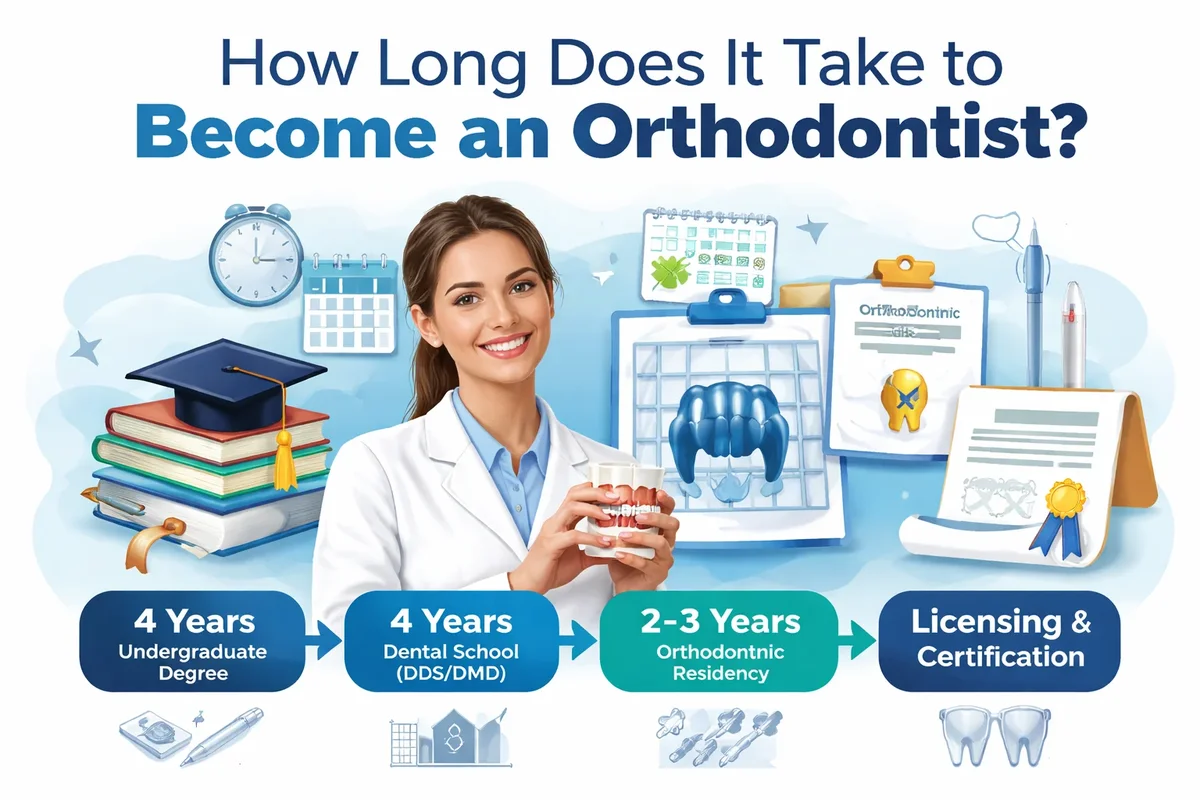
Let’s start with a straightforward breakdown of the timeline:
- Undergraduate (Pre-Dental) Education: 4 years
- Dental School (DDS or DMD): 4 years
- Orthodontic Residency: 2–3 years
Based on this structure, the minimum time required after high school is approximately 10 years, while the more common total is around 11 to 12 years. This clear breakdown is the most accurate way to answer how long does it take to become an orthodontist for most students.
Why the Timeline Often Reaches 12 Years
Although 10 years is theoretically possible, many orthodontists complete their training closer to 12 years. There are several reasons for this. Some students take gap years between undergraduate education and dental school. Others may spend additional time applying to competitive orthodontic residency programs.
These real-life factors explain why, in practice, the answer to how long does it take to become an orthodontist often exceeds the minimum estimate. The timeline is not just about education length—it is also about readiness, competitiveness, and career strategy.
Timeline Visualization: From Student to Specialist
To better visualize the process, imagine the orthodontic journey as a ladder. Each rung represents a completed stage, and progression only occurs once mastery is achieved. High school graduation is just the starting point. Undergraduate education builds academic foundations, dental school transforms students into clinicians, and residency refines them into specialists.
This layered progression is intentional. Orthodontists are responsible for long-term treatments that affect oral function, facial structure, and patient confidence. That responsibility is the core reason how long does it take to become an orthodontist involves such an extended and carefully regulated timeline.
Comparison With Other Healthcare Careers
When compared to other healthcare professions, orthodontics sits at the higher end of educational duration. It generally takes longer than becoming a general dentist and is comparable to certain medical specialties.
However, unlike some medical paths that include long hospital residencies with unpredictable schedules, orthodontic training follows a more structured academic model. This predictability helps students mentally prepare for how long does it take to become an orthodontist and plan their lives accordingly.
Does Everyone Follow the Same Timeline?
No two orthodontic journeys are exactly the same. While the average timeline is well established, individual experiences vary. Some students complete every stage without interruption, while others take time off for research, personal reasons, or additional training.
International students or those planning to practice in different countries may also face additional requirements. These variations can slightly increase how long does it take to become an orthodontist, especially if licensing or credential recognition is involved.
Accelerated and Combined Programs
In rare cases, accelerated programs allow students to shorten undergraduate education or combine degrees. While these programs can reduce total time by one year, they are highly selective and academically demanding.
Even with acceleration, the total answer to how long does it take to become an orthodontist rarely drops below 9 years. The depth of training required sets a natural lower limit.
Why the Time Investment Matters
The length of training reflects the level of trust placed in orthodontists. Patients rely on orthodontists for treatments that may last years and affect their health and appearance for a lifetime. That trust is built on rigorous education and specialization.
Understanding how long does it take to become an orthodontist helps future professionals commit fully to the process. Rather than seeing the timeline as a delay, successful orthodontists view it as preparation for excellence.
By the time an orthodontist begins practicing, they have invested over a decade in education and clinical mastery. This long-term commitment explains both the respect the profession commands and the confidence patients place in orthodontic care. In the next section, we will explore the factors that can shorten or extend this timeline and how individual choices influence the overall journey ⏳🦷.
Factors That Can Shorten or Extend the Timeline
Even though the average answer to how long does it take to become an orthodontist is fairly consistent, the actual timeline can vary significantly from one individual to another. While most orthodontists complete their training in about 10 to 12 years after high school, several personal, academic, and systemic factors can either shorten or extend this journey. Understanding these variables helps future orthodontists plan strategically and avoid unexpected delays.
When people research how long does it take to become an orthodontist, they often assume the path is fixed. In reality, it is structured but flexible. Small decisions made early—such as academic performance or application timing—can have a major impact on total training time.
Academic Performance and Competitiveness
One of the most influential factors affecting how long does it take to become an orthodontist is academic performance. Strong grades during undergraduate education and dental school can significantly streamline the process. High-achieving students are more likely to gain acceptance into dental schools and orthodontic residency programs on their first attempt.
On the other hand, students with lower grades may need to retake courses, pursue additional degrees, or apply multiple times to residency programs. Each of these steps can add months or even years to the overall timeline. This is why consistent academic excellence is one of the most effective ways to avoid extending how long does it take to become an orthodontist.
Standardized Exams and Retakes
Entrance and licensing exams play a critical role at multiple stages. Exams such as the Dental Admission Test (DAT) and dental licensing boards must be passed to progress. Failing or underperforming on these exams can delay advancement.
Retaking exams often requires months of additional preparation and waiting periods. While this does not change the required structure of the orthodontic path, it directly affects how long does it take to become an orthodontist in practice.
Application Timing and Gap Years
Another common factor is the choice to take gap years. Some students intentionally take time off between undergraduate education and dental school to gain experience, improve applications, or pursue research. Others take gap years due to unsuccessful applications.
While gap years can strengthen long-term prospects, they undeniably extend how long does it take to become an orthodontist. That said, many successful orthodontists view these extra years as valuable investments rather than setbacks.
Residency Program Availability
Orthodontic residency programs are highly competitive and limited in number. Even strong candidates may not be accepted on their first attempt. Reapplying to residency programs can add one or more years to the journey.
This bottleneck is one of the most common reasons why real-world timelines exceed the minimum estimates for how long does it take to become an orthodontist. Strategic planning, mentorship, and early preparation can help minimize this risk.
Geographic and Country-Specific Differences
The country in which you study and practice can also influence the timeline. Some countries require additional clinical service, government exams, or mandatory internships. Others may have longer or shorter residency structures.
International dentists seeking to practice in a new country may face credential evaluation processes that add significant time. These regional differences are important to consider when evaluating how long does it take to become an orthodontist globally.
Accelerated and Combined Programs
In rare cases, accelerated programs allow students to complete undergraduate education in fewer than four years or combine degrees. These programs can reduce the total timeline by up to one year.
However, accelerated programs are academically intense and highly selective. Even with these options, the minimum answer to how long does it take to become an orthodontist rarely falls below nine years. The depth of training required sets a firm lower boundary.
Personal Life and External Factors
Life events such as health issues, family responsibilities, or financial constraints can also influence the timeline. While these factors are unpredictable, they are a realistic part of many educational journeys.
Flexibility and long-term planning help students adapt without losing sight of their goals. Recognizing that how long does it take to become an orthodontist is not always linear helps reduce frustration and burnout.
Strategic Planning to Stay on Track
The best way to manage how long does it take to become an orthodontist is proactive planning. Seeking mentorship early, maintaining strong academics, preparing thoroughly for exams, and understanding application cycles can prevent unnecessary delays.
Ultimately, while some factors are beyond control, many timeline extensions are preventable with the right guidance and preparation. In the next section, we will compare orthodontics with other dental specialties to put this time investment into perspective and help you decide whether this path aligns with your long-term goals 🧠🦷.
Is the Time Investment Worth Becoming an Orthodontist?
After fully understanding how long does it take to become an orthodontist, the most important question naturally follows: is the time investment truly worth it? Spending 10 to 12 years in higher education and specialty training is a major life commitment. This section focuses on evaluating that commitment from professional, financial, and personal perspectives to help readers decide whether the long journey aligns with their long-term goals.
For many aspiring dental professionals, learning how long does it take to become an orthodontist can initially feel overwhelming. However, time alone does not determine value. The true measure lies in career satisfaction, stability, patient impact, and professional growth over decades of practice.
Professional Satisfaction and Career Fulfillment
Orthodontics is consistently ranked among the most satisfying dental specialties. Orthodontists work closely with patients over long treatment periods, often witnessing dramatic transformations in oral health and self-confidence. This long-term patient relationship is a major reason many professionals feel the answer to how long does it take to become an orthodontist is justified.
Unlike some healthcare fields that involve emergency care or unpredictable schedules, orthodontics generally offers structured working hours and planned treatments. This predictability contributes to reduced burnout and improved work-life balance, especially later in one’s career.
Financial Perspective and Long-Term Stability
While this article avoids listing exact prices or income figures, it is widely recognized that orthodontics offers strong long-term earning potential compared to general dentistry. The extended education period means delayed entry into full-time practice, but that delay is often offset by long-term financial stability.
From a purely strategic perspective, many professionals view the extended answer to how long does it take to become an orthodontist as a front-loaded investment. Over a multi-decade career, the initial time commitment becomes proportionally smaller compared to the benefits gained.
Patient Demand and Job Security
Orthodontic treatment is consistently in demand among both children and adults. Advances in clear aligners and aesthetic treatment options have expanded patient interest worldwide. This ongoing demand contributes to strong job security, reinforcing the value of the long educational path.
For those planning to work in international or medical tourism–focused clinics, patient demand can be even broader. Clinics that serve international patients, such as those reachable through the Redent Klinik Contact Page, often rely on highly trained specialists to meet global expectations.
Comparison With Other Dental Specialties
When compared to other dental specialties, orthodontics generally requires more time than general dentistry but is comparable to fields such as oral surgery or periodontics. However, orthodontics often offers more predictable schedules and fewer medical emergencies.
This comparison helps contextualize how long does it take to become an orthodontist. The timeline is long, but not unusually so for a highly specialized healthcare profession.
Intellectual and Clinical Mastery
Orthodontics appeals strongly to individuals who enjoy precision, biomechanics, and long-term treatment planning. The extended training period allows orthodontists to develop deep expertise rather than surface-level competence.
For professionals who value mastery and specialization, the years spent answering how long does it take to become an orthodontist are seen as necessary preparation rather than lost time.
Work-Life Balance Over the Long Term
One often overlooked benefit of orthodontics is long-term lifestyle balance. While the training years are demanding, many orthodontists enjoy more control over their schedules once established in practice.
This balance becomes increasingly valuable over time, making the lengthy answer to how long does it take to become an orthodontist feel more reasonable when viewed across an entire career.
Emotional Rewards and Patient Impact
Orthodontists frequently treat patients during formative years of their lives. Helping a child or adult achieve a healthy, confident smile can have lifelong psychological benefits. These emotional rewards are difficult to quantify but play a major role in job satisfaction.
This
Is the Time Investment Worth Becoming an Orthodontist?
After fully understanding how long does it take to become an orthodontist, the most important question naturally follows: is the time investment truly worth it? Spending 10 to 12 years in higher education and specialty training is a major life commitment. This section focuses on evaluating that commitment from professional, financial, and personal perspectives to help readers decide whether the long journey aligns with their long-term goals.
For many aspiring dental professionals, learning how long does it take to become an orthodontist can initially feel overwhelming. However, time alone does not determine value. The true measure lies in career satisfaction, stability, patient impact, and professional growth over decades of practice.
Professional Satisfaction and Career Fulfillment
Orthodontics is consistently ranked among the most satisfying dental specialties. Orthodontists work closely with patients over long treatment periods, often witnessing dramatic transformations in oral health and self-confidence. This long-term patient relationship is a major reason many professionals feel the answer to how long does it take to become an orthodontist is justified.
Unlike some healthcare fields that involve emergency care or unpredictable schedules, orthodontics generally offers structured working hours and planned treatments. This predictability contributes to reduced burnout and improved work-life balance, especially later in one’s career.
Financial Perspective and Long-Term Stability
While this article avoids listing exact prices or income figures, it is widely recognized that orthodontics offers strong long-term earning potential compared to general dentistry. The extended education period means delayed entry into full-time practice, but that delay is often offset by long-term financial stability.
From a purely strategic perspective, many professionals view the extended answer to how long does it take to become an orthodontist as a front-loaded investment. Over a multi-decade career, the initial time commitment becomes proportionally smaller compared to the benefits gained.
Patient Demand and Job Security
Orthodontic treatment is consistently in demand among both children and adults. Advances in clear aligners and aesthetic treatment options have expanded patient interest worldwide. This ongoing demand contributes to strong job security, reinforcing the value of the long educational path.
For those planning to work in international or medical tourism–focused clinics, patient demand can be even broader. Clinics that serve international patients, such as those reachable through the Redent Klinik Contact Page, often rely on highly trained specialists to meet global expectations.
Comparison With Other Dental Specialties
When compared to other dental specialties, orthodontics generally requires more time than general dentistry but is comparable to fields such as oral surgery or periodontics. However, orthodontics often offers more predictable schedules and fewer medical emergencies.
This comparison helps contextualize how long does it take to become an orthodontist. The timeline is long, but not unusually so for a highly specialized healthcare profession.
Intellectual and Clinical Mastery
Orthodontics appeals strongly to individuals who enjoy precision, biomechanics, and long-term treatment planning. The extended training period allows orthodontists to develop deep expertise rather than surface-level competence.
For professionals who value mastery and specialization, the years spent answering how long does it take to become an orthodontist are seen as necessary preparation rather than lost time.
Work-Life Balance Over the Long Term
One often overlooked benefit of orthodontics is long-term lifestyle balance. While the training years are demanding, many orthodontists enjoy more control over their schedules once established in practice.
This balance becomes increasingly valuable over time, making the lengthy answer to how long does it take to become an orthodontist feel more reasonable when viewed across an entire career.
Emotional Rewards and Patient Impact
Orthodontists frequently treat patients during formative years of their lives. Helping a child or adult achieve a healthy, confident smile can have lifelong psychological benefits. These emotional rewards are difficult to quantify but play a major role in job satisfaction.
This meaningful impact on patients is one of the strongest arguments in favor of the long educational journey.
Support From Professional Organizations
Orthodontists benefit from strong professional support systems, ongoing education, and research-driven advancement through organizations such as the American Dental Association. These resources ensure that the profession continues to evolve and remain relevant.
This institutional support further strengthens the argument that the long process behind how long does it take to become an orthodontist leads to a sustainable and respected career.
Final Perspective on the Time Investment
Ultimately, whether the journey is worth it depends on individual priorities. For those seeking a quick career path, orthodontics may not be ideal. But for individuals motivated by specialization, patient relationships, and long-term professional fulfillment, the answer to how long does it take to become an orthodontist becomes far less daunting.
Viewed across a 30- or 40-year career, the initial decade of training represents preparation for excellence rather than delay. For many orthodontists, that preparation is exactly what makes the profession so rewarding 🦷✨.