
Many people considering clear aligners ask the same important question: how long invisalign take to work? Invisalign has become one of the most popular orthodontic treatments in modern dentistry because it offers a nearly invisible and comfortable way to straighten teeth. However, patients naturally want to know when they will start seeing results and how long the complete process may take. The answer depends on several factors, including the condition of your teeth, your age, your commitment to wearing the aligners, and the complexity of your treatment plan. 😊
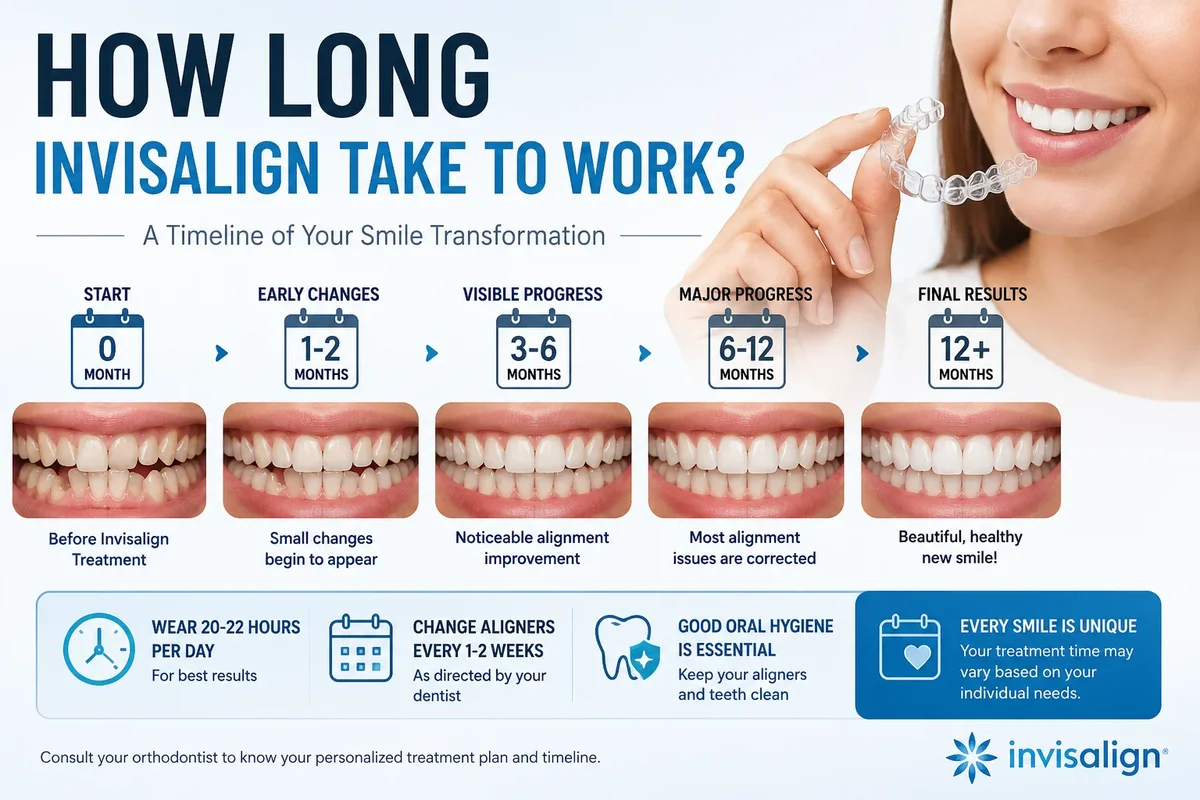
In general, most patients begin noticing small improvements within the first few weeks of treatment. Still, understanding how long invisalign take to work requires a deeper look at the full orthodontic journey. Invisalign aligners are designed to gradually shift teeth into their ideal positions using a series of custom-made trays. Each aligner is worn for approximately one to two weeks before moving to the next set. Over time, these tiny movements create major improvements in both appearance and oral health.
For mild orthodontic cases, the answer to how long invisalign take to work may be as little as 3 to 6 months. Mild crowding, small gaps, or slight bite issues can often be corrected relatively quickly when patients wear their aligners consistently for 20 to 22 hours daily. On the other hand, more complicated cases involving severe crowding, crossbites, overbites, or rotated teeth may require 12 to 24 months or longer.
One of the biggest factors affecting how long invisalign take to work is patient compliance. Invisalign only works effectively if the aligners are worn exactly as instructed. Removing aligners too often or forgetting to wear them overnight can slow progress significantly. Some patients may wonder why their treatment seems delayed, and in many situations, inconsistent wear time is the primary reason.
Another important consideration when discussing how long invisalign take to work is the biological response of the teeth and jawbone. Teeth move through a process called bone remodeling. As pressure is applied by the aligners, the bone surrounding the teeth changes shape, allowing gradual movement. Since every patient’s body reacts differently, treatment speed can vary from person to person.
Many patients also ask when they will actually notice visible improvements. Fortunately, one reason Invisalign remains highly popular is because changes can often become noticeable quite early. Depending on the severity of the case, some patients see visible movement within 6 to 8 weeks. This early progress helps motivate patients to stay committed throughout treatment.
When evaluating how long invisalign take to work, orthodontists often divide the treatment into phases. The first phase focuses on correcting the most visible alignment problems. During the middle phase, the bite and tooth positioning become more refined. The final phase fine-tunes tiny details to create the best possible smile. Even after teeth appear straighter, additional aligners may still be necessary to perfect the results.
Clear aligner therapy has advanced significantly in recent years. Modern digital scanning technology allows dentists to create highly precise treatment plans. Using 3D imaging, patients can even preview how their teeth may look after treatment. This advanced planning helps improve predictability and can reduce uncertainty about how long invisalign take to work.
Some patients may also require small tooth-colored attachments placed on the teeth during treatment. These attachments help the aligners grip the teeth more effectively and can improve movement accuracy. While attachments may slightly affect appearance, they often help shorten overall treatment time by making the aligners more efficient.
It is also important to understand that Invisalign treatment does not end immediately after the last aligner tray. Retainers are usually necessary to maintain the final results. Teeth naturally tend to shift back toward their original positions over time. Wearing retainers as instructed is critical for preserving the investment made during treatment.
Patients comparing Invisalign to traditional braces frequently ask whether one option works faster than the other. In some mild to moderate cases, Invisalign may provide similar or even shorter treatment times than braces. However, for extremely severe orthodontic problems, braces may still be recommended because they can offer stronger mechanical control. A professional consultation is the best way to determine the ideal solution for your specific needs.
Cost is another concern connected to how long invisalign take to work. In the United States, Invisalign treatment generally ranges from $3,000 to $8,000 depending on complexity and location. Some dental clinics offer monthly payment plans to make treatment more affordable. Comprehensive treatment plans often include digital scans, aligners, progress checkups, and retainers.
Patients seeking expert guidance about Invisalign treatment options can visit the Redent Klinik Contact Page for additional support and consultation details. Reliable oral health information can also be found through the American Dental Association, which provides trusted educational resources regarding orthodontic care and dental health.
Ultimately, the answer to how long invisalign take to work depends on your individual dental condition and your commitment to following instructions carefully. Most patients who wear their aligners consistently and attend regular dental checkups achieve highly satisfying results. Invisalign offers a modern, discreet, and effective way to improve smiles while maintaining comfort and flexibility throughout daily life. 😁
Whether you are dealing with crowded teeth, spacing issues, or bite alignment concerns, understanding how long invisalign take to work can help you set realistic expectations before beginning treatment. With proper planning, professional supervision, and dedication, Invisalign can gradually transform your smile and improve both confidence and oral health over time.
How Long Invisalign Take to Work for Most Patients
One of the first questions people ask before starting clear aligner treatment is how long invisalign take to work for the average patient. Invisalign is widely known for offering a comfortable and discreet alternative to traditional braces, but treatment times can vary depending on many individual factors. Most patients want fast results, especially adults who are balancing work, social activities, and daily responsibilities. Understanding the average timeline can help patients set realistic expectations and stay motivated throughout the process. 😊
Average Invisalign Treatment Timeline
For most patients, how long invisalign take to work depends on the complexity of the orthodontic problem being treated. Mild cases may take as little as 3 to 6 months, while moderate cases usually require around 12 to 18 months. Severe alignment or bite problems may extend treatment to 24 months or more.
Orthodontists create a personalized treatment plan using advanced digital imaging and 3D scans. This technology allows dental professionals to estimate how long invisalign take to work before treatment even begins. Patients can often see a digital preview of their future smile, which helps improve confidence and commitment.
Most Invisalign users change to a new set of aligners every one or two weeks. Each tray gently shifts the teeth closer to the final desired position. These small movements may seem minor at first, but over time they create dramatic smile improvements.
When Patients Start Seeing Results
Many patients become excited when they notice the first visible improvements in their smile. In most situations, patients begin seeing subtle changes within 6 to 8 weeks. This early progress is one reason Invisalign remains highly popular among adults and teenagers.
However, understanding how long invisalign take to work involves more than simply noticing cosmetic changes. Even if teeth appear straighter early in treatment, deeper bite corrections and tooth positioning may still require additional months. Orthodontic treatment focuses not only on appearance but also on creating healthy function and long-term stability.
Early Changes During Invisalign Treatment
- Small gaps may begin closing
- Crowded teeth may start aligning
- Front teeth often show improvement first
- Bite pressure may feel more balanced
- Speech usually adapts within a few days
These early improvements help reassure patients that their aligners are working effectively. Still, patience remains essential because complete orthodontic correction takes time.
Factors That Affect How Long Invisalign Take to Work
Several important variables influence how long invisalign take to work. Every smile is unique, meaning treatment speed differs from one patient to another. Understanding these factors can help patients avoid unnecessary delays.
1. Severity of Dental Problems
Mild crowding and spacing issues generally respond faster to Invisalign treatment. More complex cases involving severe crowding, overbite, underbite, crossbite, or rotated teeth usually require longer treatment times.
2. Wearing Aligners Correctly
One of the biggest reasons treatment becomes delayed is inconsistent aligner use. Invisalign aligners should be worn 20 to 22 hours per day. Removing them too frequently slows tooth movement and increases treatment time significantly.
Patients asking how long invisalign take to work should understand that commitment plays a major role in success. Aligners should only be removed for eating, drinking anything except water, and oral hygiene routines.
3. Age and Bone Response
Younger patients may experience faster tooth movement because their jawbones are still developing. Adults can still achieve excellent results with Invisalign, but tooth movement may progress slightly more slowly depending on bone density and biological response.
4. Use of Attachments and Elastics
Some patients require small tooth-colored attachments or elastics to improve aligner effectiveness. These additional tools help Invisalign apply more precise pressure, which can improve movement efficiency and reduce delays.
Can Invisalign Work Faster?
Many patients wonder whether there are ways to speed up the process after learning how long invisalign take to work. While treatment cannot be rushed excessively, patients can maximize efficiency by following instructions carefully.
Tips to Improve Invisalign Results
- Wear aligners consistently every day
- Switch aligners only when instructed
- Attend all dental appointments
- Maintain excellent oral hygiene
- Avoid losing or damaging aligners
- Use aligner chewies if recommended
Patients who follow these guidelines often experience smoother and more predictable treatment progress.
Invisalign Compared to Traditional Braces
Some people comparing orthodontic options ask whether braces or Invisalign work faster. In many mild and moderate cases, Invisalign offers treatment times similar to traditional braces. In addition, Invisalign provides several lifestyle advantages, including easier oral hygiene, fewer dietary restrictions, and improved comfort.
However, extremely complicated orthodontic cases may still benefit from traditional braces due to their stronger mechanical control. A qualified dentist or orthodontist can determine the most suitable option after evaluating the patient’s smile.
Cost and Treatment Expectations
The overall cost of Invisalign treatment often relates to the complexity and duration of the case. In the United States, treatment generally ranges between $3,000 and $8,000. Longer and more complex cases may fall toward the higher end of the range.
Patients seeking professional guidance regarding how long invisalign take to work can visit the Redent Klinik Contact Page for additional information and consultation support. Trusted dental health recommendations are also available through the American Dental Association.
Final Thoughts on Invisalign Treatment Time
Ultimately, the answer to how long invisalign take to work depends on the patient’s dental condition, dedication, and treatment goals. Most patients begin noticing improvements within weeks, while complete smile transformation may take several months or longer. Invisalign remains one of the most advanced and convenient orthodontic solutions available today because it combines aesthetics, comfort, and effectiveness. 😁
Patients who follow their dentist’s instructions carefully often achieve highly successful outcomes with Invisalign. By understanding the realistic treatment timeline and maintaining consistency, patients can enjoy a straighter, healthier, and more confident smile for years to come.
Factors That Affect How Long Invisalign Take to Work
When patients begin researching clear aligners, one of the most common concerns is how long invisalign take to work. While Invisalign is highly effective for straightening teeth and correcting bite problems, treatment timelines are never exactly the same for every individual. Some people achieve their ideal smile within a few months, while others may need over a year of treatment. The difference often depends on several important factors that influence tooth movement and aligner performance. Understanding these factors can help patients achieve better results and avoid unnecessary delays. 😊
The Complexity of the Dental Problem
The severity of the orthodontic issue is one of the biggest factors affecting how long invisalign take to work. Patients with mild spacing problems or minor crowding usually complete treatment faster than those with more complicated dental conditions.
Mild Cases
Mild cases often include:
- Small gaps between teeth
- Slightly crooked front teeth
- Minor crowding
- Small alignment irregularities
For these situations, Invisalign treatment may take only 3 to 6 months when aligners are worn correctly.
Moderate and Severe Cases
Moderate to severe orthodontic problems require more extensive movement and greater precision. These cases may involve:
- Overbite correction
- Underbite treatment
- Crossbite alignment
- Rotated teeth
- Severe crowding
- Large spacing issues
In such cases, the answer to how long invisalign take to work may range from 12 to 24 months or longer. Complex tooth movements naturally require more stages and additional aligners.
Patient Compliance and Daily Wear Time
One of the most important factors influencing how long invisalign take to work is patient discipline. Invisalign aligners are removable, which makes them more convenient than traditional braces. However, this flexibility also creates opportunities for mistakes if patients do not follow instructions carefully.
Most orthodontists recommend wearing Invisalign aligners for 20 to 22 hours every day. Aligners should only be removed for:
- Eating meals
- Drinking beverages other than water
- Brushing and flossing
- Cleaning the aligners
Patients who frequently remove their aligners or forget to wear them overnight may significantly increase treatment time. Inconsistent wear prevents teeth from moving according to schedule, which can delay progress and even require replacement aligners.
Why Consistency Matters
Teeth move gradually through controlled pressure applied by the aligners. If aligners are not worn consistently, this pressure becomes interrupted. As a result, teeth may partially shift backward, making treatment less predictable.
Patients wondering how long invisalign take to work should understand that commitment directly affects treatment success. Highly compliant patients often finish treatment faster and achieve better outcomes overall.
Biological Differences Between Patients
Every patient’s body responds differently to orthodontic treatment. Biological factors play a major role in determining how long invisalign take to work.
Age and Bone Density
Younger patients generally experience faster tooth movement because their jawbones are still developing and more adaptable. Adults can still achieve excellent Invisalign results, but treatment may progress slightly slower due to denser bone structures.
However, age alone does not determine success. Many adult patients complete Invisalign treatment efficiently by carefully following their treatment plan.
Metabolism and Healing Response
Some individuals naturally respond more quickly to tooth movement because of differences in metabolism and bone remodeling. Tooth movement depends on the body’s ability to reshape bone around the teeth, and this process varies from person to person.
The Importance of Attachments and Elastics
Many Invisalign patients require small tooth-colored attachments or elastics during treatment. These tools improve aligner grip and allow more precise tooth movement.
What Are Invisalign Attachments?
Attachments are tiny composite bumps placed on specific teeth. They help aligners apply additional force to difficult movements such as:
- Tooth rotation
- Vertical movement
- Bite correction
- Complex alignment shifts
Although some patients initially worry about attachments, they often improve treatment efficiency and reduce delays. In many cases, attachments help shorten how long invisalign take to work by increasing movement precision.
Dental Hygiene and Oral Health
Good oral hygiene is another essential factor affecting how long invisalign take to work. Healthy teeth and gums respond better to orthodontic treatment, while untreated dental problems can slow or interrupt progress.
Problems That May Delay Invisalign Treatment
- Gum disease
- Tooth decay
- Poor oral hygiene
- Inflammation or infection
- Damaged teeth
Patients should brush and floss regularly throughout treatment and attend all scheduled dental checkups. Maintaining healthy gums and teeth allows aligners to function more effectively.
Frequency of Dental Checkups
Regular appointments allow dentists to monitor progress and ensure treatment stays on schedule. During these visits, the dentist evaluates whether the teeth are moving correctly and whether adjustments are necessary.
Patients asking how long invisalign take to work should avoid skipping appointments because unnoticed problems can delay treatment significantly.
What Happens During Invisalign Checkups?
- Progress evaluation
- Aligner fitting assessment
- Attachment adjustments
- Refinement planning
- New aligner delivery
These appointments help maintain treatment accuracy and reduce the risk of complications.
Refinements and Additional Aligners
Some patients require refinement trays after completing their initial aligner series. Refinements are extra aligners used to perfect the final tooth positions.
Even when teeth appear mostly straight, small adjustments may still be necessary to improve bite alignment and smile symmetry. Refinements can add several weeks or months to treatment, depending on the case complexity.
This is another reason why the answer to how long invisalign take to work varies from patient to patient.
Lifestyle Habits That Influence Invisalign Success
Certain lifestyle habits can either improve or interfere with Invisalign treatment. Patients who maintain healthy routines often experience smoother progress.
Helpful Habits
- Keeping aligners clean
- Using aligner cases properly
- Avoiding smoking
- Reducing sugary drinks
- Following dentist instructions carefully
These habits support healthy teeth and improve overall treatment effectiveness.
Final Thoughts on Invisalign Treatment Factors
Understanding the factors affecting how long invisalign take to work helps patients prepare for a realistic orthodontic journey. Invisalign treatment is highly personalized, meaning timelines differ based on dental complexity, compliance, biology, and oral health.
Patients seeking professional advice about Invisalign treatment options can visit the Redent Klinik Contact Page for personalized guidance and consultations. Additional trusted oral health information is available through the American Dental Association.
Ultimately, patients who wear their aligners consistently, maintain good oral hygiene, and attend regular checkups often achieve the best results in the shortest possible time. Invisalign continues to provide a modern, discreet, and effective solution for creating healthier and more confident smiles. 😁
Invisalign Timeline Week by Week Explained
Many people beginning orthodontic treatment want a detailed explanation of how long invisalign take to work on a week-by-week basis. Understanding the Invisalign timeline helps patients know what to expect during each stage of treatment and reduces uncertainty throughout the process. Invisalign treatment works gradually, using custom-made aligners that gently shift teeth into their desired positions over time. While every patient’s timeline is unique, most Invisalign journeys follow a similar pattern from the first week to the final aligner. 😊
Week 1: Starting Invisalign Treatment
The first week is often the most exciting part of the process because patients officially begin their smile transformation. During this stage, patients receive their first aligner trays and instructions from their dentist or orthodontist.
What Patients Usually Experience
- Mild pressure on teeth
- Slight discomfort during the first few days
- Increased saliva production
- Minor speech adjustments
- Awareness of the aligners in the mouth
These symptoms are completely normal and usually improve within several days. The gentle pressure patients feel is actually a positive sign that the aligners are beginning to move the teeth.
At this early stage, many patients still ask how long invisalign take to work because visible changes are usually minimal during the first week. However, important biological processes are already beginning beneath the surface.
Weeks 2 to 4: Initial Tooth Movement
By the second and third weeks, patients typically switch to their next aligner trays. Each new set continues the gradual movement process planned by the orthodontist.
Common Changes During This Phase
- Pressure decreases faster after changing trays
- Patients adapt to wearing aligners daily
- Teeth may begin shifting slightly
- Some crowding starts improving
- Aligners feel more comfortable overall
At this point, many patients begin noticing very subtle improvements when comparing photos or looking closely in the mirror. Front teeth often show movement first because they are easier to reposition.
When discussing how long invisalign take to work, this early phase is important because it establishes treatment momentum. Patients who wear aligners consistently during the first month often stay on schedule throughout the rest of treatment.
Weeks 5 to 8: Visible Progress Begins
For many Invisalign users, this stage brings the first truly noticeable cosmetic improvements. Small gaps may begin closing, crowded teeth may appear straighter, and smile symmetry often improves.
Signs Invisalign Is Working
- Teeth begin aligning more evenly
- Smile appearance improves in photos
- Bite pressure feels more balanced
- Patients gain confidence wearing aligners
- Friends or family may notice subtle changes
This phase is often highly motivating because patients can finally see the results of their effort and consistency. Understanding how long invisalign take to work becomes easier once visible movement appears.
Some patients may also receive attachments during this period. These small tooth-colored bumps improve aligner grip and help perform more complex tooth movements.
Months 3 to 6: Significant Smile Improvement
By the third to sixth month, Invisalign treatment usually becomes much more noticeable. Many mild orthodontic problems are already significantly improved by this stage.
Changes Commonly Seen During Months 3 to 6
- Front teeth appear straighter
- Crowding reduces substantially
- Smile confidence improves
- Spacing issues become less visible
- Patients become fully adapted to aligners
For patients with mild cases, this stage may represent the majority of treatment progress. However, moderate and severe cases still require additional refinement and bite correction.
Patients asking how long invisalign take to work should remember that cosmetic improvements often happen before deeper bite corrections are fully complete.
Months 6 to 12: Bite Alignment and Refinement
As treatment continues, orthodontists focus on fine-tuning the bite and improving overall tooth positioning. During this phase, tooth movement may seem slower because smaller and more detailed corrections are taking place.
Why Treatment May Feel Slower
Many patients become impatient during this stage because dramatic cosmetic changes have already occurred. However, proper bite alignment is critical for:
- Long-term stability
- Jaw comfort
- Even chewing pressure
- Reduced tooth wear
- Improved oral health
This is why understanding how long invisalign take to work requires patience. The final stages often focus on precision rather than dramatic appearance changes.
Refinement Aligners and Additional Adjustments
Some patients finish treatment after their original aligner series, while others require refinement trays. Refinements are additional aligners designed to perfect the final result.
Why Refinements Are Sometimes Necessary
- Teeth may not move exactly as predicted
- Minor bite issues may remain
- Certain teeth may need additional rotation
- Smile symmetry may require improvement
Refinement aligners are very common and should not be viewed as treatment failure. In fact, refinements help optimize the final outcome and create a more stable smile.
Patients researching how long invisalign take to work should understand that refinements can extend treatment by several weeks or months depending on individual needs.
The Final Stage: Retainers
After Invisalign treatment is complete, retainers become essential for maintaining the new smile. Teeth naturally try to shift back toward their original positions, especially during the first months after treatment.
Why Retainers Matter
- Prevent teeth from shifting
- Protect orthodontic results
- Maintain bite stability
- Reduce risk of relapse
Most orthodontists recommend wearing retainers full-time initially, followed by nighttime wear long term.
How Lifestyle Habits Affect the Timeline
Patients who follow instructions carefully often complete treatment faster. The answer to how long invisalign take to work depends heavily on daily habits and consistency.
Helpful Habits for Faster Results
- Wearing aligners 20 to 22 hours daily
- Cleaning aligners properly
- Attending all appointments
- Switching trays on schedule
- Maintaining excellent oral hygiene
Patients who neglect these responsibilities may experience delays and require additional aligners.
Final Thoughts on the Invisalign Timeline
Understanding the week-by-week process helps patients develop realistic expectations regarding how long invisalign take to work. Invisalign treatment is gradual, precise, and highly personalized. While visible improvements often begin within weeks, complete smile transformation may take several months or longer depending on the complexity of the case.
Patients interested in Invisalign treatment can visit the Redent Klinik Contact Page for additional consultation details and personalized care options. Trusted oral health education is also available through the American Dental Association.
With consistency, patience, and proper dental supervision, Invisalign can successfully create a healthier, straighter, and more confident smile that lasts for many years. 😁
How Long Invisalign Take to Work for Mild Crowding
Many patients with slightly crooked teeth or small spacing issues often wonder how long invisalign take to work for mild crowding cases. Mild crowding is one of the most common orthodontic problems treated with Invisalign, and fortunately, it is usually one of the fastest conditions to improve. Invisalign aligners are highly effective for correcting minor tooth alignment problems because they apply gentle and controlled pressure that gradually shifts the teeth into better positions. 😊
For patients with mild crowding, Invisalign treatment may produce visible changes relatively quickly compared to more complicated orthodontic cases. However, understanding how long invisalign take to work still requires examining several important factors such as treatment compliance, biological response, age, and overall oral health.
What Is Mild Crowding?
Mild crowding occurs when there is not enough space in the jaw for all teeth to align properly. As a result, some teeth may overlap slightly, twist, or sit unevenly in the dental arch.
Common Signs of Mild Crowding
- Small overlaps between front teeth
- Slightly rotated teeth
- Minor alignment irregularities
- Difficulty flossing between crowded teeth
- Uneven smile appearance
Patients with these issues are often ideal candidates for Invisalign because clear aligners can efficiently correct mild misalignment without the appearance of traditional braces.
Average Treatment Time for Mild Crowding
One reason Invisalign is so popular among adults is that mild crowding usually responds quickly to treatment. In many situations, the answer to how long invisalign take to work for mild crowding ranges between 3 and 6 months.
Some patients may even notice visible improvements within the first 4 to 8 weeks of treatment. Front teeth often move first because they are generally easier to reposition compared to back teeth or bite structures.
Typical Invisalign Timeline for Mild Cases
- Weeks 1–4: Initial tooth movement begins
- Weeks 5–8: Small cosmetic improvements become visible
- Months 3–4: Significant alignment improvements occur
- Months 5–6: Final refinements and stabilization
However, even mild cases vary from patient to patient. Some individuals may require additional aligners or refinements to perfect the final result.
Why Mild Crowding Responds Faster
Mild crowding usually involves smaller tooth movements, which naturally reduces treatment duration. Since the teeth only need minor repositioning, aligners can achieve the desired result with fewer trays.
Advantages of Treating Mild Crowding with Invisalign
- Shorter treatment time
- Less discomfort
- Fewer aligners required
- Faster visible improvements
- Improved oral hygiene access
This is why patients researching how long invisalign take to work for mild crowding are often pleasantly surprised by the relatively quick timeline.
The Importance of Wearing Aligners Correctly
Although mild crowding can often be corrected quickly, treatment success depends heavily on patient compliance. Invisalign aligners must be worn consistently for 20 to 22 hours every day.
What Happens If Aligners Are Not Worn Properly?
- Tooth movement slows down
- Aligners may stop fitting correctly
- Treatment may require additional trays
- Progress becomes less predictable
- Total treatment time increases
Patients asking how long invisalign take to work should understand that skipping wear time can easily delay results, even in mild cases. Consistency is one of the biggest factors influencing Invisalign success.
How Age Influences Invisalign Results
Age may also affect how long invisalign take to work. Younger patients often experience slightly faster tooth movement because their jawbones are more adaptable. However, adults with mild crowding can still achieve excellent results with Invisalign.
In fact, many adults prefer Invisalign specifically because the aligners are discreet and nearly invisible during professional and social interactions.
Why Adults Choose Invisalign
- Transparent appearance
- Comfortable fit
- Removable design
- Easier brushing and flossing
- Fewer dietary restrictions
These benefits make Invisalign especially attractive for adults seeking fast and convenient orthodontic treatment.
Oral Hygiene During Invisalign Treatment
Maintaining excellent oral hygiene is essential throughout Invisalign treatment. Healthy gums and teeth respond more effectively to orthodontic movement, while untreated dental problems can slow progress.
Helpful Oral Hygiene Habits
- Brush after every meal
- Floss daily
- Clean aligners properly
- Avoid sugary beverages with aligners
- Attend regular dental checkups
Patients with healthy oral habits often experience smoother treatment and fewer complications.
Will Mild Crowding Require Refinements?
Some mild crowding cases finish exactly as planned, while others may need refinement aligners. Refinements are additional trays designed to perfect small details after the original aligner series ends.
Even when teeth appear mostly straight, orthodontists may recommend refinements to improve bite balance, tooth symmetry, or alignment precision.
This means the answer to how long invisalign take to work may occasionally extend beyond the original estimate if refinements are necessary.
Comparing Invisalign and Braces for Mild Crowding
Patients with mild crowding often compare Invisalign with traditional braces before choosing treatment. Invisalign is usually highly competitive in treatment speed for minor cases and offers several additional lifestyle benefits.
Invisalign Advantages Over Braces
- More discreet appearance
- Greater comfort
- Removable during meals
- Easier cleaning
- Less irritation to gums and cheeks
For many mild crowding patients, Invisalign provides both effective treatment and improved convenience.
Cost of Invisalign for Mild Crowding
The cost of Invisalign for mild crowding is generally lower than treatment for severe orthodontic problems because fewer aligners are required.
Estimated Price Range
- Mild crowding: $3,000–$5,000
- Moderate crowding: $5,000–$7,000
- Complex cases: $7,000–$8,500+
Prices vary depending on location, provider experience, and treatment complexity.
Patients seeking personalized advice regarding how long invisalign take to work can visit the Redent Klinik Contact Page for consultation details and treatment support. Trusted dental information is also available through the American Dental Association.
Final Thoughts on Invisalign for Mild Crowding
Understanding how long invisalign take to work for mild crowding helps patients develop realistic expectations before beginning treatment. Most mild cases improve relatively quickly, especially when patients wear their aligners consistently and maintain excellent oral hygiene.
Invisalign continues to be one of the most effective and convenient solutions for correcting mild crowding because it combines aesthetics, comfort, and efficiency. With proper dedication and professional supervision, patients can achieve a straighter and healthier smile in only a few months. 😁
How Long Invisalign Take to Work for Severe Cases
Patients with major orthodontic problems often ask how long invisalign take to work for severe dental cases. Severe alignment issues usually require more extensive treatment because larger tooth movements and bite corrections are involved. Although Invisalign technology has advanced significantly in recent years, complex orthodontic conditions still require careful planning, patience, and strong patient commitment. Fortunately, Invisalign can successfully treat many severe cases while offering a more discreet alternative to traditional braces. 😊
Understanding how long invisalign take to work for severe cases requires evaluating the type of dental problem, treatment complexity, patient compliance, and biological response. While mild cases may finish within several months, severe cases commonly require 18 to 24 months or longer to achieve ideal results.
What Is Considered a Severe Orthodontic Case?
Severe orthodontic cases involve major alignment or bite issues that significantly affect the position of the teeth and jaw. These problems often require more aggressive and detailed tooth movement.
Examples of Severe Orthodontic Problems
- Severe crowding
- Large spacing between teeth
- Deep overbite
- Pronounced underbite
- Crossbite
- Open bite
- Rotated teeth
- Jaw alignment issues
Patients with these conditions often require more aligners, more dental appointments, and additional treatment techniques to achieve successful outcomes.
Average Invisalign Treatment Time for Severe Cases
One of the most important factors affecting how long invisalign take to work in severe cases is the amount of movement required. Complex orthodontic problems demand gradual and carefully controlled changes to protect the teeth, gums, and jawbone.
Typical Timeline for Severe Cases
- Mild cases: 3–6 months
- Moderate cases: 12–18 months
- Severe cases: 18–24+ months
Some highly complicated cases may even extend beyond two years, especially if multiple bite corrections are needed. However, treatment speed varies significantly from patient to patient.
Patients asking how long invisalign take to work should remember that complex cases require patience because orthodontic treatment must prioritize long-term stability and oral health rather than speed alone.
Why Severe Cases Take Longer
There are several reasons why severe orthodontic cases require extended Invisalign treatment.
Larger Tooth Movements
Teeth in severe cases often need to move longer distances. Large movements must happen slowly to avoid damaging the roots, gums, or surrounding bone structure.
Bite Correction Complexity
Correcting bite problems such as overbites or underbites requires coordinated movement of multiple teeth at the same time. These movements are more difficult than simply straightening front teeth.
Biological Limitations
The body needs time to remodel bone as teeth move into new positions. This biological process cannot be rushed excessively without increasing the risk of complications.
As a result, understanding how long invisalign take to work means accepting that safe orthodontic treatment must progress gradually.
The Role of Attachments and Elastics
Patients with severe orthodontic problems often require additional treatment tools to improve aligner effectiveness.
Attachments
Attachments are small tooth-colored bumps placed on specific teeth. They help Invisalign apply stronger and more precise force.
Elastics
Rubber bands may also be used to improve jaw alignment and bite correction. Elastics are especially common for:
- Overbite treatment
- Underbite correction
- Crossbite improvement
- Jaw positioning adjustments
These additional tools often improve treatment efficiency and may reduce how long invisalign take to work in severe cases.
Importance of Patient Compliance
Patient cooperation is critical when treating severe orthodontic conditions with Invisalign. Since treatment is already more complicated, skipping aligner wear can create major delays.
Recommended Invisalign Wear Time
- 20–22 hours daily
- Remove aligners only during meals
- Wear elastics exactly as instructed
- Switch aligners on schedule
Patients who fail to follow these instructions may extend their treatment significantly. In severe cases, even small delays can affect the overall treatment plan.
This is one reason why patients researching how long invisalign take to work should understand the importance of discipline and consistency.
Can Severe Cases Be Treated Without Braces?
Modern Invisalign technology can successfully treat many severe orthodontic problems that previously required traditional braces. However, some extremely complicated cases may still benefit from braces or even jaw surgery.
When Braces May Still Be Recommended
- Extreme jaw discrepancies
- Severe tooth rotation
- Impacted teeth
- Complex surgical cases
Orthodontists evaluate each patient individually to determine the best treatment method.
What Patients Experience During Long Invisalign Treatment
Severe Invisalign treatment often involves multiple stages. Understanding these phases helps patients maintain realistic expectations regarding how long invisalign take to work.
Early Stage
- Initial crowding reduction
- Minor cosmetic improvements
- Adjustment to aligners
Middle Stage
- Bite correction
- Major tooth movement
- Jaw alignment improvements
Final Stage
- Smile refinement
- Small detail adjustments
- Retainer preparation
Many patients notice visible improvements within several months, even though full treatment may continue much longer.
Refinements in Severe Cases
Refinement aligners are very common in severe Invisalign treatment. Since large movements are involved, teeth may not always move exactly as predicted by the digital treatment plan.
Why Refinements Are Needed
- Fine-tuning tooth position
- Improving bite precision
- Correcting small remaining rotations
- Enhancing smile symmetry
Refinements may extend treatment by several additional months, but they are often essential for achieving optimal results.
Cost of Invisalign for Severe Cases
Because severe orthodontic cases require more aligners and longer treatment durations, costs are generally higher.
Estimated Severe Case Pricing
- Moderate cases: $5,000–$7,000
- Severe cases: $7,000–$10,000+
Costs vary depending on location, provider experience, and treatment complexity.
Patients interested in learning more about how long invisalign take to work for severe cases can visit the Redent Klinik Contact Page for consultation and personalized treatment options. Trusted dental information is also available through the American Dental Association.
Final Thoughts on Invisalign for Severe Cases
Understanding how long invisalign take to work for severe orthodontic problems helps patients prepare for a realistic and successful treatment journey. Severe cases naturally require more time because they involve larger tooth movements and complex bite corrections.
Although treatment may last longer, Invisalign remains a highly effective option for many complex orthodontic conditions. With proper compliance, professional supervision, and patience, patients can achieve dramatic smile improvements and long-term oral health benefits. 😁
Tips to Make Invisalign Work Faster and Better
Many Invisalign patients want to know not only how long invisalign take to work, but also whether there are ways to improve results and shorten treatment time safely. Invisalign treatment already offers an efficient and modern approach to orthodontics, but patient habits and daily routines can strongly influence how quickly the aligners achieve the desired outcome. While no treatment should be rushed aggressively, there are several proven strategies that help Invisalign work more effectively and predictably. 😊
Understanding how long invisalign take to work becomes much easier when patients follow the right habits from the beginning. Proper aligner wear, excellent oral hygiene, regular dental visits, and careful treatment compliance can dramatically improve the overall experience and reduce unnecessary delays.
Wear Invisalign Aligners the Recommended Number of Hours
The single most important factor affecting how long invisalign take to work is wearing the aligners consistently every day. Invisalign aligners are designed to apply gentle pressure continuously. If patients remove them too often, the teeth cannot move according to the planned schedule.
Recommended Daily Wear Time
- 20 to 22 hours per day
- Remove aligners only for meals
- Take aligners out for brushing and flossing
- Avoid leaving aligners out unnecessarily
Patients who fail to wear their aligners long enough may experience slower progress, poor aligner fit, and treatment delays. In some cases, new scans and replacement trays may even become necessary.
For patients asking how long invisalign take to work, consistent wear time is often the difference between finishing treatment on schedule and extending treatment by several months.
Change Aligners Exactly as Instructed
Every Invisalign treatment plan follows a carefully designed sequence of aligners. Each tray is programmed to move the teeth a specific amount before the next aligner continues the process.
Why Timing Matters
Changing aligners too early may prevent teeth from completing their intended movement. Waiting too long can also slow treatment unnecessarily.
Orthodontists usually recommend switching trays every:
- 7 days
- 10 days
- 14 days
The exact schedule depends on the complexity of the case and the patient’s biological response.
Patients researching how long invisalign take to work should never change aligners without professional guidance because doing so may reduce treatment accuracy.
Use Invisalign Chewies Regularly
Chewies are small soft cylinders that help seat the aligners more securely against the teeth. They are commonly recommended for patients whose aligners do not fit tightly enough.
Benefits of Using Chewies
- Improve aligner fit
- Enhance tooth movement precision
- Reduce air gaps between aligners and teeth
- Improve treatment effectiveness
Using chewies for several minutes daily may improve how efficiently the aligners work, especially after switching to a new tray.
Maintain Excellent Oral Hygiene
Healthy gums and teeth respond better to orthodontic treatment. Poor oral hygiene can lead to gum inflammation, cavities, or infections that may interrupt Invisalign progress.
Best Oral Hygiene Practices During Invisalign
- Brush after every meal
- Floss at least once daily
- Clean aligners regularly
- Avoid sugary beverages with aligners in place
- Use fluoride toothpaste
Patients wondering how long invisalign take to work should understand that healthy oral tissues create a more stable environment for tooth movement.
Avoid Removing Aligners Too Frequently
One common mistake Invisalign patients make is removing their aligners too often throughout the day. Frequent removal interrupts the continuous pressure needed for proper tooth movement.
Situations Where Aligners Should Stay In
- Watching television
- Working at a desk
- Sleeping
- Traveling
- Relaxing at home
Aligners should only be removed when absolutely necessary. Patients who wear them consistently often experience faster and smoother treatment.
Attend All Scheduled Dental Appointments
Regular checkups are essential for monitoring treatment progress and ensuring Invisalign is working correctly.
Why Dental Visits Matter
- Track tooth movement
- Identify delays early
- Adjust attachments if necessary
- Deliver new aligners
- Monitor oral health
Skipping appointments can delay treatment and increase the risk of complications. Patients interested in reducing how long invisalign take to work should attend every scheduled visit.
Protect Aligners from Damage
Damaged or lost aligners can interrupt treatment significantly. Invisalign trays are custom-made for each stage, meaning replacing them may take time.
Common Causes of Damaged Aligners
- Wrapping aligners in napkins
- Exposing aligners to heat
- Chewing on aligners
- Improper cleaning methods
Patients should always store aligners in their protective case when not in use.
Follow Dietary Recommendations
Although Invisalign has fewer dietary restrictions than braces, patients should still follow certain precautions.
Helpful Dietary Habits
- Drink only water while wearing aligners
- Limit sugary snacks
- Avoid smoking
- Reduce acidic beverages
These habits help maintain healthy teeth and reduce the risk of dental problems during treatment.
Stay Patient and Consistent
Many patients become impatient and constantly ask how long invisalign take to work, especially during the middle stages of treatment. However, orthodontic movement is a gradual biological process that requires time.
Some weeks may seem slower than others, particularly during bite correction or refinement phases. Staying consistent with aligner wear and maintaining realistic expectations are essential for long-term success.
Can Additional Technologies Speed Up Invisalign?
Some orthodontic offices offer supplemental technologies that may support faster tooth movement in selected cases.
Examples Include
- High-frequency vibration devices
- Accelerated orthodontic procedures
- Specialized monitoring technology
However, not every patient requires these options, and results vary depending on individual biology and case complexity.
Cost Considerations for Efficient Invisalign Treatment
Following treatment instructions carefully may also help patients avoid unnecessary costs caused by delays or replacement aligners.
Average Invisalign Costs
- Mild cases: $3,000–$5,000
- Moderate cases: $5,000–$7,000
- Complex cases: $7,000–$10,000+
Patients seeking expert guidance regarding how long invisalign take to work can visit the Redent Klinik Contact Page for consultation and treatment support. Additional oral health recommendations are available through the American Dental Association.
Final Thoughts on Improving Invisalign Results
Understanding how long invisalign take to work is only part of the Invisalign journey. Patients who follow instructions carefully, wear aligners consistently, and maintain healthy oral habits often achieve faster and more predictable outcomes.
Invisalign remains one of the most advanced and patient-friendly orthodontic solutions available today. With dedication, patience, and proper dental supervision, patients can enjoy a straighter smile, improved confidence, and better oral health for many years to come. 😁
Signs Invisalign Is Working Correctly
Many patients begin Invisalign treatment feeling excited but also slightly anxious about the results. One of the most common questions during the first weeks of treatment is how long invisalign take to work and how to recognize whether the aligners are actually doing their job properly. Since Invisalign moves teeth gradually and gently, progress may not always seem obvious from day to day. However, there are several important signs that indicate the treatment is working correctly and progressing according to plan. 😊
Understanding the signs of successful Invisalign treatment can help patients stay motivated and avoid unnecessary concerns. In most cases, Invisalign produces gradual but highly effective improvements when aligners are worn consistently and dental instructions are followed carefully.
Mild Pressure When Switching Aligners
One of the earliest signs that Invisalign is functioning properly is the sensation of mild pressure when changing to a new aligner tray.
Why Pressure Is Normal
Each aligner is designed to move the teeth slightly closer to their ideal position. When patients begin wearing a new tray, the aligners apply gentle force to specific teeth.
Patients commonly experience:
- Mild tightness
- Temporary soreness
- Pressure on certain teeth
- Slight discomfort during chewing
These sensations are generally strongest during the first one or two days after switching trays and gradually decrease afterward.
Patients wondering how long invisalign take to work should understand that this pressure is usually a positive sign because it indicates active tooth movement.
Visible Tooth Movement Over Time
Another clear sign Invisalign is working correctly is gradual visible improvement in tooth alignment. Although daily changes are often difficult to notice, comparing monthly photos can reveal significant progress.
Common Early Improvements
- Front teeth appear straighter
- Small gaps begin closing
- Crowding becomes less noticeable
- Smile symmetry improves
- Teeth appear more evenly aligned
Many patients begin seeing noticeable cosmetic changes within 6 to 8 weeks. However, the answer to how long invisalign take to work still depends on treatment complexity and individual biological response.
Aligners Continue Fitting Properly
Properly fitting aligners are one of the most important indicators of successful treatment progress.
What Proper Invisalign Fit Looks Like
- Aligners sit snugly against teeth
- Minimal air gaps are visible
- Aligners fully cover the teeth
- Trays become easier to insert after several days
At the beginning of a new tray cycle, small gaps may appear because the teeth have not fully shifted into the new position yet. By the end of the tray period, aligners should fit more closely.
If aligners consistently fail to fit properly, patients should contact their orthodontist because treatment tracking problems may exist.
Improved Bite Alignment
As Invisalign treatment progresses, patients often notice improvements in how their teeth fit together during chewing and biting.
Signs Bite Function Is Improving
- More balanced chewing pressure
- Reduced jaw discomfort
- Better contact between upper and lower teeth
- Improved speech comfort
Patients researching how long invisalign take to work should remember that bite correction may continue even after cosmetic improvements become noticeable.
Attachments and Elastics Function Properly
Some Invisalign patients require attachments or elastics to improve tooth movement and bite correction.
What Attachments Do
Attachments are small tooth-colored bumps placed on certain teeth to help the aligners grip more effectively.
These attachments support:
- Tooth rotation
- Vertical tooth movement
- Complex bite adjustments
- Improved aligner control
When attachments and elastics function correctly, treatment becomes more efficient and predictable. This can positively influence how long invisalign take to work.
Regular Progress During Dental Checkups
Routine orthodontic appointments allow professionals to evaluate whether Invisalign treatment is progressing according to plan.
What Dentists Monitor During Checkups
- Tooth movement accuracy
- Aligner fit
- Attachment condition
- Bite alignment
- Oral health status
If treatment is progressing well, patients typically continue to the next series of aligners without major adjustments.
Patients concerned about how long invisalign take to work should attend every scheduled appointment because these visits help prevent delays and identify potential problems early.
Speech and Comfort Improve Over Time
During the first days of Invisalign treatment, some patients experience temporary speech changes or mild irritation. As the mouth adapts, these symptoms usually improve quickly.
Positive Adaptation Signs
- Speech returns to normal
- Aligners feel more natural
- Less tongue awareness
- Minimal irritation inside the mouth
This adaptation process is another indication that patients are becoming comfortable with their aligners and progressing normally.
Teeth Feel Slightly Loose
Some Invisalign patients become worried when certain teeth feel slightly loose during treatment. However, mild looseness is often a completely normal part of orthodontic movement.
Why Teeth May Feel Loose
Teeth move because the surrounding bone remodels gradually under orthodontic pressure. Temporary looseness simply reflects that movement process.
As treatment continues and the teeth settle into their new positions, stability improves again.
Patients asking how long invisalign take to work should not panic about minor looseness unless severe pain or instability occurs.
What May Indicate Invisalign Is Not Working Properly?
Although Invisalign is highly effective for many patients, some warning signs may indicate treatment problems.
Possible Warning Signs
- Aligners no longer fit
- Teeth stop tracking properly
- Persistent severe pain
- Broken aligners
- Attachments falling off repeatedly
- No visible improvement over time
If any of these problems occur, patients should contact their dentist or orthodontist promptly.
The Importance of Patience During Invisalign Treatment
One reason patients constantly ask how long invisalign take to work is because orthodontic movement happens gradually. Invisalign does not create overnight changes. Instead, it produces controlled and healthy improvements over time.
Even if progress feels slow occasionally, most patients achieve significant smile transformation when they follow their treatment plan consistently.
Cost and Value of Proper Invisalign Treatment
Because Invisalign treatment represents a major investment, patients naturally want reassurance that it is working correctly.
Average Invisalign Costs
- Mild cases: $3,000–$5,000
- Moderate cases: $5,000–$7,000
- Complex cases: $7,000–$10,000+
Patients seeking expert guidance regarding how long invisalign take to work and proper treatment progress can visit the Redent Klinik Contact Page. Additional dental health information is available through the American Dental Association.
Final Thoughts on Invisalign Progress
Recognizing the signs that Invisalign is working correctly can help patients remain confident and motivated throughout treatment. Mild pressure, visible tooth movement, improved bite alignment, and properly fitting aligners are all strong indicators of successful progress.
Understanding how long invisalign take to work also means understanding that orthodontic treatment requires patience, consistency, and professional supervision. With proper care and dedication, Invisalign can create a healthier, straighter, and more confident smile that lasts for years. 😁
Invisalign vs Braces Treatment Time Comparison
One of the biggest questions patients ask before starting orthodontic treatment is whether Invisalign or traditional braces work faster. Many people researching how long invisalign take to work also want to compare Invisalign treatment time with metal braces to determine which option is more efficient. Both Invisalign and braces are highly effective orthodontic treatments, but they differ significantly in appearance, comfort, maintenance, and treatment mechanics. The answer regarding speed depends largely on the complexity of the dental problem and the patient’s commitment to treatment instructions. 😊
Modern Invisalign technology has improved dramatically over the years, allowing clear aligners to successfully treat many orthodontic conditions that once required braces. However, there are still situations where braces may provide advantages in controlling complex tooth movement.
How Invisalign and Braces Work Differently
To understand how long invisalign take to work compared to braces, it is important to first understand how these two systems move teeth.
How Invisalign Works
Invisalign uses a series of clear plastic aligners custom-designed to gradually shift the teeth into proper alignment. Patients switch to a new aligner every one or two weeks according to their treatment plan.
How Traditional Braces Work
Braces use metal brackets attached to the teeth and connected with wires. Orthodontists periodically adjust the wires to create pressure that moves the teeth.
Both methods rely on controlled orthodontic force and bone remodeling to reposition teeth over time.
Average Treatment Time for Invisalign
The answer to how long invisalign take to work depends heavily on case complexity.
Typical Invisalign Timelines
- Mild cases: 3–6 months
- Moderate cases: 12–18 months
- Complex cases: 18–24+ months
Patients with mild crowding or spacing often experience faster Invisalign treatment because aligners are highly effective for minor cosmetic corrections.
Average Treatment Time for Braces
Traditional braces generally follow a similar timeline, although severe cases may sometimes respond more efficiently with braces due to stronger mechanical control.
Typical Braces Timelines
- Mild cases: 6–12 months
- Moderate cases: 18–24 months
- Severe cases: 24–36 months
Because braces remain attached to the teeth continuously, they do not rely on patient compliance as heavily as Invisalign.
Which Option Works Faster for Mild Cases?
For mild orthodontic problems, Invisalign often works as fast as or faster than braces. This is one reason many adults choose clear aligners.
Why Invisalign Can Be Faster for Mild Cases
- Smaller tooth movements required
- Advanced digital treatment planning
- Precise aligner sequencing
- Efficient cosmetic corrections
Patients researching how long invisalign take to work for mild crowding are often surprised that Invisalign may complete treatment within only several months.
Which Option Works Better for Severe Cases?
In severe orthodontic situations, braces may still provide advantages because they offer stronger control over complex tooth movement.
Cases Often Better Managed with Braces
- Severe jaw discrepancies
- Extreme tooth rotation
- Large bite corrections
- Impacted teeth
- Complex skeletal problems
Although Invisalign can now treat many severe cases successfully, braces sometimes remain the preferred option for highly complicated orthodontic conditions.
The Role of Patient Compliance
One major difference affecting how long invisalign take to work compared to braces is patient responsibility.
Invisalign Requires Discipline
Aligners must be worn:
- 20–22 hours daily
- Every night while sleeping
- Consistently throughout treatment
Patients who remove aligners too often may significantly delay treatment.
Braces Work Continuously
Since braces remain attached to the teeth permanently during treatment, they continue working regardless of patient behavior. This can sometimes make braces more predictable in less compliant patients.
Comfort Comparison
Comfort is another major factor patients consider when comparing Invisalign and braces.
Advantages of Invisalign Comfort
- Smooth plastic aligners
- No sharp metal brackets
- Less gum irritation
- Reduced emergency visits
Many Invisalign patients report lower discomfort levels overall, even though some pressure occurs when changing aligners.
Common Braces Discomforts
- Wire irritation
- Bracket soreness
- Mouth ulcers
- Emergency wire repairs
Comfort differences may not directly affect how long invisalign take to work, but they strongly influence patient experience.
Aesthetic Differences
One of Invisalign’s greatest advantages is its discreet appearance.
Why Adults Prefer Invisalign
- Nearly invisible aligners
- Professional appearance
- More confidence during treatment
- Easy removal for photos or events
Traditional braces are far more noticeable, although ceramic braces provide a less visible alternative.
Eating and Oral Hygiene Comparison
Patients often find Invisalign easier to manage during meals and oral hygiene routines.
Advantages of Invisalign
- Remove aligners before eating
- Brush and floss normally
- No food restrictions
- Lower risk of trapped food
Challenges with Braces
- Food restrictions
- Difficult flossing
- Higher plaque accumulation risk
- Increased cleaning time
Better oral hygiene may also support healthier treatment progress overall.
Cost Comparison Between Invisalign and Braces
Cost is another important consideration when comparing treatment options.
Average Invisalign Costs
- Mild cases: $3,000–$5,000
- Moderate cases: $5,000–$7,000
- Complex cases: $7,000–$10,000+
Average Braces Costs
- Metal braces: $3,000–$7,000
- Ceramic braces: $4,000–$8,500
Prices vary depending on location, provider experience, and case complexity.
Which Option Is Better Overall?
The ideal orthodontic treatment depends on the patient’s specific dental condition, lifestyle, goals, and level of discipline.
Invisalign Is Often Best For
- Adults seeking discreet treatment
- Mild to moderate alignment issues
- Patients wanting removable aligners
- People with strong compliance habits
Braces May Be Better For
- Extremely severe orthodontic cases
- Patients likely to forget aligners
- Complex bite corrections
Patients wondering how long invisalign take to work should consult an experienced orthodontic professional to determine which option best fits their individual needs.
Patients seeking expert consultation about Invisalign treatment can visit the Redent Klinik Contact Page for personalized guidance and treatment planning. Trusted oral health resources are also available through the American Dental Association.
Final Thoughts on Invisalign vs Braces
Understanding how long invisalign take to work compared to braces helps patients make informed orthodontic decisions. Invisalign often provides similar treatment times for mild and moderate cases while offering major advantages in appearance, comfort, and convenience.
Although braces may still be preferred for certain severe conditions, Invisalign remains one of the most advanced and popular orthodontic solutions available today. With proper compliance and professional supervision, both treatments can successfully create healthier, straighter, and more confident smiles. 😁
What Happens After Invisalign Treatment Ends
Many patients focus heavily on how long invisalign take to work during treatment, but an equally important question is what happens after Invisalign officially ends. Completing the final aligner tray is an exciting milestone, yet orthodontic care does not stop immediately after the teeth become straight. The post-treatment phase plays a critical role in protecting the final results and maintaining a healthy, beautiful smile for many years. 😊
Understanding what happens after Invisalign treatment helps patients avoid relapse, preserve alignment, and maintain the investment they made in their orthodontic care. Even after active tooth movement stops, the teeth and surrounding bone structures still need time to stabilize fully.
The Importance of Retainers After Invisalign
One of the most important parts of post-treatment care is wearing retainers. Retainers are custom-made appliances designed to keep the teeth in their new positions after Invisalign treatment ends.
Why Teeth Naturally Shift Back
Teeth have a natural tendency to move back toward their original positions after orthodontic treatment. This phenomenon is called orthodontic relapse.
Several factors contribute to relapse:
- Natural pressure from surrounding tissues
- Jaw growth and aging
- Daily chewing forces
- Bone remodeling after tooth movement
Patients researching how long invisalign take to work should understand that maintaining results is just as important as achieving them initially.
Types of Retainers Used After Invisalign
Orthodontists typically recommend one of several retainer options after Invisalign treatment.
Clear Retainers
Clear retainers closely resemble Invisalign aligners and are one of the most popular choices because they are discreet and comfortable.
Hawley Retainers
These retainers use acrylic material and metal wires. They are durable and adjustable but more visible than clear retainers.
Permanent Retainers
Some patients receive fixed retainers attached behind the teeth, especially if there is a high risk of relapse.
The ideal retainer depends on the patient’s orthodontic history, treatment complexity, and lifestyle.
How Long Retainers Must Be Worn
Many patients mistakenly believe retainers are only necessary for a short period. In reality, long-term retainer use is essential for preserving orthodontic results.
Typical Retainer Schedule
- First several months: Full-time wear
- Later stages: Nighttime wear
- Long-term: Ongoing maintenance wear
Patients who stop wearing retainers completely often experience gradual tooth shifting over time.
This is why understanding how long invisalign take to work also means understanding the lifelong importance of retainer maintenance.
Post-Treatment Dental Checkups
Even after Invisalign treatment ends, follow-up dental appointments remain important.
What Dentists Evaluate After Treatment
- Retainer fit
- Tooth stability
- Bite alignment
- Gum health
- Signs of relapse
These checkups help ensure that the teeth remain properly aligned and stable over time.
How Teeth Feel After Invisalign
Patients often notice several changes in their mouth after Invisalign treatment ends.
Common Post-Treatment Experiences
- Teeth feel smoother and more aligned
- Chewing feels more balanced
- Smile confidence improves
- Retainers feel tight initially
Some minor sensitivity may still occur temporarily as the teeth stabilize in their new positions.
Patients wondering how long invisalign take to work may feel especially satisfied at this stage because the final smile transformation becomes fully visible.
Can Teeth Shift After Invisalign?
Yes, teeth can shift after Invisalign if retainers are not worn properly. This is one of the most common post-treatment concerns.
Factors That Increase Relapse Risk
- Not wearing retainers
- Severe original crowding
- Grinding or clenching teeth
- Natural aging processes
- Poor oral habits
Even small amounts of shifting can eventually affect smile appearance and bite alignment.
Long-Term Benefits of Invisalign Treatment
Successful Invisalign treatment offers more than cosmetic improvements. Properly aligned teeth also contribute to better oral health and long-term dental stability.
Health Benefits of Straight Teeth
- Easier brushing and flossing
- Reduced plaque accumulation
- Lower gum disease risk
- Improved bite function
- Reduced uneven tooth wear
Understanding how long invisalign take to work is important, but patients should also recognize the lifelong health advantages of orthodontic treatment.
Smile Confidence After Invisalign
Many patients report significant emotional and psychological benefits after completing Invisalign treatment.
Common Confidence Improvements
- Smiling more frequently
- Greater confidence in social situations
- Improved professional self-esteem
- Better comfort during photos and videos
These emotional benefits often become one of the most rewarding parts of the orthodontic journey.
Potential Refinements After Initial Treatment
Some patients require refinement aligners after their original Invisalign series ends.
Why Refinements Happen
- Small alignment adjustments remain
- Bite perfection is still needed
- Teeth did not move exactly as predicted
- Smile symmetry requires improvement
Refinements are common and help optimize the final result. They may extend the total treatment timeline slightly.
This is another reason why patients researching how long invisalign take to work should understand that every treatment journey is highly personalized.
Oral Hygiene After Invisalign
Good oral hygiene remains essential after treatment ends.
Recommended Long-Term Oral Care
- Brush twice daily
- Floss regularly
- Attend routine cleanings
- Wear retainers properly
- Monitor for shifting
Healthy oral habits protect both the smile and the investment made during orthodontic treatment.
Cost of Post-Treatment Maintenance
Patients should also understand that retainer replacement and maintenance may involve future costs.
Common Maintenance Expenses
- Replacement retainers: $200–$800
- Dental checkups
- Professional cleanings
- Retainer repairs
These costs are usually far lower than repeating orthodontic treatment due to relapse.
Patients interested in learning more about how long invisalign take to work and long-term orthodontic care can visit the Redent Klinik Contact Page for consultation support. Additional trusted dental resources are available through the American Dental Association.
Final Thoughts on Life After Invisalign
Completing Invisalign treatment is a major achievement, but maintaining the results requires ongoing care and responsibility. Understanding how long invisalign take to work is only part of the orthodontic journey. Retainers, follow-up care, and healthy oral habits are essential for preserving the final smile long term.
With proper maintenance and professional guidance, Invisalign results can remain stable and beautiful for many years. Patients who follow retainer instructions carefully often enjoy lifelong improvements in both confidence and oral health. 😁
Disclosure: this page may contain affiliate links. We may earn a commission if you use them, at no extra cost to you.