
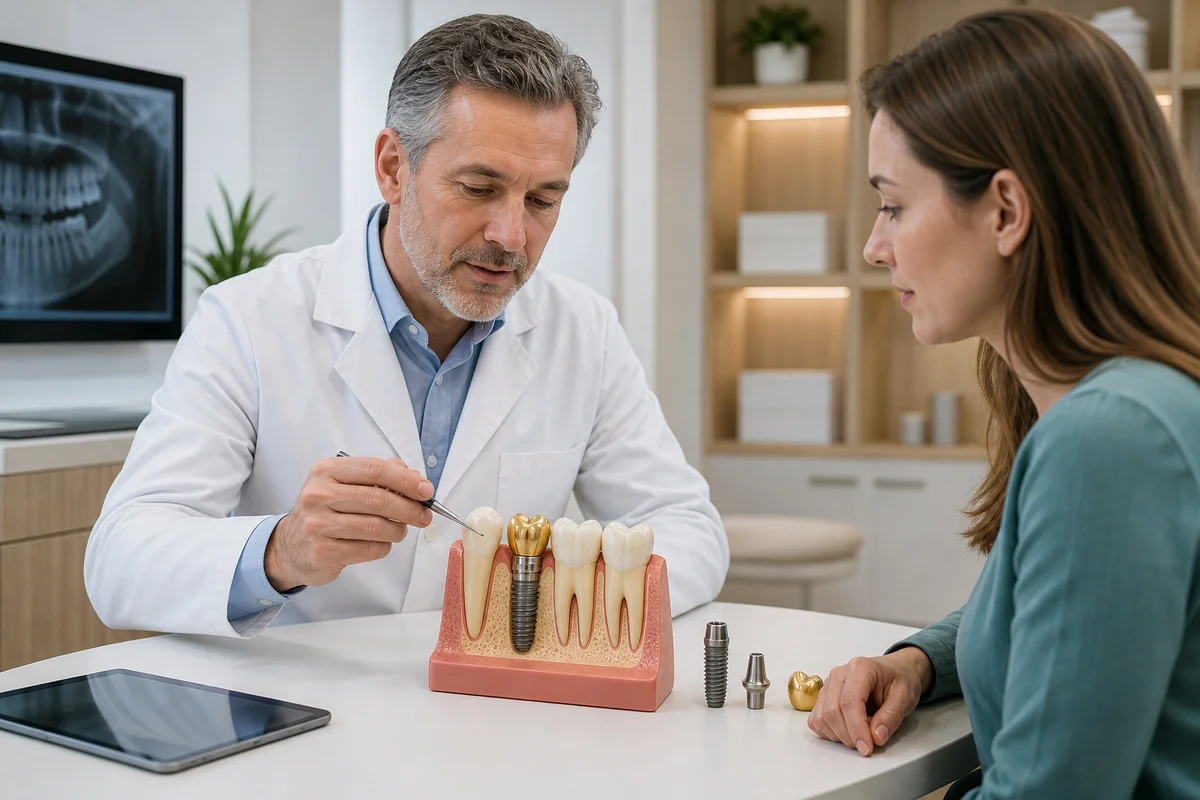
Quick answer: how much are gold implants has no reliable universal price because “gold implant” can describe different components. The implanted fixture is usually titanium or zirconium oxide, while a visible crown, framework or selected abutment component may use dental gold alloy. A complete quote should identify the exact alloy and separate examination, imaging, surgery, implant body, abutment, laboratory restoration, temporary care, grafting if needed and follow-up.
If you search how much are gold implants, first establish what the seller means by “gold.” A dental implant system is not one solid tooth-shaped object. It normally includes a fixture placed in the jaw, an abutment that connects through the gum and a crown, bridge or denture above it. The US Food and Drug Administration says most dental implant systems are made from titanium or zirconium oxide, although gold alloys and other materials are sometimes used. In everyday marketing, the visible gold-coloured part is often the restoration rather than the root-form fixture.
That distinction controls both clinical planning and price. A full-contour high-noble alloy crown, a porcelain-fused-to-high-noble crown, a gold alloy component within a restoration and an implant body described as containing gold are not interchangeable products. Pure gold is also generally too soft for many functional dental applications, so dental laboratories use engineered alloys with specified compositions and properties. Ask for a written material description rather than relying on colour or the word “gold.”
This guide explains how to read a quote without inventing a fixed market rate. It is educational, not a diagnosis or a promise that a particular material suits your bite, tissues or medical history. Redent Klinik can outline the records required for an individual plan through its English contact page, but a final decision requires a clinical examination and appropriate imaging.
1. Why how much are gold implants has no single price
The phrase can refer to a single implant crown, one component of an implant restoration, several connected crowns, a fixed full-arch bridge or even a conventional titanium implant displayed with a gold-coloured crown. Each option uses different quantities of material, laboratory processes and clinical stages. A headline price may cover only the visible crown while another quote includes surgery, the fixture and abutment.
When comparing how much are gold implants, location and currency also matter. Professional fees, laboratory costs, alloy purchasing arrangements, taxes, facility overhead, implant brand, clinician experience and the number of appointments differ between markets. Precious-metal prices change, but the restoration is not priced like a bullion coin. It is a regulated custom medical device produced to fit a planned bite and implant connection.
A responsible estimate comes after the dentist determines whether the missing tooth site, bone, gums, bite and neighbouring teeth are suitable for implant therapy. Extraction, infection management, bone or soft-tissue grafting and temporary replacement can change the plan. Any quote given before assessment should be labelled provisional and should state which assumptions could alter it.
2. How much are gold implants depends on which component is gold
The FDA describes a dental implant system as an implant body, an abutment and sometimes an abutment fixation screw, with the artificial tooth attached above. For a single missing tooth, the American Academy of Periodontology similarly explains that the implant replaces the root, an abutment connects to it and a crown replaces the visible tooth. Patients should ask which of these parts contains gold alloy.
The answer to how much are gold implants changes if the fixture is conventional titanium and only the crown is a high-noble alloy. It changes again if the crown contains a metal substructure veneered with porcelain, or if a cast gold alloy component is used within a custom restoration. In full-arch cases, a framework and multiple teeth introduce different engineering and maintenance requirements.
- Implant body or fixture: the root-form medical device surgically placed in jawbone.
- Fixation screw: a small system-specific component that secures certain connections.
- Abutment: the connector between the implant body and the restoration.
- Crown: the visible replacement for one tooth; it may be metal, ceramic, polymer or a combination.
- Bridge or full-arch prosthesis: several replacement teeth supported by multiple implants.
- Temporary restoration: a provisional tooth or bridge used during selected phases of healing.
A written quote should name the manufacturer and model of the implant system, the abutment type, the restorative design and the alloy category or composition. Colour alone cannot confirm gold content. A gold-coloured coating, a low-gold noble alloy and a high-noble alloy are not equivalent descriptions.
3. Pure gold versus dental alloy in how much are gold implants
The American Dental Association’s material overview explains that noble metals used in dentistry are typically mixed with other elements to increase strength. Gold is soft and malleable, so adding metals such as platinum-group elements, silver or copper can make an alloy usable for an indirect restoration. The exact formulation affects colour, casting behaviour, strength, compatibility with porcelain and laboratory cost.
The historic ADA classification describes “high noble” alloys as containing a high proportion of noble metals and a specified minimum proportion of gold. “Noble” and “predominantly base” are different categories. Those labels are more informative than the casual phrase how much are gold implants, but even a category does not disclose every element in a specific alloy.
Ask for the product name, manufacturer and composition certificate where available. This is particularly important if you have a known metal allergy or previous reaction. A clinician should interpret relevance to your history; a marketing statement such as “hypoallergenic” is not a substitute for material disclosure or professional evaluation.
4. What a complete how much are gold implants quote should include
A complete estimate should describe the final treatment rather than a single component. Start with the diagnostic phase: consultation, clinical examination, periodontal assessment, photographs, intraoral scan or impressions and clinically justified radiographs. If CBCT is needed for implant planning, it should be clearly listed rather than hidden inside an undefined package.
For how much are gold implants, the surgical line should distinguish tooth extraction, implant placement, grafting or sinus procedures when indicated, sedation or anaesthesia, surgical guide, healing components and post-operative reviews. The restorative line should then identify the temporary tooth, abutment, gold alloy restoration, laboratory work, try-in, delivery and bite adjustment.
- Consultation, medical and dental history, clinical examination and diagnosis
- Necessary two-dimensional or three-dimensional imaging and interpretation
- Extraction and socket management, if a tooth is still present
- Bone or soft-tissue augmentation, only if clinically indicated
- Implant body, cover screw or healing component and surgical placement
- Standard or custom abutment and system-specific fixation screw
- Provisional restoration and any planned replacement during healing
- Final crown, bridge or framework with exact alloy and surface description
- Laboratory design, casting or milling, finishing and quality controls
- Delivery, fit verification, screw tightening protocol and bite adjustment
- Post-operative and restorative review appointments
- Maintenance instructions, professional cleaning pathway and repair policy
If a quote says “implant included” without these distinctions, request clarification. A low entry price may exclude the abutment, final crown or bone preparation. A higher quote may include them. Price comparison becomes meaningful only when the endpoints and exclusions match.
5. Decision table: what does how much are gold implants mean?
Use this table to identify the product being offered. It is not a recommendation for any material or treatment.
| Offer description | What may actually be gold alloy | Questions before comparing price |
|---|---|---|
| “Gold implant tooth” | Often the visible crown; the fixture may remain titanium or zirconium oxide | Which part is implanted, which part is gold alloy and what are the manufacturer and alloy composition? |
| Full-cast gold alloy implant crown | Most or all of the visible crown’s metal structure | Is it high noble or noble alloy, how much laboratory work is included and is the abutment separate? |
| Porcelain fused to high-noble alloy | The substructure beneath a porcelain exterior | Which surfaces show porcelain or metal, how will repairs be handled and what alloy is documented? |
| Custom gold alloy component | Selected abutment, coping or framework component, depending on the system | Is the component authorised for that implant connection and is it included in the stated fee? |
| Gold-coloured restoration | May not contain a meaningful quantity of gold | Is the colour produced by the alloy itself, a surface treatment or another material? |
| Full-arch “gold teeth” | Framework, individual units, external surfaces or only decorative areas | How many implants, which framework, which teeth, what weight and composition, and what maintenance design? |
6. The clinical plan comes before how much are gold implants
A material choice cannot be separated from diagnosis. The dentist evaluates bone volume, gum condition, smile line, tooth space, opposing teeth, bite forces, grinding or clenching, hygiene access and the proposed implant position. A gold alloy crown may be technically possible yet undesirable in a particular visible zone, space or restorative design. A ceramic alternative may fit appearance goals better, while a metal restoration may offer advantages in another situation.
Asking how much are gold implants before confirming whether an implant is the appropriate tooth-replacement option risks buying a component rather than care. Alternatives can include a tooth-supported fixed bridge, resin-bonded bridge, removable partial denture or, in some cases, no immediate replacement. Each has different biological, functional and maintenance trade-offs.
Patients should also ask whether nearby natural teeth can be maintained. Extracting a restorable tooth only to obtain a gold implant crown is not equivalent to choosing a colour. Irreversible treatment requires a tooth-by-tooth prognosis, alternatives and informed consent.
7. How much are gold implants when bone or gum grafting is needed?
Grafting is not part of every implant case. It may be discussed when the ridge lacks the dimensions or contour needed for the planned implant position, or when soft tissues require support. Possible procedures include socket preservation, guided bone regeneration, ridge augmentation, sinus augmentation or soft-tissue grafting. These have different materials, techniques, healing periods and risks.
For how much are gold implants, a graft changes the surgical cost and may add stages, but it does not necessarily change the composition of the crown. Quotes should keep the two questions separate: what is required to create a safe implant site, and what material is selected for the final restoration?
A provider should not add grafting automatically because the final crown is gold alloy. Nor should anyone promise that no graft is needed from a photograph. The need follows examination and appropriate imaging, not the price category of the restoration.
8. How the gold benchmark affects how much are gold implants
The London Bullion Market Association explains that the LBMA Gold Price is an internationally recognised benchmark set twice daily in US dollars per troy ounce. This illustrates why a precious-metal input can change over time and why an old quote may expire. However, the benchmark is for market gold delivered under defined conditions; it is not a dental crown price list.
The answer to how much are gold implants cannot be calculated by multiplying a crown’s weight by a spot price. Dental alloy may contain gold plus other noble or strengthening metals. The laboratory purchases certified material, manages casting or milling, designs the restoration, compensates for processing, finishes surfaces and verifies fit. Waste recovery, remakes, shipping, currency and supplier terms can also affect the material line.
Ask how long a quote remains valid and whether the metal surcharge is fixed when you accept the plan or recalculated when the laboratory orders material. The response should be in writing. A clinic need not reveal confidential supplier agreements, but it should identify what is included and how material-price changes are handled.
9. Laboratory design and how much are gold implants
Two crowns containing similar alloy can have different fees because the clinical and technical work differs. A custom abutment, limited inter-arch space, unusual implant angle, screw-access management or complex contact area can require more design time. A large molar generally uses a different restoration volume from a small incisor, although weight alone still does not define the complete fee.
When evaluating how much are gold implants, ask whether the final restoration is screw-retained or cement-retained, full contour or porcelain veneered, and whether the abutment is standard or custom. Each design has indications, limitations and maintenance considerations. The implant connection must be compatible with the component; “custom” should not mean untraceable.
Quality-control steps may include verification of the digital or physical impression, contact and occlusion checks, radiographic seating confirmation when appropriate, torque according to the implant system and a retrievable access design. A quote that documents these stages offers more information than one that lists only grams of alloy.
10. How much are gold implants compared with ceramic options?
Gold alloy, porcelain fused to metal, monolithic zirconia and other restorative materials have different mechanical, optical and technical characteristics. No option is universally “best.” A visible front tooth may prioritise translucency and colour matching. A posterior tooth may prioritise available space, bite, wear behaviour and repair strategy. The opposing dentition and history of chipping or grinding matter.
A fair how much are gold implants comparison should use the same clinical scope. Compare a gold alloy crown plus its implant and abutment with a ceramic crown plus the same necessary surgical and restorative stages. Do not compare a crown-only gold fee with an all-inclusive ceramic implant package.
Ask the dentist to explain why a material is suitable, what alternatives are reasonable and how appearance, thickness, connector design, screw access, wear, polish, repair and laboratory support differ. The answer should not rely on prestige or luxury language.
11. Safety, alloy composition and how much are gold implants
The FDA states that dental implant systems are evaluated using international consensus standards and biocompatibility testing. It also advises patients to ask what brand and model is being used and keep that information. The fact that gold has a long dental history does not make every unlabelled gold-coloured component appropriate or compatible.
In a discussion of how much are gold implants, material traceability is a patient-safety issue as well as a price issue. Request the implant record, component identifiers and alloy information. Tell the dentist about metal reactions, skin patch testing, jewellery sensitivity, occupational exposure and previous unexplained oral reactions. The clinician may decide whether further medical or dental assessment is relevant.
Dental implant surgery itself also carries risks independent of the crown material, including infection, injury to nearby structures, healing problems, altered sensation, poor bite, screw loosening and implant failure. Smoking and uncontrolled disease can affect healing. A more expensive material does not eliminate those risks or guarantee longevity.
12. Insurance and the answer to how much are gold implants
Dental benefits vary by country, employer, insurer and policy. A plan may treat the implant body, abutment and crown as separate services. It may apply waiting periods, annual maximums, missing-tooth clauses, frequency limits, deductibles, coinsurance or an alternate benefit based on a less costly material. Some contracts may exclude implants or elective material upgrades.
Before relying on an estimate for how much are gold implants, submit an itemised treatment plan and ask the insurer for a written pre-treatment estimate. That response is usually not a guarantee of payment because eligibility and contract terms can change, but it can expose coding or scope differences. Ask whether a high-noble material allowance differs from the fee for the implant service itself.
Do not let an insurance label decide the clinical material. First determine suitable options, then compare coverage and out-of-pocket responsibility. If a plan offers an alternate benefit, ask the clinic to show the gross fee, expected insurer payment and your estimated balance separately.
13. Financing does not change how much are gold implants
A monthly payment is not the same as total treatment cost. Financing can add interest, origination charges, late fees or deferred-interest risk. Compare the cash price, financed principal, annual percentage rate, payment count, total repayment and consequences of missed or delayed treatment stages. Read cancellation and refund terms before signing.
For how much are gold implants, financing should not conceal which components are included. If a treatment plan changes after examination or surgery, ask how the loan or payment plan will be adjusted. Do not borrow for a gold material upgrade before the dentist confirms that the restoration is suitable and the complete treatment scope is known.
Urgent infection, severe swelling, trauma or uncontrolled pain should be assessed promptly; financing research should not delay necessary evaluation. The choice of a gold-coloured restoration can wait until safety and disease control are addressed.
14. How much are gold implants for dental travel?
International treatment adds currency conversion, card charges, travel, accommodation, time away from work, extra visits and local follow-up. Precious-metal surcharges may be quoted in one currency while your payment is processed in another. Ask which exchange rate applies, when the amount becomes fixed and whether tax or laboratory shipping is included.
A travel estimate for how much are gold implants should state how many visits are expected, what happens if healing takes longer, who manages a loose screw or chipped veneer after you return and whether a local dentist can obtain compatible parts. The lowest package price can become more expensive if an unplanned return journey is required.
Request copies of radiographs, scans, implant labels, component references, alloy certificate, operative notes and the definitive prosthetic design. Confirm the clinic’s aftercare route and emergency response times. Maintenance is a clinical responsibility, not merely a warranty term.
15. Maintenance and lifetime cost of how much are gold implants
Dental implants and restorations require daily cleaning and professional review. The European Federation of Periodontology warns that peri-implant diseases can affect gums and supporting bone. A crown may remain intact while tissues around the implant become inflamed, so the visible material does not replace prevention.
The lifetime answer to how much are gold implants may include maintenance appointments, professional cleaning, radiographs when clinically justified, replacement screws, access restoration, repair, polishing or eventual remake. A full-arch restoration may need periodic removal in selected designs. Ask which services are expected and which are included for a defined period.
Bruxism, bite changes, hygiene difficulty and smoking can affect maintenance needs. An occlusal guard may be considered for some patients, but it is not automatically required. The clinician should explain your own risk factors and warning signs without guaranteeing a lifespan.
16. How much are gold implants when repairs are needed?
Repairability depends on design. A screw-retained single crown may be retrievable through an access channel, while a cement-retained restoration involves different removal considerations. Porcelain over a metal substructure can chip; a full-metal surface has different aesthetic and repair issues. Screws and abutments must match the implant system.
When asking how much are gold implants, include the cost and logistics of common maintenance events. Clarify whether the clinic can obtain the original components, whether the laboratory keeps the design file and what happens if the implant brand is unavailable in another country. A written implant passport supports continuity of care.
Warranty language should be read carefully. It may cover laboratory manufacturing defects but exclude biological complications, trauma, grinding, missed reviews or third-party treatment. A warranty is not a clinical outcome guarantee and should never replace informed consent.
17. Red flags in a how much are gold implants advertisement
Be cautious when “24-karat implant” is used without identifying the component, because pure gold and a functional dental alloy are different concepts. A photograph of a gold-coloured crown does not prove composition. Likewise, “permanent,” “lifetime,” “all-inclusive” and “no graft needed” require written definitions and clinical evidence.
A trustworthy response to how much are gold implants should not pressure you to pay before a diagnosis, refuse to name the implant system, hide the laboratory or alloy, or promise the same procedure to everyone. It should distinguish provisional from final estimates and explain who performs the surgery and restoration.
- No written alloy composition, manufacturer or implant-system record
- A gold colour presented as proof of purity
- A price that omits the abutment or final crown
- A guarantee of pain-free surgery, integration or lifetime survival
- Automatic extraction without discussing whether teeth can be maintained
- Grafting promised or ruled out from a photograph alone
- Unclear responsibility for complications, repairs and local follow-up
- Payment terms that prevent review of the full consent and cancellation policy
18. Questions to ask before accepting how much are gold implants
Take the quote home and compare it with the proposed treatment plan. The clinician should be able to explain the material and each stage in plain language. If answers change, request an updated written estimate before proceeding.
- Which exact component contains gold alloy: fixture, abutment, coping, crown or framework?
- Is the visible restoration full metal, porcelain fused to metal or another construction?
- What is the alloy category, product name, manufacturer and documented composition?
- What implant body material, brand, model, diameter and connection are planned?
- Does the quote include examination, imaging, surgery, implant, abutment and final crown?
- Which temporary restoration and follow-up visits are included?
- Could extraction, grafting, sedation or a surgical guide add cost?
- How long is the quote valid, and can metal or currency changes alter it?
- What alternatives are clinically suitable, and how do their complete scopes compare?
- What records will I receive for the implant and alloy?
- How are maintenance, repairs, remakes and emergencies priced?
- Who coordinates care if treatment involves more than one clinician or country?
19. Frequently asked questions about how much are gold implants
Does how much are gold implants mean they are solid gold?
Usually, the phrase does not mean one solid pure-gold device. Most implant bodies are titanium or zirconium oxide, according to the FDA. A gold alloy may be used in selected components or in the visible crown or framework. Because pure gold is soft, dental restorations generally use alloys designed for strength. Ask for the exact component and composition.
Does how much are gold implants equal the current gold spot price?
No. The LBMA benchmark describes market gold per troy ounce, while a dental fee includes certified alloy, other metals, laboratory design and processing, clinical work, implant components and follow-up. The crown may not be pure gold, and the material input is only one part of the complete treatment price.
Is how much are gold implants higher than zirconia pricing?
It can be, but there is no universal relationship. Alloy content, crown size, laboratory, abutment, design, region and market conditions affect the fee. A fair comparison uses the same diagnostic, surgical and restorative scope. Suitability should be decided before price because appearance, bite, space and maintenance differ.
Can insurance answer how much are gold implants?
An insurer can estimate benefits under a specific contract after receiving an itemised plan. It cannot set the clinician’s diagnosis or guarantee final payment. Ask how the implant body, abutment and high-noble restoration are coded, whether an alternate benefit applies and what deductible, coinsurance, limit or exclusion remains.
Does how much are gold implants include unused dental alloy?
Dental laboratories purchase and manage alloy under their own processing and recovery systems. The material used for your restoration is not necessarily supplied as a separate patient-owned bar, and fabrication produces sprues, remnants and recoverable material. Ask the clinic and laboratory how the quoted material charge is calculated rather than assuming ownership of laboratory scrap.
Is a gold alloy crown safe with a titanium implant?
Different materials can be used within a properly designed implant-restoration system, but compatibility depends on authorised components, connection design, laboratory method and the individual patient. Material history and known sensitivities should be discussed. Only the treating team can assess whether a proposed combination meets device instructions and clinical requirements.
Does how much are gold implants include tooth extraction?
Not necessarily. Some quotes start after the tooth has already been removed; others include extraction but exclude socket preservation or later grafting. Request separate lines for extraction, implant surgery, grafting, temporary restoration, abutment and final gold alloy crown. Confirm what happens if the plan changes after extraction.
Can a gold implant be completed in one visit?
A final implant restoration normally depends on diagnosis, surgery, healing and laboratory production. Some stages can be combined for carefully selected patients, and a temporary restoration may sometimes be delivered promptly, but this is not a universal promise. The FDA notes that implant-body healing may take months or longer. The treatment sequence should follow clinical conditions, not a package timetable.
20. Final answer: how much are gold implants?
The accurate answer to how much are gold implants is a written, patient-specific total for a clearly defined product. Confirm which component is gold alloy, its documented composition, the implant body and abutment, the laboratory design and every necessary diagnostic, surgical, temporary and follow-up service. A spot gold price or a crown-only advertisement cannot provide that total.
Compare alternatives at the same scope and ask what may change after examination or surgery. Consider maintenance, repair access, insurance, financing and travel—not just the first payment. Most importantly, choose a material because it fits a sound clinical plan, not because gold colour or luxury language implies a better outcome.
For information about implant planning, restorative options and an individual record review, visit the Redent Klinik English site. Remote information can organise questions, but final suitability and cost depend on examination and diagnostic findings.
Sources
- US Food and Drug Administration: dental implants—what patients should know
- US Food and Drug Administration: safety of metals and materials in medical devices
- US Food and Drug Administration: endosseous dental implant and abutment performance criteria
- American Dental Association: materials for indirect restorations
- American Dental Association: glossary of dental terms and alloy categories
- American Academy of Periodontology: single-tooth dental implants
- American Academy of Periodontology: dental implant procedures
- European Federation of Periodontology: dental implants explained
- London Bullion Market Association: daily gold benchmark information
- National Institute of Dental and Craniofacial Research: finding dental care
- American Dental Association
- World Health Organization: oral health fact sheet