
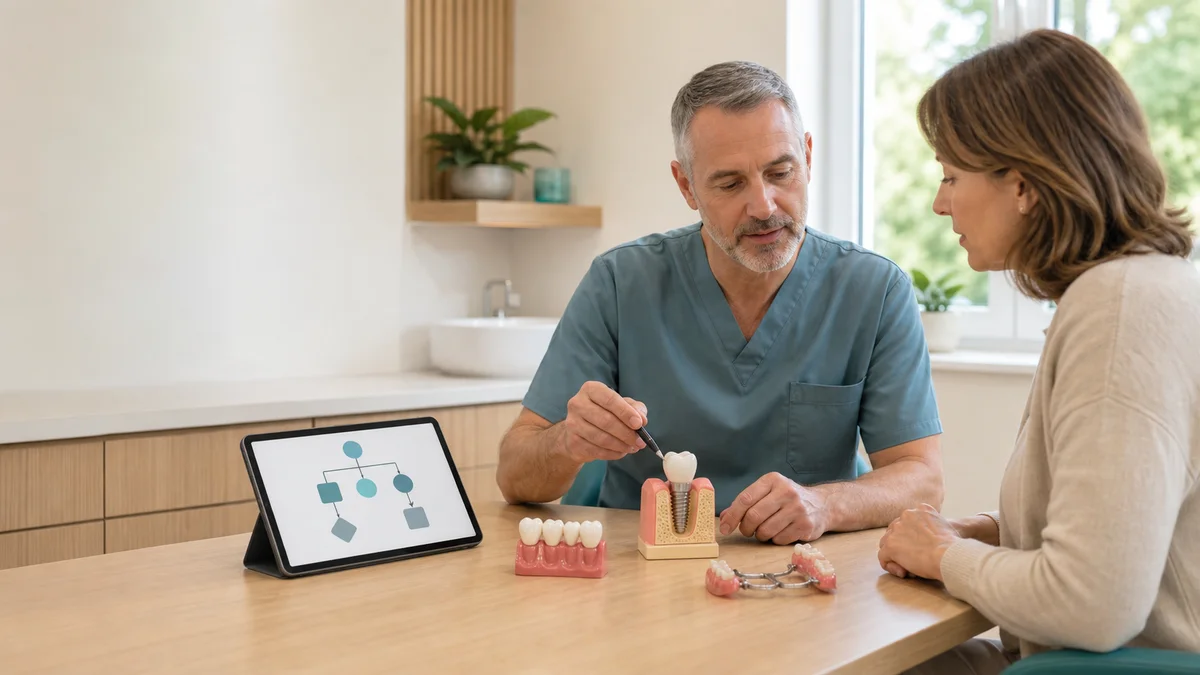
Quick answer: If you are asking how much are implants on NHS, there is no routine UK-wide implant price. Dental implants are usually private, while NHS funding is rare and reserved for defined clinical priorities. England’s Band 3 charge is £332.10 from 1 April 2026, but that standard charge covers items such as crowns, dentures and bridges; it is not a universal NHS implant fee.
People searching how much are implants on NHS often expect a simple band charge. The accurate answer is more nuanced. The NHS says dental implants are normally available privately and are expensive. They may sometimes be provided through an NHS specialist service when a person has exceptional clinical needs, for example after mouth cancer treatment, severe trauma, certain inherited conditions or repeated failure of non-implant dentures in a completely toothless jaw.
The question how much are implants on NHS comes after clinical eligibility. Even when a referral is clinically reasonable, it does not guarantee acceptance or funding. A specialist team considers the reason teeth are missing, the available alternatives, oral health, smoking, hygiene, medical factors, likely benefit and ability to maintain the result. Local commissioning and hospital criteria also matter.
This guide focuses mainly on England because its patient-charge bands are nationally published. Scotland, Wales and Northern Ireland use different charging systems, and eligibility for a specialist implant pathway is separate from routine dental charges. Any answer to how much are implants on NHS must identify the UK nation, care setting, funding decision and exemption status. Prices and rules can change, so confirm them with the treating service before consenting.
How much are implants on NHS: the direct answer
There is no standard NHS menu price for a single implant, an implant bridge or an implant-retained denture. The NHS dental treatments page states that implants are usually only available privately. It also explains that NHS implant provision is rare and may be considered for people who cannot wear dentures for particular reasons, including effects of mouth cancer or an accident.
If exceptional NHS funding is approved, the patient may receive care through a hospital or specialist dental service rather than buying an implant from a high-street practice at a band price. The charging position can depend on the nation and whether treatment is provided as hospital dental care, primary care or a mixed pathway. Ask the service to confirm in writing whether the implant surgery, abutment, crown, bridge or denture and reviews are NHS-funded.
That is why a search for how much are implants on NHS should not be answered with England’s Band 3 figure alone. Band 3 is an official charge for a completed course of clinically necessary NHS dental treatment that may include crowns, dentures and bridges. The NHS does not list routine implant placement as a standard Band 3 entitlement. A private implant quote is not converted into an NHS charge merely because a dentist also has an NHS contract.
What an implant treatment pathway includes
To answer how much are implants on NHS, first define the full pathway. A dental implant is an artificial replacement for a tooth root, commonly placed in jaw bone to support a crown, bridge or denture. Care may include assessment, justified imaging, disease control, extraction, healing, bone or soft-tissue procedures, implant placement, an abutment, the final prosthesis and long-term maintenance.
How much are implants on NHS also depends on which stages a service funds. Guy’s and St Thomas’ NHS Foundation Trust describes pre-operative assessment, bone grafting when needed, implant placement and restorative treatment. Each stage can involve several visits, and its specialist service says the complete pathway may take six to twelve months. That timeframe is an example, not a promise.
When asking how much are implants on NHS, clarify which components are actually approved. Funding for assessment does not necessarily mean every proposed procedure or future replacement part is funded indefinitely. A person may have NHS-funded surgery but later need routine maintenance from a local dentist. The crown, bridge or denture supported by implants also has its own repair and replacement needs.
- Assessment: diagnosis, disease stability, imaging and consideration of alternatives
- Site preparation: extraction, healing and bone or soft-tissue treatment if clinically indicated
- Implant phase: surgical placement and healing review
- Restorative phase: abutment plus crown, bridge or implant-retained denture
- Maintenance: hygiene, monitoring, component checks and management of complications
Why NHS implant funding is rare
The starting point for how much are implants on NHS is the NHS duty to provide clinically necessary care that keeps the mouth, teeth and gums healthy. For many missing-tooth situations, a conventional denture, adhesive bridge or other bridge design may meet that need without implant surgery. An implant can offer benefits, but it is not automatically the only suitable replacement.
Official policy limits any simple answer to how much are implants on NHS. NHS England describes implants and advanced multi-unit fixed appliances as complex elective reconstructive treatment not routinely available as NHS-funded dental care. NHS services may stabilise urgent pain or infection around private work, but that does not create an entitlement to replace or continue the private implant plan.
The practical answer to how much are implants on NHS is therefore often “not available through a routine NHS course.” This is different from saying implants have no clinical value. It means public funding is prioritised for cases where specialist assessment finds a substantial need, appropriate alternatives are unsuitable, and the person satisfies general and local eligibility requirements.
Who may be considered for NHS-funded implants?
Eligibility changes the meaning of how much are implants on NHS. Priority groups include people who have lost tissue or teeth after head and neck cancer treatment, people with congenital or inherited conditions causing absent or malformed teeth, and people who have lost teeth through severe trauma. Some services may consider complete tooth loss after repeated well-made conventional dentures have failed.
Any estimate for how much are implants on NHS remains conditional because these are examples, not automatic approvals. Guy’s and St Thomas’ limits its service to certain high-priority groups. Royal College of Surgeons guidance says priority groups still need a clinical needs assessment balanced against alternatives, while local panels apply their own referral and funding processes.
For someone researching how much are implants on NHS, the reason for tooth loss matters. Routine loss caused by decay, periodontal disease, failed root treatment or an unsuccessful bridge may not meet a specialist service’s threshold by itself. A general dentist should first assess disease, function and appropriate conventional options, then decide whether a specialist NHS referral has a defensible clinical basis.
- Rehabilitation after head and neck cancer surgery
- Severe traumatic loss of teeth and supporting structures
- Congenital or inherited conditions associated with missing or malformed teeth
- Selected cases of complete tooth loss with documented repeated denture failure
- Other exceptional cases supported by individual clinical justification
General eligibility and readiness criteria
Before asking how much are implants on NHS, check general readiness. Royal College of Surgeons guidance says candidates should generally be registered with and regularly attend a dentist, have no untreated primary dental disease, maintain the oral hygiene needed to protect the result and be non-smokers. Specialist assessment may occasionally justify exceptions, but no factor should be assumed irrelevant.
The answer to how much are implants on NHS can be delayed while active gum disease, uncontrolled decay or inadequate cleaning is addressed. Medical history, medicines, bone volume, growth, parafunction and willingness to attend a long programme also influence planning. These checks help determine whether implant treatment is safe, maintainable and likely to offer enough benefit.
This explains why how much are implants on NHS cannot be separated from “am I clinically ready?” A referral can be returned or delayed while disease is treated. A person may need to demonstrate stable oral health and consistent attendance before a specialist team makes a final decision. Do not stop smoking or change prescribed medicines solely for an implant without suitable professional support.
England’s 2026 dental charges and the implant misconception
Current bands are relevant to how much are implants on NHS, but they are not implant tariffs. From 1 April 2026, NHSBSA lists England’s charges as £27.90 for Band 1, £76.60 for Band 2 and £332.10 for Band 3. A non-exempt person normally pays one charge for a completed NHS course; Band 3 can include crowns, dentures and bridges.
A precise response to how much are implants on NHS must state that Band 3 is not an advertised implant price. The public NHS treatments page treats implants differently: they are usually private and only rarely available through the NHS. If an exceptional pathway is accepted, the hospital or referring service should state whether any patient charge applies and what it covers.
So if a page answers how much are implants on NHS simply with “£332.10,” it leaves out the most important eligibility issue. The figure is relevant when comparing NHS alternatives such as a clinically necessary bridge or denture in England, but it does not guarantee implant placement, a specific implant brand, a ceramic crown or a complete implant-retained reconstruction.
Charges differ across the four UK nations
Location is essential to how much are implants on NHS because the UK does not have one dental charging system. England uses three bands. Scotland provides free NHS examinations and generally charges paying patients 80% of NHS treatment costs up to a course maximum. Wales introduced itemised care packages in April 2026, while Northern Ireland has separate remuneration and charge rules.
Nation-specific context prevents a misleading answer to how much are implants on NHS. Routine charging systems do not establish universal implant eligibility, and specialist services may operate under secondary-care commissioning. If you move or are referred across a boundary, ask which nation’s rules and provider policy govern the pathway; do not export an English band elsewhere.
A reliable response to how much are implants on NHS must therefore name the location. It should also state the date, because patient charges can change each financial year. The comparison table below uses current official information available in August 2026 but deliberately does not invent an implant price where no routine price exists.
| Situation | What the published charge tells you | What it does not prove |
|---|---|---|
| England routine Band 3, from 1 April 2026 | £332.10 for a completed qualifying NHS course that may include crowns, dentures or bridges | It does not create routine eligibility for implant placement |
| England specialist NHS implant referral | The provider confirms funding and any applicable patient charge after acceptance | A referral does not guarantee treatment or zero cost |
| Scotland routine NHS dentistry | Eligible paying adults generally pay 80% up to the published course maximum | The maximum is not a routine implant package price |
| Wales routine NHS dentistry | Itemised care-package charges apply from April 2026 | A crown, bridge or denture charge does not imply implant funding |
| Private implant at an NHS/private mixed practice | The practice must give a private treatment plan and cost | NHS exemption does not make the private element free |
How the referral process usually works
The route to answering how much are implants on NHS starts with a general dental assessment. The dentist identifies why teeth are missing, treats active disease and discusses options. If there appears to be an exceptional indication, the dentist can check the specialist service’s referral criteria and submit records for hospital or multidisciplinary assessment.
A waiting list does not settle how much are implants on NHS because assessment is not approval for surgery. The specialist service may request information, recommend conventional care or conclude that expected benefit does not justify an implant pathway. A patient can ask how decisions are reviewed, but acceptance cannot be guaranteed before assessment.
When you ask how much are implants on NHS, request a written answer at each stage: Is the assessment NHS-funded? Has funding for surgery been approved? Is the abutment and final tooth included? Who pays for maintenance and replacement components? Without those answers, “NHS referral” can be misunderstood as a complete funded package.
- General dental examination and diagnosis
- Control of decay, gum disease and other active problems
- Discussion of no treatment, denture and bridge alternatives
- Referral against the receiving service’s criteria, if justified
- Specialist assessment and, where required, funding-panel decision
- Written treatment, consent and maintenance plan if accepted
NHS alternatives when implants are not funded
The comparison behind how much are implants on NHS should include alternatives. A missing tooth does not always require replacement. Depending on location, bite, appearance and preference, monitoring may be reasonable. Other choices include a partial or complete denture, resin-bonded bridge, conventional bridge or adapting an existing denture, each with different maintenance and future implications.
Alternatives can make how much are implants on NHS less urgent. The NHS says bridges and dentures are commonly available when clinically necessary and, in England, may fall within Band 3. A metal-coloured posterior crown may be offered according to need, while alternative materials can be private. The dentist should distinguish NHS and private choices before treatment.
For many people asking how much are implants on NHS, the immediately useful comparison is between an NHS denture or bridge and a fully itemised private implant plan. The lower upfront option is not always the best for every person, and the highest-technology option is not automatically clinically superior. Consider tissue preservation, drilling of neighbouring teeth, maintenance, repairability and long-term risk.
Mixed NHS and private treatment
Mixed care often complicates how much are implants on NHS. A practice may provide some care under the NHS and offer an implant privately when the distinction is clear. The NHS plan should identify necessary NHS care, while the private plan lists implant components, fees and terms. You should not have to become wholly private to access available, clinically necessary NHS care.
Exemption status changes only part of how much are implants on NHS. An NHS charge exemption applies to qualifying NHS treatment, not automatically to a private implant, graft, premium crown or maintenance. NHSBSA advises confirming whether each item is NHS or private; a mixed course can contain a private amount even when the person is exempt.
Before relying on an answer to how much are implants on NHS, ask for two totals rather than a blended monthly payment. The private plan should show implant placement, components, provisional restoration, final crown or denture, grafting, scans, sedation, reviews and foreseeable maintenance. Avoid assuming a deposit is refundable or that a quoted warranty pays travel and consequential costs.
- Which treatment is NHS and which is private?
- Who is the contracting provider for each part?
- Which implant, abutment and final restoration are included?
- Are grafting, imaging, sedation and temporary teeth included?
- What happens if implant placement is not possible or integration fails?
- Who provides emergency care, maintenance and component replacement?
Free NHS care and the Low Income Scheme
Personal entitlement affects how much are implants on NHS only after NHS eligibility is established. Some people do not pay NHS dental charges because of age, pregnancy or recent birth, benefits, hospital status or a valid certificate. NHSBSA says HC2 gives full help and HC3 can give partial help; entitlement must be valid when required.
The key limit for how much are implants on NHS is that exemptions do not widen the clinical range of NHS services. An HC2 holder may receive qualifying NHS dental treatment without the patient charge, but the certificate does not turn a routinely private implant into an entitlement. Funding criteria and charge exemption remain separate.
This is a crucial qualification to how much are implants on NHS: “free NHS dental treatment” means no charge for NHS treatment for which you are both clinically eligible and administratively entitled. It does not mean every dental option is available. Use NHSBSA’s current eligibility checker or ask the service before ticking an exemption box.
Long-term maintenance and future costs
Implants need ongoing cleaning and professional monitoring. The tooth or denture on top can wear, loosen, fracture or need replacement. Tissues around an implant can become inflamed, and bone support can be lost. Smoking, uncontrolled disease, plaque, bite forces and inconsistent attendance can increase risk. No clinician can promise a complication-free lifetime.
Guy’s and St Thomas’ tells patients that they are responsible for long-term implant care and that a local dentist can provide maintenance at the patient’s own cost. Its limited NHS implant service states that NHS England funding is valid for five years and that later replacement implant crowns or dentures need to be provided by a local dentist. Other services may have different policies.
Therefore how much are implants on NHS should include future care, not only placement. Ask who pays for hygiene, radiographs when indicated, replacement screws, fractured porcelain, a worn denture attachment or a new crown after the funded period. A maintenance plan should name the local dentist and explain what happens if the specialist service discharges you.
Safety, consent and realistic expectations
Implant surgery can involve pain, swelling, bruising, infection, damage to nearby structures and failure to integrate with bone. Bone grafting adds its own recovery and risks. Components can loosen or wear. Individual anatomy, medical history and the site determine specific risks, so general internet percentages cannot replace personal consent.
The specialist team should explain benefits, material alternatives, no-treatment options, expected stages, uncertainties and maintenance. Ask whether the implant is intended to support one crown, a bridge or a denture. The decision should not be driven by a promise of NHS funding, fear of dentures or a limited-time private discount.
A patient-safe response to how much are implants on NHS never guarantees eligibility, price or outcome. It directs the person to a general dentist, the relevant specialist criteria and current NHS charge information. Seek urgent dental advice for uncontrolled bleeding, rapidly increasing swelling, severe infection symptoms, difficulty swallowing or breathing; funding questions should not delay urgent assessment.
Questions to ask before accepting a plan
Bring a written checklist to the appointment. It helps separate clinical need from funding and prevents the word “referral” being mistaken for final approval. If the service cannot yet confirm a cost, ask when and by whom the charge decision will be made.
- Which published eligibility criterion might apply to me?
- What non-implant alternatives could meet my clinical need?
- Has NHS funding been approved, or is this only an assessment referral?
- Which nation and provider charging rules apply?
- Are surgery, grafting, abutment and final prosthesis all included?
- Could I pay for any laboratory-made appliance?
- How long is specialist follow-up funded?
- Who will maintain the implant after discharge?
- What private costs arise if NHS approval is declined?
For a separate private assessment or to discuss records after an NHS decision, you can contact Redent Clinic’s English-speaking team. General information about treatment planning is available on the Redent Clinic English website. A remote review is preliminary and does not establish NHS eligibility or replace an in-person examination.
How much are implants on NHS? Frequently asked questions
How much are implants on NHS in England in 2026?
There is no routine implant price. England’s Band 3 charge is £332.10 from 1 April 2026 for a qualifying course that may include crowns, dentures and bridges, but implants are usually private. If exceptional specialist funding is approved, ask the provider whether any patient charge applies.
Does Band 3 automatically include a dental implant?
No. Band 3 includes specified laboratory-made NHS treatments, but the NHS describes implants as usually private and only rarely available in certain circumstances. How much are implants on NHS cannot be answered by quoting Band 3 without checking eligibility and the care setting.
Can I get an NHS implant after losing one tooth?
Routine single-tooth loss does not usually meet specialist funding thresholds. Exceptional factors such as severe trauma, cancer rehabilitation or congenital absence may support assessment. A dentist must evaluate alternatives and the receiving service decides whether the referral and funding criteria are met.
Can I get NHS implants because I cannot tolerate dentures?
Some specialist services consider selected people with complete tooth loss when repeated, well-made non-implant dentures have failed. Denture discomfort alone does not guarantee acceptance. The service may review fit, anatomy, disease control, previous adjustments, hygiene and other options.
Are NHS implants free if I have an HC2 certificate?
An HC2 certificate provides full help with charges for qualifying NHS dental treatment. It does not create implant eligibility. For how much are implants on NHS, first establish whether the implant pathway is NHS-funded; then ask how the certificate applies to any charge.
Does pregnancy exemption cover a private implant?
No. Pregnancy or recent-birth entitlement can remove charges for qualifying NHS dental treatment, but private care remains private. Confirm the status of every procedure in the written plan and do not assume an exemption pays for a privately arranged implant.
Can my NHS dentist refer me to a hospital implant service?
A dentist can refer when there is a credible clinical indication and the receiving service’s criteria appear relevant. The hospital may reject, redirect or assess the referral. Referral is not approval, and waiting for assessment is not confirmation of treatment.
How long does an NHS implant pathway take?
Timing depends on assessment, disease control, funding approval, grafting, healing and restoration. One specialist NHS trust describes a six-to-twelve-month pathway, but waiting times and clinical stages vary. Ask your service for a personalised schedule rather than relying on a general estimate.
Will the NHS repair a private implant?
NHS care may address urgent pain or infection according to clinical need, but complex elective reconstruction or replacement of private implant work is not routinely transferred to NHS funding. Ask the original provider about maintenance and obtain urgent assessment when symptoms require it.
Are implant crowns funded forever?
Not necessarily. One NHS specialist service states that its implant funding is valid for five years and later replacement crowns or dentures are provided by a local dentist. Policies vary. When researching how much are implants on NHS, ask about the funded follow-up period in writing.
What can the NHS offer instead of implants?
Depending on clinical need, options may include no replacement, a removable denture, a resin-bonded bridge or another bridge. In England, clinically necessary dentures and bridges may be included in Band 3. Suitability depends on the gap, remaining teeth, tissues, bite and preference.
Can I mix an NHS denture with private implants?
Mixed care may be possible only with clear clinical and contractual planning. Each NHS and private component, provider, charge and maintenance duty should be documented. Do not assume the NHS will repair or replace private components or that a private payment changes NHS referral eligibility.
Official and clinical sources
- NHS: dental treatments — implant definition, private availability, rare NHS circumstances and alternatives.
- NHS: how much dental treatment costs — England’s current treatment bands and included routine care.
- NHSBSA: dental charges from 1 April 2026 — official Band 1, 2 and 3 patient charges.
- Guy’s and St Thomas’ NHS Foundation Trust: implant service — priority groups, stages, funding period and maintenance.
- NHS England: self-funded dental treatment requiring NHS intervention — stabilisation, acceptance criteria and complex elective care.
- Royal College of Surgeons: NHS-funded dental implant standards — priority groups, readiness and general eligibility.
- NHSBSA: free NHS dental treatment — exemptions, HC2 and HC3 help, and mixed private care.
- NHS inform Scotland: NHS dental treatment — Scotland’s examination entitlement and patient-charge framework.
- GOV.WALES: NHS dental charges and exemptions — Wales’ current care packages and exemption rules.
- American Dental Association — general professional oral-health information.
- World Health Organization oral health fact sheet — international context for oral disease and prevention.
Safety note: This article will be reviewed by Dentist Esma Çevrük Çakır. It provides general information, not diagnosis, an NHS funding decision, a fixed quote, legal advice or a treatment guarantee. The answer to how much are implants on NHS can change with nation, date, provider, clinical criteria and charge exemption. Confirm the current written position with your dentist and receiving NHS service.