
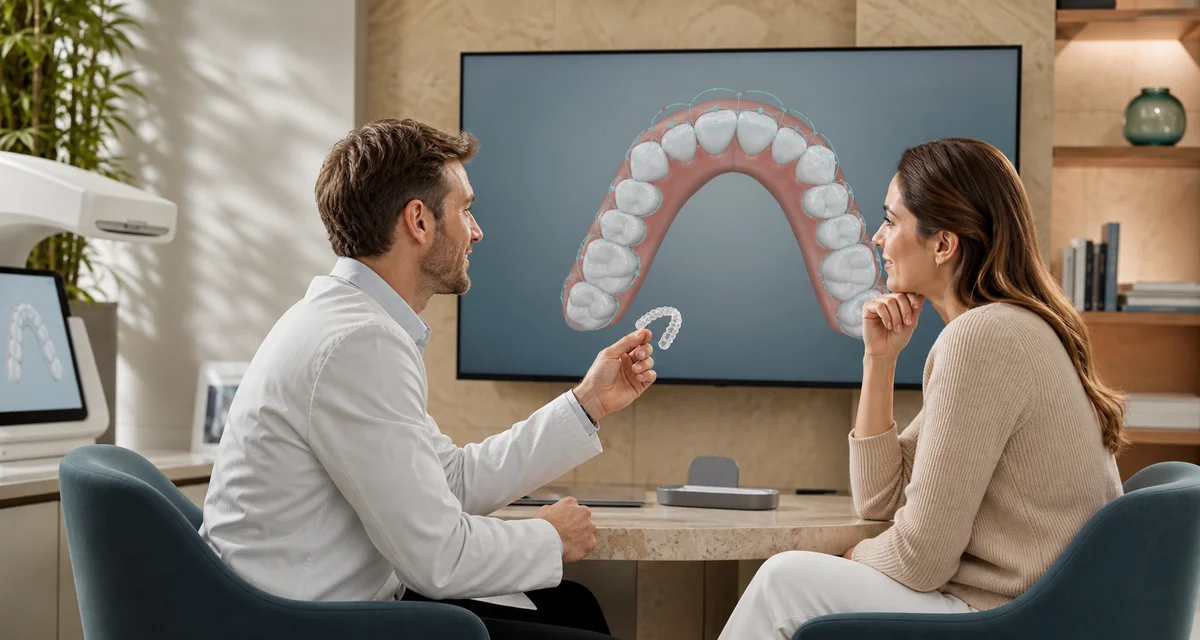
Quick answer: how much can invisalign move teeth has no single safe millimeter answer. Each aligner plans a small step, while the full series may address selected spacing, crowding and bite problems. The achievable change depends on roots, bone, gums, movement type, attachments, wear and clinical monitoring. A scan alone cannot establish suitability.
People searching how much can invisalign move teeth are often asking two different questions. One is how far a tooth is programmed to move with one aligner. The other is how much correction an entire supervised treatment can achieve. Those are not the same measurement. An aligner series uses many small planned stages; the total goal depends on diagnosis, anatomy, biomechanics, cooperation and how closely the teeth follow the digital plan.
A responsible answer to how much can invisalign move teeth cannot claim that every tooth moves exactly X millimeters. Teeth can tip, rotate, translate, intrude, extrude and change root angulation. A one-millimeter rotation is not meaningful in the same way as one millimeter of bodily movement. The amount visible at the edge of a front tooth may also differ from what happens at its root. Orthodontic planning therefore uses three-dimensional positions, not one headline number.
Manufacturer information about how much can invisalign move teeth says a clinician creates a unique digital plan that maps intended movements and designs aligners to apply force in the right place and sequence. The American Association of Orthodontists explains that each set moves teeth incrementally and that some, but not all, orthodontic problems are suitable for clear aligners. The FDA likewise says aligners move teeth gradually according to an individual plan. Together, these sources support a personalised answer rather than a guaranteed range.
This article about how much can invisalign move teeth is general education, not a remote diagnosis. Invisalign is a registered brand of Align Technology; Redent Klinik is not speaking for the manufacturer. Treatment decisions should follow an examination, appropriate records and informed consent. Diş Hekimi Esma Çevrük Çakır will review the clinical communication and patient-safety framing automatically added to the published version.
How Much Can Invisalign Move Teeth in One Aligner?
The practical answer to how much can invisalign move teeth in one tray is “a small, prescribed increment,” not a self-selected distance. AAO patient information describes a new aligner as being off by only a fraction of a millimeter so that gentle pressure guides the teeth toward its shape. The FDA describes a series in which each aligner is generally worn for one to two weeks as directed. Your provider may use another schedule based on the plan and biological response.
When estimating how much can invisalign move teeth, a planned increment is not the same as achieved movement. Software can display a target, but teeth may track differently because of fit, wear time, contact between teeth, attachment performance, root shape, bone response or the complexity of the movement. Providers check tracking and may add refinements, adjust contacts, rebond an attachment or change the strategy. Skipping ahead to a tighter tray does not safely accelerate biology.
Online answers to how much can invisalign move teeth often quote a specific fraction of a millimeter per aligner as though it applies to every tooth and every direction. That can be misleading. Staging choices vary by tooth, movement type, anchorage needs and the clinician’s prescription. Some teeth may be held while others move. Some movements are sequenced before others to create space or protect the bite. Ask to see your own staged plan rather than treating a generic number as a dosage.
When considering how much can invisalign move teeth per stage, comfort is not a reliable measuring tool. Mild pressure or tightness can occur with a new tray, yet stronger discomfort does not prove more effective movement. Persistent pain, a tray that will not seat, unusual mobility, gum swelling or a sharp bite change deserves contact with the treating team rather than forceful wear or home modification.
How Much Can Invisalign Move Teeth Across a Full Treatment?
Across a full series, how much can invisalign move teeth depends on the complete malocclusion and the treatment goals. The manufacturer describes uses ranging from simple movement to more complex cases and lists crowding, spacing, crossbite, open bite, deep bite, Class II and Class III patterns among the situations clinicians may plan. That list does not mean every severity or skeletal pattern can be corrected with aligners alone.
One public reference relevant to how much can invisalign move teeth uses up to 6 mm of crowding, spacing, overjet or overbite to define “mild to moderate malocclusion” for certain treatment-time comparisons. That marketing definition is not a universal maximum for one tooth, not a promise that all 6 mm cases are suitable, and not proof that a jaw discrepancy can be corrected without other treatment. Only clinical findings can show what that measurement represents in an individual mouth.
The answer to how much can invisalign move teeth may involve space created by widening the dental arch within safe limits, moving selected teeth backward or forward, performing clinician-prescribed interproximal reduction, extracting teeth in selected cases, or combining approaches. Each choice changes anchorage and root positions. The visible closing of a gap can involve several teeth sharing movement rather than one tooth traveling the entire distance.
The best response to how much can invisalign move teeth is therefore a tooth-by-tooth plan with realistic uncertainty. It should distinguish the initial digital setup, expected biological response and any limits that could require refinements, elastics, attachments, temporary anchorage, partial braces or a different appliance. The projected animation is a planning tool, not a guaranteed final photograph.
Six Types of Tooth Movement and Why Distance Is Not Enough
Understanding how much can invisalign move teeth requires knowing what kind of movement is intended. Two plans can show the same change at a crown while placing very different demands on roots and supporting tissues. Orthodontists evaluate the bite and three-dimensional tooth position, not just straightness from the front.
- Tipping: the crown moves more than the root, changing the tooth’s angle.
- Translation: crown and root move together through the bone, often called bodily movement.
- Rotation: the tooth turns around its long axis; rounder teeth may give an aligner less natural grip.
- Intrusion: the tooth is guided further into its supporting socket in a controlled way.
- Extrusion: the tooth is brought further out of the socket; grip and attachment design can matter.
- Root torque or angulation: root position changes relative to the crown and neighboring structures.
Several movement types may combine when answering how much can invisalign move teeth. A crowded canine might need rotation, root control and space creation. An upper incisor involved in overjet correction might need crown movement, torque and careful coordination with the lower teeth. Reporting only millimeters at the tooth edge leaves out the biomechanics that determine safety and stability.
Some movements are less predictable with removable aligners in certain circumstances. The AAO notes that severe malocclusions, significant rotations and large gaps may not respond as predictably. This does not label a specific patient as unsuitable. It means the clinician must assess severity, required root control, available anchorage and alternatives before answering how much can invisalign move teeth.
9 Factors That Set the Real Movement Limit
The biological and mechanical limit behind how much can invisalign move teeth is not simply the plastic’s flexibility. The plan must keep roots within appropriate supporting bone, protect gums, coordinate upper and lower arches and maintain a functional bite. These nine factors commonly shape the answer.
- Bone boundaries: the thickness and shape of supporting bone influence where roots can be positioned safely.
- Root anatomy: root length, shape, angulation and proximity to neighboring roots affect the movement path.
- Gum and periodontal health: active disease, recession or attachment loss can change risk and timing.
- Movement type: rotation, extrusion and root movement may require different control than simple tipping.
- Available space: crowding may require expansion, interproximal reduction, distal movement, extraction or another strategy.
- Anchorage: moving one tooth creates reciprocal forces that must be controlled elsewhere.
- Bite relationship: teeth must fit together functionally, not merely look level in one photograph.
- Appliance fit and features: attachments, elastics, cut-outs and staging can improve selected force systems.
- Patient cooperation and monitoring: wear time, hygiene, appointments and timely reporting influence whether the plan stays safe and on track.
Age alone does not decide how much can invisalign move teeth. The AAO says healthy teeth can be moved at many ages, but adults may have restorations, bone changes, gum history or missing teeth that affect planning. Growing patients have different considerations because jaw growth and tooth eruption can interact with treatment. A personalised risk assessment is more useful than an age-based promise.
Medical history and medicines also matter. Bone metabolism, healing, dry mouth and periodontal inflammation can affect orthodontic care. Tell the clinician about diagnoses, pregnancy, smoking or vaping, previous trauma, root canal treatment, implants and all medicines or supplements. The answer to how much can invisalign move teeth should never be separated from health history.
Attachments, Elastics and IPR: What They Change
Attachments can affect how much can invisalign move teeth because a clear tray alone does not always supply the required control. Tooth-colored shapes can give the aligner a more useful surface for selected movements. Invisalign describes SmartForce features and staged digital planning as ways to deliver particular force systems. Attachments do not remove biological limits or ensure that a difficult movement will occur exactly as animated.
Elastics may be added to help coordinate the bite or provide force between arches. Buttons, precision cuts or other clinician-selected auxiliaries can be part of the design. Their presence often indicates that how much can invisalign move teeth is being managed as a full bite problem rather than a cosmetic front-tooth alignment exercise.
IPR may change how much can invisalign move teeth by creating controlled space between selected teeth. Interproximal reduction is removal of a small amount of enamel by a qualified clinician within documented limits. It is not a home technique. Ask which contacts are planned, how much is proposed, why it is needed and what alternatives were considered.
In selected cases, clinicians may combine aligners with partial fixed appliances, temporary anchorage devices or restorative planning. A change in appliance is not automatically a failure; it can be a responsible response to anatomy or tracking. The goal is safe tooth and root positioning, not loyalty to a single tool.
Wear Time, Tracking and Refinements
Wear directly influences how much can invisalign move teeth. The FDA says aligners are typically worn about 22 hours per day, while AAO guidance commonly states 20–22 hours or the orthodontist’s prescription. The aligner needs sustained contact to deliver its planned force. Repeated long breaks can reduce tracking, extend treatment or allow unwanted movement. Follow the specific schedule supplied by your clinician.
If someone asks how much can invisalign move teeth while wearing trays only at night, the safe answer is that reduced wear may not match the prescribed force system. Do not invent a part-time schedule. Tell the provider if work, eating patterns, nausea, dental treatment or another issue makes wear difficult; the plan may need adjustment.
Tracking affects the real answer to how much can invisalign move teeth because the teeth and aligner must remain acceptably matched as treatment progresses. Small gaps between tray and tooth, a loose attachment or a tray that rocks may signal a problem, although only the clinician can interpret it. Chewies or seating aids should be used only as directed. Never heat, bend, trim or force an aligner to make it fit.
Refinements may alter how much can invisalign move teeth after a new scan or impression shows that further correction is appropriate. They are common enough to discuss before treatment, but they are not a guaranteed entitlement or proof of error. Ask how many refinement rounds the fee includes, how progress is evaluated and what happens if a biological or restorative limit changes the goal.
Regular reviews help the clinician compare actual progress with the setup, check gums and enamel, assess the bite and decide whether the answer to how much can invisalign move teeth remains realistic. Remote photographs can support monitoring, but AAO guidance stresses that some safety information, including root and bone findings, requires in-person examination and appropriate X-rays.
Decision Table: Aligners Alone, Aligners With Support, or Another Option?
This table turns how much can invisalign move teeth into a clinical conversation. It cannot select treatment for you, but it shows why severity alone is not the only variable.
| Clinical question | Aligners alone may be considered when | Additional support may be discussed when | Another approach may be safer when |
|---|---|---|---|
| Space and crowding | There is a feasible, periodontal-safe way to create or close space. | IPR, elastics, attachments or carefully staged expansion is needed. | The required movement exceeds safe bone boundaries or needs a different extraction strategy. |
| Rotation and root control | The tooth shape and movement offer adequate aligner control. | Attachments, overcorrection or a hybrid phase can improve control. | Movement remains unpredictable or threatens adjacent roots and tissues. |
| Bite correction | The dental relationship can be coordinated within the planned force system. | Elastics or other auxiliaries are appropriate. | A major skeletal discrepancy requires growth modification, fixed appliances or surgical assessment. |
| Gum and bone health | Tissues are stable and the movement path stays within support. | Periodontal coordination and modified goals are required. | Active disease or an unsafe movement path has not been resolved. |
| Cooperation | The patient can follow wear, hygiene and review instructions. | Monitoring or schedule support can address barriers. | A removable appliance is unlikely to be worn as prescribed. |
Braces are not inherently a punishment or an outdated fallback. Fixed appliances can offer different control because they do not depend on tray removal and can use wires, brackets and auxiliaries. Some patients benefit from aligners; some from braces; some from a combination. The best appliance is the one that matches the diagnosis and can be monitored safely.
What Records Are Needed Before Predicting Movement?
A digital scan accurately records visible tooth surfaces, but it does not show everything below the gums. AAO guidance notes that X-rays are needed to evaluate roots, supporting bone and impacted teeth when clinically appropriate. Photographs, periodontal measurements, bite assessment and medical-dental history add different information. The clinician chooses records based on age, findings and planned movement.
Before answering how much can invisalign move teeth, the provider should identify active decay, gum disease, failing restorations and other issues that could affect treatment. Routine dental care continues during orthodontics. Aligners may make brushing and flossing easier than fixed appliances for some patients, but wearing trays over plaque or sugary liquid can still raise disease risk.
- Ask for the diagnosis in plain language, including bite findings and periodontal status.
- Request a tooth-by-tooth explanation of major movements rather than only a smile simulation.
- Ask which movements are expected to be least predictable and how they will be monitored.
- Confirm whether attachments, elastics, IPR, extraction or hybrid treatment is planned.
- Discuss the likely need, process and fee for refinements.
- Understand the retention plan before active movement starts.
At Redent Klinik, a personal assessment can connect appearance goals with bite, tissue health and realistic maintenance. Learn about the clinic through the Redent Klinik English website, or use the Redent Klinik contact page to organise an evaluation. Images sent remotely may help prepare the visit but cannot replace necessary clinical records.
Retention: Movement Is Not Finished When the Last Aligner Ends
After active treatment, teeth have a natural tendency to change position. The FDA and AAO both describe retainers as the next stage of orthodontic care. Bone and soft tissues need time to adapt, and lifelong age-related changes can continue. The retention schedule and appliance type should be personalised and reviewed.
For this reason, how much can invisalign move teeth is only half the planning question. The other half is how the corrected position will be maintained. A beautiful digital endpoint has limited value if the patient cannot clean, retain or function comfortably in that position. Retention does not guarantee zero future movement, but it reduces avoidable relapse when used as prescribed.
A retainer that suddenly feels tight, no longer seats or appears damaged deserves professional advice. Do not force an old tray over significantly shifted teeth. Minor relapse may sometimes be managed with supervised aligners or braces, while larger change may require a new assessment. The right response depends on tissue health, current bite and how much movement has occurred.
Frequently Asked Questions
How much can Invisalign move teeth in millimeters?
There is no single millimeter limit that safely applies to all teeth or patients. Each aligner plans a small increment, and an entire series divides a three-dimensional goal into stages. Total movement depends on the type of movement, root and bone anatomy, space, bite, attachments, wear and monitoring. Ask for measurements from your personal digital setup and clinical records.
Can Invisalign move a tooth 5 or 6 mm?
Some supervised plans may distribute several millimeters of space closure or alignment across multiple teeth and stages, but the number alone cannot establish suitability. Invisalign references up to 6 mm when defining mild-to-moderate crowding, spacing, overjet or overbite for certain public claims; that is not a universal per-tooth capability or outcome promise.
Can Invisalign move molars?
Molars can be included in clear-aligner plans, but the direction, distance, root control, anchorage and available bone determine what is realistic. Moving a molar bodily is different from tipping its crown. Attachments, elastics, sequencing or another appliance may be considered. A scan and examination are needed before answering how much can invisalign move teeth at the back of the mouth.
Can Invisalign move teeth vertically?
Clear-aligner plans can include intrusion or extrusion in selected cases. Vertical movements may require careful attachment design, bite management and tracking checks, and predictability varies. If the issue comes mainly from jaw growth or skeletal position rather than tooth position, aligners alone may not address it. The clinician should explain whether the goal is dental, skeletal or both.
Can Invisalign rotate a tooth completely?
Rotation potential depends on tooth shape, available space, root anatomy and control. Significant rotations, especially of teeth with rounder crowns, may be less predictable and may require attachments, overcorrection, refinements or a hybrid approach. “Completely” should be defined by a functional target, not a cosmetic promise or one standard degree limit.
Do more aligners always mean more movement?
No. Some aligners may hold certain teeth while others move, coordinate the bite, repeat difficult stages or refine the result. A higher tray count can reflect complexity or conservative staging, but it does not prove greater total movement or better quality. Review the planned movements, monitoring and endpoint rather than counting trays alone.
Can I speed up movement by changing aligners early?
Do not change early unless your treating clinician specifically instructs you to do so. Teeth and supporting tissues need time to respond to controlled force. Advancing before the tray has completed its prescribed stage can worsen tracking or create unwanted pressure. If treatment feels slow, ask whether fit, wear, attachments or the biological response needs review.
What if my teeth are not tracking?
Contact the treating practice and continue only according to its instructions. The clinician may check wear, seating, attachments, contacts, bite and the need for a rescan or another appliance. Do not skip trays, double up, heat plastic or reshape it. Persistent pain, unusual looseness, swelling or a tray that cannot seat requires timely assessment.
Will teeth stay where Invisalign moves them?
Teeth can relapse or continue natural age-related movement after any orthodontic treatment. Retainers help maintain the result and are normally part of long-term care. Follow the prescribed schedule, keep retainers clean and attend reviews. If a retainer stops fitting, seek advice rather than forcing it or using an old active aligner without supervision.
How Much Can Invisalign Move Teeth? The Safe Next Step
The safest conclusion to how much can invisalign move teeth is that Invisalign can stage small movements across a series and may be used for a range of selected alignment and bite problems, but there is no responsible universal maximum. A measurement must be tied to a tooth, direction, root position, supporting bone, anchorage and bite goal.
Ask the provider to show the intended movements tooth by tooth, identify the most uncertain stages, explain auxiliary features and describe what would trigger a refinement or appliance change. Confirm that clinical and radiographic records support the plan. Discuss costs and timelines only after the treatment design is clear.
Also plan for maintenance from the beginning. Wear instructions, daily hygiene, dental check-ups, in-person orthodontic monitoring and retainers are not optional details around the “real” treatment; they help make movement safer and more stable. No aligner brand can guarantee biological response or permanent alignment.
Medical notice: This article is educational and does not diagnose malocclusion or confirm suitability for Invisalign treatment. Brand capabilities, product options and clinical protocols can change. Seek assessment from a licensed dental professional who can review your teeth, roots, bone, gums and bite.
Sources for How Much Can Invisalign Move Teeth
- Invisalign — How Treatment Works: manufacturer information on scanning, individual digital planning, aligner changes, monitoring and retention.
- Invisalign — Frequently Asked Questions: manufacturer explanation of staged force and customised movement.
- Invisalign — Why Invisalign: public details on personalised movement planning and the mild-to-moderate reference used in selected claims.
- American Association of Orthodontists — Clear Aligner Therapy: incremental movement, wear, suitability and predictability considerations.
- U.S. Food and Drug Administration — Braces and Clear Aligners: slow pressure, staged aligner wear, individual suitability and retainers.
- American Dental Association: professional oral-health and patient-information resources.
- World Health Organization — Oral Health Fact Sheet: oral-disease prevention and access-to-care context.