
Understanding how much do dental implants cost for the whole mouth is one of the most common concerns for patients researching full-mouth restoration. This treatment is a life-changing dental investment, and the price can vary significantly depending on the number of implants, material quality, clinic expertise, and required preparatory procedures. In this comprehensive guide, you will learn every step of the cost structure, why prices vary so widely across countries, and what you should expect financially and medically before committing to a full-mouth dental implant procedure. 😊
Before diving deep into the financial aspects, it is important to understand that asking how much do dental implants cost for the whole mouth is not simply about getting a universal number. The total treatment depends on individual jawbone condition, oral health, implant type (such as All-on-4, All-on-6, or traditional implants), and the level of technology used by your chosen clinic. Countries with advanced dental tourism, such as Turkey, offer significantly more affordable prices while maintaining high medical standards. This is why many international patients choose to contact clinics through pages like the
Redent Klinik Contact Page for personalized quotes and treatment planning.
Full-mouth implants are designed to replace an entire arch of teeth—upper, lower, or both—with a permanent structure supported by titanium or zirconia implants. Because of the complexity of this procedure, many patients initially feel overwhelmed. That’s completely normal. By the time you finish reading this section, you will have a crystal-clear understanding of the factors that determine how much do dental implants cost for the whole mouth, along with insight into long-term value, durability, and what makes implants a superior solution compared to other tooth-replacement options.
Let’s start by exploring why full-mouth dental implant pricing is so varied. The number of implants used is a major factor. An “All-on-4” system uses four implants per arch, whereas “All-on-6” or “All-on-8” uses more implants for greater stability. Naturally, the more implants placed, the higher the cost. Additional procedures such as bone grafting, gum treatment, or sinus lifting can also influence how much do dental implants cost for the whole mouth. These preparatory treatments make it possible for patients with bone loss to receive implants safely.
Another major component that impacts the total cost is the type of prosthetic material. Zirconia full-mouth bridges are more durable, longer-lasting, and visually superior, but they are also more expensive than acrylic or composite options. Patients often search the internet trying to compare prices, reading various estimates, and wondering why there is such a large difference among countries. According to global dental standards and scientific resources like the
American Dental Association, high-quality materials and experienced implant dentists significantly influence outcome success, which ultimately contributes to your long-term satisfaction and value.
International price comparisons are another area that strongly shapes the conversation around how much do dental implants cost for the whole mouth. For example:
🌍 Full-Mouth Dental Implant Price Ranges (Online Research)
----------------------------------------------------------
USA: $40,000 – $90,000
UK: £25,000 – £60,000
Canada: $35,000 – $80,000
Australia: $30,000 – $70,000
Turkey: $6,000 – $15,000
Europe (general): €18,000 – €50,000
These differences can be surprising, but they reflect living costs, clinic expenses, and healthcare systems. Patients seeking affordable yet high-quality treatment often research Turkey or Eastern Europe, which is why the phrase how much do dental implants cost for the whole mouth has become strongly linked with medical travel.
When evaluating prices, it’s crucial to determine whether the quoted package includes temporary teeth, final permanent restoration, anesthesia, medications, check-ups, CT scanning, and post-operative care. Some clinics offer seemingly low prices but exclude essential steps, which increases the final cost. A transparent clinic will always explain each step and clarify whether the cost is per arch or for both arches together.
Ultimately, understanding how much do dental implants cost for the whole mouth is not just about calculating numbers—it’s about understanding long-term value. Full-mouth implants restore chewing power, correct bite problems, stop bone loss, improve facial aesthetics, and significantly enhance confidence. Patients who switch from removable dentures to full-mouth implants consistently report improved quality of life. 💎
In the following sections, you will learn how specific procedures, material choices, and geographic factors influence the total price. When you’re ready, say “continue” and I will proceed with the next 600-word section in full HTML format.
Full-Mouth Dental Implants: Complete Cost Breakdown Explained
One of the most important steps in understanding how much do dental implants cost for the whole mouth is breaking down every stage of the treatment from start to finish. Full-mouth restoration is a multi-phase, highly structured procedure that involves diagnostics, surgical placement, prosthetic design, and long-term follow-up. Because each patient’s oral condition is unique, the final cost varies depending on the complexity of the plan and the type of implant-supported restoration chosen. In this section, we will explore all of these elements in detail to help you make confident decisions and understand exactly where your investment goes. 😊
What Is Included in a Full-Mouth Dental Implant Package?
When someone asks how much do dental implants cost for the whole mouth, the first thing to consider is whether a clinic offers an all-inclusive treatment package. Many high-quality clinics provide structured bundles that cover multiple services from pre-operative scans to the final zirconia bridge. However, the definition of “all-inclusive” differs widely across countries and dental centers. This can dramatically influence your final expenses.
Typical components included in a full-mouth implant package:
- 3D CBCT scan (cone beam computed tomography)
- Full oral examination and treatment planning
- Tooth extractions (if needed)
- Surgical placement of implants (4–8 implants per arch)
- Bone grafts or sinus lifts (if required)
- Temporary fixed prosthesis
- Final prosthesis (zirconia, titanium, hybrid, or acrylic)
- Follow-up appointments
- Post-operative medications
Each component adds to the overall calculation of how much do dental implants cost for the whole mouth. For example, zirconia restorations are more expensive but last significantly longer than acrylic or composite options. Similarly, a patient requiring sinus augmentation will have a higher total cost than someone with naturally strong bone structure.
The Role of Diagnostic Imaging in Total Cost
A detailed 3D scan is essential before starting full-mouth implant treatment. This advanced imaging allows the dentist to evaluate bone density, sinus position, nerve pathways, and remaining tooth stability. Without this information, no reputable clinic can give an accurate cost estimate. That’s why one of the first steps in calculating how much do dental implants cost for the whole mouth is receiving a diagnostic evaluation.
Many clinics include diagnostic imaging in their initial quote, while others charge separately. Depending on the country, a CBCT scan may cost between $75 and $400. Although this may seem like a small portion of the total expense, it is a crucial step that determines the success and placement of every implant.
Cost Breakdown of Surgical Procedures
The surgery itself is often the largest component in answering the question: how much do dental implants cost for the whole mouth? The number of implants placed directly impacts pricing. For example:
- All-on-4: 4 implants per arch → more affordable
- All-on-6: 6 implants per arch → stronger support
- All-on-8: 8 implants per arch → maximum stability
An increased number of implants means higher surgical fees, more materials, and additional laboratory work. These factors collectively influence how much do dental implants cost for the whole mouth. Titanium implants usually cost less than zirconia implants, although both are widely used globally. The dentist’s expertise also plays a significant role—clinics with long-standing implant success rates often charge higher fees due to advanced training and technology.
Additional Surgical Procedures That Affect Total Price
Depending on individual anatomy, some patients may need the following:
- Bone grafting – for insufficient bone density
- Sinus lift – when upper jawbone height is inadequate
- Gum treatment – for periodontal stabilization
- Extraction of damaged teeth – if non-viable teeth remain
These treatments increase the final calculation of how much do dental implants cost for the whole mouth. For example, bone grafts can range from $200 to $1,200 depending on the material and complexity. A sinus lift may cost between $800 and $3,000. These procedures enhance implant success and long-term durability, making them essential investments when needed.
The Cost of Temporary and Final Prosthetics
During the healing period, patients receive a temporary fixed prosthesis. This temporary phase allows the implants to integrate securely with the jawbone. The price of this temporary bridge is usually included in the full package, but some clinics charge separately. After healing, the final prosthesis is created, which can significantly influence how much do dental implants cost for the whole mouth.
Common prosthetic options:
- Zirconia bridge – premium durability & aesthetics
- Titanium bar-supported hybrid – strong and lightweight
- Acrylic bridge – more affordable but less durable
Premium zirconia restorations can cost up to three times more than acrylic options due to higher strength, superior aesthetics, and exceptional longevity. This is a major reason patients must understand material differences before accepting a price quote.
Geographical Impact on Total Implant Costs
Location is a key factor in determining how much do dental implants cost for the whole mouth. Countries with low operational costs—such as Turkey—can offer the same medical results at significantly reduced prices. This is why dental tourism has grown rapidly; patients can receive world-class treatment at a fraction of the cost while traveling abroad.
If you plan to explore international treatment options or need a personalized quote, you can contact reputable clinics through the
Redent Klinik Contact Page
for detailed cost analysis and customized planning.
Final Thoughts on Full-Mouth Implant Cost Structure
To conclude, understanding how much do dental implants cost for the whole mouth requires a comprehensive breakdown of diagnostics, surgery, prosthetics, materials, and geographic pricing. By learning what each step involves, patients can make informed financial decisions and choose a clinic that offers transparent, high-quality care. In the next section, we will examine the specific factors that influence overall cost in even greater detail.
Say “continue” when you’re ready for the next 600-word section.
What Influences the Overall Price of Whole-Mouth Dental Implants?
When researching how much do dental implants cost for the whole mouth, most patients quickly notice that prices vary dramatically from one clinic to another and from one country to the next. This is not accidental—full-mouth dental implants involve several medical, material, and logistical factors that shape the final cost. In this section, we will examine all major elements that influence pricing, so you fully understand where your investment goes and how to evaluate treatment options with clarity and confidence. 😄
Full-mouth implants are among the most advanced dental procedures available today, and because of that, they require significant planning, technology, and expertise. This means every component—from the surgeon’s experience to the type of prosthetic material—affects how much do dental implants cost for the whole mouth. The goal of this guide is to help you identify what truly matters when comparing quotes, ensuring that you focus on quality outcomes rather than simple numbers.
The Dentist’s Experience and Surgical Expertise
One of the leading factors influencing how much do dental implants cost for the whole mouth is the qualification of the surgeon performing the procedure. Full-mouth implants require advanced surgical skills, knowledge of bone anatomy, precise angulation techniques, and significant experience with All-on-4 or All-on-6 systems. A highly trained implantologist with thousands of successful cases will naturally charge more than a general dentist performing only occasional implant procedures.
Clinics equipped with digital planning software, guided surgery tools, and in-house laboratories tend to offer more predictable and long-lasting results. This level of technology contributes to the cost but dramatically improves treatment accuracy and comfort. When evaluating how much do dental implants cost for the whole mouth, always compare the dentist’s credentials, not just the price.
Implant Type, Brand, and Material Quality
The choice of implant brand and material has a significant effect on total cost. High-quality implants from global manufacturers (Straumann, Nobel Biocare, Osstem, MIS, Zimmer) come with years of research, superior surface technology, and better long-term success rates. Budget implants are cheaper but often lack clinical safety data or advanced bio-integration features.
Common Implant Material Options
- Titanium implants – globally trusted, strong, biocompatible
- Zirconia implants – metal-free, aesthetic, higher cost
Because each brand and material option affects long-term success and durability, they also influence how much do dental implants cost for the whole mouth. Premium implant systems may increase initial costs but reduce the risk of complications, re-treatment, or implant failure.
The Number of Implants Required Per Arch
Different clinics recommend different numbers of implants depending on your bone structure, lifestyle, bite strength, and long-term stability requirements. This number directly affects how much do dental implants cost for the whole mouth because each implant involves surgical fees, components, abutments, and laboratory work.
- All-on-4: 4 implants per arch → lowest cost, good for moderate bone loss
- All-on-6: 6 implants per arch → increased stability, preferred for durability
- All-on-8: 8 implants per arch → maximum support, premium pricing
More implants generally mean greater chewing force and long-term reliability—especially for patients with strong bite muscles or parafunctional habits like grinding.
Bone Grafting and Sinus Lift Requirements
Bone structure plays a crucial role in determining how much do dental implants cost for the whole mouth. Patients with insufficient jawbone density often require bone grafts or sinus lifts before implants can be safely placed.
Common Additional Procedures Impacting Cost
- Sinus lift – increases upper jawbone height
- Bone grafting – rebuilds weak bone areas
- Ridge splitting – widens narrow bone structures
- Soft tissue augmentation – improves gum aesthetics
These procedures require specialized materials and surgical skills and therefore raise the overall calculation of how much do dental implants cost for the whole mouth. However, they dramatically increase implant success and stability, making them essential when needed.
Type of Prosthetic Teeth Used
Your final teeth—known as the prosthesis—can range from budget acrylic to high-end monolithic zirconia. The difference in quality, durability, density, and aesthetics has a major impact on total cost.
The Most Common Prosthetic Options
- Acrylic hybrid – affordable, lightweight, shorter lifespan
- Composite hybrid – more durable than acrylic
- Zirconia bridge – exceptional strength, premium aesthetics
- Titanium bar + zirconia – top-tier durability
Zirconia is more expensive due to laboratory work, milling technology, and material quality. That said, many patients prefer zirconia because of its natural appearance, stain resistance, and long-term strength. This choice affects how much do dental implants cost for the whole mouth, but also delivers outstanding lifetime value.
Geographical Location and Regional Pricing Differences
The country you choose plays one of the biggest roles in determining how much do dental implants cost for the whole mouth. For example, clinics in the U.S., U.K., and Canada charge significantly more due to higher operational costs. In contrast, countries like Turkey provide world-class treatment at far more accessible prices because of favorable currency exchange and medical tourism infrastructure.
If you want personalized details or a full-mouthed implant cost plan, you can contact a trusted clinic using the
Redent Klinik Contact Page.
Technology, Clinic Facilities, and Aftercare
Clinics with in-house digital labs, 3D milling machines, CAD/CAM systems, and guided surgery tools can provide faster, more accurate results—but these innovations also contribute to the total cost. High-quality aftercare, warranties, and long-term maintenance plans add transparency and safety for patients.
Final Thoughts on Influencing Factors
In summary, understanding how much do dental implants cost for the whole mouth requires evaluating surgical expertise, implant type, bone condition, prosthetic materials, and geographical differences. Each of these elements plays a critical role in determining the final price and long-term outcome. The more you understand these factors, the easier it becomes to choose a clinic and treatment plan that align with your expectations and budget.
Say “continue” when you’re ready for the next 600-word section.
Full-Mouth Implant Options (All-on-4, All-on-6, Zirconia, Titanium)
Understanding the different treatment options is essential when researching how much do dental implants cost for the whole mouth. Each full-mouth implant system—whether All-on-4, All-on-6, or traditional implants—comes with its own benefits, limitations, durability expectations, healing times, and cost variations. Additionally, the choice of materials such as zirconia, titanium, acrylic, or hybrid prosthetics plays a major role in shaping the final price and long-term satisfaction of the patient. This section provides a detailed comparison to help you understand which option fits your needs, lifestyle, and budget. 😊
All-on-4 Full-Mouth Implant System
The All-on-4 technique is one of the most widely used systems in modern implant dentistry. It uses four strategically placed implants per arch—two placed vertically in the front and two angled in the back—to support a full fixed bridge. This design makes All-on-4 especially suitable for patients with mild to moderate bone loss who want a stable and permanent solution without extensive grafting.
Key Benefits of All-on-4
- Fewer implants → reduced cost
- Angled implants minimize the need for sinus lifts
- Immediate-load temporary teeth are often provided the same day
- Shorter surgical time and typically quicker healing
Because fewer implants are used, this option tends to be more affordable compared to other systems. This directly affects how much do dental implants cost for the whole mouth, making All-on-4 a popular choice for patients seeking both value and functionality. However, it may not be ideal for individuals needing maximum bite force or additional structural support.
All-on-6 Implant System
While similar to All-on-4, the All-on-6 technique uses six implants per arch, offering stronger support and higher long-term stability. The additional implants help distribute chewing forces more evenly, making this system recommended for individuals with good bone volume or those who require a more durable restoration.
Advantages of All-on-6
- Increased chewing strength and long-term durability
- Improved stability due to more anchor points
- Better support for zirconia bridges
Because of the extra implants and additional surgical steps, this system typically increases how much do dental implants cost for the whole mouth. However, many patients consider the additional stability worth the investment, especially if they want a long-lasting, high-performance result.
All-on-8 and Traditional Full-Mouth Implants
All-on-8 and traditional implants take restoration one step further by using eight implants per arch. This approach provides the highest level of stability, making it an ideal choice for patients with strong bone structure who desire a near-natural bite force.
Pros of All-on-8 / Traditional Implants
- Maximum support for heavy chewing
- Superior long-term stability
- Ideal for premium zirconia full-arch bridges
Because more implants are required, and the surgery is more complex, the cost is naturally higher. This means the choice of All-on-8 significantly affects how much do dental implants cost for the whole mouth. For patients who want the strongest possible full-mouth restoration, this is often the preferred option.
Material Options for Full-Mouth Implant Bridges
After choosing the implant system, the next major factor influencing how much do dental implants cost for the whole mouth is the type of prosthetic material used for the final teeth. The material determines durability, aesthetics, comfort, maintenance, and long-term value.
Acrylic / PMMA Prosthesis
- Entry-level option
- Lightweight and affordable
- Shorter lifespan (2–5 years)
Acrylic is suitable for temporary teeth, but many patients choose to upgrade to more durable options for their final restoration.
Composite Hybrid Prosthesis
- More durable than acrylic
- Better aesthetics
- Moderate cost
This material offers stronger performance and still keeps costs relatively reasonable, making it a popular mid-tier choice.
Zirconia Full-Arch Bridge
- Premium material with exceptional strength
- Beautiful, natural-looking finish
- Highly resistant to chipping and staining
- Very long lifespan (10–20+ years)
Zirconia is considered the “gold standard” for full-mouth implants. Because of laboratory technology, high-density materials, and advanced milling, zirconia significantly increases how much do dental implants cost for the whole mouth. However, its superior durability and aesthetics provide unmatched value.
Titanium Bar + Hybrid Prosthesis
- Combines titanium strength with aesthetic materials
- Excellent long-term stability
- Custom milled for precise fit
Titanium bar-supported prosthetics offer a balance between premium strength and aesthetic beauty. They are more affordable than full zirconia but provide superior durability compared to acrylic.
Which Option Is Best for You?
Choosing the right implant system and material requires evaluating your bone structure, health status, budget, and long-term expectations. Patients searching for how much do dental implants cost for the whole mouth should consider not only initial costs but also maintenance needs, comfort, and durability.
Clinics often provide personalized treatment plans with detailed cost breakdowns. If you would like to explore specific pricing or consult an expert team, you can visit the
Redent Klinik Contact Page.
When you’re ready for the next 600-word section, simply say “continue”.
Bone Grafting, Sinus Lifts & Extra Procedures That Affect Total Cost
Many patients researching how much do dental implants cost for the whole mouth quickly discover that the final price can increase if additional procedures—such as bone grafting, sinus lifting, ridge expansion, or gum treatment—are required. These procedures are extremely common and often necessary to create a stable foundation for implants. Because full-mouth restoration demands long-term durability, clinics must ensure that the jawbone and surrounding tissues are healthy, strong, and capable of supporting multiple implants. In this detailed section, we will break down each additional procedure, when it is needed, how it affects cost, and what patients should expect before and after surgery. 😊
It’s important to understand that the question how much do dental implants cost for the whole mouth cannot be answered accurately without evaluating bone quality. A comprehensive clinical and 3D CBCT scan helps determine whether implants can be placed immediately or whether bone augmentation procedures must be completed first. These additional steps ensure stability, prevent implant failure, and increase the lifespan of your full-mouth restoration.
Why Additional Procedures Are Sometimes Necessary
Jawbone naturally shrinks after tooth loss—a process known as resorption. If teeth have been missing for years, the bone may soften, weaken, or lose volume. In full-mouth implant cases, this is extremely common. Without sufficient bone density, implants cannot integrate properly, which compromises stability. For this reason, additional surgical procedures are often recommended to restore bone structure and create a safe foundation for implant placement. These extra steps influence how much do dental implants cost for the whole mouth, but they significantly increase long-term success.
Bone Grafting: Strengthening the Foundation
Bone grafting is one of the most frequently performed procedures in implant dentistry. It is used to rebuild areas where bone has deteriorated over time. Whether the bone loss resulted from missing teeth, gum disease, aging, or previous dental trauma, grafting helps regenerate sufficient volume to support implants.
Types of Bone Grafts
- Autograft – uses the patient’s own bone (most natural and predictable)
- Allograft – donor bone sourced from a certified tissue bank
- Xenograft – animal-derived bone (biocompatible and widely used)
- Synthetic graft – biocompatible, man-made regeneration materials
The extent of grafting required directly affects how much do dental implants cost for the whole mouth. Minor grafts may add a few hundred dollars, while extensive ridge augmentation may increase costs by thousands. The graft must also heal for several months before implants can be safely placed, unless immediate grafting with implant placement is feasible.
Sinus Lift: Increasing Upper Jawbone Height
The sinus lift is another extremely important procedure for full-mouth implant candidates, especially those receiving implants in the upper back jaw. The sinus cavity gradually expands when upper molars are missing, reducing available bone height. A sinus lift increases vertical height by lifting the sinus membrane and adding bone beneath it.
When a Sinus Lift Is Required
- Patient lacks adequate upper jawbone height
- Sinus cavity has expanded due to long-term tooth loss
- Implants must be placed in the molar/premolar region
- Bone density is insufficient to anchor implants
This procedure is a major factor in determining how much do dental implants cost for the whole mouth because it adds surgical complexity, materials, and recovery time. While it may increase total cost, a sinus lift dramatically improves implant stability and long-term success in the upper jaw.
Ridge Expansion and Ridge Splitting
Some full-mouth patients have narrow jawbone ridges that cannot accommodate implants. Ridge splitting widens the bone to create enough horizontal width for implant placement. Although less common than bone grafting or sinus lifts, this procedure significantly contributes to the overall calculation of how much do dental implants cost for the whole mouth.
Benefits of Ridge Expansion
- Allows implant placement in narrow jaws
- Improves long-term implant survival
- Often performed simultaneously with grafting
This procedure may add to both cost and treatment duration, but patients with very thin bone benefit enormously from this surgical enhancement.
Gum (Soft Tissue) Grafting for Aesthetics and Stability
Healthy gums play an essential role in the long-term function of full-mouth implants. Patients with gum recession or thin gum tissue may require soft tissue grafting to improve aesthetic outcomes and protect the implant foundation. Because gum grafts rely on microsurgical precision, this step can influence how much do dental implants cost for the whole mouth.
Why Soft Tissue Grafts Are Needed
- Enhance implant aesthetics
- Prevent food trapping and gum irritation
- Improve soft tissue thickness around implants
While gum grafts are generally minor compared to bone grafts, they add value by increasing comfort and appearance.
Tooth Extractions Before Implant Placement
Full-mouth implant patients often require the removal of remaining damaged or decayed teeth. Extractions are usually included in a full-mouth package, but complex surgical extractions can add to how much do dental implants cost for the whole mouth.
Types of Extractions
- Simple extractions – quick, low cost
- Surgical extractions – teeth broken below the gumline
- Impacted teeth removal – more complex and costly
Removing infected teeth also reduces the risk of future complications and ensures implants heal properly.
How These Procedures Influence the Final Cost
Every additional procedure increases complexity, material usage, and surgical time, which naturally impacts how much do dental implants cost for the whole mouth. While it may feel overwhelming, these procedures are essential for long-term success and protection against implant failure. A clinic that recommends necessary pre-implant procedures is acting in your best interest—not trying to increase costs unnecessarily.
If you want a personalized cost breakdown including any required additional treatments, you may contact a specialist through the
Redent Klinik Contact Page.
Say “continue” when you’re ready for the next 600-word section.
Country-by-Country Price Comparison for Full-Mouth Dental Implants
One of the most essential steps in evaluating how much do dental implants cost for the whole mouth is comparing prices across different countries. Full-mouth dental implants are offered worldwide, but costs vary dramatically due to differences in healthcare systems, dentist expertise, operational expenses, materials, and currency values. This comprehensive comparison helps patients understand why prices differ so widely—and why many people choose to travel abroad for dental restoration. In this section, we will explore international costs, treatment quality, pros and cons of each region, and key considerations for medical tourism. 🌍
The question how much do dental implants cost for the whole mouth becomes especially important when patients begin to research global pricing. For many individuals, the cost difference between countries can be substantial—sometimes reaching a 70% reduction without compromising quality. This is why dental tourism has grown rapidly, particularly for patients from the U.S., U.K., Canada, and Western Europe. By the end of this section, you will have a clear understanding of where each country stands in terms of affordability, quality, and long-term value.
Full-Mouth Implant Costs in the United States
The United States is known for having some of the highest dental implant prices in the world. American clinics offer advanced technology, highly trained specialists, and strict medical regulations. However, these advantages come with a very high cost for full-mouth implant procedures.
Average U.S. Prices
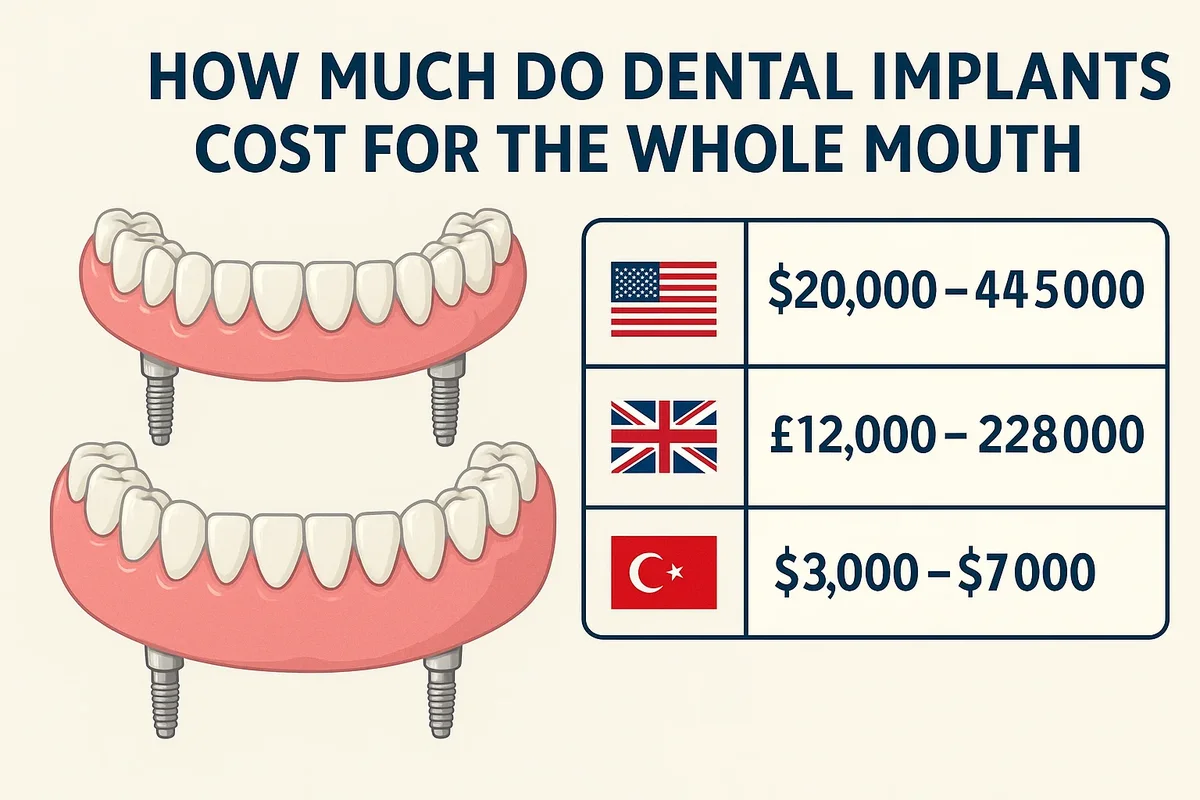
- All-on-4 per arch: $20,000 – $45,000
- Full mouth (upper + lower): $40,000 – $90,000+
This makes the U.S. one of the most expensive places to receive full-mouth implants. These numbers significantly influence how patients perceive how much do dental implants cost for the whole mouth, often pushing them to explore more affordable international options.
Full-Mouth Implant Costs in the United Kingdom
The U.K. has high-quality dental care, but treatment prices remain steep due to labor costs, clinic overhead, and strict regulatory requirements.
Average U.K. Prices
- All-on-4 per arch: £12,000 – £28,000
- Full mouth: £25,000 – £60,000+
While the quality is excellent, the high cost still leads many U.K. residents to travel abroad. Understanding how much do dental implants cost for the whole mouth becomes a matter of comparing domestic costs to international treatment packages.
Full-Mouth Implant Costs in Canada
Canada’s pricing is similar to the U.S., though slightly more moderate. Canadian clinics are known for high safety standards and well-trained dental surgeons.
Average Canadian Prices
- All-on-4 per arch: $18,000 – $35,000 CAD
- Full mouth: $35,000 – $80,000 CAD
These prices still place Canada among the more expensive countries, influencing patients who seek an affordable answer to how much do dental implants cost for the whole mouth.
Full-Mouth Implant Costs in Australia
Australia offers excellent dental care, but prices are high due to extensive regulations and high practitioner fees.
Average Australian Prices
- All-on-4 per arch: $15,000 – $35,000 AUD
- Full mouth: $30,000 – $70,000 AUD
Just like U.S. and U.K. patients, Australians frequently travel abroad for more affordable full-mouth implant treatment.
Full-Mouth Implant Costs in Western Europe
Countries like Germany, France, the Netherlands, and Belgium maintain high-quality medical infrastructure, but costs remain significant.
Average Western Europe Prices
- All-on-4 per arch: €10,000 – €25,000
- Full mouth: €18,000 – €50,000+
While slightly more affordable than the U.S. or U.K., Western Europe still presents high pricing for patients researching how much do dental implants cost for the whole mouth.
Full-Mouth Implant Costs in Turkey
Turkey has become the world’s leading destination for dental tourism thanks to its combination of high-quality treatment and dramatically lower prices. Turkish clinics use the same top global implant brands as the U.S. and Europe, but operational costs and currency advantages make treatment far more affordable.
Average Turkish Prices
- All-on-4 per arch: $2,500 – $7,000
- Full mouth: $6,000 – $15,000
Turkey offers world-class dental care at a fraction of the cost, making it a top choice for patients researching how much do dental implants cost for the whole mouth. The combination of expert surgeons, modern clinics, and competitive pricing attracts thousands of international patients each year.
If you would like a personalized country-based cost comparison or treatment plan tailored to your needs, you can contact a specialist directly through the
Redent Klinik Contact Page.
Why Global Prices Differ So Much
The global variation in how much do dental implants cost for the whole mouth is influenced by many factors:
- Local economy and cost of living
- Dental clinic operational expenses
- Labor and staffing costs
- Government regulations
- Import taxes on implant brands and materials
- Currency exchange rates
Countries with lower operational costs—like Turkey—can offer the same internationally recognized implant systems at much more accessible prices without compromising the quality of care.
Final Thoughts on International Price Comparison
A country-by-country examination shows that how much do dental implants cost for the whole mouth depends heavily on where you choose to receive treatment. While the U.S., U.K., and Canada are excellent in quality, Turkey and parts of Eastern Europe offer exceptional value with equally high medical standards. Patients seeking lasting results often choose destinations that offer both expertise and affordability.
Say “continue” when you’re ready for the next 600-word section.
The Step-by-Step Process of Getting Full-Mouth Implants
Understanding the full treatment journey is essential for anyone researching how much do dental implants cost for the whole mouth. Full-mouth dental implants are not a single appointment procedure—they are a structured, carefully coordinated medical process that involves diagnostics, surgical preparation, implant placement, healing, and final restoration. Each stage influences cost, treatment duration, and long-term success. In this section, we break down the entire process step-by-step to give you the clearest possible picture of what to expect from start to finish. 😊
Patients often ask how much do dental implants cost for the whole mouth before they understand what the full procedure actually involves. Because full-mouth implants require multiple phases and specialized tools, the price reflects the amount of labor, technology, expertise, and follow-up care required. This guide will help you feel confident and informed as you plan your treatment.
Step 1: Comprehensive Consultation and 3D CBCT Scan
The journey begins with an in-depth examination and a 3D cone beam CT scan. This advanced imaging is essential for assessing bone density, jaw structure, sinus positioning, and any hidden infections or abnormalities.
Key Goals of the Initial Scan
- Evaluate bone volume and quality
- Determine whether bone grafting or sinus lifts are needed
- Visualize nerves, sinus cavities, and vital anatomical structures
- Plan implant placement digitally with precision
This stage plays a major role in determining how much do dental implants cost for the whole mouth, especially if additional procedures (bone grafts, sinus lifts, gum treatment) must be included.
Step 2: Personalized Treatment Planning
After scanning, the dentist creates a fully customized treatment plan. This plan outlines the number of implants required per arch (All-on-4, All-on-6, or All-on-8), the type of prosthetic material to be used, and whether immediate temporary teeth will be placed.
What Happens During Treatment Planning?
- Review of implant brands and material options (titanium, zirconia)
- Discussion of temporary vs. permanent prosthesis
- Cost breakdown with all necessary procedures included
- Timeline for surgery, healing, and final restoration
This phase ensures that patients fully understand how factors such as implant type and materials influence how much do dental implants cost for the whole mouth.
Step 3: Tooth Extractions (If Necessary)
Many full-mouth implant patients still have damaged or failing teeth that need to be removed before implants can be placed. Tooth extractions may be simple or surgical depending on the condition of each tooth.
Why Extractions May Influence Cost
- Simple extractions are fast and affordable
- Surgical extractions require more advanced techniques
- Infected or fractured teeth require additional care
These steps affect how much do dental implants cost for the whole mouth because they require additional time, expertise, and healing considerations.
Step 4: Bone Grafting and Sinus Lifting (If Required)
If the jawbone lacks sufficient density or height, bone grafting or sinus lifting must be performed before implants can be safely placed. These procedures are incredibly common in full-mouth cases due to long-term tooth loss.
What These Procedures Achieve
- Strengthen weak or thin jawbone
- Prevent implant instability
- Increase long-term implant survival rates
These additional surgeries may extend the healing period and can significantly increase how much do dental implants cost for the whole mouth, depending on the complexity.
Step 5: Implant Placement Surgery
Implant placement is a highly precise surgical process. Titanium or zirconia implants are inserted into the jawbone at strategic angles to achieve maximum stability. For All-on-4 or All-on-6 systems, implants are positioned to support an entire arch of replacement teeth.
What Happens During Surgery?
- Local anesthesia or sedation is administered
- Implants are placed using guided or freehand techniques
- Detailed measurements are taken for temporary prosthetics
- The temporary bridge may be attached on the same day
Surgery is one of the most influential factors in determining how much do dental implants cost for the whole mouth, as it requires specialized equipment, surgical skill, and high-quality implant materials.
Step 6: Immediate Temporary Teeth (Same-Day Teeth Option)
Many clinics offer immediate-load temporary prosthetics, allowing patients to leave the same day with fixed teeth rather than removable dentures. This provides immediate aesthetics and improved confidence.
Temporary Teeth Benefits
- Instant smile transformation
- Improved chewing function compared to dentures
- Protects healing implants
Although temporary teeth are included in many packages, some clinics charge separately, which influences how much do dental implants cost for the whole mouth.
Step 7: Healing Phase & Osseointegration
Osseointegration is the biological process where implants fuse with the jawbone. This healing stage typically takes 3–6 months. During this time, patients wear their temporary bridge and maintain excellent oral hygiene.
What Occurs During Healing?
- Bone and implant bond together
- Regular follow-up appointments ensure proper progress
- Any adjustments needed for comfort are made
The healing stage doesn’t directly impact pricing but is essential to the success of the final restoration.
Step 8: Final Zirconia, Titanium, or Hybrid Prosthesis Delivery
Once implants are fully integrated, final impressions are taken for the permanent prosthesis. Patients may choose zirconia, titanium-reinforced hybrid bridges, composite, or acrylic options.
Final Prosthesis Benefits
- Natural aesthetics and long-lasting durability
- Customized color, shape, and bite design
- Extremely high chewing power
Because final prosthetics are the most significant component of treatment, they heavily influence how much do dental implants cost for the whole mouth. Premium zirconia options typically increase the price but provide unparalleled longevity and beauty.
Step 9: Post-Treatment Maintenance and Follow-Up
Patients return for check-ups, bite adjustments, and hygiene guidance. Full-mouth implants are easy to maintain but require consistent care for long-term success.
If you’d like a personalized step-by-step plan or pricing estimate, you can contact a specialist through the
Redent Klinik Contact Page.
Say “continue” when you’re ready for the next 600-word section.
Comparing Full-Mouth Implant Options: All-on-4, All-on-6, and All-on-8
When patients begin to research how much do dental implants cost for the whole mouth, one of the most important variables they encounter is the difference between All-on-4, All-on-6, and All-on-8 implant systems. These three treatment approaches are widely used for full-mouth restoration, and each one offers unique benefits, levels of stability, and cost structures. Understanding the differences between them is crucial for choosing the right solution based on your bone density, long-term expectations, and overall treatment budget. This section provides a comprehensive comparison to help you determine which system aligns with your goals. 😄
Patients often assume that the only difference between these systems is the number of implants, but that’s only the beginning. The number of implants directly affects stability, durability, the type of prosthetic used, healing time, and—of course—how much do dental implants cost for the whole mouth. While all three options can successfully restore full arches, certain patients will benefit more from one system than another. Below, we explore each option step by step.
What Is the All-on-4 Dental Implant System?
The All-on-4 technique uses four strategically placed implants per arch. Two implants are placed vertically at the front of the jaw, and two are placed at an angle toward the back to maximize bone contact. This approach is ideal for patients with moderate bone loss, making it a widely preferred option in full-mouth rehabilitation.
Main Advantages of All-on-4
- Requires fewer implants, reducing cost and treatment time
- Often eliminates the need for sinus lifts or bone grafting
- Same-day temporary teeth are commonly provided
- Shorter surgery duration
Potential Considerations
- May not be suitable for patients with severe bone loss
- Less implant support compared to All-on-6 or All-on-8
- Load distribution is limited to four implants
The All-on-4 is typically the most cost-effective choice, which heavily influences how much do dental implants cost for the whole mouth for patients looking for a high-quality but economical treatment solution.
What Is the All-on-6 Dental Implant System?
The All-on-6 technique uses six implants per arch, offering greater stability and load distribution compared to All-on-4. This approach is preferred for patients who want enhanced long-term strength and reduced stress on each individual implant.
Main Advantages of All-on-6
- Greater prosthetic support
- Higher stability, especially for strong chewing forces
- Better long-term success rates in patients with moderate bone density
- More balanced bite distribution
Potential Considerations
- Higher cost than All-on-4
- May require bone grafting if bone volume is low
- Longer surgery and healing times
These factors influence how much do dental implants cost for the whole mouth, as more implants require more surgical planning, materials, and chair time. However, many patients choose All-on-6 for added long-term stability.
What Is the All-on-8 Dental Implant System?
The All-on-8 system uses eight implants per arch, providing the maximum level of support. It is ideal for patients with strong bone density who want the highest stability and implant longevity possible. This option allows for a very solid connection between implants and bone, creating extremely durable foundations for zirconia or hybrid prosthetics.
Main Advantages of All-on-8
- Maximum support for full-mouth restorations
- Enhanced chewing power and bite strength
- Excellent long-term stability
- Lower risk of prosthetic movement or pressure points
Potential Considerations
- Highest cost among full-mouth implant systems
- Requires strong jawbone or extensive grafting
- Longer and more complex surgery
Because All-on-8 requires more implants, more complex surgical navigation, and higher-density prosthetics, it has a substantial effect on how much do dental implants cost for the whole mouth. However, it is often considered the “gold standard” option for patients with excellent bone quality who want the strongest restoration possible.
Which Option Is Best for You?
Choosing between All-on-4, All-on-6, and All-on-8 depends on several crucial factors:
- Your bone density: Lower density may need All-on-6 or bone grafting.
- Your budget: All-on-4 is generally the most affordable choice.
- Your long-term expectations: Heavy chewing forces may benefit from All-on-8.
- Your oral health history: Patients with long-term tooth loss may require additional procedures.
Remember that the number of implants directly influences how much do dental implants cost for the whole mouth. For example, more implants = more surgical time, more materials, and more stable prosthetics—but also higher total cost.
Global Pricing Comparison per System
Below is a general international cost overview (based on online research):
All-on-4 (per arch):
  USA: $20,000 – $45,000
  UK: £12,000 – £28,000
  Turkey: $2,500 – $7,000

All-on-6 (per arch):
  USA: $24,000 – $50,000
  UK: £14,000 – £32,000
  Turkey: $3,500 – $8,500

All-on-8 (per arch):
  USA: $30,000 – $55,000
  UK: £18,000 – £36,000
  Turkey: $4,500 – $10,000
If you’re planning to travel abroad or compare different clinics, you can request a personalized plan and cost breakdown through the
Redent Klinik Contact Page.
Say “continue” when you’re ready for the next 600-word section.
Insurance, Financing, and Payment Options for Full-Mouth Dental Implants
For many patients researching how much do dental implants cost for the whole mouth, one of the biggest concerns is how to afford treatment. Full-mouth dental implants are an investment not only in your smile, but in your long-term oral health, daily comfort, and quality of life. However, because the treatment involves surgical procedures, advanced materials, and multiple appointments, the cost can be significant—especially in countries like the United States, Canada, and the United Kingdom. This is where insurance, financing plans, and flexible payment options become extremely important. In this section, we will explore each option in detail so you can make informed financial decisions.
Patients often wonder whether insurance covers implants, whether payment plans are available, and how financing influences how much do dental implants cost for the whole mouth. The truth is that coverage varies widely depending on your country, insurance provider, and treatment plan. Let’s break down the most important financial pathways available for full-mouth implant patients.
Does Dental Insurance Cover Full-Mouth Dental Implants?
Dental insurance coverage is one of the most confusing aspects for patients. Many insurers still classify implants as a “cosmetic” procedure—even though implants restore essential chewing function, protect bone health, and improve overall quality of life. Unfortunately, this outdated classification affects coverage significantly.
Typical Insurance Coverage Scenarios
- Basic insurance plans: Often do not cover implants at all.
- Mid-tier plans: May cover part of the prosthesis but not the implant posts.
- Premium plans: May cover a small percentage of surgical costs.
- Supplemental implant insurance: Sometimes available for an additional fee.
Because of these variations, insurance rarely makes a major difference in how much do dental implants cost for the whole mouth, but it can reduce certain fees—such as extractions, scans, or temporary prosthetics.
Medical Insurance Possibilities
In some countries, medical insurance (not dental insurance) may cover part of the procedure if implants are medically necessary. This is more common in cases such as:
- Severe congenital conditions (e.g., missing teeth from birth)
- Trauma-related tooth loss
- Cancer treatment causing oral damage
- Major infection leading to total tooth loss
Medical insurance coverage can dramatically influence how much do dental implants cost for the whole mouth, but it requires strict documentation and pre-authorization.
Financing Options for Full-Mouth Dental Implants
Because insurance often provides limited assistance, most patients rely on financing or payment plans to manage full-mouth implant costs. Financing allows patients to break the total cost into smaller, more manageable monthly payments.
Common Financing Providers
- CareCredit: Popular in the United States for medical financing.
- United Medical Credit: Offers extended payment plans.
- In-house clinic financing: Many international clinics offer their own plans.
- Bank loans or medical credit cards: Can be used for full-mouth treatment costs.
Financing options can make a major difference in how patients perceive how much do dental implants cost for the whole mouth, because manageable monthly payments make the treatment accessible to more people.
Interest-Free and Low-Interest Payment Plans
Some clinics—especially dental tourism centers—offer interest-free payment plans. These plans allow patients to pay off their treatment over 3–12 months with no added fees.
Benefits of Interest-Free Plans
- Zero additional cost beyond the treatment price
- Flexible payment scheduling
- Ideal for patients needing budget-friendly options
If you are calculating how much do dental implants cost for the whole mouth and want to reduce financial pressure, interest-free plans can significantly help.
International Payment Options for Dental Tourism Patients
Countries like Turkey, Mexico, and Hungary offer world-class dental implant treatment at far lower prices than the U.S. or U.K. Because costs are much more affordable, many patients pay in full upon arrival. However, international clinics also support flexible payment solutions.
Common Payment Methods Abroad
- Bank transfers (SWIFT or SEPA)
- Credit card payments
- Partial deposit + remainder upon arrival
- Installment payments for temporary and final prosthetics
Turkey is especially popular among patients researching how much do dental implants cost for the whole mouth, because the cost is dramatically lower and financing options are simpler.
Cost Transparency: What Should Be Included?
Not all dental clinics include the same items in their pricing. To avoid hidden fees, patients should always request itemized treatment plans.
Items That SHOULD Be Included
- 3D CBCT scan
- Consultation
- Extractions (if needed)
- Temporary prosthetics
- Implants and surgery
- Final zirconia or hybrid prosthesis
- Follow-up care
Clear itemization helps patients understand the full picture of how much do dental implants cost for the whole mouth, preventing unexpected shocks later in the process.
Is Traveling Abroad a Financial Advantage?
In many cases, yes. For example, the cost of full-mouth implants in Turkey is often 60–80% lower than in the U.S. or U.K., even when including travel expenses. Because of this, dental tourists can afford higher-quality materials and more advanced implant systems for a fraction of the price.
If you’re comparing payment options or exploring international treatment packages, you can reach out for personalized guidance through the
Redent Klinik Contact Page.
Say “continue” when you’re ready for the next 600-word section.
Long-Term Value: Are Full-Mouth Dental Implants Worth the Cost?
When researching how much do dental implants cost for the whole mouth, many patients initially focus on the upfront price. However, the true way to evaluate this treatment is by understanding its long-term value. Full-mouth implants are not just about replacing missing teeth—they restore function, confidence, facial structure, and overall health. Unlike dentures that require constant adjustments, adhesives, and replacements, implants offer a stable and life-long solution. In this section, we examine why full-mouth implants are considered one of the most valuable dental investments available, and how their benefits outweigh their cost over time.
Patients often ask whether the high cost is justified, especially when comparing prices across countries. Once long-term comfort, durability, and quality of life improvements are factored in, the value becomes clear. By the end of this section, you will fully understand why full-mouth implants remain the gold standard in restorative dentistry—and how this influences how much do dental implants cost for the whole mouth.
Long-Term Health Benefits
Full-mouth dental implants provide advantages that traditional dentures cannot match. One of the most important medical benefits is the prevention of bone loss. When natural teeth are missing, the jawbone gradually deteriorates due to lack of stimulation. Implants mimic natural tooth roots, stimulating the bone and maintaining facial structure.
Key Long-Term Health Advantages
- Bone preservation: Prevents jawbone shrinkage and facial sagging.
- Improved digestion: Strong chewing ability improves overall health.
- Reduced gum irritation: No rubbing or friction like dentures.
- Better oral hygiene: Fixed prosthetics make cleaning easier.
Because implants maintain bone health and prevent future complications, these benefits play a major role in determining how much do dental implants cost for the whole mouth when evaluating long-term medical savings.
Durability and Longevity
Another major factor in full-mouth implant value is longevity. Dentures must be replaced every 3–5 years and require frequent adjustments. Full-mouth implants, by contrast, often last decades with proper care. Titanium implants can last a lifetime, while zirconia prosthetics provide extreme durability and natural aesthetics.
Implant Longevity Breakdown
- Titanium implants: 30+ years, often lifetime-lasting
- Zirconia bridges: 15–20+ years
- Hybrid prosthetics: 10–15 years depending on use
When comparing long-term durability to the cost of repeated denture replacements, the financial advantages become clear. This perspective helps patients better understand how much do dental implants cost for the whole mouth when evaluated over decades.
Daily Comfort and Functionality
Full-mouth implants feel and function like natural teeth. They restore nearly 100% of chewing power, allowing patients to eat all types of food comfortably—including crunchy, chewy, and tough foods that denture wearers often avoid. There is no slipping, clicking, or embarrassment associated with removable dentures.
Comfort Benefits
- Natural speaking and chewing ability
- No adhesives or removals required
- Permanent stability for confidence in social settings
- Improved taste sensation (no roof-covering denture plate)
These daily comfort improvements contribute significantly to the perceived value of full-mouth implants, and they influence how patients interpret how much do dental implants cost for the whole mouth beyond just the financial aspect.
Cosmetic and Emotional Benefits
Aesthetic improvement is one of the most immediate benefits of full-mouth implants. Patients often experience a dramatic boost in confidence, professional presence, and overall happiness. The psychological value of having a healthy, beautiful smile cannot be understated.
Cosmetic Advantages
- Fully customized tooth shape, color, and size
- Natural-looking zirconia or hybrid prosthetics
- Younger, lifted facial appearance due to bone support
- Permanent smile makeover without removable devices
While cosmetic benefits are difficult to assign a monetary value to, they dramatically affect how patients assess how much do dental implants cost for the whole mouth once they see their results.
Financial Value Compared to Dentures
Many patients are surprised to learn that dentures can become more expensive than implants over time. Between denture replacements, adhesive purchases, adjustments, repairs, relining, and oral health complications, dentures often cost more in the long run.
Estimated 10-Year Cost Comparison
Full Dentures (10 years):
$8,000 – $25,000
Multiple replacements + maintenance + adhesives

Full-Mouth Implants (10+ years):
$20,000 – $40,000 (USA)
$6,000 – $15,000 (Turkey)
Minimal maintenance + long-term durability
When viewed over a decade or longer, implants offer superior value—helping patients make sense of how much do dental implants cost for the whole mouth when thinking long-term.
Quality of Life Improvement
Many patients report life-changing improvements after receiving full-mouth implants, including:
- Better social confidence
- Improved speech
- Freedom to eat any food
- Elimination of pain or discomfort
- An overall sense of renewed self-esteem
This emotional and functional transformation often leads patients to conclude that implants are one of the best investments they have ever made.
If you’d like a personalized evaluation of long-term value or treatment planning, reach out through the
Redent Klinik Contact Page.
Say “continue” when you’re ready for the final section.