
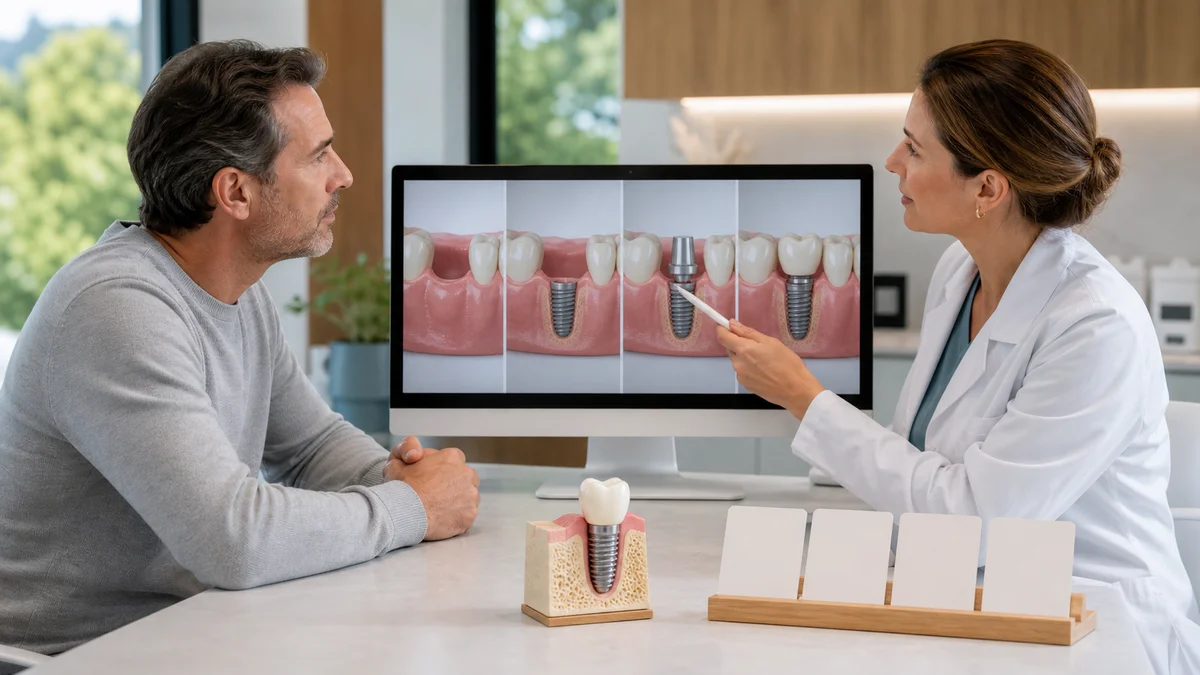
People often search how much do teeth implants usually cost when they want the price of a finished replacement tooth. Yet a clinic’s “implant” fee may describe only the implant body placed in bone. The abutment, crown, imaging, preparatory care, temporary tooth and reviews may be separate. A useful answer therefore begins with scope, not a universal number.
Quick answer: There is no dependable universal answer to how much do teeth implants usually cost. The total depends on the number of missing teeth, implant and restoration design, diagnostics, extractions or grafting when indicated, temporary teeth, laboratory work, location, coverage and follow-up. Compare itemised plans for the same finished result.
“Teeth implants” is common patient language; clinicians generally use “dental implants” or “implant-supported restorations.” This guide uses both terms while distinguishing the implant device from the visible tooth. It is prepared for evidence review by Dentist Esma Çevrük Çakır and prioritises patient safety. It cannot diagnose suitability, promise a result or replace an examination and appropriate imaging.
1. What Does “How Much Do Teeth Implants Usually Cost?” Really Ask?
The question how much do teeth implants usually cost may refer to one device, one completed implant crown, several teeth on an implant-supported bridge, a removable overdenture or a fixed full arch. Those endpoints do not use the same number of components and should not share one “usual” price.
The U.S. Food and Drug Administration describes a dental implant system as including an implant body and abutment, sometimes with an abutment fixation screw. The artificial tooth may be a crown, bridge or denture supported by the system. This distinction matters because a headline “per implant” amount may not include the restoration the patient expects to see and use.
The American Academy of Periodontology states in its patient FAQ that it cannot track an average implant cost because costs vary with factors such as the number of implants, type of treatment and location. Therefore, asking how much do teeth implants usually cost is most useful when followed by “for this exact finished restoration, with these inclusions.”
- Device: the implant body placed in the jaw.
- Connector: the stock or custom abutment that supports the restoration.
- Restoration: the visible crown, bridge, overdenture or fixed arch.
- Pathway: assessment, treatment, healing, laboratory work, reviews and maintenance.
A quote can be honest yet incomplete if it names only one layer. Ask the provider to label each line so you know whether the answer to how much do teeth implants usually cost covers a device or a completed clinical pathway.
2. Start With the Replacement Design, Not the Implant Count
The final teeth should guide implant planning. For one missing tooth, the intended result may be a single implant-supported crown. For adjacent missing teeth, a bridge may replace more teeth than the number of supporting implants. For a fully edentulous arch, the plan may use a removable implant-retained denture or a fixed restoration. More implants do not automatically mean a better plan, and fewer do not automatically mean better value.
When you ask how much do teeth implants usually cost, describe the result in ordinary words: one fixed tooth, a fixed bridge, a removable denture that attaches to implants, or a fixed full arch. The dentist can then explain the possible designs, eligibility, hygiene requirements, risks, alternatives and uncertainty.
One missing tooth
Check whether the tooth is already missing or still needs extraction. Ask whether the total includes the implant body, abutment, final crown and a temporary option during healing. Also ask how the implant site and neighbouring teeth influence the design. A web estimate cannot establish whether grafting, soft-tissue treatment or a particular timeline is appropriate.
Several missing teeth
A bridge can sometimes use implants as supports, but the number and distribution depend on anatomy and restorative planning. Compare the number of implants, number of replacement teeth, bridge material, provisional stage and cleaning access. Two totals cannot answer how much do teeth implants usually cost if one replaces three teeth and the other replaces four.
A complete arch
Fixed and removable full-arch options differ in components, laboratory stages, daily care, repair pathways and patient experience. The advertised fee may describe only the surgical stage or a provisional restoration. Ask whether the definitive arch is included and when it is expected to be made. No technique or timetable is suitable for every patient.
3. Read an Implant Quote in Four Cost Blocks
A practical answer to how much do teeth implants usually cost separates the quote into four blocks. This helps reveal missing items without assuming that every patient needs every procedure.
Block A: assessment and records
This block can include consultation, medical and dental history, examination, photographs, digital scans and appropriate radiographic imaging. Ask which records are clinically justified and whether a consultation fee is credited to treatment. More testing is not automatically better; each investigation should have a reason.
Block B: site preparation and implant placement
This may include extraction, management of disease, grafting when indicated, implant placement, surgical materials, local anaesthesia and postoperative reviews. Sedation, medicines or laboratory-produced guides may be listed separately. A conditional procedure should be labelled as conditional rather than quietly included in a worst-case total.
Block C: temporary and definitive teeth
Temporary teeth may be removable, tooth-supported or implant-supported depending on the situation. The definitive restoration involves impressions or digital scans, abutments, laboratory fabrication, try-ins, fitting and adjustments. When comparing how much do teeth implants usually cost, verify that both quotes include the same provisional and final deliverables.
Block D: follow-up and maintenance
Dental implants need cleaning and regular professional monitoring. Restorative components can also require maintenance or repair. Ask what routine reviews are included, how long the clinic’s defined aftercare period lasts, and what later services are billed separately. A service policy is not a guarantee that biological or mechanical complications cannot occur.
- Confirm when each payment is due.
- Ask how a changed clinical finding affects the fee.
- Separate included reviews from future hygiene visits.
- Request the implant brand and model for your records.
- Keep the written plan, consent information and invoices.
4. Decision Table: Compare the Same Finished Outcome
This table intentionally avoids price ranges. It shows how the answer to how much do teeth implants usually cost changes with the restoration being purchased. Only an individual assessment can determine which options deserve consideration.
| Possible result | Quote should identify | Question that prevents a false comparison | Long-term point |
|---|---|---|---|
| Single implant crown | Implant body, abutment, temporary option and final crown | Does “per implant” include the abutment and crown? | Cleaning, crown or screw service and regular reviews |
| Implant-supported bridge | Number of implants, replacement teeth, abutments and bridge | Do both plans replace the same teeth with the same support design? | Cleaning under the bridge and component monitoring |
| Implant-retained overdenture | Implants, attachment system, denture and adjustment stages | Are attachment inserts, conversions and relines included? | Daily removal, attachment wear and changing denture fit |
| Fixed full arch | Implant distribution, provisional teeth, definitive arch and laboratory stages | Is the headline fee provisional or definitive? | Professional hygiene access and repair arrangements |
If two plans fall in different rows, do not rank them by the total alone. If they fall in the same row, still check materials, temporary teeth, diagnostics and follow-up. The phrase how much do teeth implants usually cost becomes meaningful only after the service boundary matches.
5. Clinical Findings That May Change the Plan
General information cannot show bone volume, implant position, soft-tissue condition, active disease, bite forces or the health of neighbouring teeth. Medical history, medicines and smoking can also affect planning and healing. The FDA advises discussing overall health and medicines with the dental provider and notes that smoking may affect healing and long-term success.
Possible preparatory steps include treating active disease, extracting a tooth, augmenting bone, managing the sinus region, modifying soft tissues or adjusting an existing denture. They are not automatic. If one is recommended, ask why it is relevant, what alternatives exist, whether it changes timing and whether it is included in the total.
The question how much do teeth implants usually cost should never lead a provider to diagnose grafting from an advertisement response. A remote review can organise information, but definitive decisions generally depend on clinical examination and suitable imaging.
- Define the final tooth or prosthesis.
- Assess oral health, anatomy and medical considerations.
- Discuss implant and non-implant alternatives.
- Identify certain and conditional procedures separately.
- Agree on the provisional and definitive stages.
6. Temporary Teeth Can Change Both Timing and Cost
“Same-day teeth” may describe different things. It might mean a temporary restoration is delivered near implant placement, not that a definitive restoration has completed healing and long-term review. Some patients follow another sequence for clinical reasons. Marketing language should not replace a case-specific explanation.
Ask what you will wear during healing, whether it is removable or fixed, whether it is supported by the implant, and whether its fee is included. Then ask when the final restoration is planned and which clinical checkpoints must be met first. A clinic answering how much do teeth implants usually cost should name both stages.
Also confirm whether provisional adjustments, conversion of an existing denture, final impressions, try-ins and remakes caused by a change in the agreed design have separate fees. A low surgical headline can appear less attractive once an essential provisional pathway is added.
7. Insurance, Medicare and Financing Are Separate Calculations
The treatment fee and the patient’s out-of-pocket amount are not identical. Coverage may vary for consultations, imaging, extraction, implant placement, abutments, crowns, dentures and medically related dental services. Plans can impose exclusions, waiting periods, annual limits, networks and pre-authorisation requirements.
In the United States, Medicare says Original Medicare does not generally cover most dental care, including dental implants, though limited dental services can be covered when directly linked to certain covered medical treatment. HealthCare.gov states that adult dental coverage is not an essential Marketplace health benefit and that stand-alone dental plans may have waiting periods. Verify current terms with the payer.
When asking an insurer how much do teeth implants usually cost out of pocket, send the actual itemised proposal rather than a treatment nickname. Request a written estimate of benefits or predetermination where available. It may not guarantee payment, but it is more useful than a verbal assumption.
- Which line items are covered or excluded?
- Is there a waiting period or annual maximum?
- Does the policy require an in-network provider?
- Will authorisation remain valid for the later restorative stage?
- What is the total amount repayable under financing?
Financing changes the payment schedule, not the underlying clinical plan. Add interest and fees before comparing the answer to how much do teeth implants usually cost.
8. Twelve Better Versions of the Cost Question
Attach a scope detail whenever you ask how much do teeth implants usually cost. These versions are intentionally specific:
- How much do teeth implants usually cost when the total includes the implant body, abutment and final crown?
- How much do teeth implants usually cost when an extraction is needed first?
- How much do teeth implants usually cost when grafting is clinically indicated?
- How much do teeth implants usually cost for several teeth supported by a defined number of implants?
- How much do teeth implants usually cost for a removable implant overdenture?
- How much do teeth implants usually cost for a fixed full arch with provisional and definitive teeth?
- How much do teeth implants usually cost when imaging and treatment planning are included?
- How much do teeth implants usually cost when sedation is appropriate and quoted separately?
- How much do teeth implants usually cost after the insurer’s written estimate?
- How much do teeth implants usually cost after financing charges are counted?
- How much do teeth implants usually cost abroad after every necessary trip is included?
- How much do teeth implants usually cost over time with maintenance and possible component service?
These questions do not demand a generic range. They ask a clinic, insurer or lender to disclose the boundary of its answer. That makes omissions easier to identify before consent or payment.
9. Lower-Cost Routes, Alternatives and Red Flags
If implant treatment does not fit the current budget, ask about reasonable alternatives. Depending on the individual situation, these may include a conventional bridge, removable partial denture, complete denture, stabilising treatment or a staged plan. A less costly option is not automatically inappropriate; each option has different trade-offs.
The National Institute of Dental and Craniofacial Research points to dental schools and federally funded health centres as possible sources of lower-cost care in the United States, while noting that availability and services vary. It also warns that NIDCR does not provide free implant trials, grants or direct financial assistance. Verify grant or insurance claims independently.
Red flags include a guaranteed biological outcome, one technique said to suit everyone, pressure for immediate payment, refusal to name the implant system, or a headline that excludes the final teeth. When a provider answers how much do teeth implants usually cost without first defining the restoration, request clarification or seek another opinion.
- Check the clinician’s qualifications and role in each stage.
- Ask where the laboratory restoration is made.
- Request written inclusions, exclusions and assumptions.
- Keep component and implant system records.
- Do not treat an aftercare policy as an outcome guarantee.
10. Dental Travel: Add the Cost of Continuity
Comparing countries can be reasonable, but a clinic fee is not the whole journey. Flights, accommodation, transfers, time away from work, companion expenses and more than one visit may alter the total. The definitive restoration may require a later trip after healing.
Ask who handles urgent advice after you return, how records will be shared, which reviews can occur locally and what would require travel back to the treating clinic. Confirm language support, consent procedures and the pathway if the plan changes. A short itinerary should not override a clinically appropriate timeline.
Patients considering Redent Klinik in Türkiye can review the Redent Klinik English website and request an individual discussion through the English contact page. A remote estimate can support planning, but it remains subject to clinical examination and appropriate imaging.
For travel comparisons, the best version of how much do teeth implants usually cost is “what is the complete treatment-and-travel total for the same final restoration, including realistic follow-up?”
Frequently Asked Questions: How Much Do Teeth Implants Usually Cost?
Can an online calculator tell me how much do teeth implants usually cost?
An online calculator can organise possible line items, but it cannot determine your anatomy, oral health, medical considerations or restoration design. Treat its result as a checklist, not a diagnosis or binding quotation. Obtain an itemised plan after appropriate professional assessment.
Does a “per implant” fee include the artificial tooth?
Not always. It may cover only the implant body and placement. The abutment, crown, temporary tooth, imaging and follow-up may be separate. Ask for each component in writing. Without that detail, a “per implant” fee does not answer how much do teeth implants usually cost for a completed tooth.
Why are two implant quotes so different?
The plans may include different diagnostics, implant systems, temporary teeth, abutments, crown materials, laboratory work, sedation or follow-up. One may include extraction or grafting while another lists them conditionally. Compare endpoints and assumptions before comparing totals.
Are extraction and bone grafting always necessary?
No. Neither is automatic. Their relevance depends on the current tooth, tissues, anatomy and proposed restoration. If recommended, ask why, what alternatives exist, how the step changes timing and whether it is included in the written total.
Is the cheapest quote the safest choice?
Price alone does not establish safety or value. Consider assessment, informed consent, component traceability, restorative planning, hygiene access, maintenance and the complication pathway. A lower total may be reasonable, but it should still describe a complete and clinically justified service.
Will insurance cover teeth implants?
Coverage varies by policy, component and jurisdiction. Some plans contribute to certain stages; others exclude implants or apply limits and waiting periods. Send the actual itemised proposal to the insurer and request written clarification. An estimate of benefits is not necessarily a payment guarantee.
What records should I receive after treatment?
Ask for the written treatment plan, relevant clinical records under local rules, consent information and implant brand and model details. The FDA advises patients to keep the implant system information. Records support future maintenance, particularly if you move or receive care elsewhere.
Do teeth implants last for life?
No individual lifetime can be guaranteed. Biological and mechanical complications may occur, and restorations can require service. Health, smoking, hygiene, bite forces, design and maintenance can influence outcomes. Ask about risk reduction and repairability rather than a promise.
Bottom Line: Compare Complete Pathways
The most responsible answer to how much do teeth implants usually cost is a method: define the finished restoration, separate device and tooth components, identify certain and conditional procedures, verify temporary teeth, check coverage and financing, include travel, and plan for maintenance.
A transparent clinic should explain what the quote includes, what remains uncertain and what could change after assessment. Patients should have time to compare alternatives and ask questions. Cost clarity supports informed consent, but it cannot replace clinical judgement or guarantee an outcome.
Sources and Further Reading
- U.S. Food and Drug Administration: Dental Implants—What You Should Know
- American Academy of Periodontology: Patient FAQs
- American Academy of Periodontology: Dental Implant Procedures
- Medicare: Dental Service Coverage
- HealthCare.gov: Dental Coverage
- National Institute of Dental and Craniofacial Research: Finding Dental Care
- American Dental Association
- World Health Organization: Oral Health Fact Sheet