
One of the most common questions patients ask before replacing a missing tooth is: how much does a single implant cost? Dental implants have become the gold standard for tooth replacement because they offer excellent durability, natural aesthetics, and long-term oral health benefits. However, understanding the true cost of treatment requires looking beyond a single number. The answer to how much does a single implant cost depends on several factors, including the implant brand, the clinic’s location, the dentist’s expertise, additional procedures required, and whether the final crown is included in the quoted price.
In 2026, patients researching how much does a single implant cost will find a wide range of prices worldwide. While some clinics advertise low promotional prices, these often cover only the implant fixture itself and exclude essential components such as the abutment, crown, imaging, consultations, and follow-up visits. Therefore, understanding the complete treatment process is critical when comparing prices.
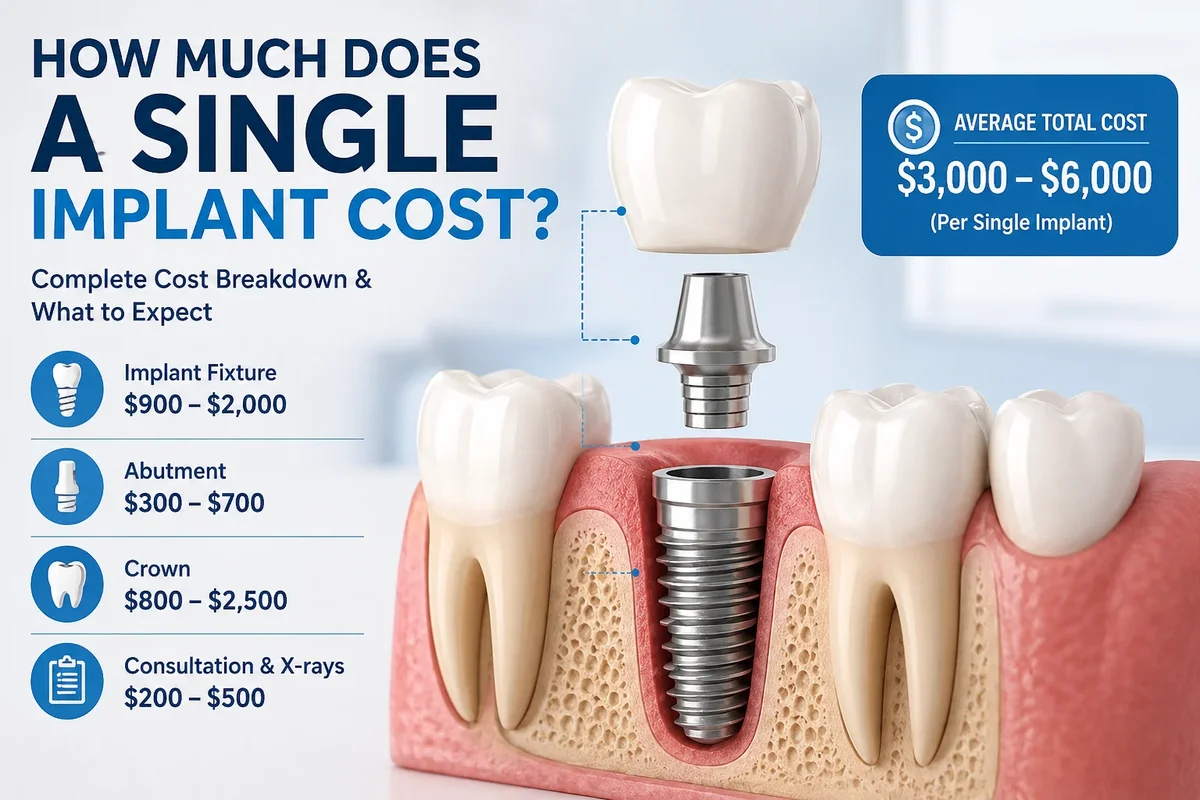
🦷 A dental implant consists of three primary components:
- Implant Fixture: The titanium or zirconia post placed inside the jawbone.
- Abutment: The connector that attaches the implant to the crown.
- Dental Crown: The visible replacement tooth that restores function and aesthetics.
When asking how much does a single implant cost, patients should clarify whether the quoted fee includes all three components. A seemingly affordable offer may become significantly more expensive once all necessary treatment stages are added.
Average international pricing for a complete single implant treatment generally falls within the following ranges:
| Country | Average Cost Per Implant |
|---|---|
| United States | $3,000 – $6,000 |
| United Kingdom | £2,000 – £4,500 |
| Canada | CAD 3,500 – CAD 6,500 |
| Australia | AUD 3,000 – AUD 7,000 |
| Turkey | $600 – $1,500 |
These figures represent general market estimates and may vary significantly depending on the clinic and treatment complexity. Patients researching how much does a single implant cost should remember that lower pricing does not always indicate lower quality, particularly in countries with lower operational expenses and favorable exchange rates.
Another important consideration is the longevity of treatment. Unlike removable dentures or traditional bridges that may require replacement after several years, dental implants can often last decades when properly maintained. This makes the answer to how much does a single implant cost more favorable when viewed as a long-term investment rather than a short-term expense.
Many patients compare implants with dental bridges because bridges may initially cost less. However, bridges often require the preparation of adjacent healthy teeth, while implants preserve surrounding tooth structure and help maintain jawbone volume. Therefore, evaluating how much does a single implant cost should include consideration of future oral health benefits and potential savings on additional treatments.
Modern implant technology has also improved treatment predictability. Advanced 3D imaging, guided implant surgery, and premium implant systems contribute to higher success rates. While these technologies may slightly increase treatment fees, they often improve long-term outcomes. As a result, patients asking how much does a single implant cost should focus not only on price but also on treatment quality and clinical expertise.
📊 Typical treatment expenses may include:
- Initial consultation and examination
- Digital panoramic X-rays
- 3D CBCT imaging
- Implant placement surgery
- Healing abutment
- Final abutment
- Custom-made crown
- Follow-up appointments
- Post-operative care
Patients frequently discover that the most accurate answer to how much does a single implant cost can only be provided after a comprehensive clinical evaluation. Factors such as bone density, gum health, medical history, and tooth location all influence treatment planning.
If you are considering dental implant treatment, choosing an experienced provider is essential. A detailed consultation can help determine whether additional procedures such as bone grafting or sinus lifting are necessary. For personalized treatment planning, patients can visit the Redent Klinik Contact Page to schedule an evaluation.
For evidence-based information about implant dentistry and oral health, patients can also refer to the American Dental Association.
✅ Ultimately, the answer to how much does a single implant cost depends on individual circumstances, treatment goals, and provider expertise. While prices vary significantly worldwide, a high-quality dental implant remains one of the most reliable and long-lasting solutions for replacing a missing tooth. Understanding what is included in the quoted fee allows patients to make informed decisions and achieve lasting oral health results.
Factors That Influence How Much Does a Single Implant Cost
When patients begin researching how much does a single implant cost, they often expect a straightforward answer. However, dental implant pricing is influenced by numerous clinical, geographic, and technical factors. This is why one clinic may quote $700 for treatment while another may charge $5,000 or more for what appears to be the same procedure. Understanding these variables helps patients make informed decisions and accurately compare treatment options.
The question how much does a single implant cost cannot be answered with a single universal figure because every patient presents a unique oral health situation. The final cost depends on the complexity of the case, the quality of materials used, the experience of the dentist, and any additional procedures that may be required before implant placement.
Implant Brand and Manufacturer
One of the most significant factors affecting how much does a single implant cost is the implant system selected by the clinic. Premium brands invest heavily in research, development, and long-term clinical studies, which contributes to higher pricing but often provides enhanced reliability and success rates.
Popular premium implant brands include:
- Straumann
- Nobel Biocare
- Zimmer Biomet
- BioHorizons
- Megagen
- Osstem
Premium implant systems generally cost more than economy alternatives because they offer extensive scientific support, advanced surface technologies, and excellent long-term documentation. Therefore, when evaluating how much does a single implant cost, patients should ask which implant brand will be used during treatment.
Premium vs Budget Implant Systems
A lower-cost implant may initially appear attractive, but long-term performance, component availability, and manufacturer support should also be considered. A premium implant often offers greater predictability and may reduce future complications.
Geographic Location of the Clinic
Location has a major impact on how much does a single implant cost. Clinics in large metropolitan cities typically face higher operating expenses, including rent, staff salaries, insurance, and laboratory fees. These costs are reflected in treatment pricing.
For example:
| Location | Average Complete Implant Cost |
|---|---|
| New York City | $4,000 – $6,500 |
| Los Angeles | $3,500 – $6,000 |
| London | £2,500 – £4,500 |
| Sydney | AUD 4,000 – AUD 7,000 |
| Istanbul | $600 – $1,500 |
This variation demonstrates why researching how much does a single implant cost requires considering where treatment is being performed.
Experience and Qualifications of the Dentist
The expertise of the implant surgeon significantly affects how much does a single implant cost. Specialists who have completed advanced implantology training and performed thousands of implant procedures often charge higher fees than general practitioners with limited implant experience.
Highly experienced clinicians typically offer:
- Advanced surgical skills
- Better treatment planning
- Lower complication rates
- Higher implant success rates
- Improved aesthetic outcomes
While treatment with a specialist may involve a higher initial investment, many patients find the additional cost worthwhile because of the increased predictability and long-term stability.
Diagnostic Technology and Digital Planning
Modern implant dentistry increasingly relies on advanced digital technologies. These tools improve precision but may also influence how much does a single implant cost.
Common technologies include:
- 3D CBCT imaging
- Digital intraoral scanning
- Computer-guided surgery
- Digital smile design
- CAD/CAM crown fabrication
These innovations help ensure accurate implant placement and improved treatment outcomes. Although they can increase treatment fees, they often reduce surgical risks and enhance patient comfort.
Why CBCT Scans Matter
A CBCT scan provides detailed three-dimensional images of the jawbone, nerves, and surrounding structures. This allows the dentist to evaluate bone quality and determine whether additional procedures are necessary before implant placement.
Bone Quality and Quantity
Another major factor affecting how much does a single implant cost is the condition of the patient’s jawbone. Dental implants require adequate bone support for long-term stability.
If significant bone loss has occurred, additional treatment may be needed before implant placement. These procedures may include:
- Bone grafting
- Sinus augmentation
- Socket preservation
- Guided bone regeneration
Additional surgical procedures naturally increase the total investment required. Patients with healthy bone structures generally experience lower overall treatment costs.
Type of Crown Used
The restoration placed on top of the implant can substantially affect how much does a single implant cost. Crowns are available in several materials, each with different aesthetic and functional characteristics.
Common crown materials include:
- Porcelain-fused-to-metal (PFM)
- Full zirconia
- Layered zirconia
- E-max ceramic
Premium ceramic restorations typically provide superior aesthetics and durability, particularly in visible smile areas. However, they may increase overall treatment expenses.
Laboratory and Customization Costs
Every implant crown is custom-made for the individual patient. The complexity of the restoration, laboratory expertise, and manufacturing process all contribute to how much does a single implant cost.
Custom restorations designed to perfectly match adjacent teeth often require advanced laboratory techniques and skilled dental technicians. This level of customization improves appearance but may increase costs.
Post-Treatment Care and Warranty
Many clinics include follow-up appointments, maintenance checks, and treatment warranties within their implant packages. These services can affect how much does a single implant cost, but they also provide valuable long-term protection.
Patients should ask whether their treatment includes:
- Follow-up examinations
- Professional cleanings
- Warranty coverage
- Emergency support
- Replacement policies
Clinics that offer comprehensive aftercare may charge slightly higher fees, but the additional support can be highly beneficial over the lifespan of the implant.
Making an Informed Cost Comparison
Ultimately, the answer to how much does a single implant cost depends on a combination of clinical requirements and treatment quality factors. Patients should avoid comparing prices alone and instead evaluate the entire treatment package, including implant brand, dentist experience, diagnostic technology, laboratory quality, and post-treatment support.
For a personalized treatment assessment, patients can visit the Redent Klinik Contact Page. Additional educational resources about implant dentistry can be found through the American Dental Association.
✅ Understanding the factors behind how much does a single implant cost enables patients to choose a treatment plan that balances affordability, safety, aesthetics, and long-term success. Rather than focusing solely on the lowest price, patients should seek value, quality, and proven clinical outcomes when investing in their smile.
Average Single Dental Implant Cost by Country
One of the most important questions patients ask when researching tooth replacement options is how much does a single implant cost in different parts of the world. Dental implant treatment has become increasingly popular due to its durability, natural appearance, and ability to preserve jawbone health. However, implant costs vary dramatically from country to country. Understanding these international price differences can help patients make informed decisions and determine whether dental tourism may be a suitable option.
The answer to how much does a single implant cost depends on multiple factors, including local labor costs, healthcare regulations, laboratory expenses, implant brand selection, taxation, and overall clinic operating costs. While treatment quality is available in many regions, the price patients pay can differ significantly.
Why Implant Prices Vary Between Countries
Before comparing specific countries, it is important to understand why how much does a single implant cost varies globally. Dental clinics in countries with higher living costs typically charge more because they face increased expenses for rent, salaries, insurance, equipment maintenance, and regulatory compliance.
Several key factors influence international pricing:
- Local economic conditions
- Cost of dental laboratory services
- Import taxes on implant components
- Dentist education and specialization requirements
- Healthcare regulations
- Technology investments
- Currency exchange rates
As a result, two clinics using the same implant brand may charge very different prices depending on their location.
Average Implant Cost in the United States
For many patients, the United States represents one of the highest-cost markets when evaluating how much does a single implant cost. A complete implant restoration that includes the implant fixture, abutment, and crown generally ranges between $3,000 and $6,000.
Typical U.S. Cost Breakdown
| Treatment Component | Average Cost |
|---|---|
| Consultation & Imaging | $150 – $600 |
| Implant Placement | $1,500 – $3,000 |
| Abutment | $300 – $700 |
| Crown | $1,000 – $2,500 |
Major cities such as New York, Los Angeles, and San Francisco often report implant costs at the higher end of this range.
Average Implant Cost in the United Kingdom
Patients researching how much does a single implant cost in the United Kingdom typically encounter prices ranging from £2,000 to £4,500 for complete treatment.
Private clinics dominate the implant market because implant treatment is generally not covered through routine NHS dental services except in limited circumstances. Costs vary according to location, with London clinics usually charging more than practices in smaller cities.
Average Implant Cost in Canada
In Canada, the answer to how much does a single implant cost generally falls between CAD 3,500 and CAD 6,500. Provincial differences may influence pricing, and urban areas such as Toronto and Vancouver typically have higher treatment costs.
Many Canadian patients choose financing plans because dental implants are often not fully covered by standard insurance policies.
Average Implant Cost in Australia
Australian patients asking how much does a single implant cost should expect fees ranging from AUD 3,000 to AUD 7,000. Costs depend on the clinic, implant brand, and whether additional procedures such as bone grafting are required.
Australia’s advanced dental infrastructure and high professional standards contribute to the overall treatment cost.
Average Implant Cost in Germany
Germany is known for high-quality dentistry and advanced implantology. Patients evaluating how much does a single implant cost in Germany generally encounter prices ranging from €2,000 to €5,000.
German clinics frequently utilize premium implant systems and advanced digital planning technologies, which contribute to pricing but also support excellent clinical outcomes.
Average Implant Cost in Turkey
Turkey has become one of the world’s most popular destinations for dental tourism. Patients researching how much does a single implant cost often discover that Turkish clinics offer significant savings compared to many Western countries.
Typical Implant Costs in Turkey
| Treatment Component | Average Cost |
|---|---|
| Complete Implant Package | $600 – $1,500 |
| Premium Implant Systems | $900 – $1,800 |
| Zirconia Crown Upgrade | $150 – $400 |
Turkey’s competitive pricing is largely driven by lower operational costs rather than reduced treatment quality. Many internationally accredited clinics utilize the same implant brands commonly found in Europe and North America.
Dental Tourism and Implant Costs
Many patients comparing how much does a single implant cost choose to travel abroad for treatment. Dental tourism destinations often include:
- Turkey
- Hungary
- Poland
- Mexico
- Thailand
- Croatia
Potential advantages include:
- Lower treatment costs
- Access to premium implant systems
- Shorter waiting times
- Comprehensive treatment packages
- Vacation opportunities during recovery
However, patients should carefully evaluate clinic credentials, implant brands, aftercare policies, and communication standards before traveling.
What Is Usually Included in International Implant Prices?
When comparing how much does a single implant cost, patients should verify exactly what is included in the quoted price.
A comprehensive implant package may include:
- Initial consultation
- Panoramic X-rays
- 3D CBCT scan
- Implant surgery
- Healing abutment
- Final abutment
- Custom crown
- Follow-up appointments
- Warranty coverage
Some clinics advertise only the implant fixture price, which can create confusion when comparing treatment estimates.
Comparing Value Rather Than Price Alone
Although many patients focus primarily on how much does a single implant cost, price should not be the sole consideration. Long-term success depends on factors such as:
- Implant quality
- Dentist experience
- Diagnostic technology
- Laboratory craftsmanship
- Post-treatment support
- Clinical safety standards
A slightly higher investment may provide superior durability, aesthetics, and long-term satisfaction.
Questions to Ask Before Choosing a Clinic
- Which implant brand will be used?
- Is the crown included?
- Are CBCT scans included?
- Is there a treatment warranty?
- What follow-up care is provided?
- Are additional procedures included in the quote?
For patients seeking a personalized assessment, the Redent Klinik Contact Page offers direct access to professional consultation services. Additional educational information regarding implant dentistry can be found through the American Dental Association.
✅ Ultimately, understanding how much does a single implant cost around the world helps patients compare options more effectively. While prices vary significantly between countries, the most important goal is finding a qualified provider who delivers safe, predictable, and long-lasting implant treatment that provides excellent value for years to come.
How Much Does a Single Implant Cost With Crown Included?
When patients begin researching how much does a single implant cost, one of the most important questions they should ask is whether the quoted price includes the final crown. Many dental clinics advertise attractive implant prices, but these figures sometimes refer only to the implant fixture placed into the jawbone. Without understanding what is included, patients may be surprised by additional expenses later in the treatment process.
The reality is that a complete dental implant restoration consists of several separate components. Therefore, the answer to how much does a single implant cost can vary significantly depending on whether the crown, abutment, imaging, and follow-up appointments are included in the treatment package.
To accurately compare clinics and treatment options, patients should always request a detailed breakdown of all fees associated with their implant procedure.
What Is Included in a Complete Single Implant?
Many people mistakenly assume that an implant is a single piece. In reality, a complete implant restoration consists of multiple components working together to replace a missing tooth.
The main elements include:
- Dental implant fixture
- Healing abutment
- Final abutment
- Custom dental crown
- Diagnostic imaging
- Surgical placement procedure
- Follow-up visits
When evaluating how much does a single implant cost, it is essential to determine whether every component listed above is included in the quoted price.
The Implant Fixture
The implant fixture is the titanium or zirconia post surgically inserted into the jawbone. It functions as an artificial tooth root and provides support for the final restoration.
Many advertisements promoting low implant prices refer only to this component. However, the fixture alone does not restore chewing ability or aesthetics because additional components are still required.
The Abutment
The abutment acts as a connector between the implant fixture and the final crown. Depending on the clinical situation, custom abutments may be required to achieve optimal aesthetics and functionality.
Abutment costs can range from $300 to $700 or more depending on the material and manufacturing process.
The Crown
The crown is the visible replacement tooth attached to the implant. This component is critical because it restores appearance, speech, and chewing function.
When researching how much does a single implant cost, patients often discover that the crown represents a significant portion of the total treatment fee.
Average Cost of a Single Implant With Crown Included
To better understand how much does a single implant cost, it helps to review average pricing for a complete implant restoration that includes all necessary components.
| Country | Complete Implant With Crown |
|---|---|
| United States | $3,000 – $6,000 |
| United Kingdom | £2,000 – £4,500 |
| Canada | CAD 3,500 – CAD 6,500 |
| Australia | AUD 3,000 – AUD 7,000 |
| Turkey | $600 – $1,500 |
These figures typically include the implant fixture, abutment, and final crown. However, every clinic structures its pricing differently, making it important to request written treatment plans.
Types of Crowns and Their Effect on Cost
The material selected for the crown can significantly influence how much does a single implant cost. Some crown materials provide enhanced aesthetics, while others prioritize durability and affordability.
Porcelain-Fused-to-Metal Crowns
Porcelain-fused-to-metal (PFM) crowns combine a metal framework with an outer porcelain layer. These crowns are generally less expensive and have been used successfully for many years.
Advantages include:
- Lower cost
- Proven durability
- Good functional performance
However, aesthetic limitations may occur if gum recession exposes the metal margin over time.
Zirconia Crowns
Zirconia has become one of the most popular implant crown materials due to its exceptional strength and natural appearance.
Benefits include:
- Excellent durability
- Natural tooth color
- Metal-free composition
- High fracture resistance
Premium zirconia restorations may increase how much does a single implant cost, but many patients consider the aesthetic improvement worthwhile.
E-Max Ceramic Crowns
E-max crowns offer superior translucency and are often selected for front teeth where aesthetics are especially important.
Because of their cosmetic advantages, E-max restorations may increase overall treatment costs compared to traditional crown materials.
Why Some Clinics Advertise Very Low Implant Prices
Patients researching how much does a single implant cost frequently encounter advertisements promoting extremely low prices. While some offers are legitimate, many represent only a portion of the total treatment cost.
Common exclusions may include:
- Crown fabrication
- Abutment placement
- CBCT imaging
- Consultation fees
- Temporary restorations
- Bone grafting procedures
This is why patients should always clarify exactly what is included before making comparisons.
Questions to Ask Before Accepting an Implant Quote
To fully understand how much does a single implant cost, patients should ask detailed questions during their consultation.
Important questions include:
- Is the crown included in the quoted fee?
- Which implant brand will be used?
- Are CBCT scans included?
- Does the price include all appointments?
- Are temporary restorations required?
- What warranty is provided?
- Could additional procedures become necessary?
These questions help eliminate misunderstandings and ensure accurate cost comparisons.
Long-Term Value of an Implant With Crown
Although many patients initially focus on how much does a single implant cost, the long-term value of treatment is equally important. Dental implants are designed to last many years and, in some cases, decades with proper maintenance.
Unlike removable dentures or traditional bridges, implants:
- Preserve jawbone volume
- Maintain facial structure
- Prevent neighboring tooth movement
- Provide strong chewing performance
- Offer natural aesthetics
Because of these benefits, many dentists consider implants one of the most cost-effective long-term tooth replacement solutions available.
Comparing Initial Cost Versus Lifetime Value
A bridge may initially cost less than an implant, but future replacement costs, maintenance requirements, and the need to alter adjacent healthy teeth can increase overall expenses over time.
For this reason, evaluating how much does a single implant cost should involve both immediate treatment expenses and long-term oral health outcomes.
Patients interested in personalized implant treatment planning can contact the Redent Klinik Contact Page for a professional consultation. Additional educational information regarding implant treatment can be found through the American Dental Association.
✅ Ultimately, the most accurate answer to how much does a single implant cost depends on whether the treatment includes the crown, abutment, imaging, and all necessary clinical services. Patients who carefully evaluate complete treatment packages rather than advertised starting prices are more likely to make informed decisions and achieve successful, long-lasting implant results.
Dental Implant Materials and Their Impact on Cost
When patients ask how much does a single implant cost, they often focus on the overall treatment price without realizing that the materials used play a major role in determining the final cost. Modern dental implants are manufactured using highly specialized biomaterials designed to integrate with the jawbone, withstand chewing forces, and provide long-term durability. The type of implant material, abutment material, and crown material selected can significantly influence both treatment cost and clinical outcomes.
Understanding how materials affect pricing helps patients make informed decisions and better evaluate the true value behind implant treatment. The answer to how much does a single implant cost depends not only on the procedure itself but also on the quality and characteristics of the materials chosen.
Why Implant Materials Matter
Dental implants are designed to function as artificial tooth roots and must remain stable inside the jawbone for many years. Because of this demanding role, implant materials must offer:
- Excellent biocompatibility
- High strength and durability
- Resistance to corrosion
- Long-term stability
- Compatibility with surrounding tissues
- Predictable bone integration
Higher-quality materials often increase how much does a single implant cost, but they may also improve longevity, aesthetics, and overall treatment success.
Titanium Implants: The Industry Standard
Titanium has been the most widely used dental implant material for decades. It remains the preferred option for many implant specialists because of its exceptional success rate and extensive scientific documentation.
Advantages of Titanium Implants
- Proven clinical history
- Excellent osseointegration
- High fracture resistance
- Suitable for most patients
- Widely available worldwide
- Long-term predictability
Because titanium implants are produced by numerous manufacturers, they are available across a wide range of price points. Therefore, the material itself may influence how much does a single implant cost, but brand selection often plays an even larger role.
Titanium implant systems from premium manufacturers typically cost more due to extensive research, quality control standards, and long-term clinical studies.
Potential Limitations of Titanium
Although titanium is highly successful, some patients prefer metal-free alternatives for personal or aesthetic reasons. In rare cases, patients may also seek alternatives due to sensitivity concerns.
These situations have contributed to the growing popularity of zirconia implant systems.
Zirconia Implants: A Premium Alternative
Zirconia implants are increasingly chosen by patients seeking a completely metal-free restoration. When evaluating how much does a single implant cost, zirconia systems generally fall into the premium price category.
Benefits of Zirconia Implants
- Metal-free composition
- Excellent aesthetics
- Natural tooth-like color
- Reduced visibility beneath thin gums
- Biocompatibility
- Resistance to plaque accumulation
Zirconia’s white color can be particularly advantageous for front teeth where aesthetics are critical.
However, zirconia implants often increase how much does a single implant cost because manufacturing processes are more complex and fewer implant companies produce these systems compared to titanium implants.
Implant Surface Technology and Cost
Another factor influencing how much does a single implant cost is the surface treatment applied to the implant. Modern implant manufacturers use advanced technologies to improve bone integration and healing speed.
Common Surface Treatments
- Sandblasted surfaces
- Acid-etched surfaces
- Hydrophilic coatings
- Laser-treated surfaces
- Nano-textured surfaces
Premium surface technologies often contribute to higher implant costs because they require sophisticated manufacturing methods and extensive clinical validation.
These enhancements may improve implant stability and support successful long-term outcomes.
Abutment Materials and Their Impact on Cost
Many patients researching how much does a single implant cost overlook the importance of the abutment. The abutment connects the implant fixture to the final crown and can be manufactured from several different materials.
Titanium Abutments
Titanium abutments are strong, reliable, and commonly used in both front and back teeth. They are generally less expensive than custom aesthetic alternatives.
Advantages include:
- Excellent strength
- Long clinical history
- Lower cost
- Broad compatibility
Zirconia Abutments
Zirconia abutments are frequently used in highly visible areas where aesthetics are important.
Benefits include:
- Natural appearance
- Excellent soft tissue aesthetics
- Metal-free restoration
Because zirconia abutments require advanced fabrication techniques, they often increase how much does a single implant cost.
Crown Materials and Overall Implant Cost
The final crown is one of the most visible and important parts of the restoration. The crown material selected significantly influences how much does a single implant cost.
Porcelain-Fused-to-Metal Crowns
These crowns combine a metal framework with an outer porcelain layer. They are often more affordable than premium ceramic alternatives.
Advantages include:
- Cost-effectiveness
- Durability
- Long clinical history
Monolithic Zirconia Crowns
Zirconia crowns have become increasingly popular because they provide exceptional strength and natural aesthetics.
Benefits include:
- High fracture resistance
- Natural appearance
- Excellent longevity
- Metal-free design
Premium zirconia crowns can increase overall treatment costs but often deliver excellent long-term value.
E-Max Ceramic Crowns
E-max restorations are frequently selected for front teeth because of their superior translucency and highly aesthetic appearance.
Due to their cosmetic advantages, E-max crowns may increase how much does a single implant cost compared to standard crown options.
How Premium Materials Affect Long-Term Value
Although premium materials generally increase how much does a single implant cost, they may provide important long-term benefits.
Potential advantages include:
- Improved durability
- Enhanced aesthetics
- Greater resistance to wear
- Better tissue response
- Longer restoration lifespan
Patients should evaluate treatment value rather than focusing solely on the initial investment.
Choosing the Right Material for Your Needs
The best material choice depends on several factors:
- Tooth location
- Bite force
- Aesthetic expectations
- Budget considerations
- Medical history
- Dentist recommendations
A personalized consultation helps determine which combination of implant, abutment, and crown materials will provide the most suitable outcome.
Balancing Cost and Quality
Ultimately, the answer to how much does a single implant cost is closely tied to the materials selected throughout treatment. While lower-cost options may reduce initial expenses, premium materials often provide superior aesthetics, durability, and long-term satisfaction.
Patients interested in personalized implant treatment recommendations can visit the Redent Klinik Contact Page for professional guidance. Additional educational resources regarding dental implant materials are available through the American Dental Association.
✅ Understanding how implant materials influence how much does a single implant cost enables patients to make informed decisions based on quality, aesthetics, durability, and long-term oral health goals. Choosing the right materials can significantly contribute to the success and longevity of a dental implant restoration.
Additional Procedures That Can Increase Implant Costs
When patients first ask how much does a single implant cost, they often assume the answer involves only the implant surgery itself. However, many individuals require additional treatments before a dental implant can be placed safely and successfully. These preparatory procedures can significantly affect the total treatment investment and are among the most important factors influencing final implant pricing.
The reality is that every patient’s oral health condition is unique. While some patients have sufficient bone volume and healthy gum tissue to proceed directly to implant placement, others may require corrective procedures to create a stable foundation for long-term implant success. Therefore, understanding these additional treatments is essential when evaluating how much does a single implant cost.
A comprehensive dental examination, including X-rays and 3D imaging, helps determine whether supplementary procedures are necessary before implant treatment begins.
Why Additional Procedures May Be Necessary
Dental implants depend on healthy bone and gum tissue for support. If a tooth has been missing for an extended period, natural bone loss may occur. Similarly, gum disease, infection, or traumatic injury can compromise the structures needed for implant placement.
As a result, the answer to how much does a single implant cost often depends on whether corrective treatment is needed before the implant procedure.
Common reasons for additional procedures include:
- Insufficient jawbone volume
- Bone deterioration after tooth loss
- Active periodontal disease
- Previous dental infections
- Sinus expansion in the upper jaw
- Traumatic injury
- Poor soft tissue support
Bone Grafting and Implant Costs
Bone grafting is one of the most common procedures that can increase how much does a single implant cost. This treatment is performed when the jawbone lacks sufficient density or volume to support an implant securely.
What Is Bone Grafting?
Bone grafting involves placing grafting material into areas where bone has been lost. Over time, the graft integrates with the existing bone and creates a stronger foundation for implant placement.
Bone graft materials may include:
- Autogenous bone (patient’s own bone)
- Allograft bone (donor bone)
- Xenograft bone (animal-derived material)
- Synthetic grafting materials
Average Bone Grafting Costs
| Procedure | Estimated Cost Range |
|---|---|
| Minor Bone Graft | $300 – $1,000 |
| Moderate Bone Graft | $1,000 – $2,500 |
| Extensive Bone Reconstruction | $2,500 – $5,000+ |
Because bone grafting may add substantial expenses, it directly affects how much does a single implant cost for many patients.
Sinus Lift Procedures
Patients missing upper back teeth may require a sinus lift before implant placement. This procedure becomes necessary when the maxillary sinus expands downward, reducing available bone height.
What Is a Sinus Lift?
A sinus lift involves carefully elevating the sinus membrane and placing bone graft material beneath it. This creates sufficient vertical bone volume for implant placement.
Without adequate bone support, implant stability may be compromised.
Average Sinus Lift Costs
| Procedure Type | Estimated Cost |
|---|---|
| Minor Sinus Lift | $1,000 – $2,000 |
| Major Sinus Lift | $2,000 – $5,000+ |
Patients who require sinus augmentation should expect this procedure to increase how much does a single implant cost compared to straightforward implant cases.
Tooth Extraction Before Implant Placement
In many situations, a damaged or infected tooth must be removed before implant treatment can begin. Tooth extraction may seem routine, but it can still influence how much does a single implant cost.
Simple Extractions
Simple extractions involve removing teeth that are easily accessible and not severely damaged.
Typical costs range from:
- $100 – $400 per tooth
Surgical Extractions
Complex extractions may require surgical techniques, particularly when teeth are fractured or impacted.
Estimated costs often range from:
- $300 – $1,500 per tooth
These procedures can increase the total investment associated with how much does a single implant cost.
Socket Preservation Procedures
After a tooth is extracted, bone loss can begin quickly. Socket preservation helps minimize this process and preserve future implant placement options.
Benefits of Socket Preservation
- Maintains bone volume
- Reduces future grafting needs
- Improves implant predictability
- Preserves gum tissue contours
While socket preservation adds an initial cost, it may reduce the likelihood of more extensive procedures later.
Periodontal Treatment Before Implants
Patients with active gum disease must typically complete periodontal treatment before receiving implants. Healthy gums are essential for long-term implant success.
Common periodontal treatments include:
- Scaling and root planing
- Deep cleaning procedures
- Antibacterial therapies
- Periodontal surgery
These treatments may add to how much does a single implant cost, but they are often necessary to reduce infection risks and improve treatment outcomes.
Soft Tissue Grafting
Some patients lack sufficient gum tissue around the implant site. Soft tissue grafting may be recommended to improve aesthetics and protect the implant from future complications.
Advantages of Gum Grafting
- Enhanced aesthetics
- Improved gum stability
- Reduced recession risk
- Better long-term maintenance
Depending on complexity, gum grafting may add several hundred to several thousand dollars to overall treatment expenses.
Temporary Restorations During Healing
During the healing period, some patients require temporary restorations to maintain appearance and function. These temporary solutions can influence how much does a single implant cost.
Examples include:
- Temporary crowns
- Essix retainers
- Flipper dentures
- Temporary bridges
While not always necessary, temporary restorations are often valuable for patients with missing front teeth.
Advanced Imaging and Diagnostic Costs
Modern implant treatment frequently relies on advanced diagnostics to improve accuracy and safety.
Common Diagnostic Tools
- Panoramic X-rays
- CBCT scans
- Digital impressions
- Intraoral scanners
Although these services increase how much does a single implant cost, they often improve treatment planning and reduce surgical risks.
Can Additional Procedures Be Avoided?
In some situations, prompt treatment after tooth loss can reduce the likelihood of needing extensive preparatory procedures. For example, immediate implant placement or socket preservation may help maintain bone volume and lower future treatment costs.
However, every patient is different, and clinical evaluation is necessary to determine the most appropriate treatment plan.
Questions to Ask During Your Consultation
- Will I need bone grafting?
- Is a sinus lift required?
- Can the implant be placed immediately?
- What diagnostic imaging is necessary?
- Are temporary restorations included?
- Will additional procedures affect healing time?
For personalized implant treatment planning, patients can visit the Redent Klinik Contact Page. Additional information regarding implant procedures and oral health can be found through the American Dental Association.
✅ Ultimately, understanding the additional treatments that may influence how much does a single implant cost allows patients to plan more accurately and avoid unexpected expenses. While supplementary procedures can increase costs, they often provide the healthy foundation necessary for long-lasting implant success and optimal oral health outcomes.
Insurance Coverage and Financing Options for Dental Implants
One of the biggest concerns patients have when researching how much does a single implant cost is how they will pay for treatment. Dental implants are widely recognized as one of the most effective and long-lasting solutions for replacing missing teeth, but they also represent a significant financial investment. Fortunately, modern patients have access to a variety of insurance benefits, financing programs, payment plans, and alternative funding options that can make treatment more affordable.
Understanding how insurance and financing work is an important part of determining how much does a single implant cost in practical terms. While the advertised treatment fee is important, the actual amount a patient pays out of pocket may be reduced through insurance reimbursements or spread over time using financing arrangements.
Why Dental Implants Are Often Considered a Major Investment
Dental implants involve advanced surgical procedures, premium biomaterials, and custom-made restorations. Unlike traditional fillings or cleanings, implant treatment requires multiple stages that may take several months to complete.
The total answer to how much does a single implant cost often includes:
- Consultation and examination
- Diagnostic imaging
- Implant surgery
- Healing components
- Custom abutment
- Final crown
- Follow-up appointments
Because these services are comprehensive, many patients explore insurance and financing solutions before beginning treatment.
Does Dental Insurance Cover Dental Implants?
A common question patients ask after learning how much does a single implant cost is whether dental insurance will cover the procedure. The answer depends on the specific insurance policy, provider, and country.
Historically, many dental insurance plans classified implants as cosmetic or elective procedures and provided little or no coverage. However, this trend has changed significantly in recent years.
Modern Insurance Coverage Trends
Today, many insurance companies recognize dental implants as a medically appropriate tooth replacement option. As a result, some plans provide partial coverage for implant-related treatment.
Coverage may apply to:
- Tooth extractions
- Bone grafting
- Implant placement
- Abutments
- Crowns
- Diagnostic imaging
Even when implants themselves are not covered, related procedures may still qualify for reimbursement.
Typical Insurance Coverage Percentages
Patients researching how much does a single implant cost should understand that insurance plans usually cover a percentage of treatment expenses rather than the full amount.
| Procedure Category | Common Coverage Range |
|---|---|
| Preventive Care | 80% – 100% |
| Basic Procedures | 50% – 80% |
| Major Restorative Care | 30% – 50% |
| Dental Implants | 0% – 50% |
Actual coverage depends entirely on the individual insurance policy and annual benefit limitations.
Annual Maximum Benefits
Many dental insurance plans impose annual maximum benefit limits. Common annual maximums range from:
- $1,000
- $1,500
- $2,000
- $3,000
Even if implants are covered, these limits may affect how much assistance the policy provides toward overall treatment costs.
Medical Insurance and Dental Implants
In certain circumstances, medical insurance may contribute to treatment expenses related to how much does a single implant cost.
This is more likely when tooth loss results from:
- Accidents
- Facial trauma
- Tumor removal
- Congenital conditions
- Medically necessary reconstruction
Patients should consult both their dental and medical insurance providers to determine eligibility.
Flexible Spending Accounts (FSA)
Many employers offer Flexible Spending Accounts that can help reduce the effective cost of implant treatment.
How FSA Plans Work
FSA contributions are typically made using pre-tax income, which can provide meaningful tax savings.
Eligible dental expenses often include:
- Dental implants
- Bone grafting
- Crowns
- Oral surgery
- Diagnostic imaging
Using FSA funds can reduce the financial burden associated with how much does a single implant cost.
Health Savings Accounts (HSA)
Health Savings Accounts are another valuable option for managing implant expenses.
Benefits include:
- Tax-deductible contributions
- Tax-free growth
- Tax-free qualified withdrawals
Many patients use HSA funds specifically to help cover major dental procedures.
Dental Financing Programs
Patients concerned about how much does a single implant cost often choose financing programs that allow treatment costs to be divided into manageable monthly payments.
Common Financing Features
- Monthly installment plans
- Low-interest options
- Interest-free promotional periods
- Extended repayment terms
- Immediate treatment approval
Financing allows patients to begin treatment sooner without needing to pay the entire amount upfront.
In-House Payment Plans
Many dental clinics now provide internal financing arrangements designed specifically for implant patients.
These plans may include:
- Monthly payment schedules
- Deposit-based treatment plans
- Flexible repayment periods
- Customized financing structures
For patients evaluating how much does a single implant cost, these programs can make treatment significantly more accessible.
Benefits of Clinic-Based Financing
- Simple application process
- Flexible payment terms
- Personalized arrangements
- Faster approval decisions
Dental Tourism and Cost Savings
Another strategy some patients use when researching how much does a single implant cost is dental tourism.
Countries frequently selected for dental tourism include:
- Turkey
- Hungary
- Poland
- Mexico
- Croatia
- Thailand
Even after accounting for travel expenses, many patients discover substantial savings compared to treatment in higher-cost regions.
Evaluating Financing Versus Delaying Treatment
Patients sometimes postpone treatment because they are concerned about how much does a single implant cost. However, delaying tooth replacement can lead to additional oral health problems.
Potential consequences of postponement include:
- Bone loss
- Tooth shifting
- Bite changes
- Gum recession
- More complex future treatment
In some cases, delaying treatment may ultimately increase total expenses due to the need for additional procedures such as bone grafting.
Questions to Ask About Financing
- Does insurance cover any portion of treatment?
- Are financing plans available?
- What interest rates apply?
- Are there prepayment penalties?
- Can treatment be phased over time?
- Is a deposit required?
Patients seeking personalized information regarding implant treatment costs and payment options can visit the Redent Klinik Contact Page. Additional educational information about oral health and restorative dentistry can be found through the American Dental Association.
✅ Ultimately, understanding insurance benefits and financing opportunities can significantly affect the practical answer to how much does a single implant cost. By exploring available coverage, tax-advantaged accounts, monthly payment plans, and alternative funding options, many patients find that implant treatment is more affordable and accessible than they initially expected.
Single Implant vs Dental Bridge: Cost Comparison
When replacing a missing tooth, patients often compare two of the most common treatment options: a dental implant and a traditional dental bridge. One of the first questions asked during this decision-making process is how much does a single implant cost compared to a bridge. While price is an important consideration, long-term durability, oral health benefits, maintenance requirements, and future replacement costs should also be carefully evaluated.
At first glance, a dental bridge may appear less expensive than an implant. However, the initial treatment fee tells only part of the story. Understanding the complete financial and clinical picture allows patients to make informed decisions about which option provides the best long-term value.
Understanding the Difference Between Implants and Bridges
Before comparing costs, it is important to understand how each treatment works.
What Is a Dental Implant?
A dental implant replaces both the missing tooth root and the visible crown. The implant fixture is surgically placed into the jawbone, where it integrates with the surrounding bone through a process known as osseointegration.
The completed restoration consists of:
- Implant fixture
- Abutment
- Custom crown
When patients ask how much does a single implant cost, they are usually referring to this complete restoration.
What Is a Dental Bridge?
A dental bridge fills the gap left by a missing tooth using an artificial tooth (pontic) supported by neighboring teeth.
A traditional bridge generally includes:
- One replacement tooth
- Two supporting crowns
- Preparation of adjacent teeth
Unlike implants, bridges do not replace the tooth root and do not stimulate the jawbone beneath the missing tooth.
Average Cost Comparison
The most direct way to evaluate how much does a single implant cost versus a bridge is to compare average treatment fees.
| Treatment Option | Average Cost Range |
|---|---|
| Single Dental Implant | $3,000 – $6,000 |
| Traditional Dental Bridge | $1,500 – $5,000 |
Although bridges often have lower upfront costs, this does not necessarily mean they are the more economical solution over time.
Long-Term Cost Considerations
Many patients focus solely on the initial answer to how much does a single implant cost. However, long-term maintenance and replacement expenses are equally important.
Expected Lifespan of a Dental Implant
With proper care, dental implants can often last several decades and, in many cases, may remain functional for a lifetime.
Advantages include:
- Exceptional durability
- Minimal maintenance requirements
- High long-term success rates
- Stable bone support
Because implants are designed as long-term solutions, their higher initial cost may provide significant value over time.
Expected Lifespan of a Dental Bridge
Traditional bridges typically last between 10 and 15 years, although individual results vary.
Factors affecting bridge longevity include:
- Oral hygiene habits
- Bite forces
- Support tooth health
- Material quality
When a bridge eventually requires replacement, additional treatment expenses arise. Therefore, evaluating how much does a single implant cost should include potential future replacement costs associated with alternative treatments.
Impact on Adjacent Teeth
One of the most important differences between implants and bridges involves neighboring teeth.
Dental Bridges Require Tooth Preparation
To support a traditional bridge, adjacent healthy teeth are typically reshaped and covered with crowns.
This process may:
- Remove healthy tooth structure
- Increase future dental risks
- Create additional maintenance needs
While bridges can successfully replace missing teeth, altering healthy teeth may contribute to future restorative needs.
Implants Preserve Natural Teeth
Dental implants are independent restorations. They do not rely on neighboring teeth for support.
Benefits include:
- Preservation of healthy enamel
- No alteration of adjacent teeth
- Independent function
- Improved oral health preservation
For many patients, this advantage justifies the higher answer to how much does a single implant cost.
Bone Preservation Benefits
Another important factor in the implant-versus-bridge comparison involves jawbone preservation.
Bone Loss After Tooth Loss
When a tooth root is missing, the jawbone no longer receives stimulation from chewing forces. Over time, the bone gradually shrinks.
This process may lead to:
- Reduced bone volume
- Changes in facial appearance
- Compromised oral function
- Future restorative challenges
Implants Help Preserve Bone
Because implants replace the natural root, they continue transmitting chewing forces into the jawbone.
This helps:
- Maintain bone density
- Preserve facial structure
- Support long-term oral health
Many dentists consider this one of the strongest reasons why the investment associated with how much does a single implant cost can be worthwhile.
Aesthetic Comparison
Both bridges and implants can provide attractive cosmetic results. However, implants often offer superior aesthetics in certain situations.
Advantages of Implant Aesthetics
- Natural emergence profile
- Independent crown design
- Preserved gum contours
- Reduced long-term recession risk
Advanced implant restorations can closely mimic natural tooth appearance, particularly when premium materials are used.
Maintenance Requirements
Patients comparing how much does a single implant cost should also consider maintenance requirements.
Bridge Maintenance
Dental bridges require special cleaning techniques because food debris can accumulate beneath the pontic.
Patients often need:
- Floss threaders
- Interdental brushes
- Special cleaning tools
Implant Maintenance
Dental implants are generally cleaned similarly to natural teeth.
Recommended care includes:
- Daily brushing
- Daily flossing
- Regular dental checkups
- Professional cleanings
Many patients find implant maintenance simpler and more convenient.
Which Option Provides Better Value?
The answer depends on individual goals, budget, oral health status, and long-term expectations.
A bridge may be appropriate when:
- Budget is the primary concern
- Implant placement is not possible
- Quick treatment is preferred
An implant may be preferable when:
- Long-term durability is important
- Bone preservation is desired
- Adjacent teeth should remain untouched
- Maximum aesthetics are desired
Questions to Discuss With Your Dentist
- Am I a candidate for an implant?
- How healthy are the adjacent teeth?
- Will bone loss affect future treatment?
- What are the long-term costs of each option?
- Which treatment offers the best value for my situation?
Patients seeking personalized treatment recommendations can visit the Redent Klinik Contact Page for professional consultation. Additional educational resources regarding tooth replacement options are available through the American Dental Association.
✅ While many patients initially focus on how much does a single implant cost, a comprehensive comparison reveals that implants often provide superior long-term value through enhanced durability, bone preservation, natural aesthetics, and reduced future treatment needs. Carefully weighing both immediate and lifetime costs helps patients choose the most appropriate solution for replacing a missing tooth.
How to Choose the Right Clinic for a Single Dental Implant
After researching how much does a single implant cost, many patients discover that pricing can vary significantly between clinics. While cost is undoubtedly an important factor, choosing a dental implant provider should involve much more than simply selecting the lowest price. The success, longevity, aesthetics, and overall value of implant treatment depend heavily on the experience of the dental team, the quality of materials used, the technology available, and the standards followed throughout the treatment process.
Dental implants are a long-term investment in oral health. Therefore, selecting the right clinic is one of the most important decisions a patient can make. Understanding how to evaluate implant providers helps ensure that the answer to how much does a single implant cost is considered alongside quality, safety, and predictable results.
Why Choosing the Right Clinic Matters
Dental implant treatment is a highly specialized procedure that combines surgical expertise, restorative dentistry, advanced diagnostics, and laboratory craftsmanship. Even when two clinics offer similar pricing, treatment outcomes can differ significantly based on clinical experience and treatment protocols.
A successful implant should provide:
- Long-term stability
- Natural aesthetics
- Comfortable function
- Healthy surrounding tissues
- Reliable chewing ability
For this reason, patients should avoid evaluating clinics based solely on how much does a single implant cost and instead assess overall treatment quality.
Verify the Dentist’s Experience
One of the first factors to consider when choosing an implant clinic is the experience of the dentist or oral surgeon performing the procedure.
Questions About Clinical Experience
- How many implants has the dentist placed?
- How many years of implant experience do they have?
- Do they perform implant surgery regularly?
- Have they completed advanced implant training?
- Can they provide before-and-after cases?
Experienced implant clinicians often achieve higher success rates and are better equipped to manage complex cases. While this expertise may affect how much does a single implant cost, it can also contribute significantly to treatment predictability.
Evaluate Diagnostic Technology
Modern implant dentistry relies heavily on advanced technology for accurate diagnosis and treatment planning.
Essential Technologies to Look For
- CBCT 3D imaging
- Digital intraoral scanning
- Computer-guided surgery systems
- Digital treatment planning software
- CAD/CAM restoration technology
These tools allow clinicians to assess bone volume, identify anatomical structures, and plan implant placement with exceptional precision.
Although advanced technology may influence how much does a single implant cost, it often improves safety and treatment outcomes.
Ask About Implant Brands
The implant system used by the clinic plays a major role in long-term success.
Common Premium Implant Brands
- Straumann
- Nobel Biocare
- Zimmer Biomet
- BioHorizons
- Megagen
- Osstem
Premium manufacturers invest heavily in research, development, and long-term clinical studies.
When discussing how much does a single implant cost, patients should ask which implant brand will be used and whether replacement parts will remain available in the future.
Review Before-and-After Cases
A reputable implant clinic should be able to demonstrate previous treatment results.
What to Look For in Implant Cases
- Natural-looking crowns
- Healthy gum contours
- Consistent aesthetic results
- Cases similar to your situation
- Long-term follow-up photographs
Examining clinical examples provides valuable insight into the dentist’s skill level and restorative quality.
Understand What Is Included in the Quote
Many patients searching for how much does a single implant cost discover that treatment estimates vary because clinics include different services.
Items Commonly Included in Comprehensive Packages
- Consultation
- CBCT scan
- Implant surgery
- Healing components
- Abutment
- Final crown
- Follow-up visits
- Warranty coverage
Requesting a detailed written treatment plan helps prevent misunderstandings and allows accurate comparisons between clinics.
Check Sterilization and Safety Standards
Patient safety should always be a priority when selecting an implant provider.
Signs of a High-Quality Clinic
- Strict sterilization protocols
- Modern surgical facilities
- Qualified support staff
- Transparent infection-control policies
- Regulatory compliance
Although these standards may influence how much does a single implant cost, they contribute directly to treatment safety and patient confidence.
Read Patient Reviews and Testimonials
Online reviews can provide valuable information about patient experiences.
Areas to Evaluate in Reviews
- Communication quality
- Treatment outcomes
- Comfort during procedures
- Professionalism of staff
- Follow-up care quality
- Transparency regarding pricing
While reviews should not be the sole decision-making factor, they can help identify patterns in patient satisfaction.
Consider the Quality of the Dental Laboratory
The final appearance and function of an implant depend heavily on laboratory craftsmanship.
Questions About Laboratory Services
- Is the crown custom-designed?
- What materials are available?
- Does the clinic use digital workflows?
- Are restorations fabricated locally or outsourced?
Premium laboratory work may increase how much does a single implant cost, but it often results in superior aesthetics and durability.
Ask About Warranty and Aftercare
Comprehensive aftercare demonstrates a clinic’s confidence in its treatment quality.
Important Warranty Questions
- How long is the warranty period?
- What components are covered?
- Are repairs included?
- What maintenance is required?
- What happens if complications occur?
Strong aftercare programs can provide significant long-term value beyond the initial answer to how much does a single implant cost.
Dental Tourism Considerations
Many patients explore international treatment options when comparing how much does a single implant cost. Dental tourism can provide substantial savings, but careful research is essential.
Key Questions for International Clinics
- Are dentists internationally trained?
- Which implant brands are used?
- How are follow-up visits managed?
- What warranty is provided?
- Are treatment plans available in writing?
Cost savings should always be balanced against quality, communication, and long-term support.
Red Flags to Avoid
Patients should be cautious if a clinic:
- Provides unusually low prices without explanation
- Refuses to disclose implant brands
- Lacks diagnostic imaging capabilities
- Cannot provide treatment examples
- Offers unclear pricing structures
- Provides no warranty information
Choosing solely based on the lowest answer to how much does a single implant cost may increase the risk of unsatisfactory outcomes.
Finding the Best Value
The ideal clinic combines:
- Experienced clinicians
- Premium materials
- Modern technology
- Transparent pricing
- Excellent patient support
- Strong long-term outcomes
Patients interested in personalized implant consultations can visit the Redent Klinik Contact Page. Additional educational information regarding dental implant treatment can be found through the American Dental Association.
✅ Ultimately, while understanding how much does a single implant cost is important, choosing the right clinic requires evaluating experience, technology, implant quality, laboratory standards, and aftercare services. A well-chosen provider can significantly improve the likelihood of achieving a successful, attractive, and long-lasting implant restoration.
Frequently Asked Questions About How Much Does a Single Implant Cost
Patients researching dental implants often have many questions beyond simply asking how much does a single implant cost. While understanding pricing is important, it is equally valuable to understand what influences implant costs, what is included in treatment, how long implants last, and whether implants truly provide good value over time. This frequently asked questions section addresses the most common concerns patients have before beginning implant treatment.
If you are considering dental implants, the answers below will help you make a more informed decision and better understand the factors that influence how much does a single implant cost.
How Much Does a Single Implant Cost on Average?
The most common question is naturally how much does a single implant cost. The answer varies significantly depending on the country, clinic, implant brand, and treatment complexity.
Average costs for a complete implant restoration generally range between:
| Region | Typical Cost Range |
|---|---|
| United States | $3,000 – $6,000 |
| United Kingdom | £2,000 – £4,500 |
| Canada | CAD 3,500 – CAD 6,500 |
| Australia | AUD 3,000 – AUD 7,000 |
| Turkey | $600 – $1,500 |
These figures typically include the implant fixture, abutment, and final crown, although every clinic structures pricing differently.
Why Do Implant Prices Vary So Much?
Many patients wonder why the answer to how much does a single implant cost differs so dramatically between providers.
Several factors contribute to these differences:
- Implant brand selection
- Dentist experience
- Geographic location
- Laboratory quality
- Diagnostic technology
- Additional procedures required
- Warranty coverage
A lower price does not necessarily indicate lower quality, but patients should always verify exactly what is included in the treatment plan.
Is the Crown Usually Included in the Price?
Not always. One of the most important questions patients should ask when discussing how much does a single implant cost is whether the final crown is included.
Components That May Be Charged Separately
- Implant fixture
- Healing abutment
- Final abutment
- Crown fabrication
- CBCT scans
- Consultation fees
Some advertisements highlight only the implant fixture cost, which can create confusion when comparing providers.
Are Dental Implants Worth the Cost?
For many patients, the answer is yes. While researching how much does a single implant cost, it is important to consider long-term value rather than focusing solely on the initial expense.
Dental implants offer:
- Exceptional durability
- Natural appearance
- Improved chewing function
- Jawbone preservation
- Protection of adjacent teeth
- Long-term reliability
Because implants can often last decades with proper care, many patients view them as a worthwhile investment.
How Long Does a Dental Implant Last?
Another common question related to how much does a single implant cost is how long the restoration will remain functional.
With proper oral hygiene and routine dental care:
- The implant itself may last decades or longer.
- The crown may eventually require replacement after many years of use.
- Success rates often exceed 95% in healthy patients.
Long-term durability is one of the primary reasons implants remain a preferred tooth replacement solution.
Can Dental Insurance Help Cover Implant Costs?
Insurance coverage varies widely depending on the policy.
When asking how much does a single implant cost, patients should review:
- Annual maximum benefits
- Coverage percentages
- Waiting periods
- Exclusions
- Preauthorization requirements
Some plans partially cover implants, while others may only reimburse related procedures such as extractions or crowns.
Alternative Payment Options
If insurance coverage is limited, patients may consider:
- Financing plans
- Flexible Spending Accounts (FSA)
- Health Savings Accounts (HSA)
- Clinic payment plans
- Dental tourism options
Does Tooth Location Affect Implant Cost?
Yes. The position of the missing tooth can influence how much does a single implant cost.
Factors may include:
- Aesthetic requirements
- Bone quality
- Bite forces
- Need for custom restorations
- Soft tissue management
Front teeth often require highly aesthetic restorations, while molars must withstand greater chewing forces.
Will I Need Bone Grafting?
Not every patient requires bone grafting, but it is one of the most common reasons treatment costs increase.
Bone grafting may be necessary when:
- A tooth has been missing for many years
- Bone loss has occurred
- Periodontal disease has damaged supporting structures
- Trauma has affected the jawbone
Because grafting adds additional treatment stages, it can significantly affect how much does a single implant cost.
How Long Does Implant Treatment Take?
Patients frequently ask whether treatment can be completed quickly after learning how much does a single implant cost.
Typical treatment timelines vary:
- Simple cases: 3–6 months
- Cases requiring grafting: 6–12 months
- Immediate implant cases: shorter timelines may be possible
The exact schedule depends on healing requirements and individual circumstances.
Are Dental Implants Better Than Bridges?
In many situations, implants provide advantages over traditional bridges.
Benefits of Implants Compared to Bridges
- No alteration of adjacent teeth
- Bone preservation
- Independent support
- Excellent longevity
- Natural aesthetics
Although bridges may have lower initial costs, implants often provide greater long-term value.
Can I Travel Abroad for Implant Treatment?
Many patients researching how much does a single implant cost explore dental tourism as a way to reduce expenses.
Popular destinations include:
- Turkey
- Hungary
- Poland
- Mexico
- Thailand
Patients should carefully evaluate clinic credentials, implant brands, warranties, and follow-up arrangements before making travel decisions.
How Can I Get an Accurate Cost Estimate?
The only reliable way to determine how much does a single implant cost for your specific case is through a professional consultation.
During an evaluation, the dentist will assess:
- Bone quality
- Gum health
- Tooth position
- Medical history
- Need for additional procedures
- Restoration options
These factors allow the creation of a customized treatment plan and accurate cost estimate.
Questions to Bring to Your Consultation
- Which implant brand do you recommend?
- Is the crown included?
- Will I need grafting?
- How long will treatment take?
- What warranty is available?
- What financing options exist?
Final Thoughts
The question how much does a single implant cost is important, but it should never be evaluated in isolation. Treatment quality, implant materials, clinical expertise, diagnostic technology, and long-term outcomes all contribute to the true value of implant therapy.
Patients interested in receiving a personalized treatment plan can visit the Redent Klinik Contact Page for professional guidance. Additional trusted information about oral health and restorative dentistry is available through the American Dental Association.
✅ Ultimately, understanding the complete picture behind how much does a single implant cost empowers patients to make informed decisions, compare treatment options effectively, and invest confidently in a long-lasting solution for replacing a missing tooth.