
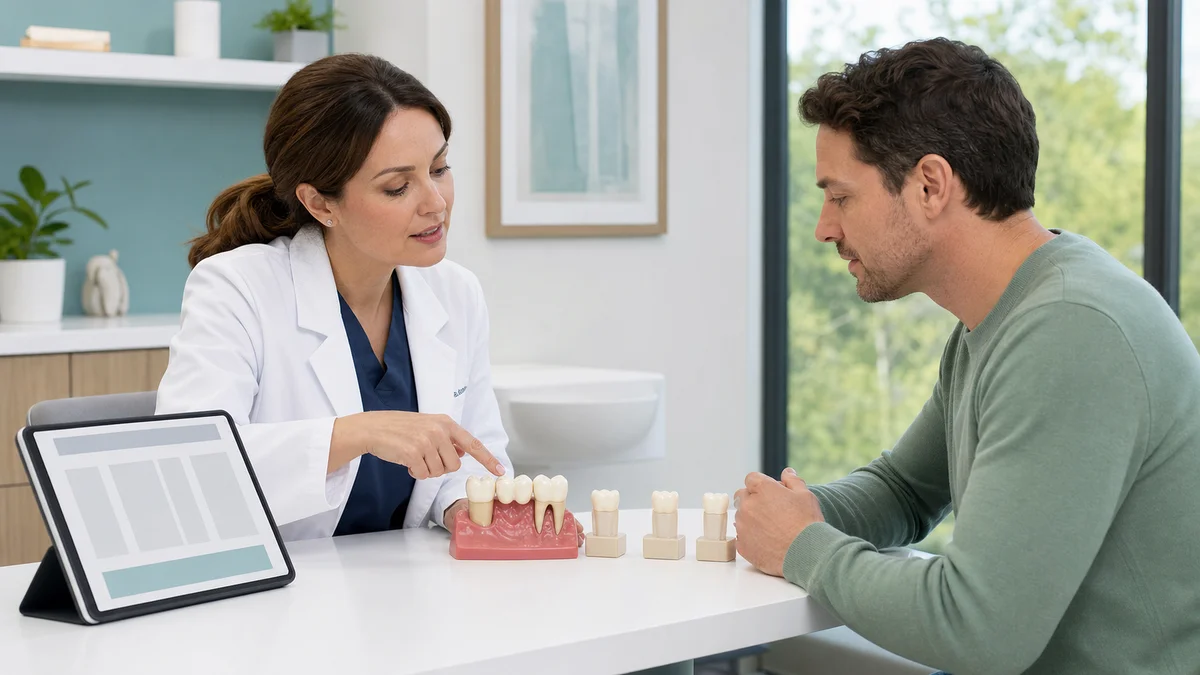
Quick answer: how much does it cost for bridges in your teeth depends on the number of bridge units rather than only the number of gaps. Supporting-tooth treatment, design, material, laboratory stages, temporary restorations and aftercare can alter the total. Compare written, itemised plans after an examination, not isolated headline prices.
People searching how much does it cost for bridges in your teeth may be describing one short bridge, several separate bridges or a longer restoration replacing multiple teeth. Those are not equivalent jobs. A dentist must first map every missing tooth, every planned replacement tooth and every proposed support. Only then can a quote identify how many connected units will be made and what clinical work is needed around them.
The most useful way to approach how much does it cost for bridges in your teeth is to decode the written proposal. A bridge unit might be an artificial replacement tooth, a crown on a natural support or part of an implant-supported restoration. One missing tooth can therefore produce a three-unit conventional bridge, while two missing teeth do not automatically produce a two-unit bill. Design and support determine the actual span.
This guide does not diagnose a mouth, set a universal fee or promise how long a bridge will last. It explains the quote variables behind how much does it cost for bridges in your teeth, including staged fees, public and private contexts, maintenance and choices for more than one gap. It is prepared for evidence-based, patient-safe review by Dentist Esma Çevrük Çakır.
how much does it cost for bridges in your teeth: start with units
The NHS describes a bridge as a fixed replacement for a missing tooth or teeth, supported by the surrounding teeth. That simple definition changes how how much does it cost for bridges in your teeth should be answered. The visible replacement is only one part of a connected restoration. Retainers on supporting teeth and connectors between the parts contribute to its design, fabrication and clinical fitting.
Consider a single gap between two teeth. A conventional bridge may contain two crowns and one artificial tooth: three units in total. An adhesive bridge may contain an artificial tooth plus one or more wings rather than full crowns. A cantilever design may receive support from one side. When a clinic answers how much does it cost for bridges in your teeth, the proposal should name the design and count the components instead of saying only “one bridge.”
For several missing teeth, the possibilities multiply. Two neighbouring gaps might be restored in one connected span if the clinical conditions permit, or they may require another approach. Two gaps in different parts of the mouth would normally be separate restorations. The answer to how much does it cost for bridges in your teeth must therefore specify the site of each restoration, the planned supports and the unit count for every span.
- Pontic: the artificial tooth that occupies a gap.
- Retainer: a crown, wing or component that connects the restoration to a support.
- Abutment: the natural tooth or implant providing support.
- Connector: the junction linking the units.
- Span: the connected section crossing one or more missing-tooth spaces.
These terms help a patient test whether a quote is complete. They do not determine suitability by themselves. A longer span is not automatically better value because it replaces more teeth, and a greater number of supports is not automatically safer. The dentist must assess biological condition, bite, cleansability and expected loading before translating the plan into a fee.
In short, how much does it cost for bridges in your teeth begins with a site-by-site drawing and a unit count, not a multiplication based only on missing teeth.
That is the first safeguard when answering how much does it cost for bridges in your teeth.
Why one advertised bridge price is rarely comparable
Private dental fees can vary between practices, regions, laboratories and clinical situations. UK Competition and Markets Authority guidance published in March 2026 advises patients to obtain a written treatment plan showing proposed treatment and costs; if the treatment or estimate changes, the plan should be updated in writing. That principle is central to how much does it cost for bridges in your teeth because an online figure may cover only the final restoration, while another quote may cover the whole pathway.
A complete pathway may include examination, appropriate imaging, gum assessment, management of decay, foundation restorations, tooth preparation, records, temporary protection, laboratory manufacture, a try-in, bonding or cementation, bite adjustment and review. When considering how much does it cost for bridges in your teeth, mark each line as included, excluded, provisional or not clinically required. An absence of detail should not be treated as a free inclusion.
The condition of every support can change the plan after examination. A tooth with a large failing filling may need rebuilding before it can carry a retainer. A tooth with mobility, decay, a crack, gum attachment loss or uncertain root condition may be unsuitable. In that situation, how much does it cost for bridges in your teeth is secondary to whether the proposed foundation is dependable and whether alternatives have been discussed.
For this reason, how much does it cost for bridges in your teeth is comparable only when each proposal includes the same clinical scope and identifies its provisional items.
A written scope makes how much does it cost for bridges in your teeth easier to compare without assuming that every quote includes identical care.
What “per unit” can mean
Some private estimates use a per-unit laboratory or restorative fee, while others show one price for the complete bridge. Neither format is inherently clearer. A per-unit quote answering how much does it cost for bridges in your teeth should still show which units are pontics, retainers or implant components and whether clinical preparation, temporaries, laboratory modifications and reviews sit outside that figure.
Why a package can conceal scope
A package may be convenient, but terms such as “standard bridge,” “premium smile” or “all-inclusive” do not identify material, span, supports or exclusions. Ask for named components and clinical stages. The point is not to demand unnecessary treatment; it is to make the assumptions behind the proposed total visible before consent.
12 checks for an itemised bridge proposal
Use these twelve checks whenever how much does it cost for bridges in your teeth appears on a quotation. The list is a comparison tool, not a prescription. A line can legitimately be unnecessary, but the reason and scope should be clear.
- Diagnosis: which teeth are missing, and what is the health and prognosis of each proposed support?
- Design: is each restoration conventional, adhesive, cantilever or implant-supported?
- Span: which gaps are connected, and which are treated separately?
- Unit count: how many pontics, crowns, wings or implant components are included?
- Records: which radiographs, scans, impressions, photographs or bite records are clinically indicated?
- Preparatory care: is decay control, gum treatment, a filling, core or another foundation procedure required?
- Material: what material is planned, and why does it suit the position, bite and appearance goal?
- Temporary phase: is temporary protection needed, and how are repairs or recementation handled?
- Laboratory stages: are design, fabrication, shade work, models and planned try-ins included?
- Fitting: does the estimate include bonding or cementation, bite adjustment and initial review?
- Changes: how will an unexpected finding or revised estimate be explained and authorised?
- Maintenance: what cleaning instruction, review pathway and repair policy follows fitting?
A dentist may discover information during care that genuinely changes the proposal. The General Dental Council says a treatment plan should include proposed treatment and a realistic cost indication, and should distinguish between NHS and private care where relevant. Therefore a safe answer to how much does it cost for bridges in your teeth includes a process for discussing, documenting and consenting to changes rather than treating the first estimate as an unconditional guarantee.
Use the twelve lines to turn how much does it cost for bridges in your teeth into a transparent estimate whose inclusions and exclusions can be checked before treatment.
Decision table: compare spans and stages before totals
The following table helps compare written plans for how much does it cost for bridges in your teeth. Complete the clinical columns first. A lower total may be appropriate, but the number alone cannot show whether both plans treat the same gaps, use the same supports or include the same stages.
| Quote area | What a clear plan records | Why totals may differ | Question to ask |
|---|---|---|---|
| Sites and spans | Each gap and whether bridges are connected or separate | One long restoration and two short restorations have different designs | Which missing teeth does each span replace? |
| Supports | Named natural teeth or implants and their prognosis | Support teeth may need different preparation or foundation care | Why is every support suitable? |
| Units | Pontics, crowns, wings and implant components counted separately | A missing-tooth count is not the same as a unit count | How many connected units will be made? |
| Material | Named system and clinical reason | Materials and laboratory processes differ | How does this choice suit the bite and location? |
| Preparation | Expected alteration of each support and any foundation treatment | Healthy, filled and root-treated supports present different needs | Which teeth will be altered, and why? |
| Temporary phase | Protection, expected duration and repair route | Not every design uses the same temporary workflow | What happens between preparation and fitting? |
| Laboratory and fitting | Records, fabrication, try-ins, cementation and adjustment | Some quotes list only the manufactured restoration | Which clinical and laboratory visits are included? |
| Aftercare | Cleaning instruction, review and repair terms | Maintenance is not identical to a sales warranty | Who assesses a loose, chipped or uncomfortable bridge? |
The table keeps how much does it cost for bridges in your teeth tied to like-for-like plans instead of totals that describe different restorations.
It also shows why how much does it cost for bridges in your teeth cannot be judged from the final line alone.
Conventional, adhesive and cantilever designs
Bridge design can substantially change how much does it cost for bridges in your teeth because each design obtains support in a different way. A conventional bridge commonly uses crowns placed over prepared neighbouring teeth. An adhesive or resin-bonded bridge usually uses one or more wings bonded to the back of a support. A cantilever restoration receives support from one side of the gap. These labels describe mechanics, not a price hierarchy.
Conventional bridge supports
For a conventional bridge, supporting teeth are shaped to receive crowns or retainers. This can be a reasonable option when those teeth already have large restorations or need crowns for separate reasons, but it removes tooth tissue and requires careful biological assessment. Leeds Teaching Hospitals explains that support teeth and gums must be healthy and that conventional preparation carries considerations for the underlying teeth. Such factors belong in the discussion of how much does it cost for bridges in your teeth, even though they cannot be reduced to a price line.
If several conventional spans are proposed, review each support separately. One tooth should not be assumed healthy because another support is favourable. Ask whether a longer connected bridge would make cleaning harder, whether all support teeth share a compatible path of insertion and whether a future problem in one support could affect the complete restoration.
Adhesive or resin-bonded bridges
An adhesive bridge may require little or no drilling compared with a conventional crown-retained bridge when the site and bite are suitable. That can make its clinical pathway different, but it should not be sold merely as a cheaper version. The answer to how much does it cost for bridges in your teeth should identify the number and material of wings, the bonding plan, the risk of debonding and what assessment follows if it becomes loose.
One wing may sometimes permit more independent tooth movement than two wings, but design must be individualised. A patient should not add or remove retainers from the proposal based on price alone. Position, available enamel, occlusion, space and the shape of the gap influence whether an adhesive restoration is feasible.
Cantilever bridges
A cantilever design crosses a gap from support on one side. It may reduce the number of prepared supports in a selected situation, yet it also creates a particular loading pattern. When asking how much does it cost for bridges in your teeth, clarify whether “one-sided” means an adhesive wing or a crown-retained cantilever because the preparation, mechanics and laboratory work are not interchangeable.
Accordingly, how much does it cost for bridges in your teeth should always be followed by “which design, supported by what, and with how much tooth preparation?”
Multiple gaps and implant-supported bridges
Several gaps do not always require several tooth-supported bridges. Depending on anatomy and preferences, options may include separate fixed bridges, an implant crown, an implant-supported bridge, a removable partial denture, orthodontic space management or leaving a selected space under review. A complete answer to how much does it cost for bridges in your teeth should state which alternative is being compared and whether it replaces the same number of teeth.
An implant-supported bridge has a different cost pathway from a tooth-supported bridge. It may include three-dimensional imaging when indicated, surgery, healing, implant components, temporary care and the definitive prosthesis. A headline for “bridge teeth” may omit the surgical stage or quote only the final restoration. Ask for the implant count, replacement-tooth count and prosthetic-unit count separately.
Implants are not automatically preferable because they avoid preparing neighbouring teeth. Suitability depends on medical history, oral health, smoking status, bone and soft-tissue conditions, anatomy, timing, maintenance ability and informed preference. Conversely, a tooth-supported bridge is not automatically simpler when potential supports are weak or untouched. The question how much does it cost for bridges in your teeth should follow, not replace, that clinical comparison.
- Ask whether every gap needs replacement for health, function or appearance.
- Compare the same number and position of replacement teeth.
- Separate surgical, restorative and maintenance phases in implant proposals.
- Ask how the design can be cleaned beneath every pontic and connector.
- Discuss what happens to the full span if one support later fails.
- Request alternatives that preserve future options where clinically reasonable.
For multiple gaps, how much does it cost for bridges in your teeth also requires a clear boundary between tooth-supported, implant-supported and removable alternatives.
Material, laboratory work and temporary care
Materials used for bridges may include zirconia, other ceramics, metal-ceramic systems, metal alloys or combinations. Material influences how much does it cost for bridges in your teeth, but the most expensive label is not automatically the most appropriate. Connector dimensions, span length, available space, bite force, opposing materials, shade demands and repair possibilities all influence selection.
Ask for a named material
“Premium,” “natural” and “high strength” are marketing descriptions, not complete specifications. Ask for the material or system by name and why it is recommended for the location. A front bridge may need detailed shade and shape work, while a posterior span may require different strength and clearance considerations. The technician’s design and the clinician’s preparation remain important whatever material is selected.
Understand the laboratory stages
The laboratory may work from conventional impressions or digital scans, plus bite records, models, photographs and shade information. Complex or long spans may need additional verification or try-in stages. In how much does it cost for bridges in your teeth, “laboratory included” should be clarified: does it cover modifications requested at a planned try-in, special shade appointments, a provisional design and remaking when fit is clinically unacceptable?
Separate temporary and definitive restorations
Prepared teeth may need a temporary bridge while the definitive restoration is manufactured. A temporary protects the teeth and maintains space and appearance, but it is not designed to provide the same service as the final bridge. Confirm its fee, expected period of use and route for urgent recementation. Do not use household adhesive on a loose temporary or definitive bridge.
Material and laboratory detail make how much does it cost for bridges in your teeth a question about a complete manufacturing and fitting process, not a ceramic label alone.
Named specifications keep how much does it cost for bridges in your teeth anchored to what will actually be made.
NHS England and private payment contexts
Payment systems vary by country and eligibility, so how much does it cost for bridges in your teeth must be tied to a location and date. In NHS England, the official NHS Business Services Authority poster states that from 1 April 2026, Band 3 treatment costs £332.10 and includes crowns, dentures and bridges when clinically necessary under NHS care. This is a regulated patient charge for a course of treatment, not a universal per-bridge market price and not a statement that every requested bridge is clinically indicated or available under that pathway.
For private care, the CMA notes that prices vary and patients should be told what treatment is proposed, what it will cost and whether changes affect the estimate. A private answer to how much does it cost for bridges in your teeth may be unit-based, package-based or staged. Ask which parts are payable at diagnosis, preparation, laboratory release and fitting, and ask for cancellation or laboratory-commitment terms before starting.
Insurance and benefit plans also vary. A plan may apply an annual maximum, waiting period, percentage contribution, missing-tooth clause, pre-authorisation rule or material limitation. “Covered” does not necessarily mean no patient payment, and approval does not establish clinical suitability. Obtain the dentist’s proposed codes or itemised plan, then seek written benefit information from the payer.
Therefore, how much does it cost for bridges in your teeth must name the country, payment route, date and eligibility assumptions attached to any quoted figure.
Those details prevent how much does it cost for bridges in your teeth from mixing public charges, private fees and insurance benefits as though they were interchangeable.
Do not mix public and private figures
A website comparison may place an NHS patient charge beside a private laboratory quote as if both purchase the same service. They represent different systems. Confirm which treatment is available under which route, what choices are private, and whether a mixed plan is being proposed. The GDC expects the distinction between NHS and private care to be clear where relevant.
Maintenance, repair and lifetime cost
The fitting invoice is only one part of how much does it cost for bridges in your teeth. A fixed bridge requires daily cleaning around its retainers and beneath its pontics, regular dental assessment and professional preventive care appropriate to risk. The restoration cannot develop decay, but supporting natural teeth can decay, gums can become inflamed and cement or bonding can fail.
Ask the clinic to demonstrate suitable floss threaders, interdental brushes or another cleaning method for the exact design. A longer span with difficult access may demand more time and different aids. Cleaning advice should be tailored to spaces, gum condition and manual ability rather than assuming one device fits every bridge.
A bridge can loosen, chip, fracture or feel different in the bite. The supporting tooth may become sensitive or develop disease. These possibilities do not prove that a treatment was unsuitable, and no responsible clinician can guarantee a fixed lifespan. However, how much does it cost for bridges in your teeth should include who will assess problems, what review is included and how technical and biological complications are distinguished.
- Seek assessment for new pain, swelling, discharge or a bad taste.
- Arrange review if a bridge moves, cracks, chips or suddenly traps food.
- Report a bite that feels high or has changed rather than trying to adjust it.
- Keep the area clean without forcing an aid that injures the gum.
- Do not rely on a sales “warranty” instead of clinical examination.
A lifetime view of how much does it cost for bridges in your teeth includes prevention, review and possible repair without pretending that future biological events can be priced or guaranteed in advance.
Planning treatment abroad or across several visits
Location, laboratory arrangements and travel can affect how much does it cost for bridges in your teeth. A lower fee in another country may still be a reasonable option, but compare complete plans: diagnosis, preparation, temporary care, manufacturing time, try-ins, fitting, review and the route for an unexpected problem after returning home.
Longer or multiple spans can require more than one verification stage. Build enough time for tissues to settle, the laboratory to modify a restoration and the clinician to check comfort, margins, contacts and bite. A short itinerary should not force fitting of a restoration that requires correction. Ask who carries the laboratory and travel cost if another visit becomes clinically necessary.
For travelling patients, how much does it cost for bridges in your teeth should include realistic time and contingency planning alongside the clinical quote.
Redent Klinik’s English dental treatment overview can help patients understand the clinic’s care pathway, while the contact and consultation page provides a route to share records and request an individual assessment. Remote information can organise questions, but it cannot establish final bridge suitability without appropriate clinical examination.
Frequently asked questions
Does one missing tooth always mean a three-unit bridge?
No. A conventional bridge between two support teeth often has three units, but an adhesive bridge may use a replacement tooth with one or more wings, and an implant crown is a different restoration. The actual design depends on the gap, support health, bite and preferences. Ask for a drawing or unit list rather than inferring components from the missing-tooth count.
Is a longer bridge cheaper per tooth?
Not necessarily. A longer span may involve more units, connectors, support assessment, laboratory verification and hygiene challenges. It can also concentrate the consequences of one support problem across a larger restoration. Cost per visible replacement tooth is therefore a poor safety measure. Compare biological foundation and maintainability before arithmetic.
Can a quote change after treatment starts?
It can change if examination or treatment reveals a legitimate new need, but the reason, alternative and revised cost should be explained before additional non-urgent care proceeds. Written-plan guidance from the CMA and GDC supports documenting changes. Ask the clinic how it handles provisional items and authorisation.
Is an adhesive bridge always the least expensive?
No. It may follow a more conservative preparation pathway in a suitable site, but its material, laboratory work, number of wings and bonding requirements still vary. It may also be unsuitable for a particular bite or gap. Price should not override retention, support and cleansability.
Does an NHS Band 3 charge cover any bridge I request?
No. The 2026 NHS England Band 3 charge applies to a course of clinically necessary NHS treatment in that system; it is not a catalogue price or an entitlement to a requested design. A dentist must assess clinical need and available appropriate options. Other UK nations and countries use different arrangements.
What if support teeth need fillings or root treatment?
Necessary foundation care can alter timing, prognosis and total cost. It should be diagnosed, explained and itemised rather than automatically assumed. Root treatment is not required simply because a tooth will support a bridge, and it should only be recommended when clinically indicated.
How can I compare two bridge quotes?
Match the gaps, design, supports, units, material, preparatory care, temporary phase, laboratory stages, fitting, review and maintenance terms. If one plan is unclear, request a written clarification. A total is comparable only when the scope and assumptions are comparable.
What should I ask about aftercare?
Ask how to clean under every replacement tooth, what review is included, whom to contact if the bridge loosens or chips, and which repair costs are technical or clinical. Also ask how the clinic coordinates urgent care when the patient lives far away.
Can an online calculator answer the question accurately?
An online tool may organise a budget range, but it cannot inspect support teeth, gums, bite, space or imaging. It also may not distinguish a missing tooth from a bridge unit. Use calculators to form questions, not to confirm diagnosis, design or a final fee.
That limitation is why how much does it cost for bridges in your teeth cannot be settled safely by an anonymous calculator or a photograph alone.
Practical checklist before consent
Before deciding, return to how much does it cost for bridges in your teeth with the clinical plan beside the total. You should be able to identify every gap, support and unit; understand which parts of the estimate are firm or provisional; and know what happens if the plan changes. There should also be time to ask about reasonable alternatives and the consequences of doing nothing.
- Keep a dated copy of the written plan and any revisions.
- Confirm the design, span and unit count for each site.
- Record named materials and laboratory stages.
- Separate necessary preparatory care from optional appearance choices.
- Check payment timing, insurance assumptions and travel contingencies.
- Understand cleaning, review and problem-assessment arrangements.
- Seek another clinical opinion if the foundation or alternatives remain unclear.
With those records in hand, how much does it cost for bridges in your teeth becomes a reviewable care decision rather than an unexplained package.
Ultimately, how much does it cost for bridges in your teeth has no safe universal number. A high-quality answer connects the price to a defensible diagnosis, an understandable design and a maintainable restoration. The written plan should let the patient compare like with like without converting a healthcare decision into a contest between headline fees.
Sources and further reading
- UK Government and Competition and Markets Authority: Choosing and paying for dental care
- NHS: Dental treatments, including bridges
- NHS Business Services Authority: NHS England dental charges from April 2026
- General Dental Council: Treatment plans and costs FAQ
- Leeds Teaching Hospitals NHS Trust: Bridges patient information
- American Dental Association
- World Health Organization: Oral health