
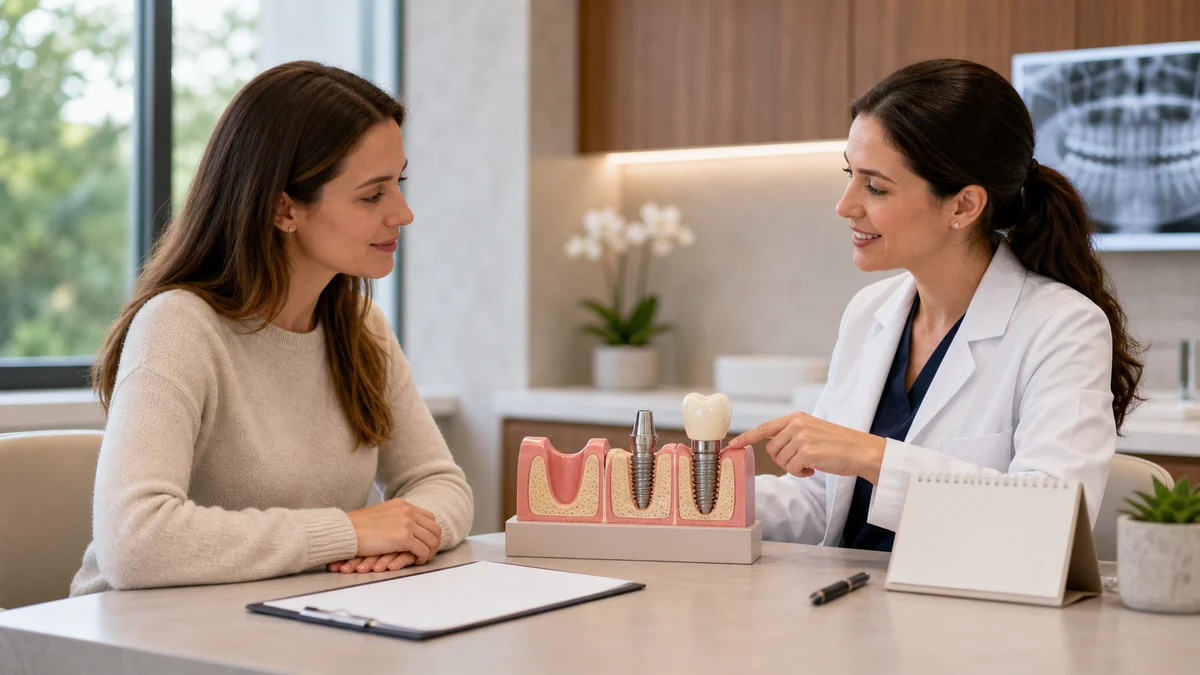
When a person asks how much does it cost to have an implant tooth, they usually mean the total for replacing one missing tooth with an implant-supported crown. That total is not simply the price of a metal implant. It can include the examination, imaging, site preparation, implant body, healing component, abutment, temporary tooth, final crown, laboratory, reviews, and long-term maintenance.
This guide does not diagnose your site, determine candidacy, or publish a universal fee. It helps you recognize a complete single-tooth estimate and compare like with like. It has been prepared for evidence-based review by Dentist Esma Çevrük Çakır with patient safety as the priority. The definitive answer to how much does it cost to have an implant tooth follows an in-person examination and appropriate records.
1. Clarify what “implant tooth” actually includes
An “implant tooth” is not one preassembled item. The U.S. Food and Drug Administration describes a dental implant system as an implant body placed in the jaw, an abutment that connects through the gum, and an artificial tooth supported above it. A fixation screw or other system-specific parts may be involved. The visible crown is a prosthetic restoration, not the implant body itself.
That distinction is central to how much does it cost to have an implant tooth. An advertisement may quote placement of the implant body and omit the abutment, temporary tooth, crown, or laboratory. Before comparing totals, require a written statement that identifies each component and the clinician responsible for placing or delivering it.
2. Why how much does it cost to have an implant tooth cannot be universal
Single-tooth sites differ in location, available space, bone and gum form, proximity to anatomical structures, condition of neighboring teeth, bite forces, and aesthetic demand. The patient’s health history, medication, oral hygiene, gum health, and nicotine use can also influence planning and healing. A remote photograph cannot establish all these factors.
When you ask how much does it cost to have an implant tooth, a responsible provider can offer a provisional range or standard fee structure, then issue an individualized estimate after assessment. The plan should identify assumptions, conditional services, and the method for approving a change. A low initial figure is not complete if necessary later stages are absent.
3. Use a single-tooth estimate decision table
The table below organizes how much does it cost to have an implant tooth into clinical stages. It does not predict which stages you need.
| Stage | What it may include | Why the estimate may vary | Question to ask |
|---|---|---|---|
| Assessment | Examination, records, site and bite evaluation | Complexity and number of required records | Which findings could change the plan? |
| Imaging | Site-specific radiographs or three-dimensional imaging when indicated | Clinical question and interpretation needs | Who reviews the image and is a report included? |
| Site preparation | Extraction, disease control, or grafting if clinically required | Condition of tooth, bone, and soft tissue | Is this expected or conditional? |
| Implant surgery | Implant body, placement, healing component, routine review | Clinician, system, facility, and surgical approach | What brand/model is used and recorded? |
| Temporary tooth | Removable, bonded, or implant-supported provisional where appropriate | Aesthetic need, bite, healing, and repair policy | Is it included, and what if it breaks? |
| Final crown | Abutment, crown, laboratory, delivery, bite adjustment | Material, customization, laboratory, and aesthetic complexity | Are the abutment and crown separate line items? |
| Maintenance | Recall, cleaning, imaging when indicated, repairs | Practice policy and future prosthetic needs | What is the long-term service pathway? |
4. Examination and imaging establish the starting point
The dentist may evaluate the missing-tooth space, neighboring roots, gum condition, available restorative height, bite, smile line, and cleansability. Imaging should answer a specific anatomical or planning question. A scan alone does not establish suitability; it must be interpreted alongside clinical findings and medical history.
In a how much does it cost to have an implant tooth estimate, ask whether consultation, records, imaging, interpretation, and planning are included. If you have recent images, the dentist should decide whether they are diagnostically suitable. A “free scan” is a marketing feature unless the result is properly assessed and integrated into an individualized plan.
5. The condition of the missing-tooth site matters
A healed space, a recently lost tooth, and a tooth that still requires extraction are different starting points. Infection, gum disease, decay on neighboring teeth, fractures, or bite instability may need attention. The implant crown must function within the whole mouth, so treating only the visible gap can overlook factors that affect the outcome.
For how much does it cost to have an implant tooth, request separate lines for disease control or extraction and ask why each is recommended. The provider should distinguish known services from conditional ones. If new findings change the plan, you should receive an explanation, alternatives, timeline effect, and revised cost before treatment continues.
6. Extraction timing can create different pathways
Some implants are placed at the time of extraction, while others are placed after the site heals. Immediate placement is not automatically quicker or better; its suitability depends on site anatomy, infection control, stability, tissue conditions, and the restorative plan. Delayed placement may be chosen for clinical reasons rather than inefficiency.
The answer to how much does it cost to have an implant tooth should show whether extraction, socket management, implant placement, and temporary restoration occur together or in stages. Ask what findings could cause the planned pathway to change during or after extraction and how a new consent and fee will be handled.
7. Bone and gum procedures may be conditional
Some sites have enough appropriate bone and soft tissue for the intended implant and crown. Others may need bone or soft-tissue management, a different implant approach, or an alternative restoration. Grafting should not be promised unnecessary before assessment or added automatically as a premium feature. The clinical reason and alternatives should be documented.
When discussing how much does it cost to have an implant tooth, ask whether graft material, membranes, tissue procedures, follow-up, and the effect on healing time are separate. Request the material source and important risks. If the recommendation has a major cost or treatment impact, it is reasonable to seek an independent second opinion before elective care.
8. Front-tooth aesthetics can add planning stages
A crown in the visible smile zone may require careful management of shape, color, gum contour, emergence profile, and symmetry with adjacent teeth. Photographs, shade records, provisional shaping, customized components, or additional laboratory communication may be used. None of these automatically guarantees a perfect match, because tissues and healing vary.
For a front site, how much does it cost to have an implant tooth may reflect extra provisional and laboratory work. Ask which aesthetic steps are included, who approves the shade and shape, and what happens if the crown needs adjustment or remake. Before-and-after images show other people’s outcomes and cannot promise yours.
9. Back-tooth load and bite also affect design
A posterior implant crown may face substantial chewing forces and limited access for hygiene or restoration. The dentist evaluates restorative space, opposing teeth, bite contacts, grinding or clenching history, and neighboring tooth position. A night guard may be discussed in some cases, but it should not be prescribed automatically without an individualized reason.
In a posterior how much does it cost to have an implant tooth plan, ask whether bite analysis, protective appliance if indicated, and post-delivery adjustment are included. Material and abutment design should be explained according to the clinical situation. The most expensive material is not automatically the safest or most durable choice for every bite.
10. Temporary-tooth options have separate costs and limits
During healing, some people can leave the space without a temporary tooth, while others may use a removable appliance, bonded temporary, or carefully designed implant-supported provisional. The choice depends on location, bite, appearance, tissue management, and implant stability. A temporary tooth is not necessarily the final crown.
A complete how much does it cost to have an implant tooth quote identifies the temporary option, delivery, adjustments, repair policy, and duration. Ask what happens if healing takes longer or the provisional breaks. Immediate loading should be based on clinical criteria, not a sales deadline, holiday, or promise that every patient leaves with the final tooth.
11. The implant brand and model should be documented
The FDA recommends asking which brand and model of implant system is used and keeping that information. A future dentist may need compatible components, instruments, or technical data to service the crown or abutment. Parts that appear similar are not necessarily interchangeable, and an unidentified system can complicate future repair.
Therefore, how much does it cost to have an implant tooth includes the future value of traceable components. Ask whether the system is authorized in the relevant market and supported by an accessible supply chain. Keep the placement date and site, brand/model, dimensions when appropriate, connected components, and operative summary.
12. Standard versus customized abutments
The abutment connects the implant to the crown. A standard component may be suitable in some situations, while a customized abutment may help manage position, tissue shape, restorative space, or aesthetics in others. Customization is not automatically superior, and a standard part is not automatically inferior. The choice should follow the restorative plan.
In the question how much does it cost to have an implant tooth, determine whether the abutment is included and what type is planned. Ask who designs it, what material is used, whether it is screw-retained or supports a cemented crown, and how the choice affects retrieval, cleaning, and future repair.
13. Crown material and laboratory work shape the final stage
The crown requires records, design, laboratory production, shade selection, try-in or verification, delivery, and bite adjustment. Material choices have different aesthetic, thickness, wear, and repair characteristics. The appropriate choice depends on site and design, not a universal ranking. An in-house laboratory is not automatically better, and an external laboratory is not automatically worse.
For how much does it cost to have an implant tooth, ask for the crown material, laboratory responsibility, expected appointments, remake policy, and adjustment period. Clarify whether the crown is screw-retained or cemented and what that means for access and maintenance. “Premium crown” is not enough detail for a meaningful comparison.
14. Anesthesia and facility charges may be separate
Local anesthesia, oral medication, intravenous sedation, and general anesthesia involve different qualifications, monitoring, facilities, recovery, and escort needs. A single implant often does not require the same approach as extensive surgery, but only the treating team can discuss suitability. Deeper sedation is not automatically safer or necessary.
Ask whether how much does it cost to have an implant tooth includes anesthesia professional fees, facility charges, monitoring, medications, and preoperative medical assessment. Confirm who administers sedation and whether the person and setting meet applicable requirements. Decide based on clinical need after discussing benefits, risks, and alternatives—not marketing comfort claims.
15. Healing and appointment sequence affect the total
The FDA notes that healing of an implant body may take several months or longer. Surgery, integration, restorative records, abutment connection, provisional adjustment, and final crown delivery may occur at different times. Extra reviews can be appropriate if healing or the bite needs further evaluation. Biology cannot be guaranteed to follow a fixed commercial schedule.
The timeline belongs in how much does it cost to have an implant tooth. Ask how many visits are expected, which are included, and what could add another appointment. Consider transport and time away from work. If treatment is far from home, include accommodation and possible return travel rather than comparing clinic invoices alone.
16. Coverage and financing change the patient’s effective cost
Dental benefits vary by contract, network, waiting period, exclusion, annual or lifetime limit, prior authorization, and the exact procedures proposed. A clinic may submit an estimate but cannot guarantee reimbursement. The implant body, abutment, crown, grafting, temporary tooth, and anesthesia may be handled differently by a plan.
The Consumer Financial Protection Bureau notes that medical credit cards and payment plans can involve interest, fees, payment schedules, and deferred-interest conditions. To calculate how much does it cost to have an implant tooth, compare the cash total with the complete financed obligation. A small monthly payment can hide borrowing cost and refund complications if the clinical plan changes.
- Verify benefits directly using the written treatment plan;
- Ask which stages require prior authorization;
- Compare cash price, financed total, interest, and fees;
- Identify whether “no interest” is actually deferred interest;
- Read missed-payment and promotional-deadline rules;
- Understand refunds for unperformed stages;
- Keep estimates, credit disclosures, and receipts.
17. Maintenance and complications are ownership costs
The FDA recommends following oral-hygiene instructions, cleaning the implant and surrounding teeth, and attending regular dental visits. A single implant crown can require professional cleaning, gum and bone monitoring, bite checks, screw or crown service, or prosthetic replacement over time. It is not a maintenance-free artificial tooth.
Long-term how much does it cost to have an implant tooth planning includes the recall schedule and repair pathway. Ask which symptoms require prompt review and who responds after hours. The FDA advises telling the dental provider if an implant feels loose or painful. Do not tighten, glue, or reshape implant parts yourself.
The FDA lists possible complications such as injury to nearby teeth or tissues, sinus injury, jaw injury, bite problems, screw loosening, infection, delayed healing, cleaning difficulty, numbness, and implant-body failure. This does not predict your outcome. It supports individualized consent and a written complication plan. No commercial warranty can guarantee biological healing.
Lower-cost care and fraud prevention
The National Institute of Dental and Craniofacial Research states that it does not provide implants, implant trials, referrals, or financial assistance and warns that communications claiming otherwise are likely fraudulent. NIDCR suggests contacting dental schools about lower-cost care. Teaching clinics are supervised, but acceptance, scope, timing, and fees vary.
A safer how much does it cost to have an implant tooth search verifies the clinic and dentist through official channels, contacts institutions directly, and rejects pressure to pay an “application fee” for an unverified grant. A legitimate clinical trial has defined eligibility, investigators, consent, and a registered protocol when applicable; it is not a universal coupon for routine care.
- Verify the dentist’s current license with the official regulator;
- Confirm the legal practice name and physical address;
- Reject definitive pricing without examination;
- Separate implant, abutment, temporary, and crown fees;
- Request brand/model and component records;
- Read cancellation, refund, repair, and warranty terms;
- Seek an independent opinion when plans differ materially.
Alternatives to a single implant crown
Depending on the site and the rest of the mouth, alternatives may include monitoring without immediate replacement, a removable partial denture, a conventional bridge, an adhesive bridge, orthodontic space management, or another individualized solution. Each option has different effects on neighboring teeth, treatment time, hygiene, repair, appearance, and future care.
The consultation for how much does it cost to have an implant tooth should explain reasonable alternatives and what may happen if elective care is delayed. The least expensive appropriate option may not be an implant. Conversely, a low initial alternative may have different maintenance or replacement needs. Informed consent requires more than presenting one purchasable package.
Discussing a single implant tooth with Redent Klinik
The Redent Klinik English website describes the clinic’s general approach. For someone researching how much does it cost to have an implant tooth in Turkey, an initial remote exchange can organize history, existing records, the missing site, aesthetic concerns, and questions. It cannot establish a final diagnosis or guarantee suitability.
Use the Redent Klinik contact page to request a conditional outline of diagnostics, implant and abutment, temporary option, crown, visits, and aftercare. Add flights, accommodation, time away from work, insurance exclusions, currency movement, possible return travel, and local follow-up when comparing how much does it cost to have an implant tooth abroad. Final planning follows an in-person dentist examination.
A 17-point single-tooth estimate checklist
- Named missing-tooth site and intended final crown;
- Clinical examination and periodontal assessment;
- Required images and interpretation;
- Condition of neighboring teeth and bite;
- Extraction and site management if needed;
- Conditional bone or soft-tissue procedures;
- Implant brand, model, dimensions, and placement;
- Healing component and routine surgical reviews;
- Temporary-tooth design, delivery, and repair;
- Standard or customized abutment;
- Crown material, laboratory, and retention type;
- Try-in, delivery, shade, and bite adjustment;
- Anesthesia, sedation, monitoring, and facility charges;
- Expected appointments and timing contingencies;
- Coverage assumptions and patient responsibility;
- Cash total, financing terms, and refund policy;
- Maintenance, repair, urgent contact, and complication policy.
Apply the checklist to every answer you receive for how much does it cost to have an implant tooth. Two estimates may represent different diagnoses, materials, temporary plans, or follow-up rather than different prices for identical care. Ask each dentist to explain those differences before comparing totals.
Frequently asked questions
How much does it cost to have an implant tooth after an online estimate?
The online estimate remains provisional until examination and appropriate imaging confirm the site, implant plan, temporary option, and final crown. A written how much does it cost to have an implant tooth plan should state assumptions and require your agreement before changes.
Does the advertised implant price include the tooth?
Not necessarily. It may include only the implant body or surgery. When comparing how much does it cost to have an implant tooth, ask for separate lines covering the implant, abutment, temporary restoration, final crown, laboratory, delivery, and follow-up. The visible crown should be explicitly named rather than assumed.
Why might a front implant tooth cost more to plan?
The visible zone can require additional provisional shaping, tissue management, shade records, customized components, and laboratory communication. These steps can affect how much does it cost to have an implant tooth but do not guarantee a perfect match. Ask which are clinically indicated and included, rather than accepting “premium aesthetics” as an unexplained fee.
Can the implant and crown be completed in one day?
Some selected situations may allow immediate placement and a temporary restoration, but the final crown and healing pathway depend on clinical conditions. Timing therefore belongs in any answer to how much does it cost to have an implant tooth. The FDA notes that implant-body healing may take several months or longer. Immediate treatment is not suitable or final for everyone.
Does one implant tooth always need bone grafting?
No. The need depends on the site, anatomy, timing, and chosen approach. A reliable answer to how much does it cost to have an implant tooth treats grafting as a justified, site-specific item after examination and imaging, with alternatives and separate costs explained. Avoid both blanket promises that grafting is never needed and automatic add-on recommendations.
Will dental insurance cover a single implant crown?
Coverage varies by plan, network, waiting period, limits, exclusions, and procedure. To calculate how much does it cost to have an implant tooth after benefits, verify the written plan directly with the insurer or administrator. Implant surgery, abutment, crown, grafting, temporary tooth, and anesthesia may be treated as separate benefits.
What records should I receive for one implant?
A complete how much does it cost to have an implant tooth plan should also specify the records you receive. Keep the site and placement date, brand/model and dimensions when appropriate, connected components, operative summary, relevant imaging, abutment and crown details, laboratory, maintenance instructions, clinician contacts, consent, invoice, and commercial warranty. These records support future servicing.
When should I contact the dentist after treatment?
Follow the clinic’s instructions and promptly report an implant that feels loose or painful. Increasing swelling, difficulty breathing or swallowing, uncontrolled bleeding, severe trauma, or rapidly worsening general condition requires prompt local professional or emergency assessment rather than waiting for an online response.
Conclusion: price the implant, connector, crown, and care pathway
The reliable answer to how much does it cost to have an implant tooth is a complete single-tooth plan, not one headline. Confirm the implant body, abutment, temporary option, final crown, laboratory, diagnostics, site preparation, anesthesia, visits, and maintenance. Verify the clinician and preserve the implant system record.
Compare reasonable alternatives, cash and financed totals, and responsibility for complications or repairs. No clinic can guarantee biological healing or a permanent cosmetic result. Once every stage is visible, how much does it cost to have an implant tooth becomes a safer question about complete care, function, and continuity.
Sources and official verification resources
- U.S. Food and Drug Administration: Dental Implants—What You Should Know.
- National Institute of Dental and Craniofacial Research: Finding Dental Care.
- Consumer Financial Protection Bureau: Medical credit cards and payment plans.
- American Dental Association.
- World Health Organization: Oral Health Fact Sheet.