
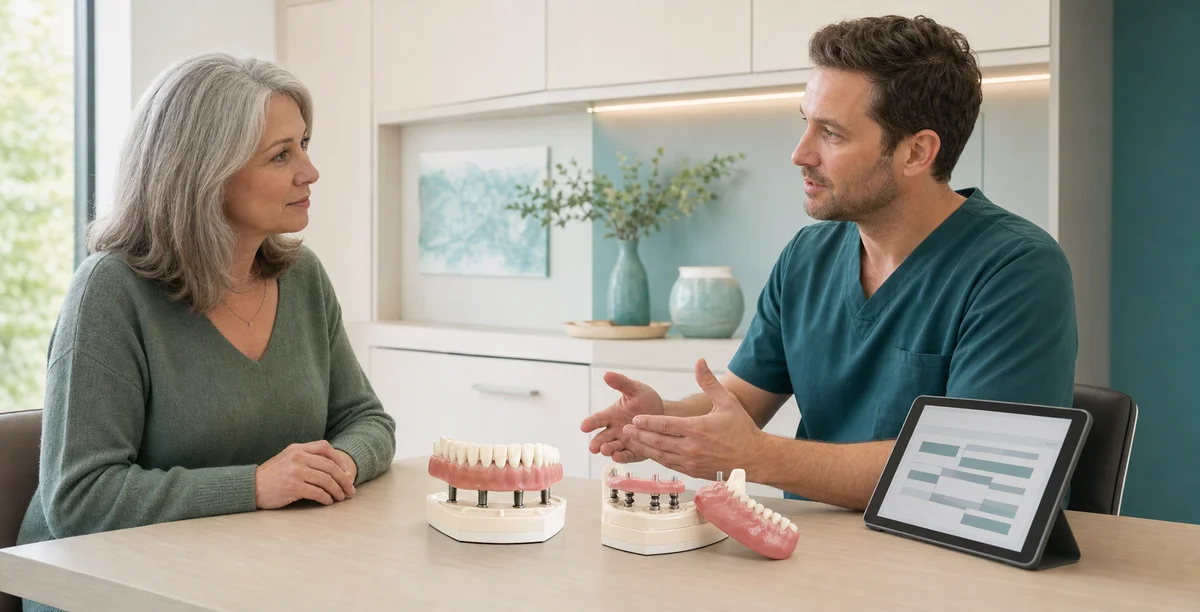
Quick answer: There is no universal answer to how much does it cost to have full dental implants. “Full” may mean one arch or both jaws, a fixed bridge or a removable overdenture. Total cost can include examinations, extractions, implant surgery, grafting, sedation, provisional teeth, definitive prostheses, materials, follow-up and maintenance. Compare diagnosis-based itemized plans, not implant count or monthly payment alone.
The search how much does it cost to have full dental implants often begins after many teeth have failed or a complete denture has become difficult to use. It can also begin with a package advertisement showing one appealing number. Before comparing figures, define whether the proposal replaces all teeth in the upper jaw, lower jaw or both. A one-arch plan and a two-arch reconstruction are not financially or clinically equivalent.
Full dental implants usually refers to a full-arch prosthesis supported or retained by implants, not an individual implant under every missing tooth. The prosthesis may be fixed so that only a clinician removes it, or removable by the patient as an overdenture. Each design has different surgery, components, laboratory work, cleaning access, repair needs and long-term cost.
This article explains the complete treatment pathway without publishing a fixed price. A reliable estimate requires an examination, appropriate records and a written restorative plan. No online article can decide that every remaining tooth should be removed, guarantee same-day fixed teeth, promise implant integration or predict the useful life of a prosthesis.
How Much Does It Cost to Have Full Dental Implants: Define “Full” First
The first step in how much does it cost to have full dental implants is naming the treatment unit. Dentists use “arch” to describe the complete row of teeth in one jaw. A full upper arch is one unit; a full lower arch is another. “Full mouth” can mean both arches, but some advertisements use “full” for only one jaw. The written plan should remove this ambiguity.
Next, identify the prosthesis. A fixed full-arch bridge is screwed or otherwise secured to implant components and normally remains in the mouth between professional maintenance visits. An implant overdenture is removed by the patient for daily cleaning and uses attachments, a bar or another retentive design. A conventional complete denture uses no implants. These are not simply premium, medium and basic versions of the same product; they behave differently.
Finally, clarify whether natural teeth remain. Full-arch treatment may be discussed for a toothless jaw or when the remaining teeth collectively have a poor prognosis. Extracting teeth is irreversible. Each tooth should be assessed for decay, fractures, periodontal support, root condition and strategic value before a full-arch replacement is chosen.
A Decision Table for Full-Arch Options
A useful how much does it cost to have full dental implants comparison matches the final design, number of arches and included stages. This table provides orientation only; implant number and prosthesis design must be individualized.
| Option | How it is supported | Cost layers to compare | Important trade-off |
|---|---|---|---|
| Fixed implant-supported full-arch bridge | Several implants support a bridge that the patient does not routinely remove | Extractions, implants, temporary and final bridges, framework, material, professional removal and repairs | Fixed feel but demanding hygiene access and mechanical maintenance |
| Implant-retained overdenture | Implants and attachments stabilize a patient-removable denture | Implants, bar or attachments, denture, reinforcement, relines and replacement inserts | Removable for cleaning; attachments and denture base need service |
| Conventional complete denture | Supported by oral tissues without implants | Impressions, jaw records, try-in, denture, adjustments and future relines | No implant surgery, but stability and chewing experience differ |
| Staged or mixed rehabilitation | Different designs in the two jaws or treatment completed in phases | Separate arch plans, interim dentures, sequencing and repeated records | Can distribute cost and risk, but extends coordination and treatment time |
| Tooth-preserving reconstruction | Suitable natural teeth support restorations, bridges or partial dentures | Periodontal, endodontic and restorative care plus maintenance | Preserves teeth when appropriate but has a different prognosis and repair pathway |
When judging how much does it cost to have full dental implants, a fixed bridge should not be called an overdenture, and an overdenture should not be marketed as fixed teeth. Ask who can remove the final prosthesis, how to clean underneath it, which parts commonly wear and how future repairs are completed. Those answers affect quality of life and cost long after surgery.
The 12 Cost Layers in a Complete Plan
When asking how much does it cost to have full dental implants, request these twelve layers in writing. A bundled price can be convenient, but the contents and exclusions still need to be visible.
- Consultation and diagnosis: medical and dental history, examination, periodontal assessment, bite evaluation and discussion of alternatives.
- Records and imaging: photographs, digital scans, panoramic imaging and CBCT when clinically justified.
- Disease control: treatment of active decay, infection or gum disease before definitive implant reconstruction.
- Extractions: removal of non-restorable teeth, surgical complexity and management of hard and soft tissues.
- Bone and soft-tissue procedures: socket preservation, ridge augmentation, sinus-related surgery or grafting where indicated.
- Implant surgery: fixtures, surgical guides where used, healing components and operative reviews.
- Anaesthesia or sedation: local anaesthesia, optional sedation and facility or anaesthesia-team requirements.
- Immediate or interim teeth: an adjusted denture or provisional fixed bridge during healing.
- Abutments and prosthetic components: multi-unit abutments, bars, screws, inserts and other connection parts.
- Definitive prostheses: final fixed bridges or overdentures for one or both arches, including laboratory material and framework.
- Follow-up and adjustments: healing reviews, restorative try-ins, bite adjustment and delivery visits.
- Long-term maintenance: professional hygiene, prosthesis removal, replacement attachments, relines, screw service, repairs and remakes.
The answer to how much does it cost to have full dental implants can look artificially low when a proposal lists only implants and provisional teeth. Ask whether the definitive bridge is included, what material it uses and when it will be made. A provisional prosthesis is a treatment stage, not automatically the final restoration.
One Arch Versus Both Arches
For how much does it cost to have full dental implants, two arches do not always equal exactly twice one arch. Both jaws require their own diagnosis, implant distribution, surgery and prosthesis, but shared appointments, anaesthesia or records may change how fees are structured. The bite relationship between the arches also becomes a central part of design.
A both-arch how much does it cost to have full dental implants plan controls the position, shape and material of nearly every chewing surface. That creates opportunities to restore vertical dimension, lip support and tooth display, but it also increases planning responsibility. Speech, smile line, facial appearance, jaw function and cleaning access need careful trial and verification before definitive material is produced.
Ask whether the arches will be treated together or staged. Simultaneous surgery may reduce separate operative dates but increases treatment burden and can make eating during early healing more challenging. Staging can preserve a stable opposing arch during part of treatment and distribute cost, but it may extend the overall timeline. Medical condition, anatomy and patient preference should guide timing.
How Much Does It Cost to Have Full Dental Implants With Fixed Bridges?
A fixed-bridge answer to how much does it cost to have full dental implants includes more than the fixtures. The implant positions must support the planned tooth arrangement, allow hygiene and distribute forces. The bridge needs a framework or monolithic structure, prosthetic screws or cemented components, accurate jaw records and a passive fit.
The American College of Prosthodontists recognizes full-arch fixed implant restorations as an established treatment alternative and emphasizes prosthetic design and maintenance. It notes that designs and materials vary. The number, angle and position of implants are clinical variables, not a fixed retail recipe. A named four- or six-implant concept cannot be selected from price alone.
In a fixed-bridge how much does it cost to have full dental implants calculation, “fixed” does not mean maintenance-free. Cleaning under the bridge requires instruction and appropriate tools. Professional removal may be recommended for some designs or problems. Acrylic teeth, composite, ceramic, zirconia, frameworks and screws have different wear and repair pathways. Ask how the clinic handles chipping, loosening, wear and a fractured component.
How Much Does It Cost to Have Full Dental Implants With Overdentures?
An overdenture changes how much does it cost to have full dental implants because the prosthesis and maintenance are different. Implants may support individual attachments or a bar that improves retention. The denture remains removable by the patient, which can make cleaning the implants and tissue surface more direct.
Initial costs may include implant surgery, attachment components, reinforcement and the overdenture. Long-term costs can include replacement inserts, clip or attachment wear, relines, repairs and eventual denture replacement. The attachment system should be identified so components remain obtainable and local clinicians can maintain it.
In an overdenture how much does it cost to have full dental implants comparison, removable does not mean inferior. For a patient with limited manual dexterity, tissue changes or a need for lip and facial support, an overdenture may offer practical advantages. Conversely, removal and palate coverage may be unwanted. The decision should reflect anatomy, hygiene ability, expectations and budget rather than a hierarchy created by advertising.
Natural Teeth, Extractions and the Irreversibility Question
Before calculating how much does it cost to have full dental implants, determine whether “full” treatment is necessary. A full-arch bridge may be appropriate in a toothless jaw or where remaining teeth have a collectively poor prognosis. It should not be a shortcut that removes maintainable teeth simply to standardize a package.
Ask for a tooth-by-tooth prognosis. Periodontal treatment, root-canal care, crowns, bridges, partial dentures or a mixed tooth-and-implant plan may preserve useful teeth in selected cases. These alternatives have their own costs and risks, but they deserve explanation before irreversible extraction.
Before accepting a complete-extraction how much does it cost to have full dental implants proposal, consider a second opinion. Request copies of radiographs, periodontal measurements and the restorative design. Ask how the plan would change if selected teeth were retained and what clinical findings make that alternative unsuitable. Informed consent requires a real choice, not only a signature.
Diagnosis and Records Before a Reliable Quote
No responsible response to how much does it cost to have full dental implants can be final from photographs alone. The clinician needs a current medical history, medication list, oral examination, periodontal assessment, tooth prognosis, jaw relationship, functional review and appropriate imaging. A surface scan shows shape but not every root, infection, nerve canal or bone boundary.
CBCT may be justified when three-dimensional anatomy will influence implant position, grafting or surgical risk. The restoration should be planned before the implant positions are finalized. A prosthetically driven plan begins with intended tooth location, speech, smile, bite and hygiene access, then determines where support can safely be placed.
- Bring medication, allergy and relevant medical information.
- Disclose smoking, vaping, diabetes, osteoporosis medication, grinding and previous radiotherapy.
- Provide previous implant, denture and radiographic records when available.
- Describe pain, swelling, loose teeth, denture instability and chewing limits.
- Explain appearance, speech and fixed-versus-removable priorities.
- Discuss dexterity and who can help with home care if needed.
- Ask which findings could change the implant number, graft plan or prosthesis.
A remote estimate for how much does it cost to have full dental implants should state its assumptions and remain provisional until examination. Avoid promises that every patient qualifies for the same implant number, immediate loading or graft-free surgery.
Bone, Sinus and Soft-Tissue Procedures
Bone and tissue needs can substantially alter how much does it cost to have full dental implants. Tooth loss, infection, trauma and time can change ridge width or height. The upper posterior jaw sits beneath the maxillary sinuses; the lower jaw contains important nerve structures. Anatomy guides implant length, angle, position and whether augmentation is considered.
Grafting is not one procedure. Options may include socket preservation, localized contour grafting, horizontal or vertical ridge reconstruction, sinus elevation or soft-tissue grafting. Materials, membranes, fixation, surgical time and healing stages differ. Ask why a procedure is recommended, whether it is certain or conditional, and whether implants will be placed simultaneously or later.
For how much does it cost to have full dental implants, some full-arch designs may reduce grafting in selected cases by using available bone strategically. “Graft-free” is not inherently superior if it compromises support, prosthetic contours or future maintenance. The goal is an appropriate, cleanable and repairable restoration, not simply fewer line items.
Same-Day Teeth: Provisional Versus Definitive
“Same-day teeth” strongly influences perceptions of how much does it cost to have full dental implants. Immediate loading can be considered when implant stability, bone, distribution, bite and medical factors satisfy the clinician’s criteria. It cannot be guaranteed before surgery. If stability is insufficient, a removable temporary solution or delayed loading may be safer.
The bridge placed on surgery day is commonly provisional. It may use a different material and design from the definitive prosthesis and may be adjusted as swelling resolves and tissues heal. Ask whether the final bridge is included, when it will be made, how many try-in or verification visits are expected and what clinical milestones must occur first.
Know the contingency. If fewer implants can be placed, an implant cannot be loaded or the provisional breaks, the agreement should explain the next step and who pays for modifications. A treatment plan is safer when it anticipates uncertainty rather than hiding it behind a one-day slogan.
Materials and Laboratory Work
Material choices change how much does it cost to have full dental implants, but price alone does not establish quality. Full-arch prostheses may combine acrylic or composite teeth with a metal framework, use milled titanium components, or use zirconia and ceramic in various forms. Each option has different thickness, weight, aesthetics, wear, repair and opposing-tooth considerations.
A highly rigid or hard material can transmit forces differently from a more repairable material. A repairable provisional-style design may need more frequent wear service. The optimal choice depends on implant positions, available restorative space, bite force, grinding, opposing material, lip support, hygiene and the laboratory-clinician workflow.
Ask for the exact final material, framework and manufacturer or laboratory information. Confirm whether the quoted bridge is a provisional, a long-term acrylic-composite restoration or a ceramic/zirconia restoration. If a material upgrade is offered, request a clinical explanation of benefit and maintenance rather than accepting a prestige label.
Anaesthesia, Treatment Time and Travel
For how much does it cost to have full dental implants, anaesthesia and logistics can be separate cost layers. Local anaesthesia is typical for implant surgery. Some patients may be offered conscious sedation or, in selected settings, general anaesthesia. The facility, clinician qualifications, monitoring and escort requirements affect cost and safety.
Guy’s and St Thomas’ NHS Foundation Trust describes implant care as a staged process that can include assessment, grafting, implant placement and restorative treatment over several visits. Actual timing varies by health, healing, grafting, loading and prosthesis. Marketing timelines cannot replace a personal schedule.
Travel patients should include flights, accommodation, companions, time away from work, medications, repeat visits and local urgent care. Ask which stages must occur at the treating clinic, how long to remain nearby after surgery and who manages complications at home. A lower package can become more expensive when unplanned travel or inaccessible maintenance is added.
Long-Term Maintenance and Lifetime Cost
The initial answer to how much does it cost to have full dental implants excludes important future expenses unless maintenance is included. Implants cannot develop tooth decay, but the surrounding tissues can develop mucositis or peri-implant disease. Prosthetic teeth, screws, bars, clips, inserts and frameworks can loosen, wear, chip or fracture.
Cambridge University Hospitals emphasizes meticulous cleaning and ongoing professional monitoring. It notes that crowns, bridges and dentures may need refurbishment and that clips or screws can wear or break. The American College of Prosthodontists likewise recommends risk-based maintenance for full-arch implant restorations.
- Ask how often clinical and hygiene maintenance is recommended for your risk profile.
- Confirm whether a fixed bridge needs periodic professional removal.
- Request the current fee or policy for removal, cleaning and screw replacement.
- Ask how overdenture inserts, clips and relines are priced.
- Understand repair options for chipped teeth, worn surfaces or a fractured provisional.
- Keep implant brand, size, component and prosthesis records.
- Identify a local dentist willing and equipped to maintain the system.
- Budget for maintenance independently of warranty language.
Long-term how much does it cost to have full dental implants planning cannot rely on a warranty, because it does not guarantee biological success or eliminate wear. It may require attendance, hygiene, protective appliances or avoidance of smoking. Read the exclusions, duration and remedy. A useful policy explains whether it covers parts, professional time, travel and replacement prostheses.
Health Factors and Risks
Before deciding how much does it cost to have full dental implants is affordable, assess whether the plan is appropriate. Medical conditions, medications, smoking, gum disease history, bone quality, grinding, hygiene and ability to attend follow-up influence risk. A factor does not automatically rule out treatment, but it may alter timing or the recommended design.
Implants may fail to integrate, and components can loosen or wear. Surgery can involve infection, bleeding, swelling, nerve or sinus complications, graft problems and soft-tissue changes. Long-term issues can include inflammation around implants, loss of supporting bone, mechanical fracture, speech or aesthetic dissatisfaction and difficulty cleaning.
Personal risks, alternatives and the consequences of no treatment should be explained before consent. A signed form is not enough without a conversation. If the proposed plan removes all remaining teeth, the irreversible nature of that decision and the possibility of future implant or prosthetic complications deserve particular attention.
How Much Does It Cost to Have Full Dental Implants With Insurance or Finance?
Insurance can change how much does it cost to have full dental implants out of pocket, but coverage varies. A plan may exclude implants, limit annual benefits, apply waiting periods or reimburse according to a lower-cost alternative. Surgical, grafting and prosthetic components may be treated differently.
Request a written predetermination based on the proposed codes and supporting records. Ask whether the benefit is per calendar year and whether staged treatment affects eligibility. A predetermination helps planning but is not always a guarantee if coverage, diagnosis or the final treatment changes.
For finance, compare deposit, amount financed, APR, fees, term, monthly payment and total repayable. A low monthly amount can hide a long term or deferred interest. Do not finance an incomplete scope or accept credit approval as evidence of clinical suitability. Understand the refund and debt consequences if the treatment plan changes after a lender pays the clinic.
How to Compare Two Full-Mouth Quotes
Two answers to how much does it cost to have full dental implants are comparable only when they cover the same arches, design and stages. Place the plans side by side and mark every assumption.
- Is the price for one arch or both?
- Are extractions, grafts and sedation included or conditional?
- How many implants are planned in each arch, and why?
- Is the temporary restoration fixed or removable?
- Is the definitive prosthesis included, and what material is specified?
- How many follow-up and adjustment visits are included?
- What happens if immediate loading is unsafe?
- What happens if an implant cannot be placed or does not integrate?
- Which maintenance, repair and replacement costs are excluded?
- Who provides urgent and long-term care?
- What refund, transfer and finance terms apply if treatment stops?
- Which reasonable non-implant alternatives were discussed?
For an individualized assessment, review the Redent Klinik English website and use the Redent Klinik contact page to ask which records are useful before an appointment or trip. The clinic can provide current terms after evaluation; this article does not quote or guarantee its fees, timelines or outcomes.
How Much Does It Cost to Have Full Dental Implants: Frequently Asked Questions
How Much Does It Cost to Have Full Dental Implants for One Arch?
There is no universal one-arch figure for how much does it cost to have full dental implants. The cost depends on extractions, implant count and position, grafting, sedation, provisional teeth, final fixed bridge or overdenture, material, follow-up and maintenance. A quote should identify whether “full” means upper or lower.
Ask whether the definitive prosthesis is included. Some offers cover surgery and a temporary bridge but price the final bridge separately. Confirm conditional costs after imaging or surgery.
How Much Does It Cost to Have Full Dental Implants for Both Arches?
Both-arch how much does it cost to have full dental implants plans include two surgical and prosthetic units, but the fee is not always exactly twice a one-arch quote. Shared records or anaesthesia may be structured differently, while full-mouth bite design and two definitive prostheses add complexity.
Confirm whether surgery is simultaneous or staged, what temporary teeth are provided and how eating, speech and hygiene will be managed during healing. Request separate upper and lower line items even if the total is bundled.
Do Full Dental Implants Mean One Implant for Every Tooth?
No. In most how much does it cost to have full dental implants discussions, several implants support or retain a full-arch bridge or overdenture. Implant number and distribution depend on anatomy, prosthesis, bite, bone and contingency planning. A brand name or fixed number is not automatically suitable.
Ask the clinician to explain why the planned number supports the chosen restoration and what happens if one site cannot be used. More implants are not always better, and fewer are not always cheaper.
Are Same-Day Teeth Included in the Final Price?
They may be provisional. A how much does it cost to have full dental implants package should state whether immediate teeth are fixed or removable, which material they use and whether the definitive prosthesis is included. Immediate loading also depends on day-of-surgery stability and cannot be guaranteed in advance.
Ask what temporary option is available if fixed loading is unsafe and whether modifications are included. The contract should describe the transition from provisional to definitive teeth.
Is a Fixed Bridge Better Than an Implant Overdenture?
Neither is universally better. In how much does it cost to have full dental implants, a fixed bridge may provide a fixed feel but requires specialized cleaning and mechanical maintenance. An overdenture is removable, can be easier to clean and may replace tissue volume effectively, but attachments and the denture base require service.
The choice depends on anatomy, lip support, speech, hygiene ability, dexterity, expectations, repair access and budget. Ask to handle examples and understand how each is cleaned.
How Long Do Full Dental Implants Last?
No fixed lifetime can be guaranteed in how much does it cost to have full dental implants. Implants and prostheses have different biological and mechanical risks. Tissue health, smoking, medical factors, bite, hygiene, material and maintenance influence outcomes.
An implant can remain integrated while its bridge teeth, screws or attachments need repair. Long-term value should include maintenance and replacement planning rather than assuming one treatment lasts forever without service.
Does Insurance Cover Full Dental Implants?
Coverage varies. For how much does it cost to have full dental implants, insurance may exclude implants, cap annual benefits, apply waiting periods or reimburse a denture alternative. Surgery, grafting, abutments and prostheses can have different rules.
Submit the written plan for predetermination and ask how staged treatment interacts with benefit years. Treat the response as an estimate unless the insurer states otherwise.
Can Full Dental Implants Be Done Without Bone Grafting?
Some patients need no graft, while others require localized or staged augmentation. The graft component of how much does it cost to have full dental implants depends on anatomy, infection, intended implant positions and prosthetic design. A scan and examination are needed for planning.
Alternative implant positions or designs may reduce grafting in selected cases, but avoiding grafts is not the only goal. Support, hygiene access, aesthetics and repairability remain important.
How Much Does It Cost to Have Full Dental Implants: The Next Safe Step
The safest answer to how much does it cost to have full dental implants begins with a diagnosis and restoration-led design. Define one or two arches, fixed or removable teeth, implant distribution, graft assumptions, temporary stage, definitive material, follow-up and maintenance. Then compare identical scopes.
Request the prognosis of every remaining tooth before agreeing to complete extraction. Understand what happens if immediate loading is unsafe or an implant cannot be used. Include travel, finance and long-term repair costs, and identify who will maintain the system locally.
Notice: This article provides general patient education. It does not replace a dental examination, individualized imaging, diagnosis, informed consent, a written estimate or professional financial, insurance, legal or tax advice.
How Much Does It Cost to Have Full Dental Implants: Sources
- American College of Prosthodontists — Maintenance of full-arch implant restorations: professional position on prosthetic design and risk-based maintenance.
- Cambridge University Hospitals — Dental implants in restorative dentistry: patient information on staged care, individualized cost, risks and long-term maintenance.
- Guy’s and St Thomas’ NHS Foundation Trust — Dental implants: patient guidance on implant stages, risks, alternatives and care.
- American Dental Association: professional dental information and patient resources.
- World Health Organization — Oral health fact sheet: global background on oral disease, prevention and access to care.