
When people lose one or more teeth, one of the first questions they ask is: how much for partial dental implants? This is an important question because dental implants are considered one of the most reliable and long-lasting tooth replacement solutions available today. Unlike removable dentures, partial dental implants are fixed securely into the jawbone, providing excellent stability, comfort, and a natural appearance. However, the total cost can vary significantly depending on several factors. Understanding how much for partial dental implants requires looking beyond a simple price tag and considering treatment complexity, materials, location, and long-term value.
Partial dental implants are commonly used when a patient is missing one or several teeth but still has healthy natural teeth remaining. Instead of replacing an entire arch, the dentist places implants only where needed and restores the missing teeth with crowns or implant-supported bridges. Because every patient has unique oral health conditions, the answer to how much for partial dental implants is rarely the same for everyone.
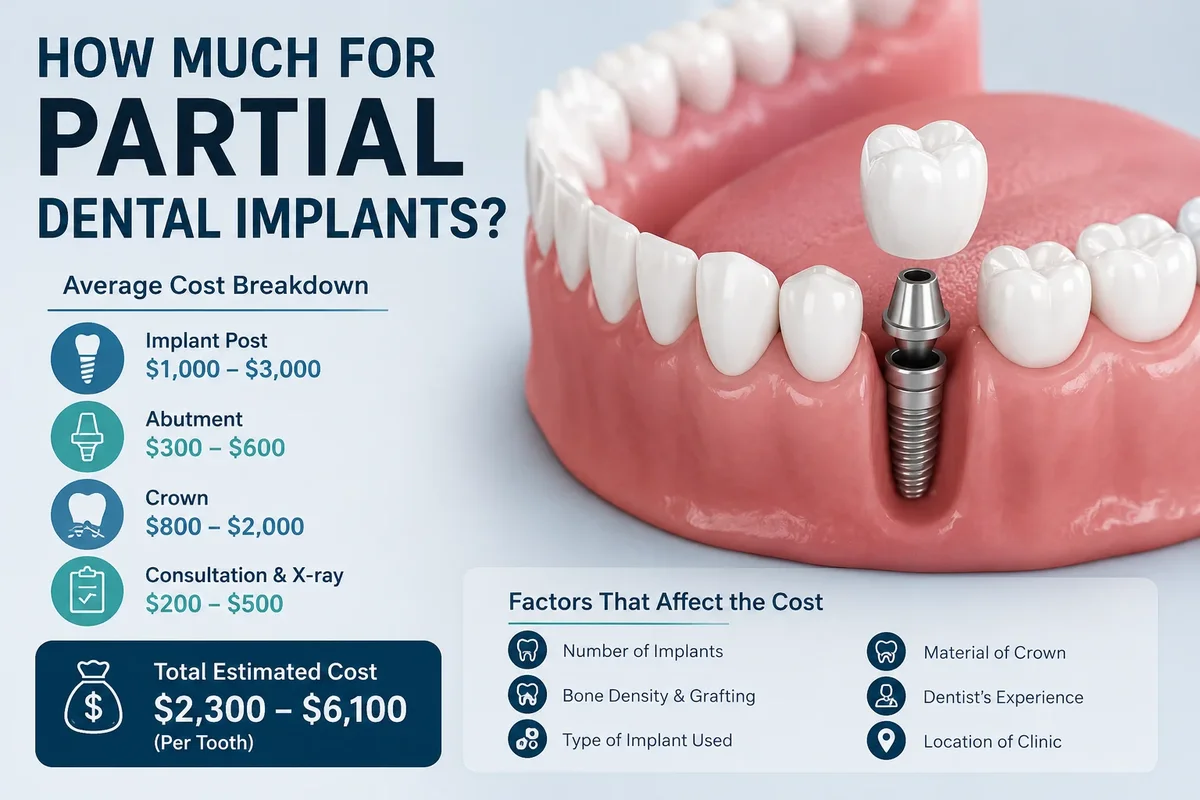
In many countries, the average cost of a single dental implant ranges from approximately $1,500 to $6,000. This estimate often includes the implant fixture, abutment, and final crown. If multiple teeth are missing, an implant-supported bridge may be recommended. Therefore, when evaluating how much for partial dental implants, patients should understand exactly what services are included in the quoted treatment plan.
🌍 Geographic location plays a major role in determining how much for partial dental implants. For example, implant treatment in the United States, Canada, or the United Kingdom is often significantly more expensive than treatment in countries known for dental tourism. Turkey has become one of the leading destinations for international patients seeking affordable implant treatment. Many patients researching how much for partial dental implants discover that high-quality treatment abroad can provide substantial savings while maintaining excellent standards of care.
Another major factor affecting how much for partial dental implants is the patient’s bone condition. Dental implants require adequate jawbone support. If significant bone loss has occurred due to missing teeth, gum disease, or trauma, additional procedures such as bone grafting may be necessary. Bone grafting can increase the total treatment cost but may be essential for long-term implant success. As a result, two patients asking how much for partial dental implants may receive very different treatment estimates.
🦷 The type of implant system selected also influences pricing. Premium implant brands are supported by extensive clinical research and often provide outstanding long-term success rates. While lower-cost implant systems may initially seem attractive, many patients prioritize proven reliability when comparing options and calculating how much for partial dental implants. Investing in a high-quality implant system may provide greater peace of mind and durability over many years.
Patients should also understand the different components involved in implant treatment. The titanium implant is surgically placed into the jawbone and acts as an artificial tooth root. After healing, an abutment is attached to connect the implant to the final restoration. Finally, a custom crown or bridge is fabricated. When discussing how much for partial dental implants, it is important to confirm whether all components are included in the quoted price.
Modern dentistry has greatly improved implant treatment through digital technologies. Cone beam CT scans, digital impressions, guided surgery, and computer-aided design help dentists achieve highly accurate results. Clinics utilizing advanced technology may charge more, which can affect how much for partial dental implants, but these technologies often contribute to better treatment outcomes and increased patient comfort.
💰 Below is a general cost overview that many patients use when researching how much for partial dental implants:
- Single implant with crown: $1,500–$6,000
- Two implants supporting multiple teeth: $3,000–$12,000+
- Bone grafting procedure: $300–$3,000
- Sinus lift procedure: $1,000–$4,000
- Diagnostic imaging and consultation: $100–$500
These figures are approximate and may vary considerably depending on the clinic and country. Patients should always obtain a personalized treatment plan before making decisions regarding how much for partial dental implants.
Another consideration is long-term value. Traditional removable dentures generally have a lower initial cost. However, dentures may require adjustments, relines, repairs, or replacement over time. In contrast, dental implants can last for decades with proper care. Therefore, when comparing options, many patients find that the true answer to how much for partial dental implants should include long-term benefits rather than only immediate expenses.
😊 Beyond financial considerations, implants offer significant quality-of-life improvements. Patients often report enhanced chewing ability, improved speech, increased confidence, and a more natural smile. Because implants integrate with the jawbone, they help preserve facial structure and reduce bone loss. These benefits are often part of the reason why so many individuals researching how much for partial dental implants ultimately decide that implants are a worthwhile investment.
Financing options are increasingly available as well. Many clinics offer payment plans that allow patients to spread costs over time. If budget concerns exist, discussing financing during the consultation can make treatment more accessible. Patients evaluating how much for partial dental implants should ask about monthly payment options, promotions, and package pricing when available.
Choosing the right clinic is equally important. The lowest price should not be the only factor. Experience, qualifications, sterilization protocols, implant success rates, patient reviews, and treatment planning standards should all be considered. The answer to how much for partial dental implants should always be balanced with treatment quality and patient safety.
If you would like a personalized consultation regarding how much for partial dental implants, you can contact a professional dental team through the Redent Klinik Contact Page. For additional oral health information and educational resources, patients can also visit the American Dental Association.
In conclusion, understanding how much for partial dental implants involves evaluating several factors, including the number of missing teeth, implant brand, clinic location, additional procedures, and overall treatment quality. While costs vary widely, partial dental implants remain one of the most effective and durable solutions for restoring missing teeth. By carefully researching providers and understanding all treatment components, patients can make informed decisions that support both their oral health and long-term financial goals.
Understanding How Much for Partial Dental Implants and What Influences the Price
One of the most important questions patients ask before beginning treatment is how much for partial dental implants. While it may seem like a straightforward question, the answer depends on numerous clinical, geographic, and personal factors. Partial dental implants are among the most advanced tooth replacement solutions available today, offering excellent aesthetics, durability, and functionality. However, because every patient has unique oral health needs, the cost can vary considerably from one case to another.
Understanding how much for partial dental implants requires looking at more than just the implant itself. The overall treatment plan may include consultations, digital imaging, surgical procedures, implant placement, healing periods, custom restorations, and follow-up care. Patients who understand these components are better equipped to evaluate treatment proposals and make informed decisions regarding their oral health.
What Are Partial Dental Implants?
Partial dental implants are used when a patient is missing one or several teeth but still retains healthy natural teeth. Unlike full-mouth implant restorations, partial implant solutions focus only on replacing the missing teeth while preserving the remaining healthy dentition.
When researching how much for partial dental implants, patients often discover that treatment options can vary significantly. A single missing tooth may require one implant and one crown, while several adjacent missing teeth may be restored using fewer implants combined with an implant-supported bridge. These treatment variations directly affect overall pricing.
Because implants integrate with the jawbone through a process called osseointegration, they provide a highly stable foundation that closely mimics natural tooth roots. This stability is one of the primary reasons why patients investigating how much for partial dental implants frequently view implants as a long-term investment rather than simply a dental expense.
Why Costs Vary Between Patients
No two implant cases are exactly alike. One patient may have excellent bone density and healthy gums, while another may require preparatory treatments before implant placement. Therefore, the answer to how much for partial dental implants often depends on the complexity of the individual’s situation.
Several factors contribute to cost differences, including:
- Number of missing teeth
- Jawbone condition
- Need for bone grafting
- Type of implant system used
- Location of the dental clinic
- Experience of the implant dentist
- Technology utilized during treatment
- Materials selected for final restorations
Each of these variables influences how much for partial dental implants, making personalized consultations essential for obtaining accurate treatment estimates.
Single-Tooth Versus Multi-Tooth Implant Cases
One of the most significant factors affecting how much for partial dental implants is the number of teeth being replaced. Replacing a single missing tooth generally costs less than restoring multiple missing teeth.
For example, a single implant may support one crown, while several adjacent missing teeth might be restored using two implants and an implant-supported bridge. Although multi-tooth cases require a larger investment, they are often more cost-effective than placing a separate implant for every missing tooth.
Patients comparing treatment options should discuss whether implant-supported bridges could reduce overall expenses while maintaining excellent functionality and appearance.
The Role of Diagnostic Technology
Modern implant dentistry relies heavily on advanced diagnostic tools. Cone Beam Computed Tomography (CBCT), digital scanners, and treatment planning software allow dentists to assess bone structure, nerve positioning, and implant placement with remarkable precision.
These technologies may influence how much for partial dental implants, but they also contribute significantly to treatment safety and predictability. Clinics that invest in advanced technology often provide more accurate diagnoses and better long-term outcomes.
Digital planning reduces surgical risks, improves implant positioning, and enhances the overall patient experience. Consequently, many patients consider the additional investment worthwhile when evaluating how much for partial dental implants.
How Location Influences Pricing
Geographic location is another major factor. Patients researching how much for partial dental implants often notice significant differences between countries and even between cities within the same country.
Approximate implant costs may vary as follows:
- United States: $3,000–$6,000 per tooth
- United Kingdom: £2,000–£4,500 per tooth
- Canada: CAD 3,000–6,000 per tooth
- Australia: AUD 3,000–7,000 per tooth
- Turkey: $600–$2,000 per tooth
These figures are general estimates and can fluctuate based on treatment complexity and clinic reputation. Many international patients seek treatment abroad after researching how much for partial dental implants and discovering substantial cost savings without sacrificing quality.
Dental Tourism and Cost Savings
Dental tourism has become increasingly popular among patients looking to reduce treatment expenses. Turkey, in particular, has emerged as a leading destination due to its combination of experienced clinicians, modern facilities, and competitive pricing.
Individuals exploring how much for partial dental implants frequently compare domestic costs with international options. Even after accounting for travel and accommodation expenses, some patients find that overseas treatment remains significantly more affordable.
Quality Versus Price
Although cost is important, patients should avoid making decisions based solely on price. When evaluating how much for partial dental implants, it is equally important to consider clinical expertise, sterilization standards, implant brands, laboratory quality, and patient reviews.
The cheapest treatment may not provide the best long-term value. High-quality implant systems supported by experienced professionals often demonstrate better longevity and lower complication rates. This can ultimately reduce future dental expenses and provide greater peace of mind.
Many successful implant restorations remain functional for decades when properly maintained. Therefore, patients should consider both immediate costs and long-term benefits when researching how much for partial dental implants.
Long-Term Financial Value of Dental Implants
While traditional bridges and removable dentures may initially cost less, they often require more maintenance and replacement over time. Dental implants, by contrast, help preserve jawbone health and provide exceptional durability.
Patients who carefully analyze how much for partial dental implants often conclude that implants offer superior long-term value. The ability to eat comfortably, speak clearly, smile confidently, and maintain bone structure contributes significantly to overall quality of life.
For patients seeking personalized guidance regarding how much for partial dental implants, a professional consultation remains the best way to receive an accurate treatment plan tailored to their unique needs. Understanding all cost factors allows patients to make informed decisions that support both their oral health and financial objectives for many years to come.
Average Cost Breakdown for Partial Dental Implants in Different Countries
When patients begin researching how much for partial dental implants, one of the first things they notice is that treatment costs can vary dramatically from one country to another. While the quality of implant dentistry has improved worldwide, differences in labor costs, operational expenses, taxation, healthcare systems, and local market conditions create significant variations in pricing. Understanding international cost differences can help patients make informed decisions and evaluate whether local treatment or dental tourism provides the best value.
The answer to how much for partial dental implants depends not only on clinical factors but also on where the treatment is performed. A procedure that costs several thousand dollars in one country may be available for a fraction of the price elsewhere while still maintaining high standards of care. However, patients should always compare quality, experience, and treatment guarantees in addition to pricing.
Why Implant Costs Differ Around the World
There is no universal price for dental implants. The cost structure varies because every country has different operating expenses. Dental clinics must cover staff salaries, facility costs, laboratory fees, equipment investments, licensing expenses, and insurance requirements.
When evaluating how much for partial dental implants, patients should understand that higher prices do not always indicate higher quality, and lower prices do not necessarily mean lower standards. Many countries have developed advanced dental tourism industries that offer excellent treatment outcomes at competitive prices.
Several factors influence international pricing:
- Cost of living
- Dentist salaries
- Laboratory manufacturing costs
- Import costs for implant systems
- Regulatory requirements
- Clinic overhead expenses
- Technology investments
- Local competition
These factors collectively influence how much for partial dental implants in every market around the world.
Average Implant Costs in the United States
The United States remains one of the most expensive countries for implant treatment. Patients searching for how much for partial dental implants often find prices ranging from $3,000 to $6,000 per implant-supported tooth.
This estimate commonly includes:
- Initial consultation
- Diagnostic imaging
- Implant placement surgery
- Abutment
- Final crown
Additional procedures such as bone grafting or sinus augmentation can significantly increase costs. Because of these higher prices, many patients explore alternative treatment destinations after researching how much for partial dental implants in the United States.
Typical U.S. Price Range
| Treatment | Average Cost |
|---|---|
| Single Implant and Crown | $3,000–$6,000 |
| Implant-Supported Bridge | $5,000–$15,000+ |
| Bone Graft | $300–$3,000 |
| Sinus Lift | $1,000–$4,000 |
Average Costs in the United Kingdom
Patients in the UK also face relatively high implant costs. Those investigating how much for partial dental implants typically encounter prices between £2,000 and £4,500 per restored tooth.
Private dental practices generally provide implant treatment, as public healthcare coverage is often limited for elective implant procedures. Consequently, many British patients compare domestic costs with international alternatives when evaluating how much for partial dental implants.
Average Costs in Canada and Australia
Canada and Australia show similar pricing patterns. Individuals researching how much for partial dental implants in these countries often receive estimates ranging between CAD 3,000–6,000 or AUD 3,000–7,000 per implant-supported tooth.
These prices reflect highly developed healthcare systems, strict regulatory standards, and relatively high operating costs. Although quality levels are generally excellent, treatment expenses encourage some patients to consider dental tourism options.
Turkey: A Leading Dental Tourism Destination
Turkey has become one of the most popular destinations for patients asking how much for partial dental implants. The country combines modern clinics, internationally trained dentists, advanced technology, and competitive pricing.
Many clinics offer complete implant packages at significantly lower costs than those found in North America or Western Europe. Depending on the implant brand and treatment complexity, patients may find prices ranging from approximately $600 to $2,000 per implant-supported tooth.
Because treatment expenses are lower while maintaining high clinical standards, thousands of international patients travel to Turkey each year after researching how much for partial dental implants.
Advantages of Implant Treatment in Turkey
- Competitive pricing
- Modern dental facilities
- Experienced implant specialists
- Advanced digital technology
- Comprehensive treatment packages
- Short waiting times
These advantages have helped Turkey become a global leader for patients seeking affordable solutions regarding how much for partial dental implants.
Other Popular Dental Tourism Destinations
In addition to Turkey, countries such as Hungary, Mexico, Thailand, Poland, and Croatia have established strong reputations for implant dentistry.
Patients researching how much for partial dental implants often compare multiple destinations before making a final decision. While prices differ, many of these countries offer substantial savings compared to Western healthcare markets.
Approximate international price ranges include:
- Hungary: $800–$2,500
- Mexico: $900–$2,500
- Thailand: $1,000–$3,000
- Poland: $1,000–$2,800
- Croatia: $1,200–$3,000
Should You Choose Based on Price Alone?
Although pricing is important, choosing treatment solely based on cost can be risky. When evaluating how much for partial dental implants, patients should also examine:
- Dentist qualifications
- Clinic accreditation
- Implant brand reputation
- Patient testimonials
- Warranty policies
- Treatment planning standards
- Post-treatment support
The lowest price is not always the best value. Long-term success depends on proper diagnosis, surgical precision, high-quality materials, and ongoing maintenance.
Long-Term Value Versus Initial Cost
Patients often focus on the upfront answer to how much for partial dental implants, but long-term value is equally important. A well-placed implant can last decades with proper care, reducing future restorative expenses and preserving oral health.
Implants help maintain jawbone density, improve chewing efficiency, support facial structure, and enhance confidence. These long-term benefits frequently outweigh the initial investment and explain why many patients ultimately choose implants over alternative treatments.
In conclusion, understanding how much for partial dental implants requires examining both geographic pricing differences and treatment quality. While countries such as the United States, Canada, Australia, and the United Kingdom often have higher costs, destinations such as Turkey provide more affordable options without necessarily compromising standards. Patients who carefully compare pricing, qualifications, technology, and long-term value can make confident decisions that support both their oral health and financial goals.
Key Factors That Affect How Much for Partial Dental Implants
Many patients begin their research by asking a simple question: how much for partial dental implants? While average price ranges can provide a useful starting point, the reality is that implant costs are influenced by many different variables. Two patients visiting the same clinic may receive completely different treatment estimates based on their oral health, treatment requirements, and personal goals. Understanding the major factors that affect how much for partial dental implants can help patients better evaluate treatment plans and avoid unexpected expenses.
Partial dental implants are highly customized restorations. Unlike standardized products, implant treatments are tailored to each individual’s anatomy, bone structure, smile design requirements, and functional needs. As a result, the answer to how much for partial dental implants is rarely identical from one patient to another.
Number of Missing Teeth Being Replaced
One of the most obvious factors influencing how much for partial dental implants is the number of teeth that need replacement. A patient missing a single tooth usually requires one implant and one crown. However, someone missing several teeth may need multiple implants or an implant-supported bridge.
The treatment approach chosen by the dentist directly impacts pricing. For example, three missing adjacent teeth may not always require three separate implants. In some situations, two implants can support a bridge, reducing overall treatment costs while maintaining excellent functionality.
Therefore, the total number of missing teeth significantly affects how much for partial dental implants, making a professional examination essential before obtaining an accurate estimate.
Single Implant vs. Implant-Supported Bridge
Patients often assume that every missing tooth requires an individual implant. In reality, implant-supported bridges can sometimes offer a more economical solution. When dentists evaluate how much for partial dental implants, they carefully consider whether a bridge can provide similar benefits while reducing the number of implants required.
This customized treatment planning helps balance functionality, aesthetics, and cost-effectiveness.
Jawbone Density and Bone Quality
Another major factor influencing how much for partial dental implants is the condition of the patient’s jawbone. Dental implants require sufficient bone volume and density to provide long-term stability.
When teeth have been missing for an extended period, the surrounding bone may gradually shrink. Bone loss can also result from periodontal disease, trauma, infection, or age-related changes. If inadequate bone support exists, additional procedures may be required before implant placement.
Because of this, patients with healthy bone structures often receive lower treatment estimates than those requiring advanced preparatory procedures.
Bone Grafting Requirements
Bone grafting is one of the most common supplemental procedures affecting how much for partial dental implants. This treatment helps rebuild lost bone volume and creates a stable foundation for implant placement.
Depending on the complexity of the case, bone grafting can add several hundred or several thousand dollars to the total cost. However, this investment often improves implant success rates and long-term stability.
Patients should understand that while bone grafting increases how much for partial dental implants, it may be essential for achieving predictable long-term outcomes.
Type and Brand of Implant System
The implant system selected by the dental provider also plays a significant role in determining how much for partial dental implants. Not all implant brands are identical. Premium manufacturers invest heavily in clinical research, product development, and quality control.
Some of the most recognized implant brands have decades of scientific documentation supporting their long-term performance. While these systems often cost more initially, many patients prefer them because of their established reliability.
Lower-cost implant systems may reduce upfront expenses, but patients should carefully discuss long-term expectations with their dentist before making decisions regarding how much for partial dental implants.
Experience and Qualifications of the Dentist
The training and expertise of the implant dentist significantly influence treatment pricing. Experienced implant specialists often charge higher fees because they bring advanced skills, extensive case experience, and a strong track record of successful outcomes.
When evaluating how much for partial dental implants, patients should consider the value of working with a highly qualified clinician. Implant placement requires precision, surgical expertise, and detailed treatment planning.
Choosing an experienced provider can reduce the likelihood of complications and improve overall treatment success.
Specialists vs. General Dentists
Some implant procedures are performed by general dentists with implant training, while more complex cases may be referred to oral surgeons, periodontists, or prosthodontists. Specialist involvement can influence how much for partial dental implants, especially when advanced surgical procedures are necessary.
Although specialist treatment may increase costs, it often provides additional expertise for complex cases involving bone loss, anatomical challenges, or extensive rehabilitation.
Technology Used During Treatment
Modern implant dentistry increasingly relies on advanced digital technologies. These tools improve diagnostic accuracy, treatment planning, and surgical precision.
Common technologies include:
- CBCT (Cone Beam CT) scanning
- Digital impressions
- 3D treatment planning software
- Computer-guided implant surgery
- CAD/CAM restoration design
While these innovations may affect how much for partial dental implants, they often improve patient comfort and increase treatment predictability.
Materials Used for the Final Restoration
The material selected for the final crown or bridge also influences how much for partial dental implants. Different restorative materials vary in strength, appearance, durability, and cost.
Common options include:
- Porcelain-fused-to-metal crowns
- Full zirconia crowns
- Layered zirconia restorations
- Ceramic crowns
Zirconia restorations are often more expensive due to their exceptional strength and highly aesthetic appearance. Patients seeking premium cosmetic results may choose higher-end materials, which naturally impacts how much for partial dental implants.
Customized Smile Design Considerations
For visible front teeth, aesthetics become especially important. Customized smile design, advanced laboratory work, and highly detailed restorations can increase how much for partial dental implants, but they also contribute significantly to natural-looking results.
Many patients view this additional investment as worthwhile because the restoration becomes virtually indistinguishable from natural teeth.
Geographic Location of the Clinic
Location remains one of the largest pricing variables affecting how much for partial dental implants. Clinics in major metropolitan areas generally face higher operating costs than clinics located in smaller cities or countries with lower living expenses.
This explains why identical implant systems may cost substantially different amounts in New York, London, Sydney, Toronto, or Istanbul. Patients comparing treatment options internationally often discover significant savings opportunities while still receiving high-quality care.
Long-Term Value Beyond Initial Cost
Ultimately, patients should view how much for partial dental implants as more than a simple financial question. Implant treatment is an investment in oral health, comfort, confidence, and quality of life. The lowest price is not always the best value if treatment quality, materials, or expertise are compromised.
When evaluating implant options, patients should consider longevity, functionality, aesthetics, and provider experience alongside the quoted fee. By understanding all of the factors discussed above, individuals can make informed decisions and choose the treatment plan that best supports their long-term dental health goals while accurately understanding how much for partial dental implants in their specific situation.
Number of Missing Teeth and Its Impact on Implant Costs
One of the most influential factors affecting how much for partial dental implants is the number of missing teeth that require replacement. While many patients initially focus on the cost of a single implant, the reality is that treatment planning becomes more complex as the number of missing teeth increases. The total investment depends not only on how many teeth are absent but also on their location, the condition of the surrounding bone and gums, and the most appropriate restoration method recommended by the dentist.
When patients ask how much for partial dental implants, dentists must first determine whether the missing teeth can be restored using individual implants, implant-supported bridges, or a combination of treatment approaches. Each solution carries different costs, benefits, and long-term maintenance requirements. Understanding these options helps patients make informed decisions while avoiding unnecessary expenses.
Replacing a Single Missing Tooth
For patients missing only one tooth, treatment is generally straightforward. A single implant is placed into the jawbone and topped with a custom-made crown. In this situation, the answer to how much for partial dental implants is typically easier to estimate because fewer variables are involved.
A single implant treatment commonly includes:
- Initial consultation and examination
- Diagnostic imaging
- Implant placement surgery
- Healing period
- Abutment placement
- Final crown restoration
Although single-tooth replacement is often less expensive than larger implant cases, the quality of materials and expertise involved remain extremely important. Patients evaluating how much for partial dental implants should remember that a properly placed implant can function successfully for decades.
Benefits of Replacing One Tooth with an Implant
When considering how much for partial dental implants, it is helpful to understand the value provided by implant treatment. Unlike traditional bridges, implants do not require modification of neighboring healthy teeth. They also help preserve jawbone density and maintain natural chewing function.
For many patients, these long-term benefits justify the investment associated with implant treatment.
Replacing Multiple Missing Teeth
The situation becomes more complex when several teeth are missing. In these cases, dentists must carefully evaluate spacing, bone quality, bite forces, and aesthetic requirements before determining the best treatment solution.
Patients researching how much for partial dental implants are often surprised to learn that replacing multiple teeth does not always require one implant per tooth. Modern implant dentistry allows strategic placement of implants that can support larger restorations while reducing overall treatment costs.
For example, three adjacent missing teeth may often be restored using two implants and an implant-supported bridge. This approach can provide excellent stability while lowering expenses compared to placing three individual implants.
Individual Implants vs. Implant Bridges
One major consideration affecting how much for partial dental implants is whether each missing tooth requires its own implant. In some situations, individual implants offer the greatest flexibility and bone preservation. In other cases, implant-supported bridges provide an equally effective and more economical solution.
The choice depends on factors such as:
- Location of missing teeth
- Available bone volume
- Bite pressure distribution
- Smile aesthetics
- Patient budget
By evaluating these elements, dentists can recommend the most efficient treatment strategy while accurately estimating how much for partial dental implants.
How Tooth Location Affects Costs
The location of missing teeth also influences how much for partial dental implants. Front teeth often require greater aesthetic precision because they are visible when smiling and speaking. Achieving natural-looking results may require additional planning, specialized laboratory work, and premium restorative materials.
Back teeth, on the other hand, experience stronger chewing forces. Implants placed in molar regions may require larger implant diameters or specific treatment considerations to ensure long-term durability.
As a result, two patients asking how much for partial dental implants may receive different estimates even when replacing the same number of teeth.
Gaps That Have Been Present for Many Years
Another important factor affecting how much for partial dental implants is the length of time teeth have been missing. When teeth remain absent for years, the jawbone naturally begins to shrink because it no longer receives stimulation from tooth roots.
This bone loss can create additional challenges during implant placement. In some cases, bone grafting procedures may be necessary before implants can be inserted safely. These supplementary treatments increase overall costs but help create a stable foundation for successful implant integration.
Patients who replace missing teeth sooner often avoid some of these complications and may reduce the total cost associated with how much for partial dental implants.
The Financial Impact of Bone Loss
Bone loss is one of the most common reasons treatment costs increase unexpectedly. While patients frequently focus on the implant itself, preparatory procedures can significantly influence how much for partial dental implants.
Additional treatments may include:
- Bone grafting
- Socket preservation
- Sinus augmentation
- Soft tissue grafting
Although these procedures add expense, they often improve long-term implant stability and overall treatment success.
Cost Comparison Based on Number of Missing Teeth
To better understand how much for partial dental implants, consider the following general cost ranges. Actual pricing varies by country, clinic, implant system, and case complexity.
| Missing Teeth | Typical Treatment | Estimated Cost Range |
|---|---|---|
| 1 Tooth | 1 Implant + Crown | $1,500–$6,000 |
| 2 Teeth | 2 Implants + Crowns | $3,000–$12,000 |
| 3 Teeth | 2 Implants + Bridge | $4,000–$15,000 |
| 4–6 Teeth | Multiple Implants + Bridge | $6,000–$25,000+ |
These figures illustrate how treatment complexity directly influences how much for partial dental implants and why individualized treatment planning is essential.
Long-Term Value of Strategic Implant Planning
Patients often focus on immediate costs when evaluating how much for partial dental implants, but long-term value should also be considered. Strategic implant planning can reduce future maintenance costs, improve chewing function, preserve bone health, and provide exceptional durability.
Whether replacing one tooth or several missing teeth, implants offer advantages that traditional dentures and bridges often cannot match. Properly planned implant treatment can last for decades with appropriate oral hygiene and routine dental care.
Ultimately, the number of missing teeth remains one of the most significant variables affecting how much for partial dental implants. By understanding how treatment complexity, tooth location, bone condition, and restoration design interact, patients can better evaluate their options and choose the solution that provides the best combination of functionality, aesthetics, and long-term value.
Additional Procedures That May Increase Partial Implant Expenses
When patients begin researching how much for partial dental implants, they often focus on the cost of the implant itself. However, one of the most important realities of implant dentistry is that the implant fixture and crown may represent only part of the overall treatment investment. Many patients require additional procedures before, during, or after implant placement to ensure long-term success. These supplementary treatments can significantly influence how much for partial dental implants and should be carefully considered when evaluating treatment options.
Dental implants depend on healthy bone, healthy gums, and proper oral conditions to achieve predictable outcomes. If any of these factors are compromised, dentists may recommend preparatory procedures to create an ideal environment for implant placement. Although these treatments increase overall costs, they often improve implant stability, aesthetics, and longevity.
Why Additional Procedures Are Sometimes Necessary
Not every patient presents with ideal conditions for immediate implant placement. Tooth loss often leads to gradual bone resorption, while gum disease, infection, trauma, or prolonged delays in treatment can create additional challenges.
As a result, the answer to how much for partial dental implants frequently depends on whether preparatory treatments are needed before implants can be safely placed. Some patients require no additional procedures, while others may need extensive rehabilitation before implant surgery can begin.
Common factors that lead to additional treatment include:
- Insufficient jawbone volume
- Bone loss after extraction
- Advanced periodontal disease
- Sinus expansion in the upper jaw
- Soft tissue deficiencies
- Infected teeth requiring removal
- Complex anatomical structures
Each of these issues can affect how much for partial dental implants by increasing the complexity of treatment.
Bone Grafting Procedures
Bone grafting is one of the most common procedures associated with implant treatment. When a tooth is lost, the surrounding jawbone gradually shrinks because it no longer receives stimulation from natural tooth roots. If sufficient bone volume is not available, the implant may lack adequate support.
In such cases, bone grafting may be recommended to rebuild lost bone and improve implant stability. Consequently, patients evaluating how much for partial dental implants should understand that bone grafting can represent a substantial portion of the overall treatment cost.
Types of Bone Grafting
Several types of grafting materials may be used depending on the patient’s needs:
- Autogenous bone grafts (patient’s own bone)
- Allografts (donor bone material)
- Xenografts (animal-derived bone substitutes)
- Synthetic bone graft materials
The selected material, treatment complexity, and graft volume all contribute to determining how much for partial dental implants.
Bone grafting procedures may range from a few hundred dollars to several thousand dollars depending on the extent of reconstruction required.
Sinus Lift Surgery
Patients missing upper back teeth frequently experience sinus expansion, a process known as sinus pneumatization. As the sinus cavity enlarges, the available bone height decreases, making implant placement difficult.
To address this issue, dentists may perform a sinus lift procedure. This surgery elevates the sinus membrane and places grafting material beneath it, creating sufficient bone volume for future implants.
Because sinus augmentation is a specialized surgical procedure, it can significantly affect how much for partial dental implants. However, it often makes implant treatment possible in areas that would otherwise be unsuitable for implantation.
How Sinus Lifts Affect Costs
Depending on the complexity of the case, sinus lift procedures can add approximately $1,000 to $4,000 or more to overall treatment expenses. Patients researching how much for partial dental implants should always ask whether sinus augmentation is necessary during the consultation process.
Tooth Extractions Before Implant Placement
In many situations, damaged or non-restorable teeth must be removed before implants can be placed. While extractions may seem straightforward, some cases involve impacted teeth, severe infections, or complicated root structures.
The need for extractions influences how much for partial dental implants because surgical removal may require additional expertise, sedation, and follow-up care.
Some patients undergo immediate implant placement directly after extraction, while others require a healing period before implant surgery. Treatment planning decisions can affect both cost and treatment duration.
Socket Preservation Procedures
After tooth extraction, the surrounding bone naturally begins to shrink. Socket preservation is a preventive procedure designed to minimize this bone loss by placing grafting material into the extraction site.
Although socket preservation adds to initial treatment expenses, it may reduce future reconstruction needs and improve implant outcomes. For this reason, it can influence how much for partial dental implants while simultaneously reducing long-term treatment complexity.
Preventing Future Bone Loss
Patients who choose socket preservation immediately after extraction often preserve more bone volume than those who delay treatment. Maintaining bone structure may simplify future implant placement and reduce overall expenses associated with how much for partial dental implants.
Soft Tissue and Gum Grafting
Healthy gums play an essential role in implant success and aesthetics. In some cases, patients lack sufficient gum tissue to support attractive, natural-looking implant restorations.
Soft tissue grafting procedures may be recommended to improve gum contours, protect implant surfaces, and enhance smile appearance. These procedures can increase how much for partial dental implants, particularly when implants are located in highly visible areas of the mouth.
For front teeth restorations, gum aesthetics are often just as important as the implant itself. Investing in proper soft tissue management can greatly improve the final result.
Sedation and Comfort Options
Some patients prefer additional comfort measures during implant treatment. Sedation options may include:
- Oral sedation
- Nitrous oxide (laughing gas)
- IV sedation
- General anesthesia in selected cases
While sedation is not always necessary, it can influence how much for partial dental implants depending on the complexity of treatment and patient preferences.
Is Sedation Worth the Additional Cost?
For anxious patients, sedation can significantly improve the treatment experience. Although it may increase how much for partial dental implants, many individuals consider the additional comfort and reduced stress worthwhile.
Treatment of Existing Gum Disease
Active periodontal disease must often be treated before implants can be placed successfully. Inflammation, infection, and bone loss associated with gum disease can compromise implant outcomes if left untreated.
Scaling, root planing, periodontal therapy, and maintenance programs may therefore affect how much for partial dental implants. Addressing these issues before implant placement helps establish a healthier foundation for long-term success.
Why Additional Procedures Often Save Money Long-Term
Although supplementary treatments increase the initial answer to how much for partial dental implants, they frequently reduce long-term risks and future expenses. Proper preparation improves implant integration, lowers complication rates, and enhances both functional and aesthetic outcomes.
Patients who invest in necessary preparatory procedures often enjoy greater implant longevity and fewer maintenance issues over time. Attempting to avoid essential treatments may lead to complications that are far more expensive to correct later.
Ultimately, understanding how much for partial dental implants requires evaluating the complete treatment plan rather than focusing solely on the implant itself. Bone grafting, sinus lifts, extractions, socket preservation, soft tissue grafts, and periodontal therapy all contribute to successful implant treatment when clinically indicated. By recognizing the role of these additional procedures, patients can make informed decisions and better understand the true investment required to restore their smile with partial dental implants.
Materials Used in Partial Dental Implants and Their Pricing Differences
When evaluating how much for partial dental implants, many patients focus on the number of implants required or the clinic they choose. However, one of the most important factors influencing overall treatment costs is the type of materials used throughout the implant restoration process. From the implant fixture itself to the final crown or bridge, material selection affects durability, aesthetics, longevity, and ultimately the answer to how much for partial dental implants.
Modern implant dentistry offers a wide range of material options designed to meet different clinical needs and patient preferences. Some materials prioritize strength and long-term durability, while others emphasize aesthetics and natural appearance. Understanding these choices allows patients to better compare treatment plans and make informed decisions about their investment.
The Main Components of a Partial Dental Implant
To fully understand how much for partial dental implants, patients should first recognize that implant restorations consist of several separate components. Each component may be manufactured using different materials and technologies.
The primary parts include:
- Implant fixture (artificial root)
- Abutment (connector piece)
- Dental crown or bridge (visible restoration)
The materials selected for each of these components directly influence treatment costs, functionality, and long-term performance.
Why Material Quality Matters
Dental implants are designed to function for many years under constant chewing pressure. High-quality materials improve resistance to wear, corrosion, fracture, and biological complications. Although premium materials may increase how much for partial dental implants, they often provide better long-term value by reducing the likelihood of future repairs or replacements.
Titanium Implants: The Industry Standard
Titanium has been the gold standard for dental implant fixtures for decades. The majority of patients researching how much for partial dental implants will encounter titanium-based implant systems because they offer exceptional strength, biocompatibility, and long-term clinical success.
Titanium integrates naturally with bone through a process called osseointegration. This biological bonding creates a stable foundation capable of supporting crowns, bridges, and other restorations.
Advantages of titanium implants include:
- Excellent success rates
- Long clinical history
- High strength under chewing forces
- Outstanding biocompatibility
- Wide availability worldwide
Because titanium systems are extensively researched and widely used, they often represent the most predictable option when considering how much for partial dental implants.
Zirconia Implants: A Metal-Free Alternative
Some patients prefer metal-free treatment solutions. Zirconia implants have emerged as an alternative to titanium and are increasingly discussed during consultations about how much for partial dental implants.
Zirconia is a ceramic material known for its tooth-colored appearance and excellent biocompatibility. Patients with aesthetic concerns or preferences for metal-free dentistry may choose zirconia implants despite their typically higher costs.
Benefits of zirconia implants include:
- Natural white color
- Metal-free composition
- Excellent aesthetics in thin gum tissue
- High biocompatibility
However, zirconia implant systems often cost more than conventional titanium implants, influencing how much for partial dental implants in cases where they are selected.
Titanium vs. Zirconia Cost Comparison
| Material | Advantages | Relative Cost |
|---|---|---|
| Titanium | Strong, proven, durable | Moderate |
| Zirconia | Metal-free, aesthetic | Higher |
Patients should discuss the advantages and limitations of each option when evaluating how much for partial dental implants and determining which material best suits their needs.
Abutment Material Choices
The abutment connects the implant fixture to the final crown. Although often overlooked, abutment materials can influence both aesthetics and pricing.
Common abutment materials include:
- Titanium abutments
- Zirconia abutments
- Custom CAD/CAM abutments
Titanium abutments are generally more affordable and extremely durable. Zirconia abutments may offer improved aesthetics, especially for front teeth where gum translucency is a concern.
Custom-designed abutments often increase how much for partial dental implants because they require advanced digital planning and laboratory manufacturing processes.
Crown Materials and Their Impact on Cost
The visible portion of the restoration plays a major role in determining how much for partial dental implants. Different crown materials vary considerably in appearance, strength, and longevity.
Porcelain-Fused-to-Metal Crowns
Porcelain-fused-to-metal (PFM) crowns have been used successfully for many years. They combine a metal framework with an outer porcelain layer.
Advantages include:
- Good durability
- Reasonable cost
- Acceptable aesthetics
PFM restorations are often among the more affordable options affecting how much for partial dental implants.
Full Zirconia Crowns
Full zirconia crowns have become increasingly popular due to their exceptional strength and natural appearance. Patients prioritizing durability frequently select zirconia restorations when discussing how much for partial dental implants.
Benefits include:
- High fracture resistance
- Excellent longevity
- Natural appearance
- Suitable for back teeth
Because of their advanced manufacturing requirements, zirconia crowns generally increase treatment costs.
Layered Zirconia and Premium Ceramic Restorations
For highly aesthetic cases, particularly involving front teeth, layered zirconia or premium ceramic restorations may be recommended. These restorations closely mimic the translucency and color variations of natural teeth.
While they often represent the most expensive restorative option, they provide outstanding cosmetic results. Therefore, patients considering how much for partial dental implants should evaluate whether enhanced aesthetics justify the additional investment.
Laboratory Quality and Manufacturing Techniques
Beyond material selection, the quality of the dental laboratory also affects how much for partial dental implants. Highly skilled technicians use advanced equipment, digital scanning, and computer-aided manufacturing systems to create precise restorations.
Premium laboratories often charge higher fees, but they contribute significantly to:
- Better fit
- Improved aesthetics
- Enhanced durability
- Greater patient satisfaction
Investing in superior laboratory craftsmanship can improve the overall success and longevity of implant treatment.
Balancing Cost and Long-Term Value
Patients frequently focus on minimizing how much for partial dental implants, but selecting the least expensive materials is not always the best strategy. Lower-cost materials may reduce initial expenses but could require more maintenance or replacement over time.
High-quality implant components and restorative materials often provide better durability, aesthetics, and long-term performance. As a result, many dentists encourage patients to evaluate overall value rather than focusing solely on immediate costs.
Ultimately, the materials chosen for implant fixtures, abutments, and restorations play a critical role in determining how much for partial dental implants. Titanium and zirconia implants, premium crown materials, customized abutments, and advanced laboratory techniques all contribute to treatment pricing. By understanding these options, patients can make educated decisions that balance budget considerations with long-term oral health, functionality, and aesthetic goals.
Insurance Coverage and Financing Options for Partial Dental Implants
One of the most common concerns patients have when researching how much for partial dental implants is how they will pay for treatment. Dental implants are widely recognized as one of the most effective and durable solutions for replacing missing teeth, but the initial investment can be significant. Fortunately, insurance benefits, financing programs, payment plans, and healthcare lending options have made implant treatment more accessible than ever before. Understanding these financial resources can help patients better manage the cost of care and make informed decisions regarding how much for partial dental implants.
While every patient’s financial situation is unique, modern dentistry offers numerous ways to reduce out-of-pocket expenses. By carefully exploring insurance coverage and financing opportunities, many individuals discover that restoring their smile is more affordable than they initially expected.
Does Dental Insurance Cover Partial Dental Implants?
One of the first questions patients ask after learning how much for partial dental implants is whether dental insurance will help cover the cost. The answer varies significantly depending on the insurance provider, policy type, annual maximums, and the reason the tooth was lost.
Historically, many dental insurance plans considered implants elective procedures and provided limited or no coverage. However, attitudes have changed over the past decade. Today, an increasing number of insurance companies recognize implants as a medically appropriate solution for tooth replacement.
As a result, some plans now provide partial reimbursement for:
- Dental implant placement
- Abutments
- Implant-supported crowns
- Diagnostic imaging
- Related surgical procedures
Patients investigating how much for partial dental implants should carefully review their policy details and consult with both their insurance company and dental provider.
Common Insurance Limitations
Even when insurance covers implants, several limitations may apply. These restrictions can affect the final answer to how much for partial dental implants and determine the patient’s out-of-pocket responsibility.
Common limitations include:
- Annual benefit maximums
- Waiting periods
- Coverage percentages
- Restrictions on implant-related procedures
- Pre-authorization requirements
Understanding these limitations helps patients avoid unexpected expenses during treatment.
Medical Insurance and Implant Coverage
In some situations, medical insurance may contribute to implant-related costs. This possibility often surprises patients researching how much for partial dental implants. While routine dental implant treatment is generally covered under dental insurance rather than medical insurance, exceptions may exist.
Medical insurance may provide benefits when tooth loss results from:
- Accidents
- Trauma
- Cancer treatment
- Congenital defects
- Major reconstructive procedures
Patients should discuss their circumstances with both their medical and dental insurance providers to determine whether additional benefits are available.
Flexible Spending Accounts (FSAs)
Flexible Spending Accounts can help reduce the effective cost of treatment for patients concerned about how much for partial dental implants. FSAs allow individuals to set aside pre-tax income for eligible healthcare expenses.
Because implant treatment is generally considered a qualified medical expense, patients can often use FSA funds to pay for:
- Consultations
- Implant surgery
- Crowns and restorations
- Diagnostic imaging
- Related procedures
Using pre-tax dollars effectively reduces the overall financial burden associated with how much for partial dental implants.
Health Savings Accounts (HSAs)
Health Savings Accounts provide similar advantages. Patients enrolled in qualifying health plans may use HSA funds for many dental treatments, including implants.
Because contributions are tax-advantaged, HSAs can significantly improve affordability for individuals evaluating how much for partial dental implants.
In-House Dental Payment Plans
Many modern dental clinics recognize that patients are concerned about how much for partial dental implants. To make treatment more accessible, clinics frequently offer internal payment plans that allow costs to be divided into manageable monthly installments.
These plans often provide advantages such as:
- Flexible repayment schedules
- Lower initial deposits
- Predictable monthly payments
- Simplified approval processes
Patients who may not be able to pay for treatment upfront often find these options extremely helpful.
Third-Party Healthcare Financing
Healthcare financing companies have become a popular solution for patients researching how much for partial dental implants. These organizations provide loans specifically designed for medical and dental treatments.
Financing programs may offer:
- Short-term interest-free promotions
- Extended repayment periods
- Fixed monthly payments
- Rapid approval decisions
Depending on the financing provider and credit profile, patients may be able to spread implant expenses over several months or years.
Evaluating Financing Offers Carefully
While financing can improve affordability, patients should carefully review interest rates, repayment terms, and total repayment costs before committing. Understanding these details ensures that decisions regarding how much for partial dental implants remain financially responsible.
Dental Tourism and Cost Reduction Strategies
Another option frequently explored by patients investigating how much for partial dental implants is dental tourism. Traveling abroad for treatment can sometimes reduce expenses significantly, especially when combined with modern clinics and experienced implant specialists.
Popular destinations include:
- Turkey
- Hungary
- Mexico
- Poland
- Thailand
Even after accounting for travel expenses, some patients find substantial savings compared to treatment costs in their home countries.
However, it is important to carefully evaluate provider qualifications, follow-up care availability, and treatment guarantees before making a decision.
Combining Insurance and Financing
Many patients successfully combine multiple financial resources to reduce the burden of how much for partial dental implants. For example, insurance benefits may cover a portion of treatment while financing plans spread the remaining balance over time.
This strategy often allows patients to access higher-quality treatment without delaying necessary care.
Questions to Ask Before Starting Treatment
Patients should discuss the following questions during their consultation:
- What portion of treatment is covered by insurance?
- Are pre-authorizations required?
- What financing plans are available?
- Are interest-free payment options offered?
- Can HSA or FSA funds be used?
- Are there package discounts available?
Obtaining clear answers helps patients understand exactly how much for partial dental implants will cost in their specific situation.
Making Implant Treatment More Affordable
Ultimately, understanding how much for partial dental implants involves more than simply reviewing a treatment quote. Insurance benefits, tax-advantaged healthcare accounts, payment plans, financing programs, and international treatment options can all contribute to making implant therapy more affordable.
While dental implants often require a larger initial investment than traditional tooth replacement methods, their durability, functionality, and long-term benefits frequently justify the expense. By exploring available financial resources and working closely with a qualified dental provider, patients can develop a realistic plan for achieving a healthy, confident smile while effectively managing how much for partial dental implants within their budget.
How to Choose the Right Clinic When Considering How Much for Partial Dental Implants
For many patients, the search for how much for partial dental implants begins with comparing prices online. While cost is undoubtedly important, choosing the right dental clinic should involve much more than selecting the lowest quote. Dental implant treatment is a long-term investment in oral health, appearance, comfort, and quality of life. The expertise of the dental team, the quality of materials used, and the clinic’s treatment standards often have a greater impact on long-term success than the initial price alone.
Patients who focus exclusively on how much for partial dental implants may overlook critical factors that influence treatment outcomes. Understanding how to evaluate a clinic properly helps ensure that the investment leads to a healthy, functional, and aesthetically pleasing result that can last for decades.
Why Clinic Selection Matters
Dental implants are among the most technique-sensitive procedures in modern dentistry. Successful outcomes require precise diagnosis, careful treatment planning, surgical expertise, high-quality materials, and long-term maintenance. Because of this complexity, the answer to how much for partial dental implants should never be viewed independently from the quality of care being provided.
Even the most advanced implant systems can fail if treatment planning is inadequate or if surgical protocols are not followed correctly. Conversely, a well-trained implant team can often maximize success rates and provide exceptional long-term value.
When comparing clinics, patients should evaluate:
- Dentist qualifications
- Implant experience
- Technology and equipment
- Sterilization protocols
- Patient reviews
- Treatment guarantees
- Communication quality
- Follow-up care
These factors provide a more complete picture than price alone when determining how much for partial dental implants is truly worth paying.
Check the Dentist’s Experience and Training
One of the first things patients should investigate when researching how much for partial dental implants is the experience of the treating clinician. Implant dentistry requires specialized knowledge that goes beyond general dental training.
Experienced implant dentists typically complete additional education in:
- Implant surgery
- Bone grafting techniques
- Digital treatment planning
- Restorative implant dentistry
- Complex rehabilitation cases
The more experience a clinician has, the better equipped they may be to manage challenging cases and achieve predictable results.
Questions to Ask About Experience
Patients evaluating how much for partial dental implants should feel comfortable asking providers questions such as:
- How many implants do you place each year?
- How long have you been performing implant procedures?
- What is your implant success rate?
- Do you handle complex cases involving bone loss?
The answers can provide valuable insight into the provider’s expertise.
Evaluate Technology and Diagnostic Capabilities
Modern implant dentistry relies heavily on advanced diagnostic tools. Clinics that invest in state-of-the-art technology often provide more accurate diagnoses and treatment planning.
Technology commonly used in implant treatment includes:
- CBCT (Cone Beam Computed Tomography)
- Digital intraoral scanners
- 3D treatment planning software
- Computer-guided surgery systems
- CAD/CAM restoration design
While these technologies may influence how much for partial dental implants, they can also improve precision, safety, and patient comfort.
Benefits of Digital Implant Planning
Digital planning allows dentists to evaluate bone structure, nerve locations, sinus anatomy, and implant positioning before surgery begins. This level of preparation can reduce complications and improve long-term outcomes.
Patients considering how much for partial dental implants should view advanced technology as an investment in treatment accuracy rather than simply an additional expense.
Review Before-and-After Cases
A reputable clinic should be willing to share examples of previous implant cases. Reviewing before-and-after photographs allows patients to evaluate the quality of aesthetic outcomes and treatment consistency.
When researching how much for partial dental implants, visual evidence of successful treatment can be just as important as pricing information.
Patients should look for:
- Natural-looking restorations
- Healthy gum contours
- Consistent aesthetic results
- Cases similar to their own situation
These examples often provide reassurance regarding the clinic’s capabilities.
Understand the Implant Systems Used
Not all implant systems are created equal. The brand and quality of implants used by a clinic can significantly affect how much for partial dental implants.
Well-established implant manufacturers typically offer:
- Extensive clinical research
- Long-term success data
- Global availability
- Reliable replacement parts
- Comprehensive warranties
Patients should ask which implant systems are used and why those systems were selected.
Beware of Unknown Implant Brands
Extremely low treatment quotes sometimes involve lesser-known implant systems with limited clinical documentation. While these options may reduce how much for partial dental implants initially, they may present challenges regarding maintenance and future component availability.
Investing in proven implant systems often provides greater long-term security.
Read Patient Reviews and Testimonials
Patient feedback can provide valuable insight into the quality of care provided by a clinic. Individuals researching how much for partial dental implants should review testimonials across multiple independent platforms.
Look for comments regarding:
- Treatment quality
- Communication
- Professionalism
- Cleanliness
- Aftercare support
- Overall patient satisfaction
Consistently positive reviews often indicate a reliable treatment provider.
Assess Communication and Transparency
Good communication is essential when discussing how much for partial dental implants. Reputable clinics should clearly explain treatment options, risks, timelines, costs, and expected outcomes.
Patients should receive detailed information regarding:
- Treatment stages
- Itemized pricing
- Potential additional procedures
- Healing periods
- Maintenance requirements
Transparency helps build trust and reduces the likelihood of unexpected expenses later in the process.
Importance of Written Treatment Plans
Before beginning treatment, patients should request a written treatment plan outlining all expected costs. This document helps clarify exactly how much for partial dental implants will cost and prevents misunderstandings regarding pricing.
Consider Follow-Up Care and Warranty Policies
Dental implant treatment does not end once the crown is placed. Ongoing maintenance and periodic evaluations are important for preserving implant health and longevity.
Patients comparing how much for partial dental implants should ask about:
- Follow-up appointments
- Warranty coverage
- Maintenance recommendations
- Emergency support availability
Strong aftercare programs often provide additional value that may justify slightly higher treatment fees.
Balancing Cost and Quality
Ultimately, selecting a clinic involves balancing affordability with clinical excellence. While it is natural to compare prices when evaluating how much for partial dental implants, the lowest quote does not always represent the best value.
Patients should consider the total treatment experience, including expertise, technology, materials, communication, and long-term support. High-quality implant treatment often provides greater durability, fewer complications, and higher patient satisfaction over time.
By carefully evaluating qualifications, technology, patient reviews, treatment transparency, and implant systems, individuals can confidently choose a provider that delivers exceptional care while helping them fully understand how much for partial dental implants in relation to the value they receive. Making a well-informed decision today can lead to a healthier smile and greater confidence for many years to come.
Long-Term Value: Are Partial Dental Implants Worth the Investment?
After researching how much for partial dental implants, many patients arrive at the most important question of all: are partial dental implants truly worth the investment? While dental implants often involve higher upfront costs than traditional treatment alternatives, evaluating their long-term value requires looking beyond the initial expense. The true worth of implant treatment lies in its durability, functionality, oral health benefits, comfort, aesthetics, and impact on quality of life.
Patients who focus exclusively on how much for partial dental implants may overlook the substantial advantages implants can provide over many years or even decades. Understanding these long-term benefits helps place treatment costs into perspective and allows individuals to make more informed decisions about restoring their smile.
Comparing Short-Term Costs and Long-Term Value
At first glance, removable partial dentures and traditional dental bridges may appear less expensive than implant treatment. This often causes patients researching how much for partial dental implants to hesitate when comparing options.
However, short-term affordability does not always translate into long-term value. Alternative restorations frequently require adjustments, repairs, relining, replacement, or additional maintenance over time. These recurring expenses can accumulate significantly over the years.
Dental implants, on the other hand, are designed as a long-term solution. When properly maintained, many implants remain functional for decades. This longevity often makes them more cost-effective than they initially appear.
Looking Beyond the Initial Price Tag
When evaluating how much for partial dental implants, patients should consider:
- Expected lifespan of the restoration
- Future maintenance requirements
- Replacement frequency
- Potential repair costs
- Long-term oral health preservation
These factors provide a more complete understanding of the true financial value of implant treatment.
Exceptional Durability and Longevity
One of the primary reasons patients choose implants after researching how much for partial dental implants is their outstanding durability. Dental implants are typically manufactured from high-strength titanium or zirconia materials that are designed to withstand daily chewing forces.
With proper oral hygiene and regular dental care, implant fixtures can often last a lifetime. Although crowns or bridges may occasionally require replacement due to normal wear, the underlying implant frequently remains stable for decades.
This long service life helps offset the higher initial investment associated with how much for partial dental implants.
Preservation of Jawbone Health
One of the most significant long-term advantages of implant treatment is bone preservation. Natural tooth roots stimulate the jawbone during chewing. When teeth are lost, the surrounding bone gradually begins to shrink due to lack of stimulation.
Patients considering how much for partial dental implants should understand that implants are the only tooth replacement option that directly stimulates the jawbone in a manner similar to natural teeth.
By preserving bone volume, implants help:
- Maintain facial structure
- Reduce premature aging appearance
- Protect adjacent teeth
- Support long-term oral health
These benefits contribute significantly to the overall value proposition of how much for partial dental implants.
Preventing Future Bone Grafting Costs
Replacing missing teeth promptly with implants may reduce future bone loss and potentially eliminate the need for more extensive reconstructive procedures later. In this way, investing in how much for partial dental implants today may help avoid higher treatment costs in the future.
Superior Chewing Function and Comfort
Many patients report dramatic improvements in chewing ability after implant treatment. Unlike removable dentures, implants are securely anchored within the jawbone and do not shift during eating.
This stability allows individuals to enjoy a wider variety of foods and often improves nutritional choices. Patients researching how much for partial dental implants frequently find that improved eating comfort becomes one of the most appreciated long-term benefits.
Common improvements include:
- Greater chewing efficiency
- Improved bite strength
- Enhanced food enjoyment
- Reduced dietary restrictions
These functional advantages significantly enhance overall quality of life.
Natural Appearance and Confidence
Aesthetics play a major role in the decision-making process for many patients evaluating how much for partial dental implants. Modern implant restorations are designed to closely replicate the appearance of natural teeth.
Advanced materials such as zirconia and premium ceramics allow clinicians to create restorations that blend seamlessly with surrounding teeth. As a result, implants often provide a highly natural smile appearance.
Many patients experience increased self-confidence in social, professional, and personal interactions following treatment.
The Psychological Value of a Complete Smile
The emotional benefits of restoring missing teeth should not be underestimated. Patients who invest in how much for partial dental implants often report improvements in:
- Self-esteem
- Confidence
- Social engagement
- Professional interactions
- Overall well-being
Although these benefits cannot be measured solely in financial terms, they contribute greatly to the overall value of implant treatment.
Protecting Adjacent Natural Teeth
Traditional bridges frequently require modification of neighboring healthy teeth to support the restoration. Dental implants function independently and do not rely on adjacent teeth for support.
Patients researching how much for partial dental implants should recognize that preserving healthy natural teeth may reduce future restorative needs and contribute to better long-term oral health.
Maintaining natural tooth structure is one of the reasons implants are often considered the most conservative tooth replacement solution available.
Reduced Maintenance Compared to Other Options
Removable dentures may require periodic relining, adjustments, adhesives, repairs, and eventual replacement. By contrast, implant restorations generally require maintenance similar to natural teeth.
Routine care typically includes:
- Daily brushing
- Flossing or interdental cleaning
- Professional dental examinations
- Regular hygiene visits
For many patients, this simplicity reinforces the value associated with how much for partial dental implants.
Lower Lifetime Replacement Costs
Although implant treatment often costs more initially, fewer replacements and repairs over time can help reduce total lifetime expenditures compared to alternative restorations.
This long-term perspective is important when evaluating how much for partial dental implants from a financial standpoint.
Return on Investment in Oral Health
Ultimately, determining whether how much for partial dental implants is worth the investment depends on individual priorities, oral health needs, and long-term goals. For many patients, implants provide a combination of durability, comfort, aesthetics, and functionality that alternative treatments simply cannot match.
Dental implants help preserve bone, support facial structure, improve chewing ability, protect neighboring teeth, and restore confidence. When viewed over decades rather than years, the investment often becomes easier to justify.
In conclusion, patients evaluating how much for partial dental implants should consider not only the immediate cost but also the substantial long-term value implants provide. While the initial expense may be higher than traditional alternatives, the benefits of improved oral health, enhanced quality of life, greater durability, and reduced future treatment needs frequently make partial dental implants one of the most rewarding investments a person can make in their smile and overall well-being.