
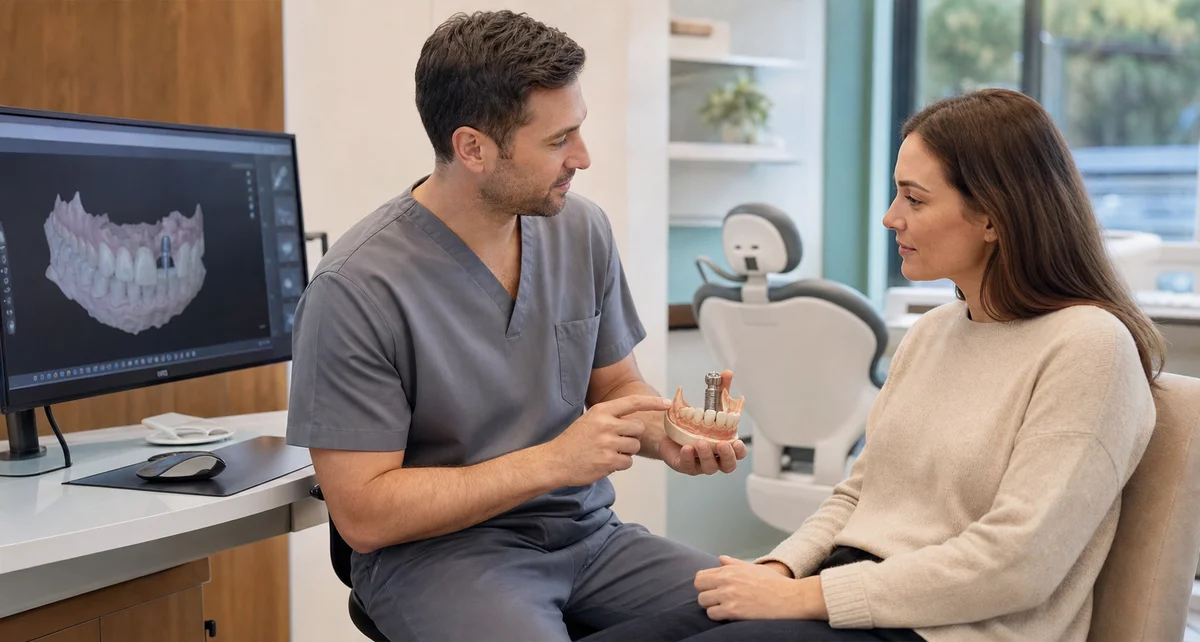
Quick answer: How much is it to have teeth implants depends on the number of missing teeth, bone and gum health, implant components, the final crown or bridge, diagnostics, anaesthesia and aftercare. A safe estimate follows an examination and imaging, then lists every included stage. Compare like-for-like written plans rather than an advertised starting price.
If you are searching how much is it to have teeth implants, the most useful answer is not a universal figure. Dental implant treatment is personalised surgery followed by a customised restoration. One person may need a single implant and crown after straightforward planning; another may require periodontal care, extraction, bone augmentation, several implants and a provisional bridge before the definitive teeth are made. Those are clinically different plans, even when both are marketed as “an implant.”
The US Food and Drug Administration describes dental implants as medical devices placed in the jaw to support artificial teeth such as crowns, bridges or dentures. It also separates the implant body from the abutment and the artificial tooth. That distinction matters when asking how much is it to have teeth implants: a headline price may refer only to the fixture, while a complete quotation should explain the surgical, restorative and maintenance phases.
This guide is designed to help you read a proposal safely. It does not diagnose suitability, promise a result or publish a fixed price. Currency, laboratory charges, regulations, material choices and clinical complexity change over time. Your dentist must assess your mouth and medical history before confirming what treatment is appropriate. If you are comparing care abroad, the same rule applies: the plan must be clear before travel, and it must include a realistic route for follow-up.
How much is it to have teeth implants when the “implant” has several parts?
When patients ask how much is it to have teeth implants, they often picture one complete replacement tooth. Clinically, the result can involve several products and appointments. The implant fixture sits in bone; an abutment connects the fixture to the restoration; and the visible crown, bridge or denture is produced for the patient. Imaging, surgical consumables, laboratory work and reviews sit around those core components.
A transparent quotation should state whether each of the following is included, excluded or not yet known:
- consultation, oral examination and review of medical history;
- two-dimensional X-rays or three-dimensional imaging when clinically indicated;
- removal of a failing tooth, if required;
- implant fixture, cover screw or healing component and abutment;
- bone or soft-tissue grafting, membranes and related surgical work;
- temporary tooth, provisional bridge or adjustment of an existing denture;
- definitive crown, bridge or implant-supported denture and laboratory fees;
- anaesthesia or sedation, medicines, reviews and professional hygiene;
- management of complications and the terms of any manufacturer support;
- long-term maintenance, replacement parts and access to urgent care.
Ask whether taxes, scans and laboratory stages are included in the same currency. If a line is provisional, request the condition that would make it necessary. This turns how much is it to have teeth implants from a vague shopping question into a clinical comparison you can actually use.
A 4-column decision table for comparing implant quotations
The following table does not rank treatments or providers. It helps you check whether two proposals cover the same scope. For every quotation, write down the answer and ask for clarification before paying a deposit.
| Decision area | What a complete proposal should identify | Why the total can change | Question to ask |
|---|---|---|---|
| Diagnosis | Examination, images and relevant medical information | Bone, gum, nerve or sinus findings may change the plan | Which findings are confirmed and which remain uncertain? |
| Replacement design | Number and position of implants plus the type of teeth supported | One crown, a bridge and a removable overdenture use different components | How many fixtures and replacement teeth are included? |
| Surgical preparation | Extractions, grafts, membranes or sinus procedures | Additional procedures add materials, appointments and healing time | Are preparatory procedures included or quoted separately? |
| Temporary stage | Whether and when a temporary tooth or bridge is supplied | Immediate provisional teeth are not suitable in every situation | What will I wear while the implant heals? |
| Final restoration | Material, retention method, laboratory and adjustment visits | Design, span, aesthetics and laboratory workflow differ | Is the definitive crown or bridge included? |
| Aftercare | Review schedule, hygiene, urgent support and maintenance | Professional care and replacement components create future costs | Which reviews are included, and for how long? |
Use this table whenever you revisit how much is it to have teeth implants. The lowest initial total may omit the restoration, provisional stage or aftercare. Conversely, a higher total may bundle services you do not need. Only a written, diagnosis-led comparison reveals the difference.
1. Number of missing teeth and the restoration design
The number of missing teeth does not always equal the number of implants. A single missing tooth may be restored with one implant and one crown. Several adjacent missing teeth might be restored with an implant-supported bridge, while an entire arch may use a carefully planned number of implants to retain a fixed or removable prosthesis. The correct design depends on available bone, bite, aesthetics, hygiene access and the distribution of forces.
That is why how much is it to have teeth implants cannot be calculated by multiplying a single advertised fee by the number of gaps. A full-arch proposal may include fewer fixtures than replacement teeth but more extensive laboratory work. A removable overdenture and a fixed bridge can also have very different components, cleaning needs and repair pathways. Ask for both the fixture count and the number and type of teeth being supplied.
The treatment plan should label each site and describe what will support the replacement teeth. If alternatives are suitable, the dentist can explain their advantages, limitations and effect on the overall scope. This is more meaningful than selecting an implant count before diagnostic imaging.
2. Examination, imaging and digital planning
Cost checkpoint: How much is it to have teeth implants depends on justified diagnostic needs.
An implant assessment considers oral health, medical history, medicines, smoking, gum condition, available space and the condition of neighbouring teeth. Standard dental radiographs may be used, and three-dimensional imaging may be clinically indicated to evaluate bone anatomy and nearby structures. Digital scans, photographs and planning guides can also support restorative design. Not every patient requires every technology, so the reason for each investigation should be explained.
If a proposal answers how much is it to have teeth implants before the necessary assessment, treat it as an estimate rather than a confirmed total. Diagnostic work can reveal active periodontal disease, infection, insufficient space or anatomy that changes the safest approach. Those findings are not “hidden extras”; they are reasons a final plan should follow proper examination.
Ask who interprets the images, whether the scan is included, and whether you will receive a copy of relevant records. A clear diagnostic fee is valuable because it supports informed consent and reduces the risk of planning from photographs alone.
3. Extractions, bone grafting and soft-tissue needs
Cost checkpoint: How much is it to have teeth implants changes when preparation is clinically necessary.
A damaged tooth may need removal before an implant can be considered. Some sites have adequate bone for straightforward placement; others may need ridge preservation, bone augmentation or a sinus-related procedure. Gum thickness and the position of the visible smile can also affect whether soft-tissue treatment is discussed. The need, material, timing and alternatives should be individualised.
When asking how much is it to have teeth implants, request separate lines for extractions and grafting. Do not assume a graft is always required, and do not assume an advertised package includes one. Ask what evidence supports the recommendation, what material is proposed, what healing interval is expected and what happens if the clinical finding differs during surgery.
Additional preparation can increase appointments and extend the route to the final teeth. It may be possible to combine stages in selected cases, but “same day” should never be treated as a universal promise. Biological stability and patient safety take priority over a marketing timetable.
4. Implant system, components and traceability
Cost checkpoint: How much is it to have teeth implants must include every specified component.
Implant systems include matched components produced for surgical and restorative use. Differences in system, dimensions, surface, abutment design and availability of replacement components can affect procurement and laboratory work. Brand alone does not determine clinical suitability, and a premium label cannot guarantee an outcome. What matters is a documented system chosen for the plan, placed by a suitably trained clinician and supported over time.
The FDA recommends asking which brand and model are used and keeping that information. Apply that practical advice when comparing how much is it to have teeth implants. Your proposal and final records should make the fixture and component identity traceable. Ask whether genuine compatible components are included and how replacements could be sourced if you move or need care elsewhere.
A very low fixture-only price may not include an abutment, healing component or final tooth. Confirm the exact unit described. The phrase “implant included” is not precise enough for informed financial consent.
5. Crown, bridge or denture material and laboratory work
Cost checkpoint: How much is it to have teeth implants includes the selected final restoration.
The visible teeth are custom restorations, not interchangeable accessories. Their cost can reflect the number of units, material, aesthetic characterisation, framework, retention method, digital or conventional workflow and the laboratory’s involvement. An implant crown in a highly visible front site may demand different design steps from a back tooth. A full-arch bridge has engineering, hygiene and repair considerations beyond those of one crown.
For a useful answer to how much is it to have teeth implants, determine whether the final prosthesis is included and exactly what it is. Ask whether the proposal covers impressions or scans, try-ins, temporary restorations, final insertion and reasonable adjustments. If material choices are offered, request an explanation of their clinical implications rather than choosing solely by price or appearance.
Also ask whether the restoration is screw-retained or cemented and how it can be maintained. Neither label alone proves superiority for every case; access, implant position, aesthetics and the restorative plan guide the decision.
6. Anaesthesia, sedation and medical preparation
Cost checkpoint: How much is it to have teeth implants can reflect different anaesthesia pathways.
Many implant procedures use local anaesthesia. Some patients may be offered sedation depending on anxiety, medical suitability, procedure length, local rules and clinician facilities. Sedation involves its own assessment, monitoring, recovery instructions and escort requirements. Medicines or coordination with a physician may also be relevant, but changes to prescribed medicine must only occur under appropriate professional guidance.
Ask whether anaesthesia is included when discussing how much is it to have teeth implants. If sedation is proposed, request the method, provider, monitoring, fasting guidance, recovery arrangements and separate fee. A price comparison is incomplete if one clinic quotes local anaesthesia and another includes a more resource-intensive sedation service.
Tell the dental team about health conditions, allergies, smoking, pregnancy, previous surgery and all medicines or supplements. The FDA notes that general health influences candidacy and healing, while smoking may impair healing and long-term success. No online estimate can replace that risk assessment.
7. Treatment timing, provisional teeth and additional visits
Cost checkpoint: How much is it to have teeth implants includes temporary stages and visits.
Implant care commonly unfolds in stages: assessment, any disease control or extraction, surgical placement, healing, restoration and maintenance. The FDA advises that healing of the implant body can take several months or longer. Individual timelines vary. Immediate placement or an immediate temporary tooth may be possible in selected conditions, but neither means the final restoration is finished that day.
Time affects how much is it to have teeth implants because it changes the number of appointments, temporary solutions, scans, adjustments and travel days. Ask for a best-current schedule with decision points rather than a guaranteed completion date. The plan should say what you will wear during healing, what foods or activities may be limited and when the final restoration can be considered.
If you live far from the clinic, calculate time away from work, accommodation, local transport and the possibility of an additional visit. These costs may not appear on the clinical invoice, but they belong in your personal budget.
8. Clinician, facility and laboratory responsibilities
Cost checkpoint: How much is it to have teeth implants reflects coordinated professional responsibilities.
Implant treatment can involve a restorative dentist, an implant surgeon, a periodontist, an oral and maxillofacial surgeon, a prosthodontist, dental nurses and laboratory technicians. Simpler cases and complex reconstructions require different expertise and coordination. The American College of Prosthodontists advises patients to ask about training, experience, alternatives, total treatment cost and follow-up maintenance.
When evaluating how much is it to have teeth implants, identify who performs each stage and who remains responsible for the complete result. Ask how the surgical and restorative plans are coordinated, where the procedure occurs, which laboratory makes the teeth and who handles an urgent problem. Credentials and an appropriate care pathway are more important than impressive social-media photographs.
Do not interpret a higher professional fee as proof of a better outcome, or a lower one as proof of poor care. Instead, verify licensure, relevant training, infection-control standards, documentation, communication and the clarity of consent.
9. Geography, currency and travelling for treatment
Fees differ across countries and cities because professional costs, laboratories, regulation, taxes, wages, rent, exchange rates and supply chains differ. A cross-border comparison should use the same clinical scope and the same date. Currency movement can change what you ultimately pay. Card fees, cash rules and refund terms may also matter.
For international patients asking how much is it to have teeth implants, add flights, transfers, accommodation, meals, insurance and potential return visits. Check passport and entry requirements through official channels. General travel insurance may exclude planned dental treatment or related complications, so read the policy wording rather than assuming cover.
At Redent Klinik’s English-language site, you can review the clinic context before requesting an assessment. A remote exchange of images may help organise an initial conversation, but it should be described as provisional. The definitive diagnosis and consent process depend on an in-person examination and appropriate imaging.
10. Aftercare, maintenance and the long-term budget
Cost checkpoint: How much is it to have teeth implants should include a maintenance strategy.
Implants do not remove the need for daily plaque control or professional review. The surrounding gums and bone can develop inflammation and disease, while screws, clips, crowns, bridges and dentures can wear or require repair. Cleaning access should be designed into the restoration, and the patient needs practical instructions and suitable tools.
A complete answer to how much is it to have teeth implants includes the ownership phase, not only placement day. Ask about routine reviews, professional cleaning, X-rays when clinically indicated, replacement of consumable components and likely laboratory repair routes. The interval should reflect your risk profile rather than a one-size-fits-all promise.
- Confirm who provides maintenance if you live in another country.
- Keep the implant system, dimensions and component records.
- Ask which symptoms require urgent contact and which number to use.
- Understand whether routine wear, accidental damage and biological complications are excluded from support terms.
- Budget for hygiene and future repairs even when the initial treatment is successful.
- Continue caring for natural teeth, gums and the implant restoration every day.
Be cautious with “lifetime guarantee” language. A manufacturer’s product warranty, a clinic’s service policy and the biological health of the patient are different matters. Request written definitions, exclusions and remedies.
11. Risks, suitability and why the cheapest plan may change
Benefits may include support for chewing and replacement teeth, but implants involve surgery and cannot be guaranteed. The FDA lists potential problems including damage to surrounding structures, inadequate function, loosening, implant-body failure, altered sensation and infection. Healing and long-term performance depend on multiple patient and treatment factors.
Therefore, how much is it to have teeth implants should never be answered by ignoring active gum disease, uncontrolled health issues or insufficient diagnostic information. Stabilising disease or seeking medical coordination may add time and care, yet proceeding without appropriate risk management can create greater harm and expense. A responsible clinician may also advise that an implant is not currently suitable.
Ask what alternatives exist: a conventional bridge, adhesive bridge, partial denture, complete denture, retention of a restorable tooth or leaving a space may be considered in different circumstances. Each option has trade-offs for adjacent teeth, comfort, function, maintenance, longevity and future treatment. The right comparison is clinically eligible options, not implant versus “doing nothing” in the abstract.
12. How to request a personalised, auditable estimate
Before contacting a clinic, collect relevant dental records, a list of medicines, significant health information and a concise description of what troubles you. Do not conceal smoking or previous complications. Photographs and existing X-rays may support an initial discussion, but new or additional images may still be needed if clinically justified.
Use the following checklist when you ask how much is it to have teeth implants:
- What diagnosis and treatment objective does this proposal address?
- Which teeth are removed, retained or replaced?
- How many implant fixtures, abutments and prosthetic teeth are included?
- Which investigations and preparatory procedures are included?
- What temporary and definitive restorations are supplied?
- Who completes each stage, and where?
- What is excluded, provisional or payable only if required?
- What schedule, healing checkpoints and travel visits are expected?
- What aftercare, maintenance and urgent support are available?
- What alternatives are clinically reasonable, and why?
For a case-specific discussion, use the Redent Klinik contact page. The team can explain what information is useful before a visit. Any preliminary indication should remain conditional until clinical assessment. This is the safest way to convert how much is it to have teeth implants into an itemised plan with understandable assumptions.
Frequently asked questions about implant costs
How much is it to have teeth implants for one missing tooth?
How much is it to have teeth implants for one gap still depends on more than the fixture. The proposal may include assessment, imaging, extraction, grafting, implant placement, an abutment, a temporary tooth, the definitive crown and reviews. Ask for an itemised written total after examination. Do not compare a fixture-only advertisement with a complete implant-and-crown plan.
Is a crown normally included in an implant price?
Not always. “Implant” may refer only to the device placed in bone, while the abutment and crown are separate. When checking how much is it to have teeth implants, ask the clinic to name every component, laboratory stage and visit. The quotation should say whether the visible definitive tooth and reasonable adjustments are included.
Why can the estimate change after a scan?
Imaging can reveal bone volume, anatomy, infection or other factors that were not visible in photographs or a brief remote conversation. Those findings may alter implant position, preparatory treatment, component selection or timing. A preliminary answer to how much is it to have teeth implants should therefore be clearly labelled as provisional until assessment is complete.
Does dental insurance pay for implants?
Coverage varies by insurer, country, policy, waiting period, annual limit and the reason for treatment. Some plans exclude implants, cover only part of the restoration or apply a missing-tooth clause. Ask the insurer for written pre-authorisation using the dentist’s itemised codes. When budgeting how much is it to have teeth implants, do not treat an informal phone answer as guaranteed reimbursement.
Are implants routinely available through the NHS?
The NHS says implants are only sometimes available, for example when a patient cannot wear dentures for particular reasons such as effects of mouth cancer or an accident. Eligibility and commissioning are specific; private treatment is separate from NHS entitlement. This illustrates why how much is it to have teeth implants depends on the health system and individual pathway rather than one global fee.
Can all treatment be completed in one trip?
Not reliably for every patient. Implant healing can take months, and definitive teeth may follow biological and restorative checkpoints. Some selected cases may receive an immediate provisional restoration, but that is not the same as universal final treatment in one day. Include possible return travel when calculating how much is it to have teeth implants.
What records should I receive after treatment?
Ask for your treatment summary, relevant images, implant brand and model, site and dimensions, component information, restoration description and aftercare instructions. Keep invoices and support terms too. These records help another clinician identify parts and understand the history, protecting the long-term value behind how much is it to have teeth implants.
How do I compare a low advertised price safely?
First identify what the advertisement includes. Then compare diagnostics, fixture and abutment, surgery, grafting, temporary teeth, definitive restoration, anaesthesia, reviews, maintenance and taxes in the same currency. If the provider cannot explain exclusions or assess suitability, the advertisement cannot answer how much is it to have teeth implants for you.
Patient-safe conclusion
The sound answer to how much is it to have teeth implants is an itemised plan grounded in examination, imaging and informed consent. Count the complete pathway: disease control, surgery, components, provisional and definitive teeth, healing, travel, maintenance and a route for complications. Avoid fixed promises and pressure to decide before the diagnosis is clear.
A lower total can be appropriate when the scope is genuinely simpler; a higher total can be appropriate when the plan is more extensive. Neither number proves quality. Use traceable components, clinician credentials, written responsibilities, realistic timing and aftercare to judge value. Most importantly, choose among treatments that a qualified dental professional considers suitable for your health, anatomy and goals.
Sources and clinical reference points
These authoritative pages support the safety and planning principles in this guide. They do not provide a personal diagnosis or a Redent Klinik quotation.