
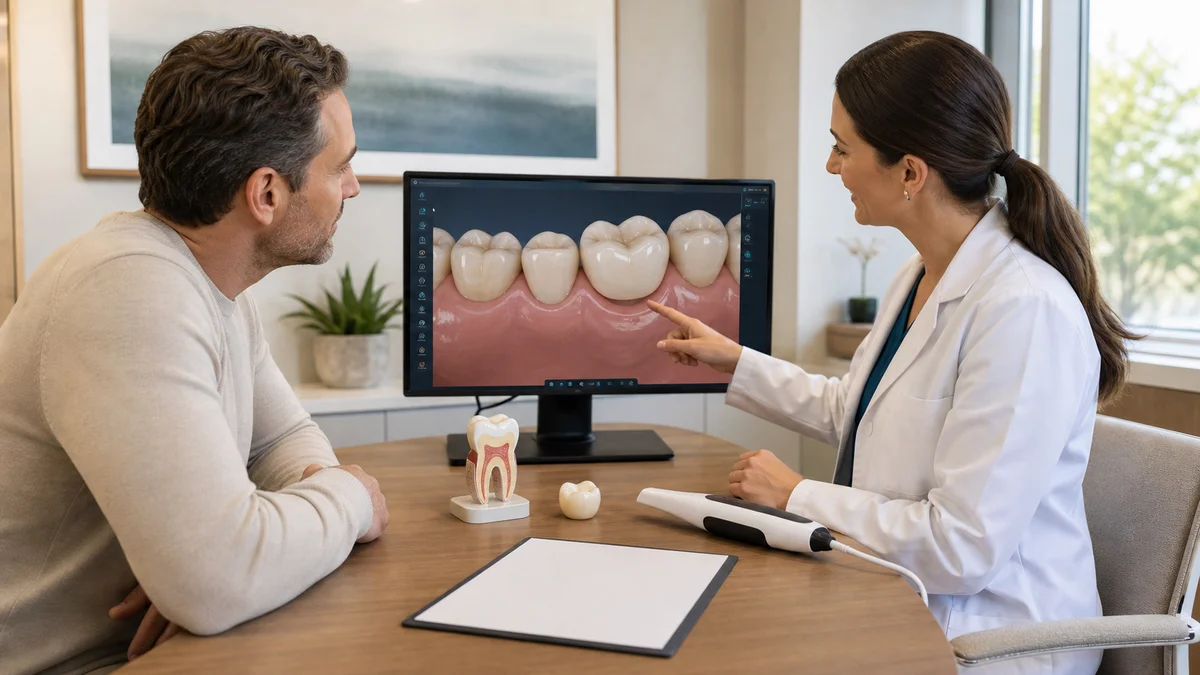
The search phrase how much is tooth crown without insurance usually expresses two needs at once: a person wants a realistic self-pay plan and wants to know what the word “crown” actually includes. A responsible answer cannot be one universal number. A natural-tooth crown is a clinical pathway involving diagnosis, preparation, a provisional restoration in many cases, laboratory or chairside fabrication, fitting, and follow-up. The condition of the tooth, material, location, provider, local market, and any separate foundation or pulp treatment can all change the scope.
This guide is educational, not a diagnosis or personal estimate. It focuses on a crown placed over a natural tooth, not a crown attached to a dental implant. It also avoids treating a low advertised starting figure as the final cost. The most useful response to how much is tooth crown without insurance is a method for defining the same scope across providers, protecting urgent health needs, and understanding the long-term responsibilities of the restored tooth.
What “Tooth Crown” Means Before You Compare Price
In anatomy, the crown is the part of a tooth normally visible above the gum. In restorative dentistry, a crown is a restoration designed to cover and support a prepared tooth. The American Dental Association’s patient information explains that crowns may strengthen teeth with large fillings, protect weak teeth, restore broken teeth, support bridges, or cover implants. Those indications are not interchangeable. A crown for a heavily restored molar, a crown for a fractured front tooth, and an implant crown involve different planning.
When asking how much is tooth crown without insurance, state that you mean a tooth-supported crown if a natural root remains. Ask whether the proposed fee is for the crown alone or the whole restorative episode. A price for an implant crown might exclude the implant and abutment; a price for a natural-tooth crown might exclude a core build-up or necessary treatment of the pulp. Mixing those categories makes comparisons unreliable.
- Natural-tooth crown: covers a prepared natural tooth and depends on how much healthy structure remains.
- Implant crown: attaches to an implant restoration and may require a separate abutment and different components.
- Bridge retainer: may look like a crown but also forms part of a multi-unit tooth replacement.
- Temporary or provisional crown: protects the prepared tooth during a defined stage and is not automatically the final restoration.
A clinic should be able to explain which category applies after suitable assessment. Photographs can help with an initial discussion, but they cannot establish decay depth, cracks, pulp health, periodontal support, bite forces, or whether the tooth is restorable. That is why how much is tooth crown without insurance should lead to an examination-based estimate rather than an instant promise.
Why How Much Is Tooth Crown Without Insurance Has No Single Answer
The final scope is built from clinical need and delivery choices. Geography affects staffing, rent, laboratory relationships, regulation, and overhead. The tooth itself may require a straightforward replacement of an old restoration, or it may need careful stabilization before a crown can be considered. Material choice is only one variable, and the most expensive material is not automatically the most suitable.
A quote for how much is tooth crown without insurance can change when diagnostic evidence reveals a separate condition. For example, removal of an old crown may expose decay or a fracture that was not completely visible beforehand. A dentist should explain foreseeable uncertainties, which services are already included, which events could change the plan, and when consent would be renewed. An estimate is therefore a planning document rather than a result guarantee.
The useful comparison is “same tooth, same clinical scope, same inclusions, same follow-up,” not merely the largest number printed on a discount. In a self-pay setting, ask each office to identify its assumptions. If one estimate includes a provisional, laboratory fee, cementation, and an adjustment visit while another lists only the final crown, the totals are not comparable. This distinction is central to answering how much is tooth crown without insurance safely. Record each answer beside the exact question how much is tooth crown without insurance so exclusions remain visible.
How Much Is Tooth Crown Without Insurance Across 10 Cash-Care Stages?
The following ten stages turn a vague price search into a checkable care pathway. Not every patient requires every additional service, and some clinics combine stages into one fee. Use the sequence to ask where each item appears in the estimate.
Stage 1: Assessment and urgency screening
The first stage determines whether a crown is appropriate and whether pain, swelling, trauma, or another condition needs earlier attention. A focused examination is not a sales formality. It helps distinguish a repairable restoration, a crown candidate, a tooth that may need another service, or a tooth that may not be predictably restorable. For how much is tooth crown without insurance, confirm whether the consultation and emergency assessment are included or billed separately.
Stage 2: Diagnostic records
Relevant records may include dental radiographs, photographs, a bite assessment, periodontal findings, vitality testing, or a digital scan. The record set should be proportionate to the clinical question. More imaging is not automatically better; each record should have a purpose. Ask who interprets it and whether copies can be provided. Any response to how much is tooth crown without insurance is provisional until essential records are reviewed.
Stage 3: Restorability and alternatives
The dentist evaluates remaining tooth structure, decay, existing restorations, cracks, gum and bone support, margin access, and functional load. The discussion should include reasonable alternatives and the likely consequence of delaying care. A filling, onlay, crown, pulp-related service, periodontal management, or extraction may be considered in different circumstances. A crown is not automatically the correct answer because a tooth is damaged. A sound how much is tooth crown without insurance plan explains why the selected option fits the findings.
Stage 4: Foundation or core planning
A weakened tooth may require a core build-up to replace missing structure before crown preparation. A post may be considered only in selected root-treated teeth; it does not strengthen every tooth and is not an automatic crown component. Ask whether the estimate assumes the foundation is adequate or lists a conditional build-up. When comparing how much is tooth crown without insurance, do not assume the words “complete crown” include every foundation procedure.
Stage 5: Material and design selection
Ceramic, metal-containing, and other designs have different optical, mechanical, preparation, and laboratory considerations. Tooth position, remaining structure, bite, available space, opposing material, gum-line appearance, allergies, and maintenance influence selection. Brand language alone does not prove quality. A useful how much is tooth crown without insurance estimate names the proposed material or design and states whether an upgrade changes the fee.
Stage 6: Tooth preparation and records for fabrication
At this stage the tooth is prepared according to the selected restoration, and an impression or digital scan is made. Local anesthetic and isolation may be involved. The dentist must balance room for the restoration with preservation of tooth structure. Ask whether preparation, scanning or impression materials, and bite records are within the quoted scope. These details help interpret how much is tooth crown without insurance without turning a technical choice into a marketing claim.
Stage 7: Provisional protection
When the final crown is not delivered at the same appointment, a provisional restoration may protect the prepared tooth, maintain position, and support comfort and appearance. It has limits and may loosen, fracture, or require adjustment. Ask whether fabrication, recementation, or replacement of a provisional is included and what to do if it fails. For how much is tooth crown without insurance, a quote that omits this stage may not reflect the complete treatment interval.
Stage 8: Laboratory or chairside fabrication
Some crowns are fabricated through an external or in-house laboratory; some workflows use chairside milling. Either approach needs a suitable design, material, fit evaluation, and quality control. “Same day” is a scheduling description, not proof that a crown is better for every tooth. Ask whether laboratory charges, characterization, remakes under defined conditions, or expedited work are included. The answer to how much is tooth crown without insurance should reveal these production assumptions.
Stage 9: Try-in, fitting, and cementation
The clinical team evaluates fit, contacts, bite, appearance where relevant, and cleans the restoration and tooth according to the chosen protocol. Patient feedback matters, especially for visible teeth, but biological fit and function cannot be judged from color alone. Ask what happens if the crown cannot be accepted at try-in. The how much is tooth crown without insurance estimate should state whether necessary routine adjustments and cementation are included.
Stage 10: Follow-up and maintenance
A crown still needs brushing, interdental cleaning, appropriate preventive care, and professional review. The tooth can develop decay at the margin, gum inflammation, sensitivity, fracture, or pulp problems; the crown can chip, loosen, or wear. No fixed lifespan can be guaranteed. Ask which early review is included and how future maintenance is charged. A complete how much is tooth crown without insurance decision considers service after delivery, not only payment on the preparation date.
Decision Table: Compare the Same Natural-Tooth Scope
Use this table before choosing between estimates. It is not a price list; it is a scope comparison. Mark an item “confirmed” only when the clinic provides the answer in writing.
| Quote format | What may be included | What to verify | Best decision question |
|---|---|---|---|
| Crown-only fee | Preparation, final restoration, and cementation | Exam, records, foundation, provisional, laboratory, adjustments | “Which necessary stages would create a separate charge?” |
| Bundled natural-tooth pathway | Several routine stages in one total | Exact material, exclusions, remake policy, follow-up period | “Please identify every included item and every exclusion.” |
| Conditional or phased estimate | Known work plus alternatives if findings change | Triggers, approval process, timing, maximum exposure | “What evidence activates each conditional line?” |
For a fair how much is tooth crown without insurance comparison, put all three quote formats into the same checklist. A bundled estimate can be convenient but vague; an itemized estimate can be transparent but appear longer. Neither format is inherently cheaper. What matters is whether the clinical plan, inclusions, conditions, and total payment obligations are understandable.
Ten Factors That Can Change the Self-Pay Scope
People often expect material to be the only cost driver. In practice, the starting condition and care pathway may matter more. The following factors should be considered when reviewing how much is tooth crown without insurance:
- Tooth position: front teeth may have demanding shade and contour needs, while back teeth face different chewing forces.
- Remaining structure: extensive loss can change foundation design and prognosis.
- Existing crown or restoration: removal may reveal previously hidden damage.
- Pulp status: symptoms and tests may indicate a separate assessment; root canal treatment is not automatic.
- Gum and bone health: inflammation or margin access can affect timing and planning.
- Bite and grinding: functional load may influence design and maintenance advice.
- Material and aesthetics: shade matching, characterization, and laboratory complexity vary.
- Provisional requirements: location and treatment interval may change provisional care.
- Provider and laboratory model: chairside, local laboratory, and external laboratory workflows differ.
- Aftercare: adjustment, review, protective appliances, and future repair may be separate.
These are variables, not reasons to accept an unlimited bill. The written estimate should distinguish known services from genuine contingencies. If how much is tooth crown without insurance changes after treatment begins, ask what new clinical finding caused the change, what alternatives exist, and whether non-urgent work can pause while you consider the information.
How to Read an Itemized Crown Estimate
A strong estimate connects clinical language with financial language. It should identify the tooth, proposed restoration, material or design where known, appointments, included records, provisional care, laboratory work, and follow-up. It should also state the amount due, deposit timing, cancellation rules, expiration date, and whether a third party will bill separately. This turns how much is tooth crown without insurance into a document you can audit.
When documenting how much is tooth crown without insurance, request separate lines for services that are possible but not yet confirmed. A conditional line is more useful than pretending uncertainty does not exist. Ask whether taxes or facility charges apply in the relevant jurisdiction, whether the quote assumes a particular payment method, and whether the clinic offers a self-pay adjustment. Do not sign a financing agreement merely because an estimate is described as urgent.
- Verify the tooth number and whether the crown is tooth-supported.
- Confirm which diagnostic records and anesthetic services are included.
- Ask whether a core build-up, post, old-crown removal, or provisional is separate.
- Identify the material, laboratory arrangement, and expected appointment sequence.
- Request the policy for routine adjustment, laboratory remake, cancellation, and refund.
- Ask what new finding could change the plan and how consent will be obtained.
- Keep copies of the estimate, consent, receipts, and financing disclosure.
The NHS’s current patient information provides a useful transparency example within its own system: patients receiving Band 2, Band 3, or mixed NHS/private care should receive a written treatment plan, and changes should be discussed. That rule does not set a worldwide private price, but it illustrates why a written scope matters when investigating how much is tooth crown without insurance.
Lower-Cost Paths for How Much Is Tooth Crown Without Insurance
Lower cost should mean a verified, clinically appropriate pathway with a clear scope. The ADA’s patient resource suggests asking about office membership arrangements and exploring federally qualified health centers, dental schools, eligible government programs, and nonprofit resources. Availability, waiting lists, eligibility, materials, specialist access, and crown services vary. A resource can be legitimate without offering every treatment.
HRSA states that community health centers may see people with or without insurance and may adjust charges according to a sliding-fee scale. That does not mean every service is free or that every center provides crowns. Laboratory and supply charges may be treated differently, so confirm the dental service, eligibility documents, outside-laboratory cost, referral process, and current capacity directly. For how much is tooth crown without insurance, a screening visit at a lower-cost setting may still yield a separate definitive-restoration fee.
Dental schools can provide supervised care, but appointment duration, case selection, calendars, and referral pathways differ. Office membership plans are not automatically insurance and may apply only within one practice. Discount arrangements can have exclusions, renewal conditions, or participating-provider limits. Ask for written terms and do not assume that a discounted crown includes related services. The safest how much is tooth crown without insurance strategy compares the total pathway and your ability to complete it.
Insurance and Public-Program Checks Before Self-Pay
“Without insurance” can mean truly uninsured, temporarily waiting for coverage, out of network, or facing an exclusion. Before committing to full self-pay, verify your exact status. HealthCare.gov explains that adult dental coverage is not an essential health benefit under Marketplace rules; some health plans include it and separate dental plans may be offered, sometimes with waiting periods. Buying new coverage after diagnosis therefore may not make immediate crown care payable.
CMS states that Original Medicare generally excludes routine dental services, with defined exceptions when dental care is inextricably linked to certain covered medical services. Some Medicare Advantage plans may offer additional dental benefits, but plan terms vary. Medicaid adult dental benefits also vary by state because there is no federal minimum requirement for adult dental coverage. These rules mean how much is tooth crown without insurance cannot be answered by assuming a national benefit.
Call the insurer or program using the number on official documents. Ask about network status, waiting period, deductible, annual maximum, frequency or replacement limits, preauthorization, material downgrades, and whether foundation services use separate codes. A benefit estimate is not a guarantee of payment. Keep a self-pay alternative because the final patient balance can differ. The question how much is tooth crown without insurance remains relevant even when a limited benefit exists.
Financing: Compare Total Repayment, Not the Monthly Figure
Some clinics offer installments; others connect patients with medical or dental credit cards. The Consumer Financial Protection Bureau warns that some products use deferred interest. If a promotional balance is not fully paid by the deadline—or if stated conditions are missed—interest can be charged under the agreement. A low monthly amount can therefore obscure a much larger total obligation.
Before financing how much is tooth crown without insurance, request the annual percentage rate, promotional end date, payment schedule, fees, late-payment consequences, total repayment, credit-reporting terms, and refund process. Calculate whether the scheduled payment actually clears the balance before any deferred-interest deadline. Ask what happens if the clinical plan changes, the crown is not placed, or a refund is sent to the lender.
- Compare the cash price and financed price for the identical treatment scope.
- Read whether “no interest if paid in full” is deferred interest rather than a true zero-percent period.
- Do not use financing approval as evidence that treatment is necessary or appropriately planned.
- Keep the financing contract separate from clinical consent and ask questions about both.
- Leave room in the budget for travel, time away from work, maintenance, and possible future care.
If repayment would jeopardize essential expenses, ask whether clinically safe phasing, another restorative option, a second opinion, or a verified lower-cost program is reasonable. The clinician must explain the risks of delay. Financial pressure should not convert how much is tooth crown without insurance into a rushed decision.
A Current Public-System Contrast: NHS England in 2026
For context, NHS England lists a Band 3 patient charge of £332.10 for the 2026–27 charging period, and crowns are among treatments that may fall within Band 3 when clinically necessary and provided under NHS rules. This is not a global market price, a private-clinic quote, or evidence that every person is eligible for an NHS crown. Exemptions, availability, clinical eligibility, mixed care, and location matter.
This example is useful because it demonstrates why how much is tooth crown without insurance depends on the care system. A regulated patient charge in one public system cannot be transplanted into a U.S. self-pay estimate, a Turkish private plan, or another country’s benefit design. Always check the official page for the relevant date and jurisdiction rather than relying on an old price article.
Dental Travel and the True Door-to-Door Cost
International care may be considered when local self-pay access is difficult, but the treatment fee is only one part of the decision. Add travel, accommodation, local transport, time away from work, companion costs if needed, records, medicines when prescribed, and a contingency for schedule changes. Also ask who manages sensitivity, a loose provisional, bite adjustment, or a complication after returning home.
For travel-based how much is tooth crown without insurance planning, request the clinician’s identity and credentials, material and laboratory information, appointment sequence, language support, written consent, records transfer, maintenance plan, and emergency contact route. A remote review can organize information but cannot confirm restorability or guarantee treatment. Do not book non-refundable travel around a promised outcome.
People independently evaluating Türkiye can review the Redent Klinik English information page and use the Redent Klinik English contact page to request an individualized discussion and itemized proposal. These links do not replace an examination, and no article can decide whether a crown is appropriate for a particular tooth.
Price Red Flags That Deserve a Pause
A good clinic does not need to promise the cheapest crown, a painless experience, a lifetime result, or universal suitability. Pause if the seller refuses to identify the treating dentist, discourages questions, will not provide an itemized plan, demands immediate financing, or guarantees that no additional assessment can be needed. A large discount timer is not clinical evidence.
Also pause if the response to how much is tooth crown without insurance treats root canal treatment, posts, or extraction as automatic before appropriate diagnosis. Beware of a crown recommended from a photograph alone, a quote that changes materially without an explanation, or a plan that ignores active gum disease and cleaning access. Seek a second opinion when the recommendation or prognosis remains unclear. A second written answer to how much is tooth crown without insurance is most useful when both clinicians assess comparable records.
When Cost Comparison Must Wait for Urgent Care
Price research should not delay urgent assessment for spreading facial or neck swelling, difficulty breathing or swallowing, uncontrolled heavy bleeding, serious facial trauma, loss of consciousness, or another major systemic emergency. Contact local emergency services when airway, breathing, or severe injury is involved. Fever, rapidly increasing swelling, severe persistent pain, or a broken tooth with significant symptoms also deserves prompt professional triage.
Do not place aspirin against a tooth or gum, do not use leftover antibiotics, and do not attempt to glue a crown with household adhesive. A lost crown can expose a sensitive or vulnerable tooth; keep the restoration if safe, avoid chewing hard foods on the area, and contact a dentist. In urgent circumstances, the first answer to how much is tooth crown without insurance may be the cost of safe assessment and stabilization before definitive treatment.
Frequently Asked Questions About How Much Is Tooth Crown Without Insurance
Can a dentist answer how much is tooth crown without insurance by phone?
A clinic may describe a starting range or its fee structure, but a reliable individual estimate normally requires appropriate examination and records. Ask what the telephone figure assumes, which stages it includes, and what could change it. Treat any remote number as preliminary, particularly when there is an old crown, pain, a fracture, or uncertain restorability.
Does how much is tooth crown without insurance include a root canal?
Usually, you should not assume so. Root canal treatment is a separate procedure and is not automatically needed for every crowned tooth. It may be considered when symptoms and clinical tests support that diagnosis. Ask for separate lines, the reason it is recommended, the provider involved, and whether the crown timing depends on the tooth’s response.
Is a core build-up included in how much is tooth crown without insurance?
Inclusion varies. A core build-up replaces missing tooth structure so a crown can be supported, but not every tooth needs the same foundation. Ask whether the estimate includes it, lists it as conditional, or assumes an existing foundation is adequate. The dentist should explain what finding makes it necessary.
Are same-day crowns cheaper for self-pay patients?
Not necessarily. Chairside fabrication and laboratory fabrication use different equipment and workflows, but appointment count alone does not determine total value or suitability. Compare the material, preparation, provisional need, fitting, adjustments, follow-up, and complete fee. Choose the workflow that fits the tooth and clinical plan rather than a scheduling label.
Can I negotiate how much is tooth crown without insurance?
You can respectfully ask whether the office has a published self-pay policy, membership arrangement, prompt-payment adjustment, or clinically appropriate phased plan. Request the terms in writing and compare the same scope. A discount should not depend on removing necessary safety steps or accepting treatment before you understand the diagnosis, alternatives, risks, and follow-up.
Will a community health center provide the crown?
Possibly, but services and capacity vary. HRSA says community health centers may serve people regardless of insurance status and may use sliding fees. Confirm that the location provides adult dental care, whether crowns are offered, how laboratory charges are handled, which documents are required, and whether a referral or waiting list applies.
Does the lowest answer to how much is tooth crown without insurance offer the best value?
No. Value includes correct diagnosis, conservation of tooth structure, material and design suitability, cleanable margins, laboratory quality, informed consent, records, provisional protection where needed, and accessible follow-up. The lowest number may exclude important stages; the highest number does not guarantee quality. Compare evidence, scope, accountability, and total obligations.
How long will a tooth crown last?
No ethical provider can promise a fixed lifespan. Remaining tooth structure, decay risk, gum health, bite, grinding, material, fit, hygiene, diet, trauma, and review care influence service. Ask how to clean the margin, what symptoms need attention, whether a protective appliance is relevant, and how future repair or replacement would be handled.
Can I delay the crown while saving money?
That depends on the diagnosis and risk. Ask the dentist what may happen if treatment is delayed, whether a temporary measure is clinically safe, how long it is intended to last, and which symptoms require escalation. A temporary restoration is not necessarily a durable substitute. Do not postpone urgent care because of an online price comparison.
What documents should I keep after comparing estimates?
Keep the examination summary, radiograph or scan information when provided, itemized treatment plan, material description, consent, payment schedule, cancellation and refund terms, receipts, financing contract, and follow-up instructions. Written records make how much is tooth crown without insurance easier to compare and help future clinicians understand what was planned and completed.
A Safer Final Checklist
Before accepting treatment, make sure you can describe the problem in plain language, why a crown is proposed, what alternatives exist, what remains uncertain, and what the complete financial scope contains. You should know the provider, tooth, material or design, stages, number of visits, provisional plan, follow-up route, and payment conditions. If any answer is unclear, pause and request clarification.
The best answer to how much is tooth crown without insurance is not a universal number. It is an examination-based, itemized plan that separates the natural-tooth crown from possible additional services and lets you compare the same pathway across providers. Protect urgent health first, verify official assistance and benefit rules, understand credit terms, and choose a plan you can complete and maintain.
Authoritative Sources
- American Dental Association MouthHealthy: Dental Crowns
- American Dental Association MouthHealthy: Tooth Anatomy
- American Dental Association MouthHealthy: Finding Affordable Dental Care
- American Dental Association: Financial Payment Options
- U.S. Health Resources and Services Administration: Find a Health Center
- U.S. Health Resources and Services Administration: Affordable Care Eligibility
- Consumer Financial Protection Bureau: Medical Credit Cards and Payment Plans
- Consumer Financial Protection Bureau: Deferred Interest
- Centers for Medicare & Medicaid Services: Medicare Dental Coverage
- Medicaid.gov: Dental Care for Adults
- HealthCare.gov: Dental Coverage
- NHS: Current NHS Dental Charges in England
- NHS: What Happens at a Dental Visit and Written Treatment Plans
- World Health Organization: Oral Health Fact Sheet
Official pages reviewed in August 2026. Program rules, charges, access, benefits, and financing terms can change; verify the current source and your individual eligibility directly.