
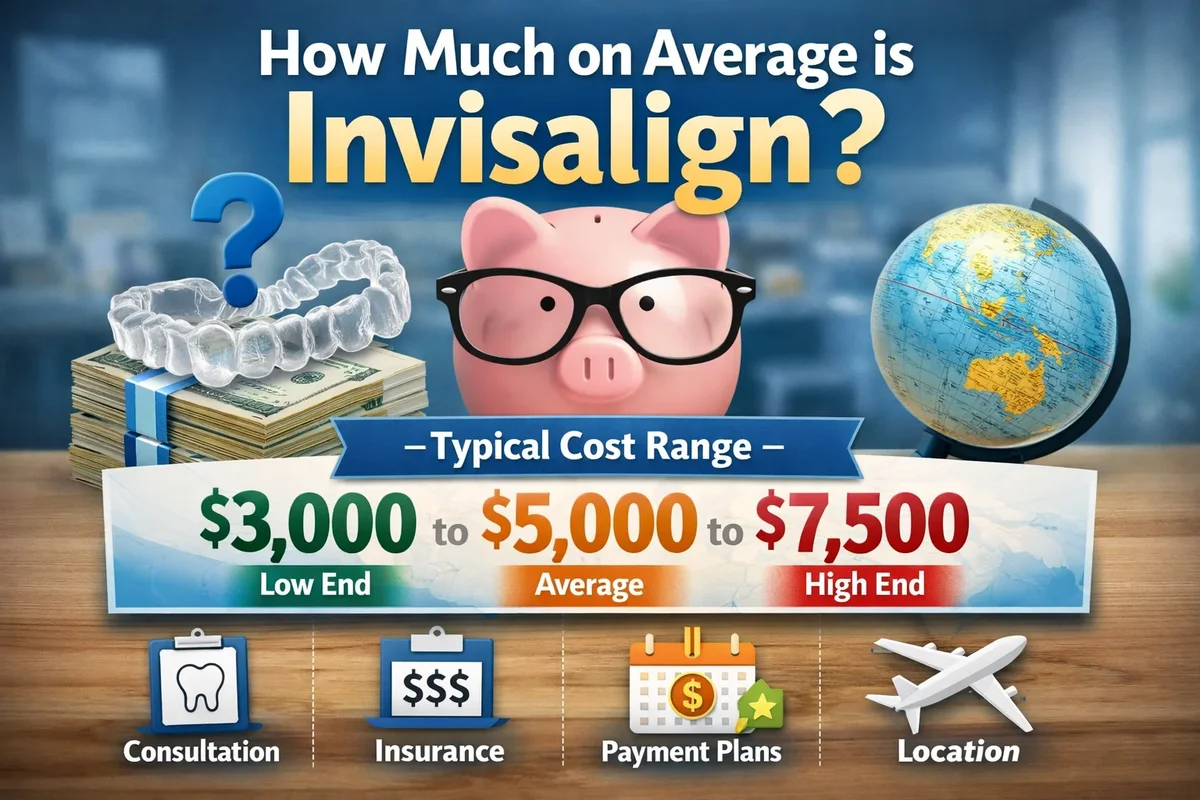
If you are considering clear aligners to straighten your teeth, one of the first questions that likely comes to mind is: how much on average is Invisalign? 💬 This is a completely natural concern. Orthodontic treatment is an investment in your health, confidence, and long-term oral function, so understanding the cost in advance helps you plan wisely. In this detailed guide, we will explore exactly how much on average is Invisalign, what influences the total price, and what you can expect when starting treatment.
So, how much on average is Invisalign in 2026? In the United States, the typical cost ranges between $3,000 and $7,000. According to general market data and orthodontic fee averages, most patients pay around $5,000 for a comprehensive Invisalign treatment. However, the exact answer to how much on average is Invisalign depends on several key factors, including treatment complexity, provider expertise, and geographic location.
Let’s break this down more clearly. If you have mild crowding or small spacing issues, your Invisalign treatment may fall closer to the lower end of the spectrum—often between $3,000 and $4,500. On the other hand, if you require full bite correction, significant tooth movement, or longer treatment duration, the cost can rise toward $6,000–$7,000 or more. This is why the question how much on average is Invisalign does not have a single fixed answer.
Another important factor influencing how much on average is Invisalign is treatment duration. Invisalign works by gradually shifting teeth using a series of custom-made clear aligners. The more aligners you need, the more complex your case is likely to be. A short treatment lasting 6–9 months will usually cost less than a comprehensive 18–24 month orthodontic plan.
Provider experience also plays a role in determining how much on average is Invisalign. Orthodontists or dentists with advanced Invisalign certification and extensive case experience may charge slightly higher fees. However, their expertise can also lead to more predictable results and fewer complications. Choosing a highly trained provider often ensures better value for your investment.
When asking how much on average is Invisalign, many patients also wonder whether the price includes all necessary components. In most cases, the total treatment fee covers:
- Initial consultation and digital 3D scan
- Custom aligner fabrication
- Regular follow-up appointments
- Attachments (small tooth-colored buttons)
- Refinement aligners if needed
- Final retainers after treatment
However, it is always important to confirm exactly what is included in your treatment plan. Asking detailed questions during your consultation will help clarify how much on average is Invisalign in your specific situation.
Insurance coverage can also influence how much on average is Invisalign for you personally. Many dental insurance plans that include orthodontic benefits may cover between $1,000 and $3,000 of the treatment cost. This can significantly reduce your out-of-pocket expense. It is wise to check with your insurance provider or speak to your clinic’s financial coordinator before starting treatment.
Some patients also explore alternative locations for treatment. For example, dental clinics in countries with lower operational costs may offer more competitive pricing. If you are considering treatment abroad, you can contact the clinic directly through the Redent Klinik Contact Page to receive a personalized consultation and cost breakdown.
Beyond price alone, it is important to consider value. When evaluating how much on average is Invisalign, remember that Invisalign offers nearly invisible aligners, removable convenience, easier oral hygiene, and advanced digital treatment planning. Compared to traditional braces, many adults prefer Invisalign because it fits seamlessly into professional and social life. 😊
For trusted oral health information, you can also review general orthodontic resources from the American Dental Association, which provides guidance on dental treatments and patient care standards.
In summary, how much on average is Invisalign typically ranges from $3,000 to $7,000 in the United States, with an average around $5,000. However, your personal cost depends on case complexity, treatment duration, provider experience, and insurance coverage. The best way to get an accurate estimate is through a professional consultation that includes digital scanning and a customized treatment plan.
If you are seriously considering clear aligner therapy, the next logical step is scheduling a consultation. Only after examining your teeth and bite can a dentist or orthodontist give you a precise answer to how much on average is Invisalign for your unique smile. 🦷✨
How Much on Average Is Invisalign for Adults?
When adults begin researching clear aligners, the first and most important financial question they ask is: how much on average is Invisalign for someone in their situation? 🦷 Adults often have different orthodontic needs compared to teenagers, which can influence overall pricing. Understanding how much on average is Invisalign for adults requires looking at treatment complexity, lifestyle factors, and long-term oral health goals.
For most adult patients in the United States, how much on average is Invisalign typically falls between $4,000 and $7,500. The national average remains around $5,000–$6,000. However, adults are more likely to require comprehensive correction rather than minor alignment adjustments, which is why their costs may sit on the higher end of the spectrum.
Why Adult Invisalign Treatment May Cost More
Many adults did not receive orthodontic care during adolescence, or they experienced relapse after braces. As a result, their bite issues can be more complex. When evaluating how much on average is Invisalign for adults, dentists consider:
- Moderate to severe crowding
- Overbite, underbite, or crossbite corrections
- Spacing from missing teeth
- Previous orthodontic relapse
- Restorative needs (crowns, implants, fillings)
These factors directly impact how much on average is Invisalign because they determine the number of aligners required and the total treatment duration. A simple 6-month case will cost significantly less than an 18–24 month full bite correction.
Treatment Duration and Its Impact on Cost
Adults often need between 12 and 24 months of treatment. The longer your case, the more aligner trays are required. Since Invisalign pricing is largely based on case complexity and lab fees, longer treatment plans increase how much on average is Invisalign for that individual. For example:
- Mild case (6–9 months): $4,000–$4,800
- Moderate case (12–18 months): $5,000–$6,500
- Complex case (18–24+ months): $6,000–$7,500+
This breakdown helps clarify how much on average is Invisalign depending on the severity of alignment issues.
Does Age Itself Affect How Much on Average Is Invisalign?
Age alone does not directly increase how much on average is Invisalign. However, adults may have additional dental considerations such as gum recession, bone density changes, or previous dental work. These factors can require more detailed planning and monitoring.
For example, if an adult patient has dental crowns or bridges, the provider must carefully design tooth movements around those restorations. This level of customization may slightly affect how much on average is Invisalign because it requires advanced treatment planning and sometimes refinement aligners.
Insurance Coverage for Adults
Another key factor influencing how much on average is Invisalign is insurance coverage. Some dental plans only cover orthodontics for patients under 18. Others provide partial coverage for adults, often ranging between $1,000 and $3,000 lifetime orthodontic benefits.
If your insurance includes orthodontic benefits, your out-of-pocket cost will decrease significantly. For instance, if the full fee is $6,000 and your insurance covers $2,000, your personal cost becomes $4,000. This dramatically changes the real answer to how much on average is Invisalign for you personally.
Payment Plans and Monthly Costs
Many adults worry about affordability. The good news is that most clinics offer financing options. Instead of paying the entire amount upfront, you can divide the total fee into monthly installments. If how much on average is Invisalign in your case is $5,500, a 24-month payment plan may result in monthly payments of approximately $200–$250.
This makes Invisalign more accessible and easier to budget for working professionals. 💼
Is Invisalign Worth the Investment for Adults?
When adults ask how much on average is Invisalign, they are often also asking whether it is worth it. Compared to traditional braces, Invisalign offers:
- Nearly invisible aligners
- Removable trays for eating and cleaning
- Fewer emergency visits
- Improved comfort
- Advanced 3D digital planning
For professionals, business owners, or individuals who prefer discreet treatment, Invisalign’s aesthetic advantage can be invaluable. Many adults find that the confidence gained during and after treatment outweighs the financial cost.
Consultation Is the Only Way to Know Precisely
Although national averages provide a helpful estimate, the only way to determine exactly how much on average is Invisalign for your adult case is through a personalized consultation. During your visit, the dentist will perform a digital scan, evaluate your bite, and create a customized treatment simulation.
At that point, you will receive a clear breakdown of how much on average is Invisalign for your specific needs, including aligners, refinements, retainers, and follow-up visits. Transparent communication ensures there are no surprises.
In conclusion, how much on average is Invisalign for adults generally ranges between $4,000 and $7,500 depending on complexity, duration, insurance, and location. While adults may sometimes face slightly higher costs than teens, the long-term benefits—healthier bite alignment, easier cleaning, and increased self-confidence—make it a valuable investment in both oral health and overall well-being. ✨
What Factors Affect How Much on Average Is Invisalign?
When patients search online and repeatedly ask, how much on average is Invisalign, they are usually looking for a simple number. However, the true answer depends on multiple clinical and practical variables. Understanding what influences how much on average is Invisalign helps you evaluate quotes realistically and avoid confusion during consultations. 🦷
Although national averages typically range between $3,000 and $7,500, that broad span exists because Invisalign treatment is highly personalized. Below, we break down the most important factors that directly impact how much on average is Invisalign for any individual patient.
1. Case Complexity and Tooth Movement
The single most important factor affecting how much on average is Invisalign is the complexity of your orthodontic case. Mild crowding or small gaps require fewer aligners and shorter treatment time. Severe misalignment, bite issues, or rotated teeth require more advanced movement planning.
Mild Cases
Minor spacing or crowding cases often need 10–20 aligners and may take 6–9 months. In these situations, how much on average is Invisalign may fall closer to the lower range, often between $3,000 and $4,500.
Moderate to Severe Cases
More complicated cases involving overbite, underbite, crossbite, or major crowding can require 30–50 aligners or more. These longer treatments significantly increase how much on average is Invisalign because laboratory production costs and chair time increase.
In short, the more movement required, the higher how much on average is Invisalign will be.
2. Treatment Duration
Time is directly linked to cost. Invisalign works gradually, using controlled pressure over weeks and months. If treatment lasts 18–24 months instead of 8–10 months, how much on average is Invisalign naturally rises.
Longer treatments also mean additional follow-up visits, monitoring appointments, and possible refinement aligners. Refinements are extra aligners provided if minor adjustments are still needed at the end of the initial series. While often included in comprehensive plans, they still influence overall pricing structures.
3. Provider Experience and Certification Level
Another major factor affecting how much on average is Invisalign is the experience level of the dentist or orthodontist. Invisalign providers are ranked based on case volume (e.g., Platinum, Diamond status). Highly experienced providers may charge slightly higher fees.
Why? Because their expertise can lead to more predictable results, better case planning, and fewer complications. While this may increase how much on average is Invisalign initially, it often reduces the risk of extended treatment time or corrective procedures later.
4. Geographic Location
Location significantly influences how much on average is Invisalign. Clinics in major metropolitan areas like New York, Los Angeles, or London typically have higher overhead costs, including rent, staffing, and operational expenses.
For example:
- Large U.S. cities: $5,500–$7,500
- Mid-sized cities: $4,000–$6,000
- Smaller towns: $3,000–$5,000
This geographic variation explains why two patients with identical cases may receive different answers to how much on average is Invisalign.
5. Additional Dental Treatments
Before starting Invisalign, some patients require preparatory dental work. This can include:
- Tooth extractions
- Dental fillings
- Gum treatment
- Dental implants
- Professional cleaning
While these procedures are separate from Invisalign itself, they affect the total investment associated with treatment. Patients sometimes misunderstand and think these additional costs change how much on average is Invisalign, but technically they are supportive treatments required before aligner therapy begins.
6. Insurance Coverage and Financial Policies
Insurance coverage plays a crucial role in determining your personal out-of-pocket answer to how much on average is Invisalign. Many dental insurance plans offer orthodontic benefits ranging from $1,000 to $3,000. This coverage significantly reduces your final payment.
Additionally, clinics may offer:
- Interest-free financing
- Monthly payment plans
- Upfront payment discounts
These flexible options do not change how much on average is Invisalign in total, but they change how you experience and manage the cost.
7. Invisalign Package Type
Invisalign offers different product tiers such as Invisalign Express, Lite, Moderate, and Comprehensive. Each package includes a different number of aligners and correction scope.
Invisalign Express
Designed for minor corrections, usually lower cost.
Invisalign Comprehensive
Full orthodontic correction with unlimited aligners for a defined period. This option increases how much on average is Invisalign but allows complete bite transformation.
Choosing the correct package is essential to receiving accurate pricing.
8. Retainers and Post-Treatment Care
After treatment, retainers are required to maintain results. Some clinics include retainers in their total Invisalign fee, while others charge separately. When asking how much on average is Invisalign, always confirm whether retainers are included.
Retainers typically cost between $200 and $500 per set if billed separately. This detail can slightly influence overall budgeting expectations.
Final Thoughts on Cost Influences
Ultimately, the answer to how much on average is Invisalign depends on clinical complexity, duration, provider experience, geographic location, additional treatments, insurance, and package type. There is no universal flat price because Invisalign is customized for each smile.
The most reliable way to determine how much on average is Invisalign for you is through a professional consultation with digital scanning and treatment simulation. Once your dentist evaluates your bite and alignment needs, you will receive a transparent and personalized cost estimate. ✨
How Much on Average Is Invisalign Compared to Braces?
When patients evaluate orthodontic treatment options, one of the most common questions is not only how much on average is Invisalign, but also how that cost compares to traditional metal braces. 🦷 Many people assume that clear aligners are significantly more expensive, while others believe braces always cost more. The truth is more nuanced. Understanding how much on average is Invisalign compared to braces requires looking at treatment complexity, materials, follow-up care, and long-term value.
In the United States, traditional metal braces typically range from $3,000 to $7,000, while Invisalign generally falls between $3,000 and $7,500. As you can see, the two treatments overlap considerably. So when asking how much on average is Invisalign, the price difference compared to braces is often smaller than many expect.
Base Cost Comparison
Let’s examine average pricing side by side to better understand how much on average is Invisalign relative to braces:
- Metal Braces: $3,000–$7,000
- Ceramic Braces: $4,000–$8,000
- Lingual Braces: $8,000–$10,000
- Invisalign: $3,000–$7,500
This comparison shows that how much on average is Invisalign is often similar to ceramic braces and frequently less expensive than lingual braces. Therefore, Invisalign is not automatically the most costly option.
Why Invisalign and Braces Can Cost Similar Amounts
Both braces and Invisalign aim to correct alignment, bite issues, spacing, and crowding. The overall cost depends more on case difficulty than the appliance itself. If you have a mild case, how much on average is Invisalign may be very close to the cost of braces for that same condition.
Complex Cases
In complex orthodontic cases requiring significant bite correction, both braces and Invisalign demand extended treatment time. In such situations, how much on average is Invisalign may be nearly identical to comprehensive braces treatment.
Mild Cosmetic Cases
For minor adjustments, Invisalign Express or limited braces treatment may both fall on the lower end of the pricing spectrum. Again, how much on average is Invisalign depends more on treatment scope than brand name.
Hidden Costs and Maintenance Differences
Another factor influencing how much on average is Invisalign compared to braces is maintenance and emergency visits. Braces sometimes require additional appointments due to broken brackets or wires. These visits can increase indirect costs such as time off work or transportation expenses.
Invisalign aligners are removable and do not include brackets or wires, which often reduces emergency visits. While this does not dramatically change how much on average is Invisalign in base price, it can reduce lifestyle inconvenience.
Aesthetic and Lifestyle Value
Adults frequently ask how much on average is Invisalign because they value discretion. Invisalign aligners are nearly invisible, making them attractive for professionals and individuals concerned about appearance.
Traditional metal braces are highly visible. Ceramic braces are less noticeable but still involve brackets. Lingual braces are hidden behind teeth but come at a significantly higher price. When comparing value, how much on average is Invisalign may feel more justified due to its aesthetic advantage.
Comfort and Oral Hygiene Considerations
Comfort also plays a role in perceived value. Invisalign aligners are smooth and removable, which allows easier brushing and flossing. Braces can trap food and require specialized cleaning tools.
Although these factors do not drastically alter how much on average is Invisalign in direct cost, they contribute to overall treatment experience. Many patients consider convenience worth a small price difference.
Treatment Time Differences
In some mild to moderate cases, Invisalign treatment may be slightly faster than braces. However, for very complex bite corrections, braces can sometimes provide more predictable control.
Therefore, when analyzing how much on average is Invisalign, it is essential to consider whether it is clinically appropriate for your case. In certain situations, braces may be the better functional choice despite similar pricing.
Insurance Coverage Comparison
Orthodontic insurance benefits typically apply equally to braces and Invisalign. Most plans offer a lifetime orthodontic maximum between $1,000 and $3,000 regardless of appliance type. This means insurance rarely changes how much on average is Invisalign compared to braces in a major way.
Long-Term Value and Confidence
Many patients feel that Invisalign’s nearly invisible appearance increases their confidence during treatment. For working adults, public speakers, or individuals in client-facing roles, this benefit is significant. When evaluating how much on average is Invisalign, confidence and professional comfort are valuable considerations.
From a purely financial perspective, how much on average is Invisalign is usually comparable to braces. The real difference lies in lifestyle, aesthetics, and comfort. For many patients, the slight cost difference—if any—is outweighed by convenience and discretion. ✨
In conclusion, how much on average is Invisalign compared to braces is often surprisingly similar. The final decision should not be based on price alone but on clinical suitability, personal preferences, and long-term oral health goals. A consultation with a qualified orthodontic provider will clarify which option best fits your needs and budget.
Does Insurance Change How Much on Average Is Invisalign?
When patients begin researching orthodontic treatment, one of the most practical follow-up questions after asking how much on average is Invisalign is whether insurance can reduce that cost. 🦷 Insurance coverage plays a major role in determining your final out-of-pocket expense. While the national average range for Invisalign typically falls between $3,000 and $7,500, what you personally pay can vary significantly depending on your dental insurance benefits.
To properly understand how insurance affects how much on average is Invisalign, it is important to examine orthodontic coverage policies, lifetime maximums, age limitations, and reimbursement structures. Insurance does not usually change the base treatment fee set by the clinic, but it can substantially reduce your personal financial responsibility.
Orthodontic Coverage Basics
Most dental insurance plans that include orthodontic benefits offer a lifetime maximum rather than an annual maximum. This lifetime orthodontic benefit typically ranges between $1,000 and $3,000. Once that limit is reached, the insurance company does not pay additional orthodontic claims.
For example, if your total Invisalign fee is $6,000 and your insurance covers $2,000, then your effective cost drops to $4,000. In this case, the real answer to how much on average is Invisalign for you becomes significantly lower than the published average.
Age Restrictions and Adult Coverage
Another key factor influencing how insurance impacts how much on average is Invisalign is age eligibility. Some insurance plans only provide orthodontic benefits for patients under 18. Others extend coverage to adults. This distinction can dramatically affect how much on average is Invisalign for working professionals seeking treatment later in life.
Teen Coverage
Many family dental plans include orthodontic benefits for teenagers. If coverage applies, parents may see a substantial reduction in Invisalign costs.
Adult Coverage
Adult orthodontic coverage is less common but increasingly available. If your employer-sponsored dental plan includes adult orthodontics, it can significantly lower how much on average is Invisalign for you.
Percentage-Based Reimbursement
Some insurance plans cover a percentage of orthodontic treatment instead of offering a flat lifetime amount. For example, a policy may cover 50% of orthodontic treatment up to a $2,000 maximum. In that scenario, insurance directly reduces how much on average is Invisalign by half until the cap is reached.
This reimbursement structure makes it important to request a pre-treatment estimate. Clinics typically submit a pre-authorization to confirm exactly how much your insurer will contribute.
Flexible Spending Accounts (FSA) and Health Savings Accounts (HSA)
Even if your dental insurance does not fully cover orthodontics, you may still reduce how much on average is Invisalign through tax-advantaged accounts. FSA and HSA funds can be used to pay for Invisalign treatment with pre-tax dollars. This effectively lowers your overall financial burden.
Using an HSA or FSA does not change the sticker price of how much on average is Invisalign, but it reduces your net expense by decreasing taxable income.
In-Network vs. Out-of-Network Providers
Insurance networks also influence how much on average is Invisalign. If your provider is in-network, negotiated fee agreements may apply. Out-of-network providers may charge standard rates, and insurance reimbursement may be lower.
Before committing to treatment, confirm whether your chosen Invisalign provider is in-network. This simple step can make a noticeable difference in how much on average is Invisalign for your specific situation.
Monthly Payment Coordination with Insurance
Many orthodontic offices coordinate payment plans with insurance reimbursements. Insurance often pays benefits in installments over the course of treatment rather than in a lump sum. This staged payment approach can affect how monthly payments are structured.
For example, if how much on average is Invisalign in your case is $5,500 and insurance covers $2,000 over 18 months, your clinic may adjust your payment schedule accordingly. This makes treatment financially manageable and predictable.
What Insurance Usually Does NOT Cover
It is also important to clarify what insurance typically does not include. Most plans do not cover:
- Lost or damaged aligners
- Replacement retainers beyond standard coverage
- Cosmetic-only refinements
These additional costs are separate from the standard calculation of how much on average is Invisalign. Understanding exclusions prevents unexpected expenses later.
Final Thoughts on Insurance and Invisalign Costs
Ultimately, insurance can significantly influence how much on average is Invisalign, but it does not eliminate the need for careful financial planning. The total treatment fee is determined by clinical complexity and provider expertise, while insurance reduces your personal responsibility based on policy terms.
The most accurate way to determine how insurance affects how much on average is Invisalign for you is through a consultation and insurance verification. Dental offices routinely provide benefit breakdowns and cost estimates before treatment begins.
In conclusion, while how much on average is Invisalign typically falls within a national range of $3,000 to $7,500, your actual cost may be much lower with orthodontic coverage, FSA/HSA funds, or coordinated payment plans. Taking the time to review your benefits carefully ensures you receive maximum financial support while investing in a healthier, more confident smile. ✨