
Quick answer: how much to get a gold tooth implant cannot be answered safely with one package fee. “Gold” usually describes the visible crown or a crown alloy, while the implant fixture and abutment are separate components. Compare examination, imaging, surgery, fixture, abutment, alloy composition, laboratory work, crown, temporary tooth, grafting when indicated, follow-up, insurance limits, and long-term maintenance in writing.
People searching how much to get a gold tooth implant may be imagining very different treatments. One person wants a durable gold-colored molar crown on an implant. Another wants a highly visible gold front tooth. Someone else may mean a removable grill, a crown on a natural tooth, or even an implant fixture made from a gold-containing alloy. Those options are not interchangeable, and they should not share one headline price.
This guide explains the terminology before the budget. It does not publish a fixed fee, diagnose a patient, or promise a result. A personalized plan requires an examination, appropriate records, and discussion of alternatives. For Redent Klinik’s restorative approach, visit the English clinic overview; for an individual assessment, use the contact page.
1. how much to get a gold tooth implant starts with the correct definition
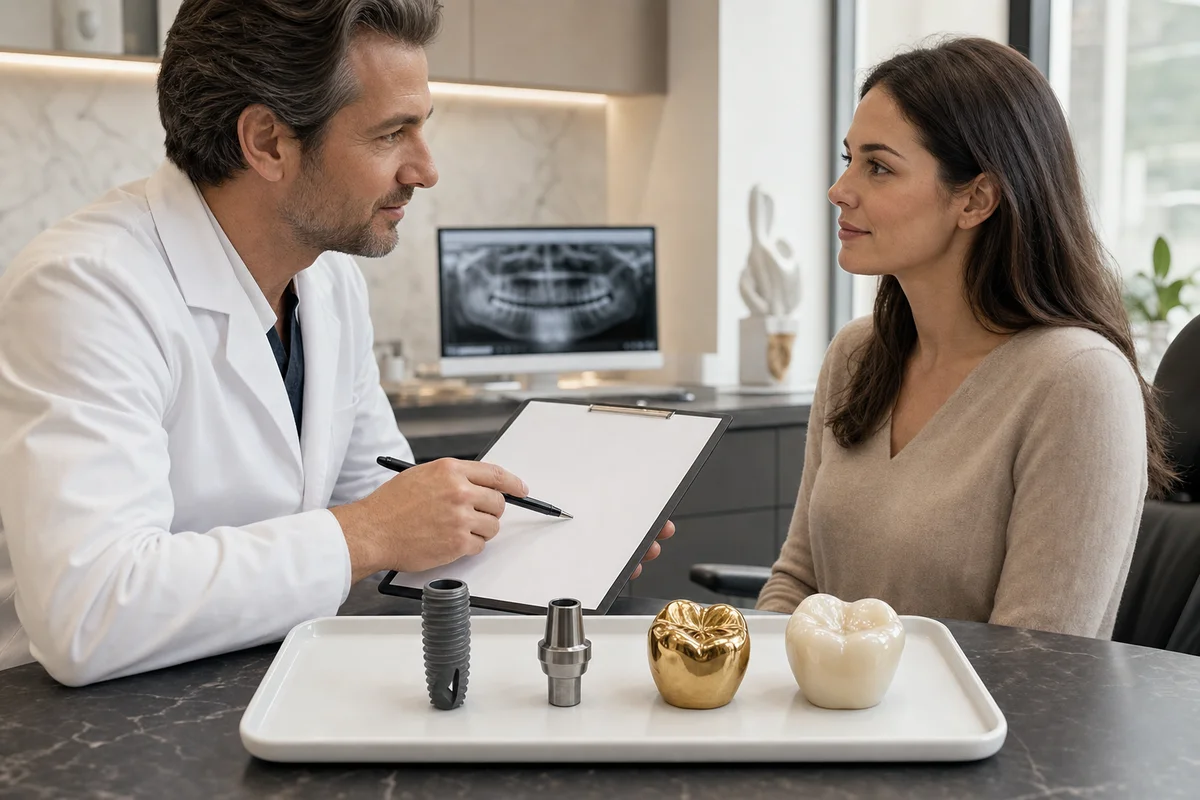
The U.S. Food and Drug Administration describes a dental implant system as an implant body placed in the jaw and an abutment that supports the artificial tooth; a fixation screw may also be part of the system. The visible crown is the prosthetic restoration attached above those components. In common conversation, a “gold implant” often means a gold-alloy crown on a conventional implant system rather than a solid-gold screw inserted into bone.
Therefore, how much to get a gold tooth implant should be divided into at least three product questions and one clinical question:
- What material and implant system will be used for the fixture in bone?
- What type of abutment will connect the fixture to the crown?
- Is the visible restoration full-cast gold alloy, a gold-containing coping under ceramic, or only gold colored?
- Is implant treatment appropriate for this missing-tooth site after examination?
A removable grill is jewelry, not an implant restoration. A tooth gem is also not a replacement tooth. A gold crown on a natural tooth requires preparation of that tooth and has no fixture in bone. Ask the dentist to write the exact procedure and material before comparing any quote.
2. how much to get a gold tooth implant versus a gold crown
A crown can be placed on a prepared natural tooth or on an implant abutment. The ADA glossary defines a crown as an artificial replacement that restores missing tooth structure or is placed on a dental implant. The clinical work differs: a natural-tooth crown may require removal of damaged tooth structure, while an implant crown follows surgical implant placement and healing.
If the tooth is still present, how much to get a gold tooth implant may be the wrong question. The dentist should first decide whether the tooth is restorable. Extraction and implant placement should not be chosen simply because a gold implant crown appears attractive. Reasonable alternatives may include restoring the natural tooth, a conventional bridge, a removable option, or no immediate replacement, depending on the clinical findings.
If the tooth is already missing, the quote should state whether it covers only the gold-alloy crown or the complete implant restoration. A crown-only laboratory fee cannot be compared with a plan that includes examination, surgery, implant fixture, abutment, and follow-up. Define the endpoint as a functioning final restoration.
3. how much to get a gold tooth implant and what “gold” means
Dental gold restorations are generally alloys rather than pure gold. The ADA explains that gold is soft and malleable, so it is combined with metals such as copper, silver, platinum, or others to increase strength. The ADA’s historic alloy classification describes high-noble alloys as containing at least 60 percent gold and platinum-group metals, with at least 40 percent gold; noble alloys have a lower minimum noble-metal content. The exact composition must come from the manufacturer or laboratory, not from color alone.
For how much to get a gold tooth implant, ask the laboratory or dentist for the alloy name, classification, manufacturer, lot or certificate information where available, and composition. “Gold colored” can describe a surface appearance without establishing that a crown contains a particular percentage of gold. A polished crown, a porcelain-fused-to-metal design, and a ceramic crown with a warm shade are different products.
The FDA’s guidance for dental noble-metal alloys identifies these materials as devices used to fabricate cast crowns and bridges or metal substructures for ceramic. It also distinguishes crown-and-bridge alloys from alloys classified for dental implant fixtures. That regulatory distinction reinforces why the crown material and the implanted device must be documented separately.
4. how much to get a gold tooth implant after a clinical examination
The treatment plan depends on gum health, available bone, adjacent teeth, bite, restorative space, smile line, hygiene, tobacco exposure, health conditions, and medications. The FDA notes that overall health affects candidacy and healing, and smoking may slow healing. Photographs can support an initial conversation but cannot show all anatomy or determine whether an implant is appropriate.
A safe answer to how much to get a gold tooth implant labels any pre-examination figure as preliminary. The final quote should follow clinical assessment and suitable imaging. It should identify active infection, periodontal disease, a non-restorable tooth, bone limitations, or esthetic concerns that may change the sequence.
The material choice comes after functional design. A gold-alloy crown may be considered for a posterior tooth because metallic restorations can be made with different thickness and wear characteristics, but the patient’s bite, opposing teeth, available space, appearance goals, and cleaning access matter. A visible front-tooth design creates different esthetic and tissue-management questions.
5. how much to get a gold tooth implant in a complete written quote
Ask each practice to label every line as included, excluded, optional, or dependent on findings. A complete comparison can include:
- Examination, periodontal assessment, medical history review, photographs, and necessary imaging.
- Extraction and infection management only if the existing tooth cannot be retained.
- Bone or soft-tissue grafting only when clinically indicated and explained.
- Implant fixture, placement, healing component, and the device brand and model.
- Local anesthesia and any separately proposed sedation, monitoring, or facility service.
- Temporary tooth or interim appliance during healing, including repair conditions.
- Restorative scan or impression, abutment, alloy surcharge, laboratory work, and gold-alloy crown.
- Crown delivery, bite adjustment, routine postoperative visits, and clinically indicated imaging.
- Maintenance, hygiene, repair, component replacement, and limited-warranty terms.
The answer to how much to get a gold tooth implant can change with the weight and composition of the alloy, precious-metal market changes, crown size, laboratory method, abutment design, and clinical complexity. Ask when the metal surcharge is locked and whether the laboratory can revise it before fabrication. The quote should state how a material change is approved.
6. how much to get a gold tooth implant versus other crown materials
Crown material should be selected with the dentist, not from a social-media image. A full-cast high-noble alloy, porcelain fused to a noble-metal coping, zirconia, lithium-disilicate ceramic, and other restorative materials differ in appearance, preparation thickness, laboratory workflow, adjustment, polishing, wear behavior, and repair. No single material is best for every implant position or bite.
When comparing how much to get a gold tooth implant with a tooth-colored option, request two itemized plans that differ only in the crown material. Confirm whether the abutment also changes. A front-tooth case may require tissue shaping and individualized shade work regardless of whether the final crown is metallic or ceramic.
Gold alloy is not the same as pure gold, and a higher metal percentage does not automatically create the best clinical choice. Ask the dentist to explain the material’s indication, manufacturer data, laboratory quality control, compatibility with the implant-abutment system, and how the crown will contact the opposing teeth.
7. how much to get a gold tooth implant: decision table
Use this table to compare plans at the same clinical endpoint. It is not a price list.
| Decision | Written detail to request | Comparison error | Why it matters |
|---|---|---|---|
| Treatment type | Implant crown, natural-tooth crown, grill, or other ornament | Calling every gold tooth an implant | Defines the procedure and risks |
| Implanted device | Fixture and abutment brand, model, and material | Assuming the fixture is solid gold | Supports traceability and future care |
| Visible crown | Alloy composition, classification, laboratory, and design | Relying on color or the word “gold” | Explains material value and behavior |
| Clinical scope | Exam, imaging, surgery, temporary, abutment, crown, follow-up | Comparing crown-only and complete-restoration fees | Shows the true endpoint |
| Site preparation | Extraction or graft only when indicated | Adding a universal graft package | Changes visits and healing |
| Insurance | Allowed amount, alternate benefit, deductible, maximum, exclusions | Assuming the gold upgrade is covered | Changes the patient’s net cost |
| Maintenance | Hygiene, examination, repair, polishing, crown replacement | Stopping the budget at delivery | Protects long-term function |
After the scopes match, how much to get a gold tooth implant becomes a comparison of documented clinical plans rather than a comparison of gold color. Ask each practice to sign or date the version used for your decision.
8. how much to get a gold tooth implant with extraction or grafting
Some implant sites are healed and have adequate hard and soft tissue. Others require extraction, infection management, ridge preservation, bone augmentation, sinus-related planning, or soft-tissue grafting. These services are not automatically required because the planned crown is gold. They are based on the site and treatment goals.
A quote answering how much to get a gold tooth implant should explain why any graft is proposed, what alternative exists, and whether it occurs with implant placement or as a separate stage. A staged procedure may add visits, healing time, imaging, temporary-tooth adjustments, and travel costs.
Extraction complexity also varies with root shape, fracture, infection, existing restorations, and nearby anatomy. Do not let a bundled “free extraction” decide whether a tooth should be removed. Ask first whether it can be predictably restored and what the benefits and limitations of retaining it would be.
9. how much to get a gold tooth implant across the healing timeline
Implant treatment often includes surgical placement, osseointegration, restorative records, and delivery of the crown. The FDA states that healing may take several months or longer. An immediate temporary tooth may be possible in selected cases, but the final gold-alloy crown may be fabricated after healing and tissue stabilization.
For how much to get a gold tooth implant, request a milestone-based payment schedule. Separate diagnosis, surgery, grafting if indicated, temporary care, abutment, alloy laboratory charge, crown, and delivery. Clarify deposit, cancellation, refund, remake, and material-change terms before work begins.
The laboratory may order alloy after the restorative design is finalized. If precious-metal pricing changes, the contract should explain whether the quoted surcharge is fixed or recalculated. A change should not be hidden in a final invoice; the patient should receive and approve an updated estimate.
10. how much to get a gold tooth implant after insurance
Dental insurance may treat the implant, abutment, and crown as separate services. Coverage can depend on network status, implant exclusions, waiting periods, missing-tooth clauses, deductibles, coinsurance, annual maximums, replacement limits, and predetermination. A plan may apply an “alternate benefit,” paying only what it would allow for a less expensive crown material while the patient pays the upgrade difference.
To estimate how much to get a gold tooth implant after insurance, submit the complete plan and crown material description for predetermination. Review the insurer’s allowed amount, not only the office fee. Ask specifically whether high-noble alloy, precious-metal surcharge, custom abutment, graft, temporary tooth, and out-of-network laboratory charges are covered.
A predetermination is generally an estimate rather than guaranteed payment. Eligibility, remaining annual benefits, clinical documentation, and plan status can change. HealthCare.gov notes that adult dental coverage is not an essential health benefit and Marketplace medical plans do not have to include it. A medical-plan card alone does not prove implant coverage.
11. how much to get a gold tooth implant with Medicare or financing
Original Medicare generally does not cover routine dental services or items such as dentures and implants. Medicare.gov describes narrow dental coverage when a service is directly connected to specified covered medical care. Those exceptions should not be read as routine coverage for an implant or a gold-alloy crown. Medicare Advantage dental benefits vary by plan.
If using financing for how much to get a gold tooth implant, compare annual percentage rate, term, deferred-interest rules, fees, down payment, and total repayment. A monthly payment does not show the total. Keep the treatment fee, estimated insurance payment, amount financed, and finance charge as separate figures.
Ask how refunds work if the material, procedure, or laboratory order changes after financing is funded. Health savings accounts and tax deductions follow separate rules. Keep itemized invoices and consult the plan administrator or a qualified tax professional rather than accepting a tax promise from a salesperson.
12. how much to get a gold tooth implant and material safety
Tell the dentist about known metal sensitivities, prior reactions to jewelry or dental restorations, health conditions, and medications. A gold alloy contains other metals to create clinical strength, so the complete composition matters. Do not assume a product is pure, hypoallergenic, or suitable because it appears gold.
The FDA notes that dental implant systems are commonly made from titanium or zirconium oxide, while other materials and alloys can sometimes be used. Ask for the exact brand and model of the implanted system and keep it in your records. For how much to get a gold tooth implant, price should never replace device traceability or biocompatibility discussion.
The FDA lists implant-related risks such as injury to surrounding structures, infection, altered bite, screw loosening, implant-body failure, hygiene difficulty, and nerve-related symptoms. Relevant risks and alternatives must be discussed for the individual. No alloy, warranty, or fee can guarantee healing or lifetime success.
13. how much to get a gold tooth implant for long-term maintenance
An implant crown requires daily cleaning and professional review. The FDA advises regular dental visits and prompt contact if an implant feels loose or painful. Depending on the design, the dentist may monitor the gum tissues, crown contacts, bite, screw stability, and surrounding bone. Imaging should be based on clinical need.
Long-term how much to get a gold tooth implant budgeting can include hygiene, polishing, examination, repair, screw replacement, or eventual crown replacement. A gold-alloy restoration is not maintenance-free. Wear, bite changes, tissue inflammation, or a component problem may require care even when the metal itself remains intact.
Ask what a laboratory or clinic warranty covers, how long it lasts, which maintenance visits are required, and what is excluded. A manufacturer’s device warranty is different from a clinical outcome promise. Keep the alloy certificate, implant identification, abutment information, laboratory invoice, and final radiographs or records as appropriate.
Red flags in a gold implant offer
- The seller cannot explain whether “gold” refers to the fixture, abutment, crown, coating, or removable jewelry.
- A fixed final plan or success guarantee is offered from photographs alone.
- The alloy composition, laboratory, implant system, or responsible dentist is withheld.
- A removable grill or natural-tooth crown is marketed as an implant procedure.
- Extraction or grafting is added before clinical findings support it.
- The patient is pressured to pay a non-refundable precious-metal surcharge immediately.
- Insurance, Medicare, or financing approval is described as guaranteed.
- Before-and-after images are presented as proof of an identical personal result.
- There is no temporary-tooth, follow-up, complication, or maintenance plan.
- A monthly payment is shown without APR, fees, term, and total repayment.
These signs do not prove poor care, but they mean the answer to how much to get a gold tooth implant is incomplete. Request clarification and consider an independent second opinion before irreversible treatment or a laboratory order.
Questions to take to the consultation
- Is this a crown on an implant, a crown on a natural tooth, or removable jewelry?
- Can the existing tooth be retained, and what alternatives are reasonable?
- Which records and imaging are necessary to plan the implant safely?
- What are the fixture and abutment brand, model, and material?
- What is the crown alloy’s exact composition and ADA classification?
- Does the quote include surgery, abutment, laboratory, crown, delivery, and follow-up?
- Could extraction, grafting, or temporary care be required, and why?
- When is the alloy surcharge fixed, and what happens if metal prices change?
- Which insurance alternate-benefit or material-upgrade rules may apply?
- What are the cancellation, refund, financing, remake, and maintenance terms?
Use the same checklist for every plan. It turns how much to get a gold tooth implant into a transparent clinical and material comparison instead of a color-based purchase.
how much to get a gold tooth implant: FAQs
how much to get a gold tooth implant if I want real gold?
Ask for the exact alloy composition, not simply “real gold.” Dental gold is usually alloyed with other metals for strength. The gold percentage, crown size, laboratory process, abutment, surgical plan, and metal market can affect the quote. A certificate or manufacturer documentation is more useful than color.
how much to get a gold tooth implant for a front tooth?
A front site can require individualized tissue shaping, temporary restoration, crown design, and smile analysis. A highly visible metallic crown may be an intentional style choice, but the patient should understand esthetic permanence, tissue display, and alternatives. The quote must include the complete surgical and restorative scope after examination.
how much to get a gold tooth implant for a back molar?
The price depends on the missing-tooth site, bone, bite, implant system, abutment, alloy classification, crown size, laboratory, and follow-up. A posterior gold-alloy crown may be considered for functional reasons, but suitability is individualized. Compare itemized fixture-to-crown plans rather than crown advertisements.
how much to get a gold tooth implant versus a gold crown?
A gold crown on a natural tooth does not include implant surgery, fixture, or abutment. A gold-alloy implant crown sits on an implant restoration after surgery and healing. If the natural tooth can be restored, extraction may not be appropriate. Diagnosis and alternatives should come before the price comparison.
how much to get a gold tooth implant if the fixture is titanium?
That is a common interpretation: a titanium implant fixture and separate gold-alloy crown. The abutment may be another material. Ask for each component’s identity and fee. The crown’s gold content does not determine the implanted fixture material, and both should remain traceable in your records.
how much to get a gold tooth implant with a bone graft?
A graft is based on bone and treatment needs, not the crown color. The type, extent, materials, membrane, timing, and whether it is staged can change visits and cost. Ask to see the clinical reason and discuss alternatives. Do not assume every implant needs grafting.
how much to get a gold tooth implant after insurance?
Coverage depends on implant benefits, network status, deductible, coinsurance, annual maximum, waiting period, missing-tooth clause, and material rules. A plan may pay an alternate benefit based on a less expensive crown while the patient pays the gold upgrade. Request written predetermination before fabrication.
how much to get a gold tooth implant with Medicare Advantage?
Original Medicare generally does not cover routine implants. Medicare Advantage benefits vary by plan and may include an allowance, network, authorization, or exclusions. Review the current Evidence of Coverage and ask the plan specifically about the implant, abutment, crown, and precious-metal surcharge.
how much to get a gold tooth implant compared with a grill?
A grill is removable oral jewelry, not an implant-supported replacement tooth. It has different risks, cleaning needs, and fees. Do not undergo extraction or implant surgery to obtain an appearance that a reversible option might provide. Discuss enamel, gum, bite, allergy, and hygiene risks with a dentist.
how much to get a gold tooth implant including lifetime care?
No provider can predict a lifetime total. Budget for examinations, professional hygiene, clinically justified imaging, polishing, and possible component or crown repair. Ask how to clean the implant, which symptoms need prompt review, and what maintenance conditions apply to any limited warranty.
Conclusion: compare the device, alloy, and complete care
The most useful answer to how much to get a gold tooth implant begins by separating the implant fixture, abutment, and crown. Confirm whether gold refers to a documented noble-metal alloy in the crown, a ceramic-metal design, a surface appearance, a natural-tooth crown, or removable jewelry. These options have different procedures and risks.
Next, compare complete, examined plans that include necessary diagnosis, surgery, temporary care, restorative work, alloy laboratory charge, delivery, follow-up, and maintenance. Apply only verified insurance benefits and transparent financing terms. Keep copies of the consent, invoice, alloy information, implant brand and model, laboratory record, and aftercare plan.
Record how much to get a gold tooth implant as several documented scenarios: the planned restoration, any clinically conditional procedure, a material alternative, and long-term maintenance. That approach supports a personal style choice without turning a medical device and surgery into a guaranteed jewelry package.
Official and professional sources
- U.S. Food and Drug Administration: Dental Implants—What You Should Know
- American Dental Association: materials for indirect restorations and dental alloy classifications
- U.S. Food and Drug Administration: dental noble-metal alloy guidance
- American Dental Association: glossary of dental terms and crown definition
- American Dental Association: professional and patient resources
- Medicare.gov: routine dental exclusions and limited medical exceptions
- HealthCare.gov: adult dental coverage and Marketplace plan rules
- World Health Organization: oral health fact sheet