
If you are researching how to become a prosthodontist, you are likely aiming for one of the most advanced and respected specialties in dentistry. Prosthodontists are experts in restoring and replacing teeth, rebuilding oral function, and designing life-changing smiles. They work with complex cases involving dental implants, crowns, bridges, dentures, full-mouth reconstructions, and cosmetic restorations. Understanding how to become a prosthodontist requires a clear view of the educational path, licensing requirements, financial commitment, and long-term career planning involved in this specialized field.
Many dental students first discover their interest in prosthodontics during clinical rotations, where they see the powerful impact restorative dentistry can have on patients. Learning how to become a prosthodontist means committing to years of rigorous academic training and hands-on experience. Unlike general dentists, prosthodontists receive advanced postdoctoral education focused specifically on complex restorative procedures, implant dentistry, occlusion, esthetics, biomaterials, and digital smile design. This additional expertise allows them to treat patients with severe tooth loss, trauma, congenital conditions, and complicated bite problems.
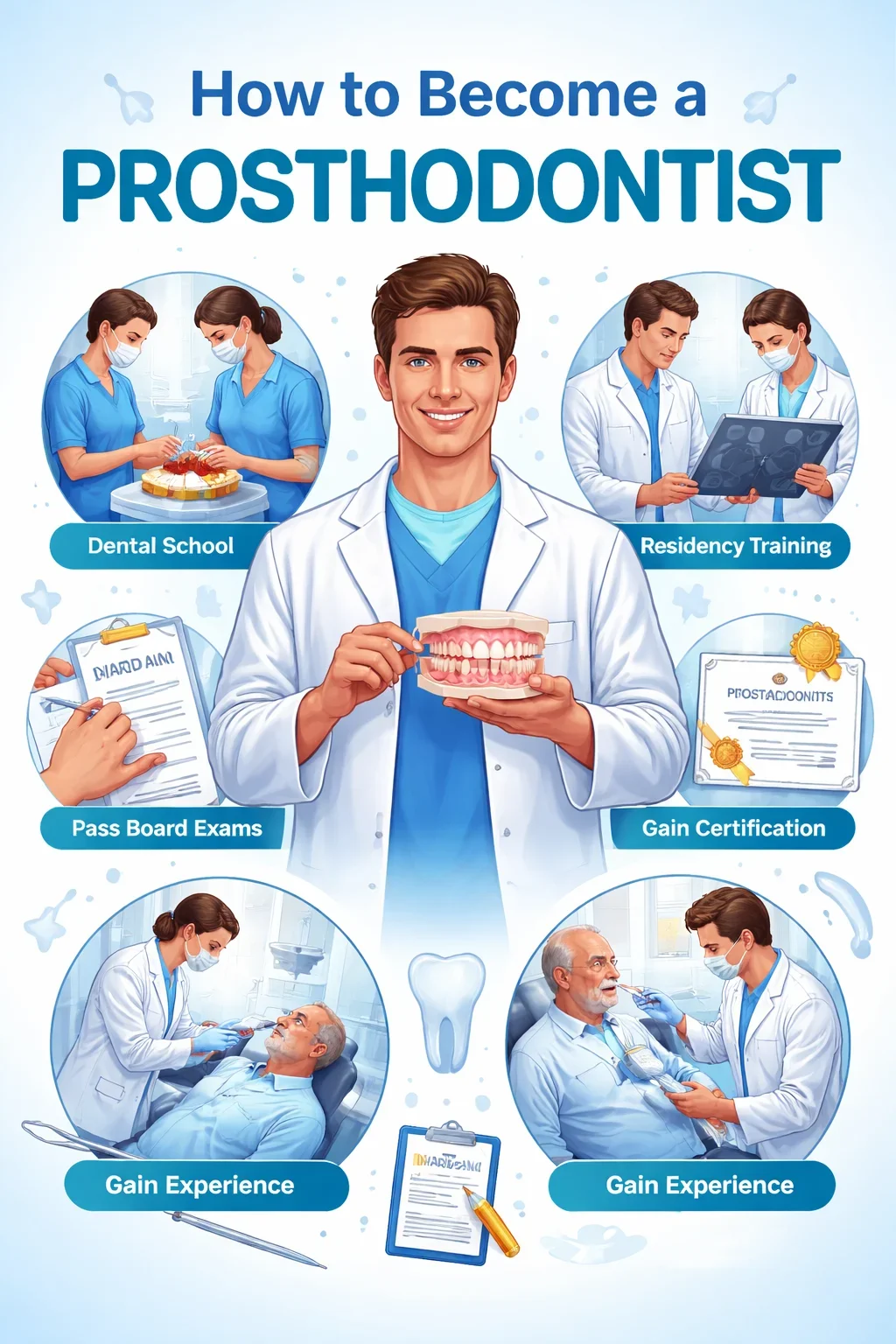
So, what exactly does the journey look like? When exploring how to become a prosthodontist, you must first understand that it begins with a strong academic foundation. Future prosthodontists typically earn a bachelor’s degree in a science-related field such as biology or chemistry. After completing undergraduate studies, they must gain admission to dental school and earn either a DDS (Doctor of Dental Surgery) or DMD (Doctor of Dental Medicine) degree. Only after becoming a licensed dentist can one pursue advanced specialty training in prosthodontics.
The question of how to become a prosthodontist also involves understanding accreditation and professional standards. Prosthodontics residency programs are accredited and typically last three years. During this time, dentists receive intensive training in fixed prosthodontics (crowns and bridges), removable prosthodontics (dentures), implant-supported restorations, maxillofacial prosthetics, and full-mouth rehabilitation. These programs are highly competitive, requiring excellent academic performance and strong clinical skills.
Another important aspect of how to become a prosthodontist is professional certification. While not always mandatory, many specialists pursue board certification through recognized professional organizations. For example, professional guidelines and standards in dentistry are supported by institutions such as the American Dental Association. Staying aligned with such organizations ensures ethical practice, continuing education, and adherence to high-quality clinical standards.
When patients ask about advanced restorative care, dental clinics like Redent Klinik Contact Page often emphasize the importance of specialized training in prosthodontics. This highlights why understanding how to become a prosthodontist is so essential for those who want to deliver complex, high-level treatment. Prosthodontists frequently collaborate with oral surgeons, periodontists, and orthodontists, making them central figures in multidisciplinary dental care.
Financial planning is another critical factor in learning how to become a prosthodontist. Dental school tuition in the United States can range from approximately $200,000 to $400,000 in total, depending on the institution. Prosthodontics residency programs may add additional tuition costs or reduced salary stipends during training. However, the long-term earning potential often offsets these investments. According to various salary reports, prosthodontists in the United States can earn between $150,000 and $300,000+ annually, depending on location, experience, and type of practice.
Beyond education and finances, how to become a prosthodontist also involves developing specific personal and technical skills. Precision, artistic vision, strong communication, and patience are essential qualities. Prosthodontics combines science and art, especially when designing natural-looking restorations. Modern technology such as CAD/CAM systems, digital impressions, and 3D printing plays a major role in advanced prosthodontic care, so technological adaptability is crucial.
For those wondering whether pursuing prosthodontics is worth the effort, the answer depends on long-term goals. If you are passionate about restorative dentistry, enjoy complex problem-solving, and want to transform patients’ lives through smile rehabilitation, then learning how to become a prosthodontist may be the ideal path. It is a demanding journey, but it leads to a rewarding and highly specialized career.
In summary, how to become a prosthodontist is not a short or simple process. It requires undergraduate education, dental school completion, state licensure, specialized residency training, and often board certification. However, for those committed to excellence in restorative and implant dentistry, the journey provides both professional prestige and significant career opportunities. Understanding every step of how to become a prosthodontist ensures you can make an informed, confident decision about your future in advanced dental care. 🦷✨
What Does a Prosthodontist Do? Understanding the Specialty
Before fully committing to the journey of how to become a prosthodontist, it is essential to understand what this specialist actually does on a daily basis. Prosthodontists are dental experts who focus on restoring and replacing missing or damaged teeth using advanced techniques and materials. While general dentists handle routine cleanings, fillings, and preventive care, prosthodontists specialize in complex restorative cases that require advanced planning, precision, and interdisciplinary collaboration. Understanding their scope of work gives real clarity to anyone researching how to become a prosthodontist and considering this demanding yet rewarding career path.
The Core Role of a Prosthodontist
At its core, prosthodontics is about restoring oral function, comfort, and aesthetics. Prosthodontists treat patients who have lost teeth due to trauma, decay, periodontal disease, or congenital conditions. If you are studying how to become a prosthodontist, you should know that these specialists are often considered the “architects” of restorative dentistry. They design treatment plans that may involve dental implants, fixed bridges, removable dentures, veneers, crowns, and full-mouth reconstructions.
Prosthodontists also manage highly complex bite (occlusion) problems. Patients with severe wear, jaw alignment issues, or temporomandibular joint (TMJ) disorders frequently require the advanced expertise of a prosthodontist. Therefore, understanding how to become a prosthodontist includes recognizing the responsibility of handling intricate biomechanical challenges that go beyond standard dental procedures.
Types of Treatments Prosthodontists Perform
To better understand how to become a prosthodontist, it is helpful to examine the primary categories of treatment they provide:
1. Dental Implants and Implant-Supported Restorations
Prosthodontists are leaders in implant dentistry. They design and restore dental implants that replace missing teeth with highly functional and natural-looking results. While oral surgeons may place the implant fixture, prosthodontists typically handle the restoration phase—creating custom crowns, bridges, or full-arch prostheses supported by implants.
2. Fixed Prosthodontics
This includes crowns, bridges, inlays, and onlays. Fixed restorations are permanently attached to teeth or implants. A key part of learning how to become a prosthodontist involves mastering advanced materials such as zirconia, porcelain-fused-to-metal, and lithium disilicate ceramics to ensure durability and aesthetics.
3. Removable Prosthodontics
Complete and partial dentures fall into this category. Prosthodontists design removable appliances that restore chewing function and facial structure. Modern dentures are far more advanced than older versions, often incorporating digital design technologies.
4. Maxillofacial Prosthetics
Some prosthodontists receive additional training to treat patients who have undergone cancer surgery, experienced facial trauma, or have congenital deformities. They create prosthetic devices that restore not only oral function but also facial appearance.
Collaboration with Other Dental Specialists
When researching how to become a prosthodontist, you should also understand the collaborative nature of the profession. Prosthodontists frequently work alongside periodontists, orthodontists, oral surgeons, and general dentists. In complex full-mouth rehabilitation cases, the prosthodontist often leads the treatment planning process. They coordinate surgical placement of implants, orthodontic alignment, and periodontal stabilization before delivering the final restorations.
This leadership role is one reason why many dentists choose to explore how to become a prosthodontist rather than remain in general practice. The specialty requires high-level diagnostic skills and strategic planning abilities.
Technology and Innovation in Prosthodontics
Modern prosthodontics heavily integrates digital dentistry. CAD/CAM systems, 3D printing, digital smile design software, and intraoral scanners are now standard tools. If you are serious about how to become a prosthodontist, you must be comfortable adapting to evolving technologies.
Digital workflows improve precision, reduce chair time, and enhance patient satisfaction. Prosthodontists often use virtual planning software to simulate full-mouth reconstructions before beginning treatment. This technological integration makes the specialty both scientifically rigorous and creatively rewarding. 🖥️🦷
Patient Impact and Quality of Life
Perhaps the most meaningful aspect of understanding how to become a prosthodontist is recognizing the life-changing impact of the work. Patients who struggle with missing teeth often face difficulties in eating, speaking, and smiling confidently. A well-executed prosthodontic treatment plan can restore function, improve nutrition, and dramatically boost self-esteem.
For example, a patient requiring full-mouth reconstruction may undergo months of treatment involving implants, crowns, and occlusal adjustments. The final outcome often transforms both appearance and oral health. Knowing this profound impact motivates many dental professionals to pursue advanced training in this field.
Is This Specialty Right for You?
If you are still evaluating how to become a prosthodontist, consider whether you enjoy detailed, precision-based work. Prosthodontics demands patience, artistic vision, and meticulous attention to detail. Treatment cases can be long and complex, requiring ongoing adjustments and follow-ups.
Unlike some faster-paced dental specialties, prosthodontics often involves extended treatment timelines and deep patient relationships. Those who thrive in problem-solving environments and appreciate combining art with science tend to excel in this career path.
In conclusion, understanding what a prosthodontist does is the first essential step in mastering how to become a prosthodontist. This specialty centers on advanced restorative dentistry, interdisciplinary collaboration, digital innovation, and transformative patient care. By fully grasping the responsibilities and opportunities within prosthodontics, you can make an informed decision about whether this challenging yet prestigious field aligns with your professional goals. ✨
Step 1: Earn a Bachelor’s Degree for Dental School Admission
The first major milestone in understanding how to become a prosthodontist begins long before dental school. It starts with earning a bachelor’s degree. While prosthodontics is an advanced dental specialty, the foundation for success is built during undergraduate education. If you are seriously researching how to become a prosthodontist, you must recognize that dental schools require strong academic preparation, particularly in the sciences.
Choosing the Right Undergraduate Major
There is no single “correct” major for students exploring how to become a prosthodontist. However, most aspiring dentists choose science-focused programs such as biology, chemistry, biochemistry, or biomedical sciences. These majors align closely with dental school prerequisites and prepare students for the rigorous coursework ahead.
Dental schools typically require courses in:
- General Biology with lab
- General Chemistry with lab
- Organic Chemistry with lab
- Physics
- Biochemistry
- English composition
Excelling in these courses is essential when planning how to become a prosthodontist, because admission to dental school is highly competitive. Strong grades in science subjects demonstrate your ability to handle complex biomedical material.
Maintaining a Competitive GPA
One of the most important academic benchmarks in the journey of how to become a prosthodontist is your undergraduate GPA. Most dental schools prefer applicants with a GPA above 3.5, especially in science courses. Since prosthodontics is one of the most competitive dental specialties, it is wise to aim even higher.
Admissions committees look for consistency, academic growth, and resilience. If you encounter challenges early in college, improvement over time can still strengthen your application. When thinking about how to become a prosthodontist, remember that undergraduate performance sets the stage for every step that follows.
Preparing for the Dental Admission Test (DAT)
Another critical component in understanding how to become a prosthodontist is the Dental Admission Test (DAT). This standardized exam evaluates academic ability, scientific understanding, perceptual skills, and critical thinking. High DAT scores significantly improve your chances of gaining admission to dental school.
Key DAT Sections Include:
- Biology
- General Chemistry
- Organic Chemistry
- Perceptual Ability Test (PAT)
- Reading Comprehension
- Quantitative Reasoning
Since prosthodontics requires advanced precision and spatial awareness, strong performance on the Perceptual Ability Test is particularly relevant. Preparing thoroughly for the DAT is an essential step in the long-term plan of how to become a prosthodontist.
Gaining Clinical Exposure and Shadowing Experience
Academic success alone is not enough when mapping out how to become a prosthodontist. Dental schools expect applicants to have hands-on exposure to the profession. Shadowing general dentists and, if possible, prosthodontists provides valuable insight into the field.
Observing restorative procedures such as crown preparation, implant restoration, or denture fabrication can clarify whether prosthodontics aligns with your interests. This real-world experience strengthens your application and deepens your understanding of how to become a prosthodontist.
Developing Manual Dexterity and Technical Skills
Prosthodontics is a specialty that demands exceptional manual precision. During your undergraduate years, it is beneficial to develop hand skills through activities such as:
- Art or sculpture classes 🎨
- Woodworking
- Musical instruments
- Laboratory research
Manual dexterity is heavily evaluated in dental school and later becomes critical in advanced restorative procedures. When studying how to become a prosthodontist, remember that technical ability is just as important as academic excellence.
Extracurricular Activities and Leadership
Dental schools value well-rounded applicants. Participation in student organizations, volunteer programs, and community service initiatives strengthens your profile. Leadership roles demonstrate responsibility and communication skills—both vital qualities in the journey of how to become a prosthodontist.
Volunteering in healthcare settings or community dental clinics can also reinforce your commitment to patient care. Prosthodontists frequently manage complex, long-term treatment plans, so interpersonal skills are essential.
Financial Planning for the Journey Ahead
Understanding how to become a prosthodontist also involves early financial awareness. Undergraduate tuition costs vary widely depending on whether you attend a public or private institution. In the United States, annual tuition may range from approximately $10,000 at public universities (in-state) to $40,000 or more at private institutions.
Planning early for dental school expenses—often between $200,000 and $400,000 total—helps reduce stress later. Scholarships, grants, and part-time employment during undergraduate studies can ease the financial burden.
Building a Strong Dental School Application
As you finalize your bachelor’s degree, you will prepare your dental school application through the centralized application system. Strong letters of recommendation from science professors and practicing dentists are crucial.
Your personal statement should clearly express your motivation for dentistry and long-term interest in advanced specialties. While you may not specialize immediately, articulating curiosity about complex restorative dentistry shows forward-thinking. Demonstrating awareness of how to become a prosthodontist can highlight your ambition and career clarity.
In conclusion, earning a bachelor’s degree is not simply a preliminary step—it is the academic and professional foundation of how to become a prosthodontist. From selecting the right major and excelling academically to preparing for the DAT and gaining clinical exposure, every decision during your undergraduate years shapes your future. By building a strong academic record, developing manual skills, and gaining meaningful dental experience, you position yourself successfully for the next stage of how to become a prosthodontist: dental school and beyond. 🦷✨
Step 2: Complete Dental School (DDS or DMD Degree)
After earning a bachelor’s degree, the next critical stage in understanding how to become a prosthodontist is completing dental school. This phase transforms you from a pre-dental student into a licensed dentist and lays the clinical foundation required for advanced specialization. Dental school is rigorous, competitive, and intellectually demanding. Anyone seriously researching how to become a prosthodontist must be prepared for four intense years of academic study and hands-on clinical training.
Understanding DDS vs. DMD Degrees
Before moving forward in how to become a prosthodontist, it is important to clarify the difference between a DDS (Doctor of Dental Surgery) and a DMD (Doctor of Dental Medicine). In reality, there is no clinical difference between the two degrees. Both follow the same curriculum standards and provide identical professional qualifications. The difference is simply the title chosen by the university.
Dental schools in the United States are accredited and must meet strict educational standards. Professional guidelines are supported by institutions such as the American Dental Association, which ensures consistent training quality nationwide. Understanding accreditation is essential when mapping out how to become a prosthodontist, because only graduates from accredited programs can pursue licensure and specialty training.
Years 1–2: Preclinical and Didactic Education
The first two years of dental school focus primarily on foundational sciences and laboratory training. Students take advanced courses in:
- Dental anatomy and occlusion
- Oral histology and pathology
- Pharmacology
- Microbiology
- Radiology
- Biomaterials
For those committed to how to become a prosthodontist, particular attention should be given to dental anatomy and occlusion. Prosthodontics relies heavily on understanding bite relationships, tooth morphology, and functional jaw movements. During preclinical laboratory sessions, students practice crown preparations, impression techniques, and restorative procedures on simulation models.
Manual dexterity becomes even more important at this stage. Precision in tooth preparation and restoration design is foundational knowledge that directly influences your future path in how to become a prosthodontist.
Years 3–4: Clinical Training and Patient Care
The final two years of dental school shift toward direct patient care. Students treat real patients under faculty supervision. This is where theoretical knowledge becomes practical skill. If you are serious about how to become a prosthodontist, you should actively seek out complex restorative cases whenever possible.
Clinical Skills to Focus On
- Crown and bridge preparation
- Impression techniques (traditional and digital)
- Complete and partial denture fabrication
- Implant restoration basics
- Comprehensive treatment planning
These procedures are directly aligned with the advanced responsibilities of prosthodontists. Demonstrating excellence in restorative dentistry during dental school strengthens your application for specialty residency programs later in the journey of how to become a prosthodontist.
Academic Excellence and Class Rank
Prosthodontics is one of the more competitive dental specialties. Residency programs often evaluate class rank, GPA, faculty recommendations, and clinical performance. Therefore, maintaining strong academic standing during dental school is critical for anyone pursuing how to become a prosthodontist.
Participation in research projects related to restorative materials, implant dentistry, or digital workflows can also enhance your specialty application. Publishing research or presenting at conferences demonstrates commitment and academic maturity.
Networking and Mentorship
Another strategic step in how to become a prosthodontist is building relationships with prosthodontic faculty members. Many dental schools have specialty departments where students can observe or assist in advanced cases. Establishing mentorship with a prosthodontist provides guidance, recommendation letters, and deeper insight into the specialty.
Shadowing prosthodontic residents during your third and fourth years can clarify what specialty training truly involves. This exposure strengthens both your confidence and your residency application.
Financial Considerations During Dental School
Understanding how to become a prosthodontist also requires realistic financial planning. Dental school tuition in the United States typically ranges between $40,000 and $90,000 per year depending on the institution. Including living expenses, total costs may reach $250,000–$400,000.
Managing student loans wisely is essential, especially since prosthodontics residency programs may add additional years of reduced income. However, long-term earning potential for prosthodontists—often between $150,000 and $300,000+ annually—can offset this investment over time.
Preparing for Licensure
Before advancing further in how to become a prosthodontist, you must complete national and regional licensing examinations. These typically include the Integrated National Board Dental Examination (INBDE) and a clinical licensing exam. Successful completion allows you to practice as a general dentist.
Licensure is mandatory before entering a prosthodontics residency. Without it, you cannot legally provide patient care during specialty training.
Strengthening Your Residency Application
During your final year of dental school, you will apply to prosthodontics residency programs. A strong application should include:
- High academic standing
- Strong faculty recommendations
- Clinical case documentation
- Personal statement explaining your passion for restorative dentistry
Clearly articulating your understanding of how to become a prosthodontist and why you are drawn to complex restorative care demonstrates focus and commitment.
In conclusion, completing dental school is one of the most transformative stages in the journey of how to become a prosthodontist. It provides scientific knowledge, clinical expertise, professional licensure eligibility, and mentorship opportunities. By excelling academically, seeking advanced restorative experiences, and building strong professional relationships, you position yourself successfully for the next major step in how to become a prosthodontist: specialized residency training. 🦷✨
Step 3: Obtain Dental Licensure in Your State
After graduating from dental school, the next essential milestone in understanding how to become a prosthodontist is obtaining dental licensure. Without a valid license, you cannot legally practice dentistry or enter an accredited prosthodontics residency program. This stage officially transitions you from a dental student to a practicing dentist. Anyone seriously researching how to become a prosthodontist must understand that licensure is not optional—it is a legal and professional requirement.
Why Licensure Is Critical in the Journey
Licensure ensures that dentists meet standardized levels of competency and patient safety. Before you can continue advancing in how to become a prosthodontist, you must prove that you can independently diagnose, treatment plan, and perform dental procedures safely. State dental boards regulate licensure requirements to protect public health.
Although requirements vary slightly by state or country, most regions require candidates to pass both national and clinical examinations. Completing these examinations demonstrates readiness for real-world dental practice, which is foundational before pursuing specialty training in prosthodontics.
National Board Dental Examination (INBDE)
One of the most important steps in how to become a prosthodontist is passing the Integrated National Board Dental Examination (INBDE). This exam assesses your understanding of biomedical sciences, clinical knowledge, ethics, and patient management.
Key Areas Tested in the INBDE:
- Diagnosis and treatment planning
- Pharmacology and patient safety
- Restorative dentistry principles
- Periodontology and endodontics
- Evidence-based decision-making
Because prosthodontics is heavily rooted in comprehensive treatment planning and restorative precision, strong performance on the INBDE reinforces your preparedness for the next phase of how to become a prosthodontist.
Clinical Licensing Examination
In addition to the national written examination, most states require a clinical exam. These exams test hands-on skills such as crown preparation, restorative procedures, periodontal assessment, and patient management. Some states now accept alternative pathways such as residency-based licensure instead of traditional patient-based exams.
Successfully completing the clinical component is a defining moment in how to become a prosthodontist, as it confirms your readiness to treat patients independently. Precision and attention to detail—skills that are crucial in prosthodontics—are evaluated carefully during these examinations.
State-Specific Requirements
Each state dental board has slightly different requirements. When planning how to become a prosthodontist, it is important to review the regulations of the state where you intend to practice or complete residency. Common requirements include:
- Graduation from an accredited dental school
- Passing the INBDE
- Passing a regional or state clinical examination
- Background checks
- Jurisprudence exams (testing knowledge of state dental laws)
Understanding these administrative steps prevents delays and ensures a smooth transition toward specialty training in how to become a prosthodontist.
Licensure Portability and Mobility
If you plan to practice in multiple states or relocate in the future, licensure portability becomes important. Some states offer reciprocity or credential-based licensure after practicing for a certain number of years. Thinking ahead about mobility is a strategic consideration in the broader plan of how to become a prosthodontist.
Specialists often move to areas with higher demand for complex restorative services. Having flexibility in licensure can expand your professional opportunities later in your career.
Ethical Standards and Professional Responsibility
Licensure is not only about passing exams; it is also about upholding ethical standards. Dentists are expected to follow professional guidelines and maintain continuing education. Organizations such as the American Dental Association provide ethical frameworks and continuing education resources that support lifelong learning.
Commitment to ethics and professional growth is an essential part of how to become a prosthodontist. As a future specialist handling complex and often expensive restorative cases, maintaining patient trust is critical.
Continuing Education Requirements
Most states require dentists to complete continuing education (CE) hours to maintain licensure. This ensures that practitioners stay updated with advancements in dental materials, digital technology, infection control, and patient safety.
Even before entering residency, developing a habit of continuous learning strengthens your professional profile. The mindset of lifelong education is deeply embedded in how to become a prosthodontist, as prosthodontics constantly evolves with new biomaterials and digital workflows. 🦷💻
Financial Considerations for Licensure
Licensure exams and application fees also involve financial planning. Examination fees can range from several hundred to several thousand dollars depending on the region and testing agency. Additional costs may include travel expenses and preparatory courses.
Although these expenses add to the overall cost of how to become a prosthodontist, they represent an investment in professional legitimacy and long-term career advancement.
Positioning Yourself for Residency
Once licensed, you are officially eligible to apply for prosthodontics residency programs. Licensure demonstrates that you are capable of independent dental practice—a critical requirement before specializing. Residency programs prefer candidates who have not only passed exams but also demonstrated clinical competence and professionalism.
In summary, obtaining dental licensure is a non-negotiable step in how to become a prosthodontist. It confirms your readiness to practice dentistry, protects patient safety, and qualifies you for advanced specialty training. By successfully completing national and clinical examinations, meeting state board requirements, and committing to ethical practice, you lay the legal and professional foundation necessary to move forward in how to become a prosthodontist. This milestone marks your transformation from student to licensed professional—and brings you one step closer to becoming a specialist in advanced restorative dentistry. ✨
Step 4: Enroll in an Accredited Prosthodontics Residency Program
Once you have completed dental school and obtained licensure, the most defining stage in how to become a prosthodontist is enrolling in an accredited prosthodontics residency program. This is where general dentistry transforms into highly specialized expertise. Prosthodontics residency training provides advanced knowledge in restorative dentistry, implant rehabilitation, occlusion, esthetics, and complex case management. If you are serious about how to become a prosthodontist, this phase represents the heart of your professional development.
What Is a Prosthodontics Residency Program?
A prosthodontics residency is a postdoctoral specialty program typically lasting three years. These programs are accredited and designed to provide intensive clinical and academic training beyond the scope of general dentistry. Understanding accreditation is crucial in how to become a prosthodontist, because only graduates from recognized programs are eligible for specialty certification.
During residency, dentists refine their skills in full-mouth rehabilitation, implant-supported restorations, digital dentistry, advanced biomaterials, and interdisciplinary case planning. This is the stage where theoretical knowledge gained during dental school evolves into true mastery.
Admission Requirements for Residency
Residency programs are highly competitive. When planning how to become a prosthodontist, you must prepare a strong application portfolio. Most programs require:
- Graduation from an accredited dental school
- Active dental license
- High academic standing
- Letters of recommendation (often from prosthodontic faculty)
- Personal statement outlining career goals
- Clinical case portfolio
Strong evidence of excellence in restorative dentistry significantly increases acceptance chances. Demonstrating a clear understanding of how to become a prosthodontist and long-term dedication to the specialty helps differentiate you from other applicants.
Core Areas of Advanced Training
Residency programs are structured to deepen both clinical and academic knowledge. Below are the primary focus areas central to how to become a prosthodontist:
1. Implant Dentistry
Prosthodontists are leaders in implant restoration. Residents learn advanced treatment planning, digital implant workflows, guided surgery collaboration, and full-arch implant rehabilitation. Complex implant-supported prostheses, such as All-on-4 systems, are routinely designed and delivered during training.
2. Fixed Prosthodontics
Advanced crown and bridge work is refined to perfection. Residents manage complex cases involving multiple units, occlusal reconstruction, and esthetic zone restorations. Precision preparation techniques and laboratory communication are emphasized.
3. Removable Prosthodontics
Complete dentures, partial dentures, and implant-retained removable prostheses are extensively practiced. Residents also manage cases involving severe bone resorption or anatomical challenges.
4. Maxillofacial Prosthetics
Some programs include exposure to maxillofacial prosthetics, helping patients who have undergone cancer surgery or facial trauma. This highly specialized area reflects the comprehensive nature of how to become a prosthodontist.
Interdisciplinary Treatment Planning
One of the defining features of prosthodontics residency is interdisciplinary collaboration. Residents frequently coordinate with oral surgeons, periodontists, orthodontists, and laboratory technicians. Mastering treatment sequencing and case leadership is central to how to become a prosthodontist.
Complex cases may require orthodontic alignment before implant placement, periodontal stabilization before prosthetic restoration, or surgical intervention before final rehabilitation. The prosthodontist often leads these comprehensive treatment plans.
Digital Dentistry and Modern Technology
Technology plays a transformative role in advanced prosthodontics. CAD/CAM systems, intraoral scanners, digital smile design software, and 3D printing are integrated into residency training. Understanding digital workflows is now essential in how to become a prosthodontist.
Residents learn how to design restorations digitally, evaluate occlusion virtually, and collaborate with dental laboratories through digital communication platforms. This technological proficiency increases precision and efficiency in patient care. 💻🦷
Financial Considerations During Residency
Prosthodontics residency programs may involve tuition costs or modest stipends. Tuition-based programs can range from $20,000 to $60,000 per year depending on the institution. Some hospital-based programs provide salaries instead of charging tuition.
Understanding these financial commitments is an important part of planning how to become a prosthodontist. While residency adds additional years of training, the long-term earning potential of a prosthodontist often justifies the investment.
Research and Academic Development
Many residency programs require research projects or thesis completion. Academic training strengthens critical thinking and evidence-based practice. Prosthodontics is deeply connected to biomaterial research, implant surface technology, and digital innovation.
Engaging in research during residency enhances your expertise and may open doors to academic careers. For those interested in teaching or university-based practice, research is an important element in how to become a prosthodontist.
Professional Growth and Confidence
Perhaps the most significant transformation during residency is confidence. Residents transition from competent general dentists to highly skilled restorative specialists. Managing complex cases builds leadership, communication, and problem-solving skills.
By the end of residency, you are no longer simply learning how to become a prosthodontist—you are functioning as one under supervision. This intensive experience prepares you for independent specialty practice and potential board certification.
In conclusion, enrolling in an accredited prosthodontics residency program is the cornerstone of how to become a prosthodontist. It provides advanced clinical mastery, interdisciplinary expertise, digital proficiency, and professional maturity. This stage demands dedication, resilience, and passion—but it ultimately shapes you into a specialist capable of delivering life-changing restorative care. ✨
Step 5: Board Certification and Advanced Credentials
After completing an accredited residency program, the next powerful milestone in understanding how to become a prosthodontist is pursuing board certification and advanced professional credentials. While board certification is not legally mandatory in every region, it represents the highest standard of clinical excellence in the specialty. For many dentists who are serious about mastering how to become a prosthodontist, achieving board certification is a defining professional goal that demonstrates advanced competency, dedication, and credibility.
What Is Board Certification in Prosthodontics?
Board certification is a voluntary process that evaluates a specialist’s knowledge, clinical judgment, and technical skills beyond residency training. It serves as formal recognition that a prosthodontist has met rigorous standards established by the specialty board. For anyone researching how to become a prosthodontist, understanding this credential helps clarify the difference between simply completing residency and achieving the highest level of professional distinction.
In the United States, prosthodontists may pursue certification through specialty boards recognized by major professional organizations. These boards operate under the standards supported by institutions such as the American Dental Association, which ensures the integrity and consistency of specialty credentials.
The Board Certification Process
The certification pathway typically involves multiple phases. If you are committed to fully understanding how to become a prosthodontist, you should be prepared for a structured examination process that includes:
1. Written Examination
This phase evaluates advanced knowledge in prosthodontics, including occlusion, biomaterials, implant dentistry, esthetics, and complex treatment planning. Candidates must demonstrate mastery of scientific principles and clinical protocols.
2. Clinical Case Presentation
Applicants present completed patient cases that demonstrate comprehensive treatment planning and successful outcomes. These cases often include full-mouth rehabilitation, implant-supported restorations, and interdisciplinary collaboration.
3. Oral Examination
During this stage, examiners assess diagnostic reasoning, ethical decision-making, and treatment planning skills through structured questioning.
Successfully completing these phases confirms that the specialist has moved beyond simply learning how to become a prosthodontist and is practicing at an elite professional level.
Benefits of Board Certification
Although not mandatory, board certification offers significant advantages for those committed to excellence in how to become a prosthodontist:
- Enhanced professional credibility
- Increased patient trust
- Competitive advantage in private practice
- Eligibility for academic and teaching positions
- Leadership opportunities within professional organizations
Patients seeking complex restorative treatment often prefer board-certified specialists, especially for full-mouth reconstruction or implant rehabilitation. The certification demonstrates dedication to the highest standards of care.
Advanced Credentials Beyond Board Certification
Expanding your knowledge does not stop after certification. Continuous development is essential in the ongoing journey of how to become a prosthodontist. Advanced credentials may include:
Fellowship Programs
Some prosthodontists pursue fellowships in implant dentistry, digital dentistry, or maxillofacial prosthetics to further refine their expertise.
Continuing Education and Mastership
Ongoing continuing education (CE) ensures that specialists remain updated on innovations in biomaterials, CAD/CAM technology, and surgical-restorative integration. Mastership awards from professional organizations reflect long-term dedication.
The mindset of lifelong learning is central to how to become a prosthodontist, because advancements in dental materials and digital workflows evolve rapidly. Staying current ensures optimal patient outcomes. 🦷✨
Academic and Research Opportunities
For some specialists, board certification opens doors to academic careers. Teaching at dental schools, supervising residents, and conducting research in biomaterials or implant systems are meaningful career extensions. Academic involvement strengthens the broader impact of how to become a prosthodontist, contributing to the future of the specialty.
Research areas may include implant surface innovation, ceramic durability, occlusal biomechanics, and digital prosthetic design. Publishing research enhances professional visibility and supports evidence-based practice.
Ethical Commitment and Professional Standards
Board-certified prosthodontists are expected to uphold strict ethical standards. Maintaining professional integrity, prioritizing patient safety, and engaging in transparent communication are essential components of how to become a prosthodontist. As specialists handling complex and often high-cost treatment plans, trust is fundamental.
Professional organizations also require ongoing recertification or maintenance of certification to ensure that standards remain high. This reinforces the commitment to excellence that defines the advanced stage of how to become a prosthodontist.
Long-Term Career Impact
Achieving board certification often positively influences long-term career trajectory. Specialists may command higher consultation fees, attract complex referral cases, and build strong professional reputations. In competitive urban markets, certification can distinguish a prosthodontist from other providers.
However, the decision to pursue board certification ultimately depends on personal goals. Some practitioners focus primarily on clinical practice, while others seek leadership roles or academic influence. Both paths are valid within the broader framework of how to become a prosthodontist.
In conclusion, board certification and advanced credentials represent the pinnacle of professional achievement in the journey of how to become a prosthodontist. While not mandatory, certification validates clinical excellence, strengthens patient trust, and enhances long-term career opportunities. By committing to continued education, ethical practice, and advanced evaluation, you move beyond basic specialization and fully embody the expertise associated with how to become a prosthodontist. 🚀
How Long Does It Take to Become a Prosthodontist?
One of the most common and practical questions students ask when researching how to become a prosthodontist is: how long does the entire process take? The answer requires understanding each educational and professional milestone involved in this highly specialized dental career. Because prosthodontics is an advanced restorative specialty, the pathway is longer than general dentistry. Anyone seriously exploring how to become a prosthodontist must be prepared for a significant time investment that spans more than a decade.
Undergraduate Education: 4 Years
The first phase in how to become a prosthodontist is completing a bachelor’s degree. Most students spend approximately four years earning an undergraduate degree, typically in a science-related field such as biology or chemistry. During this time, students complete prerequisite coursework required for dental school admission and prepare for the Dental Admission Test (DAT).
Strong academic performance during undergraduate studies is essential because dental school admission is competitive. Although some accelerated programs may shorten this stage slightly, the standard timeframe remains four years. This is the foundational academic step in how to become a prosthodontist.
Dental School: 4 Years
After earning a bachelor’s degree, the next stage in how to become a prosthodontist is dental school. Dental programs leading to a DDS (Doctor of Dental Surgery) or DMD (Doctor of Dental Medicine) degree typically require four additional years.
Years 1–2: Didactic and Preclinical Training
Students focus on biomedical sciences, dental anatomy, occlusion, and simulation-based laboratory training. Mastery of restorative principles during these early years lays the groundwork for later specialization.
Years 3–4: Clinical Patient Care
Students transition into hands-on patient treatment under faculty supervision. Those interested in how to become a prosthodontist often focus on complex restorative cases, implant restorations, and comprehensive treatment planning during this time.
By the end of dental school, students have completed approximately eight years of higher education. However, the journey of how to become a prosthodontist does not end here.
Licensure: Several Months
Following graduation, dentists must obtain state licensure. This process involves passing the Integrated National Board Dental Examination (INBDE) and a clinical licensing exam. While this stage does not typically add full years to the timeline, preparation and examination scheduling may require several months.
Licensure is a mandatory checkpoint in how to become a prosthodontist, as residency programs require applicants to hold an active dental license.
Prosthodontics Residency: 3 Years
The most specialized phase in how to become a prosthodontist is completing an accredited prosthodontics residency. These programs generally last three years. During this time, dentists receive intensive training in:
- Full-mouth rehabilitation
- Advanced implant dentistry
- Fixed and removable prosthodontics
- Digital workflows and CAD/CAM technology
- Interdisciplinary treatment planning
This advanced clinical immersion is what distinguishes prosthodontists from general dentists. At this point, the total educational timeline for how to become a prosthodontist reaches approximately 11 years after high school.
Optional Board Certification: 1–2 Additional Years
Some specialists pursue board certification after residency. While not mandatory, it involves preparing written examinations and presenting completed clinical cases. Preparation may take an additional one to two years depending on the candidate’s readiness.
Although this stage is optional, it represents the highest professional distinction in how to become a prosthodontist.
Total Estimated Timeline
Let’s summarize the typical duration involved in how to become a prosthodontist:
- Bachelor’s Degree: 4 years
- Dental School (DDS/DMD): 4 years
- Prosthodontics Residency: 3 years
- Optional Board Certification: 1–2 years
Total Estimated Time: 11–13 years after high school graduation.
This extended training reflects the complexity and expertise required in advanced restorative dentistry. Prosthodontists manage some of the most technically demanding and esthetically sensitive cases in dental medicine.
Is the Time Investment Worth It?
For many professionals, the long timeline of how to become a prosthodontist is justified by career satisfaction, earning potential, and clinical fulfillment. Prosthodontists often earn between $150,000 and $300,000+ annually depending on location and experience. More importantly, they gain the ability to transform patients’ quality of life through comprehensive oral rehabilitation.
The specialty also offers intellectual stimulation, artistic expression, and leadership opportunities within multidisciplinary care teams. While the educational commitment is substantial, the professional rewards are equally significant. 🦷✨
Alternative Pathways and International Variations
Outside the United States, the timeline for how to become a prosthodontist may vary slightly depending on national education systems. Some countries integrate dental education directly after secondary school, potentially reducing the overall timeline by a few years. However, specialty training in prosthodontics consistently requires additional postgraduate education worldwide.
Regardless of the country, one consistent theme remains: how to become a prosthodontist requires dedication, patience, and long-term commitment. The extensive training ensures that specialists are equipped to handle complex restorative cases with precision and confidence.
In conclusion, the path of how to become a prosthodontist typically spans 11 to 13 years of education and training. From undergraduate studies to advanced residency and optional board certification, each stage builds the expertise necessary for this prestigious specialty. While the journey is long, it prepares you to deliver life-changing restorative care at the highest professional level. 🚀
Prosthodontist Salary, Career Outlook, and Job Opportunities
As you progress deeper into understanding how to become a prosthodontist, one of the most practical and motivating questions is about salary and long-term career outlook. After investing more than a decade in education and specialty training, it is natural to evaluate financial return, job stability, and professional growth. Prosthodontics is widely recognized as one of the most respected and financially rewarding dental specialties. Anyone seriously researching how to become a prosthodontist should carefully examine the economic and career prospects associated with this advanced field.
Average Prosthodontist Salary
The earning potential for prosthodontists reflects the complexity of the procedures they perform and the level of expertise required. According to national compensation reports, prosthodontists in the United States typically earn between $150,000 and $300,000+ per year, depending on experience, geographic location, and practice structure.
Salary Influencing Factors
- Experience Level: Early-career specialists may start closer to $150,000–$180,000 annually, while experienced prosthodontists in private practice can exceed $300,000.
- Practice Ownership: Owning a private specialty practice can significantly increase income potential compared to working as an associate.
- Geographic Location: Urban centers and high-demand regions often offer higher earning opportunities.
- Case Complexity: Specialists handling full-mouth rehabilitation and implant-supported restorations often generate higher revenue per case.
When analyzing how to become a prosthodontist, it is important to view salary within the context of educational investment. Although dental school and residency training involve substantial tuition costs, long-term earning potential often justifies the commitment.
Private Practice vs. Academic Career
The career path you choose after completing the steps in how to become a prosthodontist will significantly influence your professional trajectory.
Private Practice
Many prosthodontists open or join specialty-focused private practices. In this environment, they treat complex restorative cases, receive referrals from general dentists, and manage implant rehabilitation cases. Private practice often offers the highest income potential and greater autonomy.
Academic and Hospital-Based Careers
Some specialists choose university teaching positions or hospital-based prosthodontics roles. While salaries in academia may range between $120,000 and $200,000 annually, these positions offer intellectual fulfillment, research opportunities, and mentorship roles.
Both paths are valid outcomes in how to become a prosthodontist, depending on whether you prioritize financial growth or academic contribution.
Job Outlook and Market Demand
The demand for advanced restorative care continues to grow. Several factors positively influence the career outlook for those pursuing how to become a prosthodontist:
- Aging populations requiring tooth replacement solutions
- Increased awareness of cosmetic and implant dentistry
- Technological advancements in digital workflows
- Higher patient expectations for esthetic outcomes
As dental implants and full-mouth reconstruction procedures become more common, the expertise developed through how to become a prosthodontist becomes increasingly valuable. Specialists often serve as referral hubs for complex restorative cases.
Referral-Based Practice Model
Unlike general dentists, prosthodontists often operate through referral networks. General practitioners, oral surgeons, and orthodontists refer complex cases requiring advanced planning. Building strong professional relationships is therefore critical in the long-term success of how to become a prosthodontist.
This referral-based model provides a steady flow of patients with advanced treatment needs, allowing prosthodontists to focus on highly specialized procedures rather than routine dental services.
Technology and Competitive Advantage
Digital dentistry continues to expand opportunities for specialists. CAD/CAM systems, digital smile design, guided implant surgery planning, and 3D printing create competitive advantages for those who master them. Integrating modern technology is a strategic component of how to become a prosthodontist in today’s evolving healthcare environment.
Specialists who embrace digital innovation often attract patients seeking high-end, efficient, and precise restorative care. 🦷💻
Return on Educational Investment
When evaluating how to become a prosthodontist, it is essential to compare educational costs with lifetime earning potential. Dental school tuition may range from $200,000 to $400,000 total, and prosthodontics residency may add additional expenses. However, a prosthodontist earning $250,000 annually could potentially repay student loans within several years of disciplined financial planning.
Additionally, owning a specialty practice may significantly increase profitability over time. The long-term financial outlook remains strong for those who strategically manage debt and build referral networks.
Professional Satisfaction and Career Stability
Beyond salary, career satisfaction is a major factor in understanding how to become a prosthodontist. Prosthodontists often report high levels of professional fulfillment due to:
- Complex problem-solving opportunities
- Artistic and esthetic case design
- Long-term patient relationships
- Leadership roles in interdisciplinary care
The ability to restore full oral function and dramatically improve patient confidence provides a deep sense of purpose. This emotional reward complements the financial benefits associated with how to become a prosthodontist.
Global Opportunities
International demand for advanced restorative dentistry continues to grow. Countries with aging populations and expanding implant markets increasingly require prosthodontic expertise. This creates global mobility opportunities for professionals who complete the structured path of how to become a prosthodontist.
In conclusion, prosthodontics offers strong earning potential, stable career demand, and high professional satisfaction. While the journey of how to become a prosthodontist requires significant time and financial investment, the long-term rewards—in both income and impact—are substantial. For those passionate about advanced restorative dentistry, the specialty delivers both financial stability and meaningful patient transformation. ✨
Skills, Costs, and Career Planning: Is Prosthodontics Right for You?
After reviewing the education, licensure, residency, certification, and career outlook, the final step in evaluating how to become a prosthodontist is personal reflection. Beyond academic achievement and financial considerations, prosthodontics demands specific personality traits, technical abilities, and long-term strategic planning. If you are seriously exploring how to become a prosthodontist, you must assess whether your strengths, interests, and professional goals align with the realities of this advanced specialty.
Essential Skills for Success in Prosthodontics
Understanding how to become a prosthodontist is not only about completing degrees—it is about developing the right skill set. Prosthodontics combines science, engineering, artistry, and patient communication. Specialists handle highly complex restorative cases that require precision and long-term treatment coordination.
1. Advanced Manual Dexterity
Prosthodontists must perform highly detailed restorative procedures. Crown preparations, implant restorations, occlusal adjustments, and veneer placements demand steady hands and microscopic precision. If you are evaluating how to become a prosthodontist, ask yourself whether you enjoy fine, meticulous work.
2. Artistic Vision and Esthetic Awareness
Smile design requires understanding facial harmony, tooth proportion, color matching, and symmetry. Prosthodontics is often described as the artistic branch of restorative dentistry. A strong visual sense is a major advantage when pursuing how to become a prosthodontist. 🎨🦷
3. Analytical and Problem-Solving Skills
Complex cases often involve bite collapse, missing teeth, implant complications, or severe wear. Successful specialists must analyze diagnostic data, evaluate radiographs, and design comprehensive treatment plans. The intellectual challenge is a defining aspect of how to become a prosthodontist.
4. Communication and Leadership
Prosthodontists frequently coordinate care with oral surgeons, orthodontists, and periodontists. Clear communication and team leadership are critical. Additionally, explaining complex procedures to patients builds trust and ensures informed consent.
Financial Costs and Investment Planning
Another major factor in deciding on how to become a prosthodontist is financial planning. The total educational investment may include:
- Bachelor’s Degree: $40,000–$160,000 (varies widely)
- Dental School: $200,000–$400,000+
- Residency Tuition (if applicable): $60,000–$180,000 total
This means the full cost of how to become a prosthodontist may exceed $300,000–$600,000 depending on the institution and geographic region. Strategic loan management, scholarships, and potential practice ownership plans are important considerations.
Despite these costs, prosthodontists often earn between $150,000 and $300,000+ annually. Over a long career span, the return on investment can be substantial when managed responsibly.
Work-Life Balance Considerations
Many students researching how to become a prosthodontist also wonder about lifestyle balance. Prosthodontics can be demanding due to complex case planning and lengthy procedures. However, many specialists enjoy structured schedules, especially in private practice settings.
Unlike hospital-based specialties that may require emergency on-call duties, prosthodontics often allows for predictable working hours. This can support long-term career sustainability and personal well-being.
Long-Term Career Strategy
Strategic planning plays a major role in the final stage of evaluating how to become a prosthodontist. Consider the following long-term questions:
- Do you plan to own a private specialty practice?
- Are you interested in academic teaching or research?
- Would you prefer urban, suburban, or international practice settings?
- Do you want to focus primarily on implants, esthetics, or full-mouth rehabilitation?
Clarifying these goals early allows you to tailor residency experiences and continuing education accordingly. A thoughtful strategy strengthens your journey in how to become a prosthodontist.
Emotional Rewards and Patient Impact
Perhaps the most meaningful aspect of how to become a prosthodontist is the impact on patients’ lives. Restoring function and esthetics for patients who have experienced trauma, severe tooth loss, or oral disease can dramatically improve confidence and quality of life.
Full-mouth reconstructions often require months of treatment planning and execution. Seeing a patient smile confidently after complex rehabilitation provides profound professional fulfillment. For many specialists, this emotional reward outweighs the long educational journey required in how to become a prosthodontist.
Final Self-Assessment: Is It the Right Fit?
Before committing fully to how to become a prosthodontist, reflect honestly:
- Do you enjoy detailed, long-term cases rather than quick procedures?
- Are you comfortable investing over a decade in training?
- Do you thrive in technologically advanced environments?
- Are you motivated by precision and artistic excellence?
If your answers align positively, prosthodontics may be the ideal specialty for you. The pathway is demanding, but it offers prestige, financial stability, and meaningful patient transformation.
In conclusion, deciding whether to pursue how to become a prosthodontist requires evaluating skills, financial investment, lifestyle preferences, and long-term goals. Prosthodontics stands at the intersection of science, technology, and artistry. For those willing to dedicate time, effort, and strategic planning, the journey of how to become a prosthodontist leads to a highly respected and rewarding career in advanced restorative dentistry. ✨