
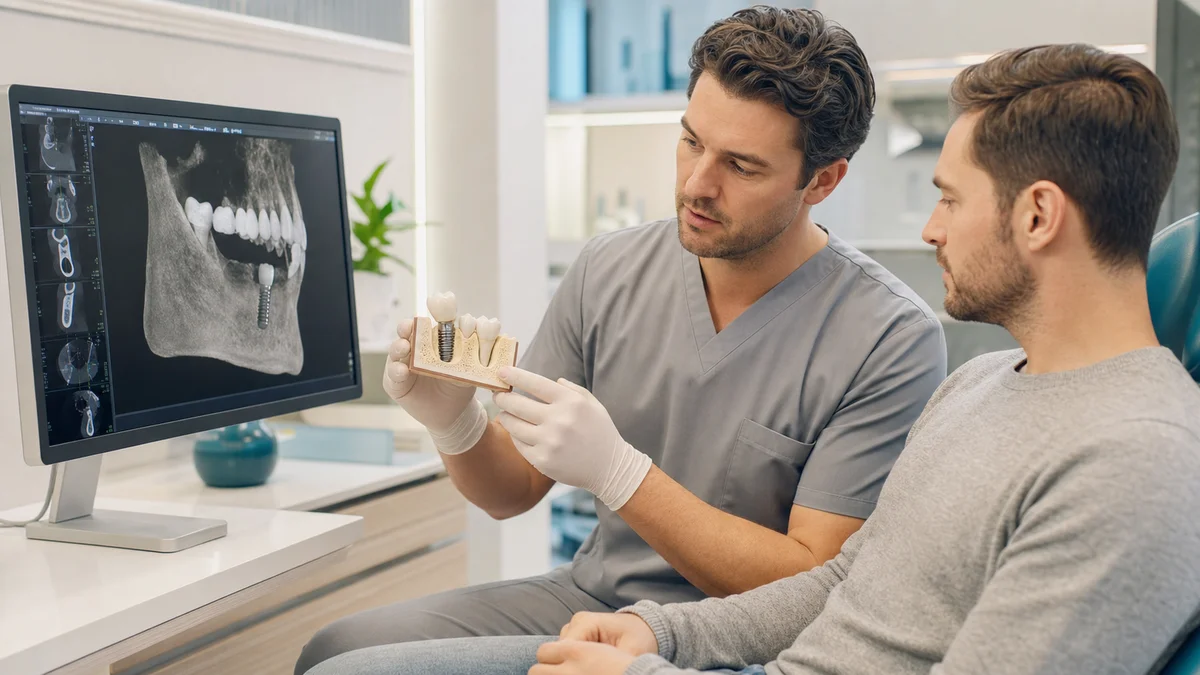
Quick answer: immediate implant placement cost is not just the price of an implant screw. A complete plan may include diagnosis, imaging, careful extraction, implant placement, grafting, a temporary tooth, the abutment, final crown and follow-up. Suitability is confirmed during assessment and sometimes only after extraction, so compare itemised plans and contingencies.
A search for immediate implant placement cost often starts with the hope of replacing a failing tooth in one visit. “Immediate” has a precise clinical meaning: the implant body is placed in the extraction socket on the same day that the tooth is removed. It does not automatically mean that a functional final tooth is attached that day, that healing is instant, or that every component is included in a single advertised figure.
This guide explains the full financial and clinical pathway without diagnosing an individual, promising candidacy, quoting a universal fee or guaranteeing an outcome. It is prepared for evidence-informed review by Dentist Esma Çevrük Çakır. A safe decision begins with the tooth’s prognosis and the condition of the site, then asks whether immediate placement offers a patient-centred advantage over early or later placement.
1. What does immediate implant placement cost include?
One clinic may use immediate implant placement cost to describe extraction and insertion of the implant body. Another may include CBCT planning, a bone graft, a temporary tooth, the abutment and the final crown. Those are not equivalent offers. The implant body, abutment and restoration are distinct components, and several clinicians or a laboratory may contribute to the complete treatment.
The US Food and Drug Administration explains that a dental implant system typically includes an implant body in the jaw, an abutment and an abutment fixation screw, with a crown, bridge or denture supported above. A quote for one component should not be mistaken for a completed tooth. Ask where the estimate begins, where it ends and which services are billed separately.
A realistic immediate implant placement cost plan should also show what happens if immediate placement cannot proceed. Extraction may reveal a socket defect, inadequate bone for stable positioning or another finding that changes the plan. The ITI consensus guidance notes that immediate placement with immediate restoration is complex and that selected sites may still need an alternative when extraction events or insufficient primary stability make the intended protocol unsuitable.
2. Immediate placement is not the same as immediate loading
Immediate placement refers to implant timing: extraction and implant insertion occur on the same day. Immediate restoration or loading refers to when a prosthesis is connected. In ITI terminology, immediate restoration or loading occurs within one week; a provisional restoration kept out of biting contact is different from a restoration that carries functional contact. A final crown may still follow after healing and tissue maturation.
This distinction materially affects immediate implant placement cost. A healing abutment, a removable temporary, a bonded temporary tooth and an implant-supported provisional crown involve different components, laboratory work and risk controls. An advertisement for “tooth in a day” may describe a provisional, not the definitive crown. Ask what you will leave with, whether it is attached to the implant, whether it may touch during biting and when the final restoration is expected.
Do not assume that an immediate provisional saves a visit or a fee. It may require digital planning, extra restorative time, a prefabricated shell or laboratory support. It also depends on extraction quality, implant position, stability, bite and patient compliance. The safest option is the one supported by the site, not the fastest label.
3. Candidacy comes before immediate implant placement cost
The question “can it be done?” must come before “what does it cost?” Medical health, periodontal condition, smoking, diabetes control, medications, bite forces, grinding, aesthetic risk, oral hygiene and willingness to attend reviews can affect planning. Site-specific considerations include the socket walls, facial bone, gum thickness, infection, adjacent teeth and available bone for primary stability.
ITI’s current consensus for immediate placement with immediate loading in the front upper jaw emphasises highly selected populations and multiple patient, site and treatment factors. It recommends thorough clinical and radiographic assessment and notes that the protocol is complex. The guidance does not mean that everyone with a failing front tooth is eligible or that the same approach should be used in every region of the mouth.
Therefore, immediate implant placement cost cannot be finalised safely from a photograph or a sales call. Remote review can organise history and records, but it cannot confirm socket integrity after extraction or the stability achieved at surgery. A written plan should state which criteria can be assessed beforehand and which decision checkpoints occur during treatment.
4. Fourteen factors that shape immediate implant placement cost
The following items explain why immediate implant placement cost varies. Not every case needs every service, and a larger package is not automatically more appropriate.
- Consultation and clinical examination: diagnosis, medical review, periodontal and restorative assessment.
- Imaging: selected dental radiographs and, when justified, CBCT acquisition and interpretation.
- Digital planning: software planning, guide design or a surgical template when clinically indicated.
- Tooth extraction: complexity, root shape, previous treatment and techniques intended to preserve bone and soft tissue.
- Socket management: debridement, inspection and treatment of unexpected defects.
- Implant body: implant system, dimensions and traceable components.
- Surgical placement: clinician time, sterile materials and procedure complexity.
- Bone augmentation: graft material, membrane and additional surgical time when needed.
- Soft-tissue management: grafting or contour procedures in selected sites.
- Healing component: cover screw, healing abutment or provisional abutment.
- Temporary tooth: removable, bonded or implant-supported provisional options.
- Definitive abutment and crown: scan or impression, laboratory work, material, fitting and adjustment.
- Anaesthesia or sedation: local anaesthetic is different from separately assessed sedation services.
- Follow-up and maintenance: reviews, imaging when indicated, hygiene care, bite checks and complication management.
Ask the practice to mark each item as included, excluded, optional or conditional. This turns immediate implant placement cost into a treatment map rather than a marketing number. It also makes clear whether the final crown is part of the offer and whether a graft is a confirmed plan or a contingency.
5. Extraction quality and the socket can change the plan
Immediate placement begins with removing a tooth while preserving the structures needed for restoratively driven implant positioning. Root anatomy, fracture, previous root canal treatment, ankylosis, infection and the amount of remaining tooth can influence difficulty. Special instruments or more time may be required. ITI recommends minimally traumatic extraction and confirmation of socket-wall integrity before proceeding.
The facial bone plate may be thin or damaged before treatment, or a defect can occur during extraction. A minor defect may be managed with additional measures in a suitable case; a larger defect may make another placement timing safer. The possibility of switching to socket preservation and delayed implant placement should be discussed before surgery.
This contingency is central to immediate implant placement cost. Ask what you will pay if the tooth is extracted but the implant is not placed, how grafting is authorised, what protects the site and whether unused implant or provisional components are charged. Consent obtained while a patient is anxious or sedated is not a substitute for explaining foreseeable alternatives in advance.
6. Imaging and planning are part of the value, not just an add-on
Implant planning must relate the proposed restoration to bone, neighbouring roots, nerves, the sinus and other anatomy. A periapical radiograph can answer some questions. CBCT provides three-dimensional information and is widely used in implant planning, but it exposes the patient to more radiation than conventional dental radiographs. The FDA says CBCT should be performed only when necessary to provide information that other imaging cannot supply.
For selected immediate anterior cases, ITI strongly recommends a good-quality periapical image and CBCT, with planning software used to simulate the restoration-driven implant position. That does not make every scan or surgical guide mandatory for every person. The clinician should justify the examination, review previous records, select an appropriate field of view and use exposure settings adequate for diagnosis while limiting dose.
When comparing immediate implant placement cost, ask whether imaging includes professional interpretation, whether the scan belongs to you, and whether a guide is included. A low surgical fee can be misleading if essential planning is billed later. Conversely, an expensive technology should have a clear clinical purpose rather than serving as proof of quality on its own.
7. Bone grafts, membranes and soft-tissue procedures
An implant placed into a fresh socket does not fill the entire socket. A gap may remain between the implant and socket wall. Depending on defect size, tissue phenotype, implant position and aesthetic demands, a graft or membrane may be considered. Soft-tissue grafting may also be proposed to support contour or tissue stability. These procedures add materials, time and follow-up, but they should not be bundled automatically into every case.
Ask which finding supports each graft, what material is proposed, whether it is included in immediate implant placement cost, and what alternative exists. Also ask whether grafting is performed at implant placement or whether the site will be preserved for a later implant. The treatment plan should distinguish a small socket gap from a larger bony defect because they do not carry the same implications.
Grafting does not guarantee that the contour will remain unchanged or that the implant will integrate. Healing is biological and individual. A clinician can explain expected benefits, risks and alternatives, but should not promise a perfect gum line or lifetime bone stability.
8. Temporary teeth and the final crown can be separate costs
The visible temporary is often the most misunderstood part of immediate implant placement cost. A patient may receive no temporary at the implant site, a removable partial appliance, a temporary bonded to neighbouring teeth, or an implant-supported provisional. Each option has different indications, cleaning requirements and effects on bite. A provisional may be shaped over time to guide soft-tissue contour.
The definitive crown usually follows after the team is satisfied with healing, implant stability, tissue form and bite. It may use a stock or custom abutment and may be screw-retained or cement-retained. Material, shade work, laboratory complexity and aesthetic demands influence cost. Ask whether the final abutment and crown are included, whether replacement of a temporary is covered, and how many adjustment visits the estimate allows.
The FDA notes that implant-body healing may take several months or longer. “Immediate” placement therefore does not eliminate healing. Do not choose a plan merely because it promises a final-looking tooth sooner. Confirm whether the day-one restoration is provisional, whether it is kept out of biting contact and what restrictions apply.
9. A decision table for comparing immediate implant placement cost
| Question | Why it changes the decision | What the written plan should show |
|---|---|---|
| Is immediate placement confirmed or conditional? | Socket integrity and stability may only be verified during extraction. | Selection criteria and the alternative if placement is deferred. |
| What does “same-day tooth” mean? | Placement, restoration and functional loading are different events. | Type of temporary, bite contact and date or criteria for the final crown. |
| Are extraction and grafting included? | They may be separate major components. | Confirmed fees, conditional fees and material charges. |
| Does the price include implant, abutment and crown? | An implant body alone is not a complete tooth. | Brand or system, components, laboratory work and restoration material. |
| Who performs each stage? | Surgical, periodontal and restorative care may involve different clinicians. | Names, qualifications, referrals and professional fees. |
| What if the implant cannot be placed? | A safe team must be able to change course. | Socket management, refund or credit terms and revised timeline. |
| Who manages complications? | Urgent care and revision can add substantial cost. | Contact route, review policy, exclusions and record transfer. |
The table prevents unlike quotes from being compared as though they are equivalent. If one immediate implant placement cost ends with an implant and healing cap while another includes grafting, a custom provisional and final crown, the totals describe different endpoints.
10. Insurance, NHS and Medicare considerations
Insurance may classify examination, extraction, grafting, implant surgery, abutment and crown as separate benefits. Networks, waiting periods, missing-tooth clauses, annual limits, replacement frequency, medical necessity and prior authorisation can affect payment. A percentage printed in a benefits brochure is not the same as a guaranteed contribution to the proposed immediate implant placement cost.
Ask the provider for proposed procedure descriptions and request a written predetermination when available. Verify eligibility and remaining benefits directly with the payer. Even a predetermination may change if the treatment delivered differs from the proposed plan, the patient loses eligibility, an annual maximum is reached, or a policy exclusion applies.
The NHS states that implants are usually available privately and are only sometimes available through the NHS in limited circumstances, such as when a person cannot wear dentures for certain reasons including mouth cancer or an accident. This is not a private price guide and does not establish eligibility. Confirm the pathway with the treating NHS provider before relying on public funding.
In the United States, CMS says Original Medicare generally excludes services connected with the care, treatment, removal or replacement of teeth. CMS describes narrow exceptions for dental services inextricably linked to certain covered medical care and notes that some Medicare Advantage plans may offer added dental benefits. A Medicare card alone therefore does not establish coverage for an implant.
11. Travel and treatment in Türkiye
A lower clinic quote abroad may still produce a higher total immediate implant placement cost after flights, accommodation, a companion, meals, time away from work, currency fees, repeat visits and emergency return travel are included. Immediate placement may reduce one waiting interval but does not remove biological healing or the need for final restorative care.
For treatment in Türkiye, check the Republic of Türkiye Ministry of Health’s current list of healthcare providers authorised for international health tourism. The ministry’s English listing was updated on 28 July 2026. Administrative authorisation is important, but it does not replace the clinician’s qualifications, an individual diagnosis, informed consent, traceable implant components or a practical aftercare pathway.
Ask how many trips are planned, how long you should stay after surgery, who fits the final crown, and whether the home dentist agrees to take over maintenance. Obtain copies of the CBCT report, operative record, graft details, implant brand, model, dimensions, lot information, abutment and restoration design. The FDA specifically encourages patients to keep the implant brand and model in their records.
Redent Clinic’s English website provides general service information, and its contact page can be used to request consultation details. Remote review can help organise records, but final candidacy and immediate implant placement cost require examination-based planning.
12. What a written immediate implant placement cost plan should contain
The General Dental Council’s standards require UK dental professionals to explain options, risks, benefits and possible costs, provide a written treatment plan with a realistic indication of cost, and update it if treatment or estimates change. These standards do not govern every country, but they provide a useful model for transparent decision-making.
- The tooth, diagnosis and reason extraction is recommended.
- Why immediate placement is preferred over early or later placement.
- Clinical and radiographic criteria that must be satisfied.
- Extraction, implant, guide, graft, membrane and soft-tissue services.
- The temporary-tooth option and whether it is implant-supported.
- The definitive abutment, crown material, laboratory and fitting fees.
- The contingency if placement, grafting or provisionalisation changes.
- Number and timing of reviews, scans or impressions.
- Insurance assumptions, deposits, finance costs and cancellation terms.
- Emergency access, maintenance, warranty wording and exclusions.
Read the plan before paying a non-refundable deposit. A single package total should be unpacked into clinically meaningful stages. A transparent immediate implant placement cost estimate says what is excluded as clearly as what is included and explains how consent will be renewed if findings change the treatment.
Use the itemised immediate implant placement cost as a baseline. Reconfirm immediate implant placement cost after extraction, review immediate implant placement cost before provisionalisation, and approve any change to immediate implant placement cost before final restoration.
13. Safety, healing and long-term maintenance
Implant surgery has risks. The FDA lists possible injury to neighbouring teeth or tissues, sinus perforation, jaw fracture, altered bite, screw loosening, implant failure, infection, delayed healing and numbness related to nerve injury. Risk differs by patient and site; a list cannot predict an individual outcome. Ask which risks are most relevant, how the team reduces them and what signs require review.
Smoking may impair healing, and uncontrolled diabetes or untreated periodontal disease can increase concern. Provide a complete medical history, including medicines, supplements, allergies, prior surgery, bleeding problems and antiresorptive or immune-modifying therapies. Do not stop prescribed medication without coordination between the relevant clinicians.
The American Academy of Periodontology describes peri-implant mucositis and peri-implantitis as inflammatory conditions around implants and identifies factors such as previous periodontal disease, poor plaque control, smoking and diabetes. Daily cleaning and professional maintenance remain necessary after the final crown is fitted. Include realistic maintenance in immediate implant placement cost rather than treating the implant as a maintenance-free device.
After surgery, follow the team’s instructions on cleaning, diet, medicines, activity and temporary-tooth use. Contact the treating provider for worsening pain, swelling, fever, discharge, persistent bleeding, numbness, a loose component or a bite problem. Seek urgent medical help for breathing or swallowing difficulty, rapidly spreading swelling, severe systemic illness or another emergency sign.
14. Red flags in an immediate implant placement cost advertisement
Be cautious when an advertisement guarantees immediate placement before reviewing health, periodontal status, bone and the extraction site. Other warning signs include a lifetime-result promise, refusal to name the implant system, pressure to pay immediately, a claim that everyone receives a fixed graft package, or language suggesting the final crown is always fitted on surgery day.
- A coordinator makes the diagnosis or dismisses a clinician’s examination as unnecessary.
- The quote hides extraction, abutment, provisional or final crown fees.
- No alternative is offered if primary stability or socket integrity is inadequate.
- CBCT is presented as automatically required without clinical justification.
- Risks, healing limits and maintenance are replaced by success guarantees.
- There is no written route for emergencies, complaints or portable records.
A premium service is defined by careful selection, qualified clinicians, restoration-driven planning, traceable components, safe infection control, clear consent and durable follow-up. It is not defined by décor, urgency or the lowest immediate implant placement cost.
Frequently asked questions about immediate implant placement cost
What is the average immediate implant placement cost?
There is no safe worldwide average that represents every case. Location, diagnosis, extraction, imaging, grafting, implant system, temporary tooth, abutment, crown, sedation and follow-up differ. Ask for an examination-based, itemised immediate implant placement cost and compare the same endpoint. An advertised implant-body fee is not the total for a completed tooth.
Does immediate implant placement cost more than delayed placement?
It can cost more, less or a similar amount depending on the pathway. Combining extraction and placement may reduce one surgical visit, but advanced planning, grafting or an immediate provisional can add expense. Delayed placement may involve socket preservation and another surgery. The comparison must use the complete treatment, not one appointment.
Is a temporary tooth included in immediate implant placement cost?
Not always. A removable temporary, bonded tooth and implant-supported provisional are different services. Ask which option is planned, whether it is included, whether it will touch during biting, what restrictions apply and how replacement is charged if it breaks. Also confirm whether the final abutment and crown are separate.
Can immediate placement be guaranteed before extraction?
No. Examination and imaging can identify many factors, but socket damage or inadequate primary stability may only become clear during extraction. A safe plan includes an alternative such as socket preservation and later placement. Ask how the immediate implant placement cost changes if the implant cannot be inserted that day.
Does immediate placement mean I receive the final crown that day?
No. Immediate placement describes the timing of the implant body. An immediate restoration may be a provisional and may be kept out of functional contact. The definitive crown commonly follows healing and tissue development. The exact sequence depends on stability, site, bite and restorative plan.
Is a bone graft always required?
No. Grafting depends on the socket, defect, implant position, tissue phenotype and treatment goal. Some sites need augmentation; others may not. Ask what finding supports the graft, what material is proposed, whether it is included in immediate implant placement cost, and what alternative timing would change the need.
Will insurance cover immediate implant placement cost?
Coverage varies by plan and by component. Extraction, graft, implant, abutment and crown may be evaluated separately. Request proposed codes and a written predetermination, then verify deductibles, annual maximums, waiting periods, missing-tooth rules and network status. A predetermination is useful but may not guarantee final payment.
How long does an immediate implant take to heal?
Immediate placement does not mean immediate biological integration. The FDA notes that implant-body healing may take several months or longer. Timing depends on health, site, stability, grafting and healing response. Ask for a range, decision checkpoints and the criteria for moving from a provisional or healing component to the final crown.
How should I compare treatment abroad?
Add travel, accommodation, time away, repeat trips, companion needs and emergency contingencies to immediate implant placement cost. Verify provider authorisation and clinician credentials, obtain traceable component records, and agree on aftercare before booking. A short flight schedule should not dictate extraction, provisionalisation or final-crown timing.
Final checklist for immediate implant placement cost
Before deciding, confirm the diagnosis, why immediate placement offers an advantage, which selection criteria must be met, and what happens if the protocol changes. Identify the temporary and final restoration, separate confirmed from conditional services, verify insurance independently, and keep portable records. If travelling, budget for the entire treatment and maintenance pathway.
The most useful answer to immediate implant placement cost is not a universal number. It is a transparent, staged plan that protects clinical flexibility: examine, image when justified, extract carefully, proceed only when the site supports it, restore at the appropriate time and maintain the implant for the long term.
Sources
- International Team for Implantology — 2023 consensus on selection criteria for immediate placement and loading
- International Team for Implantology — placement and loading protocol definitions
- US Food and Drug Administration — dental implant benefits, risks and patient records
- US Food and Drug Administration — dental CBCT uses and radiation principles
- NHS — dental implant treatment and availability
- US Centers for Medicare & Medicaid Services — Medicare dental coverage and exclusions
- General Dental Council — written treatment plans and realistic cost information
- Republic of Türkiye Ministry of Health — authorised international health-tourism providers
- American Academy of Periodontology — peri-implant diseases and maintenance
- American Dental Association
- World Health Organization oral health fact sheet
Clinical, coverage and regulatory sources were checked on 18 August 2026. Fees, eligibility, provider status, coverage and regulations can change. This educational article is not a diagnosis, quotation, insurance decision or legal advice.