
Internal whitening is a specialized dental procedure designed to lighten a tooth from the inside rather than the surface. Unlike traditional bleaching methods that work on the outer enamel, internal whitening focuses on teeth that have darkened due to trauma, root canal treatment, or internal discoloration. If you have a single tooth that appears darker than the surrounding teeth, internal whitening may be the ideal solution to restore a uniform, natural smile. 😊
Many patients search for solutions when they notice that one tooth has turned gray, yellow, or brown after a root canal. This discoloration happens because the inner pulp tissue has been removed, and blood pigments or restorative materials can stain the dentin from within. Internal whitening directly targets these stains inside the tooth structure. It is sometimes referred to as non-vital bleaching or inside-the-tooth bleaching, but the most commonly used clinical term remains internal whitening.
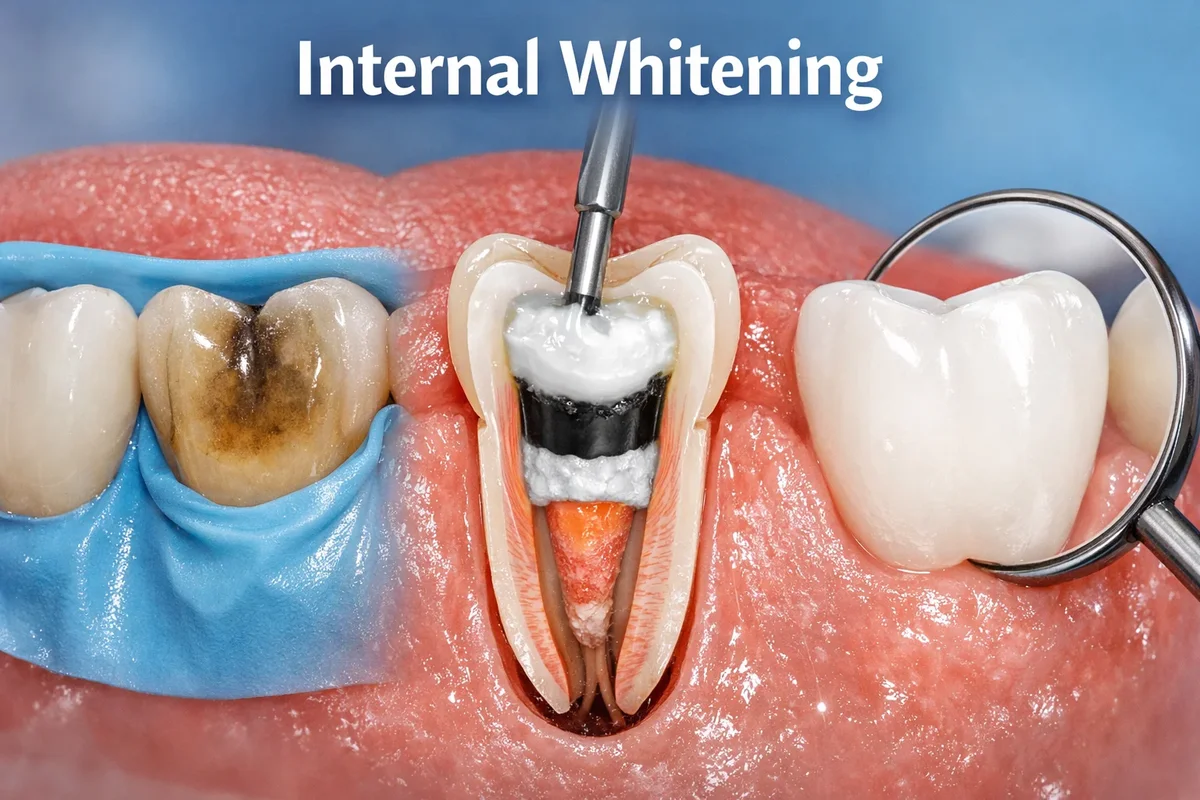
The process of internal whitening begins after a proper dental evaluation. Your dentist will first confirm that the tooth has been adequately treated with a root canal and that there are no infections present. A small opening is created in the back of the tooth to access the inner chamber. A special whitening agent is placed inside, and the tooth is temporarily sealed. Over several days, this bleaching material works from the inside out, gradually lightening the tooth color.
One of the main advantages of internal whitening is that it preserves your natural tooth structure. Instead of placing a crown or veneer immediately, which requires removing healthy enamel, internal whitening allows you to improve color conservatively. This makes it a minimally invasive and cost-effective option for many patients.
Internal whitening is not suitable for every type of discoloration. It is specifically designed for non-vital teeth—teeth that no longer have living pulp tissue. If your tooth is still vital and discolored on the outside, external whitening treatments may be more appropriate. That is why a professional diagnosis is essential before starting internal whitening. According to the American Dental Association, cosmetic procedures should always be performed under dental supervision to ensure safety and effectiveness.
The science behind internal whitening involves the diffusion of bleaching agents, typically hydrogen peroxide or sodium perborate, through the dentin. These agents break down complex stain molecules into smaller, less pigmented compounds. As the stain molecules become lighter, the overall appearance of the tooth improves. The process may require more than one appointment, depending on the severity of discoloration.
Patients often wonder how long internal whitening results last. In many cases, the improvement can last for years. However, lifestyle factors, trauma history, and the initial cause of discoloration can influence longevity. Some patients may require a touch-up procedure after several years. Fortunately, internal whitening can often be repeated if necessary, provided the tooth remains structurally sound.
Comfort during internal whitening is generally high. Since the tooth has already undergone root canal therapy, there is typically no nerve sensitivity. Mild pressure or slight discomfort may occur, but it is usually minimal. Most patients are pleasantly surprised at how straightforward internal whitening feels compared to more invasive cosmetic treatments.
Another key consideration in internal whitening is proper sealing of the tooth after the desired shade is achieved. Once the dentist confirms that the tooth matches the surrounding teeth, the bleaching material is removed, and the tooth is permanently restored with a durable filling. This step is critical to prevent leakage and maintain the long-term success of internal whitening.
If you are considering internal whitening, a consultation with an experienced dental team is the best first step. At Redent Klinik, patients receive a thorough evaluation and personalized treatment planning. You can schedule an appointment through the Redent Klinik Contact Page to determine whether internal whitening is right for your smile.
In summary, internal whitening is an advanced cosmetic solution for teeth that have darkened from within. It offers a conservative, effective, and aesthetically pleasing way to restore confidence without aggressive tooth reduction. By targeting stains inside the tooth, internal whitening delivers results that external bleaching simply cannot achieve. If you have a single dark tooth after trauma or root canal treatment, internal whitening may be the transformative treatment you have been searching for. ✨
What Is Internal Whitening and How Does It Work?
Internal whitening is a professional cosmetic dental procedure specifically designed to lighten a tooth from the inside out. Unlike surface bleaching treatments that focus on enamel stains, internal whitening targets discoloration that originates within the tooth structure itself. This type of staining commonly occurs after root canal treatment, dental trauma, internal bleeding, or long-standing restorative materials. When a single tooth becomes darker than the surrounding teeth, internal whitening provides a conservative and highly effective solution. 😊
Understanding Why Teeth Darken from the Inside
To fully understand how internal whitening works, it is important to know why internal discoloration happens. After a root canal, the pulp tissue is removed. Over time, residual blood components, tissue remnants, or filling materials can penetrate the dentinal tubules. These pigments oxidize and cause the tooth to appear gray, brown, or yellow. Because the stain originates internally, external whitening treatments are often ineffective.
Internal whitening directly addresses this issue by placing a bleaching agent inside the pulp chamber of the treated tooth. The whitening material works from within the dentin, breaking down stain molecules at their source. This inside-the-tooth bleaching process is sometimes referred to as non-vital bleaching, but in clinical settings, the term internal whitening is widely used and understood.
The Science Behind Internal Whitening
The success of internal whitening depends on the chemical action of oxidizing agents such as hydrogen peroxide or sodium perborate. These substances release oxygen molecules that penetrate the dentin. The oxygen breaks apart complex pigmented compounds into smaller, less colored particles. As these stain molecules are altered, the tooth gradually becomes lighter.
Internal whitening is particularly effective because dentin is porous. The bleaching agent diffuses through microscopic channels inside the tooth, ensuring even color improvement. This controlled chemical reaction is carefully monitored by the dentist to prevent over-whitening or structural weakening.
Why External Whitening Cannot Fix Internal Stains
External whitening treatments primarily affect enamel. However, when discoloration originates in the dentin or pulp chamber, surface bleaching cannot adequately penetrate deep enough. That is why patients with one dark tooth often feel frustrated after trying over-the-counter whitening kits. Internal whitening solves this issue by targeting the discoloration at its origin.
Step-by-Step Process of Internal Whitening
The internal whitening procedure typically begins with a thorough dental examination. The dentist confirms that the root canal is properly sealed and that there are no infections. Radiographs may be taken to ensure the tooth is stable.
Next, a small opening is created in the back of the tooth to access the pulp chamber. A protective barrier is placed over the root canal filling to safeguard the root. Then, the whitening material is inserted into the chamber. The tooth is temporarily sealed, allowing the bleaching agent to work over several days.
This technique is often called the “walking bleach technique” because the patient leaves the office with the whitening agent inside the tooth. After a few days, the patient returns for evaluation. If the desired shade has not been reached, the internal whitening material may be replaced. Once the ideal color is achieved, the tooth is permanently restored.
How Long Does Internal Whitening Take?
Internal whitening usually requires one to three visits, depending on the severity of discoloration. Mild cases may improve within a week, while deeper stains may require multiple applications. The gradual approach ensures safety and optimal aesthetic blending with adjacent teeth.
One of the reasons internal whitening is so popular is its predictability. When performed correctly, it can dramatically improve tooth color without the need for crowns or veneers. This conservative approach preserves natural enamel and dentin.
Is Internal Whitening Safe?
When carried out by an experienced dental professional, internal whitening is considered safe and effective. A protective barrier inside the tooth prevents bleaching agents from leaking into the root area. Modern protocols significantly reduce risks such as cervical root resorption, a rare complication historically associated with older techniques.
Professional guidelines, including those supported by organizations such as the American Dental Association, emphasize that cosmetic dental treatments should always be performed under supervision. Proper diagnosis and technique are essential for successful internal whitening outcomes.
Who Benefits Most from Internal Whitening?
Internal whitening is ideal for patients with a single darkened tooth following trauma or root canal treatment. It is especially beneficial when the rest of the smile is healthy and bright. Instead of covering the tooth with a crown, internal whitening restores harmony in a minimally invasive way.
Patients often appreciate that internal whitening maintains their natural tooth structure. Because the tooth is treated internally, the outer enamel remains intact. This makes internal whitening a conservative cosmetic solution compared to restorative alternatives.
If you are unsure whether internal whitening is suitable for your case, a professional consultation is recommended. The dental team can evaluate the cause of discoloration and design a customized plan. You may contact a trusted clinic through the Redent Klinik Contact Page for a personalized assessment.
In summary, internal whitening is a scientifically supported, minimally invasive procedure that lightens teeth from the inside. By targeting deep stains at their source, internal whitening delivers natural-looking and long-lasting results. For patients struggling with one discolored tooth, internal whitening offers a safe, effective, and confidence-boosting solution. ✨
Who Is the Ideal Candidate for Internal Whitening?
Internal whitening is not a universal cosmetic treatment for every type of tooth discoloration. Instead, it is a highly targeted procedure designed for very specific cases. Understanding whether you are an ideal candidate for internal whitening requires evaluating the cause of discoloration, the condition of the tooth, and your overall oral health. When properly indicated, internal whitening can restore a natural appearance with conservative and predictable results. 😊
Patients with Root Canal–Treated Teeth
The most common candidates for internal whitening are individuals who have undergone root canal therapy and later noticed that the treated tooth became darker. After the pulp is removed, changes in the internal structure of the tooth may lead to discoloration. Blood pigments, necrotic tissue remnants, or certain filling materials can stain the dentin from within. Because the tooth is non-vital (no longer living), traditional external bleaching methods are often ineffective.
Internal whitening works specifically for these non-vital teeth. Since the nerve tissue has already been removed, there is typically no sensitivity during the procedure. This makes internal whitening both comfortable and efficient for patients with previous endodontic treatment.
Why Vital Teeth Are Not Suitable
If a tooth is still vital and discolored due to surface stains, aging, or lifestyle factors like coffee or smoking, internal whitening is not the correct treatment. In such cases, external whitening procedures or professional cleaning are more appropriate. Internal whitening is strictly designed for discoloration that originates inside the pulp chamber.
Patients with Trauma-Induced Discoloration
Dental trauma is another major reason patients become candidates for internal whitening. A blow to the tooth can cause internal bleeding, even if the tooth does not fracture. Over time, the breakdown of blood components within the pulp chamber can lead to a gray or brown appearance. If the tooth later requires root canal treatment, internal whitening can effectively address the resulting discoloration.
In trauma cases, internal whitening can dramatically improve aesthetics without placing a crown. This is especially beneficial for front teeth, where preserving natural enamel is a priority.
Patients with a Single Dark Tooth
Internal whitening is particularly ideal when only one tooth appears darker than the surrounding teeth. A single discolored tooth can significantly impact smile harmony. Instead of whitening the entire smile, internal whitening focuses only on the affected tooth, allowing it to match naturally with adjacent teeth.
This targeted approach makes internal whitening a conservative alternative to veneers or crowns. By preserving healthy enamel, patients maintain the strength and longevity of their natural tooth structure.
Cosmetic Expectations and Realistic Goals
Ideal candidates for internal whitening also have realistic expectations. While internal whitening can significantly lighten a tooth, results depend on the severity and duration of discoloration. Deep, long-standing stains may require multiple applications. However, most patients experience noticeable improvement within a few visits.
Patients with Healthy Root Canal Treatment
Before performing internal whitening, the dentist must confirm that the root canal therapy is properly sealed and free from infection. Radiographic evaluation ensures that there are no underlying issues such as periapical inflammation or leakage. Internal whitening should never be performed on a tooth with unresolved infection.
If the previous root canal is inadequate, retreatment may be required before internal whitening can begin. Proper diagnosis ensures both safety and long-term success.
Patients Seeking Conservative Cosmetic Solutions
Many patients prefer minimally invasive cosmetic treatments. Internal whitening fits perfectly into this category. Instead of removing significant tooth structure to place a crown, internal whitening works within the existing anatomy of the tooth. This conservative philosophy aligns with modern dental principles supported by organizations such as the American Dental Association.
Patients who value preserving their natural teeth often find internal whitening to be an ideal first-line cosmetic solution.
When Internal Whitening May Not Be Recommended
Internal whitening may not be suitable if the tooth has extensive structural damage, large fractures, or significant enamel loss. In such cases, restorative treatments like crowns may be necessary for functional reasons. Additionally, teeth with severe internal resorption or compromised root integrity may not be candidates for internal whitening.
Each case requires individualized assessment. That is why consultation with an experienced dental professional is essential before proceeding.
Age Considerations and Oral Health Status
Age alone does not determine candidacy for internal whitening. However, overall oral health plays a critical role. Candidates should have healthy gums and stable surrounding teeth. Active periodontal disease or untreated cavities should be addressed before cosmetic procedures are considered.
Internal whitening is generally safe for adults and older teenagers whose root canal treatment is complete and stable. Comprehensive evaluation ensures that internal whitening is both effective and biologically safe.
How to Determine If You Are a Candidate
The best way to know if internal whitening is right for you is through a professional consultation. During the appointment, your dentist will assess the cause of discoloration, review your dental history, and take diagnostic images if necessary. Based on this evaluation, a personalized treatment plan can be developed.
If you are experiencing discoloration of a root canal–treated tooth and want to explore internal whitening, you can schedule a professional assessment through the Redent Klinik Contact Page.
In conclusion, the ideal candidate for internal whitening is someone with a non-vital, discolored tooth caused by root canal treatment or trauma, who seeks a conservative and effective cosmetic solution. With proper diagnosis and professional care, internal whitening can restore symmetry, confidence, and a natural-looking smile. ✨
Step-by-Step Internal Whitening Procedure Explained
Understanding the detailed process of internal whitening helps patients feel confident and informed before beginning treatment. Internal whitening is a carefully controlled cosmetic dental procedure performed exclusively by dental professionals. It focuses on lightening a non-vital tooth from the inside, making it ideal for cases where discoloration originates within the pulp chamber. Below, we explain each stage of the internal whitening process in detail so you know exactly what to expect. 😊
Initial Consultation and Diagnosis
The first step in internal whitening is a comprehensive dental evaluation. Your dentist will examine the discolored tooth and determine whether internal whitening is appropriate. Diagnostic X-rays are typically taken to confirm that the root canal treatment is properly sealed and that no infection is present.
This stage is critical because internal whitening should only be performed on teeth that have completed root canal therapy and are free of active pathology. If any infection or leakage is detected, retreatment may be required before proceeding with internal whitening. A thorough diagnosis ensures both safety and predictable results.
Shade Assessment and Treatment Planning
Before beginning internal whitening, the dentist records the current tooth shade using a professional shade guide. This baseline measurement allows accurate monitoring of progress. The goal of internal whitening is to harmonize the treated tooth with adjacent teeth, creating a natural and symmetrical smile.
Accessing the Tooth Internally
Once internal whitening is approved, the dentist begins by isolating the tooth to maintain a clean and dry working environment. A small opening is created at the back of the tooth, similar to the access used during root canal treatment. This opening provides entry to the pulp chamber.
Because the tooth is non-vital, patients usually experience minimal discomfort during this phase. In most cases, anesthesia is not even necessary, although it may be used if the patient prefers additional comfort.
Placement of a Protective Barrier
Before applying the whitening agent, a protective barrier is placed over the root canal filling material. This step is essential in internal whitening because it prevents bleaching agents from reaching the root area. Proper sealing significantly reduces the risk of complications such as external cervical resorption.
Application of the Whitening Agent
The dentist then inserts a specialized bleaching material into the pulp chamber. Common agents include sodium perborate mixed with distilled water or hydrogen peroxide. These materials release oxygen molecules that penetrate dentinal tubules and break down stain compounds.
This phase is often referred to as the “walking bleach technique.” After placing the whitening agent, the tooth is temporarily sealed with a filling material. The patient leaves the clinic while the internal whitening agent works inside the tooth over several days.
How the Bleaching Reaction Occurs
The chemistry behind internal whitening involves oxidation. The bleaching agent releases free radicals that disrupt complex pigment molecules responsible for discoloration. Over time, these molecules become lighter and less visible. Because dentin is porous, the whitening solution diffuses evenly, allowing gradual and controlled color improvement.
Follow-Up Visits and Shade Evaluation
After several days, the patient returns for evaluation. The temporary filling is removed, and the dentist checks the shade. If additional lightening is needed, a fresh internal whitening agent may be applied. This process can be repeated until the desired shade is achieved.
Most cases require one to three applications of internal whitening. Severe discoloration may take longer, but gradual improvement ensures safety and aesthetic precision. The dentist carefully monitors each stage to prevent over-whitening.
Final Restoration and Sealing
Once the desired color match is achieved, the bleaching material is completely removed. The pulp chamber is thoroughly cleaned, and a permanent restoration is placed to seal the tooth. This final step is crucial for maintaining long-term success after internal whitening.
A properly sealed tooth prevents bacterial infiltration and ensures structural integrity. The final restoration is matched to the surrounding tooth color, completing the cosmetic transformation.
Post-Procedure Monitoring
After internal whitening, routine dental check-ups are recommended. Your dentist will monitor the treated tooth to ensure color stability and structural health. While internal whitening results can last for years, occasional touch-ups may be required depending on the original cause of discoloration.
Professional supervision throughout the internal whitening process is strongly recommended. According to guidelines supported by the American Dental Association, cosmetic dental treatments should always be performed under qualified supervision to ensure safety and effectiveness.
Patient Comfort and Recovery
One of the advantages of internal whitening is minimal downtime. Patients can usually resume normal activities immediately after each appointment. Because the tooth is already non-vital, sensitivity is uncommon. Mild pressure may occur temporarily, but it is generally well tolerated.
Why Professional Expertise Matters
Internal whitening is a precise procedure that requires careful technique. Proper placement of the barrier, accurate measurement of bleaching agents, and controlled monitoring are essential. Attempting similar procedures without professional training can lead to complications. That is why internal whitening must always be performed by experienced dental professionals.
If you are considering internal whitening for a discolored root canal–treated tooth, a professional evaluation is the best first step. You may schedule an appointment through the Redent Klinik Contact Page to receive personalized guidance.
In summary, the internal whitening procedure follows a structured and safe step-by-step protocol. From diagnosis and barrier placement to bleaching and final sealing, each stage is carefully controlled. When performed correctly, internal whitening delivers natural, long-lasting results while preserving healthy tooth structure. ✨
Internal Whitening vs. External Teeth Whitening
When patients explore cosmetic dental treatments, one of the most common questions is the difference between internal whitening and traditional external teeth whitening. Although both procedures aim to improve tooth color, they are fundamentally different in purpose, technique, and indication. Understanding these differences helps patients make informed decisions and select the most appropriate treatment for their specific situation. 😊
What Is External Teeth Whitening?
External teeth whitening focuses on removing stains and discoloration from the outer enamel surface. This type of whitening is commonly performed using professional in-office bleaching systems or customized at-home trays prescribed by a dentist. External whitening is ideal for patients whose teeth have yellowed due to aging, food and beverage stains, smoking, or general enamel discoloration.
The whitening agents used in external procedures typically contain hydrogen peroxide or carbamide peroxide. These materials penetrate the enamel and break down surface stains. However, they do not effectively address discoloration that originates inside the tooth structure. This is where internal whitening becomes essential.
How Internal Whitening Is Different
Internal whitening is specifically designed for non-vital teeth—teeth that have undergone root canal treatment and have darkened from within. Instead of applying bleaching gel to the outer enamel, internal whitening involves placing a whitening agent directly inside the pulp chamber. The bleaching process works from the inside out, targeting deep dentin stains that external whitening cannot reach.
This distinction is crucial. If a single tooth has turned gray or brown after trauma or root canal therapy, external whitening will not produce satisfactory results. Internal whitening directly addresses the internal source of discoloration, making it the correct and most effective solution in these cases.
Surface Stains vs. Internal Discoloration
Surface stains are typically caused by coffee, tea, red wine, or tobacco use. These stains accumulate on enamel and respond well to professional cleaning and external whitening. Internal discoloration, on the other hand, often results from blood breakdown products, pulp necrosis, or certain dental materials inside the tooth. Internal whitening is specifically developed to treat this type of deep staining.
Procedure Differences Between Internal and External Whitening
The procedures themselves are also significantly different. External whitening is non-invasive and involves applying gel to the outer surfaces of the teeth. It may require multiple sessions or periodic touch-ups. In contrast, internal whitening requires accessing the pulp chamber of a root canal–treated tooth. A protective barrier is placed, followed by insertion of a bleaching agent inside the tooth.
Because internal whitening works internally, it requires professional skill and precise technique. According to recommendations supported by the American Dental Association, cosmetic procedures such as internal whitening should always be performed by qualified dental professionals to ensure safety and effectiveness.
Effectiveness Comparison
For generalized yellowing across multiple teeth, external whitening is highly effective. However, if the issue involves a single darkened tooth, internal whitening provides superior aesthetic results. External methods simply cannot penetrate deep enough to lighten internal stains. Attempting external bleaching in these cases may lead to uneven color, where surrounding teeth become lighter while the discolored tooth remains dark.
Internal whitening allows the treated tooth to blend harmoniously with adjacent teeth without unnecessarily whitening the entire smile. This targeted approach makes internal whitening especially valuable for patients seeking natural-looking results.
Longevity of Results
Both treatments can offer long-lasting improvements when performed correctly. External whitening results may last several months to a few years, depending on lifestyle habits. Internal whitening, on the other hand, can maintain results for many years because it removes the internal source of discoloration. Some patients may require occasional touch-ups, but internal whitening is generally considered stable and predictable.
Safety Considerations
External whitening may cause temporary tooth sensitivity, especially in patients with exposed dentin or gum recession. Internal whitening usually does not cause sensitivity because the tooth is non-vital. However, internal whitening must be performed carefully to avoid complications such as cervical resorption. Modern techniques significantly reduce such risks when performed correctly.
Professional evaluation ensures that the correct treatment is chosen. Attempting to whiten a root canal–treated tooth with external products alone can lead to frustration and uneven results. A proper diagnosis determines whether internal whitening or external whitening is appropriate.
Cost Differences
External whitening treatments typically range from $300 to $800 depending on the method and geographic location. Internal whitening costs may range between $250 and $600 per tooth, depending on complexity and the number of sessions required. Because internal whitening is targeted to one tooth, it can sometimes be more cost-effective than restoring the tooth with a crown or veneer.
Which Option Is Right for You?
The choice between internal whitening and external whitening depends entirely on the cause of discoloration. If your teeth are generally stained due to lifestyle factors, external whitening is likely sufficient. If you have one darkened tooth following root canal treatment or trauma, internal whitening is the ideal solution.
A comprehensive dental consultation is the best way to determine your treatment plan. If you would like a professional evaluation to see whether internal whitening is suitable for your case, you can schedule an appointment through the Redent Klinik Contact Page.
In conclusion, while both procedures aim to enhance smile aesthetics, internal whitening and external whitening serve different purposes. Internal whitening addresses deep internal stains in non-vital teeth, while external whitening focuses on surface discoloration. Choosing the correct approach ensures safe, effective, and beautifully balanced results. ✨
Benefits and Advantages of Internal Whitening
Internal whitening offers a highly effective and conservative solution for patients dealing with discoloration in a non-vital tooth. Unlike external whitening treatments that target surface stains, internal whitening works from within the tooth structure. This unique approach provides several important benefits, especially for patients who have experienced root canal treatment or dental trauma. When performed correctly, internal whitening restores harmony to the smile without unnecessary removal of healthy tooth structure. 😊
Preserves Natural Tooth Structure
One of the greatest advantages of internal whitening is that it preserves the natural enamel and dentin. Instead of placing a crown or veneer, which requires significant reduction of tooth structure, internal whitening works internally. This conservative approach aligns with modern dental principles that prioritize minimal intervention and maximum preservation of healthy tissue.
By choosing internal whitening, patients often avoid aggressive restorative procedures. The tooth remains largely intact, which helps maintain its strength and longevity. In many cases, internal whitening eliminates the need for more invasive cosmetic solutions.
A Conservative Alternative to Crowns
When a tooth darkens after a root canal, some patients assume that a crown is the only solution. However, crowns require reshaping the tooth, which permanently alters its structure. Internal whitening offers a less invasive alternative. By lightening the tooth from within, internal whitening can restore the original color without compromising the remaining healthy tissue.
Highly Targeted Treatment
Internal whitening is especially beneficial when only one tooth is discolored. Instead of whitening the entire smile, which may not be necessary, internal whitening focuses specifically on the affected tooth. This targeted treatment ensures natural blending with surrounding teeth and avoids unnecessary procedures.
Because internal whitening directly addresses the source of discoloration, it provides predictable and effective results. External whitening products cannot penetrate deeply enough to correct internal stains, making internal whitening the most logical choice in such cases.
Long-Lasting Results
Another major benefit of internal whitening is the longevity of its results. Since the procedure removes or neutralizes internal stain molecules, the improvement can last for many years. While minor touch-ups may occasionally be required, internal whitening typically provides stable and durable color enhancement.
Patients appreciate that internal whitening does not require frequent maintenance compared to some external whitening systems. This long-term reliability makes internal whitening both practical and cost-effective.
Stable Color Integration
Once the desired shade is achieved, the tooth is permanently sealed with a high-quality restorative material. Proper sealing ensures that the internal whitening result remains stable. Regular dental check-ups help monitor the treated tooth and maintain overall oral health.
Minimal Discomfort
Since internal whitening is performed on a non-vital tooth, patients rarely experience sensitivity during the procedure. Unlike external whitening, which may cause temporary tooth sensitivity, internal whitening is generally comfortable. Most patients report minimal discomfort, if any.
The procedure is typically completed over a few appointments, allowing gradual and controlled improvement. Because internal whitening is carefully supervised, risks are minimized and patient comfort is prioritized.
Improves Confidence and Smile Aesthetics
A single darkened tooth can significantly impact a person’s confidence. Internal whitening restores symmetry and brightness, helping patients feel more comfortable smiling. By matching the treated tooth to neighboring teeth, internal whitening enhances overall facial aesthetics.
For front teeth, this cosmetic improvement can be transformative. Patients often notice that their smile looks more balanced and natural after internal whitening.
Cost-Effective Cosmetic Solution
Compared to veneers or crowns, internal whitening is often more affordable. In many regions, the cost of internal whitening ranges between $250 and $600 per tooth, depending on the number of sessions required. This is generally less expensive than placing a crown, which can cost $800 to $1,500 or more per tooth.
By avoiding major restorative procedures, internal whitening offers financial advantages while still delivering excellent cosmetic results.
Reduced Need for Future Restorations
Because internal whitening maintains natural tooth structure, the risk of needing future complex restorations may be reduced. Preserving enamel and dentin helps ensure long-term structural stability.
Supported by Modern Dental Standards
Internal whitening is supported by contemporary dental research and clinical guidelines. Organizations such as the American Dental Association emphasize the importance of professional supervision in cosmetic procedures. When performed according to modern protocols, internal whitening is considered safe and effective.
Patients seeking expert care can consult experienced professionals to determine if internal whitening is appropriate. For personalized guidance, appointments can be scheduled through the Redent Klinik Contact Page.
Psychological and Emotional Benefits
Beyond physical improvements, internal whitening also offers emotional benefits. Restoring a discolored tooth often reduces self-consciousness and improves overall self-esteem. A brighter, balanced smile can positively influence social interactions and professional confidence.
Internal whitening not only enhances appearance but also contributes to psychological well-being. Many patients describe feeling relieved and satisfied after correcting long-standing discoloration.
In summary, internal whitening provides numerous advantages: preservation of natural tooth structure, targeted treatment, long-lasting results, minimal discomfort, cost-effectiveness, and improved confidence. For patients with a non-vital discolored tooth, internal whitening represents a conservative and highly successful cosmetic solution. ✨
Risks, Side Effects, and Safety Considerations of Internal Whitening
While internal whitening is considered a safe and effective cosmetic dental procedure when performed correctly, it is important for patients to understand the potential risks, side effects, and safety considerations. Like any professional treatment, internal whitening requires proper diagnosis, precise technique, and ongoing monitoring to ensure predictable and healthy results. When managed by experienced dental professionals, complications are rare, but awareness and informed consent are essential. 😊
Is Internal Whitening Safe?
Internal whitening is generally safe for non-vital teeth that have undergone successful root canal treatment. Modern protocols significantly reduce complications that were occasionally reported decades ago. Today, dentists use protective barriers and controlled bleaching agents to minimize risks.
Professional organizations, including the American Dental Association, emphasize that cosmetic dental procedures such as internal whitening should only be performed by qualified professionals. Proper case selection and technique are key to ensuring that internal whitening remains both safe and effective.
Potential Risks of Internal Whitening
Although uncommon, certain risks may be associated with internal whitening if not performed properly. Understanding these risks allows patients to make informed decisions.
External Cervical Resorption
One of the most discussed risks related to internal whitening is external cervical resorption. This condition involves gradual breakdown of tooth structure near the gumline. Historically, it was linked to aggressive bleaching techniques and high concentrations of hydrogen peroxide.
Modern internal whitening protocols significantly reduce this risk by placing a protective barrier over the root canal filling before applying the bleaching agent. This barrier prevents bleaching material from penetrating the root surface. When internal whitening is performed correctly, the likelihood of cervical resorption is extremely low.
Over-Whitening or Shade Mismatch
Another possible concern with internal whitening is over-lightening the treated tooth. If excessive bleaching is performed, the tooth may appear lighter than adjacent teeth. This can create an unnatural appearance.
To prevent this, dentists carefully monitor shade changes at each visit. Internal whitening is typically performed gradually, allowing precise color matching. Controlled application ensures natural and harmonious results.
Temporary Side Effects of Internal Whitening
Most patients experience minimal discomfort during internal whitening because the treated tooth is non-vital. However, mild temporary side effects may occur.
Minor Gum Irritation
If bleaching agents come into contact with soft tissues, mild gum irritation may occur. Proper isolation and professional technique greatly reduce this possibility. Any irritation is usually temporary and resolves quickly.
Temporary Pressure Sensation
Some patients report a slight feeling of pressure after placement of the internal whitening material. This sensation is typically mild and short-lived. Since the nerve tissue has been removed during root canal treatment, sensitivity is generally not an issue.
Importance of Proper Diagnosis
Internal whitening should only be performed after confirming that the root canal treatment is stable and free from infection. If the tooth has unresolved pathology, internal whitening may compromise treatment success.
Radiographic evaluation ensures that the root filling is intact and that no periapical inflammation exists. If retreatment is required, it should be completed before beginning internal whitening. Proper diagnosis is the foundation of safe treatment.
Professional Technique Matters
The safety of internal whitening depends heavily on correct technique. Key safety measures include:
- Placement of a protective cervical barrier
- Use of controlled concentrations of bleaching agents
- Gradual shade monitoring
- Proper final sealing of the tooth
These steps minimize complications and ensure long-term success. Attempting similar procedures outside a clinical setting is strongly discouraged. Internal whitening must always be carried out in a professional dental environment.
When Internal Whitening May Not Be Recommended
There are certain situations where internal whitening may not be appropriate. These include:
- Teeth with extensive structural fractures
- Teeth with severe internal or external resorption
- Teeth with inadequate root canal treatment
- Teeth requiring full-coverage restorations for functional reasons
In such cases, alternative treatments such as crowns or veneers may be more suitable. A comprehensive clinical examination helps determine whether internal whitening is the correct option.
Long-Term Monitoring After Internal Whitening
After completing internal whitening, regular dental check-ups are recommended. These visits allow the dentist to monitor color stability and structural integrity. Although internal whitening results are often long-lasting, periodic evaluation ensures ongoing oral health.
If slight discoloration returns years later, a touch-up internal whitening procedure may be possible. Proper sealing and maintenance greatly reduce the likelihood of recurrence.
How to Reduce Risks
Patients can help reduce risks by following professional advice, attending scheduled follow-ups, and maintaining good oral hygiene. Choosing an experienced dental provider is the most important factor in ensuring safe internal whitening.
If you are considering internal whitening and would like a personalized evaluation, you can schedule an appointment through the Redent Klinik Contact Page. A professional assessment ensures that your treatment plan is safe and appropriate for your specific condition.
In conclusion, internal whitening is a safe and predictable cosmetic procedure when performed with modern techniques and proper supervision. While minor risks exist, they are rare and manageable with professional care. By understanding the potential side effects and safety measures, patients can approach internal whitening with confidence and realistic expectations. ✨
Internal Whitening Costs and What Influences the Price
One of the most common questions patients ask before starting treatment is: “How much does internal whitening cost?” Understanding the financial aspect of internal whitening helps patients plan confidently and avoid surprises. While internal whitening is often more affordable than restorative options like crowns or veneers, the final cost can vary depending on several clinical and geographic factors. In this section, we will break down the typical price range of internal whitening and explain what influences the overall expense. 💰😊
Average Cost of Internal Whitening
On average, internal whitening typically ranges between $250 and $600 per tooth in many regions of the United States and Europe. In some metropolitan areas or specialized cosmetic clinics, the cost may reach $700 per tooth depending on complexity.
Here is a general price overview:
- Single-session internal whitening: $250 – $400
- Multiple-session internal whitening: $400 – $600
- Complex cases requiring retreatment: $600 – $800
Compared to dental crowns, which can cost between $800 and $1,500 per tooth, internal whitening is often considered a cost-effective cosmetic solution. Because internal whitening preserves natural tooth structure, it may also reduce the need for more expensive restorative procedures in the future.
Factors That Influence Internal Whitening Cost
The price of internal whitening is not fixed. Several factors influence the total investment required.
1. Number of Sessions Required
Some teeth respond quickly to internal whitening and require only one application of bleaching material. Others, especially those with deep or long-standing discoloration, may require multiple visits. Each additional session may slightly increase the total cost of internal whitening.
2. Severity of Discoloration
Teeth that have darkened significantly after trauma or root canal treatment may require extended treatment time. Severe internal staining often demands more careful monitoring, which may affect pricing.
3. Geographic Location
Dental treatment costs vary depending on the country and city. Clinics located in large urban areas may charge higher fees due to operational expenses. However, even in higher-cost regions, internal whitening usually remains more affordable than crowns or veneers.
4. Dentist’s Experience and Expertise
The experience of the dental professional performing internal whitening also influences the cost. Highly experienced cosmetic dentists may charge more due to their advanced training and predictable results. Choosing a skilled provider ensures both safety and long-term success.
Is Internal Whitening Covered by Insurance?
In most cases, internal whitening is considered a cosmetic procedure and is not covered by standard dental insurance plans. However, there are exceptions. If discoloration occurred due to trauma or medical necessity, partial coverage may sometimes be available.
Patients are encouraged to consult their insurance provider directly. A detailed treatment plan from your dentist can help determine whether any portion of internal whitening qualifies for reimbursement.
Cost Comparison: Internal Whitening vs. Crown
Many patients compare internal whitening to placing a dental crown on a discolored tooth. Let’s examine the financial and structural differences:
- Internal whitening: $250 – $600 per tooth, preserves natural structure
- Dental crown: $800 – $1,500 per tooth, requires enamel reduction
While crowns may be necessary in structurally compromised teeth, internal whitening offers a conservative and often more affordable solution when the tooth structure remains intact.
Long-Term Value of Internal Whitening
Although internal whitening involves an upfront cost, it often delivers long-lasting results. Because the procedure addresses discoloration at its source, results can remain stable for years. This longevity adds to the overall value of internal whitening.
In some cases, minor touch-up treatments may be required in the future. However, these are typically less extensive than the original internal whitening procedure.
Maintenance and Future Expenses
Proper sealing of the tooth after internal whitening is essential to maintaining results. Routine dental check-ups ensure continued success. Maintaining good oral hygiene reduces the risk of secondary discoloration.
Payment Options and Financing
Many dental clinics offer flexible payment options for cosmetic treatments such as internal whitening. Patients may be able to choose installment plans or phased treatment schedules. Discussing financial arrangements in advance can help make internal whitening more accessible.
If you would like a personalized cost estimate for internal whitening based on your specific case, you can schedule a consultation through the Redent Klinik Contact Page. A detailed examination allows the dental team to provide transparent pricing and treatment recommendations.
Professional Guidance and Cost Transparency
Before starting internal whitening, your dentist should provide a clear breakdown of the expected cost, including the number of sessions and final restoration. Transparency ensures that patients understand exactly what is included in the treatment plan.
Reputable dental clinics follow professional standards supported by organizations such as the American Dental Association, ensuring ethical pricing and high-quality care.
In summary, internal whitening is generally an affordable and conservative cosmetic solution compared to crowns or veneers. Costs typically range between $250 and $600 per tooth, depending on complexity and location. By understanding the factors that influence pricing, patients can make informed decisions and confidently invest in a brighter, more balanced smile. ✨
Aftercare Tips to Maintain Internal Whitening Results
After completing internal whitening, proper aftercare plays a crucial role in maintaining long-lasting and stable results. Although internal whitening effectively removes discoloration from inside a non-vital tooth, maintaining the brightness and structural integrity of the treated tooth requires consistent care and professional follow-up. With the right habits and dental supervision, internal whitening results can remain stable for many years. 😊
Immediate Care After Internal Whitening
Once internal whitening is completed and the final restoration is placed, patients can typically resume normal daily activities immediately. Since the tooth has already undergone root canal treatment, post-procedure sensitivity is usually minimal or nonexistent. However, mild awareness or slight pressure may occur for a short period.
During the first few days after internal whitening, it is advisable to avoid excessive biting pressure on the treated tooth, especially if the final restoration was recently placed. Allowing the restorative material to fully settle ensures optimal sealing and durability.
Avoid Extreme Temperature Exposure
Although internal whitening does not typically cause sensitivity, avoiding extremely hot or cold foods immediately after treatment can help maintain comfort. Gradually returning to normal dietary habits supports a smooth recovery process.
Maintain Excellent Oral Hygiene
Good oral hygiene is essential for preserving internal whitening results. Even though the discoloration was internal, maintaining a clean and healthy oral environment prevents secondary staining and supports overall tooth health.
- Brush twice daily with a fluoride toothpaste
- Floss daily to remove plaque buildup
- Use an alcohol-free antimicrobial mouthwash if recommended
While internal whitening targets internal stains, surface stains can still develop over time. Regular professional cleanings help maintain a bright and balanced smile.
Schedule Regular Dental Check-Ups
Routine dental examinations are critical after internal whitening. Your dentist will monitor the treated tooth to ensure color stability and structural health. Regular X-rays may occasionally be recommended to confirm that the root canal and surrounding bone remain healthy.
Professional monitoring helps detect rare complications early. Organizations such as the American Dental Association emphasize the importance of ongoing dental supervision following cosmetic procedures.
Monitoring the Final Seal
The long-term success of internal whitening depends heavily on the integrity of the final restoration. A well-sealed tooth prevents bacterial infiltration and protects against reinfection. If the filling becomes damaged or worn, prompt repair is necessary to preserve internal whitening results.
Limit Stain-Causing Habits
Although internal whitening removes deep internal stains, external surface staining can still occur over time. Limiting consumption of stain-causing substances can help maintain the brightness of your smile.
- Coffee and tea
- Red wine
- Dark sodas
- Tobacco products
If these items are consumed, rinsing with water afterward can reduce staining effects. Professional cleanings every six months further support long-term maintenance after internal whitening.
Consider External Whitening if Needed
In some cases, patients choose to whiten their surrounding teeth after internal whitening to achieve a more uniform smile. If this option is considered, it should always be done under professional guidance to ensure color balance.
Because internal whitening focuses on one non-vital tooth, external whitening may occasionally be recommended for adjacent teeth to enhance overall aesthetics.
Longevity of Internal Whitening Results
Internal whitening results are often long-lasting. In many patients, the treated tooth remains stable for years. However, longevity depends on the original cause of discoloration, oral hygiene habits, and structural integrity of the restoration.
If slight discoloration returns years later, a touch-up internal whitening procedure may be possible. Fortunately, repeat internal whitening can often be performed safely if the tooth remains structurally sound.
Signs That Require Dental Attention
Contact your dentist if you notice:
- Color changes in the treated tooth
- Cracks or damage to the restoration
- Swelling or discomfort around the tooth
Early evaluation ensures that internal whitening results remain stable and healthy.
Lifestyle Habits That Protect Your Smile
Maintaining a healthy lifestyle supports long-term success after internal whitening. Balanced nutrition, adequate hydration, and avoiding excessive sugar consumption reduce the risk of secondary dental problems.
Wearing a mouthguard during sports activities can also protect the treated tooth from trauma. Since many cases requiring internal whitening originate from dental injury, preventing further trauma is important.
When to Schedule a Follow-Up Consultation
If you are unsure about the stability of your internal whitening result or want a professional evaluation, scheduling a follow-up consultation is recommended. Personalized assessment ensures optimal long-term outcomes.
You can arrange an appointment through the Redent Klinik Contact Page to receive professional guidance tailored to your needs.
In conclusion, maintaining internal whitening results requires consistent oral hygiene, professional monitoring, healthy lifestyle choices, and prompt attention to any changes. When combined with proper aftercare, internal whitening provides durable, natural-looking brightness that enhances both confidence and overall smile aesthetics. ✨
Frequently Asked Questions About Internal Whitening
Internal whitening is a highly effective cosmetic solution for non-vital teeth that have darkened from within. However, patients often have detailed questions before deciding to proceed. In this section, we address the most frequently asked questions about internal whitening to provide clarity, transparency, and confidence. Understanding the facts helps you make informed decisions and set realistic expectations. 😊
How Long Do Internal Whitening Results Last?
One of the most common concerns is the longevity of internal whitening. In most cases, internal whitening results can last for many years. Because the treatment targets the source of discoloration inside the tooth, the improvement is often stable and durable.
However, longevity depends on factors such as the original cause of discoloration, the quality of the root canal treatment, and the integrity of the final restoration. In rare cases, a minor touch-up internal whitening procedure may be required after several years.
Does the Tooth Darken Again?
When properly sealed and monitored, internal whitening results typically remain consistent. If discoloration returns, it may indicate microleakage or restorative wear. Regular dental check-ups help prevent such issues and protect the long-term success of internal whitening.
Is Internal Whitening Painful?
Internal whitening is usually not painful because it is performed on a non-vital tooth. Since the nerve tissue has already been removed during root canal therapy, patients rarely experience sensitivity. Some may feel mild pressure or awareness during the treatment phase, but this is generally minimal.
Compared to some external whitening treatments that may cause temporary enamel sensitivity, internal whitening is often considered more comfortable.
How Many Appointments Are Required?
The number of visits required for internal whitening depends on the severity of discoloration. Mild cases may achieve the desired shade in one appointment. More significant discoloration may require two or three sessions.
The “walking bleach technique” allows the whitening agent to work gradually over several days between appointments. This controlled approach ensures safe and predictable color improvement.
How Long Does Each Appointment Take?
Each internal whitening appointment typically lasts between 30 and 60 minutes. This includes removing the temporary filling, evaluating shade progress, and replacing or removing the bleaching agent as needed.
Is Internal Whitening Safe for the Tooth?
When performed according to modern protocols, internal whitening is considered safe. Dentists place a protective barrier inside the tooth to prevent bleaching agents from reaching the root area. This significantly reduces risks such as cervical resorption.
Professional organizations, including the American Dental Association, emphasize that cosmetic procedures should be performed under professional supervision to ensure patient safety.
Can Internal Whitening Replace a Crown?
In many cases, yes. If a tooth is structurally intact but discolored internally, internal whitening may eliminate the need for a crown. This preserves natural enamel and reduces long-term restorative risks.
However, if the tooth has extensive structural damage, fractures, or large restorations, a crown may still be necessary. A comprehensive evaluation determines the best approach.
What Is the Difference Between Internal Whitening and Veneers?
Veneers are thin porcelain shells bonded to the front surface of teeth. They require enamel removal and are often used for multiple cosmetic concerns. Internal whitening, by contrast, works inside a single non-vital tooth and preserves natural tooth structure.
For patients with a single dark tooth after root canal therapy, internal whitening is usually the more conservative and cost-effective option.
How Much Does Internal Whitening Cost?
The cost of internal whitening typically ranges between $250 and $600 per tooth, depending on complexity and geographic location. Compared to crowns, which may cost $800 to $1,500 per tooth, internal whitening is often more affordable.
For a personalized treatment plan and cost estimate, patients can schedule a consultation through the Redent Klinik Contact Page.
Is Internal Whitening Covered by Insurance?
Because internal whitening is generally considered a cosmetic procedure, it is not typically covered by dental insurance. However, coverage may vary depending on whether the discoloration resulted from trauma or medical necessity.
Can Any Dentist Perform Internal Whitening?
Internal whitening should be performed by a dentist experienced in cosmetic and endodontic procedures. Proper placement of the protective barrier and controlled application of bleaching agents are critical for safety and effectiveness.
Attempting to address internal discoloration with over-the-counter products will not produce results. Only professional internal whitening can effectively treat deep dentin staining.
What Are the Alternatives to Internal Whitening?
If internal whitening is not suitable, alternative treatments may include:
- Porcelain veneers
- Full-coverage crowns
- Composite bonding
However, these options often require removal of healthy tooth structure. Whenever possible, internal whitening remains the most conservative solution for non-vital discoloration.
When Should I Consider Internal Whitening?
You should consider internal whitening if you have a root canal–treated tooth that appears darker than surrounding teeth. If the rest of your smile is bright and healthy, internal whitening can restore symmetry without altering adjacent teeth.
In conclusion, internal whitening is a safe, conservative, and highly effective solution for internal tooth discoloration. By understanding the procedure, safety measures, costs, and alternatives, patients can confidently choose internal whitening as part of their cosmetic dental plan. With professional care and proper maintenance, internal whitening delivers long-lasting, natural-looking results that enhance both appearance and confidence. ✨