
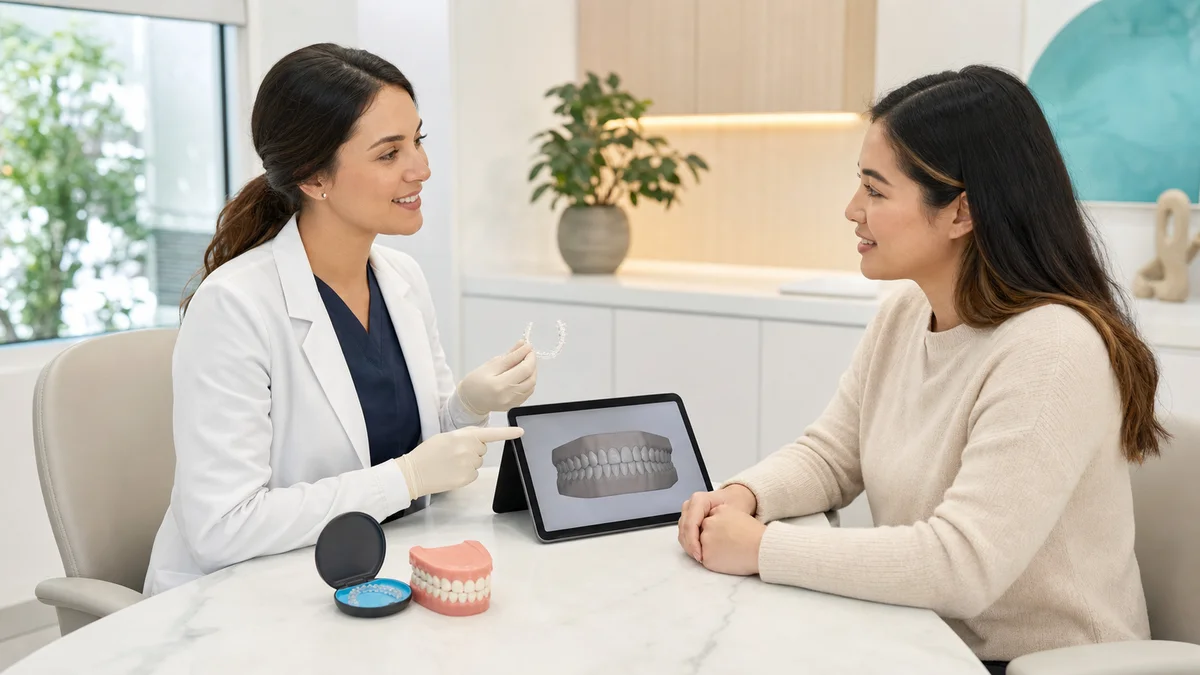
Quick answer: Invisalign approximate cost cannot be determined responsibly from a single national average. Your total depends on diagnosis, case complexity, the number of aligners, attachments, monitoring, possible refinements, retainers, location and insurance terms. Ask for a written, itemized quote after an in-person examination. Confirm whether records, replacement trays, refinements and post-treatment retainers are included before comparing providers.
People searching for “invisalign approximate cost” usually want a practical budget before committing to a consultation. That is reasonable, but a headline figure can hide major differences in treatment scope. One estimate may cover records, aligners, office reviews, refinements and retainers, while another may cover only the active first series of trays. Currency, region, provider fees and insurance rules add further variation.
Invisalign is a specific clear-aligner brand, not a generic name for every transparent tray. Clear aligners move teeth through a planned sequence of removable appliances, but suitability and complexity must be diagnosed. The manufacturer states that the treating doctor determines the fee based on individual needs, including case complexity and the number of aligners. Therefore, “invisalign approximate cost” is best treated as a framework for comparing complete clinical plans, not as a promised price.
This guide does not diagnose a bite problem, promise a result or quote a fixed fee. It explains which items can change an estimate and how to evaluate value without separating cost from safety. The content is written for visible clinical review by Dentist Esma Çevrük Çakır.
1. Why “invisalign approximate cost” is a range, not a universal fee
Orthodontic treatment is a professional service supported by a customized appliance. The fee may include clinical judgment, diagnostic records, digital planning, manufacturing, progress reviews, modifications and retention after active movement. A shorter-looking case is not always simple: root position, gum health, bite relationships and previous dental work can make apparently small cosmetic changes clinically demanding.
An “invisalign approximate cost” figure may also reflect local overhead, professional fees, laboratory arrangements and the payment system in that country. A quote from one city cannot safely be applied to another. Even within the same practice, two people with similar front-tooth crowding may need different movements, attachment designs, wear periods or finishing stages.
Brand websites sometimes display hypothetical payment examples. These are illustrations, not personal quotes or guarantees of insurance benefits. A reliable “invisalign approximate cost” discussion begins after the provider has examined your teeth, gums, jaw relationship and relevant imaging. The final cost should then be connected to a named treatment scope and clear assumptions.
2. What a safe assessment should include before pricing
A photograph or online smile simulation cannot show every structure that matters. The American Association of Orthodontists emphasizes that in-person examination and appropriate records are important because photographs and scans do not reveal root health, impacted teeth or the condition beneath the gums. Periodontal probing and clinically justified X-rays may be needed before teeth are moved.
When you request an “invisalign approximate cost,” ask whether the consultation includes a full dental and periodontal assessment or whether you must first see your general dentist. Active decay, gum inflammation, failing restorations or other disease may need treatment before aligner scans are finalized. Ignoring those conditions to keep an advertised start date can create avoidable risk and additional expense.
- Medical and dental history, including medicines and previous orthodontic treatment
- Clinical examination of teeth, gums, bite, jaw function and existing restorations
- Photographs, digital scan or impressions, and indicated radiographs
- Diagnosis of crowding, spacing, overbite, overjet, crossbite or open bite
- Discussion of aligners, fixed braces, combined methods and no-treatment alternatives
- A realistic explanation of cooperation, review visits, limitations and retention
These steps are not administrative extras. They define whether aligners are suitable and how much monitoring may be required. A responsible “invisalign approximate cost” quote should make the diagnostic stage visible rather than presenting trays as an off-the-shelf product.
3. Fifteen factors that can change the total
The phrase “invisalign approximate cost” becomes useful when it is divided into the factors below. Not every factor adds a separate charge, but each can change the amount of professional time, appliance production or supporting care required.
- Case complexity: Limited alignment and comprehensive bite correction require different planning.
- One or both arches: Treating upper and lower teeth together may be necessary to maintain a functional bite.
- Number of planned aligners: More stages usually reflect more movement and manufacturing.
- Attachments: Tooth-colored shapes may be bonded to help trays deliver specific forces.
- Interproximal reduction: Carefully planned enamel reduction may be considered to create space in selected cases.
- Elastics or auxiliaries: Some bite corrections need additional components or appointments.
- Pre-treatment dentistry: Cleaning, fillings, gum therapy or extraction may be needed before movement.
- Diagnostic records: Examination, scan, photographs and indicated radiographs may be bundled or separate.
- Review frequency: Office visits, remote monitoring and emergency access differ among plans.
- Refinement policy: Additional aligners after the first series may have limits, time windows or added fees.
- Lost or damaged trays: Replacement policy can affect unexpected costs.
- Treatment duration: Longer care may involve more supervision and plan changes.
- Retention: Removable or fixed retainers and replacement schedules may be priced separately.
- Geography and currency: Practice costs, taxes and exchange rates vary.
- Insurance and financing: Benefits reduce out-of-pocket cost only when the plan actually authorizes them.
A provider may bundle many of these items into one fee. Another may use a lower entry fee and charge separately when they occur. The better “invisalign approximate cost” comparison is not automatically the lower first number; it is the quote with a clinically appropriate plan, transparent inclusions and manageable rules if treatment changes.
4. Decision table: compare the same treatment scope
Use this table when evaluating more than one “invisalign approximate cost” estimate. It helps reveal differences that a monthly payment alone cannot show.
| Quote item | What should be written | Risk if unclear | Question to ask |
|---|---|---|---|
| Diagnosis and records | Exam, photographs, scan and required imaging | Additional fees or an incomplete safety assessment | Which records are included and why are they needed? |
| Active aligner series | Brand, treatment tier or scope, and both arches if applicable | A limited plan being compared with comprehensive care | What movements and bite goals does this plan cover? |
| Attachments and auxiliaries | Bonding, removal, elastics and other planned aids | Necessary clinical steps appearing as extras | Are all planned auxiliaries included? |
| Review visits | Expected frequency, in-person monitoring and urgent contact | Insufficient supervision or added visit charges | Who examines me and how are problems escalated? |
| Refinements | Number or period included and eligibility conditions | A finishing phase creating a new major fee | What happens if teeth do not track as planned? |
| Replacement aligners | Fee and process for lost, damaged or ill-fitting trays | Unexpected delays and manufacturing charges | How quickly can a replacement be supplied? |
| Retainers | Type, number of sets, follow-up and replacement fee | Post-treatment stability being excluded | Which retention plan begins after active treatment? |
| Insurance and finance | Estimated benefit, down payment, term, interest and total payable | A small monthly figure hiding a larger total | What is the cash total and the financed total? |
If a clinic cannot explain these rows, the quoted “invisalign approximate cost” is not ready for a fair comparison. Request a revised estimate before making a non-refundable payment.
5. Limited treatment versus comprehensive treatment
Some people want to correct a small area of visible crowding. Others need coordinated movement across both arches to improve the bite. A limited plan may use fewer aligners and shorter monitoring, but it must still respect roots, gums, jaw relationships and how upper and lower teeth meet. Moving only the front teeth can affect function and stability.
For that reason, “invisalign approximate cost” should not be judged by tray count alone. A provider may recommend a broader plan because the bite cannot be managed safely through a cosmetic-only approach. Conversely, comprehensive treatment should not be sold when a smaller, evidence-based plan can meet the clinical objective. The diagnosis should justify the scope.
Ask the provider to show which problems are being treated and which are deliberately left unchanged. A complete “invisalign approximate cost” quote should link the fee to documented goals such as alignment, overbite, overjet, crossbite, arch coordination or space management. It should also explain foreseeable limitations without guaranteeing a perfect result.
6. Refinements: the cost item many estimates hide
Teeth do not always follow the digital simulation exactly. Wear time, biology, attachment performance, damaged trays and difficult movements can create a difference between the planned and actual position. A refinement is an additional scan and series of aligners intended to improve the result after reassessment. It is a normal possibility, not proof that care failed.
When reviewing “invisalign approximate cost,” find out whether refinements are included, how many are allowed, whether a time limit applies and which new records have separate fees. “Unlimited” should be defined: it may still depend on attendance, wear compliance, the provider’s clinical judgment and a valid treatment window.
A refinement may extend the calendar and require more visits, attachments or elastics. Therefore, “invisalign approximate cost” and estimated treatment time are both conditional. A safe provider explains the possibility before treatment and documents a new plan if goals or methods change.
7. Retainers and long-term stability
Active orthodontic movement ends when the planned position is accepted; retention begins immediately afterward. Teeth can shift because the supporting tissues and bite continue to adapt. Retainers may be removable, bonded, or a combination. The type and wear schedule depend on the individual case.
A headline “invisalign approximate cost” may exclude retainers. Ask how many removable sets are included, whether a bonded retainer is recommended, when fit is checked and what replacement costs. Retainers are subject to wear, loss and changes in dental work, so future replacement is part of lifetime budgeting even when the first set is included.
- Confirm the retainer type for upper and lower teeth.
- Ask when retention begins and how wear instructions will change over time.
- Clarify whether a post-treatment scan and delivery visit are included.
- Request the price and turnaround time for a replacement set.
- Report a tight, loose, cracked or lost retainer promptly instead of forcing it.
Any “invisalign approximate cost” comparison that ends with the final active tray is incomplete. Stability and maintenance are part of the treatment journey, even though they cannot guarantee that teeth never move.
8. Insurance: verify the benefit before subtracting it
Dental plans differ widely. Some include an orthodontic benefit, some restrict benefits by age, network, waiting period or lifetime maximum, and others exclude adult orthodontics. A plan may cover clear aligners similarly to braces, but that does not mean every patient has the same benefit. Manufacturer examples cannot confirm your personal coverage.
For a reliable “invisalign approximate cost,” ask the insurer for a written pre-treatment estimate based on the provider’s procedure codes and treatment plan. Confirm deductible, coinsurance, lifetime orthodontic maximum, amount already used, network status and how payments are released. Benefits may be paid over time rather than at the start.
- Is adult orthodontic treatment covered under this exact plan?
- Are clear aligners and fixed braces covered under the same rules?
- Is the provider in network, and does that affect the allowed fee?
- Is preauthorization required before records, appliances or bonding?
- What happens to unpaid benefits if employment or coverage changes?
- Are retainers, replacement trays or refinements treated separately?
Do not subtract an estimated insurance amount from the “invisalign approximate cost” until the plan or insurer has confirmed it. Even a pre-treatment estimate is not always a payment guarantee; eligibility and coverage can change. Keep the treatment plan, claim documents, receipts and explanation-of-benefits records.
9. Monthly payments versus total cost
Financing can make scheduled payments easier, but a monthly figure is not the treatment price. Compare the cash fee, down payment, financed principal, interest or service charges, number of payments, late fees and total amount payable. Ask what happens if treatment is paused, transferred or ends earlier than expected.
An “invisalign approximate cost” advertisement built around a very small monthly payment may assume a large deposit, long term or promotional credit conditions. Financing approval may depend on credit status. Read the agreement separately from clinical consent; the lender and the dental provider may have different cancellation obligations.
Choose a schedule that remains manageable if insurance pays less than estimated. A complete “invisalign approximate cost” budget also includes travel to reviews, time away from work, oral hygiene products, possible replacement trays and future retainers. These are not always clinic charges, but they affect real affordability.
10. Aligners, braces or a combined plan?
Clear aligners are removable and discreet, but they rely on consistent wear and are not automatically the best tool for every movement. Fixed braces do not depend on removing and reinserting trays, and a combined plan may be considered for selected problems. The American Association of Orthodontists advises that appliance choice should follow diagnosis and the movements required.
When “invisalign approximate cost” is close to a braces quote, compare more than appearance. Consider treatment objectives, predictability for the particular movement, monitoring, oral hygiene, eating routines, speech, work demands and your ability to wear trays as prescribed. The clinically appropriate option may not be the one you first expected.
Ask for the advantages, limitations and fee of each reasonable alternative. A provider should not promise that one appliance is universally faster or more comfortable. Your “invisalign approximate cost” decision should follow shared planning, not pressure created by a time-limited discount.
11. Hidden or optional fees to clarify
Transparent estimates identify likely extras before a deposit. Common questions include whether X-rays are taken elsewhere, attachment bonding and removal are included, interproximal reduction has a fee, emergency visits are covered and missed-appointment charges apply. Transfer to another provider may require a records fee and a new professional fee.
“Invisalign approximate cost” can also change if you need a filling, crown, gum treatment or extraction before or during orthodontics. Those services may be clinically necessary but are separate from aligner treatment. The provider should explain which dental work is known now and which risks could only become clear later.
If a tray is lost, do not jump ahead without instructions. The provider may advise wearing the previous tray, moving to the next tray or ordering a replacement based on clinical progress. Ask whether replacement manufacturing and an urgent review are included. These details make an “invisalign approximate cost” quote more realistic.
12. Safety red flags when shopping by price
The American Dental Association warns that do-it-yourself or direct-to-consumer tooth movement without a proper dental assessment can miss disease and may contribute to bone loss, gum recession, bite problems, jaw pain or tooth loss. A low price cannot compensate for absent diagnosis or inadequate supervision.
Be cautious if “invisalign approximate cost” is offered without identifying the licensed treating professional, examining your gums, discussing imaging or explaining alternatives. A scan captures surface shape; it does not by itself diagnose root position, bone health, decay or periodontal condition. Remote monitoring can support care but should have a clear path to in-person examination when needed.
- Guaranteed results, guaranteed timing or claims that no one needs refinements
- A non-refundable deposit demanded before diagnosis or an itemized plan
- No named clinician responsible for treatment and complications
- No explanation of gum health, radiographs, roots or bite relationships
- Pressure to choose aligners without discussing braces or other alternatives
- Unclear rules for urgent visits, transfer, refinements and retention
A safe “invisalign approximate cost” conversation makes uncertainty visible. It explains what is known, what still requires examination and what could change the plan.
13. How to request a written estimate from Redent Klinik
Start with your main concern, previous orthodontic history and any current symptoms. Share relevant dental records through an approved secure channel if requested, but expect an in-person examination before a definitive plan. Mention gum bleeding, loose teeth, jaw pain, existing crowns or implants, medicines and pregnancy status where relevant.
You can review the clinic overview on the Redent Klinik homepage and request an appointment through the Redent Klinik Contact Page. An initial “invisalign approximate cost” discussion can help organize questions, but the final quote must follow examination, diagnosis and current clinical conditions.
Ask for the treatment objectives, estimated aligner series, planned attachments or auxiliaries, review format, refinement policy, retainer plan and all payment conditions. Confirm whether the quote uses the Invisalign brand or another clear-aligner system; different products should not be presented under the same trademark. A useful “invisalign approximate cost” estimate identifies the exact service being proposed.
14. Frequently asked questions
Can an invisalign approximate cost be given from photos alone?
Photos may support a preliminary conversation, but they do not show roots, bone, impacted teeth, decay or periodontal pocketing. A definitive plan requires an in-person examination and appropriate records. The quote can change if the assessment finds disease, a more complex bite problem or a need for pre-treatment dental care.
Does invisalign approximate cost include both upper and lower teeth?
Not automatically. Some plans may focus on one arch, while safe bite management may require coordinated movement in both. The written estimate should name the arches being treated and explain how the opposing teeth and bite are being managed. Never assume “full treatment” has the same meaning across providers.
Does invisalign approximate cost include refinements?
It depends on the provider agreement and product scope. Ask how many refinement series or what treatment window is included, which eligibility conditions apply and whether new scans, attachments or visits cost extra. Refinements are additional planned aligners after reassessment; they may be needed when teeth do not track exactly as simulated.
Are retainers part of invisalign approximate cost?
Some quotes include one retainer set; others price retention separately. Ask for the retainer type, number of sets, delivery visit, fit review and future replacement fee. Active alignment without a retention plan is incomplete because teeth can shift after treatment. No retainer can guarantee that teeth remain unchanged forever.
Will insurance reduce my invisalign approximate cost?
Only if your exact policy includes applicable orthodontic benefits and the claim meets its rules. Confirm age restrictions, lifetime maximum, deductible, network status, preauthorization and payment schedule directly with the insurer. A provider or brand calculator is useful for questions but cannot guarantee what your plan will pay.
Why is one invisalign approximate cost much lower than another?
The quotes may represent different complexity levels, aligner scopes, review schedules, refinement limits or retainer inclusions. Diagnostic records and supporting dental work may also be separate. Compare itemized clinical goals and exclusions before judging value. A lower entry fee can become higher if essential finishing or retention is excluded.
Does a higher invisalign approximate cost guarantee a better result?
No. Price alone cannot guarantee biological response, compliance, treatment duration or outcome. Evaluate diagnosis, provider communication, monitoring, alternative options, records and the plan for problems. The aim is an appropriate, transparent treatment plan—not the highest or lowest fee.
Can treatment finish sooner than the invisalign approximate cost estimate assumes?
Cost and time are related but not identical. Treatment may progress differently from the simulation, and refinements can extend care. Some fixed-fee agreements do not decrease if treatment finishes early because they cover planning and professional responsibility, not only the number of months. Ask how schedule changes affect fees before signing.
15. Final checklist before accepting the quote
Before paying, confirm that “invisalign approximate cost” has become a dated, personalized and itemized document. It should identify the provider, diagnosis or treatment objectives, aligner system and scope, expected reviews, refinements, retainers, payment schedule, exclusions and cancellation or transfer rules.
- I have had an appropriate in-person oral and periodontal examination.
- I understand why aligners are suitable and what alternatives exist.
- The quote identifies records, aligners, attachments, reviews and refinements.
- The retainer type and replacement policy are written.
- Insurance is verified, but I understand it is not always guaranteed.
- I know the cash total, financed total and non-refundable amounts.
- I know who to contact if a tray does not fit, is lost or causes concern.
- I have not been promised guaranteed timing or a perfect result.
The most useful answer to “invisalign approximate cost” is not a national average. It is a transparent plan that matches your diagnosis, includes realistic finishing and retention, and remains understandable if circumstances change. That approach protects both your budget and your oral health.
Sources
- American Dental Association and MouthHealthy: risks of DIY and direct-to-consumer dentistry
- American Association of Orthodontists: clear aligners, suitability and insurance questions
- Invisalign official cost information: provider-determined fees and coverage variability
- NHS: orthodontic assessment, treatment choices, private fees and oral care
- World Health Organization oral health fact sheet, updated March 2025