
Clear aligner treatment has transformed modern orthodontics, giving patients a discreet and comfortable alternative to traditional metal braces. While Invisalign remains one of the most recognized brands in the industry, many patients today are actively researching invisalign competitors before making a final treatment decision. The growing popularity of clear aligner therapy has encouraged numerous companies to develop innovative solutions that offer similar benefits, competitive pricing, and personalized treatment options.
Understanding invisalign competitors is important because orthodontic treatment is a significant investment in both oral health and appearance. Every patient has unique dental needs, treatment goals, budgets, and lifestyle preferences. As a result, the best aligner system for one person may not necessarily be the ideal solution for another. By comparing available alternatives, patients can make informed decisions and choose a treatment plan that aligns with their expectations.
Many of the leading invisalign competitors utilize advanced digital scanning technology, 3D treatment planning, and custom-made transparent aligners designed to gradually move teeth into their desired positions. These systems are commonly used to address mild to moderate orthodontic issues, including crowding, spacing, overbites, underbites, crossbites, and other alignment concerns. Some brands focus on in-office supervision by dentists and orthodontists, while others offer remote monitoring options that appeal to busy patients.
One of the primary reasons patients search for invisalign competitors is cost. Invisalign is widely regarded as a premium aligner brand, but several alternatives offer comparable treatment outcomes at a lower price point. This can be particularly appealing for adults seeking cosmetic improvements without exceeding their dental budget. However, cost should never be the sole deciding factor. Treatment quality, professional oversight, material technology, and long-term results are equally important considerations.
Another reason why invisalign competitors have gained attention is the rapid advancement of orthodontic technology. Brands such as ClearCorrect, Spark Aligners, Angel Aligner, and other clear aligner systems have introduced unique features designed to improve comfort, transparency, and tooth movement efficiency. Some aligners are manufactured using advanced stain-resistant materials, while others emphasize enhanced fit and better force distribution for more predictable outcomes.
Patients comparing invisalign competitors should also understand that treatment success depends on more than the aligner brand itself. Consistent wear, proper oral hygiene, regular follow-up appointments, and adherence to professional recommendations play a major role in achieving desired results. Even the most advanced aligner system cannot deliver optimal outcomes without patient cooperation and proper treatment planning.
From a lifestyle perspective, many people appreciate the flexibility offered by clear aligners. Unlike traditional braces, aligners can be removed during meals, brushing, flossing, and special occasions. This convenience has encouraged millions of adults and teenagers to explore orthodontic treatment options. As demand continues to grow, invisalign competitors are constantly introducing new innovations to enhance the patient experience and improve treatment efficiency. 😊
When evaluating invisalign competitors, patients should consider several key factors:
- Treatment effectiveness for their specific dental condition
- Level of dentist or orthodontist supervision
- Material quality and aligner comfort
- Total treatment cost and financing options
- Estimated treatment duration
- Availability of follow-up care and retainers
- Brand reputation and patient reviews
Professional consultation remains the most reliable way to determine which aligner system is suitable for an individual case. Experienced dental professionals can evaluate oral health, identify underlying issues, and recommend appropriate treatment options. Patients seeking expert guidance can contact specialists through the Redent Klinik Contact Page to discuss their orthodontic goals and receive personalized recommendations.
In addition, patients are encouraged to educate themselves using trusted dental resources. Organizations such as the American Dental Association provide valuable information about orthodontic care, oral health maintenance, and treatment expectations.
A common misconception is that all invisalign competitors are identical. In reality, each brand uses different technologies, treatment protocols, manufacturing processes, and monitoring systems. Some aligners are designed primarily for mild cosmetic corrections, while others can successfully manage more complex orthodontic cases under professional supervision. Understanding these distinctions can help patients avoid unrealistic expectations and select a treatment solution that matches their clinical needs.
The market for invisalign competitors continues to expand as patients seek effective, affordable, and aesthetically pleasing orthodontic solutions. Whether someone prioritizes advanced technology, lower costs, shorter treatment times, or enhanced comfort, there are now more options available than ever before. By carefully comparing features, consulting qualified dental professionals, and understanding the strengths and limitations of each system, patients can confidently choose the aligner brand that best supports their journey toward a healthier and more attractive smile. ✨
What Are Invisalign Competitors and Why Are They Popular?
The growing demand for discreet orthodontic treatment has significantly expanded the market for invisalign competitors. While Invisalign remains one of the most recognized names in clear aligner therapy, numerous alternative brands have emerged to offer patients more choices, different pricing structures, and innovative treatment technologies. Understanding what invisalign competitors are and why they have become so popular can help patients make informed decisions about their orthodontic care.
In simple terms, invisalign competitors are clear aligner systems developed by companies other than Invisalign. These brands use transparent, removable trays that gradually move teeth into their desired positions over time. Similar to Invisalign, most of these systems rely on advanced digital imaging, customized treatment planning, and a sequence of aligners that are replaced every one to two weeks.
Understanding the Rise of Clear Aligner Alternatives
For decades, traditional metal braces were the primary solution for correcting crooked teeth and bite problems. Although highly effective, braces often caused concerns related to appearance, comfort, and oral hygiene. The introduction of clear aligners revolutionized orthodontic treatment by providing a nearly invisible option for teeth straightening.
As the popularity of clear aligners increased, the market naturally became more competitive. New manufacturers recognized opportunities to develop their own systems and challenge the industry’s leading brands. Today, many invisalign competitors offer advanced treatment options that can successfully address a wide variety of orthodontic concerns, from minor spacing issues to more complex alignment problems.
Patients now have access to numerous clear aligner alternatives, including professionally supervised treatments and direct-to-consumer solutions. This wider availability has contributed significantly to the increasing popularity of invisalign competitors across the world.
What Makes Invisalign Competitors Different?
Although many invisalign competitors share similar goals, each brand introduces unique features that distinguish it from others. Some focus on affordability, while others prioritize advanced materials, improved transparency, or specialized treatment planning software.
Advanced Aligner Materials
Several modern invisalign competitors use proprietary materials designed to enhance comfort and durability. Some aligners are engineered to resist staining better than traditional plastics, while others are designed to maintain consistent force throughout treatment. These innovations may improve patient satisfaction and treatment predictability.
Different Levels of Professional Supervision
One of the biggest distinctions among invisalign competitors involves the level of professional oversight. Certain systems require regular in-office visits with dentists or orthodontists, while others rely heavily on virtual monitoring and remote communication. Patients should carefully evaluate the supervision model that best matches their comfort level and treatment needs.
Pricing and Accessibility
Affordability remains one of the strongest reasons patients explore invisalign competitors. Many alternative aligner brands offer lower treatment costs while still delivering effective results for suitable cases. Flexible payment plans and financing options have also made orthodontic treatment more accessible to a broader range of patients.
Why Patients Are Choosing Invisalign Competitors
The increasing popularity of invisalign competitors is driven by several important factors. Modern consumers often compare multiple treatment options before making healthcare decisions, and orthodontics is no exception.
- More affordable treatment options
- Greater brand selection
- Innovative treatment technologies
- Flexible payment plans
- Improved comfort and aesthetics
- Remote monitoring capabilities
- Personalized treatment approaches
As patients become more informed, they are increasingly willing to evaluate several clear aligner brands instead of automatically choosing the most well-known option. This trend has fueled rapid growth among many invisalign competitors.
Are Invisalign Competitors as Effective as Invisalign?
One of the most common questions patients ask is whether invisalign competitors can provide results comparable to Invisalign. The answer depends largely on the individual case, the complexity of the orthodontic issues involved, and the expertise of the treating dental professional.
Many modern clear aligner systems have demonstrated excellent effectiveness in treating mild to moderate alignment problems. In some cases, experienced orthodontists successfully achieve outcomes using invisalign competitors that are very similar to those obtained with Invisalign. However, certain complex cases may benefit from specific technologies available through particular aligner systems.
Ultimately, the success of treatment depends less on the brand name and more on accurate diagnosis, proper treatment planning, patient compliance, and ongoing professional supervision.
The Future of Invisalign Competitors
The future looks promising for invisalign competitors as technology continues to advance. Artificial intelligence, digital treatment simulations, improved aligner materials, and enhanced remote monitoring systems are reshaping the orthodontic landscape. These innovations are expected to improve treatment efficiency, increase patient convenience, and expand access to orthodontic care worldwide.
Competition within the clear aligner market also benefits patients by encouraging companies to continuously improve their products. As more brands enter the market, patients can expect greater innovation, better affordability, and more personalized treatment solutions.
In conclusion, invisalign competitors have become increasingly popular because they provide patients with more options for achieving straighter teeth and healthier smiles. Whether a patient prioritizes affordability, advanced technology, professional supervision, or convenience, today’s market offers a wide range of solutions capable of meeting diverse orthodontic needs. By understanding the strengths and differences among various clear aligner systems, individuals can confidently select a treatment approach that aligns with their goals, lifestyle, and budget. 😊
Top Invisalign Competitors Available Today
The clear aligner industry has grown rapidly over the last decade, giving patients more choices than ever before when searching for effective alternatives to Invisalign. While Invisalign remains one of the most recognized brands worldwide, several invisalign competitors have successfully established themselves as reliable options for patients seeking straighter teeth and healthier smiles. These companies offer innovative technologies, competitive pricing, and treatment approaches designed to meet a wide range of orthodontic needs.
Understanding the leading invisalign competitors can help patients compare treatment features, costs, supervision levels, and expected outcomes before making a decision. Although every aligner system works toward the same goal of gradually moving teeth into proper alignment, each brand brings unique advantages that may appeal to different types of patients.
ClearCorrect
ClearCorrect is widely considered one of the strongest invisalign competitors in the professional orthodontic market. Developed to provide dentist-supervised clear aligner treatment, ClearCorrect uses customized aligners created through advanced digital treatment planning.
Key Features of ClearCorrect
- Professional monitoring by dentists and orthodontists
- Transparent aligners designed for comfort
- Treatment for mild, moderate, and many complex cases
- Often available at a lower cost than Invisalign
- Flexible treatment plans
Many dental professionals recommend ClearCorrect because it combines affordability with strong clinical performance. Among all invisalign competitors, ClearCorrect is frequently mentioned as one of the closest alternatives to Invisalign in terms of treatment capabilities.
Spark Aligners
Spark Aligners have gained significant popularity among both dentists and patients. Manufactured using advanced TruGEN™ material, Spark aligners are known for exceptional clarity, stain resistance, and patient comfort.
Why Patients Choose Spark
Spark has become one of the fastest-growing invisalign competitors due to its focus on aesthetics and comfort. Many patients report that Spark aligners feel smoother and appear more transparent compared to some competing products.
- Excellent transparency
- Comfortable edge design
- Enhanced stain resistance
- Effective force application
- Professional orthodontic supervision
For image-conscious adults, Spark is often viewed as one of the most attractive invisalign competitors currently available.
Angel Aligner
Angel Aligner has become increasingly popular in international markets. The company uses advanced treatment planning software and offers solutions for both simple and complex orthodontic cases.
Unlike some direct-to-consumer brands, Angel Aligner focuses heavily on professional oversight. This approach helps ensure treatment remains safe and predictable throughout the aligner process.
Advantages of Angel Aligner
- Advanced digital treatment planning
- Professional monitoring
- Strong focus on complex cases
- High-quality aligner materials
- Global market expansion
Among modern invisalign competitors, Angel Aligner continues to gain recognition for combining technological innovation with comprehensive orthodontic care.
Byte
Byte became well known through its direct-to-consumer business model. Designed primarily for mild to moderate alignment issues, Byte attracted many patients seeking convenience and affordability.
Unlike traditional orthodontic treatment models, Byte allows much of the treatment process to be managed remotely. This convenience helped position Byte among the more recognizable invisalign competitors in recent years.
Byte’s Main Benefits
- Remote treatment monitoring
- Convenient home impression kits
- Lower treatment costs
- Flexible financing options
- Reduced office visits
However, patients should understand that direct-to-consumer aligners may not be suitable for every orthodontic case. Professional evaluation remains essential before selecting any treatment option.
Candid
Candid initially entered the market as a direct-to-consumer company but later shifted toward a dentist-supervised treatment model. This transition strengthened its position among leading invisalign competitors.
Candid combines remote monitoring technology with professional dental oversight, offering a balance between convenience and clinical supervision.
Why Candid Stands Out
- Remote treatment monitoring
- Professional oversight
- Digital progress tracking
- Personalized treatment plans
- Improved patient accountability
Patients who value convenience without sacrificing professional supervision often consider Candid one of the most appealing invisalign competitors.
SureSmile
SureSmile has long been respected in orthodontics for its digital treatment planning capabilities. Originally known for advanced braces technology, the company expanded into clear aligners and became a notable player among invisalign competitors.
SureSmile aligners are designed using precise digital workflows that help improve treatment accuracy and predictability.
Benefits of SureSmile
- Highly accurate treatment planning
- Orthodontist-guided treatment
- Effective tooth movement
- Suitable for various case complexities
- Established clinical reputation
How Invisalign Competitors Compare Overall
When evaluating invisalign competitors, patients should remember that no single brand is universally superior. The ideal choice depends on several factors, including treatment complexity, budget, lifestyle preferences, and access to qualified dental professionals.
Some patients prioritize affordability and choose lower-cost invisalign competitors. Others focus on material quality, treatment predictability, or in-person supervision. Fortunately, today’s market offers solutions for nearly every patient profile.
Important Factors to Compare
- Total treatment cost
- Level of professional supervision
- Estimated treatment duration
- Material quality and comfort
- Complexity of cases treated
- Availability of follow-up care
- Retainer options after treatment
Which Invisalign Competitor Is Best?
There is no universal answer because different patients have different needs. Some orthodontists may recommend ClearCorrect or Spark for patients seeking professionally supervised care. Others may suggest SureSmile or Angel Aligner depending on treatment complexity. Patients seeking greater convenience may explore remote-monitoring options among various invisalign competitors.
The most important factor is not simply choosing from a list of invisalign competitors, but selecting a system that is appropriate for the individual’s specific dental condition. A thorough consultation with an experienced dentist or orthodontist can help determine which aligner brand offers the best balance of effectiveness, comfort, affordability, and long-term success.
As technology continues to advance, the gap between Invisalign and many leading invisalign competitors continues to narrow. Patients now have access to high-quality clear aligner systems that can deliver excellent results while accommodating different budgets and treatment preferences. This increased competition ultimately benefits consumers by driving innovation, improving accessibility, and creating more opportunities to achieve a confident, healthy smile. 😁
Invisalign vs ClearCorrect: Key Differences
When comparing the leading options in clear aligner therapy, one of the most common discussions involves Invisalign and ClearCorrect. Both systems are designed to straighten teeth using transparent, removable aligners, and both are frequently recommended by dental professionals worldwide. Because ClearCorrect is one of the most established invisalign competitors, patients often want to understand how these two treatment systems differ before making a decision.
Although Invisalign and ClearCorrect share many similarities, they differ in areas such as material technology, treatment planning, pricing, provider networks, and patient experience. Understanding these distinctions can help patients select the aligner system that best fits their orthodontic needs, lifestyle, and budget.
Overview of Invisalign and ClearCorrect
Invisalign was introduced in the late 1990s and quickly became the most recognizable name in clear aligner treatment. Its extensive research, large provider network, and advanced digital technology helped establish it as a market leader.
ClearCorrect entered the market as one of the earliest and most successful invisalign competitors. The company was developed to provide dentists and orthodontists with a flexible alternative that could deliver effective orthodontic results while often reducing overall treatment costs.
Today, both systems are used globally and have successfully treated millions of patients seeking straighter smiles without traditional metal braces.
Material Technology Comparison
Invisalign Material
Invisalign aligners are manufactured using a proprietary material known as SmartTrack®. This material was specifically engineered to improve aligner fit, comfort, and tooth movement predictability. SmartTrack is designed to apply consistent force throughout treatment while maintaining flexibility and durability.
Many patients appreciate Invisalign’s smooth feel and precise fit. The company’s extensive investment in research and development has contributed significantly to its reputation within the orthodontic industry.
ClearCorrect Material
ClearCorrect uses a multi-layer aligner material designed to provide strength, flexibility, and comfort. Modern ClearCorrect aligners are thinner than some earlier versions, helping improve aesthetics while maintaining treatment effectiveness.
Among all invisalign competitors, ClearCorrect is often praised for its transparency and comfortable wear experience. Many patients report minimal irritation and excellent aligner clarity throughout treatment.
Treatment Planning and Digital Technology
Advanced digital technology plays a crucial role in modern orthodontics. Both Invisalign and ClearCorrect rely heavily on digital scans, treatment simulations, and customized aligner fabrication.
Invisalign Digital Ecosystem
Invisalign utilizes sophisticated software systems, including ClinCheck®, which allows providers to visualize and plan tooth movements with remarkable precision. This technology helps orthodontists create highly customized treatment plans for patients with varying levels of complexity.
One reason many patients compare Invisalign with other invisalign competitors is the company’s reputation for technological innovation and extensive clinical research.
ClearCorrect Digital Planning
ClearCorrect also offers advanced digital treatment planning software that allows providers to review projected tooth movements before treatment begins. Dentists and orthodontists can make modifications to optimize results and personalize treatment according to each patient’s needs.
Over the years, ClearCorrect has invested heavily in technology upgrades, helping it remain one of the strongest invisalign competitors in the global orthodontic market.
Cost Comparison
Cost is often one of the biggest factors influencing a patient’s decision between Invisalign and ClearCorrect. While prices vary depending on case complexity, provider experience, and geographic location, ClearCorrect is frequently positioned as a more affordable option.
Estimated Treatment Costs
| Treatment System | Estimated Cost Range |
|---|---|
| Invisalign | $3,000 – $8,000+ |
| ClearCorrect | $2,000 – $6,500+ |
These estimates can vary significantly based on treatment complexity and provider fees. Patients researching invisalign competitors often discover that ClearCorrect may offer meaningful savings while still providing professional supervision and high-quality treatment outcomes.
Case Complexity and Treatment Capabilities
Both Invisalign and ClearCorrect can successfully treat many orthodontic conditions, including:
- Crowded teeth
- Spacing issues
- Overbites
- Underbites
- Crossbites
- Open bites
- Mild to moderate tooth rotations
Historically, Invisalign was often viewed as the preferred choice for highly complex cases. However, technological advancements have enabled several invisalign competitors, including ClearCorrect, to successfully manage increasingly sophisticated orthodontic challenges.
Ultimately, treatment success depends largely on the provider’s expertise rather than solely on the aligner brand itself.
Provider Availability and Professional Support
Invisalign Provider Network
One advantage Invisalign offers is its extensive global network of certified providers. Patients can typically find experienced Invisalign practitioners in most major cities and regions worldwide.
This broad accessibility contributes to Invisalign’s continued popularity despite increasing competition from numerous invisalign competitors.
ClearCorrect Provider Network
ClearCorrect also maintains a large and growing provider network. Many dentists and orthodontists choose ClearCorrect because of its flexibility, competitive pricing structure, and treatment planning capabilities.
As ClearCorrect continues to expand internationally, it remains one of the most frequently recommended invisalign competitors for patients seeking professional orthodontic care.
Patient Comfort and Daily Experience
Comfort is a major consideration when selecting a clear aligner system. Both Invisalign and ClearCorrect are designed to be removable, discreet, and easy to integrate into daily life.
Patients generally wear aligners for approximately 20 to 22 hours per day, removing them only for eating, drinking beverages other than water, brushing, and flossing. Both systems allow patients to maintain normal oral hygiene routines more easily than traditional braces.
Many patients comparing invisalign competitors appreciate that ClearCorrect offers a comfortable alternative without sacrificing aesthetics or convenience.
Which Option Is Better?
There is no universal answer to whether Invisalign or ClearCorrect is superior. The best choice depends on individual treatment goals, case complexity, budget, and provider recommendations.
Patients seeking extensive clinical history and advanced proprietary technology may feel more comfortable choosing Invisalign. On the other hand, those looking for a cost-effective solution under professional supervision often find ClearCorrect to be one of the most attractive invisalign competitors available today.
The most important step is scheduling a consultation with an experienced dentist or orthodontist who can evaluate your specific needs. Rather than focusing exclusively on brand names, patients should prioritize clinical expertise, personalized treatment planning, and long-term oral health outcomes. Whether you choose Invisalign or one of the leading invisalign competitors, proper professional guidance remains the key to achieving a healthy, confident, and beautifully aligned smile. 😁
Byte, Candid, and Other Direct-to-Consumer Alternatives
As the demand for convenient orthodontic treatment continues to rise, several direct-to-consumer (DTC) clear aligner companies have entered the market. These brands aim to simplify the teeth-straightening process by reducing the number of in-office visits and allowing patients to complete much of their treatment from home. Among the most discussed invisalign competitors are Byte, Candid, and other remote-monitoring aligner systems that offer an alternative approach to traditional orthodontic care.
Unlike conventional treatment models that require frequent appointments with dentists or orthodontists, many direct-to-consumer aligner providers rely heavily on digital impressions, virtual consultations, and remote treatment monitoring. This approach has made certain invisalign competitors particularly attractive to adults seeking convenience, affordability, and flexibility.
What Are Direct-to-Consumer Clear Aligners?
Direct-to-consumer clear aligners are orthodontic systems that allow patients to begin treatment with minimal in-person visits. In many cases, patients either use a home impression kit or visit a scanning center to create digital models of their teeth. These records are then reviewed by dental professionals who determine whether the individual is a suitable candidate for aligner treatment.
Once approved, a customized series of aligners is manufactured and delivered directly to the patient’s home. Throughout treatment, progress is monitored remotely using photos, mobile applications, or virtual check-ins.
This model has allowed several invisalign competitors to differentiate themselves from traditional orthodontic providers by emphasizing convenience and accessibility.
Byte Aligners
Byte became one of the most recognizable names among direct-to-consumer invisalign competitors. The company focused primarily on mild to moderate orthodontic corrections and marketed its treatment as a convenient alternative to traditional aligner therapy.
Key Features of Byte
- Remote treatment monitoring
- At-home impression kits
- Customized aligners delivered directly to patients
- Flexible financing options
- Reduced need for office visits
One of Byte’s most heavily promoted features was its HyperByte® technology, a device designed to complement aligner treatment by encouraging consistent wear and improving patient compliance. This unique approach helped distinguish Byte from other invisalign competitors operating within the direct-to-consumer market.
Many adults appreciated Byte’s convenience, particularly those with busy schedules who preferred avoiding frequent dental appointments. However, patients considering any direct-to-consumer treatment should understand that not all orthodontic issues can be safely managed through remote supervision alone.
Candid Aligners
Candid initially entered the industry as a fully direct-to-consumer brand but later evolved into a hybrid treatment model that places greater emphasis on professional supervision. This transition has strengthened its reputation among modern invisalign competitors.
How Candid Works
Candid combines advanced remote monitoring technology with oversight from licensed dental professionals. Patients typically begin treatment with a digital scan, after which a customized aligner series is developed. Progress is monitored through digital submissions and regular evaluations by providers.
This approach attempts to balance convenience with clinical oversight, making Candid one of the more structured invisalign competitors in the remote aligner category.
Advantages of Candid
- Professional review of treatment progress
- Advanced remote monitoring system
- Customized treatment planning
- Convenient virtual communication
- Suitable for many mild and moderate cases
Patients who want greater professional involvement than traditional direct-to-consumer models often find Candid appealing because it bridges the gap between convenience and clinical supervision.
Other Popular Direct-to-Consumer Invisalign Competitors
Beyond Byte and Candid, several other brands have attempted to establish themselves among leading invisalign competitors. These companies generally share a common goal: making orthodontic treatment more affordable and accessible through remote care models.
SmileDirectClub (Historical Industry Impact)
SmileDirectClub played a major role in popularizing direct-to-consumer aligners and significantly influenced the growth of many invisalign competitors. Although the company experienced operational challenges and ultimately ceased operations, its impact on the orthodontic industry remains significant.
SmileDirectClub demonstrated strong consumer demand for affordable and convenient orthodontic solutions, encouraging other companies to invest in remote monitoring technologies and digital treatment systems.
New Emerging Brands
Several emerging aligner companies continue to explore innovative treatment models that combine virtual care, digital scanning technology, and customized aligners. These brands contribute to the ongoing evolution of invisalign competitors by introducing new approaches to patient engagement and treatment management.
Benefits of Direct-to-Consumer Invisalign Competitors
The popularity of direct-to-consumer invisalign competitors is largely driven by the practical benefits they offer many patients.
Convenience
Perhaps the biggest advantage is convenience. Patients can often complete large portions of their treatment journey from home, reducing travel time and scheduling challenges.
Lower Costs
Many direct-to-consumer invisalign competitors are marketed at lower price points than traditional orthodontic treatment. Reduced overhead costs and streamlined workflows often allow these companies to offer competitive pricing.
Flexible Communication
Virtual check-ins and mobile monitoring platforms allow patients to communicate with providers without needing frequent office visits. This flexibility is particularly valuable for individuals with demanding work schedules or limited access to local orthodontic providers.
Potential Limitations to Consider
While many invisalign competitors offer attractive benefits, patients should also be aware of potential limitations associated with direct-to-consumer treatment models.
Limited In-Person Examinations
Orthodontic treatment often requires careful evaluation of oral health, jaw function, gum condition, and bite relationships. Some issues may be difficult to fully assess without a comprehensive in-person examination.
Not Suitable for Complex Cases
Many direct-to-consumer invisalign competitors focus primarily on mild to moderate alignment concerns. Patients with severe crowding, significant bite discrepancies, impacted teeth, or complex orthodontic needs may require more comprehensive professional supervision.
Patient Compliance Is Critical
Remote treatment places greater responsibility on the patient. Successful outcomes depend heavily on consistent aligner wear, accurate progress reporting, and adherence to treatment instructions.
Who Should Consider Direct-to-Consumer Aligners?
Certain patients may benefit from direct-to-consumer invisalign competitors, particularly those with relatively minor alignment concerns and strong motivation to follow treatment guidelines. Individuals who value convenience, flexible scheduling, and potentially lower treatment costs often find these systems appealing.
However, a professional orthodontic consultation remains highly recommended before beginning any aligner treatment. A qualified dental provider can determine whether a patient is a suitable candidate and help identify the safest and most effective treatment path.
Final Thoughts on Byte, Candid, and Similar Alternatives
Byte, Candid, and other direct-to-consumer invisalign competitors have significantly expanded patient access to clear aligner therapy. By leveraging digital technology, remote monitoring, and innovative treatment workflows, these companies have created new opportunities for adults seeking discreet orthodontic solutions.
Although convenience and affordability are major advantages, patients should carefully evaluate the level of professional supervision provided by each system. The best results are achieved when aligner therapy is supported by accurate diagnosis, personalized treatment planning, and ongoing clinical oversight. As the market for invisalign competitors continues to evolve, patients can expect even greater innovation, accessibility, and customization in the years ahead. 😊
Cost Comparison of Invisalign Competitors
For many patients considering clear aligner treatment, cost is one of the most important factors influencing their final decision. While achieving a straighter smile and improved oral health are primary goals, budget considerations often determine which treatment option feels most realistic. This is one of the main reasons people spend time researching invisalign competitors. The clear aligner market has become increasingly competitive, and patients now have access to a variety of treatment options that may offer similar results at different price points.
Although Invisalign remains one of the most recognized names in orthodontics, several invisalign competitors have developed pricing strategies that appeal to cost-conscious patients. Understanding the factors that influence treatment costs can help individuals make a well-informed decision without sacrificing treatment quality.
Why Do Prices Vary Among Invisalign Competitors?
One common misconception is that all clear aligner treatments cost roughly the same. In reality, pricing varies significantly among invisalign competitors due to differences in technology, provider experience, treatment complexity, geographic location, and the level of professional supervision involved.
Treatment Complexity
The severity of a patient’s orthodontic issues plays a major role in determining cost. Minor spacing or crowding problems generally require fewer aligners and shorter treatment times, resulting in lower overall expenses. More complex cases involving bite correction or significant tooth movement typically require additional aligners and more extensive monitoring.
Provider Expertise
Experienced orthodontists and highly trained dentists may charge higher fees because of their expertise and track record. While this can increase treatment costs, it may also improve treatment predictability and reduce the risk of complications.
Technology and Materials
Many invisalign competitors use proprietary software, specialized materials, and advanced manufacturing processes. These innovations can influence pricing depending on the brand’s investment in research and development.
Average Cost of Invisalign
Invisalign is generally considered a premium clear aligner system. Depending on treatment complexity and location, patients can expect costs within the following range:
| Treatment | Estimated Cost |
|---|---|
| Invisalign Express | $1,500 – $3,000 |
| Invisalign Lite | $3,000 – $5,000 |
| Comprehensive Invisalign | $4,000 – $8,500+ |
These figures are estimates and can vary depending on individual circumstances. Because of these costs, many patients begin exploring invisalign competitors that may offer more affordable alternatives.
ClearCorrect Pricing
ClearCorrect is frequently regarded as one of the strongest invisalign competitors due to its combination of affordability and professional oversight.
| Treatment | Estimated Cost |
|---|---|
| ClearCorrect Limited | $2,000 – $4,000 |
| ClearCorrect Unlimited | $3,500 – $6,500+ |
Many dental practices find that ClearCorrect can provide excellent value for patients seeking professionally supervised treatment without paying premium Invisalign pricing.
Spark Aligners Cost
Spark Aligners have gained popularity among patients looking for comfort, aesthetics, and advanced aligner materials. Pricing is often comparable to Invisalign, although some providers may offer slightly lower fees.
| Treatment | Estimated Cost |
|---|---|
| Spark Aligners | $3,000 – $7,500+ |
Although Spark may not always be the cheapest among invisalign competitors, many patients believe the aligner quality justifies the investment.
Byte Pricing
Byte built much of its reputation around affordability and convenience. As one of the more recognizable direct-to-consumer invisalign competitors, it attracted patients seeking lower treatment costs and fewer office visits.
| Treatment | Estimated Cost |
|---|---|
| Byte All-Day Plan | $1,900 – $2,500 |
| Byte At-Night Plan | $2,000 – $3,000 |
While Byte’s pricing was highly competitive, patients considering remote treatment models should carefully evaluate whether their orthodontic needs are appropriate for virtual supervision.
Candid Pricing
Candid combines professional oversight with remote monitoring technology, positioning itself somewhere between traditional orthodontic care and direct-to-consumer treatment.
| Treatment | Estimated Cost |
|---|---|
| Candid Aligners | $3,000 – $6,000+ |
Among modern invisalign competitors, Candid appeals to patients seeking a balance between affordability and professional involvement.
Hidden Costs Patients Should Consider
When comparing invisalign competitors, focusing solely on advertised pricing can be misleading. Several additional expenses may affect the overall cost of treatment.
Initial Consultation Fees
Some providers charge separate fees for orthodontic evaluations, digital scans, or treatment planning.
Retainers After Treatment
Retainers are essential for maintaining treatment results. Many patients overlook this expense when comparing invisalign competitors.
Retainer costs typically range from:
- $100 – $500 per set
- Replacement retainers may incur additional fees
- Long-term retention may require multiple replacement sets
Refinements and Additional Aligners
Some treatment plans include refinements, while others may charge extra if additional aligners are required to achieve desired results.
Financing Options Available
Many providers offering Invisalign and various invisalign competitors provide flexible financing plans to make treatment more affordable.
- Monthly payment plans
- Third-party financing companies
- Interest-free promotional periods
- Healthcare credit programs
- Dental insurance benefits
These options can significantly reduce the immediate financial burden associated with orthodontic treatment.
Does Lower Cost Mean Lower Quality?
Not necessarily. Some invisalign competitors are less expensive because of different business models, manufacturing efficiencies, or reduced marketing expenses. Lower pricing does not automatically indicate inferior treatment quality.
However, patients should be cautious about selecting aligner systems based solely on price. The effectiveness of treatment depends heavily on accurate diagnosis, proper treatment planning, patient compliance, and professional supervision. In some cases, paying slightly more for experienced clinical oversight may provide greater long-term value.
How to Evaluate Value Instead of Just Price
When comparing invisalign competitors, patients should focus on overall value rather than simply choosing the cheapest option.
- Provider qualifications
- Treatment predictability
- Clinical support during treatment
- Material quality
- Retainer policies
- Refinement availability
- Long-term treatment outcomes
The best clear aligner system is not always the least expensive one. Instead, it is the solution that provides safe, effective, and predictable results while fitting comfortably within a patient’s budget.
Ultimately, the increasing number of invisalign competitors has created a highly competitive marketplace that benefits consumers. Patients now have access to a wide range of treatment options across various price levels, making orthodontic care more accessible than ever before. By carefully comparing costs, understanding potential hidden fees, and consulting qualified dental professionals, individuals can confidently choose the aligner system that offers the best combination of affordability, quality, and long-term success. 💰😁
Effectiveness and Treatment Results Compared
When patients research invisalign competitors, one of the most important questions they ask is whether alternative aligner systems can deliver results comparable to Invisalign. While cost, convenience, and brand reputation certainly matter, the ultimate goal of any orthodontic treatment is achieving a healthy bite, properly aligned teeth, and a confident smile. Therefore, understanding the effectiveness of various invisalign competitors is essential before making a treatment decision.
The good news is that many modern clear aligner systems have evolved significantly over the past decade. Advanced digital treatment planning, improved aligner materials, and sophisticated tooth movement technologies have allowed numerous invisalign competitors to produce excellent outcomes for a wide range of orthodontic cases. However, effectiveness depends on several factors beyond the aligner brand itself.
What Determines Treatment Effectiveness?
Many patients assume that the aligner brand alone determines success. In reality, treatment outcomes depend on a combination of factors working together.
Accurate Diagnosis
Every successful orthodontic treatment begins with a proper diagnosis. Before selecting among various invisalign competitors, a dentist or orthodontist must evaluate tooth alignment, bite relationships, jaw function, gum health, and overall oral condition.
Even the most advanced aligner system cannot compensate for an inaccurate diagnosis. This is why professional evaluation remains one of the most important components of successful treatment.
Treatment Planning
Modern orthodontics relies heavily on digital treatment planning. Whether patients choose Invisalign or one of the leading invisalign competitors, the quality of the treatment plan directly influences final results.
Detailed digital simulations allow providers to predict tooth movement, identify potential challenges, and make adjustments before treatment begins.
Patient Compliance
Clear aligners are removable, which creates both advantages and responsibilities. Most systems require aligners to be worn for approximately 20 to 22 hours per day. Patients who fail to wear their aligners consistently may experience slower progress or less predictable outcomes.
Regardless of which invisalign competitors patients choose, compliance remains a critical factor in achieving successful treatment results.
Can Invisalign Competitors Treat Common Orthodontic Problems?
Most major invisalign competitors are capable of treating a wide variety of orthodontic concerns. Advances in aligner design have expanded treatment possibilities far beyond simple cosmetic corrections.
Crowded Teeth
Crowding occurs when there is insufficient space for teeth to align properly. Many invisalign competitors can effectively address mild to moderate crowding through gradual tooth movement and arch expansion techniques.
Spacing Issues
Gaps between teeth are among the easiest conditions for clear aligners to treat. Several leading invisalign competitors demonstrate excellent success rates in closing spaces and improving smile aesthetics.
Overbites and Underbites
More advanced aligner systems can assist with correcting certain bite discrepancies. While severe cases may require additional orthodontic techniques, many professionally supervised invisalign competitors can successfully manage mild to moderate bite issues.
Crossbites and Open Bites
Modern clear aligners have become increasingly effective at treating selected crossbite and open bite cases. Treatment success depends heavily on proper case selection and provider expertise.
Comparing Effectiveness Among Leading Invisalign Competitors
ClearCorrect
ClearCorrect has established itself as one of the strongest invisalign competitors due to its ability to treat a broad range of orthodontic conditions under professional supervision. Many dentists report highly predictable outcomes when patients follow treatment protocols correctly.
Spark Aligners
Spark is often praised for its advanced aligner material and precise fit. Many orthodontists consider Spark one of the most effective invisalign competitors for patients seeking excellent aesthetics and reliable tooth movement.
SureSmile
SureSmile benefits from extensive digital treatment planning technology. Among professional-grade invisalign competitors, it is frequently recognized for treatment accuracy and predictable outcomes.
Angel Aligner
Angel Aligner continues to gain recognition globally because of its sophisticated treatment software and ability to manage increasingly complex orthodontic cases.
How Long Does Treatment Usually Take?
Treatment duration varies significantly depending on the patient’s orthodontic needs. Most invisalign competitors follow timelines similar to Invisalign.
| Case Type | Average Treatment Duration |
|---|---|
| Minor Cosmetic Adjustments | 3–6 Months |
| Moderate Alignment Issues | 6–12 Months |
| Comprehensive Cases | 12–24 Months |
Patients should understand that individual treatment times may vary based on compliance, biological response, and case complexity.
Professional Supervision vs Remote Monitoring
A significant factor affecting treatment effectiveness among invisalign competitors is the level of professional oversight.
Dentist-Supervised Treatment
Systems such as ClearCorrect, Spark, SureSmile, and Angel Aligner typically involve regular monitoring by dental professionals. This allows providers to identify issues early and make adjustments when necessary.
Many experts believe that professionally supervised invisalign competitors provide the highest likelihood of successful outcomes, particularly for complex cases.
Remote Monitoring Systems
Some aligner brands utilize remote monitoring technology to track treatment progress. While this approach offers convenience, effectiveness depends heavily on accurate patient reporting and case selection.
Patients considering remote-treatment invisalign competitors should ensure they understand the limitations and responsibilities associated with virtual supervision.
Clinical Research and Real-World Results
Scientific studies continue to demonstrate that clear aligners can effectively treat many orthodontic conditions when used appropriately. As technology improves, many invisalign competitors are generating increasing amounts of clinical evidence supporting their effectiveness.
Real-world patient experiences also indicate that alternative aligner systems can achieve highly satisfactory results when treatment is properly planned and monitored. Numerous orthodontists successfully use invisalign competitors as their primary aligner systems while delivering excellent patient outcomes.
Factors That Can Affect Final Results
- Wearing aligners consistently
- Following provider instructions
- Attending scheduled appointments
- Maintaining excellent oral hygiene
- Using retainers after treatment
- Choosing an experienced provider
- Accurate treatment planning
Even the most advanced invisalign competitors cannot overcome poor compliance or inadequate treatment planning. Success requires cooperation between the patient and the dental professional.
Final Thoughts on Treatment Effectiveness
The effectiveness of invisalign competitors has improved dramatically as clear aligner technology continues to evolve. Today, many alternative brands offer treatment outcomes that are remarkably similar to Invisalign for appropriately selected cases. Systems such as ClearCorrect, Spark, SureSmile, and Angel Aligner have demonstrated strong clinical performance and continue to gain acceptance among dental professionals worldwide.
Ultimately, the brand itself is only one piece of the equation. The most important factors remain accurate diagnosis, customized treatment planning, patient compliance, and professional supervision. When these elements are present, many invisalign competitors can successfully deliver beautiful, healthy, and long-lasting orthodontic results. For patients seeking straighter teeth and improved confidence, the expanding range of high-quality aligner options has never been more promising. 😁✨
Pros and Cons of Choosing Invisalign Competitors
As the clear aligner market continues to expand, patients now have more orthodontic treatment choices than ever before. While Invisalign remains a dominant brand, many individuals actively explore invisalign competitors to find solutions that better match their budget, lifestyle, and treatment goals. However, before selecting an alternative aligner system, it is important to understand both the advantages and potential drawbacks associated with various invisalign competitors.
Every orthodontic treatment option has strengths and limitations. The ideal aligner system for one patient may not necessarily be the best choice for another. By carefully evaluating the pros and cons of modern invisalign competitors, patients can make informed decisions that support long-term oral health and successful treatment outcomes.
Advantages of Choosing Invisalign Competitors
The growing popularity of invisalign competitors is not accidental. Many alternative aligner systems have invested heavily in technology, materials, and treatment planning capabilities that make them highly attractive options.
1. More Affordable Treatment Costs
One of the biggest reasons patients consider invisalign competitors is cost savings. Invisalign is often positioned as a premium treatment option, which can result in higher overall expenses. Several competing brands offer similar treatment capabilities at lower prices.
For budget-conscious patients, alternatives such as ClearCorrect, SureSmile, and certain remote-monitoring aligner systems may provide substantial savings while still delivering excellent results.
2. Greater Variety of Treatment Options
The rise of invisalign competitors has created a more diverse orthodontic marketplace. Patients can now choose between:
- Dentist-supervised aligners
- Orthodontist-supervised aligners
- Remote-monitoring systems
- Hybrid treatment models
- Short-term cosmetic alignment programs
- Comprehensive orthodontic solutions
This variety allows individuals to select treatment approaches that align with their preferences and clinical needs.
3. Technological Innovation
Competition drives innovation. Many invisalign competitors have introduced advanced materials, digital treatment planning software, and enhanced monitoring systems to differentiate themselves in the marketplace.
For example, some aligners emphasize superior transparency, while others focus on comfort, stain resistance, or more efficient force delivery. These innovations benefit patients by expanding treatment possibilities and improving overall user experience.
4. Increased Accessibility
Some invisalign competitors offer treatment models that reduce the need for frequent office visits. This can be particularly helpful for patients living in remote areas or individuals with demanding schedules.
Remote monitoring technologies and virtual consultations have made orthodontic treatment accessible to a broader population than ever before.
Potential Drawbacks of Invisalign Competitors
Although many invisalign competitors offer compelling advantages, patients should also be aware of possible limitations before committing to treatment.
1. Variability Between Brands
Not all invisalign competitors are created equal. Treatment quality, aligner materials, clinical support, and treatment planning capabilities can vary significantly between brands.
Some systems have extensive clinical research supporting their effectiveness, while others may have more limited long-term data available. Patients should carefully evaluate each option rather than assuming all clear aligner systems perform identically.
2. Differences in Provider Experience
The success of any aligner treatment depends heavily on the provider’s expertise. Some dentists and orthodontists may have significantly more experience with specific invisalign competitors than others.
Patients should ask questions about provider experience, case history, and treatment outcomes before making a final decision.
3. Limited Suitability for Complex Cases
While many invisalign competitors can effectively treat mild and moderate orthodontic concerns, certain complex cases may require more advanced treatment approaches.
Severe bite discrepancies, impacted teeth, extensive tooth rotations, and skeletal orthodontic issues may require specialized treatment planning or additional orthodontic interventions.
4. Remote Monitoring Limitations
Some direct-to-consumer invisalign competitors rely heavily on virtual communication and remote supervision. Although convenient, this model may not provide the same level of clinical oversight as regular in-person evaluations.
Patients should understand the advantages and limitations of remote care before selecting this type of treatment system.
Comparing Professional Supervision Levels
Fully Supervised Treatment
Many leading invisalign competitors, such as ClearCorrect, Spark, SureSmile, and Angel Aligner, operate under professional supervision throughout the treatment process.
Benefits include:
- Regular clinical evaluations
- Immediate identification of treatment issues
- Personalized treatment adjustments
- Professional oral health monitoring
- Greater confidence for complex cases
Remote or Hybrid Supervision
Other invisalign competitors combine virtual monitoring with occasional in-person evaluations. This model provides a balance between convenience and professional oversight.
Patients should determine which supervision style best fits their comfort level and orthodontic needs.
Patient Experience Considerations
Treatment success is not measured solely by tooth movement. Patient comfort, convenience, and satisfaction also play important roles when comparing invisalign competitors.
Comfort
Many modern aligner systems are designed with smooth edges and flexible materials that enhance comfort during daily wear.
Aesthetics
One reason clear aligner alternatives continue to grow in popularity is their discreet appearance. Most invisalign competitors offer highly transparent aligners that are difficult to notice during conversations and social interactions.
Convenience
The removable nature of aligners allows patients to continue enjoying their favorite foods and maintain normal oral hygiene routines without the restrictions associated with traditional braces.
Who Benefits Most from Invisalign Competitors?
Many patients can benefit from modern invisalign competitors, especially those seeking:
- Affordable orthodontic solutions
- Flexible treatment options
- Advanced aligner technology
- Discreet treatment appearance
- Convenient monitoring methods
- Customized treatment plans
Adults who previously delayed orthodontic treatment due to cost or aesthetic concerns often find that alternative clear aligner systems provide practical and appealing solutions.
Important Questions to Ask Before Choosing
Before selecting among available invisalign competitors, patients should ask:
- What experience does the provider have with this aligner system?
- How many similar cases have been treated successfully?
- Are refinements included?
- What happens if treatment takes longer than expected?
- How often will progress be monitored?
- What type of retainer is provided after treatment?
- Are there any additional costs beyond the quoted price?
These questions help patients evaluate overall value rather than focusing solely on marketing claims or pricing.
Final Thoughts on the Pros and Cons
The increasing number of invisalign competitors has created tremendous opportunities for patients seeking clear aligner treatment. Alternative systems often provide excellent affordability, innovative technology, flexible treatment models, and strong clinical performance. At the same time, patients must recognize that differences exist among brands, providers, and supervision methods.
The best approach is to carefully weigh the benefits and limitations of various invisalign competitors while consulting a qualified dental professional. By considering treatment goals, case complexity, budget, and desired level of supervision, patients can select an aligner system that delivers both effective results and a positive treatment experience. Ultimately, the right choice is the one that combines safety, comfort, affordability, and predictable orthodontic success to help achieve a healthier and more confident smile. 😁✨
How to Choose the Right Clear Aligner Brand
With so many clear aligner systems available today, selecting the right treatment option can feel overwhelming. Patients researching invisalign competitors often discover numerous brands that claim to offer effective, comfortable, and affordable orthodontic solutions. While having more choices is beneficial, it also makes the decision-making process more complex. Choosing the right aligner brand requires careful evaluation of your dental needs, treatment goals, budget, and the level of professional support you expect throughout your orthodontic journey.
The truth is that there is no universally “best” aligner system. Many leading invisalign competitors can produce excellent results when used appropriately. The key is identifying which option best suits your unique situation. A treatment plan that works perfectly for one patient may not be the ideal solution for another.
Start with a Professional Orthodontic Evaluation
Before comparing brands, patients should first schedule a comprehensive dental or orthodontic consultation. This step is often overlooked by individuals who focus primarily on marketing claims or online reviews of invisalign competitors.
Why Professional Assessment Matters
A qualified dentist or orthodontist can evaluate:
- Tooth alignment
- Bite relationships
- Jaw function
- Gum health
- Bone support
- Existing dental restorations
- Overall oral health
This evaluation helps determine whether clear aligners are appropriate and which of the available invisalign competitors may be most suitable for your specific case.
Understand Your Orthodontic Needs
Not every orthodontic problem requires the same level of treatment complexity. Understanding the nature of your dental concerns is essential when comparing invisalign competitors.
Minor Cosmetic Corrections
Patients with small gaps, mild crowding, or slight tooth rotations may qualify for shorter treatment plans offered by many aligner brands.
Several invisalign competitors are highly effective for these relatively straightforward corrections.
Moderate Orthodontic Cases
Moderate spacing, crowding, and bite issues often require more comprehensive treatment planning. Brands such as ClearCorrect, Spark, SureSmile, and Angel Aligner are commonly used for these situations.
Complex Orthodontic Problems
More complicated cases involving severe crowding, significant bite discrepancies, or major tooth movements require advanced treatment planning and close supervision. When evaluating invisalign competitors for complex cases, professional expertise becomes even more important than the brand itself.
Evaluate the Level of Professional Supervision
One of the biggest differences among invisalign competitors is how treatment is monitored.
In-Office Supervision
Many aligner systems rely on regular appointments with dentists or orthodontists throughout treatment. This allows providers to monitor progress closely and make adjustments when necessary.
Benefits include:
- Direct clinical oversight
- Immediate problem detection
- Personalized adjustments
- Comprehensive oral health monitoring
Remote Monitoring
Some invisalign competitors emphasize virtual check-ins and digital progress tracking. This approach offers convenience but may not be ideal for every patient.
Patients should consider how comfortable they are with remote communication and whether their orthodontic needs can be safely managed with limited in-person visits.
Compare Treatment Costs Carefully
Cost is often a major factor when evaluating invisalign competitors. However, focusing only on the advertised price can be misleading.
Look Beyond Initial Pricing
When comparing treatment quotes, ask whether the following are included:
- Initial consultation
- Digital scans
- Treatment planning
- Additional aligners
- Refinements
- Retainers
- Follow-up appointments
A slightly higher upfront cost may actually provide better long-term value if these services are included.
Financing Options
Many providers offering invisalign competitors provide flexible payment plans that make treatment more accessible.
Common options include:
- Monthly installments
- Interest-free financing periods
- Healthcare credit programs
- Insurance benefits
Consider Aligner Material and Comfort
Comfort is an important part of the patient experience. Different invisalign competitors use different materials and manufacturing techniques.
Transparency
Most patients choose clear aligners because they are discreet. Some brands are known for exceptional clarity and stain resistance, making them virtually invisible during daily wear.
Fit and Comfort
Well-designed aligners should fit snugly while minimizing irritation to the cheeks, lips, and gums. Many modern invisalign competitors have invested heavily in improving aligner comfort and wearability.
Review Clinical Reputation and Experience
When researching invisalign competitors, patients should investigate both the brand and the provider.
Questions to Ask
- How long has the brand been available?
- Is there published clinical research?
- How many patients have been treated successfully?
- Does the provider have extensive experience using the system?
- Are before-and-after case examples available?
A strong clinical track record often indicates greater treatment predictability and patient satisfaction.
Think About Lifestyle and Daily Habits
Different invisalign competitors may be better suited for different lifestyles.
Busy Professionals
Patients with demanding schedules may appreciate aligner systems that require fewer office visits and offer convenient digital monitoring.
Teenagers
Younger patients may benefit from additional supervision and accountability features that help ensure consistent aligner wear.
Frequent Travelers
Individuals who travel frequently often prefer treatment options that provide flexibility and remote communication capabilities.
Don’t Base Your Decision Solely on Marketing
Marketing campaigns can make every aligner system appear perfect. However, selecting among invisalign competitors should involve objective evaluation rather than relying solely on advertisements or social media promotions.
Online reviews can provide useful insights, but they should never replace professional guidance. Every orthodontic case is unique, and treatment recommendations should be based on clinical needs rather than marketing messages.
Important Checklist Before Choosing
Before committing to any of the available invisalign competitors, consider the following checklist:
- Have I received a professional evaluation?
- Is this aligner system appropriate for my case complexity?
- What level of supervision is provided?
- Are all treatment costs clearly explained?
- Are refinements included?
- What is the estimated treatment duration?
- What retainer options are available?
- Does the provider have experience with this brand?
- Am I comfortable with the treatment process?
Final Thoughts on Choosing the Right Aligner Brand
The growing number of invisalign competitors has created more opportunities than ever for patients seeking discreet orthodontic treatment. Whether you prioritize affordability, convenience, professional supervision, advanced technology, or aligner comfort, there is likely a solution that fits your needs.
The most successful treatment outcomes occur when patients choose aligner systems based on clinical suitability rather than brand popularity alone. By working closely with an experienced dental professional and carefully comparing available invisalign competitors, you can confidently select a treatment option that supports your oral health goals and helps you achieve a straighter, healthier, and more confident smile for years to come. 😁✨
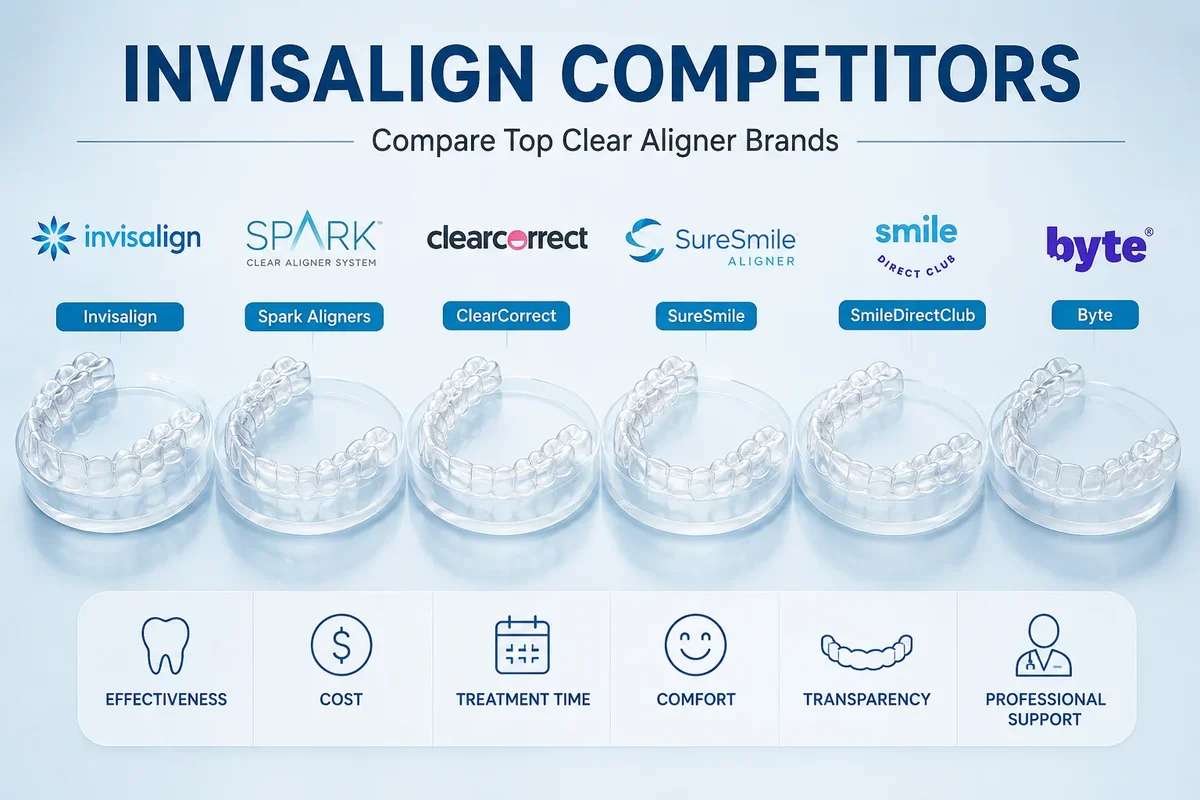
Frequently Asked Questions About Invisalign Competitors
Patients researching clear aligner treatment often have many questions before deciding which system is right for them. With the growing number of invisalign competitors available today, it is natural to compare effectiveness, costs, treatment duration, comfort, and safety. Understanding the answers to the most common questions can help patients feel more confident when evaluating different clear aligner brands and selecting the best option for their orthodontic needs.
This FAQ section addresses many of the concerns patients commonly have when exploring invisalign competitors and alternative clear aligner systems.
Are Invisalign Competitors as Effective as Invisalign?
In many cases, yes. Several leading invisalign competitors are capable of delivering excellent orthodontic results when treatment is properly planned and supervised. Modern systems such as ClearCorrect, Spark Aligners, SureSmile, and Angel Aligner utilize advanced digital treatment planning and high-quality aligner materials that can successfully treat a wide range of orthodontic conditions.
The effectiveness of treatment depends on multiple factors, including:
- Accurate diagnosis
- Case complexity
- Provider experience
- Patient compliance
- Quality of treatment planning
While the aligner brand matters, successful outcomes often depend more on professional oversight and patient cooperation than the logo printed on the aligners.
Which Invisalign Competitor Is the Most Affordable?
Cost varies significantly among different invisalign competitors. Historically, some direct-to-consumer options have offered lower pricing than traditional orthodontic treatment models. Professionally supervised systems such as ClearCorrect may also provide cost savings compared to Invisalign in certain markets.
Factors Affecting Cost
- Treatment complexity
- Number of aligners required
- Provider fees
- Geographic location
- Retainer costs
- Included refinements
Patients should compare total treatment value rather than focusing exclusively on advertised prices.
Can Invisalign Competitors Treat Complex Cases?
Many modern invisalign competitors can successfully manage moderate and even complex orthodontic cases when supervised by experienced providers. Advances in digital planning technology have significantly expanded the treatment capabilities of alternative aligner systems.
However, not all brands are equally suited for every case. Severe bite problems, impacted teeth, significant skeletal discrepancies, or extensive tooth movement may require specialized orthodontic care.
A professional consultation remains the best way to determine whether a particular aligner system is appropriate for a specific case.
How Long Does Treatment Usually Take?
Most invisalign competitors follow treatment timelines that are similar to Invisalign. The exact duration depends on the severity of the orthodontic issues being corrected.
| Case Type | Average Duration |
|---|---|
| Minor Corrections | 3–6 Months |
| Moderate Cases | 6–12 Months |
| Comprehensive Cases | 12–24 Months |
Patient compliance plays a major role in treatment speed. Individuals who wear aligners consistently typically experience more predictable progress.
Are Invisalign Competitors Safe?
When prescribed and monitored by qualified dental professionals, most reputable invisalign competitors are considered safe and effective. Professional supervision allows providers to monitor tooth movement, evaluate oral health, and address any concerns that arise during treatment.
Importance of Professional Monitoring
Regular supervision helps:
- Identify treatment complications early
- Monitor gum health
- Evaluate bite changes
- Ensure aligners fit properly
- Optimize treatment outcomes
Patients should always seek treatment from qualified dental providers whenever possible.
Do Invisalign Competitors Hurt?
Most patients experience mild pressure or discomfort when switching to a new set of aligners. This sensation is normal because the aligners are gradually moving teeth into new positions.
Many invisalign competitors utilize advanced materials designed to improve comfort and reduce irritation. Compared to traditional braces, clear aligners are generally associated with less discomfort and fewer soft tissue injuries.
The initial adjustment period typically lasts only a few days after each aligner change.
Can I Eat and Drink with Aligners?
One of the biggest advantages offered by Invisalign and many invisalign competitors is removability. Patients can remove aligners before eating and drinking, allowing them to enjoy their favorite foods without many of the restrictions associated with traditional braces.
Best Practices
- Remove aligners before meals
- Brush before reinserting aligners
- Drink water freely while wearing aligners
- Avoid sugary beverages while aligners are in place
- Maintain excellent oral hygiene
Following these habits helps protect both the aligners and overall oral health.
Will Insurance Cover Invisalign Competitors?
Many dental insurance plans provide orthodontic benefits that may apply to Invisalign and various invisalign competitors. Coverage depends on the specific insurance policy and treatment circumstances.
Patients should contact their insurance provider to verify:
- Orthodontic coverage limits
- Lifetime maximum benefits
- Eligible treatment types
- Provider network requirements
Many dental offices can assist patients in understanding and maximizing available insurance benefits.
What Happens After Treatment Ends?
Retention is a critical part of orthodontic treatment, regardless of which invisalign competitors are used. Teeth naturally tend to shift over time, making retainers essential for maintaining results.
Types of Retainers
- Clear removable retainers
- Hawley retainers
- Fixed bonded retainers
Most providers recommend wearing retainers consistently after treatment to preserve the newly achieved alignment.
How Do I Choose Among Invisalign Competitors?
Choosing among available invisalign competitors should involve careful consideration of several factors:
- Treatment goals
- Case complexity
- Budget
- Provider experience
- Level of supervision
- Aligner comfort
- Brand reputation
- Long-term support
Rather than selecting a brand based solely on price or popularity, patients should focus on finding the option that best fits their specific orthodontic needs.
Do Invisalign Competitors Use Similar Technology?
Most modern invisalign competitors utilize digital scanning, 3D treatment planning, and customized aligner manufacturing. While specific technologies vary among brands, many systems rely on similar orthodontic principles to move teeth gradually and predictably.
Some brands differentiate themselves through unique materials, specialized software, enhanced monitoring systems, or proprietary treatment protocols.
Can Teenagers Use Invisalign Competitors?
Yes. Many invisalign competitors offer treatment options suitable for teenagers. In fact, clear aligners are increasingly popular among younger patients because they are discreet, removable, and compatible with active lifestyles.
However, teenagers must demonstrate sufficient responsibility to wear aligners consistently. Parents and providers should work together to encourage compliance throughout treatment.
Final Thoughts
The growing market of invisalign competitors has created more opportunities than ever for patients seeking comfortable, effective, and aesthetically pleasing orthodontic treatment. Whether the goal is correcting minor spacing issues or addressing more complex alignment concerns, today’s clear aligner systems offer a wide range of solutions that can accommodate different budgets, lifestyles, and clinical needs.
By understanding the strengths, limitations, costs, and treatment processes associated with various invisalign competitors, patients can make informed decisions and approach orthodontic treatment with greater confidence. A thorough consultation with an experienced dental professional remains the most important step toward achieving a healthy bite, beautiful smile, and long-lasting treatment success. 😁✨