
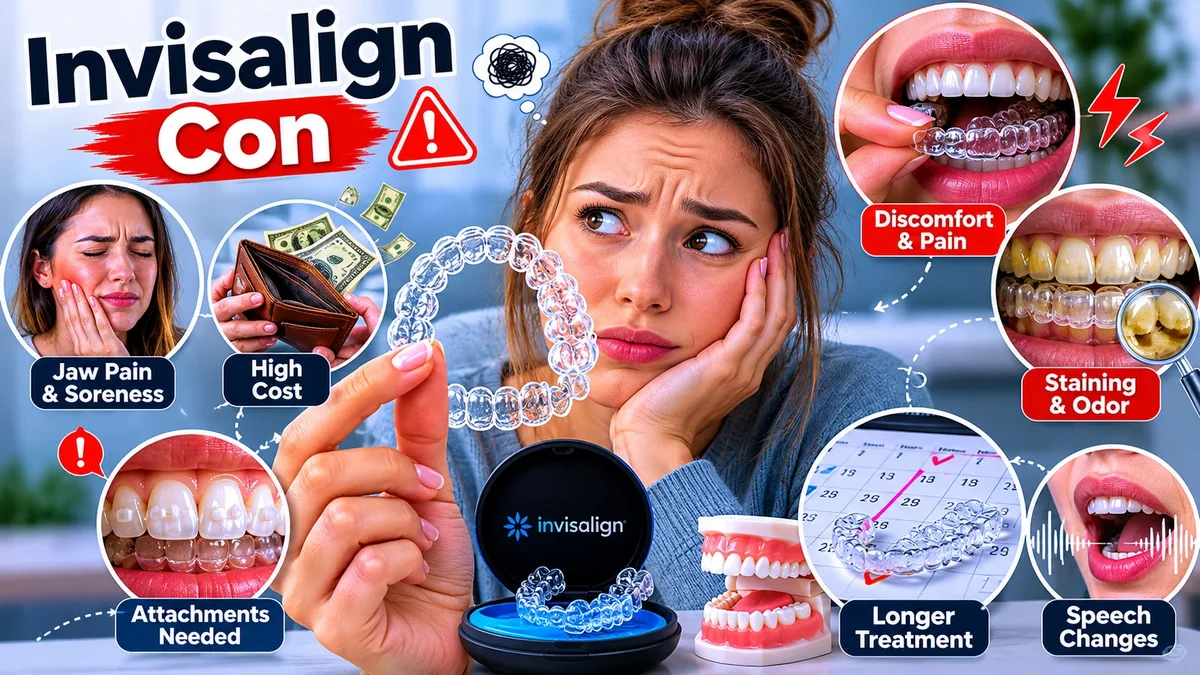
Choosing clear aligners may seem like an easy decision at first, especially because modern orthodontic marketing often highlights comfort, convenience, and aesthetics. However, understanding every possible invisalign con before starting treatment is extremely important for patients who want realistic expectations and successful results. While Invisalign has transformed orthodontic care for millions of people worldwide, there are still several disadvantages and limitations that should be carefully evaluated before beginning treatment.
One major invisalign con is the level of discipline required from the patient. Unlike traditional braces that remain attached to the teeth, Invisalign trays are removable. This may sound convenient, but it also creates opportunities for inconsistent wear. Most dentists recommend wearing aligners for 20–22 hours per day for proper tooth movement. Patients who frequently remove the trays or forget to wear them may experience delayed progress, poor alignment results, or even treatment failure. For many busy adults and teenagers, this invisalign con becomes one of the biggest challenges during treatment.
Another important invisalign con involves discomfort during tray changes. Even though clear aligners are generally considered less painful than metal braces, many patients still experience pressure, soreness, and tooth sensitivity whenever they switch to a new aligner set. The discomfort usually lasts several days and can affect eating, speaking, and daily comfort. Some people also notice irritation along the gums or inner cheeks because the plastic edges rub against soft tissues. 😬
Cost is another frequently discussed invisalign con. Invisalign treatment can sometimes be more expensive than traditional braces, especially for complex orthodontic cases. Prices vary depending on the severity of tooth movement, treatment duration, and geographic location. In the United States, Invisalign treatment commonly ranges between $3,000 and $8,000. Patients with severe crowding, bite issues, or long treatment plans may face even higher expenses.
Average Invisalign Price Estimates
- Mild Cases: $3,000 – $4,500
- Moderate Cases: $4,500 – $6,500
- Complex Cases: $6,500 – $8,000+
This financial invisalign con becomes even more significant when insurance coverage is limited or unavailable. Some dental insurance plans partially cover orthodontic treatment, but others may exclude clear aligners completely. Patients should always discuss financing and payment options with their dental provider before committing to treatment.
Another notable invisalign con relates to eating and drinking restrictions. Patients must remove aligners every time they eat or drink anything except water. Coffee, tea, soda, and colored beverages can stain the trays, while hot drinks may warp the plastic material. For individuals who snack frequently throughout the day, this invisalign con may become frustrating and inconvenient. Additionally, patients must brush and floss before reinserting the trays to prevent bacteria buildup and tooth decay.
Speech difficulties can also be considered an invisalign con, particularly during the first few weeks of treatment. Some people develop a slight lisp or altered pronunciation while adjusting to the trays. Although speech usually improves over time, professionals who speak frequently in meetings, presentations, or customer-facing roles may initially feel self-conscious. 😅
One overlooked invisalign con involves oral hygiene maintenance. Because aligners fit tightly around the teeth, food particles and plaque can become trapped if cleaning routines are neglected. This increases the risk of cavities, gum inflammation, and bad breath. Patients must clean both their teeth and aligners carefully every day. Compared to traditional orthodontic braces, clear aligners require a higher level of personal responsibility and hygiene consistency.
Not every orthodontic case is suitable for Invisalign, which represents another important invisalign con. Severe bite problems, complex jaw alignment issues, or significant tooth rotations may respond better to traditional braces or other orthodontic treatments. In some situations, dentists may recommend combining Invisalign with attachments, elastics, or additional procedures to achieve proper results. Patients expecting a simple and effortless solution may be surprised to learn that treatment can still become complicated.
Patients should also understand that losing aligners is a common invisalign con. Since the trays are removable, they can easily be misplaced in restaurants, offices, schools, or while traveling. Replacing lost trays may involve extra fees and treatment delays. Teenagers and younger patients are especially prone to losing or damaging aligners, which may interfere with treatment progress.
Another psychological invisalign con is the need for constant awareness. Patients must continuously think about wear time, tray cleaning, meal schedules, and oral hygiene. Some individuals eventually feel mentally exhausted by the routine. Traditional braces, despite being more visible, eliminate many of these daily responsibilities because they remain fixed to the teeth.
Despite every invisalign con, Invisalign still remains a highly effective orthodontic option for many patients. Modern clear aligners offer improved aesthetics, greater flexibility, and more comfortable treatment experiences compared to older orthodontic systems. However, success depends heavily on patient compliance, realistic expectations, and professional treatment planning.
Patients considering Invisalign should always seek advice from qualified dental professionals and trusted organizations like the American Dental Association. Professional consultation helps determine whether Invisalign is appropriate for specific dental conditions and long-term goals.
If you are considering treatment and want personalized guidance, you can also visit the Redent Klinik Contact Page to learn more about orthodontic evaluations, clear aligner treatment options, and modern cosmetic dentistry solutions. 🦷
Ultimately, understanding every possible invisalign con allows patients to make informed decisions about their oral health. While Invisalign can provide excellent cosmetic and orthodontic outcomes, patients should balance the benefits with the responsibilities, limitations, and financial commitments involved. Careful planning and proper expectations are the keys to achieving a healthier, straighter smile successfully.
1. Common Invisalign Cons Compared to Traditional Braces
When comparing modern orthodontic solutions, many patients immediately focus on appearance and comfort. Clear aligners have become increasingly popular because they are nearly invisible and removable. However, before starting treatment, it is essential to fully understand every possible invisalign con compared to traditional braces. Although Invisalign offers many cosmetic advantages, there are still important limitations, challenges, and treatment concerns that patients should evaluate carefully before making a final decision.
One major invisalign con is patient compliance. Traditional braces remain attached to the teeth throughout the treatment process, meaning patients cannot remove them on their own. Invisalign aligners, on the other hand, must be worn consistently for 20–22 hours per day. Patients who frequently remove the trays or forget to wear them may experience slower progress, poor alignment, or incomplete results. This invisalign con becomes especially problematic for teenagers, busy professionals, and individuals with inconsistent routines.
The Responsibility Difference Between Invisalign and Braces
Traditional braces work continuously because they are fixed to the teeth. Invisalign treatment depends heavily on patient discipline. This means the success of treatment is directly connected to daily habits and personal responsibility.
Why Compliance Matters
- Aligners must be worn almost all day.
- Removing trays too often delays treatment.
- Skipping aligners can reverse tooth movement.
- Lost trays may interrupt orthodontic progress.
This invisalign con often surprises patients who initially believe clear aligners are easier than braces. In reality, Invisalign requires consistent effort and long-term commitment.
Another important invisalign con involves treatment limitations. While Invisalign technology has improved dramatically over recent years, traditional braces may still provide better results for severe orthodontic problems. Complex bite issues, significant tooth rotations, jaw alignment disorders, and severe crowding sometimes respond more effectively to metal braces.
Cases Where Traditional Braces May Perform Better
- Severe overbite or underbite correction
- Major tooth rotation problems
- Complex jaw alignment issues
- Extremely crowded teeth
- Large gaps requiring advanced movement
This treatment limitation is considered a serious invisalign con because some patients may start aligner therapy expecting simple results, only to discover additional procedures are necessary later. In certain cases, orthodontists may recommend switching from Invisalign to traditional braces during treatment.
Comfort is another topic where opinions differ. Although many advertisements describe Invisalign as painless, discomfort remains a common invisalign con. Every time patients switch to a new aligner tray, they often experience pressure, soreness, and tooth sensitivity. While braces also create discomfort, Invisalign users frequently describe recurring pressure during each aligner transition.
Speech and Daily Lifestyle Challenges
One underestimated invisalign con involves speech changes. Because the trays cover the teeth, some patients temporarily develop a lisp or altered pronunciation. Professionals who communicate regularly in meetings, sales environments, or presentations may feel uncomfortable during the adjustment period. 😬
Traditional braces can also affect speech initially, but some patients report that Invisalign trays feel bulkier inside the mouth during the first weeks of use.
Social Challenges Some Patients Experience
- Temporary lisp during conversations
- Difficulty pronouncing certain sounds
- Embarrassment in public speaking situations
- Frequent tray removal during meals or events
Another important invisalign con relates to eating habits. Traditional braces come with food restrictions because sticky or hard foods may damage brackets and wires. Invisalign users technically have fewer food limitations because aligners are removable. However, this convenience also creates new challenges.
Patients must remove the trays every time they eat or drink anything besides water. After meals, they should brush and floss thoroughly before placing the aligners back into the mouth. This invisalign con becomes frustrating for individuals who snack frequently throughout the day or have demanding schedules.
Many patients also underestimate the cleaning requirements associated with Invisalign. Oral hygiene is extremely important because bacteria and food particles can become trapped beneath the aligners. Poor cleaning habits may increase the risk of cavities, gum inflammation, and bad breath.
Cleaning and Maintenance Requirements
Unlike traditional braces, Invisalign trays require separate daily maintenance. Patients must clean both their teeth and the aligners consistently.
Daily Invisalign Cleaning Tasks
- Brush after every meal
- Floss before reinserting trays
- Rinse aligners regularly
- Deep clean trays daily
- Avoid staining foods and beverages
This invisalign con may sound simple at first, but over several months or years of treatment, the routine can become exhausting for some individuals.
Cost is another significant invisalign con compared to traditional braces. Invisalign treatment is often more expensive depending on the complexity of the case and treatment duration. In many regions, clear aligners cost between $3,000 and $8,000 or more.
Average Treatment Costs
| Treatment Type | Estimated Cost |
|---|---|
| Traditional Braces | $2,500 – $6,000 |
| Invisalign | $3,000 – $8,000+ |
Financial concerns remain one of the most discussed invisalign con topics among adults considering orthodontic treatment. Insurance coverage may vary, and some plans offer limited support for clear aligners.
Despite every invisalign con discussed above, Invisalign remains a highly effective solution for many patients seeking a discreet orthodontic option. Modern aligners provide aesthetic benefits, improved confidence, and greater flexibility compared to visible metal braces. However, choosing the right orthodontic treatment requires careful evaluation of both advantages and disadvantages.
Patients should always consult qualified dental professionals and trusted organizations like the American Dental Association before making treatment decisions. Personalized evaluations help determine whether Invisalign or traditional braces are more suitable for individual needs.
If you want professional guidance regarding clear aligners, orthodontic treatment planning, or cosmetic dentistry solutions, you can visit the Redent Klinik Contact Page for more information and consultation support. 🦷
Understanding every possible invisalign con allows patients to enter treatment with realistic expectations. While clear aligners offer impressive cosmetic advantages, successful outcomes depend on discipline, oral hygiene, consistency, and proper case selection. Comparing Invisalign with traditional braces carefully helps patients choose the treatment that best matches their lifestyle, dental needs, and long-term goals.
2. Is Invisalign Uncomfortable? Pain, Pressure, and Adjustment Periods
One of the most common concerns patients have before starting orthodontic treatment is discomfort. Many people choose clear aligners because they believe the process will be completely painless compared to traditional braces. However, understanding the reality behind this expectation is important because discomfort remains a significant invisalign con for many patients. While Invisalign is generally considered more comfortable than metal braces, it still involves tooth movement, pressure, and adjustment phases that can affect daily life.
The primary reason discomfort occurs during Invisalign treatment is because the aligners gradually shift teeth into new positions. Controlled orthodontic pressure is necessary for successful tooth movement. Each time patients switch to a new aligner tray, the teeth experience fresh force that creates temporary soreness and sensitivity. This invisalign con is completely normal, but the intensity varies from person to person.
Why Invisalign Causes Pressure and Soreness
Every aligner tray is slightly different from the previous one. The new tray applies pressure to specific teeth to encourage gradual movement. As the periodontal ligaments around the teeth adapt, patients may experience discomfort for several days.
Common Sensations Patients Experience
- Mild to moderate tooth soreness
- Tight pressure around certain teeth
- Jaw fatigue during the adjustment period
- Increased sensitivity while chewing
- Minor gum irritation
This invisalign con is especially noticeable during the first few days after switching to a new set of aligners. Some patients describe the feeling as tightness, while others compare it to dull pressure inside the mouth. 😬
Another important invisalign con involves the first weeks of treatment. During this adjustment phase, the mouth must adapt to having plastic trays covering the teeth for most of the day. Many patients initially feel uncomfortable speaking, swallowing, or wearing the aligners continuously. While these issues usually improve with time, the early transition period can feel frustrating.
The First Week Adjustment Period
The beginning of Invisalign treatment is often the most challenging stage because patients are adapting to a completely new oral environment. The trays may feel bulky or unfamiliar at first.
Typical First Week Challenges
- Difficulty removing aligners
- Excess saliva production
- Mild speech changes or lisping
- Pressure headaches
- Temporary eating discomfort
For some individuals, this invisalign con creates anxiety because they expected a smoother experience based on marketing advertisements. Although Invisalign is more discreet than braces, it is still an orthodontic treatment system that changes tooth positioning over time.
Another frequently discussed invisalign con is gum irritation. The edges of aligners may rub against sensitive tissues inside the mouth, especially during the early stages of treatment. Some patients experience redness, soreness, or minor cuts where the plastic trays contact the gums or inner cheeks.
Fortunately, orthodontists can often smooth rough tray edges if irritation becomes severe. Dental wax may also help reduce friction in certain cases.
Common Areas of Irritation
- Inner cheeks
- Gum lines
- Tongue edges
- Lips
- Back molar regions
Another invisalign con many patients overlook is eating discomfort. Because teeth become temporarily sensitive during aligner changes, chewing hard foods may feel painful. Crunchy foods, nuts, crusty bread, and tough meats can become difficult to eat during adjustment days.
How Invisalign Affects Eating Habits
Tooth sensitivity often becomes more noticeable while chewing. Patients may unconsciously change their diet to avoid discomfort.
Foods Patients Often Avoid Temporarily
- Hard vegetables
- Steak and chewy meats
- Crunchy snacks
- Ice-cold foods
- Sticky candy
This invisalign con can affect social dining experiences and meal enjoyment, particularly during the first few months of treatment.
Some patients also report jaw soreness as an invisalign con. Since aligners slightly alter the bite relationship during treatment, the jaw muscles may feel fatigued or strained while adapting. Patients who already suffer from TMJ disorders or jaw tension may notice increased sensitivity during certain treatment phases.
Nighttime discomfort is another invisalign con that patients commonly discuss. Because aligners remain in the mouth while sleeping, some people initially wake up feeling pressure or tightness in the teeth and jaws. This sensation usually improves after a few days with each new aligner tray.
One positive aspect is that Invisalign discomfort is generally temporary. Most patients adapt within several days after changing trays. However, the recurring nature of this invisalign con means discomfort can return repeatedly throughout the treatment process.
Ways Patients Manage Invisalign Discomfort
Fortunately, there are several strategies that help reduce soreness and adjustment challenges during treatment.
Helpful Comfort Tips
- Switch to new trays before bedtime
- Use cold water to soothe irritation
- Choose softer foods temporarily
- Maintain excellent oral hygiene
- Use orthodontic wax if needed
Patients should always communicate with their orthodontist if pain becomes severe or persistent. Excessive discomfort may indicate that the aligners need adjustment or that another dental issue is developing.
Another invisalign con involves attachments. Many Invisalign patients require small tooth-colored attachments bonded to the teeth to improve aligner grip and movement precision. Although these attachments are less noticeable than metal brackets, they can still create additional discomfort and roughness inside the mouth.
Clear aligners may also feel psychologically uncomfortable for some individuals. Constantly wearing trays for 20–22 hours per day can make patients highly aware of their treatment. Some individuals feel irritated by the sensation of always having something covering their teeth.
Despite every invisalign con related to discomfort, many patients still prefer Invisalign because the trays are removable, aesthetically discreet, and generally smoother than traditional metal braces. Modern orthodontic technology has significantly improved aligner comfort compared to older systems.
For safe and successful treatment, patients should seek professional guidance from qualified orthodontic providers and trusted organizations like the American Dental Association. Proper supervision helps minimize complications and improve treatment comfort.
If you are considering Invisalign treatment and want personalized support regarding aligner comfort, orthodontic planning, or cosmetic dentistry solutions, you can visit the Redent Klinik Contact Page for more information. 🦷
Ultimately, understanding this invisalign con helps patients build realistic expectations before beginning treatment. Invisalign may be more comfortable than traditional braces for many individuals, but some level of pressure, soreness, and adjustment remains a natural part of the orthodontic process. Patients who understand these temporary discomforts are often better prepared emotionally and physically for successful treatment outcomes.
3. Invisalign Cons Related to Eating and Drinking Habits
One of the biggest lifestyle adjustments patients experience during clear aligner treatment involves changes in eating and drinking habits. While Invisalign is often promoted as a flexible alternative to traditional braces, many patients quickly discover that food-related restrictions remain a major invisalign con. In fact, daily meal routines, snacking habits, beverage choices, and oral hygiene responsibilities can all become significantly more complicated during treatment.
Unlike traditional braces, Invisalign aligners are removable. At first, this may sound extremely convenient because patients can technically continue eating all their favorite foods without worrying about breaking brackets or wires. However, this convenience also creates a hidden invisalign con that many people underestimate before starting treatment.
Why Invisalign Changes Daily Eating Habits
To maintain treatment effectiveness, Invisalign trays should remain in the mouth for approximately 20–22 hours every day. This means patients only have limited time to remove the aligners for meals, snacks, and oral hygiene.
Daily Routine Challenges
- Removing trays before every meal
- Brushing after eating
- Cleaning aligners multiple times daily
- Limiting unnecessary snacking
- Monitoring wear time constantly
This invisalign con becomes particularly difficult for individuals with busy work schedules, frequent business meetings, long commutes, or active social lives. Patients who enjoy casual snacking throughout the day often feel frustrated by the constant need to remove and clean their aligners.
Another important invisalign con involves beverage restrictions. Patients cannot safely drink most beverages while wearing aligners because liquids may stain, damage, or warp the trays. Only plain water is generally considered safe during aligner wear.
Drinks That Can Cause Problems
Many popular beverages contain sugar, acids, pigments, or heat that may negatively affect both the aligners and oral health.
Beverages Patients Should Avoid While Wearing Aligners
- Coffee ☕
- Tea
- Red wine
- Soda
- Fruit juice
- Sports drinks
- Energy drinks
This invisalign con can feel extremely restrictive for coffee lovers and individuals who sip beverages throughout the day. Hot drinks may distort the plastic trays, while dark-colored liquids can stain them, making the aligners more visible and less attractive.
Another invisalign con related to drinking habits is the increased risk of tooth decay if sugary beverages are consumed while wearing aligners. Since the trays tightly cover the teeth, sugar and acids can become trapped against enamel surfaces, increasing cavity risk.
Many patients also struggle with time management during meals. Traditional braces stay attached to the teeth continuously, but Invisalign users must carefully organize their eating schedule to avoid exceeding daily tray removal limits.
Recommended Invisalign Wear Schedule
- 20–22 hours of daily aligner wear
- Approximately 2 hours available for eating and cleaning
- Meals should be planned efficiently
- Frequent snacking may interfere with treatment
This invisalign con often causes patients to reduce spontaneous eating habits. Some individuals even skip snacks entirely because removing, cleaning, and reinserting aligners repeatedly becomes inconvenient.
Social Dining Challenges with Invisalign
Social situations create another important invisalign con for many adults and teenagers. Dining at restaurants, attending parties, or participating in business lunches can become awkward because aligners must be removed before eating.
Common Social Difficulties
- Removing trays in public restrooms
- Storing aligners safely during meals
- Feeling embarrassed during social gatherings
- Needing extra oral hygiene supplies while traveling
- Interrupting conversations for tray maintenance
Some patients feel uncomfortable removing aligners in front of friends, coworkers, or romantic partners. Others worry about accidentally losing the trays during meals. This invisalign con may create stress in social environments, especially during the first few months of treatment. 😅
Another serious invisalign con is accidental aligner loss during eating. Since the trays are removable, patients often place them inside napkins, containers, or pockets while dining. Unfortunately, many aligners are accidentally thrown away or misplaced during meals.
Replacing lost trays can delay treatment and create additional expenses. Orthodontists may charge replacement fees, and patients sometimes need to wear previous aligners temporarily while waiting for new trays.
How Invisalign Affects Oral Hygiene After Meals
Oral hygiene becomes significantly more demanding during Invisalign treatment. Patients should ideally brush and floss after every meal before placing the aligners back into the mouth.
Why Cleaning Is So Important
- Food particles can become trapped beneath trays
- Bacteria may multiply quickly inside aligners
- Poor hygiene increases cavity risk
- Bad breath may worsen without proper cleaning
- Stained aligners become more noticeable
This invisalign con becomes exhausting for some patients over time. Carrying toothbrushes, floss, toothpaste, and aligner cases everywhere may feel inconvenient and mentally tiring.
Eating discomfort is another invisalign con that many patients experience. Because aligners move teeth gradually, patients may notice sensitivity while chewing, especially after switching to a new tray set. Hard or crunchy foods can temporarily become painful to eat.
Some patients unintentionally develop unhealthy eating patterns because of Invisalign restrictions. Since removing trays repeatedly feels inconvenient, people may reduce meal frequency or avoid drinking enough fluids during the day.
Another invisalign con is the temptation to leave aligners out for extended periods during meals or events. Patients attending weddings, parties, vacations, or business dinners may wear the trays inconsistently, which can slow orthodontic progress.
Travel and Lifestyle Complications
Frequent travelers often notice another invisalign con related to eating logistics. Airports, hotels, long flights, and road trips may complicate aligner maintenance routines.
Travel Challenges Patients Face
- Limited bathroom access for brushing
- Difficulty cleaning trays while traveling
- Forgetting aligner cases during trips
- Inconsistent meal schedules
- Higher risk of losing trays
Despite every invisalign con related to eating and drinking habits, many patients still prefer clear aligners because they offer cosmetic advantages and greater dietary flexibility compared to traditional braces. With braces, patients must permanently avoid certain hard or sticky foods to prevent bracket damage.
Patients considering Invisalign should seek guidance from qualified orthodontic professionals and trusted resources like the American Dental Association. Proper education helps patients prepare for the lifestyle adjustments required during treatment.
If you are interested in Invisalign treatment and want personalized orthodontic guidance, you can also visit the Redent Klinik Contact Page for more information about clear aligners, smile design, and cosmetic dentistry solutions. 🦷
Ultimately, understanding this invisalign con allows patients to make informed decisions before starting treatment. Invisalign may provide excellent aesthetic benefits, but the eating restrictions, cleaning responsibilities, and daily lifestyle adjustments require long-term discipline and commitment. Patients who prepare mentally for these challenges are often more successful throughout the orthodontic journey.
4. Speech Changes and Social Challenges During Invisalign Treatment
Many patients choose clear aligners because they want a more discreet orthodontic treatment option. Invisalign trays are transparent, removable, and significantly less noticeable than traditional braces. However, despite these cosmetic advantages, speech difficulties and social discomfort remain important aspects of the overall invisalign con experience. While some patients adapt quickly, others struggle with pronunciation changes, social anxiety, and self-consciousness during treatment.
One major invisalign con involves temporary speech alterations caused by the aligners covering the teeth. Since speech depends heavily on tongue placement and airflow inside the mouth, even small changes can affect pronunciation. Invisalign trays create an additional layer between the tongue and teeth, which may interfere with certain sounds.
Why Invisalign Can Affect Speech
The aligners slightly change the shape of the mouth’s internal surfaces. As a result, the tongue may need time to adapt to speaking naturally again.
Sounds Most Commonly Affected
- “S” sounds
- “Sh” sounds
- “Z” sounds
- “Th” sounds
- Fast conversational speech
This invisalign con often appears during the first few weeks of treatment. Many patients develop a temporary lisp or notice that certain words feel harder to pronounce clearly. 😬
For some individuals, these speech changes are mild and disappear quickly. However, others may struggle longer depending on tongue position, oral anatomy, and speaking habits. Professionals who rely heavily on communication may find this invisalign con particularly frustrating.
Professionals Most Affected by Speech Changes
Patients whose careers involve constant communication are often more sensitive to even minor pronunciation problems.
Occupations Commonly Impacted
- Teachers
- Sales representatives
- Lawyers
- Customer service workers
- Public speakers
- Call center employees
For these individuals, the invisalign con related to speech can affect confidence during meetings, presentations, phone calls, and client interactions. Some patients report speaking more slowly or avoiding certain words until they adjust to the aligners.
Another invisalign con involves the psychological impact of constantly wearing trays. Although Invisalign is visually discreet, patients remain highly aware of having plastic aligners inside their mouths all day. This awareness may increase social anxiety, especially during conversations, romantic situations, or public events.
Teenagers and young adults may become especially self-conscious during treatment. Even though Invisalign is less visible than braces, some patients still worry that others will notice the trays or attachments bonded to the teeth.
Social Anxiety During Invisalign Treatment
Orthodontic treatment can affect self-esteem differently for every patient. Some people feel empowered by improving their smile, while others experience temporary insecurity.
Common Emotional Challenges
- Fear of speaking incorrectly
- Embarrassment about removing trays in public
- Anxiety during close conversations
- Reduced confidence while dating
- Awkwardness during social meals
This invisalign con is often underestimated because marketing campaigns mainly focus on cosmetic advantages rather than emotional adaptation.
Another invisalign con related to social situations involves eating in public places. Since aligners must be removed before meals, patients may feel uncomfortable handling trays in restaurants, cafes, or workplaces. Some individuals avoid eating socially altogether because they dislike removing and cleaning aligners in public environments.
Social Situations That May Feel Difficult
- Business dinners
- School lunches
- Family gatherings
- Weddings and celebrations
- Dating situations
- Travel and vacations
This invisalign con becomes even more noticeable during long social events where patients need to balance eating, drinking, and aligner wear time carefully.
One overlooked invisalign con involves saliva production. During the early stages of treatment, the body may respond to the aligners as a foreign object inside the mouth. This can temporarily increase saliva flow, making speech feel awkward or uncomfortable.
Some patients also experience dry mouth as an invisalign con. Wearing trays continuously may reduce natural saliva circulation around certain areas of the mouth. Dry mouth can contribute to bad breath, throat discomfort, and speaking difficulties.
How Invisalign Can Affect Communication Confidence
Confidence plays an important role in daily communication. Even minor speech changes may create emotional stress for some patients.
Ways Confidence May Be Affected
- Speaking less during conversations
- Avoiding presentations
- Feeling distracted while talking
- Overthinking pronunciation
- Smiling less frequently
This invisalign con is usually temporary, but emotional adaptation varies significantly between individuals.
Another social invisalign con involves attachments. Many Invisalign cases require small tooth-colored attachments bonded to the teeth to improve aligner grip and movement accuracy. While less visible than metal brackets, attachments may still become noticeable in close-up conversations or photographs.
Patients may also feel pressure to maintain perfect oral hygiene during social activities. Since food particles can become trapped beneath aligners, patients often carry toothbrushes, floss, and cleaning supplies everywhere they go. This invisalign con can make spontaneous social situations feel stressful.
Tips for Adjusting to Invisalign Social Challenges
Fortunately, most patients gradually adapt to Invisalign-related speech and confidence concerns over time.
Helpful Adjustment Strategies
- Practice speaking aloud daily
- Read books or articles out loud
- Stay hydrated to reduce dry mouth
- Use aligner cases for easy storage
- Maintain consistent wear time
Most patients notice significant speech improvement within several weeks. The tongue naturally learns to adapt to the aligners, and pronunciation often returns to normal.
Another positive aspect is that Invisalign trays are removable during important social or professional situations if necessary. However, patients should avoid removing aligners too frequently because inconsistent wear may delay treatment progress.
Despite every invisalign con related to speech and social adjustment, many patients still prefer clear aligners because they remain less visible than traditional braces. Modern orthodontic technology allows patients to straighten their teeth more discreetly while maintaining a relatively natural appearance.
Patients considering Invisalign should always seek guidance from experienced dental professionals and trusted organizations like the American Dental Association. Professional supervision helps patients manage treatment expectations and improve overall comfort.
If you are considering Invisalign and want personalized orthodontic support, you can also visit the Redent Klinik Contact Page to learn more about smile correction, aligner treatment, and cosmetic dentistry services. 🦷
Ultimately, understanding this invisalign con helps patients prepare mentally and emotionally for treatment. While speech changes and social discomfort may occur temporarily, most patients successfully adapt with time and practice. Realistic expectations, patience, and proper orthodontic support are essential for a smooth Invisalign experience and successful long-term results.
5. The Hidden Costs and Financial Invisalign Cons Explained
When patients first consider clear aligner treatment, they often focus on aesthetics, comfort, and convenience. However, one of the most important factors to evaluate before starting treatment is the financial side of the process. Cost-related concerns represent a major invisalign con for many individuals, especially because the final expenses are sometimes much higher than expected. While Invisalign can deliver excellent cosmetic and orthodontic results, patients should fully understand every possible hidden expense before committing to treatment.
The first invisalign con related to finances is the overall treatment price itself. Invisalign treatment is often more expensive than traditional braces, particularly in moderate or complex orthodontic cases. The total cost depends on several variables, including treatment length, aligner quantity, geographic location, orthodontist experience, and the severity of tooth movement required.
Average Invisalign Treatment Costs
Clear aligner pricing varies significantly from one patient to another. Mild cosmetic corrections are usually less expensive than major bite adjustments or severe crowding cases.
Typical Invisalign Price Ranges
| Treatment Complexity | Estimated Cost |
|---|---|
| Minor Corrections | $3,000 – $4,500 |
| Moderate Cases | $4,500 – $6,500 |
| Complex Cases | $6,500 – $8,500+ |
This invisalign con becomes especially difficult for patients without orthodontic insurance coverage. In some countries, clear aligners are considered cosmetic rather than medically necessary, which means insurance providers may only cover a limited portion of the treatment or nothing at all.
Insurance Limitations and Financial Stress
Insurance-related restrictions create another major invisalign con for adults considering treatment. Many patients assume orthodontic coverage automatically includes Invisalign, but this is not always true.
Common Insurance Challenges
- Limited orthodontic coverage
- Age restrictions for adult treatment
- Higher co-payments for clear aligners
- Lifetime orthodontic maximums
- Excluded cosmetic procedures
This invisalign con often surprises patients during consultation appointments when they discover their out-of-pocket expenses are significantly higher than expected. 😬
Another important invisalign con involves hidden fees that may not appear in the initial treatment quote. While some dental clinics provide comprehensive pricing, others charge separately for additional services that become necessary during treatment.
Hidden Expenses Patients May Encounter
Many Invisalign patients experience extra costs throughout the treatment process. These expenses can accumulate gradually over time.
Potential Additional Costs
- Replacement aligners for lost trays
- Retainers after treatment completion
- Emergency orthodontic visits
- Additional refinement aligners
- X-rays and digital scans
- Whitening or cosmetic procedures
This invisalign con becomes frustrating because patients may initially believe the quoted treatment price includes everything necessary from start to finish.
Lost aligners are another expensive invisalign con. Since Invisalign trays are removable, they are easier to misplace compared to traditional braces. Patients frequently lose trays in restaurants, offices, schools, airplanes, or while traveling. Replacement aligners may require additional payments depending on clinic policies.
Another financial invisalign con involves treatment refinements. While many patients achieve successful results within the planned aligner series, others require additional trays to correct remaining tooth movement issues. These refinement phases can increase both treatment time and total cost.
Why Refinements Are Sometimes Necessary
Teeth do not always move exactly as predicted by digital treatment simulations. Small biological differences can affect orthodontic movement.
Common Reasons for Refinement Aligners
- Incomplete tooth movement
- Poor aligner compliance
- Unexpected bite changes
- Complex rotations
- Treatment interruptions
This invisalign con may extend treatment for several additional months, creating both financial and emotional stress for patients.
Another hidden invisalign con involves long-term retainer costs. After Invisalign treatment ends, patients must continue wearing retainers to maintain their new smile alignment. Retainers may eventually wear out, crack, or loosen over time and require replacement.
Retainer replacement costs are often overlooked during initial treatment planning. However, maintaining orthodontic results long-term is essential because teeth naturally shift back over time without retention support.
The Long-Term Financial Commitment
Many people assume orthodontic expenses end once the aligner treatment is completed. In reality, retention and maintenance continue for years.
Long-Term Maintenance Expenses
- Replacement retainers
- Routine orthodontic checkups
- Professional cleanings
- Future touch-up treatments
- Emergency dental care if problems occur
This invisalign con highlights the importance of budgeting not only for active treatment but also for future maintenance.
Another financial invisalign con involves missed work or schedule disruptions. Some patients need multiple orthodontic appointments, refinement visits, or emergency consultations during treatment. Busy professionals may lose work hours or productivity while attending appointments.
Travel costs can also become part of the invisalign con experience. Patients who choose providers far from home for lower pricing may later spend substantial money on transportation, parking, accommodation, or repeated follow-up visits.
Many patients also feel psychological stress related to the financial invisalign con. Large monthly payments, financing plans, and long-term treatment commitments may create emotional pressure, particularly for families managing multiple dental expenses simultaneously.
Despite these financial concerns, Invisalign remains a highly popular orthodontic solution because many patients value the cosmetic and lifestyle advantages it offers. Clear aligners provide discreet smile correction that many adults find preferable to visible metal braces.
Patients should always discuss full treatment pricing transparently with their orthodontist before beginning treatment. Trusted organizations like the American Dental Association also recommend working with qualified dental professionals who provide clear explanations regarding costs and treatment expectations.
If you are considering Invisalign treatment and want personalized information about orthodontic planning, smile correction, or financing options, you can also visit the Redent Klinik Contact Page for more guidance and professional support. 🦷
Ultimately, understanding every financial invisalign con allows patients to prepare more realistically before starting treatment. Invisalign can provide excellent long-term smile improvements, but successful treatment requires both emotional commitment and financial planning. Patients who fully understand the possible costs are better prepared to complete treatment successfully and maintain healthy orthodontic results over time.
6. Invisalign Cons for Severe Orthodontic Problems and Complex Cases
Although Invisalign has become one of the most popular orthodontic treatment systems worldwide, it is important to understand that clear aligners are not ideal for every dental situation. One of the most significant invisalign con concerns involves treatment limitations for severe orthodontic problems and highly complex cases. While Invisalign technology has advanced dramatically over the years, certain dental conditions may still respond better to traditional braces or alternative orthodontic approaches.
Many patients assume Invisalign can solve every alignment issue because of aggressive advertising and growing popularity. However, orthodontic treatment depends on precise tooth movement, jaw relationships, bone structure, and bite mechanics. In severe cases, clear aligners may struggle to achieve the same level of control provided by traditional braces.
Why Complex Cases Can Be Difficult for Invisalign
Traditional braces use brackets and wires that apply continuous multidirectional force to the teeth. Invisalign aligners rely on removable plastic trays, which may provide less control in certain situations.
Orthodontic Problems That May Be More Challenging
- Severe overbites
- Major underbites
- Crossbites
- Large tooth rotations
- Extreme crowding
- Significant spacing issues
This invisalign con becomes especially important for patients expecting Invisalign to completely replace traditional braces in every circumstance. 😬
One major invisalign con involves tooth rotation control. Teeth that are severely twisted or rotated often require stronger orthodontic forces and more precise control than clear aligners can comfortably provide. While Invisalign attachments improve grip and movement accuracy, some severe rotations may still remain difficult to correct fully.
Understanding Invisalign Attachments
To improve treatment effectiveness, orthodontists frequently place small tooth-colored attachments on certain teeth. These attachments help the aligners grip the teeth more effectively.
Purposes of Invisalign Attachments
- Improve aligner retention
- Enhance tooth movement precision
- Assist difficult rotations
- Create stronger orthodontic force
- Support bite correction
Although attachments help address some limitations, they also introduce another invisalign con because they reduce the “invisible” appearance many patients expect from treatment.
Another important invisalign con involves vertical tooth movement. Traditional braces may perform better when orthodontists need to move teeth upward or downward within the jawbone. Invisalign can achieve certain vertical movements, but severe cases may require additional appliances or hybrid treatment methods.
Jaw alignment problems represent another major invisalign con. Orthodontic issues involving skeletal imbalances often require stronger corrective mechanics than aligners alone can provide. Patients with severe bite discrepancies sometimes need traditional braces, expanders, or even jaw surgery.
Cases That May Require Additional Orthodontic Tools
- Jaw expansion devices
- Elastics or rubber bands
- Temporary anchorage devices
- Surgical orthodontics
- Traditional metal braces
This invisalign con may disappoint patients who hoped for a simple, fully removable treatment solution.
Another invisalign con related to severe cases is treatment predictability. Invisalign uses advanced digital simulations to map tooth movement, but real biological tooth movement does not always follow computer predictions perfectly. Teeth may respond unpredictably depending on bone density, root shape, age, and patient compliance.
Why Treatment Predictability Matters
In complex orthodontic cases, even small movement inaccuracies can affect the overall treatment outcome.
Factors That Influence Tooth Movement
- Bone quality
- Patient age
- Gum health
- Wear-time consistency
- Smoking habits
- Previous dental work
This invisalign con often leads to longer treatment durations or additional refinement stages in complicated cases.
Another important invisalign con involves extraction cases. Some patients require tooth extractions before orthodontic treatment to create enough space for alignment. Traditional braces are often considered more effective for managing large tooth movements after extractions.
Invisalign can still be used in extraction cases, but the biomechanics become more complicated. Orthodontists may need to combine aligners with elastics, attachments, or other appliances to achieve proper results.
Bite Correction Challenges
Correcting bite alignment is one of the most technically demanding aspects of orthodontics. Severe bite issues may respond more efficiently to braces.
Bite Problems That Can Be Difficult
- Deep bites
- Open bites
- Class II malocclusions
- Class III malocclusions
- Asymmetrical bites
This invisalign con highlights the importance of proper orthodontic diagnosis before choosing treatment.
Another overlooked invisalign con involves patient expectations. Many people believe Invisalign works faster because it appears modern and technologically advanced. However, complex cases may actually require longer treatment durations than traditional braces.
In severe orthodontic situations, missed aligner wear can dramatically reduce treatment effectiveness. Since Invisalign depends heavily on patient compliance, inconsistent wear may create significant delays. Traditional braces continue working regardless of patient behavior because they remain fixed to the teeth.
This invisalign con becomes particularly problematic for teenagers or patients with inconsistent daily routines.
Hybrid Orthodontic Treatments
In some situations, orthodontists recommend combining Invisalign with other orthodontic systems.
Possible Combination Approaches
- Braces followed by Invisalign
- Invisalign with elastics
- Orthodontic surgery plus aligners
- Temporary braces during refinements
- Expansion appliances with aligners
While hybrid approaches may improve results, they also increase treatment complexity and represent another invisalign con for patients expecting a completely simple process.
Another important invisalign con for complex cases is the emotional impact of extended treatment. Patients with severe orthodontic problems may become frustrated if treatment takes longer than expected or if additional procedures become necessary.
Despite these limitations, Invisalign remains highly effective for many mild to moderate orthodontic problems. Advances in digital orthodontics continue improving the ability of aligners to manage increasingly difficult cases.
Patients should always seek evaluation from experienced orthodontic professionals before beginning treatment. Trusted organizations like the American Dental Association recommend individualized treatment planning based on each patient’s specific dental needs.
If you are considering Invisalign and want professional guidance regarding orthodontic complexity, bite correction, or smile design solutions, you can also visit the Redent Klinik Contact Page for more information and personalized consultation support. 🦷
Ultimately, understanding this invisalign con allows patients to make realistic treatment decisions. Invisalign can produce outstanding results in many situations, but severe orthodontic problems sometimes require additional tools, longer treatment times, or alternative orthodontic methods. Careful diagnosis and professional planning remain essential for achieving safe, stable, and successful long-term outcomes.
7. Oral Hygiene Challenges and Cleaning Requirements with Clear Aligners
One of the most underestimated aspects of clear aligner therapy is the level of oral hygiene maintenance required throughout treatment. While Invisalign is often promoted as a convenient and discreet orthodontic solution, many patients quickly discover that daily cleaning responsibilities become a major invisalign con. Compared to traditional braces, Invisalign demands a much stricter hygiene routine because the aligners cover the teeth closely for most of the day.
Patients who neglect proper oral care during treatment may experience serious dental problems, including plaque buildup, bad breath, gum irritation, enamel damage, and tooth decay. Understanding this invisalign con before starting treatment is essential because oral hygiene directly affects both treatment success and long-term dental health.
Why Oral Hygiene Is So Important with Invisalign
Invisalign aligners fit tightly around the teeth and create a sealed environment inside the mouth. If food particles, sugar, or bacteria remain on the teeth when the aligners are reinserted, harmful substances may become trapped for hours.
Problems Caused by Poor Cleaning Habits
- Bad breath
- Plaque accumulation
- Tooth discoloration
- Cavity formation
- Gum inflammation
- Enamel erosion
This invisalign con often surprises patients who initially believed removable aligners would simplify oral care compared to traditional braces. 😬
One major invisalign con involves the need to brush after nearly every meal or snack. Since aligners should not trap food particles against the teeth, patients are expected to clean their mouths thoroughly before reinserting the trays.
The Daily Cleaning Routine Required
Invisalign patients must maintain a much more disciplined oral hygiene schedule than many people are accustomed to.
Recommended Daily Steps
- Remove aligners before eating
- Brush teeth after meals
- Floss carefully every day
- Rinse aligners regularly
- Deep clean trays daily
- Avoid sugary drinks while wearing aligners
This invisalign con becomes exhausting for some individuals over time, especially those with busy schedules or limited access to restrooms during work or travel.
Another important invisalign con is bad breath, also known as halitosis. Because aligners cover the teeth continuously, bacteria and saliva can accumulate more easily if cleaning routines are inconsistent. Trapped food particles may create unpleasant odors inside the trays.
Patients who drink coffee, consume sugary beverages, or skip brushing sessions are especially vulnerable to hygiene-related issues during Invisalign treatment.
How Aligners Can Contribute to Bad Breath
Bad breath develops when bacteria break down food particles inside the mouth. Aligners may create an enclosed environment where bacteria multiply more rapidly.
Factors That Increase Bad Breath Risk
- Poor brushing habits
- Infrequent flossing
- Dry mouth
- Drinking sugary beverages
- Not cleaning aligners properly
- Smoking or vaping
This invisalign con can create social discomfort and reduce confidence during conversations or close interactions.
Another serious invisalign con is the increased risk of cavities. When patients reinsert aligners without brushing properly, sugars and acids may remain trapped against the enamel for extended periods. Over time, this can significantly increase the likelihood of tooth decay.
Common Signs of Poor Invisalign Hygiene
- White spots on teeth
- Persistent bad breath
- Yellow or stained aligners
- Swollen gums
- Tooth sensitivity
- Visible plaque buildup
This invisalign con becomes even more problematic for patients who already have existing dental issues such as gum disease, weak enamel, or frequent cavities.
Another important invisalign con involves aligner cleaning itself. Invisalign trays require separate maintenance in addition to normal brushing and flossing. Patients must clean the trays carefully to prevent staining, bacterial buildup, and unpleasant odors.
Proper Invisalign Tray Cleaning
Cleaning aligners incorrectly may damage the trays or reduce their transparency.
Recommended Cleaning Methods
- Rinse trays with lukewarm water
- Use clear antibacterial soap
- Brush trays gently with a soft toothbrush
- Use professional cleaning crystals if recommended
- Avoid hot water that may warp plastic
This invisalign con requires ongoing discipline because aligners must remain clean, clear, and odor-free throughout treatment.
Another common invisalign con involves staining. Certain foods and beverages may discolor both the aligners and the teeth if proper cleaning habits are not maintained. Coffee, tea, wine, curry, soda, and smoking are especially problematic.
Stained aligners may become more visible, reducing one of the primary cosmetic advantages of Invisalign. Many patients feel frustrated when the trays lose their transparent appearance.
Travel and Workplace Hygiene Difficulties
Maintaining proper hygiene becomes even more complicated during travel, long workdays, or busy schedules.
Situations That Make Cleaning Difficult
- Airplane travel
- Long business meetings
- School schedules
- Outdoor events
- Road trips
- Restaurant dining
This invisalign con forces many patients to carry toothbrushes, floss, toothpaste, and aligner cases everywhere they go.
Another invisalign con is dry mouth. Some patients produce less saliva while wearing aligners continuously, especially at night. Since saliva naturally protects teeth against bacteria and acids, dry mouth may increase cavity risk and oral discomfort.
Gum irritation is another hygiene-related invisalign con. If bacteria accumulate around the gums due to poor cleaning habits, inflammation and tenderness may develop. In severe cases, untreated gum problems could interfere with orthodontic progress.
Children, teenagers, and patients with inconsistent hygiene habits may struggle more with this invisalign con than highly disciplined adults. Orthodontists often evaluate patient responsibility carefully before recommending removable aligners.
How to Reduce Oral Hygiene Problems During Invisalign
Fortunately, patients can minimize most hygiene-related Invisalign complications with proper routines and professional support.
Helpful Prevention Strategies
- Brush after every meal
- Floss at least once daily
- Drink more water
- Clean aligners consistently
- Visit the dentist regularly
- Avoid smoking and sugary drinks
Patients should also attend regular dental cleanings throughout orthodontic treatment to monitor oral health and remove plaque buildup.
Despite every invisalign con related to oral hygiene, many patients still prefer Invisalign because the trays are removable and allow easier brushing compared to traditional braces. Braces can trap food around wires and brackets, making certain cleaning tasks more difficult.
Patients considering Invisalign should always seek professional advice from experienced dental providers and trusted organizations like the American Dental Association. Proper education and supervision help reduce oral health risks during treatment.
If you are considering Invisalign and want professional guidance regarding oral hygiene, aligner maintenance, or smile correction, you can also visit the Redent Klinik Contact Page for more information and consultation support. 🦷
Ultimately, understanding this invisalign con helps patients prepare for the daily responsibilities associated with clear aligner treatment. Invisalign can provide excellent cosmetic and orthodontic results, but maintaining healthy teeth and gums requires consistent oral hygiene, discipline, and long-term commitment throughout the entire treatment process.
8. Invisalign Cons for Busy Adults and Teenagers with Active Lifestyles
Although Invisalign is often promoted as a flexible and modern orthodontic solution, patients with demanding schedules may experience several lifestyle-related difficulties during treatment. One major invisalign con is the amount of daily discipline required to maintain successful progress. Busy adults, active teenagers, students, athletes, and professionals frequently struggle with the constant routines associated with aligner wear, cleaning, and scheduling.
Unlike traditional braces that remain attached to the teeth continuously, Invisalign aligners depend heavily on patient responsibility. This invisalign con becomes especially challenging for people who have unpredictable schedules, travel frequently, participate in sports, or manage demanding careers.
Why Busy Lifestyles Can Complicate Invisalign Treatment
Invisalign treatment works best when aligners are worn consistently for 20–22 hours per day. Patients must remove them only for meals, drinks other than water, and oral hygiene.
Daily Responsibilities Required
- Tracking aligner wear time
- Cleaning trays regularly
- Brushing after meals
- Avoiding unnecessary tray removal
- Attending orthodontic appointments
This invisalign con often feels overwhelming for individuals who already manage stressful routines and limited free time. 😬
Teenagers frequently experience another invisalign con related to forgetfulness. Since aligners are removable, younger patients may accidentally leave them at school, sports practice, restaurants, or friends’ homes. Lost trays can interrupt treatment progress and create additional expenses.
Challenges Teenagers Commonly Face
Teen patients often struggle more with compliance because of changing routines, school schedules, and social activities.
Common Teen Invisalign Problems
- Forgetting to wear aligners
- Losing trays during lunch
- Skipping cleaning routines
- Ignoring recommended wear time
- Removing aligners during social situations
This invisalign con may reduce treatment effectiveness significantly if aligners are not worn consistently.
Busy professionals also experience a major invisalign con related to workplace routines. Long meetings, business travel, presentations, and irregular meal schedules may interfere with proper aligner use. Some adults feel uncomfortable removing trays during work lunches or client dinners.
Professionals who speak frequently may also become frustrated with temporary speech changes caused by aligners. Even minor pronunciation issues can affect confidence during presentations, phone calls, or negotiations.
Workplace Challenges During Invisalign Treatment
Adults with demanding careers often notice that Invisalign requires more planning and attention than expected.
Common Professional Difficulties
- Limited time for brushing after meals
- Frequent coffee consumption restrictions
- Speech adjustments during presentations
- Travel-related hygiene problems
- Forgetting aligners during busy days
This invisalign con may create additional stress for professionals who already manage heavy workloads.
Travel creates another important invisalign con for both adults and teenagers. Maintaining proper oral hygiene and aligner routines becomes more difficult during vacations, business trips, long flights, or road travel.
Travel-Related Invisalign Challenges
- Limited access to clean restrooms
- Difficulty brushing after meals
- Risk of losing trays while traveling
- Changes in daily meal schedules
- Carrying cleaning supplies constantly
This invisalign con becomes especially noticeable during long international trips where patients may struggle to maintain normal routines.
Athletes and physically active individuals may also experience another invisalign con. Contact sports increase the risk of aligner damage or loss. Some athletes remove trays during training sessions, games, or workouts, which may reduce overall wear time.
Sports and Physical Activity Challenges
While Invisalign aligners are generally safer than metal braces during sports, they still create certain complications for active patients.
Sports-Related Problems
- Aligners may crack during impact
- Frequent removal during exercise
- Difficulty balancing hydration and aligner wear
- Higher risk of misplacing trays
- Additional cleaning after workouts
This invisalign con may feel exhausting for athletes who already follow intense training schedules.
Another important invisalign con involves meal timing. Busy individuals often snack throughout the day or drink coffee regularly while working. Invisalign treatment discourages frequent eating because aligners must be removed and teeth cleaned afterward.
Patients with fast-paced lifestyles may find these restrictions frustrating. Some people unintentionally reduce their food intake or skip meals entirely because they do not want to repeatedly remove and clean the aligners.
The Mental Fatigue of Invisalign Routines
One frequently overlooked invisalign con is the constant mental attention required throughout treatment. Patients must continuously think about their aligners during everyday activities.
Tasks Patients Must Remember Constantly
- Wear-time tracking
- Meal planning
- Oral hygiene routines
- Tray storage
- Appointment scheduling
- Aligner replacement timing
This invisalign con may create treatment fatigue over time, especially during long orthodontic plans lasting one to two years.
Social events also become more complicated for busy patients. Weddings, parties, concerts, networking events, and dinners often involve eating, drinking, and extended conversations. Invisalign users may feel awkward managing their aligners in public environments.
Another invisalign con is the temptation to leave aligners out longer than recommended during social or professional activities. Unfortunately, inconsistent wear can slow orthodontic progress and increase the need for refinement aligners later.
How Lifestyle Habits Affect Treatment Success
Invisalign treatment depends heavily on consistency. Small daily mistakes may accumulate over time and affect final results.
Habits That Can Delay Progress
- Frequently forgetting trays
- Removing aligners too often
- Skipping orthodontic visits
- Neglecting oral hygiene
- Failing to switch trays on time
This invisalign con highlights why orthodontists carefully evaluate patient discipline before recommending removable aligners.
Parents of teenagers should also understand that Invisalign requires maturity and accountability. Some orthodontists may recommend traditional braces instead if they believe a teenager is unlikely to follow treatment instructions consistently.
Despite these lifestyle-related invisalign con concerns, many busy adults and teenagers still prefer Invisalign because the aligners are more discreet than traditional braces. Clear aligners allow patients to maintain a more natural appearance during treatment, which remains a major advantage in professional and social environments.
Patients considering Invisalign should always consult experienced orthodontic professionals and trusted organizations like the American Dental Association. Personalized evaluations help determine whether Invisalign fits a patient’s lifestyle, habits, and orthodontic needs.
If you are interested in Invisalign treatment and want personalized guidance regarding orthodontic planning, smile correction, or cosmetic dentistry services, you can also visit the Redent Klinik Contact Page for more information and consultation support. 🦷
Ultimately, understanding this invisalign con helps patients prepare realistically for the responsibilities associated with clear aligner treatment. Invisalign can provide excellent smile improvements, but successful outcomes require consistency, time management, oral hygiene discipline, and long-term commitment. Patients with active lifestyles should carefully consider whether they can maintain these routines before beginning treatment.
9. How to Reduce Invisalign Cons and Improve Treatment Success
Although there are many challenges associated with clear aligner therapy, patients can significantly improve their experience by understanding how to manage each major invisalign con effectively. Invisalign treatment requires discipline, planning, consistency, and proper oral hygiene, but many common problems can be minimized with the right habits and professional support. Patients who prepare carefully before starting treatment are often more successful and experience fewer complications throughout the orthodontic process.
One of the biggest invisalign con issues is inconsistent aligner wear. Since Invisalign trays are removable, some patients forget to wear them long enough each day. Treatment success depends heavily on wearing aligners for approximately 20–22 hours daily. Patients who remove trays too frequently may experience delayed tooth movement, longer treatment times, and additional refinement stages.
Building Better Invisalign Wear Habits
Creating strong daily routines is one of the best ways to reduce treatment complications. Patients who consistently follow their orthodontist’s instructions generally achieve better results.
Helpful Daily Wear Strategies
- Wear aligners immediately after meals
- Use smartphone reminders or apps
- Track daily wear time consistently
- Keep aligners in their protective case
- Avoid unnecessary tray removal
This invisalign con becomes much easier to manage when aligner wear becomes part of a structured daily routine. 😊
Another important invisalign con involves oral hygiene difficulties. Since aligners fit tightly around the teeth, food particles and bacteria can become trapped if patients neglect proper cleaning habits. Poor hygiene may increase the risk of bad breath, cavities, and gum inflammation.
Improving Oral Hygiene During Invisalign Treatment
Maintaining excellent oral hygiene is essential for both dental health and successful orthodontic progress.
Recommended Oral Hygiene Habits
- Brush after every meal
- Floss at least once daily
- Clean aligners every morning and night
- Use antibacterial mouthwash if recommended
- Schedule regular dental cleanings
Patients who maintain strong hygiene routines usually experience fewer complications related to this invisalign con.
Another major invisalign con is discomfort during aligner changes. Many patients experience temporary soreness, pressure, or sensitivity when switching to new trays. Fortunately, several strategies can reduce this discomfort significantly.
How to Minimize Invisalign Discomfort
Most aligner-related discomfort occurs because the teeth are gradually shifting into new positions. The soreness is usually temporary.
Ways to Reduce Pressure and Pain
- Switch to new trays before bedtime
- Use cold water to soothe soreness
- Eat softer foods temporarily
- Stay hydrated throughout the day
- Follow aligner change schedules carefully
This invisalign con often becomes less noticeable after patients adjust to the treatment process during the first few weeks.
Another important invisalign con involves speech changes and social discomfort. Some patients develop a temporary lisp or feel self-conscious while speaking. Practicing speech regularly can help speed up adaptation.
Improving Speech and Social Confidence
Most speech changes improve naturally as the tongue adjusts to the aligners.
Helpful Speech Adjustment Techniques
- Practice speaking aloud daily
- Read books or articles out loud
- Slow down speech temporarily
- Stay patient during the adjustment period
- Wear aligners consistently to adapt faster
This invisalign con usually becomes much less noticeable after several weeks of continuous wear.
Another invisalign con many patients struggle with is meal planning and eating restrictions. Invisalign users must remove trays before eating and brush afterward before reinserting them. Frequent snacking can become frustrating and time-consuming.
Ways to Simplify Eating with Invisalign
- Plan meals at regular times
- Reduce unnecessary snacking
- Carry travel-size oral hygiene supplies
- Drink more water instead of sugary beverages
- Keep aligner cases nearby at all times
By organizing daily eating routines carefully, patients can reduce much of the inconvenience associated with this invisalign con.
Another common invisalign con is losing or damaging aligners. Since trays are removable, patients may accidentally throw them away during meals or leave them behind while traveling.
How to Prevent Lost Aligners
Simple organizational habits can dramatically reduce the risk of losing trays.
Helpful Prevention Tips
- Always store trays in their case
- Never wrap aligners in napkins
- Carry backup aligner cases
- Keep trays away from pets
- Use reminders while traveling
This invisalign con often becomes less stressful once patients develop consistent storage habits.
Financial concerns are another important invisalign con. Invisalign treatment may involve high costs, especially for complex orthodontic cases. Patients can reduce financial stress by discussing all possible expenses with their orthodontist before starting treatment.
Managing Invisalign Treatment Costs
Understanding the full financial picture helps patients avoid unexpected expenses later.
Smart Financial Planning Tips
- Ask for detailed treatment estimates
- Review insurance coverage carefully
- Discuss payment plans in advance
- Understand retainer replacement costs
- Avoid delaying appointments unnecessarily
Patients who prepare financially often feel less overwhelmed by this invisalign con throughout treatment.
Another invisalign con involves long treatment durations in some cases. Patients who become impatient may remove trays inconsistently or skip orthodontic visits. Maintaining realistic expectations is extremely important for long-term success.
The Importance of Patient Commitment
Invisalign treatment is not simply a cosmetic product—it is a medical orthodontic process that requires dedication and cooperation.
Qualities of Successful Invisalign Patients
- Strong daily discipline
- Consistent oral hygiene habits
- Patience during treatment
- Regular dental follow-up visits
- Realistic treatment expectations
This invisalign con becomes much easier to manage when patients fully understand their responsibilities before starting treatment.
Another way to improve success is choosing an experienced orthodontic provider. Orthodontists with extensive Invisalign experience are often better equipped to handle treatment complications, monitor progress, and adjust plans when necessary.
Patients should also rely on trusted professional resources such as the American Dental Association for accurate oral health information and orthodontic guidance.
If you are considering Invisalign treatment and want personalized support regarding smile correction, orthodontic planning, or cosmetic dentistry options, you can also visit the Redent Klinik Contact Page for more information and consultation support. 🦷
Ultimately, understanding every invisalign con allows patients to prepare more effectively for treatment. Invisalign can provide excellent cosmetic and orthodontic outcomes, but success depends heavily on patient commitment, discipline, and communication with dental professionals. Patients who actively manage potential problems are far more likely to complete treatment comfortably and achieve long-lasting smile improvements.