
Do you ever feel self-conscious about the small spaces between your teeth when you smile? 😊 If so, you’re not alone. Millions of people deal with gapped teeth — a condition known as diastema — and many are now turning to Invisalign for gapped teeth as a modern, discreet solution. This guide will walk you through everything you need to know about how Invisalign can effectively close those unwanted gaps and help you achieve a flawless smile without the discomfort or appearance of traditional braces.
Gapped teeth occur for several reasons: genetics, uneven tooth size, missing teeth, or even habits like thumb-sucking in childhood. These spaces might seem like a small cosmetic issue, but they can actually affect more than just your appearance. Gaps can lead to misalignment of the bite, difficulty in chewing, and even gum health problems due to food particles getting trapped between teeth. This is where Invisalign for gapped teeth makes a huge difference — offering a treatment that is both aesthetic and functional. 🦷
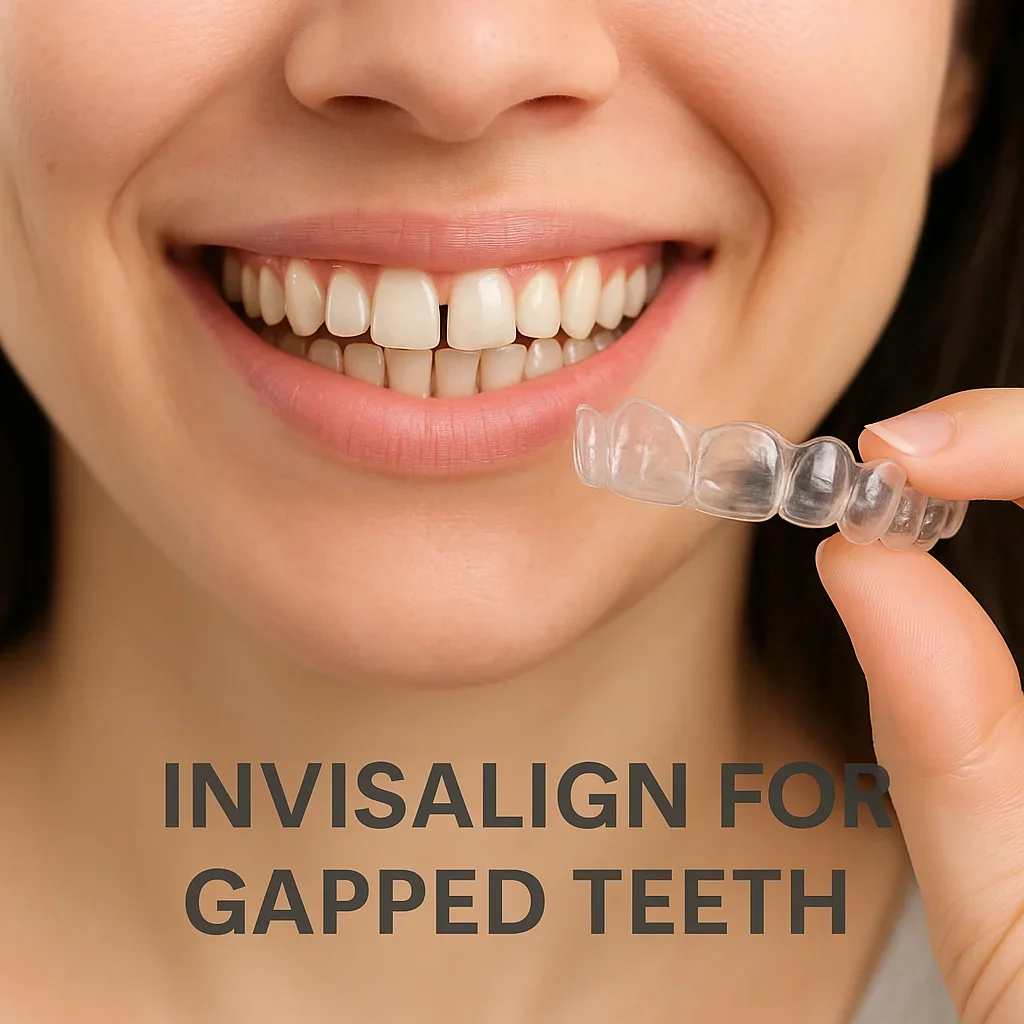
Invisalign is a set of custom-made, clear aligners designed to gently shift your teeth into their ideal position. Unlike traditional metal braces, these aligners are nearly invisible and removable, making them one of the most comfortable and lifestyle-friendly orthodontic options available today. Each aligner is worn for about 1–2 weeks before switching to the next in the series, slowly bringing the teeth closer together until the gaps are completely closed. Over time, the subtle but continuous pressure guides your teeth into alignment — without pain or embarrassment.
One of the biggest advantages of choosing Invisalign for gapped teeth is its customized nature. During your first consultation, a 3D digital scan of your mouth is taken using advanced imaging technology. This scan allows your dental professional to design a precise treatment plan that maps out each stage of your smile transformation. You’ll even be able to preview your expected results before starting — something that’s impossible with traditional braces! 🪞
What truly sets Invisalign apart is its ability to fix both small and large gaps efficiently. For patients with minor spacing, Invisalign can deliver noticeable improvements in as little as three to six months. For those with larger gaps or combined alignment issues, full treatment may take 12 to 18 months. The aligners are engineered with medical-grade thermoplastic material that’s smooth, BPA-free, and safe for long-term wear, ensuring maximum comfort throughout the process.
Beyond aesthetics, Invisalign for gapped teeth also promotes better oral health. Gaps often allow plaque and bacteria to accumulate, leading to gingivitis or even early stages of periodontal disease. By closing these spaces, Invisalign not only enhances your smile but also supports healthier gums and easier cleaning. Brushing and flossing become more effective once the teeth are properly aligned. In this sense, Invisalign isn’t just cosmetic — it’s a preventive dental health solution endorsed by experts and organizations like the American Dental Association.
Another crucial point is the lifestyle flexibility Invisalign offers. You can remove the aligners when eating, brushing, or for special occasions — meaning no food restrictions or awkward social moments. You’ll enjoy your favorite meals and maintain your daily hygiene routine without hassle. Unlike metal braces that require frequent dental visits for tightening, Invisalign check-ups are quick and spaced out every 6–8 weeks to monitor progress. This convenience makes Invisalign a top choice for busy professionals and adults seeking a more convenient orthodontic experience.
If you’re wondering whether Invisalign for gapped teeth is right for you, it’s important to consult a qualified dentist or orthodontist. At Redent Klinik Contact Page, you can schedule a free consultation to evaluate your smile and receive a personalized treatment plan. The dental experts there will assess the size of your gaps, gum condition, and overall oral structure to determine how Invisalign can deliver optimal results for your specific needs.
Patients who have completed Invisalign treatment for gapped teeth often report a major confidence boost. Smiling freely in photos, speaking with assurance, and enjoying a balanced bite are just a few of the life-changing outcomes. Plus, the aligners’ transparent design means most people won’t even notice you’re undergoing orthodontic treatment — your smile just gradually gets better each day! ✨
In summary, Invisalign for gapped teeth is a revolutionary, comfortable, and scientifically proven way to close unwanted gaps and achieve your dream smile. Whether your spaces are minimal or more pronounced, Invisalign offers a personalized and effective path to a balanced, beautiful grin. By choosing this clear-aligner system, you’re investing not just in cosmetic improvement but in long-term oral health and confidence that lasts a lifetime. 🌟
What Are Gapped Teeth and Why Do They Occur?
Gapped teeth, medically known as diastema, refer to visible spaces or openings between two or more teeth. These gaps can occur anywhere in the mouth but are most commonly seen between the upper front teeth. While some people consider a small gap to be a unique part of their smile, larger spaces often cause aesthetic and functional concerns. The good news is that modern orthodontic solutions like Invisalign for gapped teeth can close these spaces effectively, comfortably, and discreetly. 🦷
Understanding the Anatomy Behind Gapped Teeth
To understand how Invisalign for gapped teeth works, it’s important first to know why these gaps appear. Gaps form when there’s an imbalance between the size of your teeth and the jawbone. If your jaw is relatively large compared to your teeth, spaces may develop. Similarly, missing or undersized teeth can create extra room, allowing others to drift apart. This spacing isn’t merely a cosmetic issue; it can alter your bite alignment and increase wear on certain teeth over time.
In some cases, gapped teeth are linked to the labial frenulum — the thin piece of tissue connecting your upper lip to your gum. When this tissue is positioned too low or thick, it prevents teeth from coming together naturally. Invisalign can help align these teeth correctly by applying gentle, consistent pressure over time to bring them into harmony.
Common Causes of Gapped Teeth
There are numerous reasons someone might develop gaps between their teeth. Let’s explore the most common causes below:
1. Genetic Factors
Genetics play a major role in determining your oral structure. If your parents had gapped teeth, there’s a higher likelihood you might too. The shape, size, and position of your jaw and teeth are inherited traits that directly affect spacing.
2. Childhood Habits
Thumb-sucking, prolonged pacifier use, or tongue-thrusting during early development can push front teeth forward, causing spaces to form. While these habits often stop with age, the resulting gap remains until properly treated — often with Invisalign for gapped teeth or similar orthodontic solutions.
3. Gum Disease
Periodontal disease can weaken the bone and tissue supporting your teeth, causing them to shift and separate. Treating gum issues before starting orthodontic therapy is essential to prevent further damage and ensure Invisalign works effectively.
4. Missing or Undersized Teeth
When certain teeth are smaller or missing altogether, surrounding teeth may drift into the empty space. Invisalign can help close these gaps in a controlled, gradual manner, ensuring alignment is balanced across your entire arch.
Functional and Aesthetic Concerns of Gapped Teeth
Many people seek Invisalign for gapped teeth primarily for aesthetic improvement — to achieve a more balanced, confident smile. However, the problem extends beyond appearance. Gaps can trap food particles, making cleaning more difficult and increasing the risk of plaque buildup, cavities, and gum inflammation. Over time, this can lead to gum recession or tooth mobility if left untreated.
From a speech perspective, large gaps can also cause minor articulation issues. Certain sounds, especially “s” or “th,” may be harder to pronounce clearly. This is why orthodontic correction isn’t merely cosmetic but also functional. Properly aligned teeth improve speech, chewing efficiency, and oral hygiene.
How Invisalign Addresses the Root Cause
The beauty of Invisalign for gapped teeth lies in its precision. Each aligner is custom-designed to target your unique gap size and tooth structure. Using 3D digital imaging, your dentist creates a virtual model of your mouth and maps out the entire treatment plan from start to finish. Each stage involves subtle movement, bringing teeth closer together until the spaces disappear completely.
Invisalign doesn’t just close the gap visually; it ensures the root and crown of the tooth move in harmony. This prevents relapse — where teeth shift back to their original position — once the treatment is complete. When combined with retainers post-treatment, patients can maintain a perfectly aligned smile for years to come.
Why Early Detection Matters
Identifying the cause of gaps early makes treatment easier and faster. For children and teenagers, interceptive orthodontics can guide jaw growth and tooth eruption before severe spacing occurs. For adults, Invisalign for gapped teeth remains one of the most flexible and effective non-invasive options. It corrects spacing without altering daily habits or requiring complex dental procedures.
When to Seek Professional Help
If you notice persistent gaps that seem to widen over time, or if food frequently gets stuck between your teeth, it’s best to schedule a dental evaluation. Left unaddressed, spacing may worsen and affect bite function. A specialist can assess whether the cause is structural, habitual, or periodontal — and recommend the most suitable treatment.
At Redent Klinik Contact Page, patients receive a comprehensive evaluation that includes digital scans, gum assessments, and detailed treatment planning. The team ensures that before starting Invisalign, your gums and bone structure are healthy enough to support tooth movement.
For those seeking reliable information and standards about orthodontic health, the American Dental Association provides valuable insights into how treatments like Invisalign align with evidence-based dentistry.
Final Thoughts on Gapped Teeth
Gapped teeth are a common yet highly correctable condition. With Invisalign for gapped teeth, patients can achieve precise, predictable results without the discomfort or aesthetic drawbacks of metal braces. The key to success lies in proper diagnosis, consistent aligner wear, and professional guidance throughout the process. By addressing the root causes and maintaining good oral hygiene, anyone can close those gaps and enjoy a healthier, more confident smile that truly shines. 😁
How Invisalign for Gapped Teeth Works to Close Spaces
The revolutionary clear aligner system known as Invisalign for gapped teeth is designed to gradually and precisely close unwanted spaces between teeth without metal wires or brackets. By using a series of custom-made, transparent trays, Invisalign gently applies pressure to specific teeth, moving them closer together over time. The process is not only scientifically advanced but also comfortable, discreet, and highly effective — offering patients a seamless way to achieve a beautiful, gap-free smile. 😁
The Science Behind Invisalign’s Effectiveness
At its core, the success of Invisalign for gapped teeth lies in biomechanics and digital precision. Each aligner is created using advanced 3D imaging technology that maps your mouth’s current alignment and the desired end result. The aligners then work in small, calculated movements, applying targeted force to guide teeth into their optimal position. This gradual approach ensures minimal discomfort and maximum predictability.
The movement of teeth is achieved through a process called bone remodeling. When a tooth is gently pressured in a specific direction, the bone tissue around it breaks down on one side and rebuilds on the other. Invisalign uses this natural biological response to move teeth safely and steadily until all gaps are closed.
Customized Digital Treatment Planning
Before starting Invisalign for gapped teeth, your dentist or orthodontist performs a full scan using intraoral cameras or 3D digital scanners. The data collected creates a virtual model of your mouth, allowing dental professionals to simulate how each tooth will move throughout treatment. You’ll even see a projected timeline and preview of your future smile — a motivating glimpse into your upcoming transformation. ✨
Step 1: Digital Scanning and 3D Mapping
The first step involves capturing detailed images of your teeth. Unlike traditional molds, this process is quick, accurate, and comfortable. The resulting digital model allows your provider to pinpoint exact movements needed to close the gaps.
Step 2: Custom Aligner Fabrication
Using your digital scan, Invisalign’s proprietary software designs a sequence of aligners. Each aligner differs slightly from the previous one, applying controlled pressure where needed. The number of aligners depends on the severity of your spacing, but most cases require between 10 and 30 sets.
Step 3: Progressive Tooth Movement
Each aligner is worn for about 20–22 hours a day for one to two weeks. The constant yet gentle force brings teeth closer together with every change of the tray. Regular check-ups ensure progress remains on track and adjustments are made when necessary.
How Invisalign Closes Gaps of Different Sizes
Invisalign for gapped teeth is versatile — capable of addressing both small and large spacing concerns. Minor gaps (1–2 mm) often close in as little as three to six months. More extensive spacing, sometimes caused by missing teeth or bone discrepancies, may require up to 12–18 months. The aligners work by moving not just the crowns of the teeth but also their roots, ensuring a comprehensive and stable result.
For patients with very large gaps, Invisalign can be combined with other treatments such as composite bonding or dental veneers once alignment is complete. This creates a harmonious, natural look and ensures that bite function is restored as well.
Attachments and Precision Cuts: Enhancing Efficiency
In certain cases, small tooth-colored “attachments” are bonded to the enamel to help the aligners grip better and apply more effective pressure. These attachments are invisible to the naked eye but dramatically improve tooth movement control. Similarly, precision cuts in the aligners can be added to accommodate elastics when additional force or anchorage is needed — especially for complex gapped cases.
Patient Experience and Comfort
One of the main reasons people choose Invisalign for gapped teeth is comfort. The smooth, BPA-free aligners fit snugly and eliminate the irritation often caused by brackets or wires. Since they are removable, you can eat, brush, and floss as usual, maintaining superior oral hygiene throughout treatment. Patients also appreciate that there are no emergency visits for broken wires or brackets — only periodic progress checks every 6–8 weeks.
Because Invisalign relies on consistency, compliance plays a big role in success. Wearing the aligners for the recommended 20–22 hours daily ensures continuous pressure and faster results. The more consistently you wear them, the sooner your gaps close — and your confidence grows. 🌟
Advantages Over Traditional Braces
When comparing Invisalign to traditional braces, the differences are clear (literally). Braces use metal wires that can irritate gums and make eating difficult, while Invisalign provides flexibility and aesthetics. For people concerned about appearance during treatment — especially adults and professionals — Invisalign for gapped teeth offers a nearly invisible path to improvement. Moreover, the aligners are removable, which means no food restrictions and easier cleaning.
Braces often require frequent in-office adjustments, while Invisalign check-ins are fewer and simpler. Digital progress tracking allows for precise modifications without guesswork, making Invisalign both efficient and convenient.
Maintaining Results After Invisalign
Once gaps are successfully closed, patients must wear retainers to maintain their new smile. Retainers are essential because teeth have a natural tendency to shift back into their old positions. Your dental professional will provide clear retainers that look and feel similar to your aligners, ensuring long-term stability of your results. Over time, wearing retainers only at night is sufficient to preserve alignment.
At Redent Klinik Contact Page, each Invisalign plan includes comprehensive aftercare instructions to help patients maintain their perfectly aligned smiles. The clinic’s orthodontic specialists ensure that treatment results are not just aesthetic but durable.
Professional Endorsements and Clinical Backing
The effectiveness of Invisalign for gapped teeth has been verified through numerous clinical studies and is supported by global dental authorities such as the American Dental Association. The technology continues to evolve, offering even more accurate tooth movements, better fitting aligners, and faster results with every advancement.
Final Thoughts
In conclusion, the process of closing spaces with Invisalign for gapped teeth is a perfect balance of science, technology, and aesthetics. It not only eliminates gaps but also improves bite harmony, speech, and gum health. Whether your goal is a flawless smile or better oral function, Invisalign delivers predictable, lasting results without compromising comfort or confidence. 🌈
Invisalign vs. Braces for Gapped Teeth: Which Is Better?
When it comes to fixing gaps between teeth, two primary treatment options dominate modern orthodontics: Invisalign for gapped teeth and traditional metal braces. Both are effective methods for aligning teeth, closing spaces, and enhancing oral health. However, the choice between them often depends on personal preferences, treatment goals, and the complexity of your dental condition. Let’s dive deep into the comparison — from design and comfort to aesthetics, treatment duration, and long-term results — to help you determine which is the right fit for your smile journey. 😁
How Traditional Braces Work vs. Invisalign
Traditional braces use metal brackets that are bonded to the surface of each tooth, connected by an archwire. The wire applies constant pressure, gradually shifting teeth into the desired position. While braces have been used for decades with proven success, they are often associated with discomfort, dietary restrictions, and visibility concerns.
In contrast, Invisalign for gapped teeth employs a series of transparent, custom-made aligners that fit snugly over your teeth. These aligners are removable and designed to move your teeth gently without wires or brackets. Each aligner in the series slightly adjusts tooth positioning, progressively closing the gaps over time. The convenience and invisibility of Invisalign make it an especially appealing option for adults and professionals seeking a discreet solution.
Aesthetics and Confidence: The Clear Difference
When appearance matters, Invisalign is the clear winner — literally. The aligners are transparent, making them almost invisible during conversations, photos, and daily interactions. This aesthetic advantage is one of the most significant reasons patients choose Invisalign for gapped teeth over traditional braces. You can smile confidently throughout your treatment without worrying about the metallic shine of brackets or food getting stuck in wires.
Braces, on the other hand, are more noticeable and can sometimes affect self-esteem, especially for adults in social or professional environments. Although ceramic and lingual braces offer less visible alternatives, they still lack the full comfort and aesthetic appeal of clear aligners.
Comfort and Convenience
Another key differentiator is comfort. The smooth, BPA-free plastic used in Invisalign aligners prevents gum irritation, which is a common issue with braces. There are no sharp edges, no broken wires, and no emergency visits for bracket repairs. Patients using Invisalign for gapped teeth enjoy a pain-free and convenient experience since the aligners can be removed when eating, drinking, or brushing. 🍽️
Traditional braces, while effective, can cause soreness during adjustment appointments and make oral hygiene challenging. Flossing between wires and brushing around brackets often requires additional tools and more time. Invisalign eliminates these issues entirely, allowing for normal brushing and flossing — a major plus for maintaining healthy gums and fresh breath.
Treatment Duration and Predictability
The length of treatment depends on the severity of spacing and alignment issues. For minor gaps, Invisalign for gapped teeth can achieve results in as little as 3–6 months. For moderate to severe spacing, treatment may last up to 12–18 months, comparable to braces. However, Invisalign has a technological edge thanks to digital 3D planning. Each tooth movement is pre-programmed, and progress can be visualized before treatment even begins. This level of predictability ensures precise results with fewer surprises along the way. 🦷
With traditional braces, results rely heavily on manual adjustments by the orthodontist. While highly skilled professionals can achieve excellent outcomes, the process may involve more discomfort and less flexibility in scheduling.
Maintenance and Oral Hygiene
Proper oral care is vital during orthodontic treatment. Braces can make this difficult since food particles often get trapped around wires and brackets, leading to plaque buildup and staining. Invisalign simplifies this aspect entirely — you just remove the aligners before brushing and flossing. This promotes better gum health and a cleaner smile throughout treatment. Patients who choose Invisalign for gapped teeth typically experience fewer cavities or gum irritations compared to those wearing braces.
Eating and Lifestyle Flexibility
One of the most popular advantages of Invisalign is dietary freedom. You can eat whatever you like because the aligners are removable. With braces, certain foods such as popcorn, hard nuts, sticky candy, and crunchy fruits can damage brackets or get stuck. Invisalign users simply remove their trays during meals and replace them afterward — maintaining both oral hygiene and meal enjoyment.
Cost Comparison and Value
While costs vary by region and case complexity, the price difference between braces and Invisalign for gapped teeth has narrowed significantly in recent years. Invisalign often costs slightly more due to its advanced technology and customization, but patients view it as an investment in comfort, confidence, and convenience. The long-term benefits of easier cleaning, reduced gum irritation, and improved aesthetics make Invisalign well worth the price for many individuals.
For accurate pricing and consultation, it’s recommended to schedule an appointment through the Redent Klinik Contact Page. Their dental team can provide personalized cost estimates and treatment plans tailored to your unique dental structure.
Effectiveness and Clinical Outcomes
Braces remain highly effective for complex cases involving severe crowding or bite issues. However, for spacing and mild-to-moderate alignment concerns, Invisalign for gapped teeth delivers equally impressive — and sometimes faster — results. Studies published by leading dental authorities, including the American Dental Association, confirm that Invisalign is a reliable alternative for closing gaps and aligning teeth with precision when used under professional supervision.
Aftercare and Retention
After both braces and Invisalign, retainers are necessary to maintain results. Invisalign offers the advantage of providing clear retainers that are virtually identical to the aligners used during treatment. This ensures a seamless transition and comfort for long-term maintenance. With proper retention, your newly aligned smile can remain perfect for decades.
Final Verdict: Invisalign or Braces?
Ultimately, the choice between braces and Invisalign for gapped teeth depends on individual needs and preferences. Invisalign stands out for its aesthetics, comfort, and convenience, making it ideal for adults and teens seeking a modern solution. Braces, however, may still be preferred for highly complex orthodontic corrections. By consulting a qualified dentist or orthodontist, you can receive a professional evaluation and customized recommendation.
For most people with mild or moderate gaps, Invisalign is the clear, confident, and comfortable winner — a treatment that fits seamlessly into your lifestyle while delivering stunning results. 🌟
The Step-by-Step Invisalign Treatment Process for Gapped Teeth
Starting your journey with Invisalign for gapped teeth is an exciting step toward achieving a perfectly aligned smile. Understanding each stage of the process helps set clear expectations and ensures a smooth, stress-free experience. Invisalign’s approach is rooted in precision, customization, and comfort — every step is carefully planned to close gaps efficiently and safely. Let’s explore the complete treatment process from your first consultation to your final retainer. 😁
Step 1: The Initial Consultation
The Invisalign journey begins with a comprehensive consultation. During this visit, your dentist or orthodontist will evaluate your oral health, spacing issues, and smile goals. This stage determines whether Invisalign for gapped teeth is suitable for your specific case. While Invisalign works for most spacing problems, extremely large gaps or severe jaw discrepancies may require combined orthodontic or restorative treatments.
At the consultation, your provider may take photos, X-rays, and a 3D digital scan of your teeth using an intraoral scanner. This digital imaging technology replaces old-fashioned dental molds, offering a faster and more accurate experience. The data collected forms the foundation for your personalized treatment plan, showing exactly how your teeth will move and what your final smile will look like. 🦷
Step 2: Digital Treatment Planning and Simulation
Once your scans are complete, your dental team uses specialized software to design your custom Invisalign plan. This digital model maps each movement of your teeth, from the initial position to the final alignment. You’ll see a virtual preview of how your gaps will close over time, allowing you to visualize your transformation before treatment even begins. The simulation also helps determine how many aligners you’ll need and the expected treatment duration.
Precision and Customization
Each aligner is designed to exert gentle, consistent pressure on specific teeth. The precise digital mapping ensures every millimeter of movement is calculated. This accuracy minimizes discomfort and maximizes results, making Invisalign for gapped teeth both predictable and effective.
Step 3: Fabrication of Custom Aligners
After final approval of your treatment plan, the digital design is sent to Invisalign’s manufacturing facility. Here, your aligners are created using SmartTrack® thermoplastic material — a patented, medical-grade, BPA-free plastic engineered for flexibility and durability. Each aligner is laser-trimmed to fit your unique gumline, ensuring a secure and comfortable fit.
Most treatment plans include between 10 and 30 aligner sets, depending on the severity of your gaps. Each aligner is worn for approximately 1–2 weeks before switching to the next one in the sequence. As you progress through the aligners, the gaps gradually close, and your teeth move into perfect alignment.
Step 4: The Active Treatment Phase
This is the most transformative stage of Invisalign for gapped teeth. You’ll wear your aligners for 20–22 hours per day, removing them only to eat, drink, brush, or floss. Consistency is key — the more disciplined you are, the faster and more effective your results will be.
Adjustments and Progress Monitoring
Your orthodontist will schedule regular check-ups every 6–8 weeks to monitor progress. These visits are quick and painless, usually lasting less than 15 minutes. During each visit, the dentist checks the alignment progress, provides your next sets of trays, and ensures your teeth are moving as planned.
Comfort and Adaptation
Most patients adapt to wearing Invisalign aligners within a few days. You may experience mild pressure or tightness when switching to a new set — a normal sign that the aligners are working. The smooth edges prevent irritation, and since the aligners are transparent, most people won’t even notice you’re wearing them. 🌟
Step 5: Mid-Treatment Refinement (If Needed)
Sometimes, additional refinement is necessary toward the end of treatment. These refinements involve new scans and a few extra sets of aligners to perfect minor details. This ensures the final alignment is as precise as planned. Refinement is common and simply part of achieving a flawless smile.
Step 6: Completion and Final Results
Once you’ve worn your final aligner, your treatment with Invisalign for gapped teeth is complete! 🎉 Your dentist will review the final alignment and compare it to your original digital plan. Most patients notice not only cosmetic improvement but also better bite alignment, speech, and oral hygiene. At this point, you’ll receive a new digital scan to create your custom retainers.
Step 7: Retention and Long-Term Maintenance
After Invisalign treatment, it’s crucial to wear retainers to maintain your new smile. Teeth naturally have a tendency to shift back, especially in the first few months post-treatment. Retainers, which look similar to your aligners, are worn at night to keep teeth in place. Over time, you may only need to wear them a few nights per week.
Your dentist will give detailed instructions for care and duration. Retention ensures that the results achieved through Invisalign for gapped teeth remain permanent. This phase solidifies your investment in both beauty and oral health.
Step 8: Oral Care During and After Invisalign
Maintaining good oral hygiene during treatment is essential. Since Invisalign aligners are removable, you can brush and floss as usual. It’s recommended to clean the aligners with a soft toothbrush and mild soap or Invisalign Cleaning Crystals to prevent discoloration or odor. Avoid hot water, as it may warp the material.
Post-treatment, regular dental cleanings and checkups will keep your smile bright and healthy. Proper hygiene ensures your teeth and gums remain in top condition long after your gaps are closed.
Step 9: Post-Treatment Support and Consultation
At Redent Klinik Contact Page, patients receive continuous support after completing their Invisalign journey. Follow-up visits help ensure retention is effective, and any concerns are addressed promptly. The clinic’s dental experts offer professional advice on maintaining long-term results and keeping your smile camera-ready at all times. 📸
Trusted Standards and Professional Oversight
Invisalign treatment adheres to strict quality and safety standards recognized by the American Dental Association. The process is clinically proven to be safe, effective, and sustainable for closing gaps and improving bite function. Each step is guided by licensed dental professionals to ensure optimal results tailored to your needs.
Final Thoughts
The journey of Invisalign for gapped teeth is one of precision, comfort, and confidence. From initial consultation to final retention, every stage is designed to deliver predictable, beautiful outcomes with minimal disruption to your lifestyle. With proper guidance, discipline, and professional follow-up, you’ll enjoy not just a gap-free smile but a boost in self-esteem and oral health that lasts for years to come. 🌈
Benefits of Choosing Invisalign for Gapped Teeth
When it comes to closing spaces between teeth, Invisalign for gapped teeth offers a unique combination of aesthetics, comfort, and advanced technology that sets it apart from other orthodontic options. Designed to straighten teeth discreetly and efficiently, Invisalign aligners deliver more than cosmetic improvement — they promote long-term dental health, prevent gum issues, and boost overall confidence. Let’s take a closer look at the many benefits that make Invisalign the preferred choice for patients worldwide. 😁
1. Aesthetic Appeal: The Invisible Transformation
One of the most obvious advantages of Invisalign for gapped teeth is its nearly invisible appearance. Made from crystal-clear thermoplastic material, these aligners are virtually undetectable when worn. Unlike traditional braces that draw attention to your teeth with metal brackets and wires, Invisalign allows you to smile, speak, and socialize confidently during the entire treatment process.
For working professionals, students, or anyone conscious about their appearance, this feature makes Invisalign the ideal solution. Whether you’re in meetings, taking photos, or attending special occasions, your treatment remains private and discreet. ✨
2. Comfort and Convenience
Traditional braces can often cause irritation and discomfort due to sharp wires and metal edges. In contrast, Invisalign for gapped teeth is designed with patient comfort in mind. Each aligner is custom-molded to fit your teeth perfectly, ensuring a smooth surface that won’t scrape or irritate your gums, cheeks, or tongue.
Additionally, the ability to remove your aligners whenever you need offers unmatched convenience. You can take them out to eat, brush, and floss — something that’s impossible with fixed braces. This flexibility allows you to maintain your usual lifestyle without restrictions or special care tools. 🍽️
Reduced Irritation and Fewer Dental Visits
Invisalign treatments typically require fewer in-office adjustments compared to braces. Since each aligner is pre-programmed digitally to guide tooth movement, there’s no need for frequent tightening or wire replacements. This not only saves time but also reduces discomfort commonly associated with manual adjustments in traditional orthodontics.
3. Improved Oral Hygiene and Gum Health
Proper oral hygiene can be challenging with braces because food particles often get trapped in brackets and wires. With Invisalign for gapped teeth, cleaning your teeth is simple and effective — just remove your aligners and brush and floss as you normally would. This helps reduce plaque buildup and prevents issues like tooth decay and gingivitis during treatment.
Moreover, closing gaps between teeth can significantly improve gum health. When gaps are present, gums can become inflamed or prone to recession due to trapped debris and uneven pressure distribution. Invisalign not only straightens your teeth but also promotes healthier gums by ensuring they fit snugly around properly aligned teeth.
4. Predictable Results With Advanced 3D Technology
Every treatment with Invisalign for gapped teeth starts with a digital 3D scan of your mouth. Using this data, your dentist creates a precise treatment plan that predicts how your teeth will move at each stage. This digital roadmap ensures accuracy, consistency, and transparency — you’ll know what to expect before your treatment begins.
This technological precision translates to better results and greater patient satisfaction. You can preview your final smile digitally, track progress at each visit, and rest assured that your results will match the simulation. 🦷
5. Faster and More Efficient Treatment
While traditional braces can take two years or more, Invisalign for gapped teeth often achieves results in half the time for mild to moderate spacing cases. The SmartTrack® material used in the aligners provides continuous, gentle force, optimizing tooth movement and improving treatment efficiency. Patients often begin noticing visible improvements within the first few months.
Consistency Is Key
The key to faster results is consistent wear — at least 20–22 hours per day. Because the aligners are removable, patient discipline plays an essential role. Those who follow their dentist’s recommendations closely often achieve faster, more precise results than expected.
6. Enhanced Confidence and Emotional Well-being
Closing gaps with Invisalign doesn’t just change your smile; it transforms your self-image. Many patients report increased confidence and self-esteem after treatment. Smiling freely, speaking without hesitation, and feeling proud of your teeth can profoundly improve social and professional interactions.
For people who have spent years hiding their smile or feeling insecure about gaps, Invisalign for gapped teeth offers a liberating experience. The gradual progress provides ongoing motivation, as you watch your smile improve week by week. 🌟
7. Safe and Biocompatible Material
Invisalign aligners are made from SmartTrack®, a medical-grade, BPA-free plastic developed through years of research. This material is safe for long-term wear, non-toxic, and hypoallergenic. It’s also smooth and durable, ensuring comfort and safety throughout your treatment.
The aligners are approved by leading health organizations and recommended by dentists worldwide. The American Dental Association recognizes the importance of using safe, biocompatible materials in dental treatments, reinforcing Invisalign’s status as a reliable and health-conscious choice.
8. Prevents Future Dental Issues
Spacing problems, if left untreated, can cause long-term dental complications such as shifting, bone loss, or gum disease. Invisalign for gapped teeth not only enhances appearance but also prevents these potential problems by promoting better bite alignment and more even pressure across your teeth. This helps protect your enamel, reduce wear, and maintain strong, healthy teeth for years to come.
9. Long-Term Maintainability
After treatment, retainers keep your new alignment stable. Because Invisalign retainers look and feel just like your aligners, transitioning into post-treatment care is effortless. With proper maintenance, the benefits of Invisalign last a lifetime — a small daily commitment for a lasting, radiant smile. 😄
10. Professional Support and Ongoing Care
At Redent Klinik Contact Page, patients receive comprehensive support before, during, and after treatment. Each step is guided by experienced dental professionals who monitor progress and provide personalized advice. From digital scanning to final retainers, every aspect of care is handled with precision and patient comfort in mind.
Final Thoughts
The advantages of Invisalign for gapped teeth extend far beyond aesthetics. It’s a technologically advanced, comfortable, and hygienic solution that delivers lasting results. With its transparent design, personalized approach, and proven effectiveness, Invisalign stands as the modern answer for anyone seeking a healthy, confident, and perfectly aligned smile. 🌈
Common Myths and Misconceptions About Invisalign
Despite the global popularity of Invisalign for gapped teeth, there are still many misconceptions surrounding how it works, who it’s suitable for, and what kind of results it can deliver. These myths often discourage patients from pursuing treatment, even though Invisalign is one of the most advanced and proven orthodontic solutions available today. In this section, we’ll debunk the most common myths and provide the facts you need to make an informed decision about improving your smile. 😁
Myth 1: Invisalign Is Only for Minor Alignment Issues
One of the most persistent misconceptions is that Invisalign can only fix small cosmetic gaps or mild alignment problems. While Invisalign was initially designed for minor corrections, advancements in its technology have expanded its capabilities significantly. Today, Invisalign for gapped teeth can address a wide range of orthodontic issues — including larger gaps, overbites, underbites, and even crossbites.
Modern aligners are supported by precision attachments and advanced 3D planning, allowing dentists to control complex tooth movements with remarkable accuracy. In many cases, Invisalign can deliver results comparable to, or even better than, traditional braces. 🦷
Fact Check:
According to clinical research published by the American Dental Association, Invisalign aligners are now capable of treating spacing and bite problems that were once considered too complex for clear aligners. Proper diagnosis and digital planning are key to achieving these outcomes.
Myth 2: Invisalign Doesn’t Work for Gapped Teeth
Another misconception is that Invisalign cannot close noticeable gaps effectively. This couldn’t be further from the truth. The system was specifically engineered to handle spacing issues through gradual, controlled movement. Whether your gaps are small or wide, Invisalign for gapped teeth uses a customized series of aligners that gently pull teeth into their ideal position.
Unlike braces, which rely on wires to move teeth all at once, Invisalign shifts teeth incrementally, allowing precise control over how each tooth moves and how quickly gaps are reduced. With consistent wear and professional monitoring, gaps can close within a few months to a year depending on severity.
Myth 3: Invisalign Is Painful
Many patients assume that Invisalign must be painful because it moves teeth — but the reality is quite the opposite. The process of Invisalign for gapped teeth involves gentle, consistent pressure rather than abrupt force. Most people describe it as a mild tightness that fades within a couple of days after switching to a new aligner.
The SmartTrack® material used in Invisalign is specifically engineered for comfort. It applies steady force while maintaining flexibility, making the entire treatment smooth and irritation-free. There are no sharp edges or brackets to cut the inside of your mouth, which is a common issue with metal braces.
Fact Check:
Any orthodontic treatment that moves teeth will cause mild pressure, but Invisalign is known to cause less discomfort than traditional methods. This makes it a preferred option for adults and teens who want a gentle, effective experience.
Myth 4: Invisalign Takes Longer Than Braces
Some believe that Invisalign treatments take longer to complete than braces — a myth that’s simply not true. In fact, for mild to moderate spacing cases, Invisalign for gapped teeth can deliver results faster than traditional braces. Treatment time typically ranges from 6 to 18 months, depending on the size of the gaps and the patient’s compliance with aligner wear.
Because Invisalign uses advanced digital modeling, tooth movements are pre-planned for maximum efficiency. This means each aligner performs a specific, targeted function, ensuring faster, more predictable progress compared to manual wire adjustments.
Myth 5: Invisalign Is Only for Teenagers
While many think clear aligners are designed exclusively for young patients, adults are actually one of the fastest-growing groups seeking Invisalign treatment. The discretion, comfort, and flexibility of Invisalign for gapped teeth make it a perfect choice for working professionals, parents, and older adults who want to correct their smile without drawing attention.
Invisalign also offers specialized treatment options for different age groups, such as Invisalign Teen and Invisalign Express, ensuring that everyone — regardless of age — can benefit from this technology.
Fact Check:
Age is not a limiting factor for Invisalign. What matters most is gum and bone health, which determine how effectively teeth can move. Many patients in their 40s, 50s, or even 60s have successfully completed Invisalign treatment with outstanding results. 🌟
Myth 6: Invisalign Aligners Are Hard to Maintain
Another common myth is that Invisalign aligners require high maintenance. In truth, they’re simple to care for. Cleaning them involves rinsing with lukewarm water and brushing gently with a soft toothbrush. Some people use Invisalign Cleaning Crystals for extra freshness. As long as you maintain good oral hygiene and avoid staining foods while the aligners are in, upkeep is minimal.
Unlike braces, there are no wires or brackets to clean around, and you can remove the aligners to brush and floss. This makes maintaining oral hygiene much easier throughout the treatment process. 🪥
Myth 7: Invisalign Is Too Expensive
Many people assume that Invisalign for gapped teeth costs significantly more than braces, but the difference is often minimal. While prices depend on the complexity of the case, Invisalign’s cost is now comparable to most traditional orthodontic treatments. Furthermore, the value extends beyond aesthetics — you’re paying for comfort, precision, and a treatment that fits your lifestyle seamlessly.
At Redent Klinik Contact Page, patients receive transparent pricing and flexible payment plans to make Invisalign more affordable and accessible.
Myth 8: Invisalign Results Don’t Last
Some believe that teeth will shift back after Invisalign treatment. In reality, long-term success depends on proper retention, just as it does with braces. After completing treatment, your dentist will provide clear retainers to wear at night, ensuring your new alignment stays stable for life. With proper aftercare, the results of Invisalign for gapped teeth are permanent.
Fact Check:
Retention is part of every orthodontic journey, regardless of treatment type. Invisalign retainers are comfortable, transparent, and easy to wear, making maintenance effortless and effective.
Myth 9: Invisalign Aligners Stain Easily
While it’s true that aligners can discolor if not cleaned properly, following basic care instructions prevents this entirely. Avoid drinking coffee, tea, or red wine while wearing them, and rinse aligners frequently. Most patients find keeping their aligners clear quite easy with regular hygiene practices.
Final Thoughts
The myths surrounding Invisalign for gapped teeth often stem from outdated information or confusion with older orthodontic methods. In reality, Invisalign is a highly advanced, comfortable, and effective solution for spacing and alignment problems. With proper use and professional supervision, it delivers stunning results that last a lifetime — debunking every misconception one smile at a time. 🌈
How Long Does Invisalign Take to Fix Gapped Teeth?
One of the most common questions patients ask when considering Invisalign for gapped teeth is, “How long will it take to close the gaps in my smile?” The answer depends on several factors, including the size of the gaps, the number of teeth involved, your age, and how consistently you wear your aligners. In general, Invisalign offers a faster and more predictable timeline than traditional braces — all while maintaining superior comfort and aesthetics. Let’s explore what truly determines treatment duration and how to ensure the best possible results. ⏳
Understanding the Timeline of Invisalign Treatment
The average treatment time for Invisalign for gapped teeth ranges from 3 to 18 months. Minor gaps — typically 1 to 2 millimeters — can be closed in as little as three to six months, while larger gaps or complex cases may take a year or longer. Every aligner in your treatment plan is designed to make small, gradual movements that bring your teeth closer together until all spaces are completely closed.
It’s important to remember that no two smiles are identical. Invisalign treatment is entirely customized based on your digital scan and individual oral anatomy. The 3D imaging software allows your dentist to map out a step-by-step plan and provide an estimated timeline before treatment even begins. 🦷
Key Factors Affecting Treatment Duration
Several variables influence how long it takes for Invisalign for gapped teeth to work effectively. Understanding these factors helps set realistic expectations and ensures you follow your treatment plan closely.
1. Size and Number of Gaps
The larger the gap, the more time required to close it. Small gaps between front teeth often resolve quickly, while multiple or wide spaces across the upper and lower arches take longer because tooth movement must be balanced across your bite. In some cases, combining Invisalign with minor cosmetic procedures such as bonding or veneers can help achieve faster, more aesthetic results once the major alignment is complete.
2. Patient Compliance
Consistency is the single biggest factor in treatment success. Invisalign aligners must be worn for 20–22 hours a day to achieve optimal progress. Removing them too often or forgetting to wear them can delay results. Patients who follow instructions diligently usually see results faster than those who are inconsistent. 📅
3. Biological Response and Age
Teeth move through the bone via a natural process called bone remodeling. Younger patients often experience faster movement because their jawbone is more flexible. Adults can still achieve excellent results with Invisalign for gapped teeth, but movement might be slightly slower due to denser bone structure. However, the difference is minimal when treatment is properly monitored by a professional.
4. Complexity of Alignment
Some patients have gaps combined with other misalignment issues such as crowding, bite irregularities, or tooth rotation. These complex movements may require more aligners and slightly extend the treatment period. Invisalign’s advanced technology, including attachments and precision cuts, ensures that even complex cases can be managed efficiently and predictably.
Typical Invisalign Treatment Stages
Stage 1: Initial Consultation and Digital Scanning
During your first visit, the dentist uses 3D scanners to capture a complete model of your teeth. From there, a personalized treatment plan is created that shows how your gaps will close and how long it will take. The estimated time frame is based on the movement increments programmed into each aligner set.
Stage 2: Active Treatment Phase
This is the period when you wear your aligners daily. Each aligner is used for about one to two weeks before switching to the next one. The process is gradual, ensuring controlled and safe tooth movement. During this stage, you’ll have follow-up visits every six to eight weeks for progress checks. Your dentist will verify that your teeth are tracking according to the digital plan and may make adjustments if necessary.
Stage 3: Refinement (If Needed)
Sometimes, after the main aligner series, minor refinements are needed to perfect your alignment. This involves new scans and a few additional aligners to fine-tune small details. This step typically adds one to three months to the timeline but ensures a flawless, gap-free result. 🌟
Stage 4: Retention and Stability
Once your treatment with Invisalign for gapped teeth is complete, retainers are used to maintain the results. Teeth have a natural tendency to shift back slightly after orthodontic treatment, so wearing retainers at night helps keep them in their ideal positions. With consistent use, the improvements remain stable for life.
How to Speed Up Invisalign Treatment
While patience is important, there are ways to help Invisalign work more efficiently:
- Wear your aligners consistently — 20–22 hours daily, removing only for meals and hygiene.
- Keep aligners clean to prevent plaque buildup, which can interfere with fit and movement.
- Follow all dental appointments to monitor progress and ensure aligners are performing as planned.
- Use chewies — small rubber tools that help seat aligners properly, improving contact and efficiency.
- Maintain oral health — healthy gums and bone structure support smoother tooth movement.
Expected Results and Realistic Timelines
On average, visible improvements appear within the first 6–10 weeks of using Invisalign for gapped teeth. By the midpoint of treatment, most patients already notice significantly reduced spacing. The final results — complete closure of all gaps — typically occur between months 6 and 12 for standard cases. Complex treatments involving bite correction or severe spacing may take up to 18 months.
Even after the gaps close, the final few aligners are critical to refining your bite and ensuring long-term stability. Skipping these last aligners can cause slight relapse, so completing the full sequence is essential for perfect results.
Post-Treatment Retention and Monitoring
After completing Invisalign treatment, you’ll be given Vivera® retainers — clear, durable retainers custom-made to fit your new smile. Wearing them nightly prevents teeth from drifting apart again. Routine checkups every six months ensure continued oral health and retention success. At Redent Klinik Contact Page, patients receive personalized retention plans and post-treatment support to guarantee lasting results.
Clinical Validation and Professional Standards
The efficiency of Invisalign for gapped teeth has been validated by numerous clinical studies supported by the American Dental Association. These studies confirm that Invisalign can close gaps faster and with fewer complications than traditional braces for many patients. Its advanced digital mapping ensures precise movement, making treatment both predictable and efficient.
Final Thoughts
Ultimately, the duration of treatment with Invisalign for gapped teeth depends on the size of your gaps, your commitment to wearing the aligners, and your dentist’s guidance. Most patients can expect a beautifully aligned, gap-free smile in less than a year. With dedication and professional supervision, Invisalign offers not just speed, but lasting, healthy, and confidence-boosting results. ⏰✨
Before and After Results: Real Transformations With Invisalign
One of the most compelling reasons people choose Invisalign for gapped teeth is the proven, visible transformation it delivers. Seeing real before-and-after results not only inspires confidence but also demonstrates how advanced orthodontic technology can reshape smiles without metal brackets or wires. Whether you have minor spacing or larger gaps, Invisalign offers consistent, measurable improvements that go beyond aesthetics — restoring harmony, balance, and self-assurance in every smile. 😁
Visual Proof of Invisalign Effectiveness
Modern dentistry relies heavily on digital precision and data-driven outcomes. With Invisalign for gapped teeth, results are not random; they are meticulously planned. Using advanced 3D imaging and simulation tools, your dentist can create an exact digital model of your teeth before treatment begins. This allows you to visualize your current alignment and projected outcome side-by-side, offering a clear picture of what to expect by the end of your Invisalign journey.
Real-life transformations confirm what technology promises — straighter teeth, closed gaps, and improved bite alignment. Many patients who once hesitated to smile now confidently show off their gap-free teeth, experiencing not just aesthetic change but also improved oral function and health. 🌟
Common Gap Issues Corrected by Invisalign
The versatility of Invisalign for gapped teeth allows it to address a wide range of spacing problems. Some of the most common include:
- Midline diastema — the gap between the two front teeth, often the most noticeable.
- Generalized spacing — multiple small gaps distributed throughout the mouth.
- Gaps from missing or undersized teeth — which affect bite balance and gum exposure.
- Gaps due to previous tooth shifting — often caused by not wearing retainers after orthodontic treatment.
In all these scenarios, Invisalign uses a sequence of custom-designed aligners to bring teeth together in controlled, precise increments, resulting in a symmetrical and aesthetically pleasing smile.
Understanding the “Before” Phase
Before starting Invisalign, a detailed examination identifies the cause, size, and pattern of the gaps. This phase involves:
- 3D scanning to create an accurate digital map of your current tooth alignment.
- Photographic documentation to track progress visually over time.
- Consultation and simulation that show your predicted before-and-after outcome.
Most patients are surprised to see how even minor adjustments can dramatically improve facial harmony and smile aesthetics. For larger gaps, Invisalign’s algorithm plans gradual movements that protect gum and bone health while closing spaces efficiently. 🦷
Documented Patient Transformations
Case 1: Small Front-Tooth Gap
A 26-year-old patient with a 2 mm gap between the front incisors achieved complete closure within five months using Invisalign for gapped teeth. After treatment, her teeth aligned perfectly, her gum line appeared more even, and she reported increased confidence in social interactions. The retention phase involved wearing clear retainers at night for six months to ensure stability.
Case 2: Multiple Gaps and Mild Crowding
A 34-year-old male had multiple small gaps and mild crowding on his lower arch. Invisalign treatment lasted 11 months and closed all gaps while improving bite balance. Post-treatment photos showed even spacing, whiter teeth (after professional cleaning), and a harmonious bite alignment that improved chewing comfort.
Case 3: Post-Orthodontic Relapse
A 42-year-old woman who had braces as a teenager developed gaps again due to not wearing retainers. Invisalign for gapped teeth restored her previous alignment in just nine months, with minimal discomfort. Digital scans confirmed a 100% closure rate, and she now maintains her results with Vivera® retainers.
The “After” Phase: The Transformation Stage
The most exciting part of the process is seeing your new smile take shape. Once Invisalign treatment is complete, the gaps are fully closed, and the teeth are evenly aligned. Patients often notice several benefits beyond appearance, including easier cleaning, better gum health, and improved bite function.
After completion, dentists perform a final evaluation to ensure each tooth is positioned correctly in relation to the jaw and bite. A final set of photos is taken to document the outcome — and the difference is remarkable. Smiles look fuller, more symmetrical, and naturally balanced. 🌈
Psychological and Emotional Impact
The emotional benefits of Invisalign for gapped teeth cannot be overstated. Patients frequently report feeling more confident, outgoing, and socially comfortable after treatment. Closing gaps often improves not just physical appearance but also mental well-being. Smiling without hesitation leads to increased confidence at work, in relationships, and in daily interactions. 😄
Professional Validation and Safety
All treatments with Invisalign for gapped teeth are monitored by certified professionals to ensure safety and precision. The aligners are FDA-approved and supported by numerous clinical studies. According to the American Dental Association, properly managed orthodontic treatments like Invisalign not only enhance aesthetics but also reduce the risk of periodontal disease by improving tooth spacing and gum fit.
Post-Treatment Retention: Keeping the Results
After achieving your desired smile, it’s essential to maintain the results. Retainers — similar to aligners but slightly thicker — prevent teeth from drifting back into their original positions. Typically, patients wear retainers nightly for the first few months, then only a few nights a week thereafter. Consistency ensures that the investment made in Invisalign for gapped teeth remains permanent.
At Redent Klinik Contact Page, every patient receives a customized retention plan, periodic follow-ups, and professional advice on long-term smile care. The clinic’s specialists emphasize maintenance as the key to lifelong results and confidence.
Measuring Long-Term Success
Follow-up studies have shown that over 90% of patients who complete Invisalign treatment maintain their results for more than five years, provided they use retainers as instructed. Improvements in speech clarity, chewing ability, and oral hygiene are additional long-term benefits observed in clinical follow-ups. Invisalign’s digital precision ensures that the results you see after treatment are not just temporary — they are built to last.
Final Thoughts
The before and after transformations achieved with Invisalign for gapped teeth speak volumes about its effectiveness and reliability. From minor spacing corrections to complex cases, Invisalign consistently delivers natural-looking, balanced, and functional results. Patients gain not only a radiant smile but also a renewed sense of confidence that impacts every aspect of their lives. With expert guidance, proper maintenance, and commitment, Invisalign truly turns the dream of a perfect smile into reality. ✨
Cost, Maintenance, and Long-Term Care for Invisalign
Understanding the financial investment, daily maintenance, and long-term care involved in Invisalign for gapped teeth is essential before beginning treatment. While Invisalign is a premium orthodontic solution, its benefits in comfort, appearance, and oral health make it worth every penny. This section explores the cost breakdown, maintenance requirements, and strategies to ensure that your newly aligned smile stays perfect for years to come. 💎
Average Cost of Invisalign for Gapped Teeth
The price of Invisalign for gapped teeth varies depending on several factors, such as the complexity of your case, treatment duration, and geographic location. On average, the total cost ranges between $3,000 and $7,000 USD. For patients with smaller gaps or minimal corrections, the cost may be as low as $2,500. More complex cases requiring longer treatment or refinements can exceed $7,000.
At Redent Klinik Contact Page, patients receive a customized quote based on a digital scan and treatment analysis. The clinic offers flexible installment options, insurance coordination, and transparent pricing — ensuring there are no hidden fees along the way. This allows patients to begin their journey with confidence and clear expectations. 🦷
Key Factors Affecting Invisalign Cost
- Severity of spacing: Larger or multiple gaps may require additional aligners, increasing cost.
- Treatment duration: Longer treatments mean more aligners and follow-up visits.
- Professional expertise: Clinics with advanced scanning and digital monitoring technologies may charge more due to precision-based care.
- Location and facility standards: Prices may vary between countries or even cities based on economic conditions.
Invisalign vs. Traditional Braces: Cost Comparison
While the upfront price of Invisalign may appear higher than braces, the overall value is far greater. Traditional braces typically cost between $2,500 and $6,000, but they often require longer treatment time, more maintenance, and multiple in-office adjustments. Invisalign, on the other hand, offers shorter visits, faster results for mild spacing cases, and unmatched aesthetics.
Additionally, the invisible and removable nature of Invisalign for gapped teeth makes it a lifestyle-friendly investment — you can eat freely, maintain oral hygiene easily, and smile confidently throughout treatment. When factoring in convenience, comfort, and professional benefits, Invisalign provides superior value for long-term oral health and appearance. 🌟
Maintenance During Treatment
Maintaining your Invisalign aligners properly is vital to achieving the best results and preventing discoloration or bacterial buildup. Unlike braces, aligners can be removed for cleaning, but they still require daily care and attention.
Cleaning Routine for Aligners
- Rinse aligners with lukewarm water after each meal.
- Use a soft toothbrush to gently brush the aligners twice a day.
- Avoid toothpaste on aligners — it may scratch the surface and create dull spots.
- Use Invisalign Cleaning Crystals or mild antibacterial soap for deep cleaning.
- Store aligners in their case whenever they are not in use to prevent contamination or damage.
Following these steps ensures your Invisalign for gapped teeth stays crystal-clear and odor-free. Remember, clean aligners mean a cleaner mouth and better overall hygiene throughout treatment. 🧼
Oral Hygiene Habits During Invisalign
Proper brushing and flossing are more crucial than ever during Invisalign treatment. Because aligners fit snugly over your teeth, any trapped food or plaque can increase the risk of cavities or gum irritation. Here’s a simple routine to follow:
- Brush after every meal or snack before reinserting aligners.
- Use fluoride toothpaste to strengthen enamel.
- Floss daily to remove food particles from tight spaces.
- Rinse your mouth with an antibacterial mouthwash to reduce bacterial load.
Retainer Use After Invisalign
Once you complete your Invisalign for gapped teeth journey, your dentist will provide retainers — usually the Vivera® retainers made by Invisalign. These retainers are custom-fitted and designed to preserve your new tooth position. Skipping retainers can lead to relapse, where teeth gradually drift back to their original spots.
The general rule is:
- Wear retainers full-time (22 hours/day) for the first three months after treatment.
- Then switch to nighttime wear indefinitely.
Retainers should be replaced every 1–2 years or sooner if they show signs of wear. Consistent use ensures your smile remains perfectly aligned and the results from Invisalign for gapped teeth stay intact for life. 🌈
Long-Term Care Tips
1. Regular Dental Check-Ups
Continue visiting your dentist every six months for cleanings and evaluations. Professional check-ups help maintain gum health, prevent plaque buildup, and ensure your bite remains stable.
2. Avoid Harmful Habits
Refrain from using teeth as tools, biting on hard objects, or grinding your teeth. If you grind your teeth at night (bruxism), your dentist may recommend a protective night guard or specialized retainer to prevent enamel wear.
3. Diet and Lifestyle Choices
Limit sugary foods and acidic beverages to maintain enamel strength. Staying hydrated and maintaining a nutrient-rich diet supports gum tissue and bone density — both essential for long-term orthodontic stability. 🥦
Cost Transparency and Financing Options
Modern dental clinics understand that affordability matters. Many providers, including Redent Klinik Contact Page, offer monthly payment plans to make Invisalign for gapped teeth accessible. Some insurance plans also cover part of the treatment cost if Invisalign is deemed medically necessary.
Common financing options include:
- 0% interest payment plans spread over 6–24 months
- Health savings accounts (HSAs) or flexible spending accounts (FSAs)
- Discounts for full upfront payments
Transparency about fees and payment options ensures patients can plan their treatment without financial stress.
Professional Recommendations and Endorsements
The American Dental Association supports Invisalign as a safe and effective orthodontic treatment when performed under professional supervision. The organization emphasizes that regular monitoring and consistent use are key to achieving long-lasting results. Professional follow-up also helps detect any early relapse or retention issues, ensuring the durability of your new smile.
Final Thoughts
Investing in Invisalign for gapped teeth is a decision that combines aesthetics, function, and health. Though the initial cost may seem high, the benefits — invisible design, faster results, and superior comfort — make it a worthwhile investment in your long-term confidence and well-being. With proper maintenance, diligent retainer use, and regular professional care, you can enjoy your perfectly aligned smile for life. 💫
In the end, Invisalign isn’t just about closing gaps — it’s about opening opportunities to smile brighter, feel better, and live more confidently every single day. 🌟