
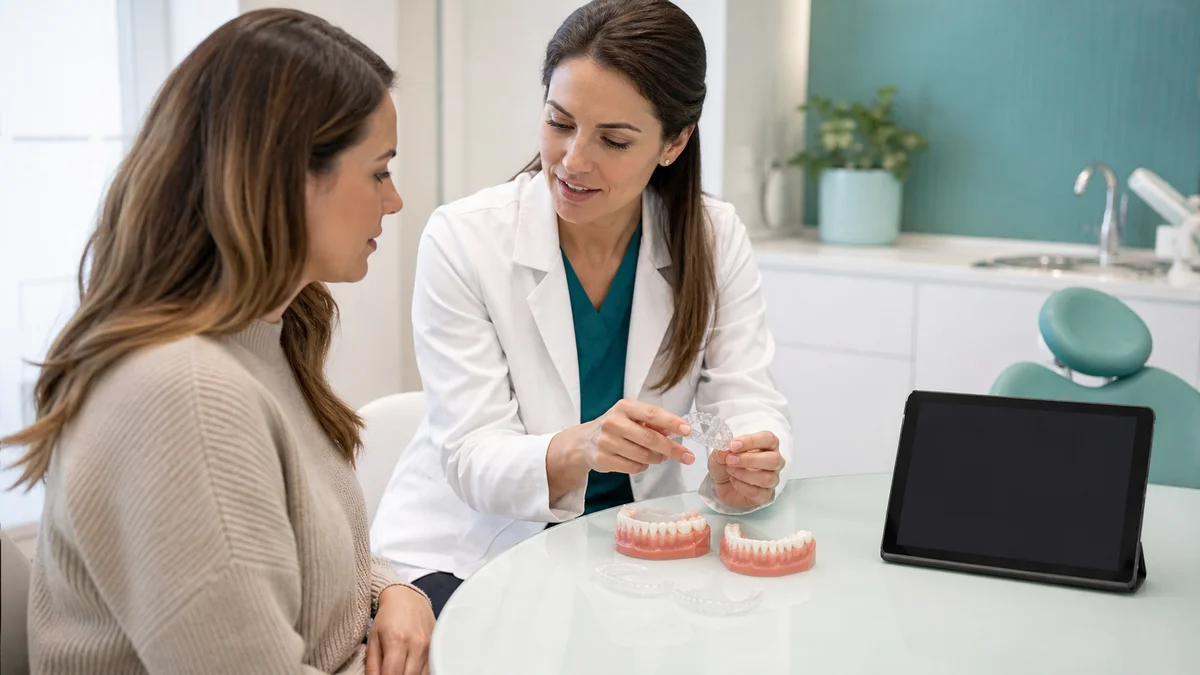
Searching for invisalign one arch cost usually starts with a simple idea: if only the upper or lower teeth look crowded, perhaps treating one row should cost half as much. Orthodontically, the decision is less mechanical. Upper and lower teeth meet as a system. Moving teeth in one arch can change overjet, overbite, tooth contacts, chewing comfort and the space available for the opposing teeth. A cosmetic concern that appears limited to one row may therefore require planning across both.
Invisalign is a trademarked clear-aligner system, not a generic name for every transparent tray. Product labels, package terms and provider arrangements can differ. This guide uses the search phrase invisalign one arch cost while keeping the clinical distinction clear: ask the provider to identify the manufacturer, exact treatment scope and responsible clinician in writing.
The NHS describes orthodontic assessment as the first stage of treatment and notes that it may include radiographs, models and photographs. It also explains that a treatment plan can present more than one option. Those steps matter before a fee is compared. This article offers education, not a diagnosis, personal estimate or promise of result. Dentist Esma Çevrük Çakır will review it for evidence, clarity and patient safety.
1. What Does One-Arch Invisalign Treatment Mean?
Invisalign one arch cost starts with an exact definition of which teeth will move and which services remain necessary for both arches.
One-arch treatment means that the planned active tooth movements are mainly in the upper arch or mainly in the lower arch. It does not mean the clinician can ignore the other row of teeth. The digital setup should still show how both arches relate at the start, throughout movement and at the planned finish. The opposing arch may need records, monitoring, a passive tray or retention even when its teeth are not being actively repositioned.
Upper-only treatment might be considered when a carefully selected alignment goal can be achieved without creating harmful contacts or an unstable bite. Lower-only treatment may sometimes address limited alignment or space management under the same condition. Suitability depends on the position of teeth and roots, periodontal support, existing restorations, jaw relationship, chewing contacts and the goal agreed with the patient.
That is why invisalign one arch cost is a scope question before it is a price question. Ask whether “one arch” describes the active trays, the digital plan, the number of appointments or the entire service. A phrase on a sales page is not a clinical definition.
2. Why Invisalign One Arch Cost Is Not Simply Half
An invisalign one arch cost comparison should separate shared clinical work from appliance-specific work before any ratio is assumed.
A two-arch plan includes two sets of active trays, but tray manufacturing is only one part of supervised orthodontics. Examination, health history, photographs, scanning, diagnosis, digital planning, clinician time, review appointments, records, consent and emergency access may be similar whether one or two arches receive active movement. Retainers and final bite checks also remain necessary.
The complexity of the intended movement can matter more than the count of active arches. A short-looking front-tooth correction can require space creation, attachments, enamel reduction, root control or changes to avoid bite interference. Conversely, a straightforward two-arch alignment plan can sometimes require less complex biomechanics than an unstable one-arch compromise. No reader can determine which pattern applies without an examination.
When comparing invisalign one arch cost, do not multiply or divide a headline fee. Compare the written services, biological difficulty and aftercare. A lower quotation may represent fewer visits, a limited number of additional trays or no retainer rather than an equivalent plan for one row of teeth.
3. Start With Oral Health and a Complete Bite Assessment
Every responsible invisalign one arch cost estimate follows an oral-health and bite assessment rather than a photograph or online form alone.
The General Dental Council states that orthodontic suitability should be based on a full oral-health assessment and that a physical clinical examination is the foundation for safe care. A scan records surfaces; it does not by itself diagnose decay, gum disease, mobility, root condition, jaw-joint concerns or every bite problem. Clinically justified radiographs may be recommended after history and examination rather than ordered automatically.
NHS guidance advises that orthodontic treatment should not begin without good oral hygiene because braces or aligners can increase the risk of decay and gum problems when plaque is not controlled. Active disease may need treatment or stabilization first. Existing crowns, implants, bridges and missing teeth also influence what can move and how the final contacts should be designed.
- Medical and dental history, medicines, allergies and previous orthodontics
- Tooth, gum and periodontal-support examination
- Facial, smile and bite assessment in three dimensions
- Photographs, scans or models and clinically indicated radiographs
- Existing restorations, missing teeth and planned dental work
- Patient goals, limitations, alternatives and retention expectations
A safe invisalign one arch cost discussion comes after these findings. If the provider cannot name the clinician responsible for diagnosis, consent, plan changes and urgent problems, pause before paying.
4. The Main Drivers Behind Invisalign One Arch Cost
The most useful invisalign one arch cost breakdown connects each charge to diagnosis, movement, monitoring or retention.
Two people asking about invisalign one arch cost may receive different plans because their starting conditions and goals differ. A transparent estimate should connect each charge to a defined service rather than present a vague package. It should also say which items could generate an additional fee if treatment changes.
- Assessment and records: examination, photographs, scan, models and any justified imaging
- Planning complexity: the number and type of tooth movements, space strategy and bite control
- Appliances: active aligners, possible passive trays for the other arch and replacement policy
- Clinical procedures: attachments, elastics or interproximal reduction when individually indicated
- Monitoring: in-person reviews, remote checks if used and access for poorly fitting trays
- Refinements: rescans and additional aligner stages when teeth do not track as planned
- Finishing: attachment removal, bite adjustment if appropriate, final records and retainers
- Pre-treatment care: hygiene, fillings or periodontal care that is clinically necessary
Provider experience, local operating costs, laboratory arrangements, follow-up period and finance terms can also affect the estimate. None of those variables proves quality on its own. The useful comparison is whether the plan is clinically supported, fully described and delivered by an accountable dental professional.
5. One Arch, Both Arches or Another Option?
Before comparing invisalign one arch cost, compare the reasonable clinical options and the limitations of each.
A patient should not be steered into one arch merely because it appears cheaper, or into both arches merely because the package is larger. The decision should follow diagnosis, realistic goals and informed consent. The table below is a conversation aid rather than a suitability test.
| Option | Active area | Question it may address | Important cost drivers | Key limitation and retention |
|---|---|---|---|---|
| One-arch clear aligners | Upper or lower mainly | Can a limited goal be met without destabilising the bite? | Records, planning, active and passive trays, reviews, refinements | Opposing contacts still require control; retainers remain essential |
| Both-arch clear aligners | Upper and lower | Do alignment and bite changes need coordination? | Complexity, two active tray series, attachments, monitoring | Wear discipline and biological response affect tracking; retainers required |
| Fixed braces | One or both arches as planned | Would fixed appliances offer better control for the required movements? | Appliance type, adjustments, repairs, duration and retention | Cleaning demands and visibility differ; diagnosis still determines scope |
| Limited bonding or contouring | Selected tooth surfaces | Is the concern shape or colour rather than tooth position? | Material, tooth preparation, maintenance and replacement | Does not correct a bite; irreversible enamel removal must be justified |
| Monitor or no treatment | No active movement | Are benefits small compared with burdens or risks? | Periodic reviews and preventive care | Appearance or function remains; seek review if symptoms change |
The invisalign one arch cost column cannot be filled safely from a photograph. Ask the clinician to show how the recommended option affects both arches and why each reasonable alternative was accepted or rejected.
6. Active Trays, Passive Trays and the Opposing Arch
A clear invisalign one arch cost plan states whether the opposing arch receives a passive tray, retainer or monitoring only.
A one-arch label can hide different appliance designs. One plan may supply active trays only for the selected arch. Another may include passive trays for the opposing arch to help maintain position or provide a surface against which elastics work. A third may use a retainer rather than a sequence of passive aligners. These are not automatically interchangeable.
Ask how the opposing teeth will be protected from unwanted movement and how new bite contacts will be checked. If only one arch receives trays, clarify whether the uncovered teeth create any wear, clenching or contact issue during treatment. The answer depends on the plan and cannot be generalized.
For a meaningful invisalign one arch cost comparison, the written quote should distinguish active aligners, passive appliances and retainers. It should also state whether the other arch is included in scans, photographs, monitoring and final records. “Upper only” should never mean “lower arch not assessed.”
7. Attachments, Enamel Reduction and Other Auxiliaries
Ask whether the quoted invisalign one arch cost includes clinically indicated attachments, IPR and auxiliaries.
Small tooth-coloured attachments may be bonded to selected teeth so an aligner can deliver particular forces. Interproximal reduction, sometimes called IPR, removes a carefully measured amount of enamel between teeth when clinically indicated to create space or adjust contacts. Elastics or other auxiliaries may assist certain bite movements. None should be added merely to justify a package.
Consent should explain purpose, alternatives, limitations and material risks. Attachments can affect appearance and make trays harder to remove. IPR is irreversible and requires appropriate measurement and technique. Teeth may feel temporarily tender during movement. Any plan may need revision if teeth fail to track, an attachment detaches or gum health changes.
Ask whether these procedures are included in invisalign one arch cost, who performs them and whether repeat visits are charged separately. A digital preview should be described as a planning simulation, not a guaranteed image of the final smile.
8. Monitoring and Refinements Can Change the Total
Monitoring is part of invisalign one arch cost because safe tooth movement requires clinical review, not only tray delivery.
Clear aligners depend on both biological response and consistent wear. At reviews, the clinician may assess fit, movement, gums, bite contacts and patient experience. Remote photographs can support some checks but cannot always replace an examination. The treatment plan should describe the balance of in-person and remote care and provide a route for timely review.
If a tooth does not follow the predicted movement, the clinician may modify wear instructions, replace an attachment, rescan or order refinement trays. Refinement is not proof of poor care; it is one way to respond to real biology. However, its financial boundary should be clear before treatment begins.
A complete invisalign one arch cost estimate states whether refinements are included, what time or scope limit applies and what happens if goals cannot be reached safely. It should also define charges for lost, damaged or distorted trays and explain what the patient should wear while a replacement is arranged.
9. Retainers Belong in Every Cost Comparison
Long-term invisalign one arch cost includes a realistic retention plan even after active trays finish.
Teeth can move after active orthodontic treatment. NHS sources emphasize the importance of retainers, and hospital orthodontic guidance commonly advises long-term wear according to the clinician’s instructions. Retention is therefore part of treatment planning, not an optional cosmetic upgrade.
One active arch does not automatically mean one retainer. The clinician may recommend retention for both arches to preserve tooth position and stable contacts. Removable retainers can be lost, cracked or distorted. Fixed retainers can detach or accumulate plaque and require professional checks. The correct type and schedule depend on the individual result.
When examining invisalign one arch cost, confirm how many retainers are included, whether both arches are covered, when they are fitted, how long reviews continue and what replacements cost. A cheaper active phase may not be cheaper overall if retention and follow-up are excluded.
10. NHS, Private Care and Insurance Questions
Coverage can affect patient responsibility for invisalign one arch cost, but it must not replace diagnosis or informed consent.
NHS guidance says orthodontic treatment for adults is not usually available through the NHS, while aligners and other less visible braces are generally provided privately. Eligibility and local pathways can change, and clinically necessary specialist care may follow different rules. Ask an NHS dental professional or relevant service about your circumstances rather than assuming coverage.
Private insurance varies by contract. A plan may exclude adult orthodontics, apply an age limit, waiting period, network rule or lifetime orthodontic maximum, or pay benefits in stages. A benefit estimate or pre-authorisation can be useful but may not guarantee payment if eligibility, employment or treatment status changes.
- Ask whether adult clear aligners are an eligible orthodontic service.
- Confirm exclusions for cosmetic-only or pre-existing treatment.
- Check waiting periods, annual or lifetime limits and network rules.
- Ask how one-arch treatment is coded and whether retainers are separate.
- Request written pre-authorisation and keep a contingency for non-payment.
Insurance should not determine the diagnosis. Use the plan to estimate patient responsibility only after the clinician has defined the care. A responsible invisalign one arch cost discussion never promises reimbursement.
11. How to Read a Written Invisalign One Arch Cost Quote
A written invisalign one arch cost quote should make inclusions, exclusions and possible change fees easy to identify.
The GDC requires dental professionals to give patients a written treatment plan and a realistic indication of cost before treatment, and to update the patient in writing when the plan changes. Consent should cover options, risks, benefits, likely prognosis and costs. A signature is not meaningful if the scope is vague or the patient feels rushed.
Use this checklist when reviewing invisalign one arch cost:
- Named responsible dentist and how to contact the clinical team
- Clear-aligner manufacturer and the exact upper, lower or both-arch scope
- Assessment, scans, photographs and any indicated radiographs
- Digital setup and how the opposing arch and bite are managed
- Attachments, elastics and IPR when clinically indicated
- Number and type of scheduled reviews, including remote monitoring
- Refinement policy and charges if active treatment extends
- Lost or damaged tray policy and urgent-care access
- Attachment removal, final records, retainers and review period
- Excluded dental treatment, refund, cancellation and transfer terms
- Deposit, instalment, finance charges and total repayment if borrowing
Do not compare monthly payments until the clinical content is equivalent. A low instalment can reflect a longer loan, interest or a limited package. Financing approval says nothing about orthodontic suitability.
12. Risks, Limitations and Reasons the Plan May Change
Consent for invisalign one arch cost should explain both clinical uncertainty and the financial process if scope changes.
Orthodontic movement involves living tissues. Temporary tenderness is common, but treatment can also be associated with gum inflammation, decay when hygiene is poor, gum recession, root changes, unwanted tooth movement, altered contacts, incomplete tracking and relapse. Individual risk depends on health, anatomy, treatment mechanics and adherence. The clinician should discuss relevant risks without promising that every possible problem can be eliminated.
One-arch movement deserves particular attention to the bite. Aligning upper teeth alone can change overjet or contacts; aligning lower teeth alone can affect how the upper teeth overlap them. Sometimes a limited goal remains reasonable. In other cases, emerging interference or an unstable finish may require a revised plan, treatment of both arches, another appliance or acceptance of a compromise.
Ask how a change would affect invisalign one arch cost and obtain updated consent and fees before proceeding. Persistent severe pain, swelling, a broken tooth, worsening gum symptoms or an aligner that will not seat should prompt contact with the treating team. Breathing or swallowing difficulty requires urgent emergency help.
13. Wear, Hygiene and Patient Responsibilities
Wear and hygiene instructions belong in an invisalign one arch cost discussion because avoidable interruptions may change care needs.
Aligners work only when worn as prescribed. The clinician should give individualized instructions for daily wear, changing trays, cleaning and what to do after missed time. Trays are normally removed for food and for drinks other than those specifically permitted by the clinician. Hot liquids can distort plastic. Sweet or acidic fluids trapped against teeth may raise decay and erosion risk.
Brush with fluoride toothpaste as advised, clean between teeth and attend preventive dental care. Do not advance to the next tray simply because a calendar says so if the current one does not fit. Contact the team for instructions after loss, damage, prolonged non-wear or an unexpected dental procedure.
Patient adherence can influence time, refinements and therefore invisalign one arch cost when extra services fall outside the written package. This does not justify blaming a patient for biological variation. It does justify a clear shared plan for wear, reviews and early problem reporting.
14. Direct-to-Consumer and Remote-Only Offers
A remote invisalign one arch cost offer is incomplete unless it identifies the responsible clinician and examination pathway.
The GDC says there is no effective substitute for a physical clinical examination as the foundation for assessing suitability for orthodontic treatment. Direct interaction between patient and practitioner is essential, and patients should know the identity of the clinician responsible for their care and how to contact them.
Remote monitoring can be part of professional treatment when it is supported by adequate records, appropriate examinations, documentation and access to in-person care. A home impression, selfie or scan alone cannot assess all tooth, root, gum and bite conditions. A low advertised fee may omit those safeguards, clinical procedures or emergency management.
Before accepting a remote invisalign one arch cost offer, ask who diagnosed the case, where the examination occurs, who approves plan changes, who performs attachments or IPR, and where urgent care is provided. If the seller cannot answer, do not rely on the price comparison.
15. Planning One-Arch Aligners Abroad
International invisalign one arch cost should include travel, continuity, records, refinements and local urgent care.
International treatment can be coordinated safely only when responsibilities and continuity are explicit. The total cost may include travel, accommodation, time away from work, local dental treatment, currency conversion, repeated visits, replacement trays, refinements and retainers. A manufacturing quote is not the total-care figure.
Ask which visits must be in person, how progress is assessed after returning home and which named clinician remains responsible. Confirm access to records and what happens if another dentist must take over. Transfer is not automatic; a new professional may repeat records, charge separately or recommend another plan.
Redent Klinik provides general information through its main website. To ask about records, visits, aftercare and an itemised preliminary plan, use the English contact page. Remote information cannot confirm suitability or final invisalign one arch cost; that requires examination and a written plan.
16. A Safe Decision Path From Search to Consent
A sound invisalign one arch cost decision follows a clinical sequence rather than beginning with finance.
- Define the concern: describe appearance, function and what outcome matters.
- Obtain an examination: assess teeth, gums, bite and relevant health history.
- Collect records: use photographs, scans and justified imaging as advised.
- Compare options: discuss one arch, both arches, braces, restorative alternatives and no treatment.
- Review the simulation: understand that it is a plan, not a guarantee.
- Confirm scope: identify active and passive appliances, procedures, reviews and refinements.
- Plan retention: document retainers for both arches and long-term care.
- Read the quote: compare inclusions, exclusions and change terms.
- Separate finance: compare total repayment only after clinical consent is sound.
- Keep documents: retain the plan, consent, invoices, records and contact details.
This sequence turns invisalign one arch cost into an informed decision instead of a headline-price contest. It also gives the patient a clear point at which to pause, seek another opinion or ask for a revised explanation.
Frequently Asked Questions About Invisalign One Arch Cost
Is Invisalign one arch cost half the price of two arches?
No fixed ratio applies. Records, diagnosis, digital planning, reviews and retention may be needed regardless of the number of active arches. Tray scope is only one cost driver. Compare itemised plans with the same supervision and aftercare rather than dividing a two-arch quotation.
Can I treat only my upper teeth with Invisalign?
Sometimes a clinician may recommend upper-only active movement for a limited goal, but only after checking both arches and the bite. If upper movement would worsen overjet, overbite or contacts, both arches or another approach may be safer. A photograph cannot establish suitability.
Can I treat only my lower teeth?
Lower-only active treatment may be considered in selected cases. Space, gum support, tooth inclination and how upper teeth overlap the lower teeth all matter. Ask the clinician to demonstrate the planned contacts and explain any compromise before consent.
Can one-arch treatment change my bite?
Yes. Moving teeth in one arch can change where and how the arches meet. That may be intentional and beneficial, neutral, or undesirable depending on the diagnosis. Monitoring should include bite contacts, not only whether front teeth look straighter.
What should an Invisalign one arch cost quote include?
It should identify the responsible dentist, manufacturer, records, active arch, opposing-arch plan, attachments or IPR, visits, refinements, replacement trays, final records and retainers. It should also list exclusions, change fees, cancellation and transfer terms.
Are refinement trays included?
Only the written plan can answer. Ask what triggers a rescan, how many additional stages or what time period is included, and when extra charges begin. Also confirm whether monitoring continues if active treatment extends.
Are retainers included after one-arch treatment?
They may or may not be. Retention is essential because teeth can move after treatment, and the clinician may recommend retainers for both arches even when only one received active aligners. Confirm type, number, fitting, reviews and replacement policy.
Will the NHS or insurance pay for one-arch Invisalign?
Adult NHS orthodontics is not usually available, and less visible aligners are generally private. Insurance depends on the individual contract and may exclude adult, cosmetic or pre-existing care. Obtain written benefit information, but do not treat it as guaranteed payment.
How long does one-arch treatment take?
There is no safe universal duration. Time depends on movement complexity, biological response, wear, tracking, oral health and refinements. A one-arch label does not guarantee a short course. Your clinician should give an estimate with the assumptions and explain possible changes.
What if my plan changes to both arches?
The clinician should explain why the change is recommended, discuss alternatives and material risks, update the written treatment plan and provide a revised cost before proceeding. You can ask questions or seek another opinion when the change is not urgent.
Is a digital smile preview a guarantee?
No. A digital setup visualises planned movements, but teeth and supporting tissues do not always respond exactly as predicted. The preview should support consent and communication, not promise a precise cosmetic or functional result.
Should I choose the lowest Invisalign one arch cost?
Not on price alone. Confirm diagnosis, responsible clinician, appliance scope, monitoring, refinements, retention and emergency access. The lowest headline can exclude essential care, while the highest quote does not prove quality. Compare clinically equivalent, written plans.
Conclusion: Compare Complete Care, Not One Row of Trays
The final invisalign one arch cost check is whether the written scope protects health, bite stability and continuity of care.
The safest answer to invisalign one arch cost begins with both arches. A clinician should examine oral health, diagnose the bite, define realistic goals and explain whether moving only upper or lower teeth can finish in stable, maintainable contacts. The quote should then connect records, appliances, procedures, reviews, refinements and retainers to that plan.
Ask what “one arch” includes, how the opposing teeth are controlled and what happens if biology or bite contacts require a change. Keep clinical consent separate from financing, verify insurance directly and budget for long-term retention. An itemised plan will not remove every uncertainty, but it makes the decision safer, more transparent and easier to compare without false price promises.
Official Sources and Evidence Notes
- NHS: Orthodontic treatments, assessment, options and retainers
- NHS: Orthodontics, oral hygiene, adult access and retention
- General Dental Council: Direct-to-consumer orthodontics and clinical assessment
- General Dental Council: Effective communication, written plans and costs
- General Dental Council: Valid consent and treatment choices
- Nottingham University Hospitals NHS Trust: Orthodontic retainers
- American Dental Association: Oral-health professional information
- World Health Organization: Oral health fact sheet
Sources reviewed August 4, 2026. Regulations, insurance terms, product packages and clinical guidance can change. Verify the current documents and obtain an individual dental examination.