
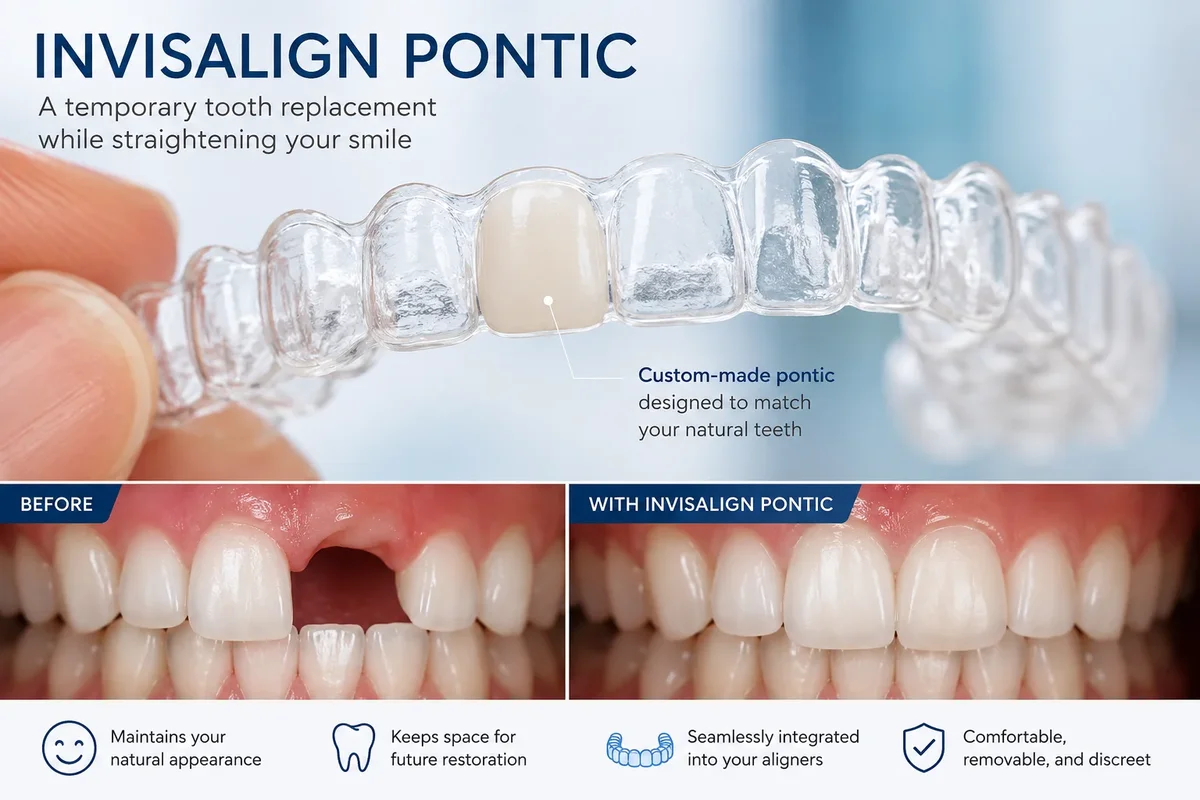
When a patient is missing one or more teeth but still wants the benefits of clear aligner treatment, an invisalign pontic can provide an excellent cosmetic solution. An invisalign pontic is an artificial tooth placed inside an Invisalign aligner to fill the visible gap left by a missing tooth. This innovative approach allows patients to maintain a complete-looking smile while simultaneously straightening their teeth through Invisalign treatment. For many people, an invisalign pontic offers both aesthetic confidence and functional convenience throughout the orthodontic journey. 😊
Understanding how an invisalign pontic works begins with understanding the role of clear aligners. Invisalign aligners are custom-made transparent trays designed to gradually move teeth into their ideal positions. However, when a tooth is missing, the empty space may become highly noticeable. This is where an invisalign pontic becomes valuable. The artificial tooth is securely integrated into the aligner, creating the appearance of a natural tooth while the surrounding teeth are being repositioned.
The primary purpose of an invisalign pontic is cosmetic enhancement during treatment. Patients often feel self-conscious about visible gaps in their smile, especially when the missing tooth is located in the front of the mouth. By incorporating an invisalign pontic into the aligner, patients can smile, speak, and interact socially with greater confidence. This temporary tooth replacement helps maintain a natural appearance throughout the orthodontic process.
One of the biggest advantages of an invisalign pontic is its seamless integration into Invisalign treatment. Unlike removable partial dentures or other temporary restorations, the invisalign pontic remains part of the aligner system. This means patients do not need to manage multiple appliances. The aligner and pontic work together as a single unit, simplifying daily wear and maintenance.
Dental professionals often recommend an invisalign pontic for patients who plan to receive a dental implant after orthodontic treatment. In many cases, teeth must first be aligned correctly before implant placement can occur. During this transitional period, an invisalign pontic serves as a temporary replacement tooth, preserving aesthetics while treatment progresses. This coordinated approach helps ensure optimal implant positioning and long-term oral health outcomes.
Another important benefit of an invisalign pontic is psychological comfort. Missing teeth can affect self-esteem, particularly in professional and social environments. Patients frequently report feeling more comfortable smiling in photographs, attending meetings, and participating in social events when wearing an invisalign pontic. The natural appearance provided by the artificial tooth can make a significant difference in overall confidence.
The materials used in an invisalign pontic are carefully selected to match the color and shape of surrounding teeth. Dental laboratories and clinicians work together to create a realistic appearance. Although the pontic is not intended to function exactly like a natural tooth, it is designed to blend harmoniously with the smile. This attention to detail helps make the invisalign pontic nearly unnoticeable during everyday interactions.
Many patients wonder whether an invisalign pontic affects the effectiveness of orthodontic treatment. In most cases, it does not interfere with tooth movement when properly planned by an experienced dental professional. The aligners continue applying controlled pressure to designated teeth, while the invisalign pontic simply occupies the missing space. Careful treatment planning ensures that aesthetics and orthodontic objectives work together successfully.
Maintaining an invisalign pontic is relatively simple. Patients should clean their aligners regularly using dentist-recommended cleaning methods and follow all Invisalign wear instructions. Proper hygiene helps prevent staining, bacterial buildup, and unpleasant odors. Since the invisalign pontic is integrated into the aligner, keeping the aligner clean also helps maintain the appearance of the artificial tooth.
In some situations, the design of the invisalign pontic may be adjusted throughout treatment. As teeth move and spaces change, new aligners may require modifications to ensure the pontic continues fitting properly and looking natural. Regular dental checkups allow clinicians to monitor progress and make any necessary refinements.
Patients considering an invisalign pontic should consult with a qualified dental provider experienced in both restorative and orthodontic dentistry. Comprehensive evaluation is essential to determine whether this solution aligns with the patient’s treatment goals. Factors such as tooth position, bone health, future implant plans, and overall oral condition all influence the treatment approach.
While an invisalign pontic provides an excellent temporary aesthetic solution, it is important to understand that it does not permanently replace a missing tooth. Instead, it serves as a transitional restoration during orthodontic treatment. After Invisalign is completed, patients may proceed with permanent options such as dental implants, bridges, or other restorative treatments based on their dentist’s recommendations.
Modern dentistry continues to evolve, and the invisalign pontic represents a perfect example of combining cosmetic dentistry with orthodontic innovation. By addressing both tooth alignment and appearance simultaneously, this treatment option allows patients to enjoy a more confident smile throughout their dental journey. Whether preparing for a future implant or simply seeking a discreet way to manage a missing tooth during treatment, an invisalign pontic can be an effective and highly satisfying solution.
For personalized guidance regarding invisalign pontic treatment options, patients can schedule a consultation through the Redent Klinik Contact Page. Additional oral health resources can also be found through the American Dental Association.
What Is an Invisalign Pontic and How Does It Work?
An invisalign pontic is a specially designed artificial tooth that is incorporated into an Invisalign aligner to fill the visible space created by a missing tooth. This innovative solution allows patients to undergo clear aligner treatment while maintaining the appearance of a complete smile. For individuals who have lost a tooth due to trauma, decay, congenital absence, or extraction, an invisalign pontic can provide a highly aesthetic temporary replacement during orthodontic treatment.
As Invisalign continues to grow in popularity, more patients are seeking solutions that address both tooth alignment and cosmetic concerns simultaneously. An invisalign pontic bridges this gap by combining orthodontic treatment with temporary smile restoration. Rather than leaving a noticeable space visible throughout treatment, the artificial tooth fills the gap and creates a more natural appearance. This can significantly improve confidence and quality of life during the treatment process. 😊
Understanding the Meaning of a Pontic
In dentistry, a pontic refers to an artificial tooth used to replace a missing natural tooth. Pontics are commonly associated with dental bridges, but the concept can also be applied within orthodontic appliances. In the case of an invisalign pontic, the artificial tooth is attached or integrated into the aligner itself rather than being permanently fixed in the mouth.
The purpose of an invisalign pontic is primarily aesthetic. Although it resembles a natural tooth, it does not function as a permanent restoration. Instead, it serves as a temporary cosmetic solution while Invisalign aligners gradually move surrounding teeth into their desired positions.
Many patients feel uncomfortable with visible gaps, particularly when missing front teeth. An invisalign pontic helps eliminate this concern by restoring the appearance of a complete smile throughout treatment.
How an Invisalign Pontic Is Created
The creation of an invisalign pontic begins with a comprehensive digital treatment plan. Modern dental clinics typically use advanced 3D scanning technology to capture precise images of the patient’s teeth and oral structures. These scans are then used to design customized Invisalign aligners.
Once the treatment plan is finalized, dental professionals identify the location of the missing tooth and determine whether an invisalign pontic should be incorporated into the aligners. The artificial tooth is carefully designed to match the shape, size, and shade of the surrounding natural teeth.
The result is a highly customized restoration that blends naturally with the patient’s smile. When the aligner is worn, the invisalign pontic occupies the empty space, making the missing tooth significantly less noticeable.
Digital Smile Planning
Digital smile planning plays a critical role in the success of an invisalign pontic. Through advanced software, dentists can visualize how teeth will move throughout treatment and ensure the artificial tooth remains properly positioned. This technology helps create a predictable treatment experience and improves overall aesthetic outcomes.
Custom Shade Matching
One of the most important aspects of an invisalign pontic is achieving a natural appearance. Dentists carefully select materials and colors that closely resemble the patient’s existing teeth. Proper shade matching allows the pontic to blend seamlessly into the smile, reducing the likelihood that others will notice the missing tooth.
How the Invisalign Pontic Functions During Treatment
An invisalign pontic functions differently from a dental implant, bridge, or denture. It does not become permanently attached to the jawbone or adjacent teeth. Instead, it moves with the aligner as part of the removable appliance.
When patients wear their aligners for the recommended 20 to 22 hours per day, the invisalign pontic remains securely positioned within the tray. At the same time, Invisalign continues applying controlled forces to guide tooth movement according to the treatment plan.
This dual-purpose approach offers substantial benefits. Patients can improve tooth alignment while maintaining a natural-looking smile throughout treatment. Because the invisalign pontic is incorporated into the aligner, there is no need for a separate cosmetic appliance.
Common Situations Where an Invisalign Pontic Is Used
An invisalign pontic is frequently recommended in several clinical situations. One of the most common scenarios involves patients preparing for future dental implants. In many cases, orthodontic treatment is required before implant placement to ensure ideal spacing and alignment.
During this preparatory phase, the invisalign pontic serves as a temporary replacement tooth. Patients benefit from an improved appearance while their teeth are moved into optimal positions.
Another common use involves congenitally missing teeth. Some individuals are born without certain permanent teeth, particularly lateral incisors. An invisalign pontic can maintain aesthetics while orthodontic treatment creates the appropriate space for future restorative procedures.
Patients who have experienced tooth loss due to injury may also benefit from an invisalign pontic. The temporary restoration helps restore confidence while comprehensive dental treatment is completed.
Advantages of Choosing an Invisalign Pontic
The popularity of the invisalign pontic continues to grow because it offers numerous advantages:
- Provides an immediate cosmetic improvement.
- Enhances confidence during orthodontic treatment.
- Integrates directly into Invisalign aligners.
- Eliminates the need for separate removable appliances.
- Supports comprehensive treatment planning.
- Maintains a natural-looking smile.
- Offers a discreet and comfortable solution.
Patients often appreciate the simplicity and convenience of an invisalign pontic. Since it is incorporated into aligners they already wear daily, there is minimal disruption to their routine.
Limitations to Understand
Although an invisalign pontic offers significant cosmetic benefits, patients should understand its limitations. The pontic is not designed for chewing or biting with substantial force. Because it is integrated into a removable aligner, its primary purpose is aesthetic rather than functional.
Patients should also recognize that an invisalign pontic is usually a temporary solution. After orthodontic treatment is completed, many individuals proceed with permanent tooth replacement options such as dental implants or fixed bridges.
Regular dental appointments are important throughout treatment. Dentists may periodically adjust the design of the invisalign pontic as teeth move and spaces change. These modifications help maintain a natural appearance and ensure the best possible treatment outcome.
Why Invisalign Pontics Are Becoming More Popular
Modern patients increasingly prioritize both aesthetics and convenience. The invisalign pontic addresses these concerns by providing a discreet, comfortable, and visually appealing solution for missing teeth during orthodontic treatment.
As digital dentistry advances, the quality and realism of an invisalign pontic continue to improve. Today’s customized designs can closely mimic natural teeth, allowing patients to smile confidently throughout their treatment journey.
For individuals seeking a solution that combines clear aligner therapy with temporary tooth replacement, an invisalign pontic represents one of the most effective and patient-friendly options available in modern dentistry. By enhancing appearance, supporting confidence, and complementing orthodontic treatment goals, an invisalign pontic has become an essential tool in comprehensive smile transformation plans.
Benefits of Using an Invisalign Pontic During Orthodontic Treatment
One of the most significant concerns patients have when starting orthodontic treatment with a missing tooth is how their smile will look throughout the process. While Invisalign is known for its discreet appearance, a visible gap caused by a missing tooth can still affect confidence. This is where an invisalign pontic becomes extremely valuable. An invisalign pontic is specifically designed to improve aesthetics while allowing tooth movement to continue according to the orthodontic treatment plan.
For many patients, choosing an invisalign pontic is about much more than appearance alone. This temporary tooth replacement can positively influence confidence, comfort, treatment satisfaction, and overall quality of life during the orthodontic journey. Whether a patient is preparing for a future dental implant, managing a congenitally missing tooth, or recovering from tooth loss due to trauma, an invisalign pontic offers numerous practical and cosmetic advantages.
Enhanced Smile Aesthetics Throughout Treatment
The most obvious benefit of an invisalign pontic is the immediate improvement in smile appearance. Missing teeth can create noticeable gaps that many patients find embarrassing in professional, social, or personal situations. By filling the space with a realistic artificial tooth, an invisalign pontic helps create the appearance of a complete and natural smile.
Patients often report feeling more comfortable smiling in photographs, attending social gatherings, and speaking with others after receiving an invisalign pontic. Since the pontic is incorporated directly into the clear aligner, it remains discreet and blends naturally with surrounding teeth.
A More Natural Appearance
Modern dental technology allows each invisalign pontic to be customized according to the patient’s tooth shape, size, and color. This level of personalization ensures that the restoration looks realistic and harmonizes with the rest of the smile.
Unlike visible metal appliances or removable temporary prosthetics, an invisalign pontic works seamlessly within the aligner system, helping patients maintain a natural appearance throughout treatment.
Increased Self-Confidence and Emotional Well-Being
Missing teeth can have a significant emotional impact. Many people feel self-conscious about speaking, laughing, or smiling when a visible gap exists. An invisalign pontic helps address these concerns by restoring visual completeness to the smile.
Confidence plays an important role in everyday life. Patients who feel good about their appearance are often more willing to engage in social activities, professional interactions, and public speaking opportunities. The psychological benefits of an invisalign pontic can be just as valuable as the physical benefits.
Many orthodontic patients spend months or even years in treatment. During this period, the presence of an invisalign pontic can make the experience significantly more comfortable from an emotional perspective.
Supports Comprehensive Orthodontic Treatment Planning
In many cases, orthodontic treatment must be completed before permanent tooth replacement options can be performed. For example, patients planning to receive dental implants often require tooth movement to create ideal spacing and alignment.
An invisalign pontic allows dentists and orthodontists to focus on achieving optimal tooth positioning without sacrificing smile aesthetics. This makes it easier to follow a comprehensive treatment plan that addresses both orthodontic and restorative goals.
Because the invisalign pontic occupies the missing tooth space during treatment, patients can enjoy a more attractive smile while waiting for their final restoration.
Ideal for Future Dental Implant Candidates
One of the most common applications of an invisalign pontic involves future implant placement. Dental implants require precise spacing and alignment for long-term success. The orthodontic phase often takes several months, making temporary cosmetic solutions especially important.
An invisalign pontic helps maintain aesthetics throughout this preparation phase while preserving the intended treatment outcome.
Convenience and Simplicity
Another major advantage of an invisalign pontic is convenience. Since the pontic is integrated directly into the aligner, patients do not need to wear additional removable appliances. Everything functions as a single unit.
This simplifies daily routines and reduces the complexity associated with temporary tooth replacement. Patients already wear their Invisalign aligners for approximately 20 to 22 hours per day, making the addition of an invisalign pontic a seamless enhancement rather than a separate treatment.
Compared to removable flippers or temporary partial dentures, an invisalign pontic often feels less cumbersome and more comfortable.
Maintains a Discreet Orthodontic Experience
One reason Invisalign remains popular is its nearly invisible appearance. An invisalign pontic complements this benefit by ensuring that missing tooth spaces are less noticeable.
Without a pontic, the transparent nature of aligners may make tooth gaps more apparent. By incorporating an invisalign pontic, patients can enjoy the full cosmetic advantages of clear aligner treatment while minimizing visual distractions caused by missing teeth.
This makes the overall orthodontic experience more discreet and appealing for image-conscious individuals.
Helps Maintain Speech Confidence
Although every patient adapts differently to tooth loss, missing front teeth can sometimes affect speech patterns. Certain sounds may become more challenging to pronounce clearly. While an invisalign pontic is not a permanent functional replacement, it can help create a more natural oral environment during speaking.
Many patients find that the presence of an invisalign pontic improves their comfort level when communicating in professional or social settings.
Feeling confident while speaking can have a positive impact on work performance, relationships, and daily interactions.
Improved Treatment Satisfaction
Patient satisfaction is a critical component of successful orthodontic care. Individuals who feel comfortable and confident during treatment are more likely to follow instructions and remain committed to wearing their aligners consistently.
An invisalign pontic contributes to a positive treatment experience by addressing one of the most common aesthetic concerns associated with missing teeth. Patients often appreciate being able to maintain a complete-looking smile while achieving orthodontic improvements.
The combination of cosmetic enhancement and orthodontic correction makes an invisalign pontic a highly desirable solution for many individuals.
Adaptability Throughout Treatment
As teeth move throughout Invisalign treatment, the shape and dimensions of the missing tooth space may change. One of the advantages of an invisalign pontic is its adaptability. Dentists can modify future aligners and pontic designs to accommodate these changes as treatment progresses.
This flexibility ensures that the appearance of the smile remains attractive from the beginning of treatment until the final aligner stage.
Regular monitoring and adjustments help maintain the effectiveness and aesthetic quality of the invisalign pontic throughout the orthodontic process.
Why Many Patients Choose Invisalign Pontics
Ultimately, the popularity of the invisalign pontic stems from its ability to solve multiple challenges simultaneously. It improves smile aesthetics, supports emotional well-being, complements orthodontic treatment objectives, and provides a convenient temporary tooth replacement option.
For patients undergoing Invisalign therapy with one or more missing teeth, an invisalign pontic can transform the treatment experience. Instead of focusing on visible gaps, patients can confidently enjoy the process of improving their smile while maintaining a natural appearance every step of the way.
As digital dentistry and orthodontic technologies continue to advance, the invisalign pontic is expected to remain one of the most effective solutions for combining aesthetic enhancement with modern clear aligner treatment.
Who Is a Good Candidate for an Invisalign Pontic?
An invisalign pontic is an excellent solution for many orthodontic patients who are missing one or more teeth and want to maintain an attractive smile throughout treatment. However, not every patient requires an invisalign pontic, and determining candidacy involves evaluating several dental, cosmetic, and functional factors. Understanding who can benefit most from an invisalign pontic helps patients make informed decisions about their orthodontic and restorative treatment plans.
Modern dentistry increasingly focuses on combining aesthetics and functionality. An invisalign pontic is a perfect example of this philosophy because it allows patients to undergo tooth alignment while temporarily restoring the appearance of missing teeth. Whether a person has lost a tooth due to trauma, extraction, congenital absence, or advanced dental disease, an invisalign pontic may provide an effective cosmetic solution during treatment.
Patients Missing One or More Visible Teeth
The most common candidates for an invisalign pontic are individuals who have a missing tooth in a highly visible area of the mouth. Missing front teeth can significantly affect smile aesthetics and self-confidence. Even though Invisalign aligners are transparent, they do not conceal gaps caused by tooth loss.
For these patients, an invisalign pontic fills the empty space and creates the appearance of a complete smile. This benefit is especially important for individuals who frequently interact with clients, coworkers, students, patients, or the public.
Because front teeth play a major role in facial aesthetics, many patients choose an invisalign pontic to avoid feeling self-conscious during orthodontic treatment.
Missing Front Incisors
Patients who are missing a central incisor or lateral incisor are often among the best candidates for an invisalign pontic. These teeth are immediately visible when smiling, speaking, or laughing. A temporary tooth integrated into the aligner can dramatically improve confidence throughout treatment.
Patients Preparing for Dental Implants
One of the largest groups of candidates for an invisalign pontic includes individuals planning future dental implant treatment. Before an implant can be placed, orthodontic treatment is often necessary to create ideal spacing and tooth positioning.
During this preparation period, the missing tooth space remains visible. An invisalign pontic helps maintain aesthetics while orthodontists and restorative dentists work together to prepare the site for implant placement.
In many comprehensive treatment plans, the invisalign pontic serves as a temporary cosmetic replacement until the implant restoration is completed.
Creating Optimal Implant Space
Proper implant placement requires precise spacing between adjacent teeth. Invisalign treatment may gradually open or refine this space. Throughout this process, an invisalign pontic helps patients maintain a natural-looking smile without compromising treatment goals.
Individuals Born with Missing Teeth
Some people are born without certain permanent teeth, a condition known as tooth agenesis. Missing lateral incisors are among the most common examples. These patients frequently undergo orthodontic treatment to create ideal spacing for future restorative procedures.
An invisalign pontic can be particularly beneficial for these individuals because it temporarily fills the space while treatment progresses. Rather than living with a visible gap, patients can enjoy a more complete smile during the entire orthodontic process.
For younger adults and teenagers transitioning into restorative treatment, an invisalign pontic often provides valuable cosmetic support.
Patients Recovering from Tooth Loss Due to Trauma
Dental injuries can result in sudden tooth loss that affects both function and appearance. Accidents involving sports, falls, vehicle collisions, or workplace injuries may leave patients with missing teeth and a strong desire for immediate cosmetic improvement.
For individuals pursuing Invisalign treatment after traumatic tooth loss, an invisalign pontic can restore confidence while comprehensive dental care is completed. Since treatment planning often involves multiple stages, the temporary appearance benefits of an invisalign pontic can be extremely valuable.
Patients frequently appreciate the ability to smile confidently again while awaiting definitive restorative treatment.
Professionals Concerned About Appearance
Many professionals place a high value on maintaining a polished appearance. Business executives, sales representatives, teachers, healthcare providers, public speakers, and media professionals often interact with others daily.
For these individuals, a visible tooth gap may cause embarrassment or reduce confidence. An invisalign pontic allows them to continue orthodontic treatment without drawing attention to missing teeth.
Because Invisalign itself is highly discreet, adding an invisalign pontic further enhances the cosmetic benefits of treatment and helps patients feel more comfortable in professional environments.
Patients Seeking a Temporary Cosmetic Solution
Not everyone is ready to proceed immediately with a permanent restoration. Some patients need additional healing time, bone grafting procedures, financial planning, or orthodontic adjustments before receiving implants or bridges.
During this transitional phase, an invisalign pontic can serve as an effective temporary tooth replacement. It provides aesthetic improvement without requiring invasive procedures.
Patients who want a non-surgical, minimally disruptive solution often find an invisalign pontic to be an ideal choice while planning future treatment.
Patients Committed to Invisalign Wear
Successful use of an invisalign pontic depends on consistent aligner wear. Since the pontic is integrated into the aligner, patients must follow recommended Invisalign guidelines to experience maximum benefits.
Individuals who are motivated, compliant, and committed to wearing their aligners for 20 to 22 hours per day are generally excellent candidates for an invisalign pontic. Consistent wear helps maintain both orthodontic progress and cosmetic appearance.
Patients who frequently remove aligners for extended periods may experience reduced benefits from the pontic because the artificial tooth is only present when the aligner is worn.
Who May Not Be an Ideal Candidate?
Although an invisalign pontic benefits many patients, it may not be appropriate in every situation. Individuals seeking a permanent tooth replacement solution may require implants, bridges, or removable prosthetics instead.
Additionally, patients with highly complex restorative needs may require alternative treatment approaches depending on their oral health status, bone support, and overall treatment objectives.
A comprehensive examination is necessary to determine whether an invisalign pontic is the most appropriate option. Dentists evaluate factors such as bite relationships, missing tooth location, future restorative plans, and orthodontic goals before making recommendations.
Why a Professional Evaluation Matters
Ultimately, the best candidates for an invisalign pontic are individuals who want to improve smile aesthetics while undergoing Invisalign treatment and who have a missing tooth that would otherwise remain visible.
Every patient has unique needs, which is why a personalized treatment plan is essential. During a consultation, dental professionals can determine whether an invisalign pontic will effectively support both cosmetic and orthodontic objectives.
For patients preparing for implants, managing congenital tooth absence, recovering from dental trauma, or simply wanting a more confident smile during treatment, an invisalign pontic often represents one of the most practical and aesthetically pleasing solutions available in modern orthodontics. By carefully selecting the right candidates, dentists can maximize the benefits of an invisalign pontic and help patients enjoy a smoother, more satisfying treatment experience from start to finish.
Invisalign Pontic vs Traditional Temporary Tooth Replacement Options
When patients lose a tooth and begin orthodontic treatment, maintaining a natural-looking smile often becomes a top priority. Fortunately, modern dentistry offers several temporary tooth replacement solutions. Among these options, the invisalign pontic has gained significant popularity because it combines aesthetics with the convenience of clear aligner therapy. However, many patients wonder how an invisalign pontic compares to more traditional temporary tooth replacement methods such as removable flippers, temporary partial dentures, Essix retainers with pontics, and Maryland bridges.
Choosing the most suitable solution requires understanding the strengths and limitations of each option. While every patient’s situation is unique, comparing an invisalign pontic with traditional alternatives can help clarify why this approach has become increasingly preferred among orthodontic patients seeking a discreet and comfortable treatment experience.
What Makes an Invisalign Pontic Different?
An invisalign pontic is a customized artificial tooth integrated directly into an Invisalign aligner. Unlike standalone temporary restorations, it becomes part of the clear aligner system that patients already wear throughout treatment.
This integration creates several unique advantages. The invisalign pontic provides cosmetic coverage of a missing tooth space while Invisalign simultaneously moves teeth into their planned positions. Rather than managing multiple appliances, patients benefit from a single coordinated treatment approach.
Traditional temporary tooth replacements generally focus solely on replacing the missing tooth’s appearance. An invisalign pontic, by contrast, works alongside active orthodontic treatment.
Invisalign Pontic vs Removable Flipper Dentures
A removable flipper denture has long been one of the most common temporary tooth replacement options. A flipper consists of an acrylic base with an artificial tooth attached. Patients insert and remove the appliance as needed.
Advantages of Flipper Dentures
- Relatively affordable.
- Quick to fabricate.
- Provides immediate cosmetic improvement.
- Can replace one or several missing teeth.
Limitations Compared to an Invisalign Pontic
While flippers can be effective, they often feel bulkier than an invisalign pontic. Some patients report difficulty speaking initially, while others experience irritation from the acrylic material.
Because a flipper is a separate appliance, patients must remember to remove, clean, and store it independently. In contrast, an invisalign pontic is incorporated directly into the aligner already being worn as part of orthodontic treatment.
For Invisalign patients, the simplicity of an invisalign pontic often makes it a more convenient option than a removable flipper.
Invisalign Pontic vs Temporary Partial Dentures
Temporary partial dentures are another traditional method used to replace missing teeth. These appliances typically contain one or more artificial teeth attached to a framework that rests against the gums and remaining teeth.
Benefits of Temporary Partial Dentures
- Can replace multiple missing teeth.
- Provide reasonable aesthetics.
- Widely available.
- Offer a temporary solution before definitive treatment.
Drawbacks Compared to an Invisalign Pontic
Partial dentures are often larger and more noticeable than an invisalign pontic. They may require clasps or retention mechanisms that become visible when smiling.
Because Invisalign aligners already occupy the teeth, wearing a temporary partial denture simultaneously can be impractical. An invisalign pontic eliminates this complication by combining cosmetic tooth replacement with orthodontic treatment in a single appliance.
Patients frequently find that an invisalign pontic offers a more streamlined and aesthetically pleasing experience.
Invisalign Pontic vs Essix Retainers with Pontics
An Essix retainer with a pontic closely resembles an invisalign pontic in appearance. Essix appliances are clear plastic trays that can include artificial teeth to replace missing spaces.
In many ways, an invisalign pontic shares similarities with this approach. Both use transparent materials and provide a highly aesthetic appearance.
Key Difference: Active Tooth Movement
The primary distinction is that an Essix retainer is generally passive, meaning it is designed to maintain tooth positions rather than move teeth actively. An invisalign pontic, however, functions within a dynamic orthodontic system that gradually shifts teeth according to a detailed treatment plan.
For patients undergoing Invisalign treatment, incorporating an invisalign pontic into active aligners is typically more efficient than using a separate Essix appliance.
Invisalign Pontic vs Maryland Bridges
A Maryland bridge is a conservative fixed restoration that uses wings bonded to adjacent teeth to support an artificial tooth. It can serve as a temporary or semi-permanent replacement option.
Advantages of Maryland Bridges
- Fixed in place.
- No daily removal required.
- Natural appearance.
- More stable than removable appliances.
Limitations During Orthodontic Treatment
One challenge is that Maryland bridges may interfere with planned orthodontic tooth movement. Since the restoration is bonded to neighboring teeth, adjustments can become complicated when tooth positions change.
An invisalign pontic avoids this issue because it moves along with the aligner rather than remaining permanently attached to adjacent teeth.
For patients actively undergoing Invisalign treatment, an invisalign pontic often provides greater flexibility and compatibility with orthodontic goals.
Comfort Comparison
Comfort is a major factor when evaluating temporary tooth replacement solutions. Many patients choose Invisalign because of its smooth plastic design and minimal impact on daily activities.
An invisalign pontic preserves these comfort benefits. Since the artificial tooth is incorporated into the aligner, patients generally experience little additional bulk or irritation.
Traditional removable appliances may feel larger, require adjustment periods, or create pressure points against the gums. For individuals prioritizing comfort, an invisalign pontic is often one of the most appealing options available.
Aesthetic Comparison
From an aesthetic standpoint, the invisalign pontic performs exceptionally well. The transparent aligner combined with a carefully customized artificial tooth creates a highly natural appearance.
Many traditional appliances contain visible acrylic components, metal clasps, or structural elements that may attract attention. By contrast, an invisalign pontic is designed specifically to blend seamlessly into the smile.
Patients who place a high value on appearance frequently prefer an invisalign pontic because it allows them to maintain confidence throughout treatment.
Maintenance and Daily Care
Maintaining an invisalign pontic is relatively straightforward. Since patients already clean their Invisalign aligners regularly, caring for the pontic typically becomes part of the same routine.
Traditional temporary restorations often require separate cleaning procedures and storage considerations. Losing or damaging removable appliances is also a common concern.
Because the invisalign pontic remains integrated into the aligner system, many patients find daily maintenance simpler and more convenient.
Which Option Is Best?
The ideal temporary tooth replacement solution depends on individual needs, treatment objectives, oral health status, and future restorative plans. Traditional options such as flippers, partial dentures, Essix retainers, and Maryland bridges each offer unique benefits and may be appropriate in certain circumstances.
However, for patients actively undergoing Invisalign treatment, an invisalign pontic frequently stands out as the most efficient and aesthetically pleasing choice. It combines orthodontic therapy with temporary smile restoration while minimizing inconvenience and maximizing confidence.
By integrating directly into the aligner system, an invisalign pontic offers a modern solution that aligns perfectly with contemporary dentistry’s focus on comfort, aesthetics, and comprehensive treatment planning. For many patients, the ability to straighten teeth while maintaining a complete-looking smile makes the invisalign pontic an outstanding alternative to traditional temporary tooth replacement options.
The Step-by-Step Process of Getting an Invisalign Pontic
Many patients who are missing one or more teeth are interested in improving both the appearance and alignment of their smile. An invisalign pontic offers a practical solution by combining temporary tooth replacement with clear aligner treatment. While the final result often appears simple and natural, achieving a successful outcome involves several carefully planned stages. Understanding the complete process can help patients feel more confident and prepared before beginning treatment with an invisalign pontic.
The journey toward a healthier and more attractive smile begins with a professional evaluation and continues through digital planning, aligner fabrication, pontic customization, treatment monitoring, and eventually the transition to a permanent restoration if needed. Each phase plays an important role in ensuring the invisalign pontic functions effectively while supporting orthodontic treatment goals.
Step 1: Initial Consultation and Oral Examination
The first step in obtaining an invisalign pontic is a comprehensive dental consultation. During this appointment, the dentist or orthodontist evaluates the patient’s oral health, missing tooth location, bite relationship, and overall treatment objectives.
The clinician will determine whether Invisalign treatment is appropriate and assess how an invisalign pontic can be incorporated into the treatment plan. This evaluation often includes reviewing medical and dental history, discussing aesthetic concerns, and identifying long-term restorative goals.
For example, some patients plan to receive a dental implant after orthodontic treatment, while others may eventually choose a bridge or another restorative option. These future plans influence how the invisalign pontic is designed and used during treatment.
Diagnostic Imaging
To gather detailed information, dentists frequently use digital X-rays, panoramic images, and intraoral scans. These diagnostic tools help evaluate bone levels, tooth positions, and available space around the missing tooth site.
The information collected during this stage forms the foundation of a successful invisalign pontic treatment plan.
Step 2: Digital Smile Scanning and Treatment Planning
Once candidacy is confirmed, the next phase involves creating a precise digital model of the patient’s teeth. Modern Invisalign treatment typically relies on advanced intraoral scanners rather than traditional dental impressions.
These scanners generate highly accurate three-dimensional images that allow clinicians to visualize tooth movement and plan the placement of the invisalign pontic. Using specialized software, dentists can simulate the entire orthodontic process before treatment even begins.
This digital planning stage is particularly important because the invisalign pontic must remain aesthetically pleasing while the surrounding teeth gradually change position.
Virtual Treatment Simulation
One of the advantages of digital planning is the ability to preview anticipated results. Patients can often see how their smile may look after treatment and understand how the invisalign pontic will fit into the overall plan.
This visualization helps improve communication and allows patients to make informed decisions regarding their care.
Step 3: Designing the Invisalign Pontic
After the orthodontic plan is finalized, attention turns to the design of the invisalign pontic. The artificial tooth must closely resemble neighboring natural teeth in size, shape, contour, and color.
Dental professionals carefully customize the appearance of the invisalign pontic to ensure it blends naturally with the smile. The goal is to create a restoration that is difficult for others to distinguish from real teeth.
Depending on the location of the missing tooth, subtle adjustments may be made to optimize aesthetics and ensure harmony with the patient’s facial features.
Step 4: Fabrication of Aligners and Pontic Integration
Once planning and design are complete, Invisalign aligners are manufactured according to the approved treatment sequence. At the appropriate stage, the invisalign pontic is incorporated into the aligner.
The pontic becomes securely positioned within the clear tray, allowing it to occupy the missing tooth space whenever the aligner is worn. Since Invisalign aligners are designed for nearly continuous wear, the invisalign pontic remains visible during most daily activities.
This integration is one of the reasons the invisalign pontic is considered highly convenient compared to many traditional temporary tooth replacement methods.
Quality and Aesthetic Verification
Before delivery, dental teams inspect the aligners and the invisalign pontic to ensure proper fit, appearance, and functionality. Any necessary refinements are completed before the appliance is provided to the patient.
Step 5: Initial Placement and Patient Education
At the delivery appointment, the patient receives the first aligners containing the invisalign pontic. The dentist evaluates fit, comfort, and aesthetics while ensuring the appliance functions as intended.
Patients are then instructed on proper insertion, removal, cleaning, and storage techniques. Learning how to care for an invisalign pontic is essential for maintaining both appearance and oral hygiene.
Most patients adapt quickly and appreciate the immediate cosmetic improvement provided by the invisalign pontic.
Step 6: Daily Wear and Treatment Progression
Like standard Invisalign therapy, treatment involving an invisalign pontic requires consistent wear. Patients are generally instructed to wear their aligners for 20 to 22 hours per day.
During this period, the aligners gradually move teeth according to the prescribed treatment plan while the invisalign pontic maintains the appearance of a complete smile.
Because tooth movement occurs incrementally, patients transition through a series of aligners over time. Each new aligner continues supporting the orthodontic process while accommodating the evolving position of surrounding teeth.
Monitoring Oral Hygiene
Proper cleaning is especially important during treatment with an invisalign pontic. Patients should clean aligners regularly and maintain excellent brushing and flossing habits to prevent plaque accumulation and staining.
Good oral hygiene contributes to both treatment success and overall dental health.
Step 7: Regular Follow-Up Appointments
Throughout treatment, patients attend periodic follow-up visits. During these appointments, clinicians monitor tooth movement, evaluate aligner fit, and assess the appearance of the invisalign pontic.
As spaces change during orthodontic treatment, modifications may occasionally be necessary. Dentists can adjust future aligners or refine the design of the invisalign pontic to maintain optimal aesthetics.
Regular monitoring ensures that treatment progresses smoothly and that the patient remains satisfied with the appearance of their smile.
Step 8: Completing Orthodontic Treatment
Once Invisalign treatment is complete, the patient’s teeth should be aligned according to the planned outcome. At this stage, the role of the invisalign pontic as a temporary cosmetic solution may come to an end.
For some patients, this marks the transition toward permanent tooth replacement options such as dental implants, implant-supported crowns, or fixed bridges.
The orthodontic preparation achieved during treatment often creates ideal conditions for these definitive restorative procedures.
Step 9: Transition to a Permanent Restoration
The final step involves replacing the temporary invisalign pontic with a long-term solution when appropriate. Many patients proceed with implant placement because implants provide excellent stability, function, and aesthetics.
Others may choose fixed bridges or alternative restorative treatments based on their individual circumstances.
Regardless of the final restoration selected, the invisalign pontic serves an important role throughout treatment by maintaining confidence and smile aesthetics during the orthodontic journey.
Why the Process Is Worth It
The process of receiving an invisalign pontic is carefully designed to balance cosmetic enhancement with orthodontic precision. From the initial consultation to the final restoration, every stage focuses on creating a positive patient experience while supporting long-term oral health.
By allowing patients to straighten their teeth without displaying noticeable gaps, an invisalign pontic helps maintain confidence throughout treatment. The combination of advanced digital planning, customized aesthetics, and seamless integration with Invisalign aligners makes the invisalign pontic one of the most effective temporary tooth replacement solutions available in modern dentistry.
Caring for Your Invisalign Pontic and Clear Aligners
Proper maintenance is essential for achieving the best results from your invisalign pontic and clear aligner treatment. While Invisalign aligners are designed to be convenient and easy to use, neglecting oral hygiene or aligner care can lead to staining, unpleasant odors, bacterial buildup, and even delays in treatment progress. An invisalign pontic serves as a cosmetic replacement for a missing tooth, and because it is integrated into the aligner, both the aligner and pontic require consistent care to maintain their appearance and functionality.
Patients often focus primarily on tooth movement during Invisalign treatment, but maintaining the condition of the invisalign pontic is equally important. A clean and well-maintained invisalign pontic helps preserve a natural-looking smile throughout treatment while supporting good oral health. By following a few simple daily habits, patients can keep their aligners clear, comfortable, and effective.
Why Proper Care Matters
An invisalign pontic is visible whenever you wear your aligners. If plaque, food debris, or stains accumulate on the appliance, the appearance of your smile may be affected. Unlike natural teeth, the artificial tooth within the invisalign pontic cannot be cleaned through saliva alone.
Additionally, aligners fit snugly around the teeth and gums. Any bacteria trapped between the aligner and the teeth can multiply quickly if oral hygiene is neglected. Maintaining a clean invisalign pontic and aligner system helps reduce the risk of bad breath, tooth decay, and gum inflammation.
Proper care also protects your investment in orthodontic treatment and helps ensure predictable tooth movement throughout the process.
Daily Cleaning Routine for an Invisalign Pontic
A consistent cleaning routine is one of the most important aspects of maintaining an invisalign pontic. Because aligners are worn for most of the day, they can accumulate bacteria and plaque if not cleaned properly.
Clean Aligners Every Morning and Evening
Patients should gently clean their aligners and invisalign pontic at least twice daily. Using a soft toothbrush and lukewarm water can help remove surface buildup without damaging the appliance.
Hot water should be avoided because excessive heat may distort the aligner material and affect how the invisalign pontic fits within the tray.
Use Invisalign-Approved Cleaning Products
Many dental professionals recommend specialized aligner cleaning crystals or cleaning solutions. These products help remove bacteria and stains while preserving the clarity of the aligners.
Using approved cleaning products can help keep the invisalign pontic looking natural and prevent discoloration over time.
Maintain Excellent Oral Hygiene
Keeping your natural teeth and gums healthy is just as important as cleaning the aligners themselves. Since the invisalign pontic sits directly over the teeth and gums, poor oral hygiene can create problems beneath the appliance.
Brush After Every Meal
Whenever possible, patients should brush their teeth before reinserting their aligners. Food particles trapped beneath the aligner can increase bacterial growth and contribute to plaque accumulation.
Regular brushing helps ensure that the invisalign pontic remains clean and that the surrounding teeth stay healthy throughout treatment.
Don’t Forget to Floss
Flossing removes debris from areas that brushing cannot reach. Daily flossing helps reduce inflammation and supports long-term oral health while wearing an invisalign pontic.
Healthy gums are an important part of successful orthodontic and restorative treatment outcomes.
Remove Aligners Before Eating and Drinking
One of the most important Invisalign rules is removing aligners before eating meals or snacks. This guideline also applies when wearing an invisalign pontic.
Eating while wearing aligners can damage the appliance, stain the materials, and trap food particles around the artificial tooth. Hard foods may even crack or distort the aligner.
Removing the aligners before eating helps protect the invisalign pontic and ensures continued treatment effectiveness.
What About Drinks?
Water is generally safe to consume while wearing aligners. However, coffee, tea, wine, sports drinks, and sugary beverages should be avoided unless the aligners are removed.
These beverages can stain both the aligner and the invisalign pontic, reducing the appliance’s aesthetic appeal.
Prevent Staining of the Invisalign Pontic
Because the invisalign pontic is designed to mimic the appearance of a natural tooth, maintaining its color is essential. Certain lifestyle habits can contribute to discoloration.
Smoking and tobacco use are among the most common causes of staining. Tobacco products can quickly discolor both aligners and the invisalign pontic, making them more noticeable.
Highly pigmented foods and beverages may also affect appearance over time. Practicing good cleaning habits and avoiding stain-causing substances can help preserve the natural look of the invisalign pontic.
Store Aligners Properly
Whenever aligners are removed, they should be stored in their protective case. Leaving aligners exposed on tables, napkins, or countertops increases the risk of contamination, damage, or accidental loss.
Since the invisalign pontic is attached to the aligner, losing the appliance means losing both the aligner and the temporary tooth replacement.
Using the provided storage case helps protect the appliance and extends its lifespan.
Monitor for Damage or Wear
Although Invisalign materials are durable, aligners and the invisalign pontic can occasionally become damaged. Cracks, chips, loose components, or changes in fit should be reported to your dental provider promptly.
Ignoring damage may compromise both aesthetics and orthodontic treatment progress. Regular inspections allow problems to be addressed before they become more significant.
Signs You Should Contact Your Dentist
- The aligner no longer fits properly.
- The invisalign pontic becomes loose.
- Cracks or fractures appear.
- Persistent discomfort develops.
- Noticeable staining does not improve with cleaning.
Attend Scheduled Follow-Up Visits
Routine appointments play a critical role in caring for an invisalign pontic. During these visits, dentists evaluate treatment progress, monitor tooth movement, and assess the condition of the appliance.
As teeth shift throughout treatment, adjustments may occasionally be necessary to maintain the appearance and fit of the invisalign pontic. Professional monitoring helps ensure that everything continues functioning as planned.
These appointments also provide an opportunity to discuss any concerns regarding comfort, hygiene, or maintenance.
Long-Term Success Starts with Daily Care
An invisalign pontic can dramatically improve smile aesthetics during orthodontic treatment, but its effectiveness depends on proper maintenance. Daily cleaning, excellent oral hygiene, careful handling, and regular professional checkups all contribute to a successful experience.
By taking care of your invisalign pontic and aligners, you can enjoy a cleaner, healthier, and more attractive smile throughout treatment. Consistent maintenance not only preserves the appearance of the artificial tooth but also supports overall oral health and orthodontic success.
For most patients, caring for an invisalign pontic quickly becomes part of their daily routine. With the right habits and professional guidance, the appliance can continue providing comfort, confidence, and aesthetic benefits until permanent tooth replacement treatment is completed.
Common Challenges and Solutions with Invisalign Pontic Treatment
Although an invisalign pontic offers an excellent way to maintain smile aesthetics during orthodontic treatment, patients should understand that every dental treatment comes with potential challenges. Fortunately, most issues associated with an invisalign pontic are minor, manageable, and easily addressed with proper planning and professional guidance. Understanding these challenges in advance can help patients set realistic expectations and enjoy a smoother treatment experience.
The good news is that modern digital dentistry has significantly improved the design and effectiveness of the invisalign pontic. Most patients complete treatment without major complications. However, factors such as aligner fit, oral hygiene, speech adaptation, staining, and changing tooth positions can occasionally require attention. By recognizing these potential concerns and learning the appropriate solutions, patients can maximize the benefits of their invisalign pontic while maintaining treatment progress.
Initial Adjustment Period
One of the most common challenges patients encounter when first receiving an invisalign pontic is adapting to the new appliance. Any orthodontic device placed in the mouth can feel unusual during the first few days.
Patients may initially notice slight pressure, increased awareness of the aligners, or minor speech changes. These sensations are typically temporary and improve as the mouth adjusts to the appliance.
Solution: Give Yourself Time to Adapt
Most patients become comfortable with an invisalign pontic within several days. Consistent wear is often the best solution because it allows the tongue, cheeks, and oral muscles to adapt naturally.
Practicing speaking, reading aloud, and maintaining recommended aligner wear schedules can accelerate this adjustment process.
Speech Changes and Pronunciation Difficulties
Because an invisalign pontic occupies space within the aligner, some patients experience temporary speech alterations. Certain sounds, particularly “s,” “sh,” or “th” sounds, may feel slightly different during the initial adaptation period.
This challenge is usually more noticeable when the missing tooth is located in the front of the mouth. Fortunately, speech patterns generally normalize as patients become accustomed to wearing the appliance.
Solution: Practice Speaking Regularly
Reading aloud, engaging in conversations, and speaking consistently while wearing the invisalign pontic can help improve adaptation. Most patients report significant improvement within one to two weeks.
If speech concerns persist beyond the expected adjustment period, a dental professional can evaluate the fit and design of the invisalign pontic.
Maintaining Proper Oral Hygiene
Oral hygiene can become more challenging when wearing any removable dental appliance. Since the invisalign pontic is integrated into the aligner, plaque and food particles can accumulate if cleaning routines are neglected.
Poor hygiene may lead to unpleasant odors, staining, gum inflammation, or increased risk of tooth decay. This is one of the most preventable challenges associated with an invisalign pontic.
Solution: Establish a Consistent Cleaning Routine
Patients should clean both their aligners and invisalign pontic daily using dentist-approved cleaning methods. Brushing and flossing before reinserting aligners also helps maintain optimal oral health.
Good hygiene habits preserve both the appearance and function of the invisalign pontic throughout treatment.
Staining and Discoloration
Because the invisalign pontic is designed to blend with natural teeth, staining can become a cosmetic concern. Coffee, tea, red wine, tobacco products, and highly pigmented foods may discolor both the aligner and the artificial tooth over time.
Visible staining can reduce the natural appearance of the invisalign pontic and make the appliance more noticeable.
Solution: Prevent and Remove Stains
Removing aligners before consuming staining beverages and practicing regular cleaning can significantly reduce discoloration. Patients should avoid smoking whenever possible and follow professional cleaning recommendations.
If staining becomes severe, the dentist may recommend replacing or modifying the affected invisalign pontic.
Changes in Fit During Tooth Movement
One unique aspect of Invisalign treatment is that teeth continuously move throughout the orthodontic process. As these changes occur, the appearance and positioning of the invisalign pontic may occasionally require adjustments.
Spaces surrounding the missing tooth can become smaller, larger, or differently shaped as treatment progresses. Without proper monitoring, the invisalign pontic may eventually appear less natural.
Solution: Regular Professional Monitoring
Routine orthodontic appointments allow dental professionals to evaluate tooth movement and modify future aligners if necessary. This ensures that the invisalign pontic continues looking natural and functioning properly throughout treatment.
Ongoing adjustments are a normal part of comprehensive orthodontic care.
Risk of Damage or Breakage
Although Invisalign aligners are durable, they are not indestructible. The invisalign pontic can occasionally become damaged if exposed to excessive force, improper handling, or accidental dropping.
Patients who chew on aligners, use them during meals, or store them improperly may increase the likelihood of damage.
Solution: Handle Aligners Carefully
Always remove aligners before eating and store them in their protective case when not in use. Following manufacturer and dentist recommendations helps protect the invisalign pontic from unnecessary wear and damage.
If damage occurs, patients should contact their dental provider promptly for guidance.
Patient Compliance Challenges
Like all Invisalign treatment, success depends heavily on patient compliance. Since the invisalign pontic is integrated into the aligner, removing the aligners frequently reduces both orthodontic effectiveness and cosmetic benefits.
Patients who do not wear aligners for the recommended 20 to 22 hours per day may experience delayed treatment progress and inconsistent aesthetics.
Solution: Follow Wear Instructions Carefully
Maintaining a consistent wear schedule is one of the simplest ways to ensure success with an invisalign pontic. Establishing daily routines and using smartphone reminders can help patients remain compliant.
The more consistently the aligners are worn, the more effective the treatment becomes.
Aesthetic Expectations
Some patients initially expect an invisalign pontic to function exactly like a permanent dental implant or natural tooth. While the appliance offers excellent aesthetics, it remains a temporary cosmetic solution.
The invisalign pontic is not designed for heavy chewing or long-term tooth replacement. Understanding this distinction helps prevent unrealistic expectations.
Solution: Clear Communication with Your Dentist
Before treatment begins, patients should discuss goals and expectations with their dental provider. Understanding the role of an invisalign pontic within the broader treatment plan helps create a more satisfying experience.
Education and communication are essential components of successful orthodontic care.
Emotional Concerns During Treatment
Missing teeth can affect confidence, and some patients may feel anxious about undergoing orthodontic treatment while awaiting a permanent restoration. Even with an invisalign pontic, emotional concerns occasionally arise.
Fortunately, most patients report increased confidence once they see how naturally the invisalign pontic blends into their smile.
Solution: Focus on Long-Term Results
Remember that the invisalign pontic is part of a comprehensive treatment strategy designed to improve both aesthetics and oral health. Each stage of treatment contributes to achieving a healthier and more attractive final outcome.
Maintaining realistic expectations and celebrating progress can help patients stay motivated throughout their orthodontic journey.
Most Challenges Are Easily Managed
While several challenges may arise during treatment with an invisalign pontic, most are temporary and highly manageable. Modern technology, personalized treatment planning, and regular professional supervision significantly reduce the likelihood of serious complications.
Patients who follow care instructions, attend scheduled appointments, and maintain good oral hygiene typically enjoy excellent results with an invisalign pontic. The cosmetic and psychological benefits often far outweigh the minor inconveniences associated with treatment.
By understanding common challenges and applying the appropriate solutions, patients can confidently move through their orthodontic journey while enjoying the aesthetic advantages that an invisalign pontic provides every day.
Invisalign Pontic Cost: What to Expect
One of the most common questions patients ask before starting treatment is, “How much does an invisalign pontic cost?” The answer depends on several factors, including the complexity of the orthodontic case, the number of missing teeth, the type of Invisalign treatment being performed, geographic location, and whether additional restorative procedures are planned. Because an invisalign pontic is typically incorporated into a broader orthodontic treatment plan, its cost is often considered part of the overall Invisalign process rather than a completely separate treatment.
Understanding the financial aspects of an invisalign pontic can help patients make informed decisions and prepare for treatment. While cost is an important consideration, it is equally important to evaluate the aesthetic, psychological, and functional benefits that an invisalign pontic can provide during orthodontic care.
What Is Included in the Cost?
The cost associated with an invisalign pontic generally includes more than just the artificial tooth itself. Since the pontic is integrated into Invisalign aligners, treatment planning and fabrication involve multiple steps.
Depending on the clinic and treatment plan, costs may include:
- Initial consultation and examination.
- Digital scans or impressions.
- Orthodontic treatment planning.
- Custom fabrication of Invisalign aligners.
- Design and placement of the invisalign pontic.
- Follow-up appointments and monitoring.
- Adjustments as teeth move throughout treatment.
Because the invisalign pontic is customized for each patient, pricing reflects the level of planning and personalization required.
Average Invisalign Treatment Costs
In most countries, the largest component of treatment expenses is the Invisalign therapy itself. The invisalign pontic is typically added to this treatment rather than billed as an entirely independent service.
Comprehensive Invisalign treatment generally ranges between:
Estimated Invisalign Treatment Costs
- Minor Invisalign cases: $2,000 – $4,000
- Moderate Invisalign cases: $4,000 – $6,500
- Complex Invisalign cases: $6,500 – $9,000+
The inclusion of an invisalign pontic may slightly increase treatment costs depending on the complexity of customization required.
Average Invisalign Pontic Costs
When billed separately, the cost of an invisalign pontic may vary significantly from one provider to another. In many cases, the fee is bundled into the Invisalign treatment package.
However, where separate fees apply, patients may encounter pricing within the following approximate range:
Estimated Invisalign Pontic Costs
- Single invisalign pontic: $100 – $500
- Advanced customization: $300 – $800
- Multiple pontics: $500 – $1,500+
Actual costs vary depending on provider, location, treatment complexity, and customization requirements.
Patients should remember that these figures represent general estimates and may differ based on individual circumstances.
Factors That Influence Invisalign Pontic Pricing
Several variables can affect the overall cost of an invisalign pontic. Understanding these factors helps explain why pricing varies between patients and treatment providers.
Number of Missing Teeth
A patient requiring a single invisalign pontic will generally incur lower costs than someone requiring multiple pontics. Additional customization and fabrication increase treatment complexity.
Case Complexity
Complex orthodontic cases often require more extensive treatment planning. If significant tooth movement is necessary around the missing tooth site, additional modifications to the invisalign pontic may be needed throughout treatment.
Provider Experience
Experienced Invisalign providers may charge higher fees due to their expertise and advanced treatment planning capabilities. However, many patients view this investment as worthwhile because it can contribute to better outcomes and fewer complications.
Geographic Location
Dental treatment costs frequently vary by region and country. Metropolitan areas often have higher fees than smaller communities due to differences in operating expenses and local market conditions.
As a result, the cost of an invisalign pontic may differ substantially depending on where treatment is received.
Does Insurance Cover Invisalign Pontic Treatment?
Insurance coverage for an invisalign pontic depends on the specific insurance plan and the reason treatment is being performed. Some dental insurance plans provide partial coverage for orthodontic treatment, while others may contribute toward temporary tooth replacement solutions.
Patients should contact their insurance provider directly to determine eligibility and benefit limitations.
Even when insurance does not fully cover the cost of an invisalign pontic, many dental practices offer financing options that make treatment more accessible.
Financing and Payment Plans
Many orthodontic offices recognize that treatment costs can represent a significant financial commitment. As a result, flexible financing arrangements are commonly available.
Payment plans may allow patients to spread the cost of Invisalign treatment and the invisalign pontic over several months or years. Some providers also partner with healthcare financing companies that offer low-interest or interest-free payment options.
These arrangements help make treatment more manageable for patients who want to improve their smile without paying the full amount upfront.
Comparing Cost to Other Temporary Tooth Replacement Options
When evaluating treatment costs, it is helpful to compare the invisalign pontic with other temporary tooth replacement alternatives.
- Flipper dentures: generally lower initial cost but may be less comfortable.
- Temporary partial dentures: moderate cost with additional maintenance requirements.
- Essix retainers with pontics: similar cosmetic benefits but no active tooth movement.
- Maryland bridges: often higher cost and may not be ideal during orthodontic treatment.
Although an invisalign pontic may not always be the least expensive option, many patients consider its convenience and aesthetic advantages to be highly valuable.
Value Beyond the Price Tag
When assessing the cost of an invisalign pontic, it is important to consider the broader benefits it provides. The appliance allows patients to maintain a complete-looking smile while simultaneously correcting orthodontic issues.
This combination of cosmetic improvement and active treatment can significantly enhance confidence, social comfort, and overall treatment satisfaction.
For individuals with visible missing teeth, the emotional benefits of an invisalign pontic often extend far beyond the financial investment.
Long-Term Financial Considerations
An invisalign pontic is generally a temporary solution rather than a permanent restoration. Patients should plan for future restorative treatment costs, such as dental implants, implant-supported crowns, or fixed bridges.
However, by supporting proper tooth alignment before these procedures, an invisalign pontic may help create more favorable conditions for long-term restorative success.
In many cases, investing in orthodontic preparation and an invisalign pontic can contribute to better final outcomes and potentially reduce future complications.
Is an Invisalign Pontic Worth the Cost?
For many patients, the answer is yes. An invisalign pontic provides a unique combination of aesthetics, convenience, and orthodontic compatibility that few temporary tooth replacement solutions can match.
By allowing patients to maintain a natural-looking smile while actively improving tooth alignment, the invisalign pontic delivers value throughout the treatment process. Although costs vary depending on individual circumstances, many patients find that the confidence, comfort, and cosmetic benefits justify the investment.
Ultimately, the best way to obtain accurate pricing for an invisalign pontic is through a personalized consultation. A qualified Invisalign provider can evaluate your specific needs, explain available treatment options, and provide a customized cost estimate based on your unique orthodontic and restorative goals.
Frequently Asked Questions About Invisalign Pontic
An invisalign pontic is still a relatively unfamiliar concept for many patients, even though it has become increasingly popular in modern orthodontic treatment. Individuals considering Invisalign while missing one or more teeth often have questions about how an invisalign pontic works, whether it looks natural, how long it can be used, and what to expect during treatment. This FAQ section addresses the most common concerns and provides detailed answers to help patients better understand the role of an invisalign pontic in comprehensive smile restoration and orthodontic care.
What Is an Invisalign Pontic?
An invisalign pontic is a temporary artificial tooth integrated into an Invisalign aligner. It is designed to fill the visible space created by a missing tooth while orthodontic treatment is in progress.
Unlike permanent restorations such as dental implants or bridges, an invisalign pontic serves primarily as a cosmetic solution. It helps maintain the appearance of a complete smile while Invisalign aligners gradually move teeth into their desired positions.
Many patients choose an invisalign pontic because it combines aesthetics and orthodontic treatment in a single appliance.
Does an Invisalign Pontic Look Like a Real Tooth?
Yes, in most cases an invisalign pontic is designed to closely resemble a natural tooth. Dentists customize the size, shape, and color of the pontic to blend harmoniously with surrounding teeth.
Modern digital dentistry techniques allow for highly realistic results. While close examination may reveal minor differences, most people will not notice that the tooth is an invisalign pontic during normal conversation or social interaction.
Can Others Tell I Am Wearing One?
Because Invisalign aligners are transparent and the invisalign pontic is customized to match your smile, the appliance is generally very discreet. Most patients report that friends, family members, and coworkers do not notice it.
Can I Eat with an Invisalign Pontic?
No. Like standard Invisalign aligners, an invisalign pontic should be removed before eating or drinking anything other than water.
Eating while wearing aligners may damage the appliance, distort the fit, or stain the artificial tooth. Removing the aligners before meals helps protect both the invisalign pontic and the orthodontic treatment process.
After eating, patients should brush their teeth before reinserting the aligners whenever possible.
Does an Invisalign Pontic Replace a Dental Implant?
No. An invisalign pontic is not a permanent tooth replacement. It is a temporary cosmetic solution used during orthodontic treatment.
Many patients eventually replace the missing tooth with a dental implant, fixed bridge, or another long-term restoration. The invisalign pontic simply helps maintain aesthetics while preparing for these future procedures.
Think of an invisalign pontic as a transitional step within a broader treatment plan rather than a final restoration.
Who Typically Needs an Invisalign Pontic?
An invisalign pontic is commonly recommended for patients who:
- Have one or more missing front teeth.
- Are preparing for future dental implants.
- Were born with missing teeth.
- Lost a tooth due to trauma or injury.
- Want to maintain smile aesthetics during Invisalign treatment.
Patients concerned about visible gaps often benefit significantly from an invisalign pontic because it improves confidence throughout treatment.
Will an Invisalign Pontic Affect Tooth Movement?
When properly designed, an invisalign pontic does not interfere with planned orthodontic tooth movement. The aligners continue applying controlled forces to the teeth according to the treatment plan.
The invisalign pontic simply occupies the missing tooth space and contributes cosmetic enhancement. Experienced Invisalign providers carefully design the appliance to support both orthodontic and aesthetic objectives.
Can the Pontic Be Adjusted During Treatment?
Yes. As teeth move, modifications may occasionally be made to maintain the appearance and fit of the invisalign pontic. These adjustments help ensure consistent aesthetics throughout treatment.
How Long Can I Wear an Invisalign Pontic?
The length of time a patient wears an invisalign pontic depends on the duration of orthodontic treatment and future restorative plans.
Some patients use an invisalign pontic for only a few months, while others wear one throughout a treatment period lasting one to two years or longer. The appliance remains effective as long as aligners are worn according to professional instructions.
Your dentist or orthodontist will determine the appropriate duration based on your individual treatment goals.
Is an Invisalign Pontic Comfortable?
Most patients find an invisalign pontic comfortable after a brief adjustment period. Since the artificial tooth is integrated into the aligner, it typically feels less bulky than many traditional temporary tooth replacement appliances.
Initial awareness of the appliance is normal, but most individuals adapt quickly. After several days, many patients report forgetting they are even wearing an invisalign pontic.
How Do I Clean an Invisalign Pontic?
Cleaning an invisalign pontic is similar to cleaning standard Invisalign aligners. Patients should:
- Rinse aligners regularly.
- Use approved cleaning products.
- Brush teeth before reinserting aligners.
- Maintain daily flossing habits.
- Avoid exposing aligners to excessive heat.
Good hygiene practices help preserve the appearance and function of the invisalign pontic while reducing the risk of plaque buildup and staining.
Can an Invisalign Pontic Become Stained?
Yes. Like natural teeth, an invisalign pontic can become stained over time if exposed to tobacco products, coffee, tea, red wine, or strongly pigmented foods.
Removing aligners before consuming staining beverages and cleaning them regularly can help maintain the appearance of the invisalign pontic.
Patients who follow proper care instructions usually experience minimal discoloration.
What Happens If My Invisalign Pontic Breaks?
If an invisalign pontic becomes damaged, cracked, or detached, patients should contact their dental provider as soon as possible. Continuing treatment with a damaged appliance may affect aesthetics and aligner performance.
In many cases, repairs or replacement solutions can be provided quickly. Prompt attention helps minimize disruptions to treatment progress.
Is an Invisalign Pontic Worth It?
For many patients, the answer is absolutely yes. An invisalign pontic offers a unique combination of cosmetic improvement, convenience, and orthodontic compatibility that few temporary tooth replacement solutions can match.
Patients frequently report greater confidence, improved comfort in social situations, and higher overall satisfaction with their orthodontic experience when using an invisalign pontic. The ability to maintain a complete-looking smile while teeth are being aligned is one of the primary reasons this treatment option has become increasingly popular.
Final Thoughts
An invisalign pontic is an innovative solution that bridges the gap between orthodontics and cosmetic dentistry. Whether you are preparing for a future implant, managing a congenitally missing tooth, or recovering from tooth loss, an invisalign pontic can help maintain your smile’s appearance throughout treatment.
By understanding how an invisalign pontic works, how to care for it, and what benefits it offers, patients can approach treatment with greater confidence and realistic expectations. When incorporated into a well-designed orthodontic plan, an invisalign pontic provides an effective, discreet, and highly satisfying way to preserve smile aesthetics while achieving long-term dental health goals.