
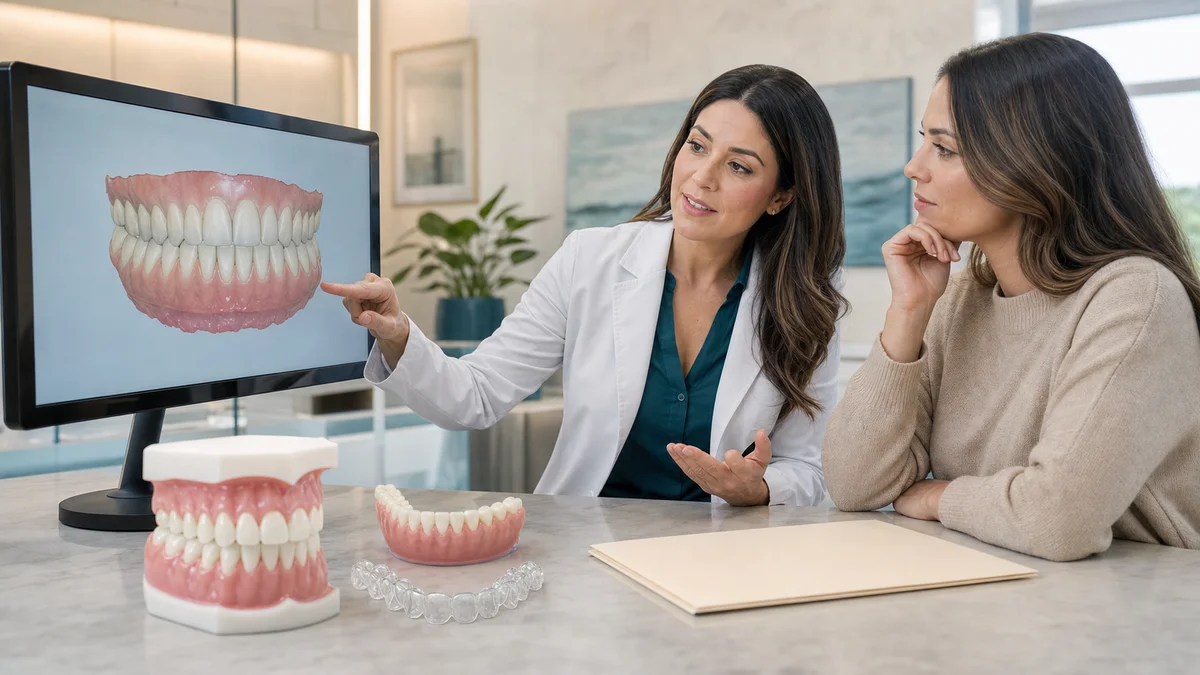
Invisalign single arch cost cannot be calculated safely by dividing a two-arch fee in half. Treating only the upper or lower arch may involve fewer aligners, but diagnosis, digital planning, bite assessment, clinical monitoring, attachments, refinements and retention can still be required. A lower headline price is meaningful only when the treatment is suitable and the written quote defines exactly what is included.
Single-arch clear aligner treatment can be appropriate for selected, limited tooth movements. It is not automatically appropriate when the teeth in one arch look mildly crowded. Upper and lower teeth function together, so moving one arch can change how they meet. The British Orthodontic Society warns that limited treatment focused on front teeth may worsen an existing bite in unsuitable cases and recommends assessment of all diagnostic criteria and alternatives.
This guide explains the clinical and financial questions behind invisalign single arch cost without publishing a fixed price or promising a result. Only a dentist or orthodontist who has examined your teeth, gums, jaw relationship and records can decide whether one-arch treatment is reasonable. The final fee can then be presented in the relevant currency, with its scope, conditions and possible additional charges made clear.
Quick answer: Invisalign single arch cost depends on case complexity, number of aligners, records, attachments, monitoring, refinements, retention and local professional fees. One arch is not automatically half the price of two because planning and supervision still cover the whole bite. Ask for an examination-led diagnosis and a written, itemised quote that states inclusions, exclusions and alternatives.
What does Invisalign single arch cost actually cover?
A “single arch” generally means that active aligner movement is planned for either the upper teeth or the lower teeth, rather than both. It does not mean that the other arch can be ignored. The untreated teeth form the opposing surface against which the moving teeth must fit, guide and function. For that reason, responsible planning evaluates the entire mouth even if appliances are supplied for one arch.
This whole-mouth evaluation is part of invisalign single arch cost even when the prescription supplies aligners for only one jaw.
The manufacturer’s current cost information does not publish one universal fee. It states that the treating doctor determines cost according to case complexity and the number of aligners required. This is an important starting point: invisalign single arch cost is a professional treatment fee, not simply the retail price of a stack of plastic trays.
- Clinical examination of teeth, gums, existing dental work and jaw function
- Diagnostic records such as photographs, digital scans and indicated radiographs
- Digital movement planning for the treated arch and bite review against the other arch
- Aligners, attachments, interproximal reduction or other planned clinical procedures
- Progress appointments, fit checks and management of tracking problems
- Defined refinement policy and post-treatment retainers
Some quotes bundle all these items; others separate them. Neither structure is inherently wrong, but it must be transparent. Comparing invisalign single arch cost requires matching like with like rather than choosing the smallest number before confirming the clinical scope.
12 factors that shape a single-arch clear aligner quote
The table below shows why two people asking about invisalign single arch cost may receive different plans. It deliberately avoids fixed monetary figures because fees depend on examination findings, location, provider arrangements, currency, treatment scope and timing.
| Quote factor | Why it matters | Question to ask |
|---|---|---|
| 1. Diagnosis and records | Scans alone do not assess every aspect of periodontal health, restorations, roots or bite. | Which examination and records are included? |
| 2. Movement complexity | Simple alignment differs from rotation, space closure, intrusion, extrusion or root control. | Which movements are planned, and why is one arch suitable? |
| 3. Number of aligners | A longer prescribed series can increase laboratory, planning and monitoring requirements. | How many initial aligners are anticipated? |
| 4. Bite relationship | Moving one arch may improve, preserve or worsen how upper and lower teeth meet. | How will my bite change at the end? |
| 5. Attachments and auxiliaries | Tooth-coloured attachments, elastics or other features may be needed for control. | Are placement and removal included? |
| 6. Interproximal reduction | Selected cases may need carefully planned enamel reduction to create space. | Is it proposed, and what are the alternatives? |
| 7. Clinical appointments | Monitoring confirms fit, tissue health and whether teeth are tracking as planned. | How many visits are included and where do they occur? |
| 8. Refinements | Additional aligners may be considered if planned movements are incomplete. | How many refinement rounds or what time window is included? |
| 9. Retainers | Retention is needed after active movement to help maintain the result. | Which retainers and how many sets are included? |
| 10. Oral health treatment | Caries, gum inflammation or failing restorations may need care before or during treatment. | Are these services separate from the aligner quote? |
| 11. Replacement policy | Lost, damaged or poorly fitting aligners may require replacement or reassessment. | What happens and what may cost extra? |
| 12. Location and finance | Professional fees, taxes, insurance rules, currency and financing terms vary. | What is the total cash price and the total financed cost? |
A quote should also identify the treating clinician, expected review pattern and the circumstances that could change the plan. This turns invisalign single arch cost from a marketing figure into a decision document.
When reviewing invisalign single arch cost, mark every uncertain item for written clarification before comparing totals.
Why one arch is not automatically half the price
Some costs may fall when only one arch receives aligners, especially if the case needs a smaller product package or fewer trays. Other costs do not halve. The clinician still needs to diagnose the entire bite, review both arches, create and approve a movement plan, monitor oral health and manage retention. Practice time, records, professional responsibility and follow-up remain substantial.
The untreated arch may also influence what is achievable. If a lower front tooth is moved into a position that collides with an upper tooth, the apparent cosmetic improvement can create a functional problem. Sometimes a small amount of coordinated movement in both arches is safer or more stable than pushing one arch toward a visual target in isolation. That is why invisalign single arch cost should be compared with the clinically appropriate alternative, not with an imagined “half plan.”
A two-arch proposal does not necessarily mean the provider is upselling. Equally, a one-arch proposal is not automatically conservative. The reasoning should be visible in the records and explained in plain language: what will move, what will not move, how the bite is expected to finish and what compromises remain.
A fair discussion of invisalign single arch cost explains why the proposed scope is clinically proportionate rather than merely cheaper.
When can single-arch treatment be reasonable?
Limited treatment may be considered when the concern is modest, the bite is stable, movements are predictable within the planned scope and the opposing arch does not need coordination. Examples might include selected minor relapse or local alignment, but these examples are not a suitability test. Root position, gum and bone support, restorations and previous orthodontic history can change the decision.
The British Orthodontic Society describes limited or short-term orthodontics as treatment that often focuses on the front teeth in one or both arches. It says this can address selected adult cosmetic concerns only when diagnostic criteria are assessed and comprehensive orthodontic and restorative alternatives are also presented. This supports a cautious interpretation of invisalign single arch cost: lower scope should follow diagnosis, not replace it.
- The desired movement is limited and clearly defined.
- The existing bite can safely accommodate the planned change.
- Teeth and gums are healthy enough for orthodontic movement.
- The patient understands the cosmetic and functional limits.
- A retention plan is accepted before treatment starts.
Suitability can change after examination or records. A responsible clinician may recommend treating both arches, using a different appliance, completing dental care first or not starting orthodontics. These are clinical outcomes of assessment, not pricing failures.
For a suitable limited case, invisalign single arch cost should still include a documented endpoint and retention strategy.
When treating both arches may be safer
Coordinated movement may be needed when crowding, spacing, overbite, overjet, crossbite, midline relationships or contacts between upper and lower teeth must be corrected together. If one arch is already compensating for the other, moving only the visible irregular teeth can reduce space for the opposing teeth or make contacts less balanced. Complex movement, extraction spaces or significant root control can also exceed the scope of limited treatment.
The U.S. Food and Drug Administration notes that clear aligners may not work for every set of teeth and that the dentist or orthodontist must determine suitability after examination. The FDA also explains that orthodontic movement relies on slow pressure affecting the bone around teeth; faster is not inherently safer. These principles matter when evaluating invisalign single arch cost against a shorter timeline or cosmetic-only promise.
If both-arch treatment is advised, ask the clinician to show the specific bite issue. A visual explanation using scans, photographs or study models can distinguish a necessary coordinated plan from a vague recommendation. You can also ask what compromise would remain if one arch were treated alone.
This comparison allows invisalign single arch cost to be weighed against function and stability, not appearance alone.
Records and examinations included in the fee
Digital scanning is useful, but it is only one part of diagnosis. A clinical examination reviews decay, gum inflammation, periodontal support, tooth mobility, wear, restorations, missing teeth and jaw function. Photographs document appearance and relationships. Radiographs may be indicated to assess roots, bone, impacted teeth or other findings; the type and need should be justified for the individual patient.
The manufacturer states that Invisalign treatment begins with a licensed dentist or orthodontist and a customised plan, with ongoing check-ups to track progress. The American Dental Association likewise warns against moving teeth without a licensed dentist’s oversight because unknown oral conditions can lead to serious harm. A credible invisalign single arch cost therefore includes or clearly accounts for appropriate professional assessment.
Ask whether records taken elsewhere can be used, whether new records are necessary and who owns or can provide copies. If you may move or travel, clarify how records and treatment responsibility can be transferred. A cheap scan-only offer can become expensive if comprehensive assessment, imaging or follow-up must be purchased separately.
The records included in invisalign single arch cost should be listed separately from optional cosmetic imaging or convenience services.
Initial aligners, refinements and tracking
The initial aligner series reflects the first approved digital plan. Teeth do not always follow a simulation exactly. Fit, wear time, attachment integrity, biological response and the complexity of movement can affect tracking. A clinician may modify instructions, replace an attachment, rescan or prescribe additional aligners after reassessment.
“Refinements included” is not precise enough for comparing invisalign single arch cost. The quote should state whether refinements are limited by number, time, clinical indication or product terms. It should also explain whether new scans, appointments, attachments and replacement retainers are included. No provider can responsibly guarantee that a refinement will never be needed or that every requested cosmetic change is biologically achievable.
Patient cooperation matters but does not eliminate professional responsibility. Aligners generally need to be worn for the prescribed daily duration and changed according to instructions. If a tray stops fitting, forcing the next one without advice can compound a tracking problem. Contact the treating team and follow the documented plan.
A realistic invisalign single arch cost policy states how tracking concerns are reviewed and when additional fees might apply.
Retainers are part of the real lifetime cost
Teeth can move after active orthodontic treatment, so retention is discussed from the beginning rather than as an optional accessory at the end. The FDA describes retainer use as the next stage after aligner treatment, directed by the dentist or orthodontist. The British Orthodontic Society also advises clinicians to explain the likely need for long-term retention when treatment is planned.
A transparent invisalign single arch cost quote should identify the type and number of retainers, whether the untreated arch also needs retention, the review schedule and the replacement policy. Retainers can wear, crack, distort or be lost. Future replacement may be a separate cost, even when the first set is included.
Retention instructions are individual. Do not assume that a single treated arch means only one retainer or a shorter retention period. The clinician considers the original problem, movements completed, bite and previous relapse. A plan that omits retention may look less expensive while failing to show the real path for maintaining the result.
For long-term comparison, add expected retainer replacement to the initial invisalign single arch cost rather than treating it as an unrelated surprise.
Attachments, enamel reduction and other procedures
Small tooth-coloured attachments can help an aligner grip a tooth and express a planned movement. Some cases use elastics or other auxiliaries. Selected plans may include interproximal reduction, in which a carefully measured amount of enamel is reduced between teeth to create space. These procedures require consent, technique and monitoring; they should not appear as unexplained additions on the final invoice.
Ask whether attachment placement and removal, polishing, replacement and any planned enamel reduction are included in invisalign single arch cost. Also ask what happens if the plan changes. A treatment simulation is a planning tool, not a guarantee, and any material change should be explained before extra procedures or fees are accepted.
Existing crowns, bridges, implants, veneers or large fillings can affect movement and attachment bonding. These restorations do not automatically exclude aligner treatment, but they may change the plan. Necessary restorative or periodontal treatment is usually a separate service, so the quote should distinguish oral-health preparation from the orthodontic package.
Clear separation keeps invisalign single arch cost understandable when other dental work must be completed before movement begins.
Insurance, financing and currency questions
Insurance coverage varies by country, plan, age, diagnosis, waiting period, annual or lifetime limit and provider network. The manufacturer’s U.S. cost page notes that some dental plans cover orthodontic treatment by a percentage or fixed amount, but it also says coverage varies. A promotional example is not proof that your policy will pay. Obtain benefit verification and, where available, written pre-authorisation directly from the insurer.
Financing can spread payments, but the monthly amount is not the total price. Compare deposit, term, interest, administrative fees, late-payment rules, cancellation terms and total repayable amount. For treatment in another country, also consider exchange-rate movement, card charges, travel, accommodation and the cost of unplanned return visits. These are separate from the clinic’s invisalign single arch cost.
- Ask for the cash price and total financed price in the same currency.
- Confirm whether tax is included and how long the quote remains valid.
- Verify insurance benefits with the insurer, not only with a calculator.
- Check refund and cancellation terms before paying a deposit.
- Budget for retainers, replacements and travel if they are excluded.
No article can confirm your insurance entitlement. Policy wording and insurer decisions control coverage, and clinically suitable treatment remains the priority whether or not a particular benefit is available.
Insurance reimbursement changes the patient’s net expense, but it does not change the clinical scope of invisalign single arch cost.
How to compare two Invisalign single arch cost quotes
Place quotes side by side only after confirming that they address the same diagnosis and intended outcome. One may cover limited front-tooth alignment, while another may include coordinated bite correction. A lower invisalign single arch cost can be entirely reasonable for a smaller clinical objective, but it is not cheaper if it omits services you will predictably need.
- Write down the diagnosis, treated arch and agreed treatment objective.
- Confirm who is responsible for planning and every clinical review.
- List records, aligners, attachments, enamel reduction and appointments.
- Record refinement limits and the date or condition on which they end.
- Identify the retainer type, quantity, fitting visit and replacement price.
- Separate essential dental treatment from optional cosmetic services.
- Add travel, currency, insurance and financing costs to the same total.
- Read cancellation, transfer and missed-appointment policies.
Do not compare treatment on price alone. Compare clinical scope, professional oversight, access to urgent advice and what happens if teeth do not track. A clear plan should be understandable without relying on verbal promises.
The best invisalign single arch cost comparison uses one checklist and one currency for every provider under consideration.
Red flags in a low-cost offer
A discount is not itself a safety problem. Concern arises when a seller offers treatment without an adequate oral examination, cannot identify the responsible licensed clinician, guarantees a finish, dismisses the bite, avoids explaining records or gives no route for in-person assessment. The ADA strongly opposes direct-to-consumer dentistry that removes licensed dental oversight because tooth movement without full knowledge of oral health can contribute to bone loss, gum recession, tooth loss, bite problems and jaw pain.
Be cautious when invisalign single arch cost is advertised as an instant fixed fee before anyone knows the condition of your gums, roots, restorations or bite. A provisional starting figure can be useful, but it should be clearly labelled and followed by a personal assessment. The final written plan should identify expected treatment, risks, benefits, limitations and alternatives.
- No examination or no clear plan for indicated radiographs
- No named dentist or orthodontist responsible for care
- Guaranteed result, guaranteed timeline or “zero risk” language
- No explanation of the opposing arch and final bite
- Unclear refinement, retainer or replacement fees
- Pressure to pay immediately without time to consider alternatives
Seek another professional opinion if the explanation does not make sense or if the plan conflicts with known dental problems. A second opinion can be especially helpful when one provider recommends a single arch and another recommends comprehensive treatment.
A second opinion can clarify whether invisalign single arch cost reflects a valid limited objective or an unsafe omission.
A safer 7-step decision pathway
A structured process keeps invisalign single arch cost in the right place: after suitability and before informed consent. It also reduces the risk of discovering excluded items after treatment has begun.
- Define the concern: identify whether the goal is cosmetic alignment, relapse correction, bite improvement or another issue.
- Complete the assessment: examine teeth, gums, restorations, jaw relationship and appropriate records.
- Compare options: discuss observation, one arch, both arches, fixed appliances and any restorative alternative relevant to the case.
- Review the simulation carefully: ask what it can and cannot predict and how the opposing arch will contact.
- Read an itemised quote: confirm inclusions, exclusions, refinement limits, retainers and payment terms.
- Plan monitoring: know where reviews occur and whom to contact for pain, poor fit or tissue changes.
- Decide without pressure: consent only when the clinical objective and financial commitment are both clear.
For a personalised discussion, you can review the Redent Klinik English website and use the Redent Klinik contact page to ask about an assessment and the records needed. A fee and treatment recommendation can be confirmed only after individual evaluation; no outcome or fixed price is guaranteed by this article.
Following these steps makes invisalign single arch cost the result of an informed plan rather than the starting assumption.
Frequently asked questions about Invisalign single arch cost
Is Invisalign single arch cost always lower than two arches?
It may be lower in selected cases, but not by a fixed proportion. Diagnosis, records, planning, professional monitoring and retention still involve the whole bite. The product package, number of aligners and clinical scope also matter. Compare itemised plans rather than assuming one arch must cost exactly half.
Can I request only the upper arch to save money?
You can ask, but the clinician must decide whether upper-only movement can finish with safe, functional contacts against the lower teeth. If coordinated movement is needed, treating only the upper arch may create compromise or worsen the bite. The recommendation should be demonstrated with examination findings and records.
In that situation, invisalign single arch cost should be discussed alongside the consequences of leaving the lower arch unchanged.
Does Invisalign single arch cost include retainers?
Not automatically. Some quotes include one or more retainers, while others price them separately. Ask which arch or arches will be retained, what type is proposed, how many sets are included, when they are fitted and how future replacements are charged.
Are refinements included in Invisalign single arch cost?
Policies vary. “Included” may still have a limit based on time, number of refinement rounds, clinical need or product conditions. Confirm whether rescanning, additional aligners, attachments and review appointments are part of the refinement policy. Ask for this in writing before treatment.
How many aligners will a single arch need?
There is no safe universal number. It depends on the starting position, types and amount of tooth movement, biological limits, product plan and how the teeth track. The manufacturer identifies complexity and number of aligners as cost factors. Only a personalised digital plan reviewed by the treating clinician can estimate the initial series.
Will insurance pay for single-arch aligners?
It depends on the policy and jurisdiction. Coverage may be affected by age, orthodontic benefit rules, clinical need, network status, waiting periods and lifetime limits. Ask the insurer for written benefit information or pre-authorisation where available, and do not treat a manufacturer example as confirmation of your entitlement.
Ask the insurer whether it assesses invisalign single arch cost as orthodontic treatment, a limited service or a non-covered cosmetic expense.
Is an online scan enough to confirm Invisalign single arch cost?
A scan shows tooth surfaces and supports planning, but it does not replace a complete dental assessment. Gum and bone health, decay, restorations, roots, jaw function and the bite may require clinical examination and indicated imaging. A final quote should follow adequate diagnosis and identify the licensed professional responsible for care.
Can a single-arch plan correct an overbite or crossbite?
Some bite changes require coordinated movement of both arches or additional mechanics. Suitability depends on the cause and severity, not the name of the appliance. If a provider proposes one arch, ask how the overbite, overjet, crossbite and final contacts will change and what compromise may remain.
What can make Invisalign single arch cost increase later?
Possible additions include treatment for newly identified dental disease, replacement aligners, extra refinements outside the agreed policy, additional records, extended monitoring, retainers or changed treatment goals. An itemised quote and written variation process reduce surprises. New fees should be explained before the related service is provided.
Is the cheapest Invisalign single arch cost the best value?
Not necessarily. Value includes correct diagnosis, a suitable objective, professional oversight, access to reviews, transparent refinement rules and retention. A lower fee may be good value when the scope is genuinely limited and complete; it may be poor value if essential services or follow-up are excluded.
Can treatment time be guaranteed?
No responsible plan can guarantee an exact finish date. Complexity, biology, wear, tracking, appointment attendance and plan changes can affect timing. A clinician can provide an estimate and explain assumptions. Be cautious of offers that promise a fixed result by a fixed date before assessment.
Time-related conditions in an invisalign single arch cost quote should explain what happens if treatment extends beyond the estimate.
Is “Invisalign” the same as every clear aligner?
No. Invisalign is a specific clear aligner brand owned by Align Technology, while “clear aligner” is a broader appliance category. Product systems, clinician arrangements and included services can differ. Confirm the named system in the quote and avoid assuming that every transparent tray is the same branded product.
Conclusion: ask what the quote is designed to achieve
Invisalign single arch cost makes sense only beside a diagnosis, defined objective and bite plan. One-arch treatment may be a proportionate choice for selected limited movement, but fewer trays do not remove the need for whole-mouth assessment, clinician oversight or retention. A higher-scope plan may be safer when upper and lower teeth require coordination.
Ask for the treated arch, planned movements, records, aligners, appointments, refinements, retainers, exclusions and total payment terms in writing. Verify insurance independently and include travel or finance costs in your comparison. The content is prepared for clinical review by Dentist Esma Çevrük Çakır and prioritises informed, patient-safe decision-making; it does not diagnose suitability or guarantee price, timing or outcome.
A transparent invisalign single arch cost plan protects both clinical decision-making and the patient’s financial expectations.
Sources and clinical reference points
- Invisalign: official treatment cost information and factors
- Invisalign: licensed-provider assessment and monitoring
- British Orthodontic Society: limited treatment orthodontics
- British Orthodontic Society: adult orthodontic assessment, fees and retention
- U.S. Food and Drug Administration: clear aligners, wear and retention
- American Dental Association: licensed oversight for tooth movement
- American Dental Association: professional oral-health resources
- World Health Organization: oral health fact sheet
Editorial note: Source pages were checked for current patient guidance and cost caveats. Manufacturer information explains its own product and does not replace independent clinical assessment. Fees, insurance rules and product terms can change, so obtain a dated personal quote and verify benefits directly.