
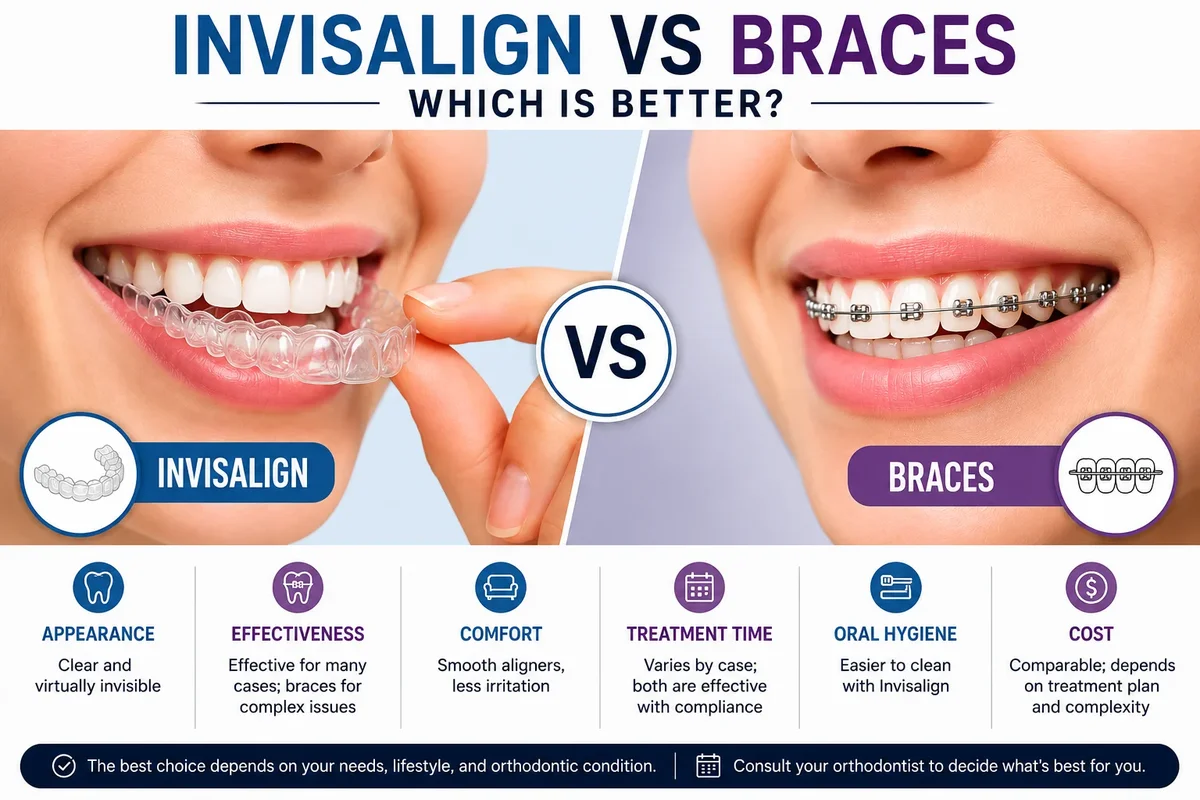
If you are searching for invisalign vs braces which is better, the short answer is that neither treatment is automatically better for everyone. The right choice depends on your bite, the position of your teeth, your daily habits, your treatment goals, and the recommendations of a qualified dentist or orthodontic provider. While Invisalign aligners offer a discreet and removable option, traditional braces remain one of the most effective solutions for correcting a wide range of simple and complex orthodontic problems. Understanding invisalign vs braces which is better begins with looking at your own dental condition instead of focusing only on appearance or price.
Many people compare these two treatments because they want straighter teeth, improved oral health, and a more confident smile. However, choosing between them is not simply a cosmetic decision. Tooth alignment affects how you bite, chew, clean your teeth, and maintain long-term dental health. When considering invisalign vs braces which is better, it is important to understand that every smile responds differently to orthodontic treatment.
Invisalign uses a series of custom-made, clear plastic aligners that gradually move teeth into better positions. Because the aligners are removable, patients can eat normally and brush and floss without brackets or wires getting in the way. Many adults and teenagers appreciate Invisalign because it is less noticeable during everyday life, work, or social events. Nevertheless, successful treatment depends heavily on wearing the aligners for approximately 20 to 22 hours each day. Patients who frequently forget to wear them may experience slower or less predictable progress.
Traditional braces, on the other hand, use brackets and wires that stay attached to the teeth throughout treatment. Although braces are more visible, they provide continuous force without relying on patient compliance. For individuals with severe crowding, significant bite problems, complex tooth rotations, or certain jaw alignment issues, braces may offer more predictable control. Therefore, when asking invisalign vs braces which is better, the answer often depends on the complexity of the orthodontic correction required.
Comfort is another important consideration. Invisalign aligners generally have smooth plastic edges, which may reduce irritation inside the mouth compared with metal brackets. However, each new set of aligners can create temporary pressure as the teeth begin moving. Braces can also cause temporary discomfort after adjustments and may occasionally irritate the cheeks or lips until the mouth adapts. Both treatment methods involve tooth movement, so mild soreness at certain stages is considered normal for many patients.
Daily lifestyle also plays an important role in deciding invisalign vs braces which is better. Invisalign allows patients to remove aligners before meals, making it possible to enjoy nearly any food. Braces require more dietary precautions because sticky, hard, or crunchy foods may damage brackets or wires. At the same time, Invisalign demands discipline because forgetting to wear the aligners consistently can delay treatment. Patients who prefer a treatment that works continuously without needing daily decisions may find braces more suitable.
Appearance is frequently one of the biggest reasons patients choose Invisalign. Adults who work in professional environments or individuals who simply want a less noticeable treatment often appreciate the nearly invisible appearance of clear aligners. However, appearance should not outweigh clinical suitability. If braces are more appropriate for achieving healthy tooth alignment, choosing them may provide a better long-term result. This is why evaluating invisalign vs braces which is better should always include both cosmetic preferences and clinical findings.
Cost is another common concern. There is no universal price that applies to every patient because treatment fees depend on the complexity of tooth movement, treatment duration, geographic location, provider experience, and additional procedures that may be necessary. During a professional consultation, your dentist or orthodontic provider can prepare a personalized treatment plan explaining expected costs and available payment options. It is important not to assume that one treatment is always less expensive than the other.
A comprehensive dental examination is especially valuable if you have severe crowding, missing teeth, gum disease, jaw pain, bite problems, previous orthodontic treatment, or existing dental restorations such as crowns or implants. These factors may influence which treatment is recommended and whether additional dental care should be completed before orthodontic treatment begins.
When researching invisalign vs braces which is better, it is also helpful to rely on trusted professional information. Organizations such as the American Dental Association provide educational resources about oral health and orthodontic care, but individual treatment decisions should always be based on a clinical examination rather than general online information.
If you are considering treatment abroad or would like a personalized assessment, clinics such as Redent Klinik can evaluate your dental photographs, X-rays, and clinical findings before discussing suitable treatment options. If further information or an appointment is needed, you can visit the Redent Klinik Contact Page to request an individual consultation. This evaluation helps determine whether Invisalign, traditional braces, or another orthodontic option is more appropriate for your specific situation.
Practical next step: Instead of asking only invisalign vs braces which is better, ask which treatment is better for your teeth, bite, lifestyle, and long-term oral health. Scheduling a professional orthodontic consultation allows your provider to examine your smile, discuss realistic treatment expectations, explain possible risks and limitations, and recommend a personalized treatment plan based on your individual needs rather than a general comparison.
Quick Answer: Invisalign vs Braces Which Is Better for Most People?
When people search for invisalign vs braces which is better, they are usually hoping for a simple yes-or-no answer. The reality is that there is no universal winner. The better treatment depends on your individual oral health, the complexity of your orthodontic concerns, your lifestyle, your commitment to treatment, and your long-term expectations. For some patients, Invisalign provides an excellent combination of comfort, aesthetics, and convenience. For others, traditional braces remain the most reliable and predictable option for achieving healthy tooth alignment.
If you want the quickest summary of invisalign vs braces which is better, consider this general guideline:
- Invisalign is often suitable for patients who want a discreet treatment and can wear aligners consistently.
- Traditional braces may be more appropriate for complex tooth movement, severe crowding, significant bite correction, or situations where continuous force is beneficial.
- Both treatments can successfully straighten teeth when planned and monitored by qualified dental professionals.
The most important point is that treatment should be selected based on clinical findings rather than popularity or marketing. A professional examination is always more valuable than comparing online opinions alone.
Why There Is No Single Best Treatment
One of the biggest misunderstandings surrounding invisalign vs braces which is better is the belief that one system has replaced the other. In reality, orthodontic technology has expanded rather than eliminated options. Invisalign has become increasingly advanced, while braces continue to evolve with smaller brackets and improved materials. Both systems have strengths and limitations.
Your dentist or orthodontic provider evaluates several important factors before recommending treatment, including:
- The amount of tooth crowding
- Spacing between teeth
- Overbite, underbite, crossbite, or open bite
- Jaw relationship
- Existing dental restorations
- Gum health
- Bone support
- Patient age
- Treatment goals
- Expected cooperation with treatment instructions
Because every smile is different, two patients with similar-looking teeth may receive completely different recommendations.
When Invisalign May Be the Better Choice
For many adults and teenagers, Invisalign offers advantages that make everyday life easier. Patients often appreciate the removable aligners because they allow normal eating habits and easier brushing and flossing. The clear appearance is another significant benefit, especially for individuals who regularly interact with clients, coworkers, or the public.
Common reasons patients choose Invisalign include:
- Less visible during treatment
- Ability to remove aligners while eating
- Simpler oral hygiene routine
- No dietary restrictions while aligners are removed
- Fewer emergency visits related to broken brackets or wires
However, Invisalign requires excellent patient compliance. Aligners should usually be worn for approximately 20 to 22 hours each day. Removing them too frequently may extend treatment time or reduce treatment effectiveness.
Therefore, when asking invisalign vs braces which is better, Invisalign often works best for motivated patients who are willing to follow instructions consistently.
When Braces May Be the Better Choice
Traditional braces continue to be one of the most versatile orthodontic treatments available. Because brackets remain attached to the teeth, they continuously apply force without relying on the patient to remember wearing aligners. This makes braces particularly valuable for younger patients or individuals who may struggle with removable appliances.
Braces are commonly recommended for:
- Severe crowding
- Large tooth rotations
- Complex bite correction
- Significant jaw discrepancies
- Certain cases requiring more controlled tooth movement
Although braces are more noticeable, they often provide highly predictable results in challenging orthodontic situations. Modern braces are also generally smaller and more comfortable than many people expect.
Lifestyle Considerations Matter
Choosing between these treatments is not only about clinical suitability. Lifestyle has a major influence on success. Someone who frequently travels, attends business meetings, or prefers a nearly invisible treatment may naturally lean toward Invisalign. Meanwhile, someone who prefers not to worry about remembering removable aligners may feel more comfortable with braces.
Daily habits also affect treatment. Invisalign users must remove aligners before eating or drinking anything except water and clean them regularly. Braces require additional care around brackets and wires, and certain foods should be avoided to reduce the risk of damage.
Neither option is maintenance-free. Good oral hygiene remains essential regardless of which treatment is selected.
Should Cost Decide Your Treatment?
Many patients searching invisalign vs braces which is better are mainly concerned about cost. While financial considerations are understandable, cost should rarely be the only deciding factor. Treatment fees vary depending on:
- Case complexity
- Treatment duration
- Diagnostic records
- Geographic location
- Provider experience
- Additional dental procedures if required
For this reason, no responsible clinic can promise an exact treatment fee before completing an examination and treatment plan. A personalized consultation provides a much more accurate estimate than general online price comparisons.
Think Beyond Straight Teeth
The goal of orthodontic treatment extends beyond cosmetic improvement. Proper tooth alignment can contribute to easier cleaning, improved bite function, reduced uneven tooth wear, and better long-term oral health. This broader perspective helps patients understand that the question invisalign vs braces which is better is really about choosing the treatment that best supports both appearance and function.
Some patients also benefit from combining orthodontic treatment with restorative or cosmetic dentistry after tooth alignment has been completed. Your treatment plan may therefore include future options that are not immediately obvious during the initial consultation.
Making a Confident Decision
If you remain uncertain about invisalign vs braces which is better, avoid making your decision solely based on advertisements, social media, or before-and-after photographs. A complete clinical evaluation provides information that cannot be seen in online images, including bite relationships, jaw function, gum health, and bone support.
Clinics experienced in comprehensive dental care, such as Redent Klinik, can evaluate your individual situation and explain which treatment options are appropriate based on your specific clinical findings rather than general assumptions.
What to Check Before Choosing Treatment
Before deciding between Invisalign and braces, make sure your consultation includes:
- A complete dental examination
- Digital scans or impressions if appropriate
- Bite analysis
- Discussion of treatment goals
- Estimated treatment duration
- Maintenance requirements
- Possible limitations and risks
- Expected follow-up appointments
- Individual cost estimate based on examination findings
When to request professional advice: Arrange a dental or orthodontic consultation if you have crowded teeth, bite problems, difficulty cleaning between teeth, jaw discomfort, shifting teeth, or questions about whether Invisalign or braces are suitable for your situation. A personalized assessment is the safest way to determine which treatment is most appropriate for your oral health and long-term goals.
Cost Comparison: Invisalign vs Braces Which Is Better for Your Budget?
For many people researching invisalign vs braces which is better, cost is one of the biggest deciding factors. While appearance, comfort, and treatment effectiveness are important, most patients also want to understand how much they are likely to invest and whether one option provides better long-term value. The simplest answer is that there is no universal price difference that applies to every patient. The total investment depends on your individual treatment plan, the complexity of tooth movement, treatment duration, the experience of your dental provider, geographic location, and whether additional dental procedures are needed before orthodontic treatment begins.
Instead of asking only which treatment is cheaper, it is often more useful to ask which treatment delivers the greatest value for your specific dental condition. A treatment with a lower initial cost may not always be the better choice if it cannot predictably achieve your orthodontic goals. Likewise, paying more for features that are not important to your lifestyle may not provide additional value. When evaluating invisalign vs braces which is better, the overall treatment outcome should always be considered alongside the financial investment.
Why Treatment Costs Can Vary So Much
Many online articles publish estimated prices, but these figures should only be viewed as general references. Responsible dental providers do not guarantee treatment costs before completing a comprehensive examination because every orthodontic case is unique. Even patients with similar-looking teeth may require very different treatment plans.
Several factors influence the final treatment cost, including:
- The severity of crowding or spacing
- The complexity of bite correction
- The estimated length of treatment
- The number of aligners or orthodontic adjustments required
- Diagnostic records such as digital scans, photographs, and X-rays
- The need for tooth extractions or other preparatory procedures
- Retention appliances after treatment
- The location and experience of the treating provider
Because of these variables, the question of invisalign vs braces which is better cannot be answered by comparing prices alone. A personalized treatment plan provides a much more meaningful estimate than online averages.
Understanding the Cost Structure of Invisalign
Invisalign treatment involves a series of custom-manufactured clear aligners that gradually reposition the teeth. The number of aligners varies according to the complexity of treatment. Simpler cases may require fewer aligners, while more comprehensive orthodontic correction often involves many additional stages.
Costs associated with Invisalign may include:
- Initial consultation and examination
- Digital scanning or impressions
- Custom aligner fabrication
- Progress evaluations throughout treatment
- Replacement aligners if needed
- Retention appliances after active treatment
Patients often appreciate Invisalign because the removable aligners fit easily into daily life, but consistent wear is essential. If aligners are not worn as instructed, treatment may require refinements that can influence overall treatment planning.
Understanding the Cost Structure of Braces
Traditional braces use brackets and wires that remain attached to the teeth throughout treatment. While the materials differ from Invisalign, braces also require regular professional monitoring to ensure that teeth continue moving safely and efficiently.
Braces commonly include:
- Comprehensive orthodontic assessment
- Bracket placement
- Regular adjustment appointments
- Replacement of damaged components if necessary
- Retention after treatment completion
For patients with complex bite problems or significant crowding, braces may provide excellent value because they can effectively manage many types of tooth movement without relying on removable appliances.
Looking Beyond the Initial Price
When comparing invisalign vs braces which is better, focusing only on the starting fee may overlook important long-term considerations. A successful orthodontic treatment is not simply about moving teeth—it is about achieving stable results while maintaining healthy gums, supporting bone, and proper bite function.
Patients should also consider:
- Appointment frequency
- Expected treatment duration
- Ease of maintaining oral hygiene
- Potential emergency visits
- Lifestyle convenience
- Long-term retention requirements
Sometimes a treatment that appears more expensive initially may reduce other inconveniences that are important to a patient’s lifestyle. Conversely, a lower-cost option may still be the most appropriate if it fully addresses the patient’s orthodontic needs.
Insurance and Financing Considerations
Dental insurance coverage for orthodontic treatment varies considerably depending on the country, insurance provider, policy terms, patient age, and medical necessity. Some plans contribute toward orthodontic treatment regardless of whether Invisalign or braces are selected, while others provide more limited benefits.
Many dental clinics also offer structured payment plans that allow treatment costs to be divided into manageable installments. Availability depends on local regulations and individual clinic policies. Patients should request detailed information about financing during their consultation rather than assuming identical options are available everywhere.
When evaluating invisalign vs braces which is better, reviewing payment flexibility may be just as important as comparing the overall treatment estimate.
How Treatment Complexity Affects Value
The complexity of your orthodontic condition often has a greater influence on value than the treatment method itself. Mild alignment concerns may be successfully managed with either Invisalign or braces. More complicated bite problems may benefit from the additional control that traditional braces can provide. Your dentist or orthodontic provider will evaluate which approach offers the most predictable outcome based on your clinical findings.
This is why responsible providers avoid promising identical treatment times, identical costs, or identical results for every patient. Individual assessment remains essential for selecting the most appropriate treatment.
Making a Smart Financial Decision
Choosing orthodontic treatment is a long-term investment in oral health rather than simply a cosmetic purchase. Before deciding, ask your provider to explain exactly what is included in the proposed treatment plan. Understanding consultation fees, diagnostic records, follow-up appointments, retainers, and possible additional procedures helps prevent misunderstandings later.
Clinics such as Redent Klinik often prepare individualized treatment plans after a detailed examination so patients can compare available options based on their specific needs instead of relying on generalized online information.
Questions Worth Asking During Your Consultation
Before deciding between Invisalign and braces, consider asking:
- Which treatment is clinically more appropriate for my bite?
- How long is treatment expected to take?
- What services are included in the treatment estimate?
- Will retainers be required after treatment?
- How often will follow-up visits be necessary?
- Are payment plans available?
- What factors could change my treatment plan during care?
What to check before making your decision: Compare not only the estimated financial investment but also the expected treatment goals, convenience, maintenance requirements, and long-term oral health benefits. If you have complex bite problems, previous orthodontic treatment, missing teeth, gum disease, or questions about which option best suits your needs, request a comprehensive orthodontic consultation. A personalized clinical evaluation remains the most reliable way to determine whether Invisalign or braces offers the better overall value for your individual situation.
Who Is the Better Candidate? Invisalign vs Braces Which Is Better Based on Your Dental Condition?
One of the most important questions behind invisalign vs braces which is better is not which treatment is newer or more popular, but which treatment matches your individual dental condition. Every patient has a unique combination of tooth alignment, bite relationship, jaw structure, oral hygiene habits, and treatment goals. Because of these differences, the same orthodontic option may be ideal for one person and less suitable for another.
If you are comparing invisalign vs braces which is better, remember that a recommendation should always be based on a clinical examination rather than photographs alone. Digital scans, X-rays, bite analysis, and a full dental assessment help determine which treatment is most likely to provide a healthy and predictable result.
Why Individual Assessment Matters
Orthodontic treatment is designed to improve much more than the appearance of your smile. Proper alignment can contribute to healthier gums, improved chewing efficiency, easier cleaning between teeth, and reduced uneven tooth wear. Choosing the right appliance is therefore an important part of protecting long-term oral health.
When evaluating invisalign vs braces which is better, your dentist or orthodontic provider will usually assess:
- The amount of crowding or spacing.
- The position of each individual tooth.
- Overbite, underbite, crossbite, or open bite.
- Jaw relationship.
- Existing crowns, bridges, implants, or veneers.
- Gum and bone health.
- Patient age.
- Daily lifestyle and treatment expectations.
- Ability to follow treatment instructions consistently.
These clinical findings often influence the treatment recommendation more than patient age or cosmetic preference.
When Invisalign May Be a Good Candidate
Many adults choose Invisalign because the aligners are clear, removable, and fit comfortably into everyday life. However, appearance is only one part of the decision. Invisalign works best when patients are committed to wearing the aligners for approximately 20 to 22 hours every day.
Patients who may benefit from Invisalign include:
- Adults seeking a discreet orthodontic solution.
- Teenagers who are responsible enough to wear aligners consistently.
- Patients with mild to moderate crowding.
- Individuals with spacing between teeth.
- Patients who want to remove aligners during meals.
- People who prioritize easier brushing and flossing.
Modern Invisalign systems can successfully treat many orthodontic conditions that were previously managed mainly with braces. Even so, certain complex movements may still require fixed orthodontic appliances depending on the individual case.
For motivated patients with suitable clinical conditions, invisalign vs braces which is better may lean toward Invisalign because of its convenience and aesthetics.
When Braces May Be the Better Choice
Traditional braces remain one of the most effective orthodontic treatments available. They provide continuous tooth movement because brackets stay attached throughout treatment, eliminating the need for patients to remember wearing removable appliances.
Braces are often recommended for:
- Severe crowding.
- Large tooth rotations.
- Significant bite discrepancies.
- Complex orthodontic treatment plans.
- Cases requiring precise control of tooth movement.
- Patients who may struggle with removable aligners.
Although braces are more visible, they continue to provide highly predictable results across a wide variety of orthodontic situations.
Therefore, when considering invisalign vs braces which is better, braces frequently remain the preferred option for patients whose treatment requires greater mechanical control.
How Age Can Influence Treatment
Both Invisalign and braces are suitable for teenagers and adults, although treatment planning differs according to dental development. Younger patients who still have erupting teeth may require a different orthodontic strategy than fully grown adults.
Adults often choose Invisalign because of its nearly invisible appearance in professional or social environments. Teenagers may also be good candidates if they demonstrate consistent compliance. However, if there are concerns that aligners may not be worn as instructed, braces may provide a more dependable treatment approach.
Age alone rarely determines invisalign vs braces which is better. Clinical findings and patient cooperation usually play a much larger role.
Lifestyle Questions to Ask Yourself
Orthodontic success depends not only on the appliance but also on everyday habits. Before choosing treatment, consider how each option fits into your routine.
You may prefer Invisalign if you:
- Want a less noticeable treatment.
- Can wear aligners consistently every day.
- Travel frequently.
- Prefer unrestricted food choices after removing aligners.
- Are comfortable cleaning aligners regularly.
You may prefer braces if you:
- Prefer not having removable appliances.
- Are concerned about forgetting aligners.
- Need complex orthodontic correction.
- Want continuous treatment without depending on daily compliance.
Answering these questions honestly helps narrow the choice when deciding invisalign vs braces which is better for your lifestyle.
Existing Dental Conditions That Require Special Evaluation
Some dental conditions require additional planning before orthodontic treatment begins. These situations do not necessarily prevent Invisalign or braces, but they may influence treatment sequencing.
- Active gum disease.
- Untreated tooth decay.
- Dental implants.
- Large bridges.
- Multiple crowns.
- Missing teeth.
- Temporomandibular joint (TMJ) symptoms.
- Previous orthodontic treatment.
These conditions should always be discussed during your consultation because they may affect both treatment options and expected outcomes.
Can Cosmetic Goals Be Combined with Functional Improvement?
Many patients begin researching invisalign vs braces which is better because they want a more attractive smile. Cosmetic improvement is certainly an important benefit, but healthy function should remain the primary objective. Proper alignment can improve bite balance, simplify oral hygiene, and reduce unnecessary stress on individual teeth.
After orthodontic treatment, some patients also consider cosmetic procedures such as whitening, bonding, or veneers to further enhance their smile. These decisions should usually be made after tooth alignment has been completed so that restorations are planned around the final tooth positions.
Making the Right Decision for Your Situation
Rather than asking which treatment is universally superior, focus on which option best matches your diagnosis, lifestyle, expectations, and oral health goals. Experienced clinics such as Redent Klinik evaluate these factors together before recommending an individualized treatment plan. This approach helps ensure that recommendations are based on clinical evidence instead of general assumptions.
No online comparison can replace a comprehensive examination. Even detailed articles cannot evaluate your bite, jaw relationship, gum condition, or treatment complexity without professional assessment.
What to Check Before Choosing Between Invisalign and Braces
Before making your final decision, make sure you understand:
- Your exact orthodontic diagnosis.
- The complexity of your case.
- Expected treatment duration.
- Your role in treatment compliance.
- Oral hygiene requirements.
- Retention needs after treatment.
- Possible limitations of each option.
- Whether additional dental treatment is recommended before orthodontics.
When to request professional advice: Schedule a consultation if you have crowded teeth, bite problems, jaw discomfort, shifting teeth, previous orthodontic treatment, missing teeth, or extensive dental restorations. A complete examination—including digital imaging when appropriate—can determine whether Invisalign or traditional braces are the better choice for your specific dental condition and long-term oral health goals.
Treatment Process Explained: Invisalign vs Braces Which Is Better from Start to Finish?
When comparing invisalign vs braces which is better, many people focus on appearance or cost, but the treatment process itself is equally important. Understanding what happens from your first consultation until the day your treatment is completed can help you choose the option that fits both your dental needs and your lifestyle. Although Invisalign and traditional braces share the same ultimate goal—moving teeth into healthier positions—they achieve that goal in different ways, involve different patient responsibilities, and require different types of follow-up care.
The answer to invisalign vs braces which is better often becomes clearer when patients understand exactly what each treatment involves. Knowing what to expect reduces uncertainty and allows you to prepare for each stage of your orthodontic journey.
The Initial Consultation
Every successful orthodontic treatment begins with a comprehensive dental examination. Regardless of whether Invisalign or braces are being considered, your dentist or orthodontic provider needs detailed information before recommending a treatment plan.
The first appointment may include:
- A complete oral examination.
- Digital photographs.
- Digital intraoral scans or impressions.
- X-rays when clinically appropriate.
- Bite analysis.
- Assessment of gum and bone health.
- Review of medical and dental history.
- Discussion of treatment expectations and goals.
This evaluation helps determine whether Invisalign, braces, or another orthodontic solution is the most suitable choice. Without this information, it is impossible to answer invisalign vs braces which is better accurately for an individual patient.
Beginning Invisalign Treatment
If Invisalign is selected, custom clear aligners are created using digital treatment planning. Each aligner is designed to move specific teeth by a small amount before the next aligner continues the process.
Typical Invisalign treatment steps include:
- Digital treatment planning.
- Manufacturing of custom aligners.
- Delivery of the first aligners.
- Placement of small composite attachments if required.
- Regular progress appointments.
- Transition through multiple aligner sets.
- Completion of active treatment.
- Retention phase.
Patients usually change to a new set of aligners according to their provider’s instructions. Success depends heavily on wearing the aligners for approximately 20 to 22 hours each day.
For individuals who consistently follow instructions, invisalign vs braces which is better may favor Invisalign because of its flexibility and discreet appearance.
Beginning Braces Treatment
If braces are recommended, brackets are bonded directly to the teeth and connected with orthodontic wires. Unlike removable aligners, braces work continuously because they remain attached throughout treatment.
The braces process commonly includes:
- Cleaning and preparation of tooth surfaces.
- Bonding brackets.
- Placement of orthodontic wires.
- Periodic wire adjustments.
- Monitoring tooth movement.
- Bracket removal after treatment.
- Cleaning and polishing.
- Retention phase.
Because braces remain fixed, patients do not need to remember wearing an appliance every day. This continuous treatment is one reason braces remain highly effective for many complex orthodontic cases.
Appointment Frequency
One practical consideration when evaluating invisalign vs braces which is better is the number of follow-up appointments required. Both treatments involve regular professional monitoring, although the type of appointment differs.
Invisalign appointments often focus on:
- Checking aligner fit.
- Evaluating tooth movement.
- Providing additional aligners.
- Monitoring treatment progress.
Braces appointments commonly include:
- Adjusting orthodontic wires.
- Replacing elastic components if necessary.
- Monitoring bracket stability.
- Evaluating bite correction.
The exact appointment schedule varies according to each patient’s treatment plan.
Daily Responsibilities During Treatment
The treatment process does not end when you leave the dental office. Daily habits have a significant influence on treatment success.
Invisalign responsibilities include:
- Wearing aligners consistently.
- Removing aligners before eating.
- Cleaning aligners daily.
- Maintaining excellent oral hygiene.
- Changing aligners as instructed.
Braces responsibilities include:
- Careful brushing around brackets.
- Cleaning between wires.
- Avoiding foods that may damage braces.
- Attending adjustment appointments.
- Monitoring for loose brackets or wires.
These routine responsibilities often influence the answer to invisalign vs braces which is better, particularly for patients with demanding work schedules or active lifestyles.
Possible Challenges During Treatment
Both orthodontic systems involve an adjustment period. Mild discomfort after aligner changes or brace adjustments is common because teeth are gradually moving into new positions.
Patients may also experience:
- Temporary pressure after adjustments.
- Minor speech adaptation with new aligners.
- Occasional irritation of cheeks or lips with braces.
- The need for improved oral hygiene routines.
- Temporary dietary adjustments.
These experiences vary from patient to patient and should always be discussed with your dental provider if they become significant or persistent.
What Happens After Active Treatment?
Completing orthodontic treatment does not mean treatment is entirely finished. Teeth naturally tend to shift over time, making retention an essential part of maintaining results.
Retention commonly involves:
- Custom removable retainers.
- Fixed retainers in selected cases.
- Periodic follow-up evaluations.
- Long-term monitoring of tooth stability.
Whether you choose Invisalign or braces, wearing retainers according to professional instructions plays a major role in preserving the outcome achieved during treatment.
How the Treatment Journey Influences Your Decision
Understanding the complete treatment process often helps patients answer invisalign vs braces which is better more confidently. Someone who values flexibility and discreet treatment may appreciate Invisalign’s removable design. Another patient who prefers continuous treatment without depending on daily compliance may find braces to be the more practical solution.
Rather than focusing on isolated advantages, consider how each treatment fits into your routine from consultation through retention. This broader perspective often leads to a better long-term decision.
Clinics experienced in comprehensive treatment planning, such as Redent Klinik, typically explain every stage of the orthodontic journey before treatment begins. This allows patients to understand expected responsibilities, realistic timelines, and available treatment options based on their specific clinical findings.
What to Review Before Starting Orthodontic Treatment
Before beginning Invisalign or braces, make sure you clearly understand:
- Your diagnosis and treatment objectives.
- The estimated treatment timeline.
- Your daily responsibilities.
- Follow-up appointment frequency.
- Retention requirements after treatment.
- Possible limitations and expected adjustments.
- How treatment fits your work, school, or travel schedule.
When to request professional advice: Schedule a detailed orthodontic consultation if you are uncertain about the treatment process, have complex bite problems, previous orthodontic treatment, missing teeth, jaw discomfort, or questions about long-term maintenance. A personalized examination and treatment plan can clarify whether Invisalign or traditional braces is the more appropriate option for your individual dental condition and lifestyle.
Benefits, Limitations, and Risks: Invisalign vs Braces Which Is Better Long Term?
One of the most valuable ways to answer the question invisalign vs braces which is better is to look beyond the first few months of treatment and consider the long-term picture. Orthodontic treatment is an investment in your oral health that may influence your bite, appearance, comfort, and dental maintenance for many years. Both Invisalign and traditional braces have proven benefits, but each option also has limitations and potential risks that patients should understand before making a decision.
Rather than assuming one treatment is always superior, it is more useful to compare how each option performs in real-life situations. Your orthodontic provider will consider your diagnosis, expected tooth movement, lifestyle, and treatment goals before recommending the most appropriate solution. Understanding these factors makes the question invisalign vs braces which is better much easier to answer with confidence.
Long-Term Benefits of Invisalign
Invisalign has become increasingly popular because it combines orthodontic correction with convenience and aesthetics. The clear aligners are designed to fit closely over the teeth, making them much less noticeable than traditional braces. Many adults and older teenagers appreciate this feature, especially in professional or social settings.
Potential long-term advantages of Invisalign include:
- Discreet appearance throughout treatment.
- Removable aligners that allow unrestricted eating.
- Simpler brushing and flossing compared with fixed appliances.
- Reduced likelihood of food becoming trapped around brackets.
- Comfortable smooth plastic surfaces with minimal soft tissue irritation for many patients.
Because aligners can be removed during meals and oral hygiene, many patients find it easier to maintain healthy gums during treatment. Good oral hygiene supports healthier long-term outcomes regardless of which orthodontic system is selected.
Limitations of Invisalign
Although Invisalign offers many benefits, it is not the ideal solution for every patient. One of its biggest limitations is that treatment success depends heavily on patient cooperation. Aligners generally need to be worn for approximately 20 to 22 hours every day to achieve the planned tooth movement.
Potential limitations include:
- Requires excellent daily compliance.
- Aligners must be removed before eating and drinking anything except water.
- Misplacing aligners may interrupt treatment.
- Some complex orthodontic movements may require alternative techniques.
- Speech may temporarily feel different during the adjustment period for some patients.
For patients who know they may struggle with wearing removable appliances consistently, these limitations are important when deciding invisalign vs braces which is better.
Long-Term Benefits of Traditional Braces
Traditional braces have been successfully used for decades and continue to be one of the most reliable orthodontic treatment methods available. Because brackets remain attached throughout treatment, they provide continuous orthodontic force without depending on patient memory or motivation.
Long-term strengths of braces include:
- Suitable for many mild, moderate, and complex orthodontic cases.
- Continuous tooth movement without removable appliances.
- Excellent control for complex bite correction.
- Predictable management of difficult tooth rotations.
- Reduced dependence on patient compliance.
These advantages explain why many orthodontists continue recommending braces for patients with significant alignment or bite concerns.
Limitations of Braces
Like every orthodontic treatment, braces also have disadvantages that patients should consider before making a decision.
Common limitations include:
- Greater visibility during treatment.
- Additional care required while brushing and flossing.
- Dietary restrictions to protect brackets and wires.
- Occasional emergency visits if brackets loosen or wires become damaged.
- Temporary irritation inside the mouth, particularly after adjustments.
Many of these challenges become easier to manage after the first few weeks as patients adapt to their orthodontic appliances.
Understanding Possible Risks
Regardless of whether you choose Invisalign or braces, orthodontic treatment carries certain risks that should be discussed during your consultation. Most patients complete treatment successfully, but informed decision-making requires understanding possible complications.
Potential orthodontic risks may include:
- Temporary tooth sensitivity.
- Mild discomfort during active tooth movement.
- Inflammation if oral hygiene is inadequate.
- White spot lesions caused by plaque accumulation.
- Delayed treatment if appointments are missed.
- Relapse if retainers are not worn after treatment.
- Occasional need for treatment plan modifications.
These risks do not occur in every patient, and many can be minimized through good oral hygiene, regular professional monitoring, and following treatment instructions carefully.
Which Option Supports Better Oral Hygiene?
Patients often ask whether invisalign vs braces which is better from an oral hygiene perspective. Invisalign generally allows easier brushing and flossing because the aligners are removable. However, patients must remember to clean both their teeth and aligners regularly.
Braces require more detailed cleaning because plaque can accumulate around brackets and wires. Using orthodontic brushes, floss threaders, or water flossers may improve cleaning efficiency during treatment. Regardless of the appliance used, maintaining excellent oral hygiene is essential for protecting gums and tooth enamel.
Which Treatment Offers Better Long-Term Stability?
Long-term stability depends less on whether Invisalign or braces were used and more on how well retention instructions are followed after treatment. Teeth naturally tend to shift over time, which is why retainers are commonly recommended after active orthodontic treatment.
Successful long-term outcomes usually depend on:
- Accurate diagnosis.
- Appropriate treatment planning.
- Patient cooperation.
- Regular follow-up care.
- Consistent retainer use.
This means that invisalign vs braces which is better cannot be answered simply by looking at the appliance itself. Long-term success depends on the entire treatment process.
Balancing Appearance, Function, and Lifestyle
Every patient places different importance on appearance, convenience, treatment complexity, and maintenance. Someone who values a discreet orthodontic experience may naturally prefer Invisalign. Another patient who prioritizes maximum control for complex tooth movement may benefit more from braces.
Neither choice is automatically right or wrong. The best option is the one that safely addresses your clinical needs while fitting comfortably into your daily routine.
Experienced providers, including clinics such as Redent Klinik, evaluate all of these factors together before recommending treatment. This individualized approach helps patients make informed decisions based on evidence rather than assumptions.
How to Make a Well-Informed Long-Term Decision
Before selecting either treatment, ask yourself several practical questions:
- Can I wear removable aligners consistently every day?
- Do I have a complex bite problem requiring greater orthodontic control?
- Is appearance during treatment an important priority?
- Will my work or lifestyle influence my treatment choice?
- Am I prepared to wear retainers after treatment?
- Can I maintain excellent oral hygiene throughout treatment?
Answering these questions honestly often provides more useful guidance than comparing advertisements or online rankings.
What to Review Before Choosing Your Treatment
Before making your final decision, review the following with your dentist or orthodontic provider:
- Your complete orthodontic diagnosis.
- The expected benefits of each treatment option.
- Possible limitations based on your specific case.
- Potential treatment risks.
- Long-term maintenance requirements.
- Retention planning after active treatment.
- Your ability to follow treatment instructions consistently.
When to request professional advice: Arrange a comprehensive orthodontic consultation if you have severe crowding, bite irregularities, previous orthodontic treatment, gum disease, missing teeth, jaw discomfort, or uncertainty about long-term treatment expectations. A personalized examination can determine whether Invisalign or traditional braces is more appropriate for your clinical condition, oral health goals, and lifestyle.
Alternatives to Invisalign and Braces: Which Treatment Should You Consider?
Although many people begin their research by asking invisalign vs braces which is better, these are not the only orthodontic or cosmetic treatment options available. Depending on your diagnosis, treatment goals, and overall oral health, your dentist may recommend an alternative approach or even a combination of treatments. Understanding these alternatives helps you make a more informed decision and prevents choosing a treatment simply because it is the most widely advertised.
The most important point to remember is that every treatment has specific indications. An option that works well for one patient may not be appropriate for another. This is why the question invisalign vs braces which is better should always be considered alongside a professional evaluation of your teeth, gums, bite, and jaw relationship.
Why Alternatives May Be Recommended
Not every patient requires comprehensive orthodontic treatment. Some people have only minor cosmetic concerns, while others have missing teeth, worn restorations, gum disease, or jaw-related issues that should be addressed before tooth alignment begins.
Your dentist or orthodontic provider may recommend an alternative if:
- Your teeth are already well aligned.
- The concern is mainly cosmetic rather than functional.
- Existing restorations affect orthodontic planning.
- Active gum disease requires treatment first.
- Missing teeth influence bite stability.
- Another option may achieve your goals more efficiently.
For this reason, the answer to invisalign vs braces which is better sometimes becomes neither option—at least not immediately.
Clear Aligner Systems Other Than Invisalign
Invisalign is one of the best-known clear aligner systems, but it is not the only one. Several orthodontic providers use other clear aligner brands that may be suitable for selected cases. The treatment principles are generally similar, although planning software, materials, manufacturing processes, and clinical protocols may differ.
Potential advantages of alternative clear aligners include:
- Discreet appearance.
- Removable design.
- Digital treatment planning.
- Comfortable daily wear for many patients.
Whether Invisalign or another aligner system is appropriate depends on your provider’s clinical assessment rather than the brand name alone.
Ceramic Braces
Patients who want the effectiveness of traditional braces but prefer a less noticeable appearance may consider ceramic braces. These appliances function similarly to conventional metal braces but use tooth-colored or clear brackets that blend more naturally with the teeth.
Ceramic braces may be suitable for:
- Adults concerned about aesthetics.
- Patients requiring fixed orthodontic treatment.
- Individuals with moderate to complex alignment needs.
Like metal braces, ceramic braces require careful cleaning and regular professional adjustments.
When comparing invisalign vs braces which is better, ceramic braces may represent a useful compromise for some patients who want both discreet appearance and fixed treatment.
Lingual Braces
Lingual braces are attached to the inner surfaces of the teeth instead of the front. Because they are hidden behind the teeth, they are generally not visible during normal conversation.
Potential considerations include:
- Excellent cosmetic appearance.
- Fixed orthodontic treatment.
- Possible speech adaptation during the early stages.
- More detailed cleaning requirements.
- Suitability depends on individual anatomy.
Lingual braces are not appropriate for every patient, and treatment planning requires careful clinical evaluation.
Minor Cosmetic Treatments
Some patients searching for invisalign vs braces which is better are actually more concerned about improving smile appearance than correcting significant orthodontic problems. In selected situations, cosmetic dentistry may provide an alternative or complementary solution.
Possible cosmetic options include:
- Professional teeth whitening.
- Composite bonding.
- Porcelain veneers.
- Minor enamel reshaping when clinically appropriate.
These procedures can improve the appearance of certain teeth but generally do not correct underlying bite problems or major alignment issues. They should not be viewed as direct replacements for orthodontic treatment when functional correction is needed.
When Orthodontics Should Be Delayed
There are situations where neither Invisalign nor braces should begin immediately. Treating underlying oral health conditions first often leads to safer and more predictable orthodontic outcomes.
Your provider may recommend addressing:
- Active gum disease.
- Untreated cavities.
- Dental infections.
- Poor oral hygiene.
- Unstable restorations.
- Certain jaw-related conditions.
Completing these treatments first creates a healthier foundation before orthodontic tooth movement begins.
Combination Treatment Approaches
In some cases, the best solution is not choosing between two treatments but combining several approaches in a carefully planned sequence. Orthodontics may be followed by restorative or cosmetic procedures to achieve both functional and aesthetic goals.
A comprehensive treatment plan may include:
- Orthodontic alignment.
- Professional whitening.
- Composite bonding.
- Replacement of old restorations.
- Dental implants for missing teeth if indicated.
- Long-term retention.
This illustrates why invisalign vs braces which is better is often only one part of a broader oral health strategy.
Factors That Should Influence Your Decision
Instead of choosing treatment based solely on popularity or online reviews, evaluate each option according to your individual circumstances.
Important questions include:
- What is my actual orthodontic diagnosis?
- Is my concern cosmetic, functional, or both?
- Do I have existing crowns, implants, or bridges?
- Can I commit to wearing removable aligners consistently?
- Would a fixed appliance better suit my daily routine?
- Are there underlying dental problems that require treatment first?
Answering these questions often provides more useful guidance than comparing brand names alone.
The Importance of a Personalized Treatment Plan
Every smile is unique. Even patients with similar-looking teeth may require different treatment approaches after digital scans, bite analysis, and clinical examination. Experienced clinics such as Redent Klinik evaluate orthodontic needs together with overall oral health before recommending a personalized treatment plan.
This individualized approach ensures that treatment recommendations are based on clinical findings rather than assumptions or generalized online comparisons.
Making the Best Long-Term Choice
When researching invisalign vs braces which is better, remember that choosing the right treatment is not about selecting the newest technology or the most popular brand. It is about selecting the option that safely addresses your diagnosis while supporting long-term oral health, function, and smile aesthetics.
Sometimes that choice is Invisalign. Sometimes it is traditional braces. In other cases, another orthodontic or restorative solution may provide a better overall outcome.
What to Check Before Deciding on an Alternative
Before choosing any treatment, review the following with your dental provider:
- Your complete diagnosis.
- Whether orthodontics is truly necessary.
- Available alternative treatment options.
- The advantages and limitations of each option.
- Expected maintenance requirements.
- Whether additional dental treatment should be completed first.
- Your long-term oral health goals.
When to request professional advice: Arrange a comprehensive consultation if you are unsure whether Invisalign, braces, ceramic braces, another aligner system, or a combined treatment plan is most appropriate. A detailed examination—including bite assessment and diagnostic imaging when indicated—can identify the treatment option that best matches your oral health, cosmetic expectations, and long-term functional needs.
Payment Options and Treatment Planning: Invisalign vs Braces Which Is Better Financially?
For many patients, the decision about invisalign vs braces which is better is influenced not only by clinical suitability but also by financial planning. Orthodontic treatment is often completed over many months, and understanding how costs are structured can make the process more manageable. While it is natural to compare prices, the best financial decision is not always the option with the lowest initial fee. Instead, patients should consider overall treatment value, what is included in the treatment plan, available payment options, and how well the selected treatment meets their long-term oral health goals.
The question invisalign vs braces which is better becomes much easier to answer when financial considerations are viewed alongside treatment effectiveness, convenience, expected maintenance, and future dental needs. A well-planned orthodontic treatment can contribute to healthier teeth and gums, making it worthwhile to evaluate the complete picture rather than focusing only on the starting price.
Why Personalized Treatment Planning Comes First
Before discussing payment options, your dentist or orthodontic provider must first determine which treatment is clinically appropriate. A financial discussion without an accurate diagnosis may lead to unrealistic expectations because every orthodontic case is different.
A comprehensive treatment plan typically considers:
- The complexity of tooth movement.
- The condition of your bite.
- Estimated treatment duration.
- The number of follow-up appointments.
- Whether additional dental procedures are recommended.
- The type of retention required after treatment.
Because these factors differ from patient to patient, the answer to invisalign vs braces which is better financially should always be based on an individualized treatment plan rather than online averages.
What Is Usually Included in Orthodontic Treatment?
Patients sometimes compare treatment fees without understanding what each provider includes. One clinic may include retainers and follow-up appointments, while another may structure treatment differently. Reviewing these details helps you compare treatment plans more accurately.
Orthodontic treatment may include:
- Initial consultation.
- Clinical examination.
- Digital scans or impressions.
- Diagnostic photographs.
- X-rays when clinically indicated.
- Treatment planning.
- Regular progress appointments.
- Retention after active treatment.
Always ask your provider to explain exactly what is included so you can make an informed financial comparison.
Comparing Long-Term Value Instead of Initial Cost
When researching invisalign vs braces which is better, patients often focus on which treatment appears less expensive at the beginning. However, long-term value depends on much more than the initial investment.
Consider factors such as:
- Whether the treatment is appropriate for your diagnosis.
- Expected treatment efficiency.
- Appointment frequency.
- Convenience during daily life.
- Maintenance requirements.
- Retention after treatment.
- Long-term oral health benefits.
A treatment that fits your lifestyle and clinical needs may provide greater overall value, even if its initial fee differs from another option.
Monthly Payment Plans
Many dental clinics understand that orthodontic treatment represents a significant investment and therefore offer installment or staged payment options when appropriate. Availability depends on local regulations, clinic policies, and individual circumstances.
Payment arrangements may include:
- Initial deposit followed by monthly installments.
- Scheduled payments throughout treatment.
- Clinic-specific financing programs where available.
- Third-party financing depending on the country.
Because payment policies vary, patients should request detailed information directly from the treating clinic during their consultation.
Insurance Considerations
Dental insurance policies differ significantly between providers and countries. Some insurance plans contribute toward orthodontic treatment, while others offer limited or no orthodontic benefits. Coverage may also vary depending on patient age, policy conditions, and clinical indications.
Before beginning treatment, consider asking:
- Does my insurance include orthodontic benefits?
- Are Invisalign and braces covered equally?
- Are there annual or lifetime benefit limits?
- What documentation is required?
- Will pre-authorization be necessary?
These questions can help you understand the financial aspects of invisalign vs braces which is better before treatment starts.
Hidden Costs Patients Sometimes Overlook
When comparing treatment options, patients occasionally focus only on the advertised treatment fee while overlooking additional expenses that may arise during care. Discussing these possibilities in advance helps prevent misunderstandings.
Topics worth reviewing include:
- Replacement retainers.
- Lost aligners if applicable.
- Emergency visits.
- Repairs if orthodontic appliances become damaged.
- Additional treatment if significant changes occur.
Not every patient will experience these situations, but understanding them allows for more realistic financial planning.
Planning Beyond Active Orthodontic Treatment
Completing orthodontic treatment is not necessarily the final stage of smile improvement. Some patients choose additional cosmetic or restorative procedures after tooth alignment has been completed. Whitening, bonding, veneers, or replacing older restorations may be considered depending on individual treatment goals.
Planning these possibilities in advance may help patients prioritize treatment according to both clinical needs and available budget.
This broader perspective often provides a more practical answer to invisalign vs braces which is better than comparing orthodontic treatment alone.
Questions to Ask During Your Financial Consultation
Helpful questions include:
- What is included in the proposed treatment plan?
- How are payments scheduled?
- Will retainers be included?
- Are follow-up visits covered?
- What happens if treatment requires additional time?
- Are replacement appliances included if needed?
- Does my insurance contribute toward treatment?
Having clear answers to these questions helps patients compare treatment plans more accurately and avoid unnecessary uncertainty.
Choosing Value Over Price Alone
The most affordable option is not always the best investment if it does not address your orthodontic needs appropriately. Likewise, choosing a more expensive treatment without clear clinical benefits may not provide additional value. The most effective financial decision balances treatment quality, expected outcome, convenience, maintenance, and long-term oral health.
Experienced providers, including clinics such as Redent Klinik, typically prepare individualized treatment plans so patients understand both the clinical recommendations and the financial aspects before making a decision. This approach allows patients to evaluate Invisalign and braces using information specific to their own diagnosis instead of relying solely on generalized online comparisons.
What to Review Before Making Your Financial Decision
Before selecting your treatment, review the following with your provider:
- Your complete orthodontic diagnosis.
- The recommended treatment option.
- Estimated treatment duration.
- Everything included in the treatment plan.
- Retention requirements after treatment.
- Available payment arrangements.
- Insurance coverage if applicable.
- Potential future maintenance needs.
When to request professional advice: Schedule a comprehensive consultation if you are comparing Invisalign and braces primarily on cost, have insurance questions, require flexible payment arrangements, or are uncertain which treatment offers the best overall value for your dental condition. A personalized examination combined with a detailed treatment plan provides the most reliable foundation for making both a clinical and financial decision.
Frequently Asked Questions About Invisalign vs Braces Which Is Better?
Patients often spend weeks researching invisalign vs braces which is better before scheduling a consultation. While every orthodontic case requires an individual examination, there are several common questions that nearly every patient asks before making a decision. This section answers those frequently asked questions while helping you understand how each answer applies to your own situation. Remember that online information is useful for education, but it cannot replace a comprehensive clinical assessment performed by a qualified dental professional.
The goal of this guide is not to declare one treatment universally superior. Instead, it explains how different factors—including tooth alignment, bite complexity, oral hygiene, lifestyle, and treatment expectations—influence the answer to invisalign vs braces which is better.
Is Invisalign Always Better Than Braces?
No. One of the biggest misconceptions is that Invisalign has completely replaced traditional braces. Modern clear aligners are highly effective for many orthodontic conditions, but braces continue to be an excellent treatment option, especially for certain complex tooth movements and bite corrections.
The better choice depends on:
- Your orthodontic diagnosis.
- The amount of crowding or spacing.
- The complexity of your bite.
- Your commitment to wearing aligners consistently.
- Your treatment priorities.
Therefore, when asking invisalign vs braces which is better, the correct answer is that the most suitable treatment varies from patient to patient.
Which Treatment Usually Works Faster?
There is no fixed answer because treatment duration depends primarily on case complexity rather than the appliance itself. Mild orthodontic corrections may require less time than comprehensive bite correction, regardless of whether Invisalign or braces are used.
Treatment duration may be influenced by:
- Severity of tooth movement.
- Bite correction requirements.
- Patient compliance.
- Attendance at follow-up appointments.
- Overall oral health.
Patients wearing Invisalign should also remember that inconsistent aligner use may prolong treatment.
Which Option Is More Comfortable?
Comfort varies between individuals. Many patients appreciate Invisalign because the aligners have smooth plastic surfaces without metal brackets. Others adapt quickly to braces and experience minimal long-term discomfort.
Temporary pressure is expected with both treatments because controlled tooth movement is occurring. Mild soreness after aligner changes or brace adjustments is common and usually improves as the teeth adapt.
Comfort alone should not determine invisalign vs braces which is better. Clinical suitability remains the most important factor.
Which Treatment Looks Better?
For patients who prioritize appearance during treatment, Invisalign is often preferred because the clear aligners are much less noticeable than traditional braces.
However, appearance should be balanced with treatment effectiveness. If braces are expected to provide better control for your orthodontic condition, choosing them may lead to a healthier long-term result despite being more visible.
Can Adults Wear Braces?
Absolutely. Orthodontic treatment is not limited to teenagers. Many adults successfully complete treatment with both braces and Invisalign.
Adults often seek orthodontic care for:
- Crowded teeth.
- Spacing.
- Bite correction.
- Smile improvement.
- Preparation for restorative dentistry.
Age alone rarely determines invisalign vs braces which is better. Overall dental health and treatment goals are usually much more important.
Will I Need Retainers?
Yes, retainers are commonly recommended after both Invisalign and braces. Teeth naturally have a tendency to move over time, and retainers help maintain the corrected tooth positions achieved during active orthodontic treatment.
Your provider will explain:
- The type of retainer recommended.
- How often it should be worn.
- Long-term maintenance requirements.
- Follow-up review schedule.
Retention is an important part of orthodontic success regardless of which treatment method you choose.
Can Invisalign and Braces Fix the Same Problems?
Many orthodontic problems can be treated successfully using either Invisalign or braces. However, some complex tooth movements, jaw relationships, or bite corrections may be managed more effectively with fixed appliances depending on the individual case.
This is why digital scans, X-rays when indicated, and bite analysis are valuable before making treatment decisions.
Which Option Is Easier to Keep Clean?
Many patients believe Invisalign makes oral hygiene simpler because aligners are removable before brushing and flossing. This allows direct access to tooth surfaces without brackets or wires.
Braces require more detailed cleaning around orthodontic components, but excellent oral hygiene is still achievable with proper brushing techniques and regular professional guidance.
Regardless of treatment choice, maintaining healthy gums and controlling plaque are essential for successful orthodontic outcomes.
Can Missing Teeth or Dental Crowns Affect Treatment?
Yes. Existing restorations such as crowns, bridges, veneers, or implants may influence orthodontic planning. Missing teeth can also affect bite stability and treatment sequencing.
These situations do not automatically prevent Invisalign or braces, but they should always be evaluated during a comprehensive consultation.
Patients with previous restorative dental treatment should inform their orthodontic provider before beginning treatment.
Should Cost Be the Main Deciding Factor?
Financial planning is certainly important, but cost should not be the only factor when comparing invisalign vs braces which is better. The treatment that best addresses your clinical needs often provides greater long-term value than selecting an option based solely on price.
When reviewing treatment estimates, consider:
- Clinical suitability.
- Treatment duration.
- Appointment schedule.
- Retention.
- Daily convenience.
- Long-term oral health.
What Happens During the Consultation?
A comprehensive orthodontic consultation generally includes a detailed examination of your teeth, gums, bite, and jaw relationship. Digital scans, photographs, or X-rays may also be recommended when clinically appropriate.
During the appointment, your provider typically discusses:
- Your diagnosis.
- Available treatment options.
- Expected treatment process.
- Estimated treatment duration.
- Maintenance requirements.
- Possible limitations.
- Personalized financial planning.
Clinics such as Redent Klinik use this information to prepare individualized treatment recommendations based on your unique clinical findings rather than relying on generalized comparisons.
Final Questions You Should Ask Yourself
Before deciding between Invisalign and braces, ask yourself:
- What are my main treatment goals?
- How important is appearance during treatment?
- Can I consistently wear removable aligners?
- Am I prepared for long-term retainer use?
- Do I understand the maintenance requirements?
- Have I received a professional diagnosis?
Answering these questions honestly often provides greater clarity than reading dozens of online comparisons.
What to check before requesting professional advice: Make sure your consultation includes a complete orthodontic examination, bite analysis, discussion of treatment alternatives, estimated treatment timeline, retention planning, and an opportunity to ask questions about your specific dental condition. If you have crowded teeth, bite concerns, previous orthodontic treatment, missing teeth, jaw discomfort, or uncertainty about which option best fits your lifestyle, schedule a personalized orthodontic evaluation before making your final decision.
Final Decision: Invisalign vs Braces Which Is Better for You and What Should You Do Next?
After reviewing the differences between treatment methods, costs, suitability, risks, maintenance, and long-term expectations, many people still return to the same question: invisalign vs braces which is better? The most accurate conclusion is that there is no single answer that applies to every patient. The right treatment is the one that safely addresses your orthodontic needs while fitting your lifestyle, expectations, and long-term oral health goals. Choosing between Invisalign and braces is not about following trends—it is about selecting the option that provides the most appropriate clinical solution for your individual smile.
If you have read this guide from beginning to end, you have probably realized that the discussion about invisalign vs braces which is better is much broader than appearance alone. Factors such as bite function, treatment complexity, oral hygiene, compliance, maintenance, and future dental health all contribute to the final recommendation.
Step 1: Define Your Treatment Goals
Before comparing orthodontic systems, take a moment to identify what you hope to achieve. Different patients begin treatment for different reasons, and understanding your priorities helps guide the discussion with your dentist or orthodontic provider.
Common treatment goals include:
- Straighter teeth.
- Improved smile appearance.
- Correction of crowding or spacing.
- Better bite function.
- Easier oral hygiene.
- Preparation for restorative dental treatment.
- Improved long-term oral health.
Your personal objectives influence whether Invisalign, braces, or another orthodontic option is likely to be recommended.
Step 2: Consider Your Daily Lifestyle
The answer to invisalign vs braces which is better often depends on how treatment fits into your everyday routine. A treatment that complements your lifestyle is generally easier to complete successfully.
You may appreciate Invisalign if you:
- Prefer a discreet appearance.
- Can wear aligners consistently every day.
- Want flexibility during meals.
- Travel frequently.
- Value simplified brushing and flossing.
You may prefer braces if you:
- Would rather not manage removable aligners.
- Have a complex orthodontic diagnosis.
- Prefer continuous treatment without daily decisions.
- Need greater orthodontic control for specific tooth movements.
Being realistic about your daily habits often leads to a better treatment experience.
Step 3: Think Beyond Cosmetic Appearance
Many patients initially compare Invisalign and braces because they want a more attractive smile. Although aesthetics are important, orthodontic treatment should also improve function whenever possible. Correcting bite problems can contribute to healthier chewing patterns, improved tooth positioning, and easier oral hygiene.
When considering invisalign vs braces which is better, remember that the healthiest long-term result is usually more valuable than selecting a treatment based only on appearance.
Step 4: Understand That Every Case Is Different
Even patients with similar-looking smiles may receive completely different recommendations after a professional examination. Digital scans, bite analysis, photographs, and clinical findings provide information that cannot be evaluated accurately from online images or general articles.
Factors influencing treatment selection include:
- Severity of crowding.
- Spacing between teeth.
- Bite relationship.
- Jaw alignment.
- Bone support.
- Gum health.
- Existing crowns, bridges, or implants.
- Previous orthodontic treatment.
These clinical findings are often more important than patient age or treatment preference.
Step 5: Balance Cost with Overall Value
Financial planning is naturally part of the decision-making process, but value should be considered alongside cost. A treatment that appropriately addresses your orthodontic condition may provide greater long-term benefits than selecting the least expensive option available.
When reviewing treatment plans, compare:
- Clinical suitability.
- Expected treatment duration.
- Appointment schedule.
- Maintenance requirements.
- Retention after treatment.
- Long-term oral health objectives.
This balanced approach provides a more meaningful answer to invisalign vs braces which is better than comparing fees alone.
Step 6: Prepare Questions Before Your Consultation
A successful consultation is a conversation rather than simply a diagnosis. Preparing questions in advance helps ensure that you fully understand your available treatment options.
Consider asking your provider:
- Which treatment is most appropriate for my diagnosis?
- Why is this option recommended?
- What are the expected benefits?
- What limitations should I understand?
- How long might treatment take?
- What maintenance will be required?
- Will retainers be necessary afterward?
- How will treatment fit into my lifestyle?
Clear communication allows you to make a confident and informed decision.
Step 7: Why Personalized Treatment Planning Matters
No article, video, or online comparison can determine the best orthodontic treatment for your specific smile. A comprehensive examination allows your provider to evaluate your teeth, bite, jaw relationship, and overall oral health before recommending an individualized treatment plan.
Clinics such as Redent Klinik focus on personalized treatment planning rather than one-size-fits-all recommendations. By reviewing your clinical findings, digital records, and treatment goals together, the dental team can explain which option is most appropriate for your situation and why.
This individualized approach helps patients understand that invisalign vs braces which is better is ultimately a clinical decision supported by personal preferences—not the other way around.
Making a Confident Decision
Choosing orthodontic treatment is an important decision, but it does not have to be confusing. By understanding your diagnosis, asking informed questions, comparing realistic advantages and limitations, and working closely with an experienced dental professional, you can move forward with confidence.
Whether your treatment plan involves Invisalign, traditional braces, or another orthodontic solution, the objective remains the same: creating a healthier, more functional, and more confident smile through evidence-based care and individualized planning.
Your Practical Next Step
If you are still uncertain about invisalign vs braces which is better, avoid making a decision based solely on advertisements, online reviews, or before-and-after photographs. Instead, arrange a comprehensive orthodontic consultation where your diagnosis can be evaluated using appropriate clinical examinations and diagnostic records.
During your consultation, ask your provider to explain:
- Your exact orthodontic diagnosis.
- Whether Invisalign or braces is recommended and why.
- The expected treatment process.
- Estimated treatment duration.
- Daily care requirements.
- Retention after treatment.
- Possible alternatives if appropriate.
- Individualized financial planning based on your case.
What to check before requesting professional advice: Make sure your teeth and gums are evaluated comprehensively, your bite is carefully assessed, and your treatment goals are clearly discussed. Request professional advice if you have crowding, spacing, bite irregularities, jaw discomfort, previous orthodontic treatment, missing teeth, or uncertainty about which orthodontic option best matches your lifestyle. A personalized consultation provides the most reliable foundation for deciding whether Invisalign or traditional braces is the right choice for your long-term oral health and smile goals.
Disclosure: this page may contain affiliate links. We may earn a commission if you use them, at no extra cost to you.