
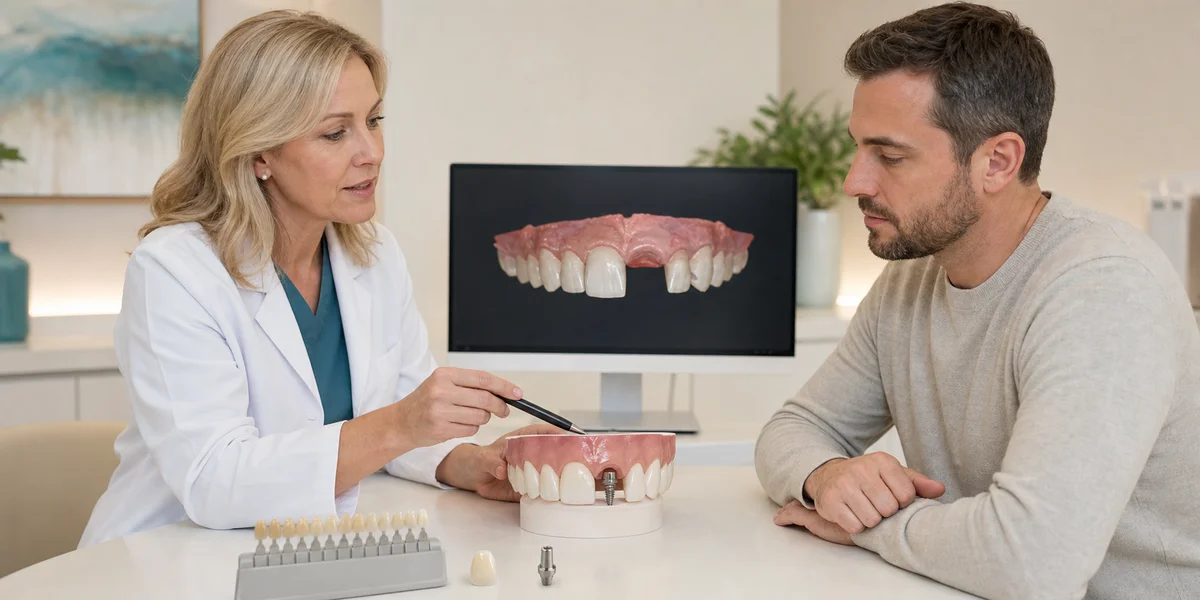
Lateral incisor implant cost is not the price of one screw. Replacing the small tooth beside an upper central incisor can involve diagnosis, space assessment, implant surgery, an abutment, a provisional tooth, a custom crown, gum shaping, reviews, and—only when clinically necessary—bone or soft-tissue augmentation. The front of the smile is technically demanding because millimetres of tooth position, gum height, colour, and symmetry can affect the final appearance.
Quick answer: lateral incisor implant cost should be based on an itemized treatment plan after clinical examination and appropriate imaging. Confirm whether the quote includes extraction, grafting, implant, abutment, provisional tooth, final crown, sedation, reviews, and complication care. Compare the diagnosis and scope—not headline prices—and ask whether a bridge or orthodontic space closure is clinically reasonable.
A missing lateral incisor may result from congenital absence, trauma, failed root-canal treatment, decay, resorption, or an unrestorable fracture. Those starting points do not require identical care. Someone with a healed site and adequate bone has a different pathway from a growing teenager with a congenitally missing tooth or an adult who needs an infected tooth removed. That is why a responsible lateral incisor implant cost estimate follows diagnosis rather than preceding it.
This guide explains cost drivers and decision points without offering a fixed fee, remote diagnosis, or outcome guarantee. A dentist must examine the mouth, review health and medication history, assess growth where relevant, evaluate the bite and gums, and interpret suitable imaging. Patients considering treatment abroad should also plan continuity of care at home. For an individualized assessment, use the Redent Klinik contact page; the Redent Klinik English homepage provides the clinic’s general service information.
1. What a lateral incisor implant actually replaces
A single-tooth implant restoration has several distinct parts. The implant body is placed in the jaw and acts as an artificial root. An abutment connects that implant to the visible crown. The crown is shaped and shaded to resemble the missing lateral incisor. A screw may secure the components, or a crown may be cemented to an abutment, depending on the design. Each component, appointment, and laboratory stage can influence lateral incisor implant cost.
The US Food and Drug Administration describes dental implants as medical devices surgically placed in the jaw and notes that the implant body, abutment, and fixation screw may form the system. The American Dental Association’s patient information similarly explains that a single-tooth implant receives a customized crown after the bone heals around the implant. These sources support asking whether a quote covers the complete restoration rather than implant placement alone.
Front-tooth treatment has an additional aesthetic challenge: the new crown sits beside the central incisor and canine, where differences in length, brightness, translucency, contact points, or gum contour can be conspicuous. The narrow space may also affect implant diameter and angulation. A low advertised lateral incisor implant cost cannot show whether those planning steps are included.
- Diagnostic phase: examination, photographs, periodontal assessment, scans, and treatment planning.
- Surgical phase: extraction if required, implant placement, and any clinically justified augmentation.
- Temporary phase: a provisional tooth that protects appearance while avoiding harmful pressure.
- Restorative phase: abutment, final crown, try-in, bite adjustment, and delivery.
- Maintenance phase: hygiene instruction, professional reviews, and management of future wear or disease.
2. Why lateral incisor implant cost cannot be quoted safely from a photo
A smile photograph can help explain aesthetic goals, but it cannot measure bone width, reveal infection, confirm root positions, show the facial bone plate, diagnose gum disease, or establish whether implant space is adequate. Even a panoramic image may not answer every three-dimensional question. The clinician decides what imaging is justified and should minimize exposure while obtaining the information needed for safe care.
The starting diagnosis changes the scope. If a retained baby tooth is healthy, preservation may sometimes be discussed. If an adult tooth is fractured, the possibility of restoration must be assessed before extraction. If the tooth is congenitally absent, orthodontic history, skeletal growth, space distribution, and symmetry matter. Therefore, lateral incisor implant cost should be presented after options are compared, not used to force every patient into an implant pathway.
General health matters too. The FDA advises patients to discuss benefits, risks, candidacy, and healing with their dental provider; it identifies smoking, uncontrolled diabetes, local infection, and untreated periodontal disease among factors that can affect healing or complications. Medication history, previous radiotherapy, immune conditions, bleeding risk, allergies, and pregnancy considerations may change timing or require medical coordination. This is clinical planning, not an optional upgrade hidden inside lateral incisor implant cost.
3. Lateral incisor implant cost: consultation, records, and digital planning
A complete consultation usually examines the missing-tooth space, neighboring roots, central incisor and canine health, gum phenotype, smile line, bite, tooth proportions, plaque control, and available bone. Photographs and scans can help communicate the desired crown position. A diagnostic wax-up or virtual setup may be useful because the planned crown should guide implant placement, rather than placing the implant first and trying to make a crown fit afterward.
When comparing lateral incisor implant cost, ask whether the planning fee includes all diagnostic records or whether CBCT imaging, intraoral scanning, surgical-guide design, and specialist opinions are separate. A surgical guide may help transfer a digital plan in selected cases, but it does not replace surgical judgment and is not essential in every case. The value lies in appropriate case selection and execution, not simply adding technology.
Interdisciplinary planning may involve an orthodontist, periodontist, oral surgeon, prosthodontist, restorative dentist, or dental technician. More than one professional does not automatically mean better care, yet a narrow or poorly positioned space may genuinely require coordination. Patients should understand who is responsible for each stage and who makes the final decision if the surgical and restorative requirements conflict.
4. How extraction timing changes lateral incisor implant cost
If the lateral incisor is still present but cannot be restored, extraction technique and timing may affect the plan. Immediate implant placement means placing an implant at the extraction appointment; it does not mean the final tooth is always fitted immediately. Early or delayed placement allows different healing periods. Each pathway has indications, limitations, and provisional-restoration needs.
A recent systematic review of single anterior maxillary implants found that different placement and loading protocols can perform well in appropriately selected patients, while tissue and aesthetic outcomes vary. A randomized trial focused on missing maxillary lateral incisors also reported comparable assessed outcomes between immediate provisional restoration and a one-stage approach under its strict inclusion protocol. These studies do not prove that immediate treatment is best for every patient or that it should reduce lateral incisor implant cost.
Active infection, damaged socket walls, thin facial bone, implant instability, gum recession, or an unfavorable bite may lead the clinician to recommend a staged approach. The plan should explain whether extraction, socket preservation, implant placement, and provisionalization occur together or separately. It should also identify what happens if surgery reveals conditions different from those expected.
5. Bone grafting and lateral incisor implant cost
The implant needs a three-dimensional envelope of bone that supports placement in a prosthetically useful position. After tooth loss or trauma, the ridge may be thin, particularly on the facial side. Bone augmentation may be proposed before or during implant placement, but it should not be treated as an automatic line item for every missing lateral incisor.
For a clear lateral incisor implant cost estimate, ask what clinical finding makes grafting necessary, what material is proposed, where it comes from, whether a membrane is used, and whether grafting changes the timeline. The consent discussion should cover realistic alternatives and material-specific risks. A graft can support treatment goals, but it adds biology, healing time, expense, and uncertainty; it is not merely a cosmetic accessory.
Some narrow ridges may be managed with different implant dimensions or orthodontic strategies, while others require augmentation to avoid a compromised position. Narrow-diameter implants have been studied for lateral-incisor sites, but limited studies and selected cases cannot establish a universal solution. The safest question is not “Can grafting be avoided?” but “Which option provides a maintainable crown and healthy tissue in my anatomy?”
6. Soft-tissue shaping within lateral incisor implant cost
Gum architecture strongly affects whether a lateral-incisor crown looks natural. The height of the gum margin, fill of the papillae, tissue thickness, implant depth, and crown emergence profile are interdependent. A provisional crown may be adjusted gradually to guide tissue shape, which can add appointments and laboratory work to lateral incisor implant cost.
Thin tissue can be more vulnerable to visible recession or color show-through. A connective-tissue graft may be discussed in selected cases, but it is a separate procedure with its own donor-site or biomaterial considerations. Patients should ask whether the recommendation addresses health, tissue volume, aesthetics, or several goals. The clinician should avoid guaranteeing identical gum levels to the natural opposite tooth.
A recent systematic review and network meta-analysis comparing treatments for missing maxillary lateral incisors found no single approach superior across every periodontal, occlusal, and aesthetic outcome. That matters when evaluating lateral incisor implant cost: a more complex implant plan is not automatically the best plan. Orthodontic space closure or a tooth-supported replacement can sometimes better match the patient’s age, anatomy, priorities, or tolerance for surgery.
7. Why the provisional tooth affects lateral incisor implant cost
Most patients do not want to leave a front-tooth appointment with a visible gap. Temporary options may include a removable tooth, a resin-bonded provisional, an orthodontic retainer containing a tooth, or an implant-supported provisional in carefully selected cases. The provisional must protect appearance and speech without applying destabilizing pressure to a healing implant or graft.
When reviewing lateral incisor implant cost, identify which provisional is included, how many adjustments are expected, and what replacement costs apply if it breaks or is lost. A temporary that is suitable for one stage may not work throughout a longer grafting and healing pathway. If orthodontic retainers are involved, responsibility for adjustments should be clear.
Immediate provisionalization is not synonymous with immediate loading in normal function. The bite may be deliberately relieved so the temporary crown does not contact heavily. The FDA notes that implant healing may take several months or longer, although individual timing varies. Patients should receive practical instructions for eating, cleaning, and recognizing movement or pain.
8. Implant, abutment, and crown choices inside lateral incisor implant cost
Implant systems differ in connection design, dimensions, components, documentation, and availability of replacement parts. The FDA recommends asking for the brand and model and keeping it in personal records. A treatment plan should state whether genuine compatible components are used and whether replacement components can be obtained where the patient lives. Brand recognition alone does not guarantee an outcome, but traceability supports future care.
The abutment may be prefabricated or custom and may use titanium, zirconia, or a combination such as a ceramic structure on a titanium base. The final crown may be monolithic or layered ceramic. These choices can influence masking, translucency, strength, retrievability, and lateral incisor implant cost. The correct option depends on implant angle, tissue thickness, available space, bite, and the desired optical result.
A screw-retained crown can often be removed by accessing the screw channel, while a cement-retained design may help in certain angulations but requires careful cement control. Neither is universally best. Ask where the screw access would emerge, how residual cement will be prevented, and whether the restoration can be serviced without damage.
9. Decision table for lateral incisor implant cost
This table helps compare scope. It is not a price list and cannot determine candidacy.
| Decision point | What should be documented | Why it changes the plan |
|---|---|---|
| Site diagnosis | Reason for tooth loss, infection status, bone and gum findings | Determines whether preservation, extraction, staging, or augmentation is considered |
| Space and roots | Crown width, root positions, bite, and any orthodontic need | An implant must fit safely and support a correctly proportioned crown |
| Bone management | No graft, simultaneous graft, or staged graft with named materials | Adds surgery, healing, materials, and follow-up |
| Temporary tooth | Type, delivery timing, adjustments, and replacement policy | Maintains appearance while protecting healing tissues |
| Restoration | Implant system, abutment, crown material, retention, and laboratory | Changes aesthetics, serviceability, and component cost |
| Aftercare | Included reviews, hygiene visits, imaging, and emergency pathway | Clarifies long-term responsibility and likely additional fees |
| Alternative plan | Bridge, resin-bonded bridge, space closure, or monitored retention | Allows informed consent rather than a price-only decision |
10. What an itemized lateral incisor implant cost should include
A meaningful quote separates mandatory treatment from conditional procedures. It also states its validity period, currency, tax position, payment schedule, cancellation terms, and what could change after surgery. Comparing only the headline lateral incisor implant cost can be misleading when one clinic bundles the crown and reviews while another advertises only implant placement.
- consultation, periodontal assessment, photographs, and indicated radiographs or CBCT;
- digital setup, diagnostic wax-up, or surgical guide when clinically planned;
- tooth extraction and management of infection, if applicable;
- implant fixture, cover screw or healing abutment, and surgical placement;
- bone graft, membrane, or soft-tissue graft only if specified and justified;
- temporary tooth, its adjustments, and any replacement during healing;
- second-stage surgery if the implant is covered during healing;
- custom or stock abutment, final crown, laboratory work, and shade appointments;
- local anaesthesia, prescribed medicines, sedation if requested and suitable;
- postoperative visits, final review, maintenance plan, and emergency contact route.
Ask whether the estimate changes if the implant cannot be placed on the planned day. A safe provider should have a contingency pathway rather than continuing at all costs. Also ask whether a failed component, lost temporary, extra graft, remake for shade, or management of complications is included, discounted, or charged separately. These answers make lateral incisor implant cost more transparent without pretending every event can be predicted.
11. Insurance, financing, and total lateral incisor implant cost
Dental benefit plans differ by country, employer, policy, waiting period, annual maximum, exclusions, and definitions of medical necessity. The ADA’s consumer guidance notes that some plans exclude implants, apply least-expensive-alternative clauses, or restrict coverage for a tooth missing before the policy began. Patients should request a written pre-treatment estimate but understand that it is not always a payment guarantee.
Submit procedure codes, radiographs, clinical notes, and the full proposed sequence when the insurer requests them. Ask whether surgical and restorative claims are assessed separately and whether grafts, sedation, temporary teeth, and the crown have distinct limits. Insurance contribution should be deducted from the complete lateral incisor implant cost, not assumed from a promotional percentage.
Financing can spread payments but may add interest, fees, or penalties. Compare the total repayable amount, not only a monthly figure. Treatment abroad can offer a different fee structure, yet travel, accommodation, additional visits, time away from work, and local follow-up affect the real total. Redent Klinik patients should receive written staging and understand which appointments must occur in person.
If the patient returns home between stages, both clinics need adequate records. Obtain implant system details, component sizes, scans or radiographs, operative notes, graft materials, prescriptions, and crown information. Before accepting a travel-based lateral incisor implant cost, ask who will evaluate unexpected pain, a loose temporary, infection, or component failure after return.
12. Alternatives to compare with lateral incisor implant cost
An implant is one option, not the automatic answer to every missing lateral incisor. Alternatives may include orthodontic space closure with canine reshaping, a resin-bonded bridge, a conventional bridge, a removable temporary or definitive appliance, retention of a suitable primary tooth, or postponement with monitoring. Suitability depends on age, growth, tooth positions, enamel, bite, space, gum display, health, and patient preference.
A resin-bonded bridge may avoid implant surgery and substantial preparation of neighboring teeth in selected cases, but it can debond and needs suitable enamel and occlusion. A conventional bridge may provide reliable replacement in some situations but generally involves preparing supporting teeth. Orthodontic space closure can avoid a prosthetic replacement, though it requires movement, reshaping, and retention planning. Each alternative has costs, maintenance, and possible complications.
The most ethical discussion compares expected pathway, reversibility, tissue effects, maintenance, aesthetics, and patient burden—not only lateral incisor implant cost. A 2025 network meta-analysis found no significant aesthetic difference between orthodontic space closure and implants within the limits of the available studies, while periodontal findings remained complex. That evidence favors individualized shared decision-making over a universal ranking.
Risks, red flags, and lateral incisor implant cost
Dental implants can restore appearance and function, but complications can occur early or later. The FDA lists risks including injury to nearby teeth or tissues, infection, delayed healing, implant loosening or loss, bite problems, difficulty cleaning, and possible nerve-related symptoms. The anterior upper jaw is generally away from the lower-jaw nerve canal, but neighboring roots and the nasal region still demand precise planning.
No provider should promise painless treatment, guaranteed integration, permanent results, or an identical match to a natural tooth. Be cautious when lateral incisor implant cost is offered without examination, when grafting is declared mandatory before imaging, or when brand slogans replace discussion of diagnosis. Pressure to pay immediately can undermine informed consent.
- Who will perform surgery and who will design and fit the final crown?
- What findings make me a candidate, and what findings could change the plan?
- Are my neighboring roots and crown space adequate without orthodontics?
- What temporary tooth will I wear and how will it avoid loading the site?
- Which complications require urgent contact, and who provides that care?
- What implant identification and treatment records will I receive?
- How will hygiene, gum health, bite, and radiographic findings be monitored?
Frequently asked questions about lateral incisor implant cost
Is lateral incisor implant cost lower because the tooth is small?
Not necessarily. A smaller crown does not eliminate diagnostic imaging, surgical time, implant components, an abutment, provisionalization, laboratory work, or follow-up. The lateral-incisor space may be narrow and aesthetically demanding. The treatment can require orthodontic coordination or tissue management even though the visible tooth is small. Compare full scope and complexity rather than crown size.
Does the quote usually include the crown?
There is no universal convention. Some advertisements describe only the implant fixture and surgery; others bundle the implant, abutment, temporary, and final crown. Ask for those components as separate written lines. A quote that excludes the crown is not a complete lateral incisor implant cost, because the implant body alone does not replace the visible tooth.
Will I always need a bone graft?
No. Grafting depends on the three-dimensional bone envelope, planned implant position, extraction history, tissue goals, and clinician assessment. Some patients have adequate bone; others need simultaneous or staged augmentation. Ask to see the finding that supports the recommendation and request the proposed material, timing, alternatives, risks, and separate fee.
Can the implant and tooth be completed in one day?
Selected patients may receive an implant and non-functional provisional crown on the same day, but the final crown and normal loading may still wait for healing. Infection, bone defects, low primary stability, tissue concerns, or bite forces can make a staged plan safer. Same-day marketing should never override site-specific diagnosis.
When is implant treatment considered for a congenitally missing lateral incisor?
Timing requires assessment of skeletal and dental growth, orthodontic space, root positions, bone, bite, and alternatives. An implant does not move like a natural tooth during continuing growth, so age alone is an unreliable green light. Orthodontic and restorative teams may coordinate the definitive plan while providing a temporary replacement.
Can insurance reduce lateral incisor implant cost?
Possibly, but coverage varies widely. A plan may cover certain diagnostic, surgical, or crown procedures while excluding implants, applying annual limits, or paying only toward a less expensive alternative. Request written preauthorization or a pre-treatment estimate and verify waiting periods, missing-tooth clauses, deductibles, coinsurance, and lifetime or annual maximums.
Why can two implant quotes differ so much?
They may include different records, implant systems, grafts, temporary teeth, abutments, crown materials, laboratory services, sedation, reviews, and complication policies. Provider training, clinic location, currency, and travel requirements also matter. Reformat both quotes into the same itemized checklist before deciding whether the difference reflects scope or merely pricing.
What should I keep after treatment?
Keep the implant brand, model, diameter, length, connection, component details, graft records, operative notes, radiographs, crown material, and clinician contacts. These records help another dentist identify compatible parts and understand the site. The FDA specifically recommends retaining implant brand and model information for future reference.
How long will a lateral incisor implant last?
No clinician can guarantee a fixed lifespan. Implant and crown outcomes depend on health, healing, position, restoration design, hygiene, gum disease, smoking, bite forces, maintenance, and unforeseen complications. The crown, screw, or abutment may need service even when the implant remains integrated. Regular professional review is part of protecting the result.
How to make a safer lateral incisor implant cost decision
Begin with diagnosis and options, then compare complete written plans. Confirm who is responsible for surgery, temporary teeth, the final restoration, and maintenance. Ask which steps are definite and which are conditional. Make sure the plan accounts for the opposite lateral incisor, smile line, gum symmetry, root space, bite, and future cleanability. Only then does lateral incisor implant cost become a useful decision variable.
A sound decision need not be the fastest or most technologically elaborate. It should be explainable, anatomically feasible, maintainable, and aligned with informed patient priorities. Allow time to review consent documents and obtain another opinion if the alternatives or contingency plan are unclear. Urgent infection or trauma may require prompt care, but definitive aesthetic rehabilitation usually deserves careful planning.
Evidence and patient-information sources
- US Food and Drug Administration: Dental Implants—What You Should Know
- American Dental Association MouthHealthy: Implants
- American Dental Association MouthHealthy: Choosing the Right Dental Plan
- American Academy of Periodontology: Single-Tooth Dental Implants
- PubMed: implant placement and loading protocols for single anterior maxillary implants
- PubMed: missing maxillary lateral incisor treatment outcomes
- PubMed: randomized trial of restorations for a missing maxillary lateral incisor
- American Dental Association
- World Health Organization: Oral Health