
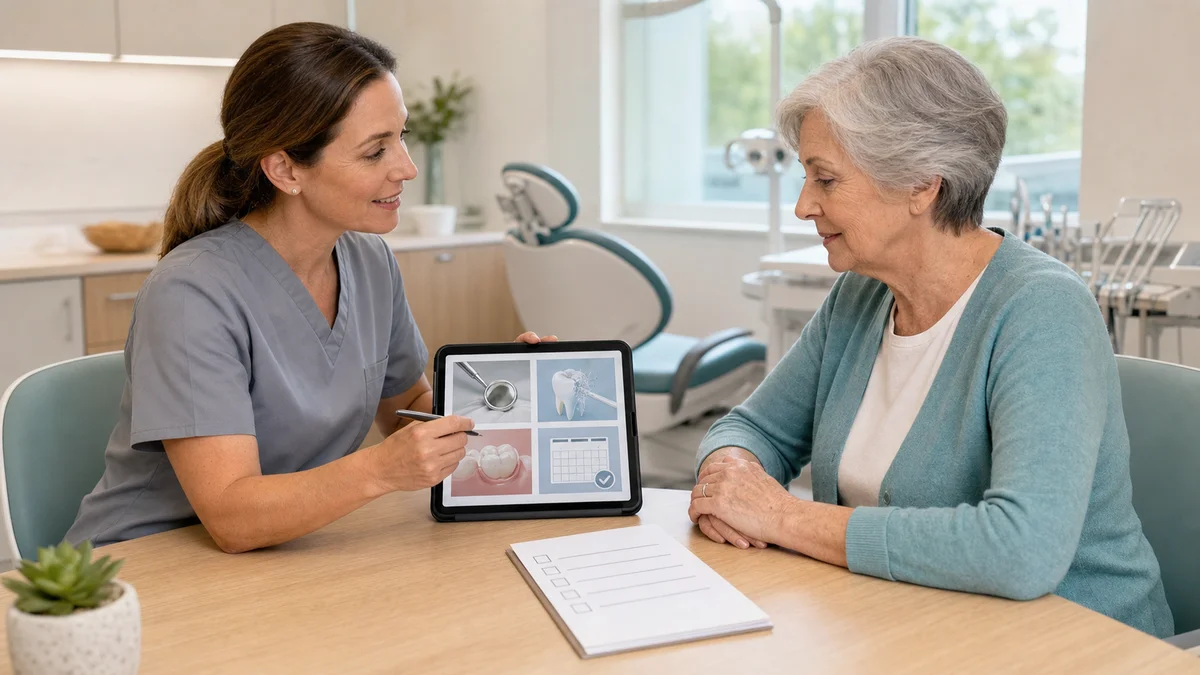
Quick answer: To find low cost dentists for seniors, start with an examination-based priority list, then contact HRSA health centers, dental or dental-hygiene schools, state and local health departments, Area Agencies on Aging, Medicaid, Medicare Advantage or VA resources if applicable. Confirm eligibility, services, waiting times and fees directly. Compare written quotes and financing terms; do not delay urgent infection, swelling or trauma.
A search for low cost dentists for seniors often begins after a tooth breaks, a denture becomes painful or a fixed income makes a proposed treatment feel impossible. The useful goal is not merely to locate the smallest advertised fee. It is to find licensed, clinically appropriate care with a complete price, realistic timing, accessible follow-up and a plan that protects health and function.
This guide focuses mainly on United States resources because Medicare, Medicaid, HRSA and VA rules are country-specific. Coverage, eligibility, networks and waiting lists change, so every program must confirm your current status. Nothing here is a diagnosis, referral, coverage promise or price quotation. A licensed dentist must examine the mouth, review medical history and explain reasonable alternatives before treatment.
Clinical review: Prepared for review by Dentist Esma Çevrük Çakır. The guide prioritises patient safety, informed consent, preservation of healthy tissue and access to appropriate care over promotional price claims.
1. Define what “low cost” must include
For low cost dentists for seniors, affordability is the total cost of reaching a stable clinical endpoint, not a coupon for one procedure. A discounted exam may still lead to laboratory fees, imaging, extractions, periodontal treatment, temporary restorations, relines, repairs or specialist care. Transport, time away from a caregiver and repeat visits can also affect the real burden.
Start by naming the immediate problem and the desired outcome. Pain relief, infection control, the ability to chew, denture stability and preserving a restorable tooth are different goals. Ask the dentist to separate urgent disease control from definitive rehabilitation and elective appearance changes. This creates a staged plan that can be priced and compared without sacrificing necessary care.
A useful low cost dentists for seniors search therefore begins with a written problem list rather than a discount code.
Use a complete-cost question
Ask: “What will it cost to diagnose, stabilise and complete this problem, including likely follow-up?” For low cost dentists for seniors, request the cash fee, insurance estimate, sliding-fee amount and financed total separately. If the final treatment cannot yet be known, ask which finding would change the plan and price.
2. Start with the federal NIDCR care-finding guide
The National Institute of Dental and Craniofacial Research has an official “Finding Dental Care” page. It recommends contacting dental schools, dental-hygiene schools, state or local health departments and community resources such as 2-1-1. It also explains that NIDCR is a research institution: it does not provide routine dental treatment, referrals, second opinions or financial assistance.
This warning matters when searching for low cost dentists for seniors. NIDCR specifically cautions that messages claiming the institute provides dental implants or financial assistance are likely fraudulent. Use links from official government domains, avoid paying anyone who claims to “unlock” an NIH grant and never send identity or banking details in response to an unsolicited message.
Save the official NIDCR page as the first verified checkpoint in your low cost dentists for seniors research.
- Open the NIDCR resource page and note the options relevant to your state.
- Call the clinic or program directly to confirm that it accepts new adult patients.
- Ask whether it treats your problem, not merely whether it “offers dental.”
- Confirm documents, income verification, appointment length and waiting time.
- Request language, mobility, hearing or caregiver accommodations when needed.
3. Search HRSA health centers by location
Health Resources and Services Administration-funded health centers are community clinics that can provide medical, dental and other services. HRSA states that health centers adjust fees based on income and family size, serve everyone even if they cannot pay and may offer patient support such as transport assistance. However, each site’s dental scope, capacity and schedule can differ.
Use the official HRSA Find a Health Center tool, then call before travelling. When evaluating low cost dentists for seniors, ask whether the listed location itself provides dental care or refers elsewhere. A referral provider’s fees may work differently. Ask for the dental sliding-fee discount schedule and the documentation used to determine it.
Keep each HRSA site’s answers in the same low cost dentists for seniors comparison sheet so service gaps remain visible.
Questions for a health center
- Is the sliding-fee application based on household income and family size?
- Are examinations, preventive care, fillings, extractions and dentures all available?
- Do different dental services use different discount schedules?
- Are laboratory, denture, implant or specialist charges treated separately?
- Is there an urgent-care queue, cancellation list or transportation support?
HRSA guidance allows separate sliding-fee schedules for service types such as preventive and additional dental services. It also notes that supplies such as dentures may be charged under a different approach. Do not assume that qualifying for a discounted exam fixes every later fee.
4. Call dental and dental-hygiene schools
NIDCR identifies dental schools as a common source of reduced-cost care. Students treat patients under faculty supervision, and dental-hygiene schools may provide supervised preventive services. These settings can be valuable low cost dentists for seniors pathways, particularly when a patient can attend longer or more frequent appointments.
Lower fees may come with trade-offs: screening appointments, teaching schedules, longer visits, semester breaks, eligibility criteria and limited treatment types. A school may provide fillings or dentures but refer complex surgery, sedation or medically complicated care. Ask who supervises, who manages an emergency after hours and what happens if treatment crosses an academic term.
Add the screening visit and expected appointment count to the full low cost dentists for seniors budget.
Compare time as well as price
For a senior who needs transport, a caregiver or time-sensitive infection control, multiple long visits can add hidden costs. When comparing low cost dentists for seniors, include travel, parking, meals, missed work for a caregiver and the number of expected visits. A slightly higher local fee may be more manageable than a distant teaching clinic.
5. Ask state and local health departments
NIDCR recommends contacting state or local health departments about free or reduced-cost programs. Programs may be run by counties, public hospitals, mobile units, nonprofit partners or periodic community events. Availability is local and may depend on income, residency, disability, age, insurance status or the type of treatment needed.
When asking for low cost dentists for seniors, describe the clinical need precisely: urgent pain, broken denture, extraction, filling, hygiene, oral lesion, or replacement teeth. A list labelled “dental resources” may include clinics that offer only screenings or preventive care. Confirm the service and eligibility before relying on the referral.
A local program belongs on a low cost dentists for seniors shortlist only after it confirms the needed procedure and follow-up.
6. Use Eldercare Locator and Area Agencies on Aging
The Eldercare Locator is a public service of the U.S. Administration for Community Living. It connects older adults and families with local services and Area Agencies on Aging. It is not a dental insurer, yet it can help identify community programs, transport, benefits counselling, caregiver support and local organisations that know the access landscape.
For low cost dentists for seniors, ask the local agency about dental clinics, transportation benefits, homebound services, benefits counsellors and organisations that assist with applications. Use the official locator rather than a commercial lead-generation directory. A genuine referral should still be verified with the dental provider.
Transportation and caregiver support can determine whether a low cost dentists for seniors option is genuinely accessible.
Accessibility information to request
Ask about step-free access, transfer assistance, accessible toilets, appointment length, a quiet waiting area, interpreter services, large-print forms and whether a trusted supporter may attend. Cost is not the only access barrier. The safest clinic is one that can accommodate mobility, sensory, cognitive and communication needs without undermining the patient’s autonomy.
7. Understand Original Medicare dental limits
Medicare’s official dental-services page states that Original Medicare usually does not cover routine dental care such as cleanings, fillings, tooth removal, dentures or implants. Limited dental services can be covered when they are directly related to certain covered medical treatments, such as specified transplant, cancer, heart-valve or dialysis care. The rules are narrower than many people expect.
Do not assume that turning 65 creates a routine dental benefit. When comparing low cost dentists for seniors, ask Medicare or the plan—not only the dental office—whether a service is covered. A dentist can provide clinical notes and codes, but Medicare determines coverage. Request an explanation of any non-covered service before treatment.
Record the coverage answer next to the written low cost dentists for seniors treatment estimate rather than subtracting an assumed benefit.
Medically necessary is not the same as generally dental
A painful or important dental procedure is not automatically a covered medical service under Original Medicare. The official examples depend on a direct connection to specified covered treatment. Ask the medical team and Medicare what documentation, timing and provider requirements apply; do not rely on a general “medically necessary” label.
8. Verify Medicare Advantage dental benefits each year
Some Medicare Advantage plans may offer extra dental benefits that Original Medicare does not. Benefits vary by plan and can change. A plan may limit networks, covered procedures, annual allowances, frequency, laboratory categories or prior authorisation. “Dental included” does not reveal what a particular crown, denture or periodontal service will cost.
Before choosing low cost dentists for seniors through a Medicare Advantage directory, call both the plan and the dental office. Verify that the individual dentist—not merely the group name—is in network at that location, that the office accepts new plan members and that the needed procedure is covered. Record the date, representative and reference number.
Repeat the low cost dentists for seniors benefit check whenever the plan year, provider or treatment code changes.
- Ask for the evidence of coverage and current provider directory.
- Confirm deductibles, copayments, coinsurance and yearly limits.
- Check waiting periods, prior authorisation and referral rules.
- Ask how dentures, implants, crowns and periodontal care are classified.
- Confirm out-of-network consequences and appeal instructions.
9. Check Medicaid adult dental coverage in your state
The Centers for Medicare & Medicaid Services explains that states choose which dental benefits to provide adult Medicaid enrollees; there are no federal minimum requirements for adult dental coverage. Benefits, provider networks and limits therefore differ by state and may change. Dual eligibility for Medicare and Medicaid does not produce identical dental benefits everywhere.
For low cost dentists for seniors, contact the state Medicaid agency or managed-care plan using the number on the member card. Ask about the exact procedure, participating providers, authorisation, benefit limit and whether transport is available. A clinic saying it “takes Medicaid” may accept only certain plans or only existing patients.
A state-specific low cost dentists for seniors list should name the exact Medicaid plan, not only “Medicaid.”
10. Explore VA dental care and VADIP if relevant
VA dental eligibility is not automatic for every Veteran. The Department of Veterans Affairs assigns benefits based on factors such as service-connected dental conditions, disability status, former prisoner-of-war status, timing after discharge, rehabilitation participation and other circumstances. Eligible classes receive different scopes of care.
Veterans researching low cost dentists for seniors should use the official VA dental eligibility page and contact VA directly. Veterans enrolled in VA health care, and certain CHAMPVA beneficiaries, may also be eligible to purchase private coverage through the VA Dental Insurance Program. VADIP is insurance, not a promise that every procedure is free.
Place the confirmed VA benefits class or VADIP terms beside any private low cost dentists for seniors quote.
11. Use this 11-point decision table
| Option | What to verify | Possible trade-off |
|---|---|---|
| HRSA health center | Dental scope, sliding-fee documents, supplies and referrals | Waits and service availability vary by site |
| Dental school | Screening, faculty supervision, treatment types and schedule | Visits may be longer or more numerous |
| Dental-hygiene school | Preventive services and referral pathway | May not provide fillings, surgery or dentures |
| Health department | Residency, age, income and procedure eligibility | Programs may be periodic or narrowly scoped |
| Medicare Advantage | Network, allowance, authorisation, frequency and annual limit | Extra benefits can change by plan year |
| Medicaid | State benefit, managed-care network and procedure code | Adult coverage differs by state |
| VA or VADIP | Benefits class or insurance eligibility and covered scope | Eligibility is specific, not age-based alone |
| Private cash clinic | Itemised fee, alternatives, warranty and aftercare | Discounted headline may omit laboratory work |
| Dental discount plan | Membership fee, participating dentist and negotiated schedule | It is not necessarily insurance |
| Financing | APR, deferred interest, fees and total repayable | Lower monthly payment may cost more overall |
| Charitable event | Date, eligibility, treatment limit and follow-up | May address one urgent need, not continuing care |
Apply the same table to every low cost dentists for seniors lead. The best initial option may change by problem: a hygiene school can be appropriate for preventive cleaning but not facial swelling; a health center may stabilise disease but refer a complex prosthesis; a dental school may offer comprehensive care but have a longer timeline.
Reusing one table prevents a low cost dentists for seniors decision from being distorted by different advertising formats.
12. Compare written treatment plans, not advertisements
Ask each dentist to list diagnosis, tooth numbers, alternatives, procedure stages, materials, laboratory work, expected visits, aftercare and likely additional charges. The cheapest line item may not reach the same endpoint. One denture quote may include extractions, impressions and adjustments; another may cover only the appliance.
When comparing low cost dentists for seniors, make sure both clinicians are pricing the same clinical problem. If plans differ, ask why. A difference may reflect reasonable judgement, additional diagnostic information or a different restorative strategy. A second opinion is especially useful before irreversible extraction, extensive crowns, implants or major borrowing.
Attach radiographs and findings to the low cost dentists for seniors comparison only with the patient’s consent and secure handling.
Prioritise treatment in phases
- Urgent: swelling, spreading infection, trauma, uncontrolled bleeding or severe pain.
- Disease control: active decay, gum infection, broken restorations and hygiene barriers.
- Function: comfortable chewing, stable dentures and maintainable restorations.
- Elective refinement: appearance changes that can safely wait.
Phasing can make low cost dentists for seniors care more manageable, but it must be clinically safe. Ask what can wait, what cannot and what temporary measure is realistic. A temporary repair is not a permanent solution unless the dentist explains and documents it as such.
13. Review senior-specific medical and access needs
Older adults are not one clinical category. Some are medically fit and independent; others manage multiple conditions, medicines, mobility limitations or cognitive change. Age alone should neither exclude a treatment nor justify aggressive care. The plan should reflect health, goals, capacity, support and ability to maintain the result.
Bring a current medicine list, diagnoses, allergies, prior dental records and relevant clinician contacts to low cost dentists for seniors. Do not stop anticoagulants, osteoporosis medicines or any prescription without the prescribing clinician’s guidance. Tell the dentist about diabetes, heart conditions, kidney disease, immune suppression, cancer treatment and previous reactions to anaesthesia.
Medical coordination is part of safe low cost dentists for seniors care, even when it adds a planning step.
Dry mouth deserves attention
The National Institute on Aging notes that many medicines can contribute to dry mouth, which can raise the risk of decay and oral infection and make chewing, swallowing or speaking difficult. A low-cost plan that repeatedly repairs cavities without addressing dry mouth may be poor value. Ask about causes, fluoride, saliva support, denture fit and home-care adaptations.
Consent and caregiver support
Speak directly to the patient whenever possible. A caregiver can help with history, transport, instructions and home care, but should not automatically replace the patient’s voice. Request plain language, large print, hearing support and enough time for decisions. Capacity is decision-specific and should never be inferred from age or a diagnosis alone.
14. Protect against financing traps and scams
The Consumer Financial Protection Bureau warns that medical credit cards and payment plans can add interest and fees, and that deferred-interest promotions may be misunderstood. Before financing care from low cost dentists for seniors, compare the cash price with the total repayable. Review APR, term, late fees, retroactive interest, refund handling and what happens if treatment changes.
Do not rank low cost dentists for seniors by monthly payment until the underlying clinical fee and credit cost are both clear.
- Do not sign a credit agreement while sedated, in severe distress or under deadline pressure.
- Ask whether the clinic receives immediate payment from the lender.
- Keep copies of the treatment plan, loan agreement and cancellation policy.
- Check that “discount plan” marketing clearly says whether the product is insurance.
- Reject demands for gift cards, cryptocurrency or payment to an individual.
Be cautious with ads promising government grants, free implants, guaranteed same-day dentures or treatment without an examination. A legitimate opportunity can explain who funds it, who qualifies, which services are included and how follow-up works. Verify professional licences and clinic contact details independently.
15. Do not delay urgent or suspicious symptoms
Cost concerns are real, but some symptoms need prompt assessment. Worsening facial swelling, fever, difficulty breathing or swallowing, uncontrolled bleeding, serious injury, spreading infection, severe pain or rapidly changing symptoms may require urgent dental or emergency care. Call local emergency services for breathing difficulty or another life-threatening condition.
Ask low cost dentists for seniors resources about urgent slots, cancellation lists and staged stabilisation. Emergency departments can assess serious medical risk but may not provide definitive dental restoration. After urgent care, arrange dental follow-up so the cause is treated rather than repeatedly managed with temporary medication.
An urgent low cost dentists for seniors pathway should state who will provide definitive follow-up after immediate stabilisation.
Oral cancer and denture checks still matter
The National Institute on Aging notes that even people with no natural teeth should continue dental visits for oral examinations. Seek professional assessment for a sore, lump, red or white area, unexplained bleeding, numbness, swallowing difficulty or denture irritation that persists. This list is not diagnostic, and waiting for a low-cost event may be unsafe when a lesion is concerning.
16. Frequently asked questions about low cost dentists for seniors
Does Medicare pay for routine senior dental care?
Original Medicare generally does not cover routine cleanings, fillings, extractions, dentures or implants. It may cover limited dental services directly linked to certain covered medical treatments. Some Medicare Advantage plans offer extra dental benefits, but scope, network and cost sharing vary. Confirm with the plan.
Are HRSA health centers free?
Health centers serve people regardless of ability to pay and adjust fees based on income and family size, but that does not mean every dental service or supply is free. Ask the specific site about its sliding-fee schedule, documentation, laboratory items, dentures and referrals.
Can anyone use a dental school clinic?
Not always. Schools screen patients for teaching needs, medical complexity and available services. Reduced fees may be paired with longer appointments and semester schedules. Ask whether the clinic can complete your treatment and manage urgent problems.
Is Medicaid dental coverage the same in every state?
No. CMS states that adult dental benefits are determined by each state and have no federal minimum requirement. Check the state agency or managed-care plan for current coverage, limits, participating dentists and authorisation.
Do all Veterans receive VA dental care?
No. VA dental benefits depend on eligibility classes and individual circumstances. Use the official VA eligibility tool or contact VA. VADIP may allow eligible Veterans and certain family members to buy private dental insurance, but it is not the same as free VA treatment.
How do I know whether low cost dentists for seniors are licensed?
Ask for the treating dentist’s full name and verify the licence with the state dental board. Confirm the clinic address and whether disciplinary or restriction information is publicly available. A directory listing or social-media profile is not proof of current licensure.
Can I ask for a cheaper treatment alternative?
Yes. Ask about safe alternatives, phasing, repair versus replacement, tooth preservation, removable versus fixed options and the consequences of no treatment. The dentist should explain trade-offs rather than pressure you toward the highest-cost plan.
Should I buy a medical credit card at the dental office?
Only after comparing alternatives and reading the complete agreement. Check APR, deferred-interest rules, fees, credit reporting, total repayable and refunds. A low monthly amount does not make the clinical fee lower.
What documents should I bring when asking for a sliding fee?
Requirements differ. A clinic may request proof of income, household size, identity, address, insurance or program enrolment. Call first and ask for a written list. Do not send sensitive documents to an unverified email or website.
Can a caregiver arrange the visit?
A caregiver can help with scheduling, transport and information, subject to privacy and consent rules. The dental team should still involve the patient directly to the greatest extent possible and document lawful decision-making authority when another person must consent.
17. A practical call script and checklist
Use this script when contacting low cost dentists for seniors: “I am looking for an examination and a written plan for [brief problem]. Do you accept new patients? Do you offer a sliding fee or accept my exact plan? What documents are required? Which services and laboratory charges are excluded? How soon can urgent symptoms be assessed? Is the clinic accessible, and may a caregiver attend?”
Use identical questions for every low cost dentists for seniors call so availability, access and scope can be compared fairly.
Write down the answer, date and staff member. Before booking, confirm the address, dentist, cancellation policy and estimated first-visit charge. Before treatment, obtain the diagnosis, alternatives, risks, staged priorities and itemised fee. After treatment, keep receipts, instructions, device or denture details and the emergency number.
For an individual assessment in Türkiye, review the Redent Klinik English home page and use the contact page. International patients should add travel, accommodation, return visits, complication management and local follow-up to any comparison. Neither online information nor a remote estimate replaces an in-person examination and informed consent.
18. Bottom line
The best path to low cost dentists for seniors is a verified network of options, not a single promotional list. Start with NIDCR and HRSA resources, then check health departments, dental schools, Area Agencies on Aging, Medicare Advantage, Medicaid or VA pathways that fit the person’s circumstances. Confirm every program and provider directly.
Affordability should preserve safety. Prioritise urgent disease, compare complete written plans, account for transport and follow-up, disclose medicines and health conditions, and be cautious with loans or “free care” claims. A sound choice is understandable, maintainable and respectful of the older adult’s goals and autonomy.
Sources
- National Institute of Dental and Craniofacial Research — Finding Dental Care
- Health Resources and Services Administration — Find a Health Center
- HRSA Bureau of Primary Health Care — What Is a Health Center?
- Medicare — Dental Service Coverage
- Medicaid — Dental Care and Adult Benefits
- U.S. Department of Veterans Affairs — VA Dental Care
- Administration for Community Living — Eldercare Locator
- National Institute on Aging — Taking Care of Your Teeth and Mouth
- Consumer Financial Protection Bureau — Medical Credit Cards and Payment Plans
- American Dental Association MouthHealthy — Paying for Dental Care
- American Dental Association — Home Oral Care
- World Health Organization — Oral Health Fact Sheet