
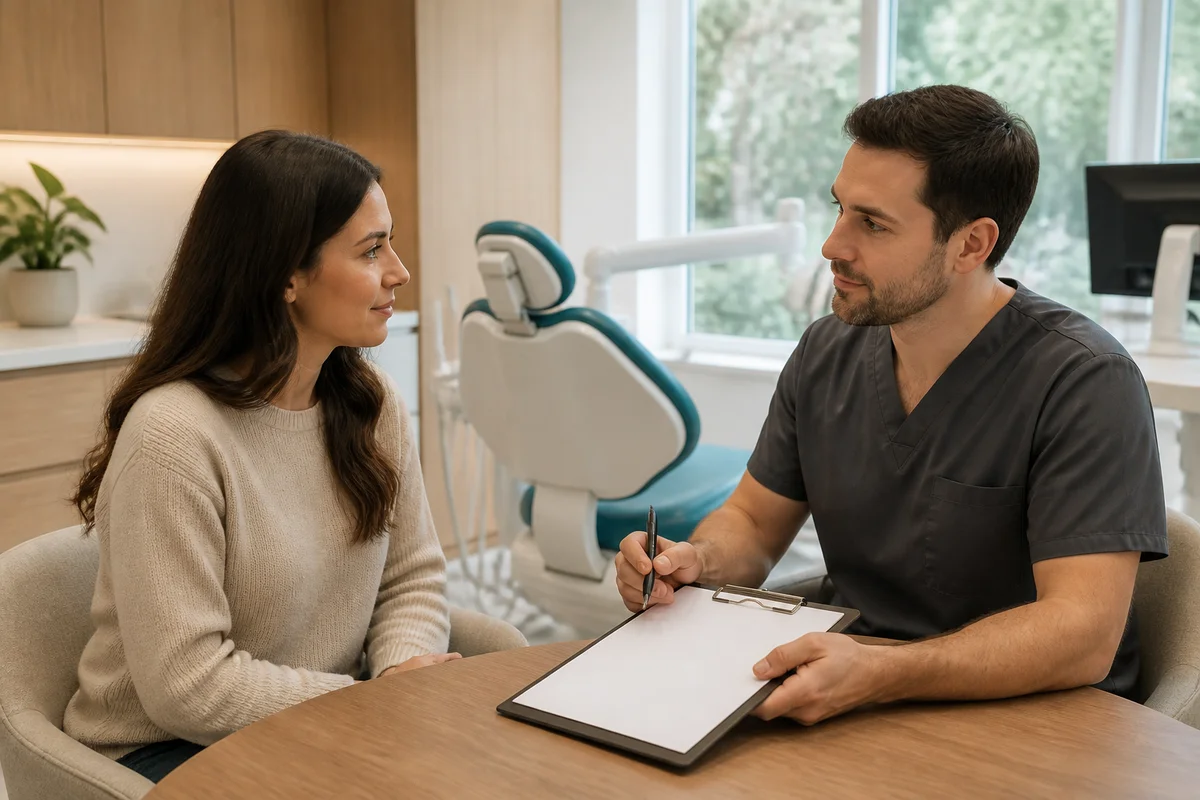
Typing new dentist near me into a search box can produce a long list, but proximity and star ratings do not establish clinical fit. A careful choice also considers a dentist’s active license, relevant experience, communication, infection-prevention practices, network status, accessibility, written estimates and emergency arrangements. This guide turns a local search into a practical, patient-safe comparison without diagnosing a condition or naming a universal “best” office.
Quick answer: When searching for a new dentist near me, shortlist licensed practices that meet your clinical, access and communication needs. Confirm the exact dentist, insurance network and appointment type directly; ask about infection prevention, records, emergencies and itemized estimates. Use reviews only as one signal, attend an examination before accepting major treatment, and seek a second opinion when the diagnosis or plan remains unclear.
The right practice is personal. A convenient general dentist may be ideal for prevention and routine care, while a patient with complex medical needs, a young child, severe anxiety, mobility limitations or a specific procedure may need additional expertise or facilities. Your priorities can change over time. A deliberate process helps you establish a “dental home”—a trusted place for continuing care and urgent guidance—rather than selecting an office on convenience alone.
What a new dentist near me search can—and cannot—tell you
A map result can show distance, opening hours, a phone number and sometimes an appointment link. It cannot confirm that a particular dentist is accepting patients, licensed without current restrictions, in your specific insurance network or experienced with your needs. It also cannot show whether the information is current. Sponsored placement is advertising, not an independent clinical ranking.
The American Dental Association’s MouthHealthy guide to choosing a dentist suggests beginning with practical factors such as location, hours, benefits, communication and prevention. Its guidance also recommends asking trusted people and health professionals and considering more than one office. Those steps complement, rather than replace, your new dentist near me results.
- Useful search facts: approximate travel time, listed services, languages, physical address and published hours.
- Facts to verify directly: new-patient availability, exact clinician, license, network participation, accessibility and fees.
- Facts that require a visit: whether you feel heard, whether findings are explained and whether the proposed plan reflects an examination.
- Facts a search cannot promise: diagnosis, treatment suitability, painless care, a specific result or insurance payment.
Use a consistent shortlist. Three to five practices are usually enough for meaningful comparison without turning the process into endless browsing. Write down the same questions for each office and record the date of every answer. If an insurer directory and practice website disagree, contact both the plan and office before booking.
Before choosing a new dentist near me, decide how urgent the need is
A routine search is inappropriate when symptoms may need urgent assessment. Severe pain, a knocked-out permanent tooth, uncontrolled bleeding, facial trauma or rapidly increasing swelling should not wait for a perfect long-term match. The ADA’s dental-emergency guidance advises contacting a dentist promptly and seeking emergency help when appropriate. Difficulty breathing or swallowing, major facial or mouth swelling, or a serious injury warrants emergency medical evaluation.
Tell the office exactly what is happening, when it began, whether swelling or fever is present, what medications you take and whether you have relevant medical conditions. A scheduler can gather information, but only an appropriately qualified professional can assess urgency. Do not rely on a web review, chatbot or this article to decide whether an infection is present.
When a new dentist near me search is routine
A routine new dentist near me comparison is reasonable for checkups, prevention, a planned move, dissatisfaction with communication, a change in benefits or a non-urgent second opinion. You have time to verify credentials, transfer records and discuss costs before treatment. If symptoms develop while you wait, call a dental professional and describe the change.
When a new dentist near me search must move quickly
For trauma, escalating swelling, uncontrolled bleeding or severe symptoms, prioritize timely triage and safe access. The clinician who manages the immediate problem does not have to become your long-term dentist. After urgent care, request the clinical notes and images needed for continuity, then resume the broader selection process when it is safe.
Build a new dentist near me priority list before calling
Define “near” in real life. A practice five miles away may be difficult to reach during rush hour, while a farther clinic near work or public transportation may be easier. Consider appointment frequency, parking, elevators, entrance steps, weather, caregiver schedules and whether someone must accompany you after sedation. Accessibility is not a courtesy; for some patients, it determines whether care is usable.
Separate requirements from preferences. A wheelchair-accessible operatory, a clinician comfortable coordinating with an oncology team or interpretation in a preferred language may be essential. Saturday hours, a quiet waiting area or digital forms may be helpful but negotiable. Ranking these factors before reading reviews prevents a glossy website from displacing what actually matters.
- Routine prevention, restorative needs or a specific unresolved concern.
- Adult, pediatric, family, geriatric or special-care experience.
- Language support and an explanation style you can understand.
- Mobility, sensory, neurodiversity or caregiver accommodations.
- Insurance network, self-pay process and written-estimate policy.
- Travel time, hours, emergency access and cancellation rules.
- Coordination with physicians, specialists or a previous dental office.
A good new dentist near me shortlist should meet every requirement and as many preferences as practical. If no office meets all requirements, ask your physician, pharmacist, state or local dental society, health plan or community health center for additional routes. Do not conceal a disability or medical issue to obtain an appointment; the team needs accurate information to plan safe care.
Verify the license behind each new dentist near me result
Confirm the individual dentist who will examine or treat you, not only the business name. In the United States, dental licenses are issued and regulated by state authorities. Search the official state dental board or professional-licensing portal for the clinician’s name and license status. Board displays and terminology differ, so contact the board if a result is ambiguous. A missing online result can be a spelling or database issue; it is a reason to verify, not to make a public accusation.
Licensure establishes legal authority to practise; it does not rank dentists or guarantee a particular outcome. Board certification, hospital privileges, memberships and continuing education can add context, but each has a different meaning. Ask who will perform each part of the proposed care and what training is relevant. Titles such as “implant dentist,” “cosmetic dentist” or “sedation dentist” may be used differently across jurisdictions and should not be interpreted without checking local rules and credentials.
Questions about new dentist near me credentials and scope
Ask the new dentist near me candidate which procedures are routinely managed in the office, when a specialist is involved and how referrals work. For complex endodontic, periodontal, surgical, prosthodontic, orthodontic, pediatric or oral-medicine needs, a specialist consultation may be appropriate. A thoughtful referral is not a weakness; it can be evidence that the dentist recognizes the limits of their scope.
If sedation is proposed, ask who administers it, what permit is required locally, how you will be monitored, which emergency equipment is available and what recovery and escort rules apply. These are safety questions, not predictions that sedation is right for you. Your medical history and the specific procedure must be evaluated first.
Ask every new dentist near me about infection prevention
Patients cannot audit a sterilization program from the waiting room, but they can ask clear questions. The CDC dental infection-prevention program describes basic expectations for safe dental care. CDC Standard Precautions include hand hygiene, appropriate personal protective equipment, respiratory hygiene, sharps safety, safe injections, sterile instruments and devices, and cleaning and disinfection of environmental surfaces.
A calm office should be able to explain, in plain language, how reusable instruments are cleaned, packaged, sterilized and monitored; how treatment surfaces are prepared; and how single-use items are handled. You do not need to demand confidential staff records or disrupt care. The goal is to understand whether the practice has an organized safety process and welcomes reasonable questions.
- Does the team follow current CDC and applicable local infection-control requirements?
- How are reusable instruments processed and sterilization cycles monitored?
- Which items are single-use, and how are they discarded?
- How are hand hygiene, gloves, masks and eye protection used?
- How does the practice manage a patient with respiratory symptoms?
- Who is responsible for staff training and periodic program review?
Visible cleanliness is reassuring but does not prove instrument sterilization, and an older building is not automatically unsafe. Evaluate the process rather than décor. If the team dismisses basic safety questions, uses visibly contaminated items or cannot explain who oversees infection prevention, pause before non-urgent treatment and seek clarification or another practice.
Confirm insurance and estimates for a new dentist near me
“We accept your insurance” can mean the office will submit claims; it does not necessarily mean the dentist is contracted in your plan’s network. Verify the exact clinician and practice location with the insurer and the office. Ask whether the network status applies on the expected service date and whether another clinician may perform the care. Save a dated directory result and call the plan if information conflicts.
Insurance coverage is plan-specific. A service may be subject to a deductible, coinsurance, waiting period, frequency rule, annual maximum, alternate benefit, missing-tooth provision or prior authorization. A benefits estimate is not a payment guarantee because eligibility, accumulated benefits, coding and the final service can change. Ask for an itemized treatment plan and a written pre-treatment estimate when appropriate.
For uninsured or self-pay patients, CMS explains that a good faith estimate is generally available for scheduled care or on request under federal rules, but CMS also notes important scope and coverage distinctions. Dental-only insurance is generally outside some No Surprises Act balance-billing protections. State rules may add protections. Ask the office what estimate applies to your situation and what it does not include.
Price questions for a new dentist near me
Do not compare a single headline price. Ask what the examination, imaging, laboratory work, anesthesia, temporary restoration, final restoration, follow-up and likely maintenance include. Costs vary with findings and treatment design, so this article does not provide a fixed amount. A trustworthy new dentist near me discussion should separate the clinical recommendation from payment arrangements and give you time to review both.
Read financing terms before signing. Compare the total repayment, annual percentage rate, fees, deferred-interest deadline and effect of a missed payment. Do not let a limited-time promotion rush consent. If affordability is the main barrier, the National Institute of Dental and Craniofacial Research lists dental schools, health centers and state or local resources that may offer lower-cost care; availability and eligibility vary.
Evaluate communication at the first new dentist near me visit
A good relationship does not require agreement on every detail. It does require an opportunity to describe symptoms and priorities, an examination appropriate to the concern, understandable explanations and room for questions. The dentist should distinguish findings from options and explain the expected benefits, material risks, alternatives, uncertainties and consequences of delaying care. No ethical clinician can promise a painless procedure or guaranteed result.
Notice whether the team asks about medications, allergies, pregnancy, medical conditions, tobacco or nicotine, prior complications and relevant anxiety. These questions support safety; they are not a substitute for examination. Bring an updated medication list and the contact information of clinicians who manage significant conditions. Never stop or change prescribed medicine solely because of general online advice.
Signs the new dentist near me explanation is working
After the new dentist near me consultation, you should be able to summarize the problem being evaluated, the evidence supporting the recommendation, reasonable options, next steps and what could change the plan. Ask the dentist to show relevant images or findings when helpful. Request a written plan for extensive care. “Teach-back”—explaining the plan in your own words—can reveal misunderstandings before consent.
Dental anxiety and communication with a new dentist near me
Tell the office about anxiety, sensory triggers, past trauma, hearing or visual needs and preferred communication methods before the visit. Ask about a stop signal, breaks, step-by-step explanations, support persons and quieter appointment times. If language access is essential, confirm whether a qualified interpreter or other communication support is available; do not assume a family member is always the safest option for complex consent.
Know what to expect at a new dentist near me appointment
The first visit varies with age, symptoms and appointment purpose. A routine new-patient visit may include health and dental history, discussion of concerns, examination, periodontal assessment, oral-cancer screening and diagnostic images when clinically justified. A problem-focused emergency visit may concentrate on the urgent area and defer comprehensive planning. A consultation is not necessarily the same as an examination or cleaning.
The ADA’s common questions about dental visits notes that visit frequency is individualized rather than one-size-fits-all. Be cautious if a practice claims that every patient needs the same schedule or imaging pattern. The dentist should base recommendations on your findings, history and risk.
- Before booking: confirm appointment purpose, clinician, duration, forms, accessibility, records and payment expectations.
- Before arrival: prepare medications, allergies, medical conditions, concerns, insurance information and questions.
- During history: answer honestly and mention prior dental experiences, anxiety and treatment priorities.
- During assessment: ask why images or tests are recommended and what the dentist is evaluating.
- During planning: discuss options, benefits, risks, alternatives, timing and the effect of postponement.
- Before treatment: review consent, written estimates, network assumptions and aftercare arrangements.
- After the visit: keep copies, note unanswered questions and decide whether a second opinion would help.
A practice may need prior radiographs, but new images can still be appropriate if existing images are unavailable, outdated, incomplete or unsuitable for the current question. Ask why they are needed. Avoid insisting on or refusing diagnostic imaging based only on a generic schedule; appropriateness depends on the individual clinical situation.
Use reviews carefully when comparing a new dentist near me
New dentist near me reviews can reveal recurring operational themes such as scheduling, billing communication, accessibility or how complaints are handled. They cannot verify diagnosis quality, sterilization records or whether the writer had the same needs as you. The sample may be small or unrepresentative, and very positive or negative accounts can omit important context. Reviews should generate questions, not decide treatment.
Look for patterns across time and platforms. Give more weight to specific, consistent descriptions than to vague praise or anger. Be alert to comments that disclose another person’s health information or invite the office to respond publicly with clinical details; privacy-conscious practices may give a limited response even when they have more context. A professional inability to debate a review publicly is not proof that the review is accurate.
What reviews cannot prove about a new dentist near me
A high rating does not prove the new dentist near me is in network, licensed for a specific service or suitable for complex care. A low rating does not prove negligence. Neither establishes that your result will match someone else’s. Verify objective facts through the insurer, licensing authority and direct conversation, then use the first visit to assess the relationship.
Ask how a new dentist near me handles specialists and emergencies
Continuity includes knowing what happens outside routine appointments. Ask how the practice triages urgent calls, what instructions are available after hours and where patients are directed when the dentist is unavailable. Clarify whether urgent evaluation is limited to existing patients. A voicemail that simply says “call later” offers less useful planning than a clear, current pathway.
Ask which specialists commonly receive referrals, how information returns to the general dentist and who coordinates multi-step care. A referral should identify the clinical question, not force you to accept treatment. For a major or irreversible recommendation, a second opinion can help—especially when options, diagnosis or expected maintenance remain unclear. The ADA ethics guidance recognizes second opinions and states that the dentist providing one should not have a vested interest in the resulting recommendation.
When a new dentist near me second opinion is useful
Consider a second opinion when the proposed care is extensive, alternatives were not explained, two recommendations conflict, you feel pressured or the diagnosis is uncertain. Provide the second dentist with relevant records and ask for an independent examination. Different plans can both be reasonable when they reflect different risk assessments or patient preferences; ask each clinician to explain the evidence and tradeoffs.
Transfer records to the chosen new dentist near me
Records support continuity with a new dentist near me and can reduce avoidable repetition. Ask the previous practice for relevant notes, radiographs, periodontal charts, laboratory prescriptions, photographs and information about implanted devices or restorations. Confirm how the new office prefers to receive them and whether you need to sign a request. Do not delay urgent assessment merely because records have not arrived.
The U.S. Department of Health and Human Services explains that, with limited exceptions, the HIPAA right of access includes broad health and billing information maintained in a designated record set, including X-rays and other diagnostic images. HHS’s right-of-access guidance also discusses electronic copies, timing and directing records to another person or entity. HIPAA applies to covered entities; state laws can provide additional rights.
Keep a personal copy. Confirm that exported images retain diagnostic quality and that the file can be opened by the receiving office. If a practice charges a permitted copying fee, request an explanation. Never send sensitive records through an unverified public email address or messaging account; use the method agreed with the offices.
New dentist near me decision table: compare 21 checks
Complete this table for each new dentist near me candidate. A blank answer is not automatically disqualifying, but it tells you what to clarify before non-urgent care.
| Check | Question | Evidence or observation |
|---|---|---|
| 1. Need | Does the practice manage my routine or specific concern? | Direct office confirmation |
| 2. Urgency | Can it triage my current symptoms appropriately? | Clear phone pathway |
| 3. Dentist | Who will examine and treat me? | Named clinician |
| 4. License | Is the clinician’s license active? | Official state portal |
| 5. Scope | What relevant experience or training applies? | Specific, verifiable answer |
| 6. Referral | When does the dentist involve specialists? | Explained referral process |
| 7. Infection prevention | Can the office explain its safety program? | CDC-aligned process |
| 8. Medical coordination | Can the team coordinate with my clinicians? | Secure communication process |
| 9. Language | Can I understand and participate in consent? | Confirmed language support |
| 10. Accessibility | Do facilities meet my mobility or sensory needs? | Specific accommodation details |
| 11. Location | Is real travel time sustainable? | Door-to-door test |
| 12. Hours | Do normal and urgent hours fit? | Current office schedule |
| 13. Network | Is the dentist in my exact plan network? | Plan and office confirmation |
| 14. Estimate | Will I receive itemized written estimates? | Office financial policy |
| 15. Financing | Are total repayment and terms clear? | Written agreement |
| 16. Records | Can records be received and shared securely? | Documented transfer process |
| 17. Examination | Are recommendations based on individual findings? | Visit experience |
| 18. Options | Are alternatives, risks and timing explained? | Written treatment plan |
| 19. Questions | Does the clinician answer without pressure? | Visit experience |
| 20. Emergencies | What happens after hours? | Clear current instructions |
| 21. Fit | Can I realistically continue care here? | Your informed assessment |
Do not convert the table into a simplistic score. License and safety are foundational; décor and digital convenience are preferences. A practice that meets clinical, access and communication requirements may be a better fit than a closer office with more reviews. Revisit the table if your needs, insurance or treatment plan changes.
Red flags during a new dentist near me comparison
No single awkward phone call proves unsafe care, and busy teams can make ordinary mistakes. Look for significant or repeated patterns: refusal to identify the treating clinician, pressure to begin irreversible treatment before adequate assessment, guarantees, unexplained changes in the plan, dismissal of medical history, unwillingness to provide written estimates, or inability to explain a basic infection-prevention process.
- A guaranteed clinical result or claim that treatment is risk-free.
- A diagnosis or extensive plan issued from a marketing form alone.
- Pressure to sign financing or consent immediately to preserve a promotion.
- Unclear provider identity, credentials or responsibility for treatment stages.
- Refusal to discuss alternatives or a reasonable request for a second opinion.
- Public disclosure of identifiable patient information in review responses.
- Inconsistent explanations about network status, charges or included services.
Respond proportionately. Ask for clarification, review written documents, verify the license and plan network, or obtain an independent opinion. For a serious concern about professional conduct, the relevant licensing board can explain its complaint process. Do not make allegations online based only on a misunderstanding or incomplete information.
New dentist near me versus planned dental travel
A nearby dental home and planned care abroad solve different problems. Local care can make routine prevention, urgent access and long-term maintenance easier. Travel may expand provider options but adds questions about eligibility, records, timing, complications and follow-up after returning home. Neither route is inherently correct for everyone.
If you are comparing local care with treatment in Türkiye, the Redent Klinik English website explains the clinic’s approach, and the Redent Klinik contact page provides a route to request an individual assessment. These links are not a diagnosis, price promise, insurance confirmation or outcome guarantee. Any proposal should follow clinical evaluation and informed consent.
Ask who manages routine follow-up and an urgent problem after travel. Obtain copies of diagnostic images, treatment notes, material or device identifiers and aftercare instructions. Confirm what can be evaluated remotely and what requires examination. A lower headline quote is not a complete comparison if it excludes diagnostics, temporary work, travel, maintenance or management of complications.
Frequently asked questions about finding a new dentist near me
How do I know whether a new dentist near me is accepting patients?
Call the practice or use its secure booking channel and ask about the exact appointment type, clinician and earliest appropriate availability. “Accepting new patients” may apply only to routine care, certain dentists or specific plans. Confirm again if the appointment is weeks away. For urgent symptoms, describe them rather than booking a generic cleaning online.
How far should a new dentist near me be?
There is no universal radius. Measure realistic door-to-door travel at likely appointment times and consider frequency, accessibility, parking, public transit and aftercare. A farther office that meets essential clinical or communication needs may be more usable than the nearest listing. For emergencies, know the practice’s actual triage route rather than relying on distance alone.
Should I choose the highest-rated new dentist near me?
Not automatically. Ratings reflect selected experiences and may emphasize service factors rather than clinical appropriateness. Use reviews to identify questions, then verify license, dentist identity, network, access and office processes. Your first-visit communication and individualized examination provide information a star average cannot.
How do I confirm insurance for a new dentist near me?
Ask the insurer whether the named dentist at the exact address is in network for your exact plan and date of service. Then ask the office to confirm. “Accepts insurance” does not always mean in network. Request code-level benefit information for planned care, while recognizing that an estimate is not a payment guarantee.
Should I transfer X-rays before visiting a new dentist near me?
Transfer relevant recent records when practical, but do not postpone urgent assessment while waiting. The new dentist decides whether existing images answer the current clinical question. HHS guidance says the HIPAA right of access generally includes X-rays held in a covered entity’s designated record set, subject to limited exceptions and applicable procedures.
Will a new dentist near me repeat my X-rays?
Possibly, but the decision should be clinically justified. Existing images may be unavailable, outdated, incomplete, poor quality or not show the area at the needed angle. Ask why a new image is recommended and what it will change. Imaging should be individualized, not ordered solely because you are a new patient.
Can I see a new dentist near me for a second opinion?
Yes. Tell the office that the visit is for an independent second opinion, ask what records are needed and expect an examination before a meaningful recommendation. Bring the original plan without demanding that the second dentist agree or disagree. Compare the findings, options and tradeoffs, not only the quoted amount.
What should I bring to a new dentist near me appointment?
Bring photo identification if requested, insurance details, an updated medication and allergy list, relevant medical contacts, prior records or device information, and your questions. Mention pregnancy, significant diagnoses, previous reactions, anticoagulants, antiresorptive medicines and anxiety. Do not stop medicine unless the prescribing clinician and treating dentist give individualized instructions.
Can a new dentist near me guarantee painless treatment?
No responsible clinician can guarantee a completely painless experience or a particular result. The dentist can discuss anesthesia, anxiety support, expected sensations, risks and what to do if discomfort occurs. Be cautious with absolute promises. Individual response, procedure complexity and healing vary.
What if the new dentist near me recommends extensive work immediately?
Ask for the findings, urgency, alternatives, sequence and a written plan. Determine which items are necessary now and which can reasonably wait. Request relevant images and an itemized estimate. An independent second opinion may be valuable before extensive, expensive or irreversible care, unless delay would create a safety risk explained by the clinician.
How can I find lower-cost dental care near me?
NIDCR suggests contacting dental or dental-hygiene schools, federally funded health centers, state or local health departments and applicable Medicaid or CHIP programs. Services, eligibility and charges vary, and some settings have limited appointments. Verify who supervises care, what services are offered and how emergencies or referrals are handled.
When should I stop searching and book the new dentist near me?
Book when a practice meets your essential clinical, license, safety, access and communication requirements and you understand the appointment purpose. The first visit is part of the evaluation; it does not obligate you to accept non-urgent treatment. If urgent symptoms are present, seek timely professional triage before completing a full comparison.
Bottom line: choose a new dentist near me with evidence, not hype
A new dentist near me search is the beginning of due diligence. Define your needs, distinguish routine from urgent care, verify the named dentist’s license and network, ask about infection prevention, examine estimates carefully and assess communication at the first visit. Use reviews as context and seek a second opinion when major recommendations remain unclear.
The goal is not a perfect online score. It is a sustainable dental home where individualized examination, understandable consent, safety, access and continuity work together. Update your decision if the dentist, insurance, location or needs change. No directory, article or advertisement can replace direct verification and professional assessment.
Sources
- American Dental Association MouthHealthy: How to choose a dentist
- American Dental Association MouthHealthy: Common questions about going to the dentist
- American Dental Association MouthHealthy: Dental emergencies
- CDC: Infection prevention and control in dental settings
- CDC: Standard Precautions in dental settings
- HHS: Individuals’ right under HIPAA to access health information
- CMS: What is a good faith estimate?
- CMS: Know your rights
- National Institute of Dental and Craniofacial Research: Finding dental care
- American Dental Association: Ethics, nonmaleficence and second opinions
- American Dental Association
- World Health Organization: Oral health