
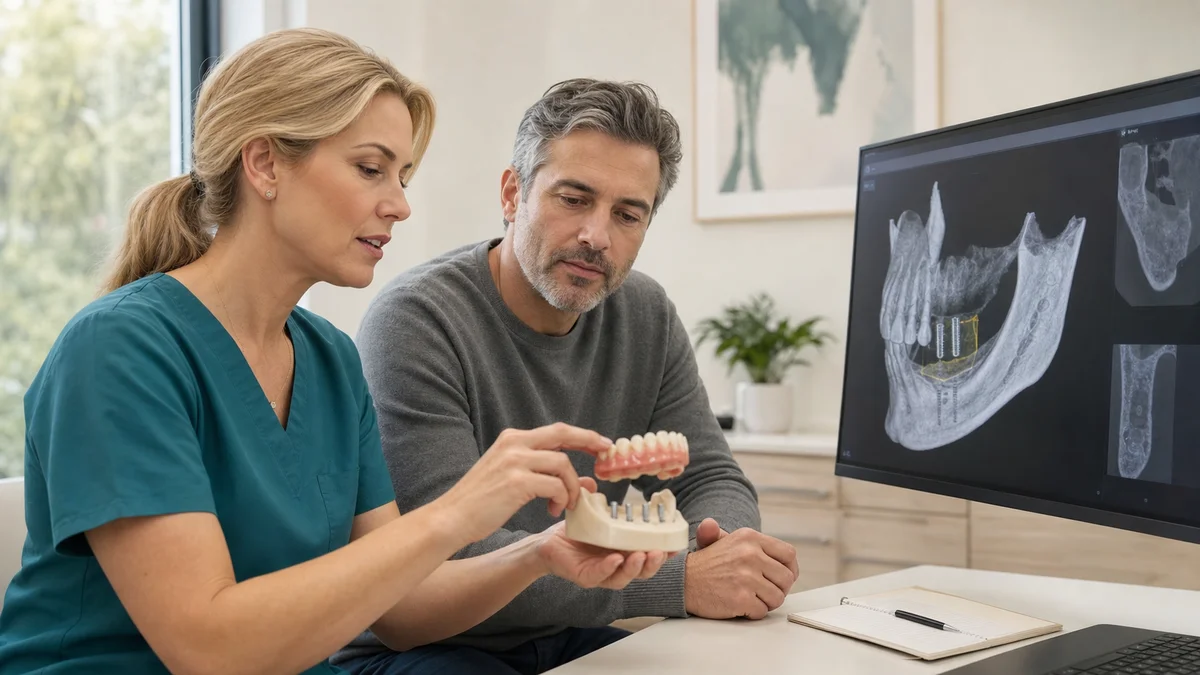
Searching for no bone solution dental implants cost usually begins after someone has been told that the jaw is too thin or too short for conventional implants. The phrase “no bone” is marketing shorthand, not a diagnosis. Some supporting bone is always present, but its height, width, quality or position may be unsuitable for a particular implant and prosthesis. Only a clinical assessment and three-dimensional imaging can show which pathways are realistic.
A headline price cannot answer that question. One quote may describe bone grafting followed by conventional implants; another may use short or tilted implants; another may involve specialist zygomatic implants in a severely atrophic upper jaw. Temporary teeth, the definitive bridge, sedation, extractions, imaging and maintenance may be included or omitted. This guide explains how no bone solution dental implants cost is constructed without promising a fixed fee, instant teeth or a guaranteed outcome.
Quick answer: Severe jawbone loss does not automatically rule out implants, but there is no single “no-bone” solution. Options may include augmentation, sinus grafting, short or tilted implants, zygomatic implants, or a removable prosthesis. Cost depends on anatomy, one or two arches, surgery, implant system, temporary and final teeth, anaesthesia, follow-up and maintenance.
Medical review: This patient guide will be reviewed by Dentist Esma Çevrük Çakır for clinical accuracy, evidence-based wording and patient safety.
1. What “no bone” really means in implant planning
After tooth loss, the jaw can change in volume and shape. Periodontitis, infection, trauma, previous implant failure, long-term denture use and natural anatomy may also reduce available bone. In the upper posterior jaw, the maxillary sinus can limit height. In the lower jaw, the position of the inferior alveolar nerve matters. A two-dimensional panoramic image can give an overview, but complex cases often require cone beam computed tomography, or CBCT, for three-dimensional planning.
The phrase no bone solution dental implants cost should therefore trigger a diagnostic question: insufficient bone for which implant position and which final tooth design? A jaw may have limited bone in one zone but usable anatomy elsewhere. The prosthesis must be planned before implant positions are selected, because a technically placeable implant is not useful if it cannot support hygienic, functional and maintainable teeth.
The US Food and Drug Administration’s dental implant guidance advises patients to discuss candidacy, benefits and risks with their provider. Overall health, smoking and healing capacity affect suitability and long-term performance. An online scan review may help triage a case, but it cannot replace an examination of the mouth, gums, bite and medical history.
- Bone quantity: height and width at each proposed implant site.
- Bone quality: density and architecture that influence initial stability.
- Anatomy: sinus, nasal cavity, nerves, blood vessels and neighbouring teeth.
- Soft tissue: gum health, thickness and the ability to clean the future prosthesis.
- Prosthetic space: room and implant distribution for a functional, hygienic restoration.
- Patient factors: health, medicines, smoking, clenching, expectations and capacity for maintenance.
2. Why no bone solution dental implants cost requires CBCT-led diagnosis
A robust estimate follows a records stage. It may include clinical photographs, digital or conventional impressions, gum assessment, bite analysis, panoramic imaging and CBCT when justified. In zygomatic implant planning, the International Team for Implantology recommends CT or CBCT that includes the mid-face so the maxilla, zygomatic bone and sinus health can be assessed in three dimensions.
These records show whether the case is a single missing tooth, a segment or a full arch. They also identify untreated periodontal disease, retained roots, infection or failing teeth that may require care before or during reconstruction. Each finding can alter no bone solution dental implants cost, the number of stages and the risk discussion.
Medical assessment is equally important. Diabetes control, smoking, blood-thinning medicines, antiresorptive or antiangiogenic drugs, immune conditions, previous radiotherapy and sinus disease may influence the plan. This does not mean every condition prevents implants. It means the treating team must assess risk, coordinate with other clinicians when appropriate and obtain informed consent.
Can a remote quote be final?
No. A remote review can produce a provisional range and list likely options, but a final no bone solution dental implants cost should follow examination and verified imaging. Ask the clinic to state which assumptions could change after arrival, who bears the cost of additional care and what happens if the planned option proves unsuitable.
3. Treatment pathways behind no bone solution dental implants cost
There is no universal hierarchy that starts with the cheapest technique. The choice balances anatomy, prosthetic goal, invasiveness, healing time, evidence, clinician expertise and patient preference. In some sites, adding bone creates the best implant position. In others, a shorter or tilted implant can avoid an anatomical structure. Severe upper-jaw atrophy may justify evaluation for zygomatic implants by a highly experienced team.
When comparing no bone solution dental implants cost, separate these pathways rather than treating them as substitutes with identical indications:
- Minor guided bone regeneration: particulate graft material and a membrane may add width around a planned implant.
- Block or major grafting: a larger volume may be reconstructed using bone from the jaw or another donor site, sometimes in a separate stage.
- Sinus floor elevation: selected upper posterior cases may gain height for conventional implants.
- Short implants: a site-specific option when reduced height makes augmentation more invasive, provided biomechanics and bone width are suitable.
- Narrow implants: a limited option for particular indications, not a universal answer to thin ridges.
- Tilted implants and full-arch concepts: implant angulation may use available bone and improve anteroposterior distribution.
- Zygomatic implants: specialist anchorage in the cheekbone for selected severely atrophic or deficient maxillae.
- Removable prostheses: conventional or implant-retained dentures may offer a less invasive alternative.
The ITI consensus on short implants considers them a valid option in selected reduced-height posterior sites when avoiding augmentation morbidity or reducing treatment time matters. That does not mean short implants suit every bite, arch or prosthesis. Site-specific evaluation remains essential.
4. No bone solution dental implants cost decision table
The following table shows why two no bone solution dental implants cost estimates can differ even when both appear to restore one arch. It is a discussion aid, not a recommendation for any individual.
| Pathway | When it may be discussed | Major cost components | Important limits and questions |
|---|---|---|---|
| Bone graft plus conventional implants | Bone can be reconstructed to support prosthetically ideal implant positions | Graft surgery, material or donor site, membrane, imaging, healing reviews, later implant and prosthesis | Is grafting minor or major? Can implant placement occur at the same visit? What if graft volume is insufficient? |
| Sinus augmentation | Upper posterior bone height is limited by sinus anatomy | Sinus procedure, graft material, imaging, implant stage, medication and follow-up | What is the sinus condition? Is a staged approach needed? What complications require ENT input? |
| Short or tilted implants | Usable bone can be engaged while avoiding selected grafting or anatomy | Implants, guided or conventional surgery, components, temporary and definitive prosthesis | Are dimensions, distribution and bite appropriate? Is immediate loading actually supported by stability? |
| Zygomatic implant reconstruction | Severe maxillary atrophy or deficiency where conventional implants or grafting are unsuitable or not preferred | Specialist planning, mid-face CBCT, advanced surgery, anaesthesia, hospital or facility, provisional and final full-arch prostheses | Who performs it? What is the sinus plan? How are complications and long-term maintenance managed? |
| Removable denture or implant overdenture | A fixed reconstruction is unsuitable, too invasive or not preferred | Impressions, try-ins, denture, possible attachments, adjustments and relines | What retention and maintenance can be expected? Are future relines and component changes included? |
“Graftless” does not mean risk-free, surgery-free or maintenance-free. Avoiding a graft may reduce one procedure but require greater surgical and prosthetic complexity. The right comparison is total treatment burden, not merely the first surgical invoice.
5. Bone grafting in a no bone solution dental implants cost estimate
Bone grafting ranges from a small augmentation placed with an implant to major reconstruction performed months before implant placement. Graft material may come from the patient, a human donor source, an animal source or a synthetic source, depending on local regulation and clinical indication. The source, alternatives and relevant consent information should be explained.
Guy’s and St Thomas’ NHS Foundation Trust notes that grafts may heal for several months before implant treatment, and that pain, swelling, bruising, infection or inadequate graft success can occur. Major grafting may involve a donor site and hospital care. These variables are central to no bone solution dental implants cost; “bone graft included” is not enough detail.
Ask whether the price covers donor-site surgery, graft material, membrane or fixation screws, anaesthesia, pathology if needed, postoperative visits and removal of fixation hardware. Also ask what the financial plan is if more grafting is needed or if an implant cannot be placed as planned. A responsible estimate acknowledges uncertainty without suggesting that failure is expected.
Does grafting guarantee the no bone solution dental implants cost outcome?
No. Grafts often support successful implant treatment, but integration and volume are not guaranteed. Smoking, infection, wound opening, systemic health and local anatomy can affect healing. This uncertainty should be disclosed in the no bone solution dental implants cost plan, including who pays for repeat surgery or an alternative prosthesis if the goal is not achieved.
6. Short and tilted implants in no bone solution dental implants cost
Short implants can reduce the need to approach the sinus or nerve in selected sites. Narrow implants can sometimes fit reduced ridge width. Tilted posterior implants may improve distribution for a full-arch fixed prosthesis when anatomical or prosthetic conditions support that design. These methods require adequate residual bone, suitable loading and a restoration that can be cleaned.
The ITI consensus on tilted implants reports comparable outcomes to axial implants in full-arch fixed prostheses within the studied settings, while also documenting prosthetic complications such as interim prosthesis fracture and screw loosening. Therefore, no bone solution dental implants cost must include prosthetic repair and maintenance expectations, not just surgical placement.
Immediate loading is a separate decision. It depends on primary implant stability, implant distribution, bone quality, bite, parafunction and the design of the provisional prosthesis. “Same-day teeth” may refer to a temporary restoration with diet and loading restrictions, not the final bridge. If adequate stability is not achieved, a removable temporary option or delayed loading may be safer.
7. Zygomatic implants within no bone solution dental implants cost
Zygomatic implants are long implants anchored in the cheekbone to support a prosthesis in selected patients with severe maxillary atrophy or deficiency. They are not a routine alternative for every person with reduced bone and do not treat lower-jaw bone loss. The 2023 ITI zygomatic implant consensus describes indications including severe maxillary atrophy, failed previous graft or implant treatment and situations where grafting is not feasible, predictable or preferred.
The same consensus calls zygomatic implant care complex and highly dependent on surgical and restorative expertise. Planning should evaluate the maxilla, zygomatic bone and sinus health. This expertise, diagnostic field, facility, anaesthesia and coordinated prosthetic work help explain why no bone solution dental implants cost for zygomatic reconstruction cannot be compared with a conventional implant package.
Risks can include sinusitis, oral-sinus communication, soft-tissue problems, nerve disturbance, infection, implant failure and prosthetic complications. The most appropriate technique varies with anatomy. Ask the team about its training, case selection, complication pathway and access to ear, nose and throat or maxillofacial support if sinus problems occur.
Do zygomatic implants lower no bone solution dental implants cost?
They are often discussed as a graft-avoiding pathway, but an individual plan may still require other hard- or soft-tissue procedures, conventional implants or additional surgery. Do not assume the phrase “zygomatic package” defines every component. The written no bone solution dental implants cost should list implant numbers, adjuncts and both temporary and final prostheses.
8. Fourteen no bone solution dental implants cost factors
A useful quote breaks down known components and labels contingencies. The following factors often determine no bone solution dental implants cost:
- One arch or two: upper, lower or full-mouth reconstruction.
- Diagnostic records: examination, photographs, scans, CBCT and prosthetic planning.
- Teeth and infection: extractions, periodontal treatment, cyst management or healing before reconstruction.
- Bone pathway: no augmentation, minor graft, major graft, sinus augmentation or zygomatic approach.
- Implant number and type: conventional, short, narrow, tilted or zygomatic components.
- Surgical guide or navigation: whether digital planning tools are clinically appropriate and included.
- Anaesthesia: local anaesthetic, conscious sedation or general anaesthesia and the qualified team involved.
- Facility: clinic, day-surgery unit or hospital and any monitoring or overnight care.
- Temporary teeth: removable denture or immediate fixed provisional, including repairs and adjustments.
- Final prosthesis: design, framework, tooth material, laboratory and try-in stages.
- Additional tissue procedures: gum grafting, vestibular work or hygiene access modification when indicated.
- Follow-up: postoperative reviews, suture care, healing checks and implant integration review.
- Maintenance: hygiene visits, professional removal of the bridge if necessary, screws and component replacement.
- Travel and currency: flights, accommodation, time away from work, exchange-rate movement and unplanned return visits.
A single total can still be clear if it identifies these inclusions. A staged estimate should state when each payment is due and what clinical milestone triggers it. Ask for the amount in the clinic’s local currency, the date of any conversion and the refund or revision policy if the treatment plan changes.
9. Temporary teeth in no bone solution dental implants cost
Many full-arch quotes advertise “teeth in a day,” but the teeth fitted soon after surgery are commonly a provisional prosthesis. It protects appearance and limited function while tissues heal and the bite is monitored. It may require a softer diet and repairs. The definitive bridge is usually made later after healing, new records and laboratory stages.
When reviewing no bone solution dental implants cost, ask whether both prostheses are included. Clarify the temporary and definitive materials, framework, number of try-ins, hygiene design, warranty terms and repair policy. A low surgical quote that excludes the final bridge is not comparable with a complete restorative plan.
Also ask how cleansability will be tested. A fixed full-arch prosthesis needs space and contours for daily cleaning. Poor access can contribute to plaque accumulation and inflammation. A beautiful photograph does not demonstrate a maintainable design.
10. Risks and contingencies in no bone solution dental implants cost
The FDA lists potential implant complications including damage to nearby teeth or tissues, sinus perforation, jaw fracture, altered bite, screw loosening, infection, delayed healing, nerve injury and implant failure. Complications may occur early or later and can require repair, implant removal or further surgery. The aim of planning is to reduce risk, not claim that risk is zero.
A complete no bone solution dental implants cost conversation should cover foreseeable contingency costs. Ask what happens if an implant does not integrate, a provisional bridge breaks, a graft loses volume, sinusitis develops or the definitive prosthesis needs modification. Some services may be included under defined conditions; others may be charged separately. Get those conditions in writing.
Smoking can impair healing, and uncontrolled diabetes or untreated periodontal disease can increase risk. Medicines and medical conditions require individual review. Do not stop prescribed medicine without advice from the prescribing clinician. If a clinic promises acceptance without medical assessment, that is a safety warning rather than a convenience.
- Who provides urgent advice after surgery, including outside office hours?
- Which complications can the clinic manage directly, and when is hospital or specialist care needed?
- What is included if an implant fails during the initial healing phase?
- Who pays for travel and accommodation if an extra visit is required?
- How are implant brand, model, size and component details recorded for future care?
11. Insurance and no bone solution dental implants cost
Dental implant coverage differs by country and policy. In the United States, HealthCare.gov notes that adult dental coverage is not an essential Marketplace benefit and health plans do not have to include it. Stand-alone dental plans may have waiting periods, deductibles, co-payments, annual maximums or exclusions. Medicare states that it does not cover dentures and implants in most cases, although narrow exceptions exist for certain medically linked services.
In the United Kingdom, complex elective implant reconstruction is not routinely available through standard NHS dental care and is subject to specific acceptance criteria where specialist funding exists. Current Competition and Markets Authority guidance on paying for dental care says private prices vary by practice and recommends obtaining clear price information and a written treatment plan before care begins.
For private or cross-border treatment, the clinic’s no bone solution dental implants cost estimate and an insurer’s benefit estimate are not the same document. Verify pre-authorisation, exclusions, reimbursement rules, required records and whether overseas care is eligible. Financing can spread payments but adds credit terms; compare total repayable amount, interest, fees and what happens if treatment changes.
Can a clinic guarantee insurance reimbursement?
No. A clinic can provide records and procedure details, but the insurer applies policy terms and eligibility on the service date. Treat reimbursement as unconfirmed until the payer approves and processes it. Keep a financial contingency so clinical decisions are not forced by an overly optimistic no bone solution dental implants cost calculation.
12. Cross-border no bone solution dental implants cost
International treatment can offer different fee structures, but the comparison must include the entire care pathway. Complex atrophic-jaw reconstruction may require at least a planning visit, surgery, postoperative review and a later definitive prosthesis. Additional visits can be needed if healing, bite or laboratory work requires adjustment.
Add flights, accommodation, local transport, meals, travel insurance limitations, a companion, time away from work and the possibility of an unplanned return. Compare these separately from the clinical no bone solution dental implants cost. A compressed itinerary is not automatically safer or cheaper if it sacrifices appropriate healing or review.
Ask who will provide maintenance when you return home. Some local clinicians may not have compatible components or may charge for taking responsibility for work performed elsewhere. Obtain the implant passport, CBCT and radiograph copies, prosthetic design, screw specifications, material details and operative notes.
13. Requesting itemised no bone solution dental implants cost
Redent Klinik provides information about zygomatic dental implants and other implant pathways, but suitability cannot be established from a web page. Use the Redent Klinik contact page to request a consultation and explain your medical history, missing teeth, previous graft or implant treatment and current symptoms. General clinic information is available on the Redent Klinik English homepage.
For a preliminary remote review, the clinic may request recent imaging. Do not send scans through an insecure channel, and do not assume an old scan represents current anatomy. The final no bone solution dental implants cost should identify whether it remains provisional until an in-person examination and new imaging.
Ask the team to separate diagnosis, surgery, implants, temporary teeth, definitive teeth, anaesthesia, accommodation or transfers, follow-up and maintenance. Also request the implant manufacturer and component system. This helps you compare complete treatment rather than a vague “full-mouth package.”
14. A 15-point no bone solution dental implants cost checklist
Use this checklist before accepting any no bone solution dental implants cost proposal:
- What is the exact diagnosis and where is bone deficient?
- Has prosthetic design been planned before implant positioning?
- Which imaging is required, and does CBCT cover all relevant anatomy?
- What alternatives include grafting, short or tilted implants, zygomatic implants, dentures or no treatment?
- Why is the recommended pathway preferable for my anatomy and priorities?
- Who performs the surgery and who designs and maintains the prosthesis?
- What training and experience does the team have with this specific advanced pathway?
- Which implant brand, model and components will be used?
- What anaesthesia and monitoring are included?
- Are extractions, graft materials and soft-tissue procedures included?
- Are both provisional and definitive teeth included?
- What could prevent immediate loading on the surgery day?
- What follow-up, emergency care and complication treatment are included?
- What maintenance, repairs and component replacements are likely later?
- What currency, payment stages, change policy and travel contingencies apply?
If answers are incomplete, ask for clarification or seek an independent second opinion. High-complexity implant care should allow time for informed consent. Urgency created by a discount deadline is not a clinical indication.
Frequently asked questions about no bone solution dental implants cost
Can I have implants if I have very little jawbone?
Possibly, but candidacy depends on the location and type of deficiency, prosthetic plan, health and risk. Options may include augmentation, short or tilted implants, zygomatic implants for selected upper jaws, or removable prostheses. A CBCT-led assessment is required before a reliable no bone solution dental implants cost can be issued.
Are zygomatic implants cheaper than bone grafting?
Not necessarily. They may avoid staged graft surgery in selected severe upper-jaw cases, but they require specialist planning, advanced surgery, anaesthesia and coordinated full-arch prosthetics. Compare the entire pathway, not one procedure. Cost is only one part of the decision.
Is All-on-4 always possible without bone grafting?
No. Tilted-implant concepts can use available bone efficiently, but sufficient bone volume, distribution and primary stability are still required. Some patients need grafting, more implants, zygomatic support, delayed loading or a different prosthesis. No brand or implant number removes the need for individual anatomy-based planning.
Does no bone solution dental implants cost include final teeth?
Never assume so. Some packages include only surgery and a provisional bridge. Ask for written confirmation of the temporary and definitive prostheses, materials, framework, laboratory stages and adjustments. This is one of the largest variables in no bone solution dental implants cost.
How long does treatment take?
Timing varies widely. Grafting may add months of healing; graft-avoiding full-arch pathways may reduce stages but still need tissue healing and a later final prosthesis. Immediate loading depends on stability and risk. A schedule is an estimate, not a guarantee.
Can the final price change after I arrive?
Yes, if examination or updated imaging changes the diagnosis. A trustworthy clinic states provisional assumptions in advance and obtains consent for any revised plan and price. Ask what happens if the planned treatment is not possible and whether unused components are refundable.
What happens if a bone graft fails?
The area must be reassessed. Options may include healing, repeat grafting, a different implant position, a graft-avoiding pathway or a removable prosthesis. The original no bone solution dental implants cost estimate should explain whether revision care is included or separate.
Are dental implants guaranteed for life?
No. Implants and prostheses can function for many years, but biological and mechanical complications can occur. Smoking, disease, hygiene, bite forces and maintenance affect outcomes. The FDA advises regular care and prompt review if an implant becomes painful or loose.
What are the main risks of zygomatic implants?
Reported risks include sinusitis, oral-sinus communication, altered sensation, soft-tissue problems, infection, implant failure and prosthetic complications. They are complex procedures that should be planned and delivered by experienced surgical and restorative teams with a clear complication pathway.
Will insurance pay for advanced implant reconstruction?
Coverage varies. Many adult dental plans limit or exclude implants, grafting and overseas care; public systems may restrict advanced reconstruction to narrow criteria. Verify the proposed procedures, waiting periods, annual or lifetime limits, pre-authorisation and overseas reimbursement directly with the payer.
What is the safest way to compare prices?
Compare itemised plans for the same arch, diagnosis, implant pathway, anaesthesia, temporary and final prosthesis, follow-up and maintenance. Add travel and contingency costs separately. The lowest no bone solution dental implants cost is not good value if it omits a definitive bridge or safe continuity.
Conclusion: no bone solution dental implants cost needs a complete pathway
Severe bone loss can make implant reconstruction more complex, but it does not automatically mean there is no option. Bone augmentation, short or tilted implants, zygomatic implants and removable prostheses each have different indications, risks, stages and maintenance needs. “No bone” is not enough information to choose among them.
A reliable no bone solution dental implants cost follows examination, prosthetically driven planning and appropriate three-dimensional imaging. It includes known surgical and restorative components, labels contingencies and separates provisional from definitive teeth. It also explains who will manage healing, complications and long-term maintenance.
Take time to compare complete written plans, not promotional totals. Ask how anatomy, medical risk and the final hygienic design support the recommendation. When no bone solution dental implants cost is transparent, financial consent and patient safety become part of the same decision rather than competing priorities.
Sources and further patient information
- US Food and Drug Administration: Dental Implants — What You Should Know, candidacy, records, benefits and risks.
- Guy’s and St Thomas’ NHS Foundation Trust: Bone Grafting for Dental Implants, graft types, healing and complications.
- International Team for Implantology: Indications for Zygomatic Implants, 2023 consensus and planning recommendations.
- International Team for Implantology: Short Implant Consensus, site-specific use in reduced bone height.
- UK Competition and Markets Authority: Choosing and Paying for Dental Care, current private-price and written-plan guidance.
- HealthCare.gov: Dental Coverage and Medicare: Dental Services, US coverage limitations.
- American Dental Association, professional oral-health resource required for further reference.
- World Health Organization: Oral Health, international oral-health context.
Sources checked July 2026. Clinical evidence, fees, insurance terms and regulations can change. Confirm current local information and obtain an individual written plan before treatment.