
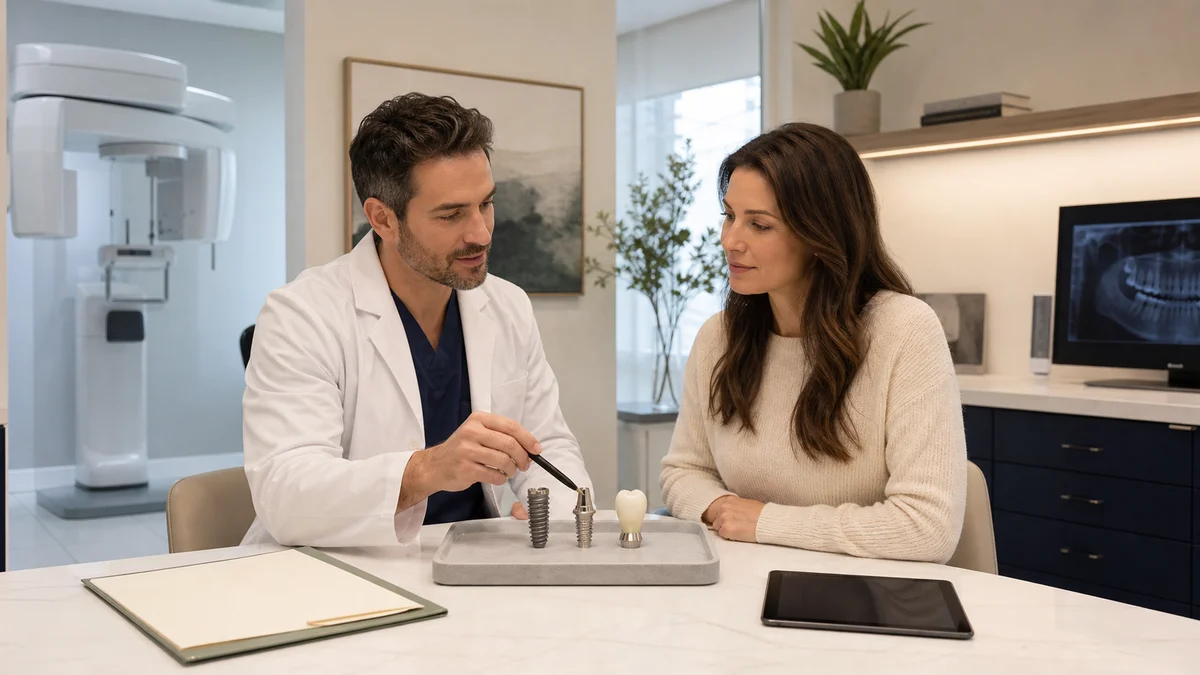
When comparing places to get dental implants near me, verify the clinician and facility, ask how diagnosis, surgery and the final tooth are coordinated, request a written plan with alternatives and complete fees, and confirm infection control, implant traceability and long-term maintenance. Convenience matters, but safe planning and reliable follow-up matter more than distance or advertising.
Typing places to get dental implants near me into a search engine is an understandable first step, but the closest result is not automatically the right clinical match. Map position, sponsored placement, photographs and review scores do not show whether a clinic has assessed your gums, bone, bite, medical history and realistic alternatives. They also cannot tell you who will perform each stage or what happens if healing takes longer than hoped.
A dental implant is a surgical medical device placed in the jaw to support a crown, bridge or denture. The visible tooth is only one part of the treatment. A sound decision therefore covers diagnosis, surgery, restoration and maintenance as one connected pathway. This guide helps you compare places to get dental implants near me without making a diagnosis or assuming that implants are suitable for everyone. A dentist who has examined you must make that judgment.
Use the checks below to turn a broad local search into a careful shortlist. Take notes, request copies of important records and seek a second opinion if the reasoning is unclear. A trustworthy clinic should be willing to explain uncertainty, discuss alternatives and allow time for an informed decision.
1. Define what complete implant care includes
Before comparing places to get dental implants near me, clarify what you are actually buying. “An implant” may refer only to the fixture in the bone, while a complete replacement may also require an abutment and a crown. Multiple missing teeth may be restored with an implant-supported bridge or denture. Examinations, scans, extractions, temporary teeth, grafting, sedation, laboratory work and maintenance may be separate parts of the plan.
Ask the clinic to name every planned stage and the professional responsible for it. Some practices provide the entire pathway; others coordinate with a surgeon, restorative dentist, laboratory or another facility. Either model can work well when roles and records are clear. The concern is not the number of clinicians but whether decisions are coordinated and accountability is explicit.
Ask each of the places to get dental implants near me to describe the same complete pathway so that you compare like with like.
- Diagnostic examination, gum assessment and relevant imaging
- Management of active disease before elective implant surgery
- Implant placement and any necessary grafting or extraction
- Temporary restoration, if clinically appropriate
- Abutment and final crown, bridge or denture
- Reviews during healing and a long-term maintenance plan
If one provider delivers only part of this sequence, ask how records, images and instructions move between teams. The answer helps distinguish coordinated implant care from a disconnected collection of appointments.
2. Verify every license and the facility
One of the most useful filters for places to get dental implants near me is independent license verification. Do not rely only on a framed certificate or a biography page. Search the current register maintained by the dental regulator in the state, province or country where treatment will occur. Confirm the clinician’s full name, license status and any publicly available restrictions. If a separate anesthesia professional is involved, verify that person’s authorization too.
Training pathways and scope-of-practice rules vary by location. General dentists and different specialists may participate in implant care depending on their education, experience and local rules. A title alone does not prove competence for your specific procedure. Ask how often the clinician manages cases similar in complexity to yours, what continuing education is relevant and when they refer to another professional.
Also confirm the clinic’s legal name, physical address and the entity responsible for your records. Where facilities require a separate registration or inspection, ask where it can be verified. A professional response should be specific and checkable, not defensive.
For every result under places to get dental implants near me, record the regulator page you checked and the date you checked it.
3. Compare experience with your clinical complexity
The best places to get dental implants near me for one patient may not be the best for another. Replacing a single tooth in a healthy site is different from treating severe bone loss, advanced gum disease, a heavily restored bite or an entire arch. Relevant experience is more informative than a large lifetime total presented without context.
Ask the clinician to describe the types of cases they manage directly and the circumstances in which they seek a specialist opinion. Discuss who plans the position of the final tooth, because implant placement should support the intended restoration rather than simply follow available bone. For a team-based case, ask when the surgeon and restorative dentist communicate and who approves the final design.
Be cautious with before-and-after images. They may be educational, but they do not predict your outcome and should not replace an examination. A reliable consultation focuses on your anatomy, health, priorities and ability to maintain the result.
During calls to places to get dental implants near me, ask about comparable complexity rather than requesting a generic success claim.
4. Expect a real examination before a recommendation
A credible shortlist of places to get dental implants near me should become shorter after you evaluate the consultation. A clinician generally needs to review your dental and medical history, medicines, allergies, previous surgery, smoking or nicotine use, symptoms and expectations. They should examine the teeth, gums, soft tissues, bite and proposed implant site. The FDA notes that overall health can affect healing and how long an implant may last.
Tell the dental team about conditions and medicines that could affect bleeding, healing, infection risk or procedural planning. Do not stop prescribed medicine unless the prescribing clinician and dental team give coordinated instructions. Patients with complex health histories may need communication between their dentist and physician.
A remote conversation can help with logistics, but photographs or a video call cannot replace all elements of an in-person examination. Be wary if definitive treatment, grafting or immediate loading is promised before adequate assessment and relevant records.
Any of the places to get dental implants near me may offer an initial virtual review, but the limits of that review should be explicit.
5. Check gum health and disease control first
When screening places to get dental implants near me, ask how the clinic evaluates periodontal health. Bleeding, pocketing, bone loss, plaque control and active infection may influence timing and risk. The goal is not to make every mouth “perfect,” but to identify and manage conditions that could undermine surgery or maintenance.
A clinic should explain how natural teeth and implants will be monitored together. Implant-supported teeth cannot decay like natural enamel, yet the tissues around them can become inflamed. Home care, professional cleaning and risk-based reviews remain important. If the plan says little about gum health, hygiene access or recall, it is incomplete.
Smoking and nicotine exposure deserve an honest discussion because they may impair healing and influence risk. A responsible clinician explains modifiable factors without shaming the patient and does not hide them to preserve a sale.
Each of the places to get dental implants near me should connect surgical planning with a realistic hygiene and maintenance strategy.
6. Ask why each image is needed
Diagnostic imaging is a major difference between superficial and careful evaluations of places to get dental implants near me. Ordinary dental radiographs and three-dimensional cone-beam computed tomography, or CBCT, provide different information. The FDA explains that CBCT can support implant planning by showing three-dimensional anatomy, but it also uses more radiation than conventional dental X-rays.
That does not mean every patient always needs the same scan. Imaging should answer a clinical question and be chosen after considering benefit and exposure. Ask what the clinician needs to learn, whether previous suitable images can be used and who interprets the scan. The plan may consider bone dimensions, nearby roots, nerves, sinuses and the future restoration.
Technology is useful only when it changes or confirms a clinical decision. A large scanner in a promotional photograph is not proof of thoughtful planning.
When asking places to get dental implants near me about scans, listen for the clinical question rather than a claim that more imaging is always better.
7. Demand alternatives, limits and informed consent
Ethical places to get dental implants near me should discuss reasonable alternatives. Depending on the condition, these might include a conventional bridge, a removable partial or complete denture, treatment of an existing tooth, monitoring or no immediate treatment. Every option has trade-offs involving tooth preparation, surgery, hygiene, comfort, durability and cost.
Informed consent is more than signing a form. The conversation should cover the intended benefit, material risks, alternatives, likely stages and what remains uncertain. FDA-listed risks include infection, damage to nearby teeth or tissues, nerve injury, sinus complications, bite problems, loosening components and failure to integrate or remain stable. Individual risk depends on the patient and procedure.
Ask what could change after surgery begins and how the team would respond. A clinic that acknowledges limits is usually giving you more useful information than one that promises a specific result.
A consultation with places to get dental implants near me should leave you able to restate the alternatives and the reasons for the recommendation.
8. Confirm implant brand and component traceability
When interviewing places to get dental implants near me, request the proposed implant system’s manufacturer and model. The FDA advises patients to ask for this information and keep it in their records. Traceability matters because future clinicians may need compatible components if a screw, abutment or restoration requires attention years later.
Ask whether you will receive a written implant record or “passport” after placement, including site, system, dimensions and relevant batch information. Also ask how the clinic obtains genuine components and whether the chosen system has continuing manufacturer support. No brand eliminates biological or mechanical risk, so treat brand claims as one factor rather than a guarantee.
If a clinic will not disclose the system before treatment or cannot explain how records are preserved, ask for clarification before consenting.
A record from places to get dental implants near me should remain useful even if you later move or change dentists.
9. Inspect infection prevention and surgical safeguards
Safe places to get dental implants near me should be able to explain infection prevention plainly. The CDC’s standard precautions for dental settings include hand hygiene, appropriate personal protective equipment, respiratory hygiene, sharps safety, safe injections, sterilization of instruments and cleaning or disinfection of environmental surfaces.
You do not need to conduct a technical audit, but you can observe whether the clinic appears organized and whether the team answers questions confidently. Ask how reusable surgical instruments are sterilized, how cycles are monitored, how single-use items are handled and who oversees the infection-control program.
When touring places to get dental implants near me, respectful questions about standard precautions should receive clear, professional answers.
- Clean and dirty workflows are separated and consistently followed.
- Packages and instruments are opened or prepared for the individual patient.
- Hand hygiene and appropriate barriers are routine rather than performative.
- Injection and medication handling follow safe, single-patient practices.
- The clinic has written procedures for exposures and medical emergencies.
Ask who monitors you during sedation, what qualifications that person holds and what emergency equipment and protocols are available. Sedation options and rules vary; the clinic should explain what is appropriate for you rather than presenting deeper sedation as automatically better.
10. Understand timing without accepting a speed guarantee
Advertisements for places to get dental implants near me often emphasize speed. Some patients may receive an implant or temporary restoration on an accelerated schedule, while others require staged treatment, disease control, extraction healing or graft maturation. Even when a temporary tooth is fitted promptly, the implant still undergoes biological healing.
The FDA notes that healing may take several months or longer. Ask the clinician to separate the surgical date, healing phase, temporary phase and final restoration date. The answer should include what clinical findings must be present before moving forward and how the plan changes if stability or tissue response is not adequate.
Words such as “same day” can describe very different endpoints. Clarify whether they refer to an extraction, implant placement, temporary tooth or final restoration. A conditional timeline is more credible than a universal promise.
Ask each of the places to get dental implants near me to put the proposed stages and review points in writing.
11. Compare written plans and complete fees
Price comparisons among places to get dental implants near me are meaningful only when the scope is comparable. Request an itemized written estimate tied to a clinical plan. It should distinguish known services from possible additions and explain when fees may change. No article can quote a correct personal price because anatomy, materials, restoration type, location and provider arrangements vary.
Ask whether the estimate includes consultations, imaging, extraction, graft material, implant placement, sedation, temporary teeth, abutment, final restoration, laboratory work, reviews and maintenance. If insurance may contribute, obtain the relevant procedure codes and a pre-treatment estimate where available, while remembering that an insurer’s estimate is not a guarantee of payment.
Financing can spread payments but may add interest, fees or deferred-interest conditions. Read the agreement separately from the clinical consent. The lowest advertised figure may omit the restoration or other essential stages.
Ask places to get dental implants near me to separate clinical scope, payment terms and any third-party finance agreement.
12. Use a decision table for places to get dental implants near me
Record the same facts for every clinic. The table below keeps your comparison of places to get dental implants near me focused on verifiable care rather than marketing impressions.
| Decision area | Evidence to request | Reassuring answer | Reason to pause |
|---|---|---|---|
| Licensing and roles | Names, license registers and who performs each stage | Current, independently verifiable details | Vague identities or pressure not to verify |
| Diagnosis | Medical history, gum and bite exam, clinically justified imaging | Findings and uncertainties explained clearly | Final promise before adequate assessment |
| Options and risks | Written alternatives, material risks and contingencies | Balanced consent and time for questions | Guarantees or dismissal of alternatives |
| Traceability | Implant manufacturer, model and record policy | Patient receives identifying documentation | System is undisclosed or records are unclear |
| Fees | Itemized total pathway and possible extras | Scope, exclusions and payment terms are explicit | Headline price without restoration details |
| Aftercare | Review schedule, maintenance and urgent contact route | Named local team and documented handover | No plan after the final tooth is fitted |
Score evidence, not charisma. If two clinics appear similar, a second opinion can reveal different assumptions about tooth prognosis, grafting, restoration design or treatment sequence.
Use the same decision table for all places to get dental implants near me so that a memorable sales presentation does not outweigh documented care.
13. Test the aftercare and complication pathway
The strongest places to get dental implants near me plan beyond the final crown. Ask which reviews are included, who performs maintenance and how often recall is individualized. You should receive instructions on cleaning around the restoration, using prescribed medicines, eating during healing and recognizing signs that require contact.
Ask what number to call after hours, where you would be seen urgently and which clinician has access to your surgical record. The FDA advises contacting the provider if an implant feels loose or painful. Persistent swelling, worsening pain, uncontrolled bleeding, fever, difficulty breathing or swallowing, or altered sensation should be assessed promptly according to the clinician’s instructions; breathing or swallowing difficulty may require emergency care.
Also clarify how complications are assessed, which corrective services may create additional fees and how responsibility is shared when several providers are involved. This is not pessimism—it is practical continuity planning.
Before selecting among places to get dental implants near me, make sure the urgent-contact route works outside the sales process.
14. Balance distance, travel and continuity
Convenience is a legitimate factor when choosing among places to get dental implants near me. Implant care may involve several appointments, and quick access can help if a temporary restoration breaks or symptoms need assessment. Yet the nearest address should not outweigh the quality of diagnosis or your confidence in the team.
A clinic farther away may be reasonable when it offers relevant expertise, coordinated care or a treatment approach that fits your needs. If you are considering care in another city or country, plan for the entire pathway rather than the operation alone. Ask how many visits may be needed, how long you should remain nearby, who will provide routine and urgent care at home, and how records will be shared.
International treatment can involve different licensing systems, legal remedies, language, travel costs and follow-up arrangements. Patients exploring Turkey can review the Redent Clinic English information hub and use the Redent Clinic contact page to request an individualized assessment. Online information cannot confirm candidacy, and travel should not be booked around a fixed treatment promise before clinical review.
Distance between places to get dental implants near me matters most when it affects access to assessment, staged visits and unplanned review.
15. Build a shortlist and recognize warning signs
Start with a manageable list of places to get dental implants near me. Official regulator directories, recognized professional associations and academic dental centers can provide starting points, but listings are not endorsements. Verify each clinician independently and compare written information after consultations.
Good communication is observable. The team should answer who does what, why tests are recommended, what alternatives exist, which implant system is planned and how follow-up works. You should be able to take the plan away without losing a special price or appointment.
- Pause if a result, lifespan or pain-free experience is guaranteed.
- Pause if a permanent plan is sold before adequate examination and imaging.
- Pause if the provider’s identity, license or role is difficult to verify.
- Pause if risks and alternatives are brushed aside as unnecessary.
- Pause if the quote omits the abutment, restoration or likely adjunctive care.
- Pause if implant brand, records or emergency arrangements are undisclosed.
- Pause if you are pressured to pay immediately or discouraged from a second opinion.
No single concern proves that care is unsafe, but several unresolved concerns justify stepping back. Keep copies of your plan, consent, scans, prescriptions, implant identifiers and payment documents.
A shortlist of places to get dental implants near me becomes useful only after marketing claims have been converted into verifiable answers.
16. A 20-point consultation checklist
Bring this list when visiting places to get dental implants near me. A written answer makes different consultations easier to compare.
- What is the working diagnosis, and which findings support it?
- Are implants appropriate now, later or not at all?
- What non-implant alternatives should I consider?
- Who will perform the examination, surgery and final restoration?
- How can I verify each clinician’s license?
- What relevant experience applies to my level of complexity?
- How have my medical history, medicines and smoking status affected the plan?
- How were my gum health and bite evaluated?
- Which images are needed, and what question will each answer?
- Could extraction, grafting or another preparatory step become necessary?
- Which implant system and components are proposed?
- What identifying implant record will I receive?
- What are the material risks and case-specific uncertainties?
- What type of anesthesia or sedation is proposed, and who monitors it?
- What is the staged timeline, and what could delay it?
- Is a temporary restoration planned, and what are its limits?
- What does the written estimate include and exclude?
- How are infection prevention and sterilization monitored?
- Who provides urgent care and manages complications?
- What maintenance and long-term follow-up will I need?
Comparing answers to these questions is a more dependable approach than choosing solely by distance, testimonials or a promotional bundle.
The answers from places to get dental implants near me should be specific enough for you to review at home or discuss during a second opinion.
Frequently asked questions about places to get dental implants near me
How do I find licensed places to get dental implants near me?
Use a search engine or professional directory only to create a starting list. Then check the current online register of the dental regulator where the clinic operates. Match the clinician’s full name and practice location, review any public restrictions and verify separate anesthesia credentials where relevant. A directory listing, paid advertisement or social profile should not replace regulator verification.
Should I choose the closest implant clinic?
Distance affects convenience and access to follow-up, but it is one factor. Compare diagnosis, relevant experience, team coordination, written alternatives, infection control, traceability, aftercare and fees. A somewhat farther clinic may be a better fit; a very distant clinic requires a particularly clear plan for urgent and routine care.
Rank places to get dental implants near me by the whole care pathway, then use travel time as a practical tie-breaker.
Can places to get dental implants near me give an accurate quote online?
A clinic can explain typical fee categories, but a personal total usually requires clinical assessment. The number and type of restorations, bone and gum condition, imaging, extraction, grafting, sedation and laboratory work may change the plan. Request an itemized written estimate after evaluation and ask which possible services are not included.
Does every dental implant patient need a CBCT scan?
Not necessarily. CBCT can provide valuable three-dimensional information for implant planning, but it uses more radiation than conventional dental radiographs. The clinician should choose imaging that answers a specific question after considering benefits and exposure. Ask why the scan is recommended and who will interpret it.
Different places to get dental implants near me may recommend different images, so ask each clinician to connect the choice to your examination.
Which dentist is qualified to place implants?
Permitted roles and training pathways vary by jurisdiction. General dentists and several dental specialists may participate when appropriately educated, experienced and licensed. Verify the individual, ask about experience with cases like yours and understand when the clinician refers or collaborates. The quality of planning and coordination matters alongside the professional title.
Are same-day dental implants always possible?
No. “Same day” may describe placement of an implant, a temporary tooth or another stage, not completion of healing. Suitability depends on anatomy, infection, stability, bite, health and the restoration. Ask what the phrase means in your proposed plan and what findings would require a staged approach.
What records should I receive after implant placement?
Ask for the implant manufacturer and model, site, dimensions and relevant identifying or batch information, along with operative notes, imaging and restoration details. The FDA recommends knowing the brand and model and keeping that information. These records can help another clinician identify compatible components in the future.
What if I am comparing local care with treatment abroad?
Compare the full pathway: licensing, diagnosis, travel time, number of visits, accommodation, language, records, legal protections, urgent care, routine maintenance and the cost of an unexpected return. Arrange a local continuity plan and do not assume that a short advertised itinerary will suit your healing response.
What symptoms after implant treatment need attention?
Follow the clinic’s written instructions. Contact the provider for an implant that feels loose or painful and for symptoms that worsen rather than improve. Persistent swelling, fever, uncontrolled bleeding or altered sensation also deserve prompt professional advice. Difficulty breathing or swallowing can be an emergency and warrants immediate emergency assessment.
What is the best final question to ask places to get dental implants near me?
Ask: “What finding could make you change this plan?” The answer reveals whether the recommendation includes genuine contingencies. Then ask who would manage that change, how it would affect time and fees, and what alternatives remain. A thoughtful, conditional answer is more useful than absolute reassurance.
Final perspective
A search for places to get dental implants near me should end with evidence, not just a pin on a map. Verify licenses, require a complete diagnosis, understand who coordinates surgery and restoration, ask for alternatives and material risks, document the implant system, compare complete fees and test the aftercare pathway. Give extra weight to clinicians who explain why a recommendation fits your findings and what could change it.
Dental implants can support a crown, bridge or denture, but suitability and outcome depend on individual factors and ongoing care. Use this guide to organize questions, then make the decision with a licensed dentist who has examined you. For an individualized discussion, contact a qualified local provider or Redent Clinic; neither this page nor an online quote replaces diagnosis.
Sources and further reading
- U.S. Food and Drug Administration: Dental Implants—What You Should Know
- U.S. Food and Drug Administration: Dental Cone-beam Computed Tomography
- U.S. Centers for Disease Control and Prevention: Standard Precautions in Dental Settings
- U.S. Centers for Disease Control and Prevention: Oral Health
- American Dental Association
- American Academy of Periodontology: Dental Implant Procedures
- World Health Organization: Oral Health Fact Sheet