
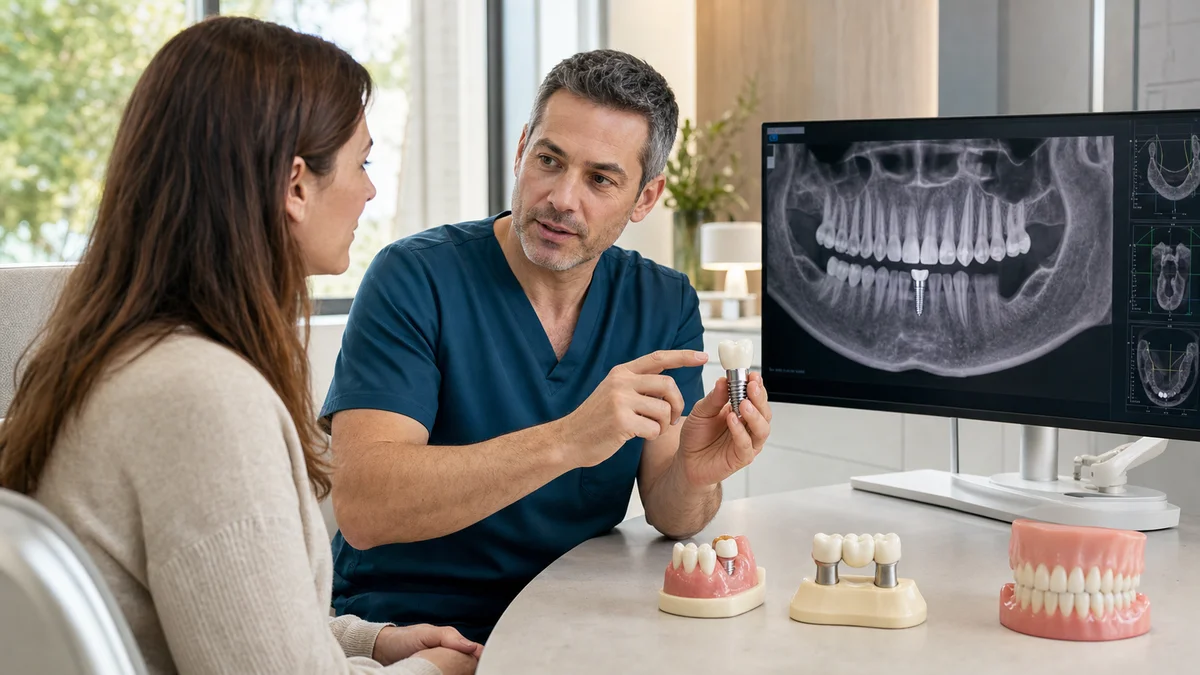
Quick answer: The pros and cons for dental implants depend on your oral health, general health, anatomy, restoration and ability to maintain them. Implants can restore chewing and replace teeth without preparing adjacent teeth, but require surgery, healing and ongoing care. Infection, nerve or sinus injury, loosening and implant failure are possible. A clinical assessment and comparison with bridges, dentures or no treatment are essential.
Replacing a missing tooth is not simply a choice between “best” and “second best.” It is a clinical decision about function, anatomy, risk, time, maintenance and personal priorities. A dental implant can support one crown, a fixed bridge or a removable denture, but the implant itself is only one part of a larger treatment. The result also depends on the surrounding bone and gum, the prosthetic design, the bite, hygiene and follow-up. A useful review of the pros and cons for dental implants therefore has to look beyond the visible replacement tooth.
This guide is designed to support an informed conversation with a dentist; it cannot determine whether an implant is appropriate for an individual. Examination, medical and dental history, periodontal assessment and suitable imaging may change the recommendation. If you have facial swelling, fever, uncontrolled bleeding, altered sensation, severe pain, difficulty swallowing or a loose implant component, seek prompt professional assessment rather than relying on general information online.
1. What a Dental Implant Treatment Actually Includes
Understanding the pros and cons for dental implants begins with knowing what the treatment includes. A dental implant is a device placed surgically into the jawbone. After the implant has achieved sufficient stability and healing, it may support an abutment and a crown, bridge or denture. Some plans are completed in stages, while selected cases may receive a temporary restoration earlier. “Implant treatment” can therefore include assessment, imaging, disease control, extraction, bone or soft-tissue procedures, implant placement, healing reviews, the definitive prosthesis and continuing maintenance.
That distinction matters when discussing the pros and cons for dental implants. The titanium or ceramic fixture is not a natural tooth root, and the restoration attached to it is not maintenance-free. Screws, clips, crowns and denture attachments can wear or loosen. The tissues around an implant can become inflamed. Even when the implant remains integrated, the visible restoration may later need repair or replacement.
One of the pros and cons for dental implants is that an implant may replace a single tooth without cutting down healthy adjacent teeth. Multiple implants can support a bridge where several teeth are absent, or improve the retention of a removable denture. However, using more implants is not automatically better. The number, position and restorative design should follow anatomy, cleanability, load distribution and the person’s goals—not a package or headline.
2. Pros and Cons for Dental Implants at a Glance
The table below summarises the pros and cons for dental implants as a conversation aid, not a suitability test. Every potential advantage has a condition attached, and every drawback has ways to reduce—but not eliminate—risk.
| Decision factor | Potential benefit | Tradeoff or uncertainty | Question to ask |
|---|---|---|---|
| Chewing and stability | A fixed restoration or implant-retained denture may improve stability and function. | Comfort and function vary; bite forces still require careful design and review. | What functional change is realistic for my case? |
| Adjacent teeth | A single implant may avoid preparing neighbouring teeth for a conventional bridge. | Space, root position or bone anatomy may limit placement. | Are the adjacent teeth healthy, restored or better used as bridge supports? |
| Bone and gum | Functional loading may help maintain local bone compared with an unrestored gap. | Bone can still remodel, and grafting or soft-tissue treatment may be necessary. | Is there adequate bone and tissue for a cleansable result? |
| Surgery | Placement can create a stable foundation without a removable appliance. | Infection, bleeding, nerve or sinus injury, delayed healing and failure are possible. | What structures are close to the proposed site? |
| Time | A staged plan allows tissues to heal and the restoration to be tested. | Treatment can take months and may involve several visits. | What are the stages, contingencies and temporary-tooth plan? |
| Maintenance | Implant restorations can be cleaned and professionally monitored. | Daily plaque control, periodic reviews and future component repairs remain necessary. | Can I clean this design effectively at home? |
| Cost | A durable, repairable plan may provide value for an appropriate patient. | Fees vary with diagnostics, grafting, components, temporaries and maintenance. | What is included, excluded and likely to need renewal? |
When comparing the pros and cons for dental implants, ask how each point applies to your specific site and restoration. A single front tooth, a molar in a person who clenches, and a lower denture supported by two implants are different clinical problems. They should not share an identical risk statement or timetable.
3. Potential Benefits: Function, Tooth Preservation and Stability
Among the pros and cons for dental implants, one important benefit is support for a replacement tooth without relying on a removable plate. A well-planned implant crown may feel stable during chewing, while implant-retained dentures may move less than conventional dentures. The US Food and Drug Administration lists restoration of chewing ability and cosmetic appearance among possible benefits. It also notes potential support for the stability of surrounding teeth and tissues.
For a single missing tooth, avoiding preparation of sound neighbouring teeth can be valuable. A conventional bridge often needs those teeth to support connected crowns. Yet this comparison changes if adjacent teeth already need crowns, have large restorations or have a prognosis that affects the whole plan. The pros and cons for dental implants should be compared with the real alternative for that mouth, not with an idealised bridge that no clinician has proposed.
- Independent support: a single implant can carry a crown without using adjacent teeth as supports.
- Prosthetic stability: implants may help retain a bridge or removable denture.
- Chewing function: a stable restoration may improve a person’s ability to manage an appropriate range of foods.
- Local tissue support: implant loading may help limit some bone changes after tooth loss, although it cannot stop all remodelling.
- Design options: fixed and removable solutions can be considered according to anatomy, hygiene and preference.
These possible advantages are part of the pros and cons for dental implants, not promised outcomes. Comfort, speech and appearance depend on the planned tooth position, gum contours, space and the person’s adaptation. A restoration that looks attractive but cannot be cleaned is not a good long-term design. A responsible account of the pros and cons for dental implants gives hygiene and repairability the same weight as initial appearance.
4. Bone Preservation Claims Need Context
Bone behaviour is an important part of the pros and cons for dental implants. After a tooth is removed, the surrounding ridge usually changes. An implant placed in an appropriate position may transmit function to the bone and help maintain local support, but it does not freeze the tissues in time. Bone and gum levels can still change because of healing, anatomy, inflammation, loading, smoking, systemic health and restorative design.
Grafting can change the pros and cons for dental implants because some sites do not have enough bone for the intended implant position. A clinician may discuss ridge preservation at extraction, bone augmentation, sinus-related procedures or a narrower restorative plan. Grafting adds another wound, cost, material choice and healing period, and the result is not guaranteed. In other sites, a graft may not be necessary. The decision must come from examination and imaging, not from a universal rule.
In the pros and cons for dental implants, “bone preservation” is best treated as a possible biological advantage with limits. Ask whether the proposed implant position is driven by the final crown, whether the surrounding tissue can be cleaned and what happens if a graft does not produce enough volume. These questions turn a slogan into a meaningful consent discussion.
5. Surgical Risks and How Planning Addresses Them
Surgery is central to the pros and cons for dental implants. Expected short-term effects can include soreness, swelling, bruising or minor bleeding, but individual experiences differ. Recognised complications include infection, damage to adjacent teeth or bone, sinus problems in the upper jaw, altered sensation from nerve injury, delayed healing and failure of the implant to integrate. The exact profile depends strongly on the site and the person.
Planning can improve the balance of pros and cons for dental implants. It usually combines clinical examination with appropriate radiographs, and three-dimensional imaging may be indicated where anatomy or risk requires it. A scan does not make treatment risk-free; it helps the clinician evaluate available bone, root positions, the maxillary sinus and nerve canals. The final plan should relate the surgical position to the restoration that will be placed above it.
A balanced review of the pros and cons for dental implants should include what will happen if placement cannot proceed as expected. Ask whether the clinician may stop, change implant dimensions, add a graft or postpone restoration. Also ask who manages a complication, how urgent contact works and whether specialist input could be appropriate before treatment.
When altered sensation needs attention
Neurological risk belongs in the pros and cons for dental implants. Numbness or tingling after local anaesthetic should be discussed urgently if it persists longer than the treating team advised, changes or causes concern. Nerve-related symptoms can affect the lip, chin, teeth, gum or tongue depending on the site. Rapid documentation and assessment are important; do not wait for a routine review if the clinic instructed you to report altered sensation promptly.
6. Healing, Integration and Treatment Time
Healing time shapes the pros and cons for dental implants. Bone healing around an implant is called osseointegration, and the time needed is not fixed: it depends on initial stability, bone quality, site, additional procedures, health factors and the planned restoration. Some implants can carry a carefully controlled temporary tooth earlier, while others should heal without functional loading. “Same-day teeth” describes a timing approach, not guaranteed biological integration or a final restoration for every person.
Temporary teeth are another part of the pros and cons for dental implants. During healing, an option may be removable, bonded to nearby teeth, attached to selected implants or occasionally unnecessary. Each choice affects appearance, comfort, loading and cleaning. If treatment is important for work, travel or a major event, ask what the temporary is designed to tolerate and what contingency exists if healing takes longer.
Time is one of the practical pros and cons for dental implants. Staged care allows evaluation and adjustment, but it can require multiple appointments over months. Extraction healing, bone graft maturation, implant integration and laboratory production may each add time. A short advertised timeline may not include disease control, unexpected healing or the transition from provisional to definitive teeth.
7. Who May—or May Not—Be a Suitable Candidate
Candidacy determines how the pros and cons for dental implants apply, and age alone rarely answers the question. Suitability is usually based on growth status, general health, medications, ability to undergo surgery, oral disease control, bone and soft-tissue anatomy, bite, hygiene and willingness to attend maintenance. Active decay or gum infection should be assessed and managed before implant placement. The rest of the mouth also matters: an implant cannot compensate for uncontrolled disease elsewhere.
A complete medical history makes the pros and cons for dental implants more meaningful. Disclose all diagnoses, medicines, supplements, allergies, previous radiotherapy, bone-related therapies, smoking or nicotine use, pregnancy possibility and prior problems with surgery or healing. Never stop an anticoagulant, osteoporosis medicine or other prescription without instructions from the prescribing clinician and dental team. Medical coordination may be needed, but a diagnosis does not automatically mean treatment is impossible.
For candidacy, the pros and cons for dental implants are individual. A condition may alter timing, monitoring or risk rather than create a simple yes/no answer. Equally, a person who appears healthy still needs an oral examination and imaging. Online quizzes and photographs cannot confirm bone dimensions, infection status or the relationship to nerves and sinuses.
Smoking and nicotine use
Smoking can impair healing and is associated with gum disease; the FDA also warns that smoking may affect implant healing and long-term success. Nicotine use should be discussed honestly so the clinician can explain risk and cessation support. Concealing use prevents realistic planning. Stopping can be beneficial, but no brief abstinence window guarantees integration or removes later disease risk.
Diabetes and other health conditions
For someone with diabetes, the relevant questions include current control, complications, infection risk and coordination with medical care. Other conditions and medicines can influence bleeding, immunity, bone metabolism or the ability to maintain hygiene. The pros and cons for dental implants must therefore be reviewed with up-to-date medical information, not a generic exclusion list.
8. Maintenance Is a Lifelong Part of the Plan
Hygiene is one of the continuing pros and cons for dental implants. Implants cannot develop tooth decay, but the tissues around them can become inflamed. Plaque also collects on implant-supported prostheses. The National Institute of Dental and Craniofacial Research notes that plaque forms on prosthetic devices, including implants, and that plaque can cause gingivitis. Daily cleaning and professional monitoring remain essential.
Daily self-care can change the long-term pros and cons for dental implants. The right tools depend on the design and your dexterity. A clinician or hygienist may demonstrate a soft toothbrush, interdental brushes, floss designed for bridges, a water irrigator or other aids. More tools are not automatically better; what matters is safe, effective access beneath and around the restoration. If you cannot reach an area, say so before the definitive prosthesis is completed.
- Brush twice daily with a technique recommended for your tissues and restoration.
- Clean between implants and under bridges or denture components every day.
- Remove and clean a removable implant-retained denture as instructed.
- Attend reviews at an interval based on your risk rather than a universal schedule.
- Report bleeding, swelling, discharge, persistent bad taste, pain, movement or a bite change.
- Use a night guard only if prescribed and reviewed for the implant restoration.
Maintenance is often underweighted in discussions of the pros and cons for dental implants. Ask who provides maintenance, what the likely recall pattern is and how components can be accessed. If the restoration is screw-retained, it may sometimes be removed for servicing; if cement-retained, excess cement and retrieval must be considered. Neither method is universally superior.
9. Longevity, Repairs and the Meaning of “Success”
Longevity is often oversimplified in the pros and cons for dental implants. No implant should be described as guaranteed for life. “Success” may mean the fixture remains integrated, but patients usually care about the complete system: comfort, appearance, cleanability and function. A crown can chip, a screw can loosen, an attachment can wear or a denture base can fracture while the implant itself remains in place. Conversely, an attractive crown does not make inflamed tissues healthy.
Repairability adds practical detail to the pros and cons for dental implants. Bite forces, grinding, the number and distribution of implants, restoration material and maintenance affect repair needs. A plan should explain which parts are replaceable, how access is achieved and whether the chosen components are traceable. The FDA advises patients to ask for the brand and model of their implant system and to keep that information. Records can be especially valuable if care later moves to another clinic or country.
When weighing the pros and cons for dental implants, distinguish biological complications from mechanical ones. Biological problems involve tissues, infection, bone or integration. Mechanical problems involve components and materials. Both can require treatment and expense. A realistic consent process covers early and late complications, as well as the possibility that an implant may need removal.
10. Cost, Insurance and What a Quote Should Explain
Cost is a material part of the pros and cons for dental implants, but there is no responsible single price without a clinical plan. Cost varies with the number and type of records, extractions, grafting, implant components, sedation where appropriate, temporary teeth, laboratory work, restoration material, complexity and follow-up. The lowest headline price may describe only placement of the fixture rather than the complete, maintained tooth.
Coverage can alter the financial pros and cons for dental implants. Insurance policies and national rules differ and can change. Ask the provider or insurer directly about exclusions, annual limits, pre-authorisation, waiting periods and reimbursement documentation. Do not assume that “medically necessary,” “cosmetic” or “dental” has the same meaning across policies. Written pre-treatment estimates help, but they are not a promise that every complication or additional procedure is covered.
Financial comparison belongs within the pros and cons for dental implants, but it should compare like with like. A bridge quote should include the health and future needs of supporting teeth. A denture quote should include relines, attachment replacements and maintenance where relevant. An implant quote should state what happens if grafting, additional imaging, a new provisional or a repair becomes necessary.
- Request an itemised plan with implant, abutment, temporary and definitive restoration identified.
- Ask which diagnostic, surgical, laboratory and review appointments are included.
- Confirm whether graft materials, sedation, medicines and aftercare are separate.
- Ask how complications, early failure and future prosthetic maintenance are charged.
- Keep implant system records, invoices, scans and the final restoration specification.
11. Alternatives: Bridge, Denture or No Immediate Replacement
Alternatives provide the reference point for the pros and cons for dental implants. Informed consent requires reasonable options. A conventional bridge can be efficient when supporting teeth already need crowns, although it joins teeth together and may require tooth preparation. A resin-bonded bridge can be conservative in selected situations but has its own limitations. A removable partial or complete denture avoids implant surgery and may replace teeth and missing gum volume, but stability, bulk, adaptation and maintenance differ.
Doing nothing immediately also belongs in the pros and cons for dental implants. It can be a valid choice in some positions if function, tooth movement, appearance and future options are discussed. Monitoring is still a plan. Leaving a gap may allow changes in neighbouring or opposing teeth, but the significance varies by site and person. A short-term choice can be reviewed later, although bone and space may change with time.
Comparing the pros and cons for dental implants with alternatives is most useful when the same outcomes are considered: surgery, tooth preparation, time, maintenance, repairability, appearance, chewing, tissue replacement and cost. “Fixed” does not always mean implant-supported, and “removable” does not always mean unstable. Ask to see how each design would work in your mouth.
When a bridge may deserve closer consideration
A bridge may be attractive when adjacent teeth have large failing restorations and are suitable supports, when surgery is undesirable or when timing makes implant healing impractical. Its disadvantages can include preparation of supporting teeth and the consequences if one support later fails. The correct comparison is prognosis of the whole design, not a blanket claim that an implant is always more conservative.
When a denture may be practical
A denture can replace multiple teeth and lost gum volume without placing an implant at every site. It may be modified if circumstances change and can be easier to remove for cleaning. Some people find movement, coverage or adaptation difficult. Implants may also be used to retain a removable denture, creating a hybrid option rather than an either-or choice.
12. A Patient-Safe Decision Process
A good consultation should connect your priorities with clinical findings, because personal goals can change the pros and cons for dental implants. If appearance matters most, discuss gum levels, tooth proportions and whether a temporary can test the design. If chewing is the priority, discuss the opposing teeth, bite and realistic food function. If minimising surgery matters most, compare non-surgical options openly. The decision is stronger when the treatment goal is explicit.
Use the pros and cons for dental implants to structure questions, not to score yourself. Ask the clinician to identify the site-specific benefit, main risks, uncertainty and alternative. You should understand who will place the implant, who will make the restoration and who coordinates follow-up. If different clinicians are involved, communication and shared records matter.
- Define the problem: pain, appearance, chewing, denture movement or prevention of further damage may lead to different solutions.
- Stabilise disease: address active decay, gum disease, infection and hygiene barriers.
- Assess anatomy: use examination and appropriate imaging to evaluate bone, tissue, roots, nerves and sinuses.
- Design the final tooth first: position the implant to support a functional, attractive and cleansable restoration.
- Compare alternatives: include reasonable fixed, removable and monitoring options.
- Plan contingencies: discuss grafting, delayed healing, failure, temporaries and repair pathways.
- Confirm maintenance: agree how daily cleaning and professional review will work.
For an individual implant assessment, you can learn about the clinic’s approach on the Redent Clinic English website and use the Redent Clinic contact page to request a consultation. A remote exchange may help organise records, but final suitability still requires appropriate clinical evaluation.
Travel and Continuity of Care
Travel logistics add another layer to the pros and cons for dental implants. Travel can compress appointments, but biology does not follow an airline schedule. If care occurs away from home, ask how many visits are expected, what happens if healing is delayed and whether the definitive restoration should wait. Plan enough time for reviews before departure and avoid arranging important travel immediately after surgery unless the treating team considers it appropriate.
Continuity changes the practical pros and cons for dental implants. Confirm who responds to urgent questions, who can review the implant locally and how records will be shared. Obtain the implant brand, model, dimensions where provided, component details, radiographs and restorative information. Ask whether replacement components are available in your home country.
A local dentist may not be able to service every proprietary system, and correcting another provider’s work may require new assessment and fees. This is not a reason to avoid travel, but it is a reason to include aftercare in the initial decision. The value of a plan includes access to maintenance and repair, not only the day of placement.
Warning Signs and When to Seek Help
Follow the treating clinic’s written instructions. Some discomfort and swelling can be expected after surgery, but worsening pain, increasing swelling, fever, pus, persistent bleeding, difficulty breathing or swallowing, or an allergic-type reaction require prompt assessment. New or persistent numbness and tingling should also be reported without delay.
Later, contact a dental professional if the crown, bridge, denture or implant feels mobile; if the bite suddenly changes; or if you notice bleeding, swelling, discharge, bad taste or persistent soreness around the implant. Do not repeatedly tighten, glue or adjust components yourself. Early assessment may limit damage even though it cannot guarantee that the implant or restoration will be saved.
Urgent-care planning belongs in any discussion of the pros and cons for dental implants. Before treatment, save the clinic’s contact route, know what constitutes an emergency and identify where you would seek help outside opening hours—especially if you will travel during healing.
Frequently Asked Questions About Pros and Cons for Dental Implants
Are dental implants always better than bridges?
No. An implant may avoid preparation of healthy neighbouring teeth, but it involves surgery and healing. A bridge may be reasonable when adjacent teeth already require crowns or when implant surgery is unsuitable. The pros and cons for dental implants must be compared with the condition and prognosis of the actual supporting teeth, the site anatomy, time and maintenance.
Can an implant last for life?
No clinician can guarantee that. An implant may remain integrated for many years, but tissues can become diseased and components or restorations can wear, loosen or fracture. Health, smoking, plaque control, bite, design and maintenance affect risk. Ask separately about the expected service and repair of the implant fixture, abutment and visible restoration.
Is implant placement painful?
Local anaesthesia is commonly used during placement, with additional anxiety or sedation options considered when clinically appropriate. Soreness and swelling afterward vary with the procedure and person. Pain that is severe, worsening or accompanied by fever, discharge, spreading swelling or altered sensation needs prompt advice. Do not compare your recovery timetable with an advertisement or another patient.
Does every implant patient need a bone graft?
No. A graft may be considered when available bone does not support the restorative plan, but anatomy and objectives differ. Appropriate examination and imaging guide the decision. Grafting adds treatment, healing, expense and uncertainty. Ask why it is recommended, what material is proposed, what alternatives exist and what the plan will be if the result is insufficient.
Can I have an implant immediately after extraction?
Immediate placement may be possible in selected sites, but it is not automatically safer or faster overall. Infection, bone walls, soft tissue, implant stability and the planned tooth position matter. Immediate placement is also different from immediate loading with a temporary tooth. Both choices require case-specific consent and a contingency if conditions at surgery are different from expected.
Can smokers receive dental implants?
Smoking does not create one universal answer, but it can impair healing and increase oral disease risk. The clinician needs accurate information about smoking or nicotine use to explain the pros and cons for dental implants in that context. Cessation support may reduce risk, yet no specific pause guarantees integration or eliminates future complications.
Can dental implants get cavities?
The implant and crown cannot develop tooth decay, but neighbouring natural teeth can. Plaque can accumulate around implant restorations, and the surrounding gum and bone can become inflamed or diseased. This is why daily brushing, cleaning between and beneath components, and professional monitoring remain essential after the replacement tooth is delivered.
What records should I keep?
Keep the implant brand and model, component information, relevant scans and radiographs, treatment dates, restorative design and clinician contact details. The FDA specifically advises asking for implant system information. Records make maintenance and urgent repair easier if you move, travel or see another provider, although a new clinician will still need to assess the current condition.
What if an implant does not integrate?
The implant may need to be removed, the site allowed to heal and the plan reassessed. Depending on the cause and anatomy, options might include later replacement, grafting, a bridge, a denture or leaving the space. Retreatment is not automatic and cannot be guaranteed. Ask before surgery how early failure is detected, managed and charged.
How should I choose between fixed and removable implant teeth?
Consider the number and position of implants, missing gum volume, speech, lip support, cleanability, dexterity, repairability and cost. A removable implant-retained denture can provide stability while remaining accessible for cleaning. A fixed bridge may feel more tooth-like but can be harder to clean. The best design is the one that meets clinical and personal needs safely.
What is the most important question before deciding?
Ask: “Why is this design more suitable for me than the reasonable alternatives?” The answer should connect evidence to your health, anatomy and priorities. A complete explanation of the pros and cons for dental implants should cover benefit, uncertainty, surgery, restoration, maintenance, future repairs, cost and the plan if healing or components do not behave as expected.
Final Perspective on Pros and Cons for Dental Implants
Dental implants can provide independent tooth support, stable restorations and useful fixed or removable options. They may avoid preparation of neighbouring teeth and help support local tissues. Their disadvantages include surgery, healing time, anatomical limitations, possible infection or injury, failure risk, maintenance and future component repair. Neither side of that balance can be judged from the missing tooth alone.
The safest way to use the pros and cons for dental implants is to turn them into site-specific questions. Confirm the diagnosis and goal; understand the final restorative design; compare bridge, denture and monitoring options; disclose health and medication information; and plan maintenance and contingencies. Take time to read the consent information and seek another opinion if the rationale, alternatives or responsibilities remain unclear.
This article provides general education and does not replace diagnosis or personalised advice. Recommendations can change when examination, imaging and medical information are reviewed. Content is prepared for clinical review by Dentist Esma Çevrük Çakır, with patient safety, shared decision-making and evidence-based communication as priorities.
Sources and Further Reading
- US Food and Drug Administration: Dental Implants—What You Should Know
- National Institute of Dental and Craniofacial Research: Oral Hygiene
- NIDCR: Ask the Expert—Gum Disease
- Guy’s and St Thomas’ NHS Foundation Trust: Dental Implants
- Cambridge University Hospitals NHS Foundation Trust: Dental Implants in Restorative Dentistry
- US Centers for Disease Control and Prevention: Smoking and Periodontal Disease
- American Dental Association: Dental Implants
- World Health Organization: Oral Health Fact Sheet