
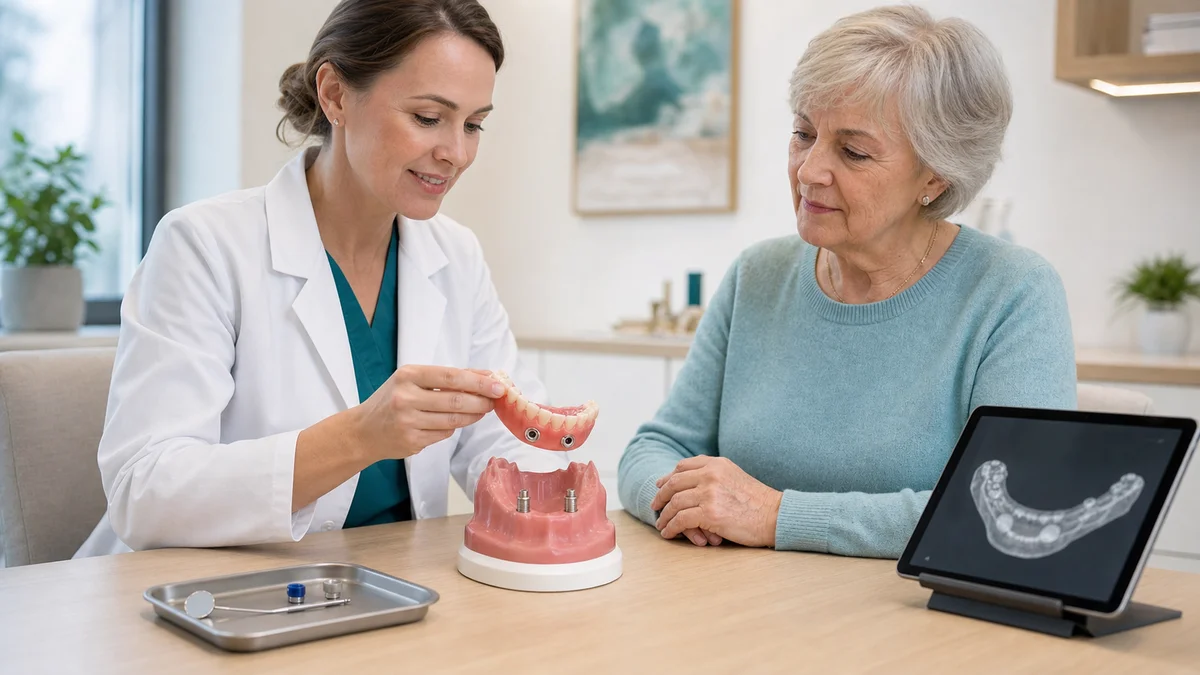
Quick answer: removable dental implants cost usually means the total for implants plus an implant-retained removable overdenture—not implants that you remove. A complete estimate should separate examination and imaging, surgery, implant bodies, abutments or a bar, the denture, temporary teeth, grafting if needed, follow-up, attachment replacement, relines, and future repairs. An examination is required before a reliable personal total can be given.
removable dental implants cost is easy to misunderstand because the common search phrase describes two connected but very different parts. The dental implants are medical devices placed in the jaw and are not routinely removed by the patient. The overdenture is the removable prosthesis that snaps, clips, or seats onto implant attachments. A price that covers only the implants is therefore not the price of a finished smile, while a price for a denture alone may exclude surgery, implant components, imaging, and maintenance.
This evidence-led guide explains how to compare quotes for an implant-retained overdenture without assuming that one implant number, attachment type, or advertised package fits everyone. It does not diagnose candidacy or promise a result. Bone volume, gum health, remaining teeth, medical history, medications, smoking, dexterity, cleaning ability, bite forces, and the opposing arch can change both the treatment design and the total. A personal plan becomes reliable only after clinical examination and the imaging your dentist considers necessary.
What does removable dental implants cost actually describe?
The more precise clinical term is often implant-retained overdenture or implant-supported removable denture. The FDA explains that a dental implant system can include an implant body, an abutment, and an abutment fixation screw, while the artificial teeth may be a crown, bridge, or denture. Leeds Teaching Hospitals similarly distinguishes removable overdentures from fixed crowns and bridges: the overdenture connects to implants with attachments and can be removed for cleaning.
That distinction matters when reading removable dental implants cost. One quote may include implant bodies and placement only. Another may include surgery, attachment abutments, a new denture, and early follow-up. A third may convert an existing denture if its design, condition, tooth position, and available space are suitable. These totals are not comparable until each component is identified.
- Implant body: the component surgically placed in the jawbone.
- Abutment or bar: the part that connects the implants to the removable denture.
- Attachment insert or clip: a replaceable component that helps the denture engage the abutment or bar.
- Overdenture: the removable teeth and denture base that the patient takes out for hygiene.
- Maintenance: professional review, attachment adjustment or replacement, reline, repair, and eventual remake when clinically indicated.
Why one advertised total cannot fit every patient
removable dental implants cost changes first because the prosthetic goal changes. A lower overdenture retained by individual attachments is not the same design as an upper overdenture supported by a milled bar. The upper jaw may require a different implant number and distribution than the lower jaw. Some plans rely mainly on the tissues for support while implants improve retention; other designs distribute more load through implants. Those choices affect surgery, component count, laboratory work, space requirements, cleaning, and repair.
The condition of the existing denture also matters. A dentist may determine that it cannot be safely converted because it is worn, unstable, poorly fitting, cracked, incorrectly positioned, or lacks room for attachments. ACP guidance notes that removable prostheses have limited service lives because oral tissues change and materials can wear, fracture, or degrade. Consequently, removable dental implants cost should not assume that an old denture will always be reusable.
Clinical variables can add or remove phases. Active gum disease may need treatment before implant placement. A badly infected tooth may require extraction and healing. Inadequate bone may lead to a graft discussion, although not every patient needs grafting. A medical condition or medication may alter timing or candidacy. These findings must be assessed rather than inserted into every quote as automatic extras.
The 9 components of a complete removable overdenture quote
A transparent removable dental implants cost estimate identifies what is included now, what is conditional on a clinical finding, and what may arise later as normal maintenance. The following nine components provide a practical structure.
For this reason, a removable dental implants cost comparison should match the same arch, implant count, attachment design, denture type, temporary phase, and follow-up scope before either quote is described as lower.
1. Examination, records, and imaging
The first phase may include a dental and medical history, examination of the gums and oral tissues, evaluation of an existing denture, assessment of the bite, and appropriate radiographs. Three-dimensional imaging may be indicated when anatomy and implant position need further evaluation, but it is not a substitute for clinical examination. Ask whether consultation, radiographs, scans, digital records, and diagnostic models are included in removable dental implants cost or billed separately.
2. Extractions and disease control
Remaining teeth should not be removed merely to match a package. Teeth that are maintainable may contribute to alternative plans, while teeth with a hopeless prognosis may need extraction. Active periodontal or peri-apical infection, uncontrolled plaque, and traumatic denture areas require attention. A quote should state whether extractions, socket care, periodontal treatment, or a healing denture are included. removable dental implants cost is incomplete when pre-implant disease control is omitted from a patient who needs it.
3. Implant bodies and placement surgery
The implant device and the surgical service may be separate line items. The number, diameter, length, position, and system should follow the prosthetic plan and anatomy rather than a discount tier. The FDA advises patients to ask for the brand and model of the implant system and keep that information in their records. When comparing removable dental implants cost, confirm how many implants are planned per arch, which system is proposed, and whether surgical supplies and routine post-operative checks are included.
4. Bone or soft-tissue procedures
Bone grafting, membranes, ridge shaping, or soft-tissue procedures may be considered when clinical and imaging findings support them. The need, site, material, timing, alternatives, and effect on the temporary denture should be explained. “Graft extra if needed” is too vague for a useful comparison. A conditional removable dental implants cost estimate can show a primary scenario and a second scenario if a defined additional procedure becomes necessary.
5. Attachment abutments or a bar
Individual stud-style attachments and bar systems have different component, space, laboratory, hygiene, and maintenance requirements. Angulation and tissue height may affect abutment selection. A bar requires design and fabrication beyond the implant bodies themselves. Ask for the attachment system and the number of abutments, housings, clips, or inserts included. These are core parts of removable dental implants cost, not incidental accessories.
6. Temporary teeth during healing
Implant integration can take time, and a patient may need an adjusted existing denture, a new healing denture, or another temporary solution. The temporary appliance must avoid damaging the surgical sites and may need adjustments as swelling resolves. Immediate connection is not suitable for every case. A complete removable dental implants cost quote explains what the patient will wear between surgery and final attachment, how many adjustments are included, and what happens if healing changes the schedule.
7. The definitive removable overdenture
The final denture has its own clinical and laboratory stages: impressions or digital records, jaw relation, tooth setup, try-in, processing, attachment pickup, delivery, and adjustment. Base reinforcement, tooth material, space for components, lip support, speech, and cleanability matter. A new implant-retained overdenture should not be reduced to “clips included.” removable dental implants cost should specify whether the definitive prosthesis is new or a conversion, which arch it covers, and which clinical and laboratory stages are included.
8. Review and hygiene program
Implants do not decay, but the tissues around them can become inflamed. The denture and the abutments collect biofilm and require daily cleaning. ADA guidance notes that removing an implant-supported denture provides access to implant abutments for cleaning. The review interval should be personalized to tissue health, dexterity, periodontal history, smoking, medical risk, and prosthesis design. Ask whether early reviews and professional maintenance are included in removable dental implants cost.
9. Attachment replacement, reline, repair, and remake
Attachment inserts or clips can wear and lose retention. The denture base may need relining as the supporting tissues change. Teeth or acrylic can chip or fracture, and the prosthesis may eventually need replacement. Leeds NHS specifically warns that overdentures or their clips may wear over time, while ACP advises regular examination of removable prostheses and identifies loss of fit, instability, wear, and damage as reasons for review. These predictable categories belong in a lifetime removable dental implants cost discussion even though their timing cannot be guaranteed.
Decision table: compare the main full-arch options
The lowest initial total is not automatically the best value, and the highest total does not prove the best fit. Compare function, removability, hygiene, repair pathways, anatomy, and patient preference alongside removable dental implants cost.
| Option | What the patient removes | Main cost drivers | Maintenance questions | Decision focus |
|---|---|---|---|---|
| Conventional complete denture | The entire denture | New denture, impressions, try-in, adjustments | Relines, repairs, remake, tissue review | Can an appropriately made conventional denture meet the goal? |
| Implant-retained overdenture with individual attachments | The entire overdenture | Implants, abutments, housings, denture, possible grafting | Insert wear, attachment cleaning, reline, repair | Is the implant number and distribution appropriate for this arch? |
| Bar-retained removable overdenture | The entire overdenture | Implants, fabricated bar, clips, denture, laboratory stages | Cleaning under the bar, clip wear, bar and denture review | Is there enough restorative space and cleaning ability? |
| Fixed full-arch implant bridge | Nothing during routine home care; clinician removes only if indicated | Implants, multi-unit components, temporary and definitive bridge | Special hygiene, screw/prosthesis review, repairs | Does fixed treatment justify its different surgery, hygiene, and cost? |
This table is a decision aid, not a prescription. A fixed restoration and a removable overdenture cannot be compared by implant count alone. The removable design may replace more lost gum and lip support and may be easier for some patients to clean outside the mouth. A fixed bridge may meet a strong preference for non-removability but demands a cleanable design and different maintenance. Personal anatomy and capability determine whether an option is reasonable.
A sound removable dental implants cost decision therefore starts with the intended prosthesis, not with a predetermined number of implants or a package name.
How implant number and attachment design change the total
Search results sometimes imply that every lower overdenture uses two implants and every upper overdenture uses four. Those numbers may appear in common treatment patterns, but they are not automatic prescriptions. Implant number and distribution should reflect the arch, bone, opposing teeth, prosthetic support, load, anatomy, and guideline-based planning. EFP guidance for complex rehabilitation recognizes implant-supported removable full-arch prostheses as an option when fixed full-arch criteria are not met or a reduced implant number and position favors an overdenture.
removable dental implants cost may rise with more implants, yet a simple multiplication is still misleading. Additional implants affect imaging, surgical time, components, the prosthesis design, and future maintenance. A bar may add laboratory complexity even when the implant number resembles an attachment-retained plan. Conversely, fewer implants do not automatically mean a clinically suitable or lower-lifetime-cost plan.
Ask the dentist to explain the role of every implant. Is it intended mainly to improve retention, increase support, distribute load, or enable a bar? What is the alternative if one planned site lacks adequate bone? What happens to the prosthesis if an implant is not integrated? A clear removable dental implants cost proposal links each component to the treatment objective.
First-fit price versus lifetime ownership cost
A new overdenture is a medical device with maintenance needs, not a permanent object that remains unchanged. Oral tissues remodel, attachment inserts wear, and denture materials age. ACP’s position on replacement frequency explains that changes in hard and soft tissues can reduce fit and that material wear or fracture can require relining, rebasing, repair, or remaking. Therefore, removable dental implants cost has an initial phase and a continuing phase.
- Routine clinical review of implants, tissues, bite, and denture fit
- Professional hygiene around implant abutments
- Replacement or adjustment of worn attachment inserts or clips
- Reline or rebase when tissue support changes
- Repair of a cracked base, worn tooth, housing, or reinforcement
- Remake when the denture no longer fits, functions, or can be repaired predictably
No ethical quote can predict the exact date of every future event. It can, however, disclose which maintenance tasks are normal, who performs them, what an urgent visit looks like, and whether the clinic stocks compatible components. A low first-fit removable dental implants cost can become less attractive when attachment access, local service, or repair documentation is weak.
A lifetime removable dental implants cost discussion should identify these service categories without pretending to predict exactly when a specific insert, reline, repair, or replacement will be needed.
Can an existing denture be converted?
Conversion may be possible when an existing denture is structurally sound, appropriately designed, has adequate restorative space, and meets current fit, bite, appearance, and tooth-position needs. The dentist and laboratory must also determine whether attachment housings can be incorporated safely. A conversion can reduce one part of removable dental implants cost, but it should not preserve a poor denture merely to protect an advertised package.
A denture may be unsuitable if it is old, heavily worn, unstable, repeatedly repaired, cracked, too thin around the proposed housings, or unable to accommodate the attachment path. Tissue changes during healing may also create a need for reline or remake. Ask for two clearly labeled scenarios when appropriate: conversion of the existing denture and fabrication of a new overdenture. Each should state assumptions and exclusions.
Immediate loading and the temporary denture
Marketing may suggest that implants and a finished denture are always connected on the same day. Immediate or early connection depends on primary stability, bone quality, implant distribution, attachment choice, bite, and whether augmentation is performed. The final decision may change during surgery. A patient-safe removable dental implants cost quote includes a fallback if immediate connection is not advisable.
The temporary denture may require a soft reline, relief over the surgical areas, or staged attachment pickup. The final overdenture may be made only after healing and tissue stabilization. Ask which prosthesis is temporary, which is definitive, how many adjustment visits are expected, and whether the advertised “same-day teeth” are attached, tissue-supported, or simply a modified existing denture. Speed should not replace biological judgment.
Insurance, Medicare, financing, and currency questions
Coverage varies by country, insurer, plan, medical indication, and provider network. In the United States, Original Medicare generally excludes routine dental services related to replacing teeth, with limited circumstances when dental care is integral to certain covered medical services. Private dental or Medicare Advantage benefits can differ. Do not assume that a surgical implant benefit automatically includes abutments, attachment inserts, the overdenture, imaging, or maintenance.
For an insurance-ready removable dental implants cost estimate, request procedure descriptions, arch, implant number, attachment system, prosthesis type, and separate fees. Ask the insurer whether preauthorization is required, whether annual maximums or waiting periods apply, and whether replacement frequency rules affect the denture. Coverage confirmation should come from the current plan, not an online anecdote.
When benefits are limited, removable dental implants cost should be divided into covered, noncovered, conditionally covered, and patient-responsibility lines rather than reduced to an estimated reimbursement promise.
For international treatment, a quote may be stated in a currency different from the patient’s. Confirm the exchange-rate policy, quote-validity date, deposit terms, refund conditions, and which payments occur at surgery versus final prosthesis delivery. Travel, accommodation, time away from work, companion expenses, and return visits are not dental fees but affect total ownership. A transparent removable dental implants cost comparison uses the same currency date and the same clinical scope.
How to compare two written quotes in 12 steps
Before deciding which removable dental implants cost is lower, normalize the proposals. A two-implant lower overdenture cannot be directly compared with a four-implant bar overdenture or a fixed full-arch bridge. Use this sequence:
- Match the arch and diagnosis: upper, lower, or both; remaining teeth; tissue and bone findings.
- Match the treatment objective: retention, support, fixed function, lip support, or a combination.
- Confirm implant count: number, planned positions, and the clinical reason for each.
- Separate device and surgery: implant bodies, placement, routine supplies, and follow-up.
- Name the attachments: individual abutments, housings, inserts, clips, or a fabricated bar.
- Define the denture: new overdenture, converted existing denture, temporary appliance, or final prosthesis.
- List conditional procedures: extraction, graft, membrane, soft-tissue procedure, or sedation.
- Map the timeline: surgery, healing, attachment, impressions, try-in, delivery, and adjustments.
- Check records: imaging, implant system identification, laboratory information, and treatment summary.
- Clarify maintenance: early reviews, hygiene, attachment replacement, reline, repair, and remake.
- Calculate travel and financing: currency, payment milestones, interest, and likely visits.
- Review the fallback: what changes if an implant site, healing, or immediate loading does not proceed as planned?
This process converts a headline removable dental implants cost into an understandable clinical proposal. If a line remains unclear, ask for a revision before paying a deposit or signing consent. A time-limited sales message should not prevent a second opinion.
Clinical quality checks beyond price
Price cannot establish candidacy, infection control, implant position, laboratory quality, or follow-up access. The FDA advises patients to discuss benefits and risks, disclose overall health, keep the implant brand and model in their records, maintain hygiene, and attend regular visits. Those steps remain important regardless of removable dental implants cost.
In practical terms, removable dental implants cost is one part of informed consent; the clinical rationale, alternatives, limitations, care burden, and response to complications are equally necessary.
- The clinician records medical conditions, medications, smoking, allergies, and previous dental treatment.
- Active gum disease and denture-related tissue problems are assessed before surgery.
- Implants are planned from the intended overdenture design backward, not placed without a prosthetic plan.
- Alternatives include a conventional denture and, where appropriate, fixed or tooth-supported options.
- The attachment and denture can be cleaned by the patient or caregiver.
- The implant system and component identifiers will be available in the patient record.
- The team explains common biological and mechanical complications without guaranteeing success.
- A local plan exists for urgent pain, swelling, persistent bleeding, looseness, or denture fracture.
- Maintenance responsibilities and fees are available in writing.
Smoking can impair healing, and uncontrolled systemic or periodontal disease can affect risk. The dentist may coordinate with a physician when health history warrants it. “No bone needed,” “pain-free,” “lifetime,” or “guaranteed” should not replace individualized assessment. A trustworthy removable dental implants cost conversation includes uncertainty and alternatives.
Treatment abroad: continuity matters as much as the quote
Patients considering care in Istanbul or another destination should ask how many visits the surgical and prosthetic phases require. Implant integration and tissue healing cannot be compressed to fit a flight. The denture may need adjustments after swelling changes, and the definitive prosthesis can involve impressions, jaw records, try-in, delivery, and review. Travel assumptions should be written beside removable dental implants cost.
A realistic removable dental implants cost comparison for travel also includes the possibility of an extra review, a delayed final denture, or local maintenance after the patient returns home.
Ask who will manage attachment wear, reline, sore areas, a cracked denture, or a loose abutment after returning home. A local dentist may need the implant system, component specifications, radiographs, treatment notes, and laboratory design. Confirm whether compatible inserts and tools are readily available. Lower removable dental implants cost can be offset by repeat travel when the maintenance pathway is not portable.
Patients can review the approach to implant care on the Redent Klinik English website and share available radiographs, denture history, medical information, and questions through the Redent Klinik contact page. Remote information can help organize a consultation, but it cannot establish final candidacy or a guaranteed total without the necessary in-person assessment.
Frequently asked questions
Is the implant itself removable?
No. In the usual implant-overdenture design, the implant body is surgically placed in the jaw. The patient removes the overdenture for cleaning; they do not unscrew or remove the implant. If a clinic uses “removable implants” informally, ask it to identify the implant, abutment, attachment, and removable prosthesis separately.
Does removable dental implants cost include the denture?
Not necessarily. removable dental implants cost may refer to implant surgery only, implants plus attachments, or a complete implant-overdenture pathway. A written quote should state whether it includes a temporary denture, a new definitive overdenture, attachment housings, insertion, adjustments, and early reviews.
How many implants are needed for a removable overdenture?
There is no universal number for every arch or patient. The lower and upper jaws have different anatomical and biomechanical considerations. The prosthesis design, bone, implant distribution, opposing teeth, load, and maintenance ability inform the plan. An examination and appropriate imaging are required.
Is a two-implant overdenture always the cheapest option?
No. It may have a lower initial component count than some alternatives, but it is not suitable for every jaw or goal. Existing denture condition, grafting, attachment design, maintenance, and future remake affect the total. A lower implant count is not a substitute for an appropriate plan.
Can my current denture snap onto new implants?
Sometimes, but only after evaluation. The denture must have acceptable fit, strength, tooth position, bite, and room for attachment housings. A worn, thin, unstable, damaged, or poorly designed denture may need replacement. Request separate conversion and new-denture scenarios when both are clinically reasonable.
How often do attachment inserts need replacement?
There is no guaranteed universal interval. Wear depends on attachment type, alignment, insertion and removal habits, bite, cleaning, and use. Reduced retention is a reason for review; the insert may need adjustment or replacement, but the dentist should also assess the denture fit and implant components.
Because timing varies, removable dental implants cost should disclose the clinic’s current maintenance process rather than bundle an unsupported lifetime promise.
Will the overdenture need a reline?
It may. The tissues and residual ridge can change over time, reducing fit and support. A reline can adapt the denture base when the prosthesis remains otherwise suitable. A damaged, severely worn, poorly positioned, or repeatedly repaired denture may require a remake instead.
A complete removable dental implants cost explanation distinguishes a routine adjustment from a reline, repair, rebase, or full remake because they are not interchangeable services.
Is a bar overdenture better than individual attachments?
Neither is universally better. A bar can change support, retention, implant splinting, space, laboratory work, hygiene access, and repair pathways. Individual attachments can be simpler in some plans but have their own wear and alignment considerations. Anatomy, restorative space, dexterity, and clinical objectives guide selection.
Does dental insurance cover removable dental implants cost?
Coverage varies. A plan may cover a denture but not implants, or may treat surgery, abutments, attachments, and the prosthesis as separate benefits. Preauthorization, annual maximums, waiting periods, frequency limits, and network rules may apply. Verify the current plan directly before treatment.
Are removable implant dentures permanent?
The implants may remain in function for a long time, but no outcome is guaranteed and the removable prosthesis is not maintenance-free. Attachments can wear, tissues can change, and the denture can need reline, repair, or remake. Implant survival is not the same as complication-free prosthesis survival.
Can the final overdenture be delivered on surgery day?
Not for every patient. Immediate connection depends on implant stability, anatomy, bone quality, the number and distribution of implants, bite, and additional surgery. The first appliance may be temporary or tissue-supported. Ask for a fallback if immediate attachment is not clinically advisable.
What three questions reveal whether a quote is complete?
Ask: “Does this include implant bodies, surgery, abutments or bar, housings, and the definitive overdenture?” Then ask: “Which findings could add extraction, grafting, imaging, or a temporary denture?” Finally ask: “What maintenance—insert replacement, reline, repair, hygiene, and remake—is expected but not included?”
Conclusion: compare the whole pathway, not one line
removable dental implants cost is meaningful only when the implant surgery, attachment system, removable prosthesis, temporary phase, conditional procedures, clinical reviews, and maintenance responsibilities are defined. A small advertised total may exclude the denture or future attachment care. A larger proposal may describe a different arch, bar, new prosthesis, graft, or follow-up program. Normalize the scope before comparing totals.
Choose a plan that is clinically justified, cleanable, maintainable, documented, and compatible with the patient’s goals and abilities. Ask for alternatives and a fallback; keep the implant system records; plan for attachment wear and denture changes; and do not rely on a success guarantee. A personal removable dental implants cost estimate requires examination and appropriate imaging, followed by a written treatment and maintenance plan.
Sources and verification notes
- American Dental Association — required professional authority reference.
- ADA: Denture Care and Maintenance — implant-retained dentures, cleaning access, fit, and replacement indicators.
- ADA 2026 Overdenture Coding Guidance — current distinction among implant, surgical, and prosthetic stages.
- U.S. Food and Drug Administration: Dental Implants—What You Should Know — system components, patient records, benefits, risks, and follow-up.
- Leeds Teaching Hospitals NHS Trust: Dental Implants — removable overdentures, fixed restorations, treatment stages, and attachment wear.
- American College of Prosthodontists: Frequency of Denture Replacement — fit changes, material degradation, repair, reline, and remake.
- American College of Prosthodontists: Dental Implants — individualized prosthodontic, radiographic, and surgical planning.
- European Federation of Periodontology: Stage IV Rehabilitation Guidance — fixed and removable implant-supported full-arch pathways.
- Centers for Medicare & Medicaid Services: Items and Services Not Covered Under Medicare — dental exclusion and limited medical-service exceptions.
- World Health Organization oral health fact sheet — prevention, disease burden, and access context.
Sources were checked on July 30, 2026. Coverage, coding, manufacturer components, and clinic policies can change. Confirm the current written terms with the treating clinic and the relevant insurer before care.