
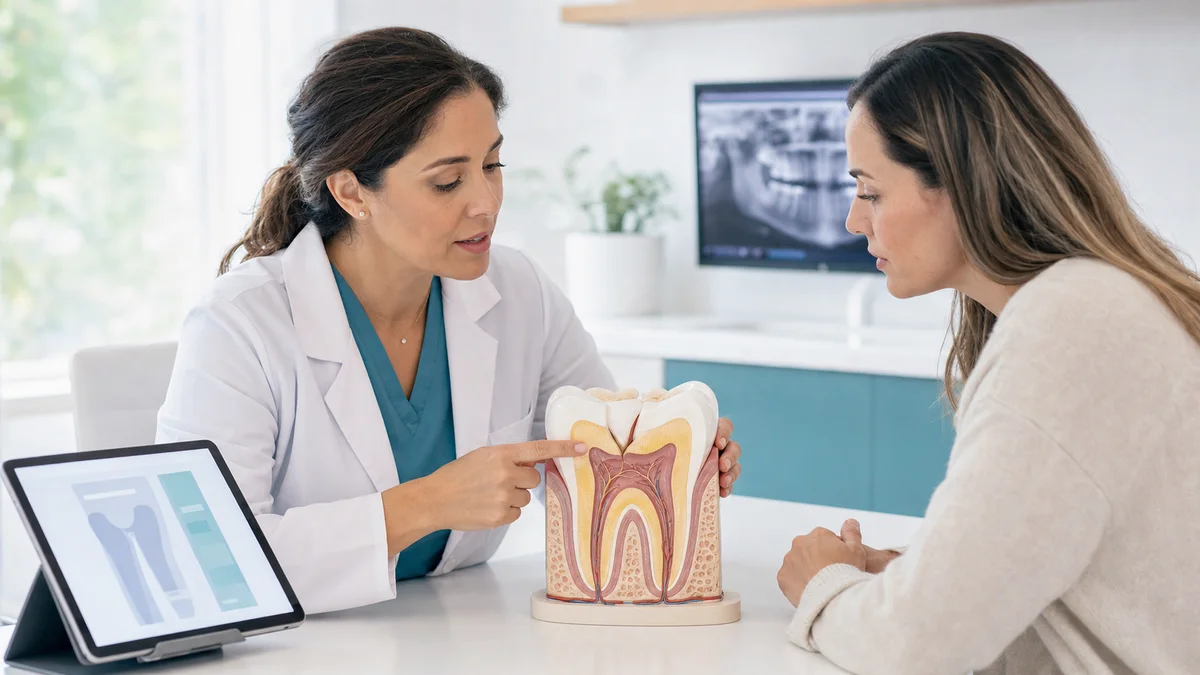
Quick answer: Whether root canal best option applies depends on diagnosis. Treatment may be preferred when the pulp is irreversibly inflamed or infected and the tooth can still be predictably restored and maintained. Extraction may be more appropriate when the tooth is not restorable, has an unfavorable fracture or lacks adequate support. Examination, tests and imaging are needed.
Typing root canal best option into a search box usually means you are weighing pain, uncertainty, cost and the fear of choosing irreversible treatment. There is no universal answer. Root canal treatment is designed to remove inflamed or infected pulp, disinfect and seal the internal canal space, and preserve the natural tooth. It can be a sensible tooth-saving choice when the tooth has enough healthy structure, periodontal support and a realistic restorative plan.
However, root canal best option should never be treated as a promise that every damaged tooth can or should be saved. A tooth may be unsuitable if decay or fracture leaves too little sound structure, a vertical root fracture is present, periodontal support is severely compromised, the tooth cannot be restored to useful function, or patient-specific risks make the proposed plan unreasonable. An examination and appropriate diagnostic records are essential.
The decision is also wider than “root canal or extraction today.” If a tooth is removed, you may later consider an implant, bridge, removable partial denture or, in selected circumstances, no immediate replacement. Those choices have their own treatment stages, biological effects, maintenance needs and costs. A complete comparison should place the root canal plus its final restoration beside the extraction plus the chosen management of the space.
This independent guide explains how dentists assess restorability, what endodontic treatment involves, when specialist review may help and which warning signs need urgent attention. It is general education rather than diagnosis or an individualized recommendation. Content is prepared for clinical review by Dentist Esma Çevrük Çakır and emphasizes informed consent, reasonable alternatives and patient safety.
Is a root canal best option for an infected tooth?
When the pulp inside a mature tooth is irreversibly inflamed or infected, root canal treatment is one established way to address the source while retaining the tooth. This is the clinical setting in which root canal best option is often investigated. The American Association of Endodontists explains that treatment removes the diseased pulp, cleans and shapes the canals, and fills and seals the space. The NHS similarly describes cleaning and filling the tooth to prevent reinfection. A crown or another definitive restoration may then be needed to protect function.
In this setting, root canal best option may be a reasonable conclusion if the tooth is strategically useful, periodontal support is adequate, the canals can be treated, and enough tooth remains for a durable seal and restoration. Keeping a maintainable natural tooth avoids creating an extraction site and may preserve chewing, appearance and the existing relationship with neighboring teeth.
That conclusion still depends on prognosis. A root canal best option assessment should determine whether disease can be controlled, whether the crack or decay pattern permits restoration, and whether the patient can complete both endodontic and restorative stages. “Possible to treat” is not identical to “predictably maintainable.” Ask how the clinician distinguishes short-term technical treatment from a tooth expected to remain useful with ongoing care.
The phrase root canal best option is therefore shorthand for a conditional decision: best among which alternatives, for which tooth, with what restoration, under what health and maintenance conditions? A written plan should answer those questions without guaranteeing an outcome.
Root canal best option decision table
Use this table as a discussion aid, not a self-diagnosis tool. The finding column must be established by a dentist through history, clinical tests and imaging where indicated. A root canal best option decision is strongest when endodontic and restorative findings point in the same direction.
| Clinical question | May favor root canal treatment | May favor extraction or another plan | What to ask |
|---|---|---|---|
| Can the tooth be restored? | Adequate sound tooth structure and a feasible definitive restoration | Decay or damage extends so far that a durable restoration is not feasible | Show me which structure will support the final restoration |
| Is there a crack? | A treatable crack pattern that can be stabilized | Unfavorable fracture extending through the root or separating the tooth | Where does the crack end, and how certain is that assessment? |
| Periodontal support | Gums and bone can support a cleansable, functional tooth | Severe attachment loss, mobility or anatomy that cannot be maintained | What is the periodontal prognosis independent of the pulp problem? |
| Endodontic access | Canals appear treatable with appropriate technique or specialist care | Anatomy, obstruction or damage makes treatment unreasonable | Would endodontist assessment change the options? |
| Previous treatment | Retreatment or root-end surgery offers a reasonable tooth-saving path | Repeated disease with an uncorrectable cause and poor restorative outlook | What caused the problem, and can that cause be corrected? |
| Whole treatment journey | Root canal plus restoration fits health, time and maintenance needs | Another option offers a more realistic overall plan | Compare all stages, not just today’s procedure |
| Patient priorities | Strong preference to preserve a maintainable natural tooth | Preferences or circumstances make a different informed option reasonable | What trade-offs matter most to me? |
How a dentist decides whether the tooth is restorable
Restorability is central to the root canal best option question. Endodontic treatment can clean the internal canal system, but it cannot replace missing walls, reverse an unfavorable fracture or create periodontal support that is not present. The dentist must consider the amount and location of sound tooth structure above the gum, the condition below the gum, the bite, existing restorations and the possibility of placing a reliable final restoration.
Assessment may include visual examination, periodontal probing, bite tests, percussion, palpation, pulp tests and radiographs. Those findings collectively answer the root canal best option question. Three-dimensional imaging may be useful in selected complex cases, but it is not automatically required for every tooth. No single online symptom list or image can determine root canal best option safely.
Restorability also includes access for cleaning. A tooth that could technically receive root canal treatment but cannot later be cleaned or protected may have a poor overall prognosis. Conversely, a tooth that looks extensively restored may remain treatable if adequate structure and support can be established. The clinician should explain the evidence, uncertainty and alternatives in plain language.
Remaining tooth structure and the ferrule concept
For many heavily damaged teeth, the restorative team looks for a band of sound tooth structure that a crown can encircle. This can help the restored tooth resist functional forces. The exact requirement depends on the tooth and plan; it is not a measurement patients should judge themselves. Ask whether additional procedures would be needed to expose sound structure and whether those steps improve or weaken the overall prognosis.
Periodontal health and strategic value
A successful root canal does not cure severe gum disease. The tooth needs adequate supporting tissues and a surface that can be maintained. Its position in the arch, relationship to neighboring teeth and role in the bite also matter. A root canal best option recommendation should integrate endodontic, periodontal and restorative outlooks rather than consider the nerve alone.
Cracks and fractures: when saving the tooth may or may not be realistic
Cracks are not all equivalent, so root canal best option cannot be answered from the word “crack” alone. Some are limited to part of the crown and may be managed with endodontic treatment and a protective restoration if the pulp is affected. Others extend deeply, divide the tooth or involve the root in a way that makes predictable restoration difficult. Symptoms can vary and the full extent of a crack is not always visible before treatment.
For a cracked tooth, root canal best option depends on crack location, depth, periodontal probing, remaining structure, symptoms and the ability to stabilize the tooth. A root canal treats pulpal disease; it does not glue a vertical root fracture back together. If the prognosis is uncertain, request an explanation of the best-case, most likely and worst-case scenarios.
An endodontist may help evaluate difficult cracks, persistent pain or complex anatomy. Specialist assessment does not guarantee that the tooth can be saved, but it can clarify whether nonsurgical treatment, retreatment, surgery or extraction is the most defensible option. Do not choose extraction solely because a difficult case exceeds one clinician’s scope without asking whether referral is appropriate.
What root canal treatment actually involves
Root canal treatment is performed after diagnosis and informed consent. Understanding the procedure helps a patient judge whether root canal best option fits the proposed plan. Local anesthesia is commonly used. The clinician isolates the tooth, creates access, removes inflamed or infected pulp, cleans and shapes the canal system, disinfects it, and fills and seals the space. A temporary filling may be placed between appointments. The number and length of appointments vary with anatomy, infection, previous treatment and the plan.
Understanding these stages makes the root canal best option discussion more concrete. The goal is not to “kill” the tooth; it is to treat disease inside a mature tooth so the remaining structure can continue to function. Tissues around the root continue to support and nourish the tooth after treatment.
A rubber dam or equivalent isolation approach is important for contamination control and safety during endodontic treatment. Ask who will perform the procedure, what magnification or imaging may be used, how the canals will be sealed and what signs would lead to referral. Complex molars, unusual anatomy, calcification, trauma, resorption or previous treatment may benefit from endodontic specialist care.
- Diagnosis, tests and imaging appropriate to the tooth
- Local anesthesia and isolation of the treatment field
- Access to the pulp chamber and canal system
- Removal of inflamed or infected tissue
- Cleaning, shaping and disinfection of canals
- Filling and sealing of the prepared spaces
- Temporary or definitive coronal seal
- Final restoration and scheduled review
Why the final filling or crown is part of the decision
The procedure is not complete merely because the canals have been filled. A credible root canal best option plan must include coronal restoration. The AAE explains that patients return for a crown or another restoration to protect the tooth and restore function. The NHS also notes that a crown may be needed, particularly when a tooth has been badly damaged or infected. Back teeth commonly face higher chewing forces and often require cuspal protection, while the plan for front teeth can differ.
When asking whether root canal best option applies, include the definitive restoration from the start. A delay, leaking temporary filling or breakdown of the final seal can allow contamination or increase fracture risk. Ask how soon the restoration should be completed, what material is proposed and what eating precautions apply in the meantime.
The restorative price, remaining structure and expected maintenance belong in the same written plan as the root canal. Comparing the cost of root canal treatment alone with extraction alone is incomplete. The fair comparison is root canal plus restoration versus extraction plus any grafting, replacement, provisional care and long-term maintenance you are actually considering.
When extraction may be the more appropriate option
Extraction may be appropriate when the tooth cannot be predictably restored, has an unfavorable root fracture, has severe non-maintainable periodontal loss, cannot be treated endodontically with a reasonable outlook, or presents another clinical circumstance in which preservation would not provide useful function. In these cases, root canal best option may not describe the safest complete plan. The decision should be explained with evidence rather than reduced to a slogan.
In those situations, root canal best option may be the wrong conclusion even if the canals themselves could be instrumented. Saving a tooth at all costs can expose a patient to repeated procedures without a realistic restorative endpoint. A patient-safe recommendation weighs biological value, uncertainty, burden of care and the alternatives.
Extraction is irreversible and creates a new set of decisions. Depending on the tooth, bite and patient preference, the space may be managed with an implant-supported crown, tooth-supported bridge, removable option or no immediate replacement. Each approach has benefits, limitations, maintenance requirements and possible complications. Ask what happens if you postpone replacement and whether bone preservation measures are relevant.
- Request the specific finding that makes the tooth non-restorable or poorly maintainable.
- Ask whether endodontic or restorative specialist consultation could change the prognosis.
- Compare extraction alone with extraction plus the intended space-management plan.
- Discuss healing time, temporary appearance and chewing limitations.
- Ask how neighboring teeth, bone, gums and bite may be affected.
- Review alternatives, material risks and the consequences of no treatment.
Root canal versus implant, bridge or removable tooth
The AAE describes root canal treatment and dental implants as viable options in appropriate cases and encourages discussion about saving a natural tooth before extraction. A root canal best option comparison must respect that these treatments solve different clinical situations. That does not mean a root canal is always superior or an implant is a failure. An implant replaces a missing tooth; root canal treatment preserves an existing one.
For a restorable tooth, root canal best option may avoid extraction and surgery in the edentulous site. For a non-restorable tooth, an implant may offer a useful replacement without preparing adjacent teeth, provided bone, gums, health and maintenance are suitable. A bridge may provide fixed replacement but can involve neighboring teeth. A removable partial denture has another cost and maintenance profile.
Compare total treatment pathways rather than isolated success claims. Consider diagnostic appointments, procedures, definitive restorations, healing periods, temporary teeth, maintenance and possible future interventions. Neither a treated natural tooth nor an implant is maintenance-free, and neither should be presented with a lifetime guarantee.
If you are considering care in another country, compare compatible records, component documentation, travel, accommodation, time away, emergency access and local follow-up. The Redent Klinik English website provides general clinic information, and the Redent Klinik contact page can be used to ask what records are needed for a preliminary discussion. A definitive diagnosis still requires appropriate clinical assessment.
Can retreatment or endodontic surgery save a previously treated tooth?
Persistent or recurrent disease after root canal treatment does not automatically mean extraction. In this context, root canal best option may mean retreatment or surgery rather than repeating the original plan unchanged. Possible causes include untreated anatomy, leakage, a new restoration problem, fracture or another diagnosis. Depending on the cause and restorability, nonsurgical retreatment or endodontic surgery may be considered. The AAE notes that root-end surgery can sometimes address persistent disease when nonsurgical care alone is insufficient.
For a previously treated tooth, root canal best option becomes a comparison among monitoring, retreatment, surgery and extraction. The important question is whether the suspected cause can be identified and corrected. Repeating treatment without addressing an uncorrectable fracture or inadequate restoration is unlikely to create a sound plan.
Ask whether existing crowns or posts must be removed, what damage could occur during access, whether canals are blocked, and how the final restoration will be resealed. Request a realistic prognosis and the contingency if healing does not occur. No surgical or nonsurgical procedure can be guaranteed.
Pain, antibiotics and dental emergencies
Tooth pain can arise from irreversible pulp inflammation, infection around the root, a crack, gum disease, bite trauma, sinus-related pain or another source. Because symptoms overlap, root canal best option cannot be decided by pain location alone. Symptoms alone cannot reliably identify which tooth needs treatment. Severe pain when biting, lingering temperature sensitivity, swelling, a gum swelling or pimple, deep decay or a damaged tooth warrant prompt dental assessment.
The ADA’s evidence-based guidance says dentists should prioritize definitive dental treatment—such as pulpotomy, pulpectomy, nonsurgical root canal treatment or drainage—for many pulpal and localized periapical conditions in immunocompetent adults rather than relying on antibiotics alone. Antibiotics may be appropriate when there is systemic involvement or another clinical indication, but they do not remove diseased pulp or restore a damaged tooth.
Accordingly, root canal best option cannot be decided by whether an antibiotic temporarily reduces symptoms. Pain relief and infection-source control are separate issues. Take medicines only as directed, disclose allergies, medical conditions and current drugs, and do not use leftover antibiotics or someone else’s prescription.
Seek urgent dental care for rapidly increasing swelling, fever, spreading facial swelling, difficulty opening the mouth, persistent bleeding, trauma or severe uncontrolled pain. Difficulty breathing or swallowing, swelling affecting the eye or neck, marked illness, confusion or other severe symptoms require urgent emergency assessment. Do not delay urgent care while researching root canal best option online.
Recovery, aftercare and long-term maintenance
Some tenderness after treatment can occur and should generally improve. Recovery planning is part of deciding whether root canal best option fits the patient’s circumstances. Follow the treating clinician’s instructions, avoid chewing hard foods on an incompletely restored tooth, attend restorative and review appointments, and contact the practice if pain or swelling is severe, worsening or not following the expected course. The clinician should explain when normal function can resume.
A root canal best option decision assumes the patient can complete the final restoration and maintain the tooth. Brush with fluoride toothpaste, clean between teeth as advised, manage gum health and attend recall based on individual risk. Root canal treatment does not protect the tooth from new decay, gum disease, fracture or restoration failure.
Long-term reviews may include symptoms, clinical examination and radiographs when indicated. Healing around the root can take time. A tooth that feels comfortable still benefits from review, while a persistent radiographic finding needs interpretation in context rather than automatic re-treatment.
Cost, insurance and time: compare complete pathways
Fees vary by tooth, anatomy, complexity, clinician, country, imaging, number of visits and restoration. Cost can influence a root canal best option decision, but it should compare complete pathways. Molar treatment can differ from treatment of a front tooth because root and canal anatomy differ. Retreatment or surgery has another scope. A fixed online price cannot safely predict an individual total.
For financial planning, root canal best option should compare a root canal plus build-up and final restoration with extraction plus the replacement pathway you would choose. Include consultations, imaging, temporary restorations, grafting if indicated, implant or bridge components, follow-up and maintenance. A low extraction fee is not the total cost of replacing a tooth.
Insurance policies can classify endodontic, restorative, extraction and replacement services differently. Check deductible, coinsurance, annual maximum, waiting period, network rules, missing-tooth clauses and pretreatment-estimate procedures. An insurer’s estimate is useful but may not guarantee claim payment. Never postpone urgent infection care solely to optimize benefit timing without clinical advice.
If financing is offered, compare the cash price, APR, deferred-interest deadline, fees and total repayment. Monthly affordability is relevant, but credit terms should not determine whether a tooth is clinically restorable. Ask for the treatment plan before choosing a payment product.
Questions to ask before agreeing to treatment
A clear consultation turns root canal best option from a generic search phrase into an informed decision. Asking why root canal best option applies—or does not apply—to this exact tooth invites a useful explanation. Bring medication and medical-history details, describe symptoms and timing accurately, and ask to see the diagnostic findings. If the recommendation is uncertain or irreversible, a second opinion can be reasonable unless urgent infection or trauma requires immediate action.
- What diagnosis explains my symptoms and test results?
- Is the pulp reversibly inflamed, irreversibly inflamed, necrotic or infected?
- Can this tooth be restored and cleaned after treatment?
- Is a crack suspected, and where does it appear to extend?
- What is the periodontal prognosis?
- What final restoration is needed, and when?
- Would endodontist or restorative specialist review improve the decision?
- What are the reasonable alternatives, including no immediate treatment?
- What risks and uncertainties apply to each option?
- What is included in the written fee and treatment timeline?
- What signs require an urgent call after treatment?
- What is the contingency if the tooth does not heal as expected?
Frequently asked questions
Is a root canal best option instead of extraction?
It may be when the tooth has treatable pulpal disease, adequate periodontal support and enough sound structure for a durable restoration. Extraction may be more appropriate when the tooth is not restorable or has an unfavorable fracture or prognosis. The decision requires examination, tests and appropriate imaging.
Is root canal best option for every painful tooth?
No. Pain can come from several dental and non-dental causes. Some pulpal conditions may be managed differently, while cracks, gum disease, bite problems or referred pain require another plan. Treatment should follow a diagnosis; pain intensity alone does not identify the correct procedure.
Does a root canal remove the infection?
Treatment removes inflamed or infected pulp, cleans and disinfects the canal system, and fills and seals the prepared spaces. Healing also depends on controlling contamination and completing a sound coronal restoration. No procedure can eliminate every risk or guarantee long-term success.
Will I always need a crown after root canal treatment?
Not always. The need depends on tooth position, remaining structure, existing restorations and functional load. Molars and premolars commonly need protective coverage, while some front teeth may be restored differently. The final restorative plan should be made before or during endodontic care.
Is root canal treatment painful?
Local anesthesia is commonly used, and the procedure is intended to relieve pain caused by pulpal disease. Experiences vary with diagnosis and complexity. Tenderness afterward can occur. Tell the clinician if you are anxious or not adequately numb so comfort options can be discussed.
Can antibiotics replace a root canal?
Usually not when the source is diseased pulp inside the tooth. The root canal best option question is about source control and restorability, not simply medication. ADA guidance prioritizes definitive dental treatment for many pulpal and localized periapical conditions in immunocompetent adults. Antibiotics may be used for systemic involvement or another indication, but only a clinician can decide.
What if a previous root canal has failed?
Failure symptoms or persistent disease need diagnosis. For a treated tooth, root canal best option may refer to retreatment or root-end surgery. Restoration repair, monitoring or extraction may also be considered depending on the cause and restorability. An endodontist can assess complex anatomy and whether the underlying problem is correctable.
Is root canal best option for a cracked tooth?
Sometimes. A treatable crack with pulpal involvement may be managed with root canal treatment and protection, but a vertical root fracture or deeply extending split can make the tooth non-restorable. Crack location, probing, structure and stabilization potential are essential.
How long does root canal treatment take?
It may take one or more appointments, depending on the tooth, anatomy, infection, previous treatment and clinician’s plan. The final restoration may require another visit. Ask for the complete timeline and what temporary protection is needed between stages.
Should I get a second opinion before extraction?
A second opinion can be helpful when restorability is uncertain, the tooth is strategically important, specialist treatment may exist or the choice is irreversible. It should not delay urgent management of spreading infection, severe trauma or other emergency signs.
Bottom line: the best option is the best complete plan
The safest response to root canal best option is conditional. Root canal treatment can preserve a natural tooth when pulpal disease is treatable and the tooth has a credible restorative and periodontal future. Extraction can be appropriate when preserving the tooth would not create a maintainable, functional result.
Ask the dental team to show why the tooth is or is not restorable, explain the crack and periodontal findings, identify the final restoration, compare complete alternatives and state the contingency if healing does not occur. This turns root canal best option into a documented clinical decision. A good recommendation respects your priorities without offering a fixed prognosis or result guarantee.
Use online information to prepare questions, not to diagnose yourself. Symptoms, fees, insurance and treatment availability vary. If swelling is spreading, breathing or swallowing is difficult, fever or marked illness is present, or pain is severe and uncontrolled, seek urgent professional care.
Sources and clinical verification
- American Association of Endodontists: root canal treatment explained
- American Association of Endodontists: root canal versus extraction
- American Association of Endodontists: options for a diseased tooth
- American Association of Endodontists: endodontic surgery and alternatives
- NHS: root canal treatment, stages and recovery
- American Dental Association: antibiotics for dental pain and swelling
- American Dental Association: oral-health resources
- World Health Organization: oral health fact sheet