
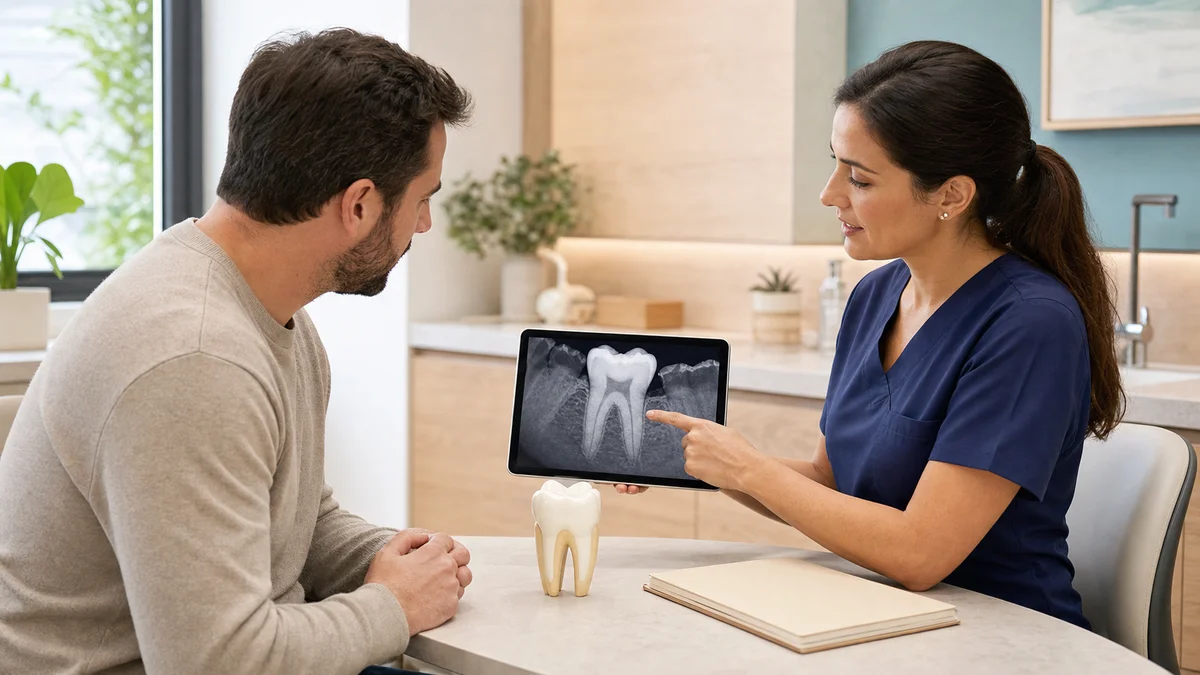
Quick answer: Root canal treatment is intended to remove inflamed or infected pulp, disinfect the internal space and preserve a restorable tooth. Root canal risks include temporary soreness, persistent or recurrent infection, difficulty treating complex anatomy, procedural complications and later fracture if restoration is inadequate. Personal risk depends on the tooth, infection, health, technique, restoration and follow-up.
Searching for root canal risks is a reasonable part of informed consent. The challenge is keeping the answer in context. No dental procedure is risk-free, but leaving a painful or infected tooth untreated has risks too. A useful discussion compares treatment, monitoring, retreatment, surgery and extraction according to the diagnosis and whether the tooth can be predictably restored.
This article explains possibilities rather than predicting an individual outcome. It does not diagnose pain, swelling or an X-ray. At Redent Klinik, the decision should follow an examination and appropriate records. Patients who want to discuss symptoms or an existing treatment plan can request an assessment through the Redent Klinik contact page.
1. Put root canal risks beside the reason for treatment
A root canal is commonly considered when the pulp—the soft tissue inside a tooth—is inflamed, infected or no longer vital. Deep decay, a crack, trauma or previous dental work may be involved. The American Association of Endodontists describes treatment as removing the pulp, cleaning, disinfecting and shaping the canals, then filling and sealing the internal space. The tooth usually also needs a suitable final restoration.
The relevant comparison is not “treatment versus a perfectly healthy tooth.” It is treatment versus the realistic alternatives for a compromised tooth. Depending on the findings, alternatives may include another type of pulp treatment, extraction, specialist care or observation in limited circumstances. If active infection is present, delay may allow pain, abscess or spread to worsen. Therefore, root canal risks should be weighed against the risks of non-treatment and the consequences of losing the tooth.
A balanced root canal risks review should record both sides of that comparison before consent.
- Diagnosis: Is the pulp inflamed, infected, necrotic or uncertain?
- Restorability: Is enough sound tooth structure available for a durable restoration?
- Periodontal support: Are the gums, bone and attachment adequate?
- Anatomy: Are canals unusually narrow, curved, calcified or previously treated?
- Alternatives: What would extraction, retreatment, surgery or monitoring mean?
- Patient factors: Do health conditions, medicines or access to follow-up change the plan?
2. Expected recovery is not the same as a complication
Some tenderness, sensitivity around the tooth or mild swelling can occur after treatment, especially when the surrounding tissues were inflamed beforehand. The NHS notes that the area may feel swollen and sore during recovery and should improve. The AAE likewise describes short-term sensitivity or inflammation in some patients. An uneven bite can also make a treated tooth feel unusually tender and may need adjustment.
These expected experiences belong in a root canal risks conversation, but they should not be used to dismiss severe or worsening symptoms. A clinician should explain what level and duration of discomfort is anticipated for the particular case, how to use any recommended pain relief safely, and how to reach the clinic if recovery does not follow the expected pattern.
This makes recovery instructions an essential part of managing root canal risks, not an optional handout.
How can I distinguish normal soreness from a warning sign?
Trend and severity matter. Mild discomfort that gradually settles is different from rapidly increasing pain, spreading swelling, fever, malaise, difficulty swallowing, breathing difficulty or a reaction to medication. A high bite, lost temporary filling or new facial swelling also deserves contact with the treating team. Online symptom lists cannot replace triage because medical history and examination findings change urgency.
3. Persistent infection or incomplete healing
One of the most discussed root canal risks is that symptoms or inflammation may persist. Root canal systems can contain branches, fins and very narrow spaces. Infection may remain when anatomy cannot be adequately accessed or disinfected, or a canal may be difficult to identify. Healing also depends on the condition around the root and whether the tooth is sealed from new contamination.
Persistent symptoms do not automatically mean the original treatment was careless, and absence of pain does not by itself prove complete healing. Clinical examination and follow-up imaging may be needed. If disease remains, the options can include nonsurgical retreatment, endodontic surgery, extraction or monitoring where clinically appropriate. The decision depends on cause, anatomy, restorability, prognosis and patient preferences.
Follow-up therefore converts uncertain root canal risks into findings that can be assessed and managed.
The AAE identifies reasons a treated tooth may need further care, including previously untreated narrow or curved canals, new decay, trauma, or a loose, cracked or broken restoration. These are practical reminders that root canal risks continue beyond the day the canals are filled.
4. Recontamination and the coronal seal
The internal canal filling is only one part of protection. Saliva and bacteria can re-enter through a leaking temporary filling, recurrent decay, a loose restoration or a crack. Delays in completing the recommended restoration may expose the tooth to contamination or fracture. The correct timing and type of restoration vary by tooth and remaining structure.
For this reason, a complete root canal risks plan should identify who places the final restoration, when it should happen and what the patient should avoid in the meantime. The AAE advises avoiding chewing or biting on an unrestored treated tooth until the dentist restores it, because it can be susceptible to fracture.
Timely restoration is one of the practical ways patients and clinicians can reduce avoidable root canal risks.
- Keep the planned restorative appointment.
- Follow chewing restrictions while a temporary restoration is present.
- Report a lost, cracked or loose filling or crown promptly.
- Maintain brushing and interdental cleaning as instructed.
- Attend clinical and radiographic reviews recommended for the case.
5. Tooth or root fracture
A tooth needing endodontic treatment may already have lost structure because of decay, cracks, trauma or large restorations. Access preparation and the original disease can add to structural vulnerability. Fracture risk is therefore not simply caused by “removing the nerve.” Tooth type, remaining walls, cracks, bite forces and restoration design all matter.
Fracture is among the root canal risks described in NHS patient information. Some fractures can be restored; others extend into a location that makes the tooth non-restorable. A clinician may recommend a crown, onlay or another protective restoration depending on the tooth. Not every root-treated tooth automatically needs the same restoration, and a personalised explanation is preferable to a universal rule.
Structural assessment keeps root canal risks connected to the actual tooth rather than a generic label.
Does every root-treated tooth become brittle?
The everyday phrase “brittle tooth” oversimplifies the issue. Structural loss, dehydration changes, cracks, cavity design and chewing load may all contribute. The key question is how much healthy structure remains and how it will be protected. Until the final restoration is completed, avoid testing the tooth with hard foods unless the treating dentist says otherwise.
6. Complex anatomy, blocked canals and missed spaces
Teeth do not all follow textbook anatomy. A canal may divide, curve sharply, calcify, merge with another canal or be hidden beneath restorative material. Previous treatment can add obstructions. In some teeth, the clinician may recommend magnification, three-dimensional imaging when justified, specialist referral or a different treatment strategy.
Difficulty locating or negotiating anatomy is part of honest root canal risks consent. Leeds Teaching Hospitals NHS Trust lists failure to find or negotiate canals, blockage and difficulty removing old filling material among possible problems. Referral is not a failure; it can be an appropriate way to match complexity with equipment and experience.
When anatomy is unusually complex, specialist input may clarify root canal risks and feasible treatment limits.
A scan cannot guarantee that every microscopic branch will be treated, and more imaging is not always better. Records should be selected because they answer a clinical question while respecting radiation principles. Ask how the available information affects prognosis and whether a specialist opinion would change the plan.
7. Instrument separation and perforation
Root canal instruments are fine because they must work inside narrow, curved spaces. An instrument can occasionally separate. The effect varies: a fragment may have little consequence in one situation, while in another it can prevent adequate cleaning beyond its position. Options may include removal, bypassing, leaving it under observation, surgery or referral. Aggressive retrieval can itself damage the tooth, so the safest response is case-specific.
Perforation means an unintended opening between the canal system and surrounding tissues. It may relate to anatomy, disease or instrumentation. Location, size, contamination and how quickly it is sealed influence management. These procedural root canal risks should be disclosed in proportion to the case without implying they are expected outcomes.
Early recognition and transparent communication can reduce the practical impact of procedural root canal risks.
If a complication occurs, the patient should receive a clear explanation, relevant records, options and follow-up. A second opinion or endodontic referral may be useful. The goal is to preserve safety and future choices, not to pursue a technically difficult retrieval at any cost.
8. Irrigant, material and medication reactions
Disinfecting solutions are essential for reducing microbes in spaces instruments cannot fully touch. If an irrigant passes beyond the intended area, it can cause sudden pain, swelling, bruising or tissue injury. Such an event is distinct from routine postoperative soreness and requires prompt professional management. Modern technique, controlled delivery and attention to anatomy are intended to reduce this risk.
Filling material can also extend beyond the root end, and medicines or dental materials may cause an individual reaction. Leeds NHS patient guidance includes pain, burning, swelling, bruising, numbness or tingling among symptoms that may follow material extrusion and require further care. This is one reason root canal risks must be explained alongside a direct route for urgent contact.
An accessible emergency contact is therefore part of responsible root canal risks planning.
- Tell the clinician about allergies and previous reactions.
- Provide an accurate medicine and medical history.
- Report sudden severe pain or rapidly expanding swelling during or after care.
- Seek urgent medical help for breathing difficulty or signs of a serious allergic reaction.
- Do not self-prescribe leftover antibiotics or someone else’s medicine.
9. Local anaesthetic, pain relief and antibiotics
Local anaesthesia is commonly used so treatment can be performed with the patient awake and comfortable. Temporary numbness is expected. Accidental biting, injection-site soreness and incomplete anaesthesia can occur; serious reactions are uncommon but require appropriate response. Medical conditions, pregnancy, allergies and medicines may alter drug choices, so history matters.
Medication-related root canal risks include allergy, interactions, stomach or kidney effects, liver toxicity from excessive dosing and other drug-specific problems. Follow the individual instructions and check active ingredients, especially when combining products. If pain relief is unsuitable because of health conditions or other medicines, ask a dentist, pharmacist or physician rather than improvising.
A complete medicine history allows the team to individualise these root canal risks before prescribing.
Antibiotics do not replace cleaning and treating the source inside a tooth. The American Dental Association’s evidence-based guidance recommends prioritising definitive dental treatment for most pulpal and localised periapical conditions in adults who are not severely immunocompromised, with antibiotics reserved for defined situations such as systemic involvement. Fever or malaise can change management and deserves prompt assessment.
10. Root canal risks decision table
This table organises the discussion but does not estimate personal probability. Your clinician should adapt it to the tooth, diagnosis and planned restoration.
| Issue | What it may mean | Risk-reduction discussion | Possible response |
|---|---|---|---|
| Short-term soreness | Inflamed supporting tissues or bite sensitivity | Expected recovery and safe pain plan | Review if severe, worsening or persistent |
| Persistent infection | Complex anatomy, resistant contamination or limited healing | Diagnosis, disinfection, seal and follow-up | Retreatment, surgery, extraction or monitoring |
| Recontamination | Leakage, decay, lost restoration or crack | Timely durable restoration and hygiene | Restore, reassess or retreat |
| Instrument separation | Access beyond a fragment may be limited | Anatomy review, technique and specialist input | Remove, bypass, retain, operate or refer |
| Perforation or extrusion | Communication or material beyond the canal | Controlled technique and early recognition | Seal, monitor, medicate, refer or perform surgery |
| Tooth fracture | Insufficient remaining structure or a crack | Restorability assessment and protective restoration | Repair, crown/onlay, specialist review or extraction |
The table shows why root canal risks are a pathway, not a single event. Prevention, early recognition and access to corrective care influence the practical consequence of a complication.
11. Factors that can change personal risk
Generic lists cannot calculate an individual prognosis. A front tooth with a single straight canal differs from a heavily restored molar with curved anatomy. A first treatment differs from retreatment through a crown and post. The size of an infection, presence of a crack, periodontal support and ability to obtain a reliable final seal can all influence planning.
Health factors may matter too. Diabetes control, immune status, bleeding risk, allergies, pregnancy, previous radiotherapy, bisphosphonate or antiresorptive medicine use, and other conditions can change precautions or alternatives. Do not stop prescribed medicine without advice. Instead, make root canal risks assessment more accurate by providing complete information.
- Which tooth and how much sound structure remains?
- Is there a suspected vertical root fracture?
- Is this first treatment, retreatment or surgery?
- Are canals curved, calcified, obstructed or difficult to access?
- Can moisture control and a durable restoration be achieved?
- Is gum and bone support adequate?
- Can the patient attend restoration and review appointments?
12. What can reduce root canal risks?
No measure eliminates uncertainty, but careful diagnosis, case selection, isolation, disinfection, sealing and restoration can reduce avoidable problems. Rubber dam isolation is commonly used to keep the field clean and help protect the airway from small instruments and solutions. Magnification and additional imaging may be useful when clinically justified. Complex cases may benefit from an endodontist’s assessment.
Patients influence several root canal risks after leaving the chair. Protect the temporary restoration, follow medication instructions, complete the final restoration, maintain oral hygiene and attend follow-up. Tobacco use, uncontrolled disease or repeated missed appointments may affect healing or continuity; the treating team can discuss support without judgment.
Clear written instructions help patients recognise which root canal risks they can actively reduce.
- Confirm the diagnosis and whether the tooth is restorable.
- Review appropriate radiographs and anatomical complexity.
- Discuss alternatives, benefits, limitations and referral thresholds.
- Use an isolation and disinfection strategy suited to the case.
- Seal and restore the tooth without avoidable delay.
- Review symptoms and healing at clinically appropriate intervals.
- Respond early to leakage, fracture, swelling or recurrent pain.
13. Myths about systemic disease
Online posts sometimes claim root-treated teeth cause cancer or chronic systemic illness. The AAE states that there is no valid scientific evidence linking root canal treatment to systemic disease and describes modern endodontic care as safe and effective. This does not mean root canal risks are imaginary; it means real local and procedural risks should not be mixed with unsupported claims.
Untreated oral infection also deserves context. The World Health Organization identifies untreated dental caries and severe periodontal disease among major oral health burdens. A clinician’s goal is to address disease while preserving health and function where reasonably possible. If a claim sounds dramatic, ask for the source, study design and whether professional guidance supports it.
14. Retreatment, surgery and extraction if healing is incomplete
A tooth that remains symptomatic or shows persistent disease is not automatically hopeless. Nonsurgical retreatment may allow removal of old materials, treatment of missed anatomy and renewed sealing. Endodontic surgery may address disease around the root end when an orthograde approach is unsuitable. Extraction removes the tooth and may lead to a separate discussion about replacement.
Identifying the cause first keeps further root canal risks proportionate to the expected benefit of another procedure.
Each response has its own benefits, limitations and root canal risks. Retreatment can be complicated by posts, crowns, obstructions or perforations. Surgery involves soft tissue and bone healing. Extraction can affect chewing, neighbouring teeth and future restorative choices. Sometimes no further intervention is reasonable under monitoring; sometimes prompt action is advised. Personalised diagnosis is essential.
Ask whether the suspected cause has been identified and whether correcting it changes prognosis. A technically possible procedure is not always the best value if the tooth is structurally non-restorable. Conversely, extraction should not be presented as the only choice without explaining feasible tooth-saving options.
15. When to seek urgent help
Contact the treating clinic promptly for severe or increasing pain, new swelling, a lost temporary restoration, a bite that prevents comfortable closure, rash, persistent numbness or a tooth that fractures. Urgency depends on severity, progression and medical history. Do not wait for a scheduled review if symptoms are changing quickly.
Seek urgent medical or dental assessment for spreading facial or neck swelling, fever with worsening dental symptoms, difficulty swallowing, breathing difficulty, eye involvement, marked weakness or signs of a serious allergic reaction. These red flags sit at the serious end of root canal risks and require professional triage rather than online reassurance.
Antibiotics may be indicated when infection has systemic involvement, but they are not a substitute for treating the source. Avoid using leftovers, sharing medicine or delaying definitive care because symptoms temporarily improve.
16. Questions to ask before consent
A strong consent conversation is specific enough to guide a decision but does not promise certainty. Consider asking:
- What findings support the diagnosis?
- Is the tooth restorable, and what final restoration is planned?
- Which root canal risks are most relevant to this tooth?
- Does the anatomy or previous work make specialist referral reasonable?
- What are the alternatives and likely consequences of delay?
- What discomfort is expected, and which symptoms should trigger a call?
- Who provides the final restoration and follow-up?
- If healing is incomplete, what are the next options?
- What fees and stages are included in the written plan?
There is no responsible fixed result or universal treatment duration. Anatomy, infection, restoration and biological healing vary. Written information should complement a conversation in which the patient can ask questions and consider alternatives.
17. Frequently asked questions about root canal risks
Can root canal treatment fail?
Yes, a tooth can remain symptomatic, fail to heal or become diseased again. Causes may include untreated anatomy, difficult disinfection, leakage, recurrent decay, a damaged restoration, trauma or a fracture. Assessment may identify an option such as retreatment, surgery or extraction. Failure is not diagnosed from pain alone.
Is pain after treatment always a sign of infection?
No. Temporary tenderness can reflect inflammation in tissues around the root or an uneven bite. However, severe, increasing or persistent pain, particularly with swelling or systemic symptoms, should be reviewed. Contact the clinic for advice tailored to timing, symptoms and medical history.
Can an instrument break inside a canal?
It can occur, particularly in narrow or curved anatomy. The clinical importance varies according to location, infection and how much cleaning occurred before separation. Removal is not automatically safest. An endodontist may consider retrieval, bypass, monitoring, surgery or another option.
Will I definitely need a crown?
Not every tooth receives the same restoration. Back teeth often need substantial protection because of chewing forces, while some front teeth may be restored differently. Remaining tooth structure, cracks, existing restorations and bite guide the recommendation. Ask why a specific restoration is proposed.
Do root canals cause cancer or chronic illness?
Professional endodontic guidance states there is no valid scientific evidence that properly performed root canal treatment causes systemic disease or cancer. Real root canal risks include local healing, infection, structural and procedural issues; unsupported systemic claims should not replace evidence-based consent.
Are antibiotics always needed?
No. ADA guidance prioritises definitive dental treatment for most local pulpal and periapical conditions in otherwise appropriate adults. Antibiotics may be indicated when there is systemic involvement or another specific reason. The prescribing clinician must consider allergies, interactions and health status.
Can a treated tooth become infected years later?
Yes. New decay, leakage, trauma, a loose or broken restoration, a crack or previously untreated anatomy can allow disease to develop later. Regular dental review and prompt repair of restoration problems help protect the tooth. Retreatment may sometimes preserve it.
Is extraction safer than root canal treatment?
Neither option is universally safer. Extraction avoids retaining the affected tooth but has surgical and healing considerations and may create a need for replacement. Root canal treatment aims to preserve a restorable tooth but has the risks described here. Diagnosis, prognosis, patient health and preferences should guide the comparison.
18. Balanced conclusion
Root canal treatment is designed to control disease inside a tooth and preserve function where restoration is feasible. The meaningful root canal risks include short-term discomfort, incomplete healing or reinfection, anatomical and procedural challenges, restoration failure and fracture. Many risks can be reduced—but not eliminated—through diagnosis, appropriate technique, timely restoration and follow-up.
An informed decision does not minimise complications or exaggerate them. It asks what is wrong with the tooth, what treatment can realistically achieve, what alternatives exist and how problems would be managed. If symptoms are severe or spreading, seek prompt professional care instead of using this article for self-triage.
That approach keeps root canal risks factual, personalised and useful for shared decision-making.
This educational guide does not replace examination, diagnosis, radiographs, emergency assessment or personalised consent. It makes no guarantee about suitability, timing, healing or tooth survival.
Authoritative sources
- American Association of Endodontists — Root Canal Treatment
- American Association of Endodontists — Root Canal Explained
- NHS — Root Canal Treatment
- Leeds Teaching Hospitals NHS Trust — Understanding Endodontic Treatment
- American Dental Association — Antibiotics for Dental Pain and Swelling
- American Dental Association
- World Health Organization — Oral Health Fact Sheet