
Many people searching for a straighter smile want to know whether a shortest invisalign treatment plan is truly possible. The good news is that modern clear aligner technology has significantly improved over the years, making it easier for some patients to complete orthodontic correction in a surprisingly short amount of time. In mild alignment cases, the shortest invisalign treatment may take only a few months when supervised by an experienced dental professional. However, the exact timeline depends on several important factors including tooth crowding, bite issues, patient compliance, and the complexity of movement required. 😊
The concept of the shortest invisalign treatment has become increasingly popular because many adults and teenagers want cosmetic improvements without committing to years of braces. Unlike traditional metal braces, Invisalign aligners are removable, discreet, and digitally customized. This allows dentists and orthodontists to plan highly targeted tooth movements that may accelerate the overall process in suitable candidates. Patients with mild spacing, small gaps, or slight crowding are often ideal candidates for a shortest invisalign treatment plan.
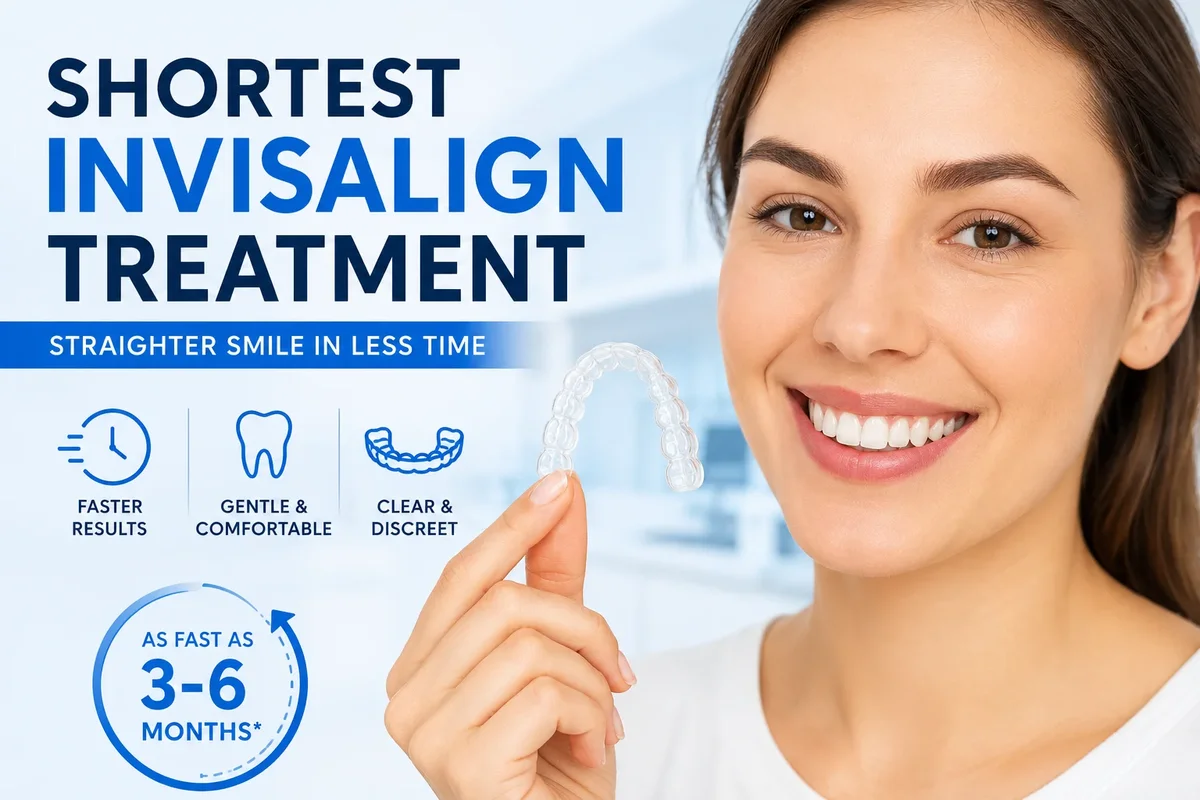
One major advantage of Invisalign is the advanced 3D scanning technology used during treatment planning. Instead of relying on old-fashioned impressions, dentists use digital scans to create a customized roadmap for tooth movement. This digital precision helps reduce unnecessary adjustments and may shorten the total treatment time. In many mild cosmetic cases, the shortest invisalign treatment can range from 3 to 6 months. Some Invisalign Express systems are specifically designed for quick smile enhancements and minimal orthodontic corrections.
Patients often wonder whether the shortest invisalign treatment delivers permanent and reliable results. The answer depends largely on consistency. Invisalign aligners usually need to be worn for 20 to 22 hours per day. Removing aligners too frequently can slow progress and extend the treatment timeline considerably. Patients who carefully follow instructions often achieve significantly faster results compared to those who wear aligners inconsistently.
Another reason why the shortest invisalign treatment attracts attention is convenience. Adults with professional careers frequently prefer invisible orthodontic options that do not affect confidence during meetings, social events, or photographs. Since clear aligners are almost invisible, they provide a discreet cosmetic orthodontic solution while maintaining comfort and flexibility. Many patients also report less irritation compared to traditional braces because there are no metal brackets or wires involved.
Although the shortest invisalign treatment sounds appealing, not every patient qualifies for rapid treatment. Severe bite problems, major crowding, rotated teeth, or jaw alignment issues may require comprehensive Invisalign plans lasting 12 to 24 months or longer. During the consultation stage, a dentist carefully evaluates whether a patient is suitable for accelerated treatment. This evaluation often includes digital scans, X-rays, oral examinations, and smile analysis.
Invisalign Express is one of the most commonly recommended options for achieving the shortest invisalign treatment. This limited-treatment system uses fewer aligners and focuses mainly on mild cosmetic adjustments. Invisalign Express may involve only 5 to 10 aligner trays in certain situations. Patients seeking small improvements before weddings, business events, or social occasions often choose this approach because it can deliver noticeable changes quickly.
Cost is another important factor for patients researching the shortest invisalign treatment. Since shorter treatment plans usually require fewer aligners and fewer dental visits, they are often more affordable than full orthodontic correction. Average Invisalign Express prices may range between $1,500 and $4,000 depending on the clinic, country, and complexity of the case. Comprehensive Invisalign treatments can cost significantly more. Patients should always request a detailed consultation and treatment breakdown before starting.
💰 Estimated Invisalign Price Overview
- Invisalign Express: $1,500 – $4,000
- Moderate Invisalign Treatment: $3,500 – $6,500
- Complex Invisalign Cases: $6,000 – $9,000+
Many dentists also combine modern technologies with the shortest invisalign treatment approach to optimize tooth movement. Techniques such as dental monitoring apps, attachment systems, and AI-assisted progress tracking can help maintain accurate aligner progression. Some clinics even use vibration devices designed to stimulate bone remodeling, although results may vary from patient to patient.
When searching for the shortest invisalign treatment, choosing the right clinic is essential. Experienced Invisalign providers understand how to optimize movement efficiency while maintaining patient safety. Fast treatment should never compromise oral health or long-term stability. A qualified provider will prioritize healthy tooth movement, gum protection, and bite balance rather than unrealistic promises.
Patients should also understand the importance of retainers after completing the shortest invisalign treatment. Teeth naturally tend to shift over time if retainers are not worn properly. Retainers help preserve the newly aligned smile and maintain long-term treatment success. Even short Invisalign plans require proper retention to avoid relapse.
According to the American Dental Association, maintaining good oral hygiene throughout orthodontic treatment is extremely important. Patients should brush and floss carefully before placing aligners back into the mouth. Clean aligners and healthy gums contribute to smoother and more predictable treatment progress.
If you are considering the shortest invisalign treatment, scheduling a professional consultation is the best first step. A personalized assessment helps determine whether you qualify for rapid treatment and which Invisalign system is most appropriate for your smile goals. At Redent Klinik, patients receive customized evaluations and advanced digital smile planning designed to maximize comfort, aesthetics, and efficiency. You can learn more or schedule a consultation through the Redent Klinik Contact Page. ✨
Overall, the shortest invisalign treatment is an excellent option for patients with mild orthodontic concerns who want quick and discreet smile improvements. While treatment speed varies between individuals, modern clear aligner systems continue to make faster smile transformations more achievable than ever before. With proper patient compliance, expert supervision, and realistic expectations, Invisalign can provide an efficient and comfortable path toward a straighter and healthier smile.
What Is the Shortest Invisalign Treatment Timeline?
The question many patients ask before starting aligners is simple: how long does the shortest invisalign treatment actually take? Invisalign has become one of the most popular orthodontic systems because it offers flexibility, aesthetics, and potentially faster treatment times compared to traditional braces. However, the exact timeline varies from patient to patient depending on dental complexity, compliance, and treatment goals. Understanding realistic expectations is essential before beginning any orthodontic journey. 😊
In mild cases, the shortest invisalign treatment may last as little as 3 to 6 months. Patients with very small gaps, minor crowding, or slight cosmetic misalignment often qualify for accelerated Invisalign systems such as Invisalign Express or Invisalign Lite. These shorter plans use fewer aligner trays and focus mainly on minor tooth corrections instead of full bite reconstruction.
How Invisalign Treatment Duration Is Determined
Dentists and orthodontists evaluate several factors before estimating the shortest invisalign treatment timeline. During the consultation process, digital scans and X-rays are used to analyze tooth movement requirements. The complexity of movement directly impacts how long treatment will last.
Some patients only need slight adjustments to front teeth, while others require correction of bite alignment, tooth rotation, spacing, or crowding. Minor cosmetic cases naturally qualify more easily for the shortest invisalign treatment compared to complex orthodontic problems.
Factors That Influence Treatment Speed
- Severity of crowding
- Presence of bite issues
- Tooth rotation complexity
- Patient age and bone response
- Daily aligner wear consistency
- Overall oral health condition
Patients who follow instructions carefully often complete the shortest invisalign treatment much faster than patients who remove aligners frequently or skip trays.
Average Invisalign Timelines Explained
Although some advertisements promise rapid results, realistic Invisalign treatment timelines depend on individual circumstances. Below is a general overview of common treatment durations.
⏳ Typical Invisalign Treatment Durations
- Minor cosmetic correction: 3–6 months
- Invisalign Lite: 6–8 months
- Moderate orthodontic cases: 12–18 months
- Complex bite correction: 18–24 months or longer
Patients seeking the shortest invisalign treatment usually fall into the first category involving mild cosmetic improvements. These patients may only require a limited number of aligners to achieve noticeable smile enhancement.
What Is Invisalign Express?
One of the fastest orthodontic solutions available today is Invisalign Express. This system was specifically designed for patients who need minimal tooth movement. Invisalign Express typically involves 5 to 10 aligner trays and focuses mainly on aesthetic corrections.
The shortest invisalign treatment is often associated with Invisalign Express because the process is simplified and highly targeted. Small gaps, slightly crooked teeth, or minor relapse after previous braces are common reasons patients choose this option.
Invisalign Express can be ideal for adults preparing for important events such as weddings, interviews, conferences, or public appearances. Since aligners are nearly invisible, patients can improve their smiles discreetly without noticeable metal brackets.
Patient Compliance and Faster Results
Even the best-designed treatment plan cannot deliver the shortest invisalign treatment without proper patient cooperation. Invisalign aligners must generally be worn for 20 to 22 hours every day. Removing them too frequently slows tooth movement and increases total treatment time.
Patients who consistently wear aligners according to instructions often achieve faster and more predictable results. Compliance is one of the biggest factors affecting treatment success.
Tips to Maintain Fast Invisalign Progress
- Wear aligners the recommended number of hours daily
- Switch trays exactly as instructed
- Attend regular dental checkups
- Maintain excellent oral hygiene
- Avoid losing or damaging aligners
- Use chewies if recommended by the dentist
Following these recommendations increases the likelihood of completing the shortest invisalign treatment successfully and safely.
Can Invisalign Be Faster Than Braces?
In many mild and moderate cases, Invisalign may indeed be faster than traditional braces. Metal braces often require lengthy adjustments and manual wire tightening over extended periods. Invisalign treatment uses digitally planned aligners designed for efficient staged movement.
For suitable patients, the shortest invisalign treatment may provide visible results within just a few weeks. Many patients notice small improvements after the first month of consistent wear. This rapid cosmetic improvement is one reason Invisalign has become so popular worldwide.
However, severe orthodontic problems may still require longer treatment times regardless of the appliance used. Realistic expectations are important for patient satisfaction.
Technology Behind Faster Invisalign Treatment
Modern Invisalign systems rely heavily on digital technology and artificial intelligence. Advanced treatment planning software helps dentists map every stage of tooth movement with remarkable precision. This digital accuracy contributes significantly to the effectiveness of the shortest invisalign treatment.
Some clinics also use remote monitoring systems that allow patients to send progress scans from home. This reduces unnecessary appointments and helps providers detect tracking problems early before they delay treatment.
According to the American Dental Association, personalized orthodontic planning and regular monitoring are important components of safe tooth movement and successful treatment outcomes.
Why Professional Evaluation Matters
Not every patient qualifies for the shortest invisalign treatment. A professional consultation is necessary to determine whether accelerated Invisalign systems are appropriate. Some clinics advertise unrealistic treatment times without fully evaluating bite stability or long-term oral health.
An experienced Invisalign provider focuses not only on speed but also on functional balance, gum health, and long-term smile stability. Proper diagnosis ensures the patient receives safe and realistic treatment recommendations.
At Redent Klinik, advanced digital scanning and personalized treatment planning help determine whether a patient is a good candidate for the shortest invisalign treatment. Patients can request a consultation through the Redent Klinik Contact Page to receive customized guidance tailored to their smile goals. ✨
Ultimately, the shortest invisalign treatment is achievable for many patients with mild orthodontic concerns. With modern technology, consistent aligner wear, and expert supervision, Invisalign can provide fast, discreet, and highly effective smile improvements while maintaining comfort and aesthetics throughout the process.
Who Qualifies for the Shortest Invisalign Treatment?
Not every patient is automatically eligible for the shortest invisalign treatment. While Invisalign technology has made orthodontic treatment faster and more comfortable than ever before, treatment duration still depends heavily on individual dental conditions. Some people can complete aligner therapy within a few months, while others require more comprehensive correction lasting over a year. Understanding who qualifies for the shortest invisalign treatment helps patients set realistic expectations before beginning their smile transformation. 😊
In general, patients with mild cosmetic alignment issues are the best candidates for the shortest invisalign treatment. These cases typically involve small spacing problems, minimal crowding, slight tooth tilting, or minor relapse after previous orthodontic work. Since fewer tooth movements are required, aligners can achieve results more quickly and efficiently.
Mild Orthodontic Cases Are Ideal
The most common candidates for the shortest invisalign treatment are patients with mild orthodontic concerns. Invisalign works by gradually applying controlled pressure to move teeth into better alignment. The smaller the movement required, the shorter the treatment timeline tends to be.
Examples of Mild Cases Suitable for Fast Invisalign
- Small gaps between front teeth
- Minor lower incisor crowding
- Slight tooth rotation
- Cosmetic smile enhancement
- Small relapse after braces
- Minor spacing issues
These conditions often respond very well to clear aligner therapy and may qualify for the shortest invisalign treatment using Invisalign Express or Invisalign Lite systems.
Patients With Previous Braces Often Qualify
Many adults who had braces years ago experience gradual tooth shifting over time because they stopped wearing retainers consistently. In these situations, the teeth may only need small corrections to restore proper alignment.
This type of orthodontic relapse is one of the best scenarios for the shortest invisalign treatment. Since the patient’s bite was previously corrected, only minor cosmetic adjustments are usually necessary. Invisalign can often reposition the teeth quickly with a limited number of trays.
Patients who previously completed orthodontic treatment often achieve faster results because their teeth may respond more efficiently to controlled movement. This makes them excellent candidates for accelerated Invisalign systems.
Age and Bone Response Matter
Age can also influence whether someone qualifies for the shortest invisalign treatment. Younger patients sometimes experience slightly faster tooth movement because bone remodeling tends to occur more efficiently. However, adults can still achieve excellent results with Invisalign when they follow treatment instructions carefully.
Healthy gums and strong bone support are extremely important for successful orthodontic treatment. Patients with periodontal disease or significant bone loss may require additional dental care before beginning Invisalign therapy.
Important Oral Health Requirements
- Healthy gums
- No untreated cavities
- Stable jawbone support
- Good oral hygiene habits
- No severe TMJ complications
Patients with strong oral health foundations are more likely to complete the shortest invisalign treatment safely and predictably.
Patient Compliance Is Critical
One of the most overlooked aspects of qualifying for the shortest invisalign treatment is patient compliance. Invisalign aligners are removable, which offers convenience but also creates responsibility. Patients must wear aligners approximately 20 to 22 hours daily to maintain proper progress.
Patients who frequently remove their aligners, forget to wear them, or skip tray changes may significantly delay treatment. In contrast, disciplined patients who follow all instructions closely often complete treatment much faster.
Good compliance allows teeth to track properly according to the digital treatment plan. This minimizes refinements and reduces unnecessary delays.
Who May Not Qualify for Rapid Invisalign?
While many patients hope for the shortest invisalign treatment, some dental conditions naturally require longer correction periods. Complex orthodontic problems demand more extensive tooth movement and bite adjustment.
Conditions That Usually Require Longer Treatment
- Severe overcrowding
- Major bite misalignment
- Crossbite correction
- Large tooth rotations
- Jaw alignment issues
- Open bite or deep bite problems
These complex conditions often require comprehensive Invisalign treatment plans rather than limited express systems. Attempting to rush complex orthodontic correction may compromise stability and long-term oral health.
Digital Smile Analysis and Qualification
Modern Invisalign consultations involve advanced digital technology that helps determine whether a patient qualifies for the shortest invisalign treatment. Dentists use 3D scanners, X-rays, and computer simulations to analyze tooth movement requirements in detail.
Digital treatment planning helps providers estimate how many aligners will be needed and whether rapid correction is realistic. This technology also improves precision and allows patients to preview their expected smile transformation before treatment begins.
Clinics that specialize in Invisalign often achieve better efficiency because they understand how to optimize aligner sequencing and movement planning.
Lifestyle and Motivation Also Play a Role
Patients seeking the shortest invisalign treatment are often highly motivated individuals preparing for important personal or professional events. Weddings, interviews, graduations, and public appearances commonly motivate patients to seek accelerated orthodontic solutions.
Motivated patients tend to follow instructions more carefully, maintain better oral hygiene, and attend appointments consistently. This dedication contributes significantly to faster treatment success.
Clear aligners are especially attractive to professionals because they remain discreet throughout daily activities. Unlike traditional braces, Invisalign trays are nearly invisible and can be removed briefly for meals or presentations.
Why Professional Assessment Is Essential
Even if a patient appears to have a simple case, professional evaluation remains essential before starting the shortest invisalign treatment. A qualified Invisalign provider evaluates not only cosmetic alignment but also bite function, jaw health, and long-term stability.
According to the American Dental Association, personalized diagnosis and treatment planning are crucial components of successful orthodontic care. Attempting unsupervised or unrealistic rapid treatment may increase the risk of complications or relapse.
At Redent Klinik, digital smile assessments help determine whether patients are suitable candidates for the shortest invisalign treatment. Individualized treatment plans focus on balancing aesthetics, comfort, oral health, and long-term results. Patients interested in rapid smile improvement can request a personalized consultation through the Redent Klinik Contact Page. ✨
Ultimately, the best candidates for the shortest invisalign treatment are patients with mild orthodontic concerns, excellent compliance habits, and healthy oral conditions. With expert supervision and modern aligner technology, many individuals can achieve noticeable smile improvements faster than they ever expected.
How Invisalign Express Creates Faster Smile Transformations
For patients searching for the shortest invisalign treatment, Invisalign Express is often one of the most attractive solutions available today. Designed specifically for mild orthodontic corrections, Invisalign Express focuses on limited tooth movement and faster cosmetic improvements. Unlike comprehensive Invisalign systems that may require dozens of aligners over many months, Invisalign Express uses a smaller number of trays to achieve subtle but noticeable smile enhancements in a shorter time frame. 😊
The popularity of Invisalign Express continues to grow because modern patients often want rapid results without sacrificing aesthetics or comfort. Many adults prefer a treatment system that fits their busy schedules while remaining discreet in professional and social environments. The shortest invisalign treatment is particularly appealing to individuals preparing for weddings, interviews, public events, or important life milestones.
What Is Invisalign Express?
Invisalign Express is a simplified aligner system created for patients who need only minimal orthodontic correction. It is commonly used to fix small gaps, minor crowding, mild tooth rotation, or slight shifting after previous braces.
Because Invisalign Express focuses on smaller movements, it often qualifies as the shortest invisalign treatment option for eligible patients. Most cases involve significantly fewer aligners than traditional Invisalign plans.
Typical Invisalign Express Features
- Limited number of aligner trays
- Shorter overall treatment duration
- Focused cosmetic correction
- Lower overall treatment cost
- Minimal dental appointments
- Discreet and removable aligners
These benefits make Invisalign Express highly appealing to patients seeking efficient smile improvements without lengthy orthodontic commitments.
How Long Does Invisalign Express Take?
The exact duration varies depending on the patient’s condition, but many Invisalign Express cases are completed within 3 to 6 months. Some very minor corrections may finish even faster when patient compliance is excellent.
This rapid timeline is one reason Invisalign Express is frequently associated with the shortest invisalign treatment. Since fewer tooth movements are required, aligners can work more efficiently and predictably.
However, patients must understand that fast treatment still requires careful supervision and consistent aligner wear. Even a mild case can become delayed if aligners are not worn correctly.
Who Benefits Most From Invisalign Express?
Not every patient qualifies for Invisalign Express. The best candidates are individuals with relatively simple orthodontic concerns that do not require major bite correction.
Ideal Candidates for Fast Invisalign Treatment
- Adults with slight crowding
- Patients with small front tooth gaps
- People with mild orthodontic relapse
- Patients seeking cosmetic smile enhancement
- Individuals with healthy gums and teeth
These patients often achieve excellent results with the shortest invisalign treatment because their cases involve limited and controlled movement.
How Invisalign Express Works
The process begins with a digital consultation where the dentist scans the patient’s teeth using advanced 3D imaging technology. This digital model allows the provider to create a highly precise treatment plan.
Each aligner tray is designed to move the teeth gradually according to a predetermined sequence. Patients typically switch to a new aligner every one or two weeks depending on the provider’s instructions.
Because Invisalign Express cases are simpler, the aligner sequence is shorter and more focused. This helps patients achieve the shortest invisalign treatment while maintaining comfort and precision.
Advantages Compared to Traditional Braces
One major reason patients choose Invisalign Express instead of braces is convenience. Traditional braces involve metal wires and brackets that may irritate the mouth and require dietary restrictions.
In contrast, Invisalign aligners are removable and nearly invisible. This allows patients to eat normally, brush comfortably, and maintain a more natural appearance during treatment.
Benefits of Invisalign Express
- Almost invisible appearance
- Comfortable smooth aligners
- No food restrictions
- Easier oral hygiene maintenance
- Fewer emergency dental visits
- Shorter treatment timelines
These features make Invisalign Express one of the most desirable solutions for patients seeking the shortest invisalign treatment.
Patient Compliance Determines Success
Even though Invisalign Express offers faster treatment, patient discipline remains essential. Aligners must usually be worn for 20 to 22 hours per day for optimal progress.
Patients who frequently remove aligners or forget to wear them may lose the opportunity to achieve the shortest invisalign treatment. Delayed tray progression can extend the treatment timeline significantly.
Consistency is one of the most important factors influencing treatment speed. Patients who follow instructions carefully often notice visible improvements within weeks.
Cost of Invisalign Express
Another reason patients are interested in Invisalign Express is affordability. Because treatment uses fewer aligners and fewer appointments, the overall cost is generally lower than comprehensive Invisalign treatment.
💰 Average Invisalign Express Pricing
- Minor cosmetic cases: $1,500 – $2,500
- Moderate express cases: $2,500 – $4,000
- Additional retainers may involve extra costs
Prices vary depending on the clinic, geographic location, provider experience, and complexity of the correction required.
Why Professional Evaluation Matters
While many online advertisements promote rapid aligner systems, professional diagnosis remains critical before starting the shortest invisalign treatment. Some patients may appear suitable for Invisalign Express but actually require more comprehensive correction to achieve stable long-term results.
A qualified provider evaluates bite function, jaw alignment, tooth health, and gum condition before recommending accelerated treatment. According to the American Dental Association, personalized treatment planning is essential for safe and predictable orthodontic care.
At Redent Klinik, advanced digital smile analysis helps determine whether Invisalign Express is the right option for each patient. Customized treatment planning focuses on aesthetics, comfort, efficiency, and long-term oral health stability. Patients interested in achieving the shortest invisalign treatment can request a consultation through the Redent Klinik Contact Page. ✨
Long-Term Stability After Fast Invisalign
Completing the shortest invisalign treatment successfully does not end the orthodontic journey. Retainers are extremely important for maintaining the final results. Teeth naturally tend to shift over time if retention protocols are ignored.
Most dentists recommend wearing retainers consistently after treatment to preserve smile alignment and prevent relapse. Even patients with very short Invisalign plans must follow retention instructions carefully.
Overall, Invisalign Express has revolutionized cosmetic orthodontics by making rapid smile correction more accessible than ever before. For suitable candidates, it offers a comfortable, discreet, and highly efficient pathway toward a straighter smile without the long commitment associated with traditional braces.
Average Treatment Times Compared to Traditional Braces
One of the biggest reasons patients search for the shortest invisalign treatment is the desire to avoid the long timelines commonly associated with traditional braces. Orthodontic treatment has changed dramatically over the years, and Invisalign has become one of the most popular alternatives to metal braces because of its comfort, discreet appearance, and potentially faster results. However, treatment speed depends on several factors, and understanding the differences between Invisalign and braces helps patients make informed decisions. 😊
Traditional braces have been used successfully for decades to correct severe crowding, bite issues, and complex orthodontic problems. While braces remain extremely effective, they often require longer treatment durations due to the mechanical process of wire adjustments and gradual repositioning. Invisalign, especially in mild cosmetic cases, can sometimes provide the shortest invisalign treatment timeline with greater convenience and flexibility.
How Traditional Braces Work
Metal braces use brackets attached directly to the teeth along with wires that apply continuous pressure over time. During routine appointments, orthodontists tighten or replace wires to continue tooth movement. This gradual adjustment process often takes many months or even years depending on the complexity of the case.
Braces are highly effective for difficult orthodontic conditions, but they are generally more noticeable and may require dietary restrictions. Patients often experience irritation from brackets and wires, especially during the early stages of treatment.
Although braces can successfully treat severe cases, many patients interested in cosmetic improvements prefer Invisalign because it may allow for the shortest invisalign treatment in mild to moderate situations.
How Invisalign Differs From Braces
Invisalign uses a series of custom-made clear aligners instead of metal brackets and wires. Each aligner tray is digitally designed to move teeth gradually according to a personalized treatment plan.
The digital planning technology behind Invisalign is one reason many patients can achieve the shortest invisalign treatment timeline. Computer-guided tooth movement helps improve efficiency and precision while reducing unnecessary adjustments.
Main Advantages of Invisalign
- Nearly invisible appearance
- Removable aligners for eating and cleaning
- Improved comfort compared to braces
- Fewer emergency appointments
- Advanced digital treatment planning
- Potentially faster cosmetic results
These benefits make Invisalign especially attractive for adults and professionals seeking discreet orthodontic treatment.
Average Treatment Duration Comparison
The average treatment time for braces is often longer than Invisalign in simple cosmetic cases. However, complex orthodontic problems may still require similar timelines regardless of the system used.
⏳ Average Orthodontic Treatment Timelines
- Invisalign Express: 3–6 months
- Invisalign Lite: 6–8 months
- Moderate Invisalign: 12–18 months
- Traditional braces: 18–36 months
Patients with minor alignment issues often achieve the shortest invisalign treatment because Invisalign systems can focus specifically on targeted cosmetic movement without requiring full orthodontic reconstruction.
Why Some Invisalign Cases Move Faster
There are several reasons why Invisalign may provide faster treatment compared to braces in selected cases. One important factor is the precision of digital treatment planning.
Before treatment begins, Invisalign software creates a complete 3D simulation of tooth movement. This allows providers to predict movement sequences accurately and optimize aligner progression.
Because aligners are customized for each stage, patients pursuing the shortest invisalign treatment often experience more controlled and efficient movement.
Factors That Help Invisalign Work Faster
- Precise digital planning
- Focused movement for mild cases
- Reduced need for manual wire adjustments
- Improved patient comfort and compliance
- Remote monitoring technology in some clinics
These technological advantages contribute significantly to Invisalign’s reputation for faster cosmetic correction.
When Braces May Still Be Better
Although Invisalign can deliver the shortest invisalign treatment in mild cases, braces may still be more appropriate for severe orthodontic conditions. Major bite problems, impacted teeth, and significant jaw discrepancies often require the stronger mechanical control provided by traditional braces.
Braces are also beneficial for patients who may struggle with aligner compliance. Since braces remain fixed to the teeth, treatment continues constantly without depending on patient discipline.
This is an important consideration because Invisalign success relies heavily on consistent aligner wear.
Patient Compliance and Treatment Speed
One major difference between Invisalign and braces is the patient’s level of responsibility. Invisalign aligners must typically be worn for 20 to 22 hours daily. Patients who frequently remove their aligners may experience slower progress and lose the opportunity for the shortest invisalign treatment.
Traditional braces do not require this level of cooperation because they are permanently attached during treatment. However, braces may involve more frequent office visits and occasional emergency repairs due to broken wires or brackets.
Common Invisalign Mistakes That Delay Treatment
- Not wearing aligners long enough
- Skipping aligner trays
- Missing dental appointments
- Poor oral hygiene habits
- Losing aligners frequently
Patients who avoid these mistakes are far more likely to achieve faster Invisalign results.
Aesthetic and Lifestyle Differences
Many adults choose Invisalign instead of braces because of appearance and convenience. Clear aligners are much less visible than metal braces, making them ideal for social and professional settings.
Patients pursuing the shortest invisalign treatment often appreciate the ability to remove aligners during meals and special occasions. This flexibility helps many individuals maintain confidence throughout treatment.
Invisalign also simplifies oral hygiene because patients can brush and floss normally after removing aligners. Braces, on the other hand, may trap food particles and require specialized cleaning tools.
Professional Assessment Is Essential
Choosing between Invisalign and braces requires professional evaluation. According to the American Dental Association, orthodontic treatment should always be based on individualized diagnosis and proper clinical assessment.
An experienced Invisalign provider can determine whether a patient qualifies for the shortest invisalign treatment or whether braces may provide safer and more stable long-term results.
At Redent Klinik, digital smile analysis and personalized consultations help patients compare Invisalign and traditional braces based on their unique needs. Patients can learn more or request a consultation through the Redent Klinik Contact Page. ✨
Ultimately, Invisalign and braces both offer highly effective orthodontic solutions. However, for suitable mild and moderate cases, Invisalign often provides a more comfortable, discreet, and potentially faster pathway toward smile improvement. Patients seeking the shortest invisalign treatment should always consult an experienced dental professional to determine the safest and most efficient treatment plan for their individual smile goals.
Factors That Can Shorten or Delay Invisalign Results
Patients searching for the shortest invisalign treatment often focus only on treatment duration, but several important factors influence how quickly Invisalign can deliver results. While some patients complete treatment within a few months, others may require significantly more time depending on their oral condition, lifestyle habits, and compliance with instructions. Understanding what can accelerate or delay Invisalign progress helps patients achieve more predictable and successful outcomes. 😊
The good news is that many of the factors affecting the shortest invisalign treatment are manageable. Patients who understand these variables and follow professional guidance carefully often experience smoother treatment progress and faster smile improvements.
Case Complexity Is the Biggest Factor
The severity of orthodontic problems plays the largest role in determining whether a patient qualifies for the shortest invisalign treatment. Mild cosmetic cases generally move faster because fewer adjustments are needed.
Patients with small gaps, mild crowding, or minor tooth rotation often respond very well to Invisalign Express or Invisalign Lite systems. However, severe bite problems, major overcrowding, and jaw discrepancies usually require more comprehensive treatment.
Conditions That Usually Allow Faster Treatment
- Minor front tooth crowding
- Small spacing issues
- Limited cosmetic correction
- Mild relapse after braces
- Slight tooth tilting
Patients with these conditions are more likely to achieve the shortest invisalign treatment because the aligners can focus on smaller, controlled tooth movements.
Daily Aligner Wear Is Extremely Important
One of the most critical factors affecting Invisalign speed is how consistently patients wear their aligners. Invisalign trays are removable, which offers flexibility but also creates responsibility.
Most providers recommend wearing aligners 20 to 22 hours daily. Patients who remove aligners too frequently may significantly delay progress and lose the opportunity for the shortest invisalign treatment.
Common Mistakes That Slow Invisalign
- Removing aligners for long periods
- Skipping tray changes
- Forgetting to wear aligners overnight
- Ignoring provider instructions
- Using damaged aligners
Consistent wear allows teeth to move according to the digital treatment plan. Patients who follow instructions carefully usually achieve faster and more stable results.
Age and Bone Remodeling Speed
Age may also influence Invisalign treatment duration. Younger patients sometimes experience slightly faster tooth movement because their bone remodeling process tends to respond more efficiently.
However, adults can still achieve excellent outcomes with the shortest invisalign treatment when they maintain good compliance and oral health. Modern Invisalign technology works effectively across many age groups.
What matters most is not simply age, but overall oral condition, bone support, and consistency during treatment.
Oral Health Conditions Affect Progress
Healthy teeth and gums are essential for efficient orthodontic movement. Patients with untreated dental problems may experience delays because additional procedures must often be completed before Invisalign begins.
Dental Problems That Can Delay Invisalign
- Gum disease
- Untreated cavities
- Bone loss
- Poor oral hygiene
- Tooth infections
Addressing these issues early improves the chances of achieving the shortest invisalign treatment safely and effectively.
Maintaining excellent oral hygiene throughout treatment is equally important. Clean teeth and healthy gums help reduce inflammation and improve treatment predictability.
Attachment Usage and Tooth Movement
Many Invisalign patients require small tooth-colored attachments placed on the teeth to improve aligner grip and movement control. These attachments help guide difficult tooth movements more efficiently.
Although some patients initially dislike attachments cosmetically, they often help providers achieve the shortest invisalign treatment by improving movement precision.
Attachments are especially useful for rotations, vertical movements, and complex aligner tracking situations.
Technology and Provider Experience Matter
The experience level of the Invisalign provider can strongly influence treatment speed. Experienced providers understand how to optimize tooth movement while minimizing unnecessary refinements or delays.
Modern clinics using advanced digital scanners and AI-based treatment planning often create more precise aligner sequences. This precision increases the likelihood of successful tracking and contributes to the shortest invisalign treatment.
Technologies That Help Speed Invisalign
- 3D digital scanning
- Artificial intelligence treatment planning
- Remote monitoring systems
- Digital progress tracking
- Precision attachment systems
These innovations allow providers to monitor movement carefully and identify problems before they delay treatment.
Diet and Lifestyle Habits
Although Invisalign aligners are removable, lifestyle habits still influence treatment success. Patients who snack frequently throughout the day may remove aligners too often, reducing effective wear time.
Smoking can also negatively affect oral health and potentially increase complications during orthodontic treatment. Maintaining healthy daily habits supports the success of the shortest invisalign treatment.
Hydration, nutrition, and consistent oral hygiene all contribute to healthier gums and more predictable tooth movement.
Refinement Trays Can Extend Treatment
In some cases, teeth may not move exactly as predicted by the original treatment plan. When this happens, providers may order refinement trays to fine-tune alignment.
Refinements are common and do not necessarily indicate failure, but they can extend the overall timeline and reduce the likelihood of achieving the shortest invisalign treatment.
Patients who follow instructions closely often reduce the need for major refinements because their teeth track more accurately during treatment.
Retainers and Long-Term Stability
Completing Invisalign treatment successfully is only part of the process. Retainers play a major role in maintaining results after the shortest invisalign treatment is completed.
Without proper retention, teeth naturally tend to shift back toward their original positions. Retainers help preserve alignment and protect the investment made during orthodontic treatment.
Most providers recommend nightly retainer wear after active treatment ends.
Why Professional Guidance Is Essential
According to the American Dental Association, orthodontic treatment should always involve proper diagnosis, supervision, and personalized planning. Attempting unsupervised or unrealistic rapid treatment can increase the risk of complications or unstable results.
At Redent Klinik, patients receive individualized Invisalign evaluations designed to maximize efficiency while protecting long-term oral health. Advanced digital smile planning helps determine the safest and most effective strategy for achieving the shortest invisalign treatment. Patients interested in personalized consultation can visit the Redent Klinik Contact Page. ✨
Ultimately, achieving the shortest invisalign treatment depends on a combination of patient compliance, oral health, provider expertise, and treatment complexity. Patients who follow professional guidance carefully often enjoy faster, smoother, and more predictable Invisalign results while maintaining long-term smile stability.
Best Dental Problems for the Shortest Invisalign Treatment
One of the most important questions patients ask before starting aligners is whether their dental condition qualifies for the shortest invisalign treatment. While Invisalign technology can successfully correct many orthodontic problems, some dental issues respond much faster than others. Mild cosmetic cases are generally ideal for shorter treatment plans because they require fewer aligners and less complex tooth movement. Understanding which dental problems are best suited for the shortest invisalign treatment helps patients develop realistic expectations before beginning care. 😊
Modern Invisalign systems are highly versatile, but treatment speed depends heavily on the severity of the alignment problem. Small cosmetic improvements often move quickly, while severe bite corrections naturally require longer treatment periods. Patients who seek early consultation and maintain good oral health usually have the best chance of achieving faster results.
Minor Crowding Responds Very Well
Mild dental crowding is one of the most common conditions treated with the shortest invisalign treatment. Minor crowding occurs when there is slightly insufficient space for the teeth to align perfectly within the dental arch.
Because the crowding is limited, Invisalign can often reposition the teeth efficiently without requiring extensive movement. In many mild cases, only a small number of aligners are necessary to create visible cosmetic improvement.
Signs of Mild Crowding
- Slight overlapping of front teeth
- Minor lower incisor crowding
- Small cosmetic misalignment
- Teeth appearing slightly uneven
- No major bite problems
Patients with these symptoms are often excellent candidates for the shortest invisalign treatment because the required tooth movements are relatively simple.
Small Gaps Between Teeth
Spacing issues are another condition that commonly responds quickly to Invisalign treatment. Small gaps between teeth, especially in the front smile zone, often require only limited aligner therapy.
Patients seeking cosmetic correction for minor spacing problems frequently achieve the shortest invisalign treatment because closing small gaps generally involves controlled and predictable movement.
Many adults choose Invisalign specifically for this purpose because the aligners remain nearly invisible throughout treatment. This discreet appearance is especially appealing for professional and social settings.
Orthodontic Relapse After Braces
Patients who previously completed braces treatment but experienced mild relapse are often ideal candidates for the shortest invisalign treatment. Orthodontic relapse occurs when teeth gradually shift after retainers are no longer worn consistently.
In these cases, the bite may already be relatively stable, and only minor cosmetic repositioning is necessary. Invisalign can often restore alignment efficiently with a limited number of trays.
Common Signs of Orthodontic Relapse
- Front teeth shifting slightly
- Small gaps reopening
- Minor lower crowding returning
- Retainers no longer fitting properly
- Smile appearing less straight over time
Since these corrections are usually mild, relapse patients frequently qualify for the shortest invisalign treatment available.
Minor Tooth Rotation
Slight tooth rotation is another problem commonly corrected with Invisalign Express systems. Rotated teeth may appear twisted or angled slightly out of position.
Small rotational adjustments often respond well to clear aligners because Invisalign applies gentle and controlled pressure directly to the affected tooth. Patients with limited rotation issues may complete the shortest invisalign treatment relatively quickly compared to individuals with more severe orthodontic complications.
However, larger rotations involving canines or premolars may require additional aligners and attachments to improve control.
Cosmetic Smile Enhancements
Some patients pursue Invisalign primarily for aesthetic reasons rather than major orthodontic correction. Cosmetic smile enhancement cases are frequently among the best candidates for the shortest invisalign treatment.
Examples include slight asymmetry, mild unevenness, or small alignment imperfections that affect smile appearance. Since the goal is cosmetic refinement rather than major bite correction, treatment timelines are often shorter.
Popular Cosmetic Invisalign Goals
- Straighter front teeth
- Improved smile symmetry
- Enhanced smile aesthetics
- Closing visible front gaps
- Smoother tooth alignment
These cosmetic-focused cases often achieve excellent results with relatively limited treatment duration.
Conditions That Usually Require Longer Treatment
Although Invisalign can treat many complex orthodontic problems, some conditions naturally require longer timelines and may not qualify for the shortest invisalign treatment.
Dental Problems That Often Extend Treatment
- Severe overcrowding
- Crossbite correction
- Deep bite problems
- Open bite conditions
- Significant jaw discrepancies
- Large tooth rotations
These more advanced orthodontic situations often require comprehensive treatment planning and additional aligner stages to achieve safe and stable results.
Why Early Consultation Matters
Patients who seek orthodontic care early often have more options for achieving the shortest invisalign treatment. Mild problems can become more severe over time if left untreated.
Early intervention may prevent worsening crowding, bite imbalance, or shifting that could eventually require longer and more expensive correction.
Modern digital scanning technology allows dentists to identify even small alignment issues before they progress significantly.
The Importance of Oral Health
Healthy teeth and gums are essential for efficient Invisalign treatment. Patients with untreated cavities or gum disease may experience delays because these conditions must often be treated before aligners can begin.
Good oral hygiene also improves treatment predictability and supports the success of the shortest invisalign treatment. Clean teeth and healthy gum tissues help ensure smoother tooth movement throughout the process.
Healthy Habits That Support Fast Treatment
- Brushing after meals
- Daily flossing
- Routine dental cleanings
- Consistent aligner cleaning
- Attending follow-up appointments
Patients who maintain these habits are more likely to achieve successful and efficient Invisalign results.
Digital Technology Improves Candidate Selection
Modern Invisalign consultations involve advanced digital smile analysis that helps determine whether a patient qualifies for the shortest invisalign treatment. Dentists use 3D scanners and treatment simulation software to evaluate movement complexity in detail.
This technology allows providers to estimate treatment duration more accurately while improving precision and predictability.
According to the American Dental Association, individualized orthodontic planning is essential for achieving safe and stable treatment outcomes.
At Redent Klinik, advanced digital evaluations help determine which dental problems are best suited for the shortest invisalign treatment. Personalized treatment planning focuses on balancing aesthetics, efficiency, comfort, and long-term oral health. Patients interested in learning whether they qualify for rapid Invisalign treatment can request a consultation through the Redent Klinik Contact Page. ✨
Ultimately, the best candidates for the shortest invisalign treatment are individuals with mild orthodontic concerns, healthy oral conditions, and realistic expectations. With proper diagnosis, modern technology, and professional supervision, Invisalign can provide efficient and highly aesthetic smile improvement for many patients seeking fast orthodontic results.
Tips to Speed Up Your Invisalign Treatment Safely
Many patients beginning Invisalign therapy want to know how they can achieve the shortest invisalign treatment possible without compromising safety or long-term results. While Invisalign is already known for being efficient in mild and moderate orthodontic cases, there are several important habits and strategies that can help optimize treatment speed. However, it is equally important to understand that tooth movement must occur gradually and under professional supervision to protect oral health. 😊
The goal of the shortest invisalign treatment should never involve forcing teeth to move unnaturally fast. Safe orthodontic movement depends on controlled pressure, healthy bone remodeling, and careful monitoring by an experienced provider. Patients who combine excellent compliance with healthy oral habits often experience the best and fastest Invisalign outcomes.
Wear Aligners for the Recommended Time
The single most important factor for achieving the shortest invisalign treatment is wearing aligners consistently. Invisalign trays are generally designed to be worn for 20 to 22 hours every day.
Patients who remove aligners too frequently may significantly delay treatment progress because teeth begin shifting back toward their original positions when pressure is interrupted.
Best Practices for Daily Aligner Wear
- Wear aligners during sleep
- Only remove aligners for meals and cleaning
- Return aligners immediately after eating
- Avoid unnecessary removal during the day
- Follow the tray schedule precisely
Consistent aligner use is one of the strongest predictors of successful and efficient treatment.
Change Aligners Exactly on Schedule
Every Invisalign tray is designed to perform a specific stage of tooth movement. Switching trays too early or too late can interfere with treatment progress.
Patients pursuing the shortest invisalign treatment should carefully follow their provider’s instructions regarding tray changes. Most patients switch to new aligners every one or two weeks depending on the treatment plan.
Skipping ahead without approval may reduce aligner tracking accuracy and increase the need for refinements later.
Maintain Excellent Oral Hygiene
Healthy teeth and gums support smoother orthodontic movement. Patients with gum inflammation or plaque buildup may experience complications that delay Invisalign progress.
Maintaining strong oral hygiene habits helps improve the likelihood of achieving the shortest invisalign treatment while also protecting long-term dental health.
Recommended Oral Hygiene Habits
- Brush after every meal
- Floss daily
- Clean aligners regularly
- Use antibacterial mouthwash if recommended
- Attend professional dental cleanings
Healthy gum tissues respond better during orthodontic movement and reduce the risk of treatment interruptions.
Use Invisalign Chewies Properly
Many Invisalign providers recommend small soft devices called chewies. These are designed to help aligners fit more tightly against the teeth.
Proper aligner seating improves movement precision and may contribute to the shortest invisalign treatment by ensuring the trays work exactly as intended.
Chewies are especially useful after switching to a new aligner tray because they help reduce small gaps between the aligner and tooth surface.
Benefits of Invisalign Chewies
- Improved aligner fit
- Better tray tracking
- Enhanced tooth movement control
- Reduced risk of refinements
- Improved treatment efficiency
Attend All Scheduled Appointments
Routine monitoring is extremely important during Invisalign treatment. Providers need to evaluate how the teeth are moving and identify any tracking problems early.
Patients who skip appointments may unknowingly develop movement issues that delay the shortest invisalign treatment. Regular visits allow providers to make adjustments before complications become more serious.
Some clinics now offer remote monitoring technology that enables patients to send digital progress scans from home. This can improve convenience while maintaining close supervision.
Avoid Damaging or Losing Aligners
Lost or broken aligners are a common reason for delayed treatment. Every aligner tray represents an important stage in the treatment sequence.
Patients pursuing the shortest invisalign treatment should handle aligners carefully and store them properly whenever they are removed.
Tips to Protect Invisalign Aligners
- Always use the aligner case
- Keep aligners away from heat
- Do not wrap aligners in napkins
- Clean trays gently with approved products
- Avoid chewing gum while wearing aligners
Protecting aligners helps prevent unnecessary replacement delays.
Follow Dietary Recommendations
Although Invisalign aligners are removable, dietary habits can still influence treatment efficiency. Frequent snacking often leads to longer aligner removal times.
Patients who consistently keep aligners out for extended periods may reduce their chances of achieving the shortest invisalign treatment.
Minimizing sugary drinks and acidic foods also supports healthier teeth and gums during orthodontic care.
Do Not Attempt Unsafe DIY Acceleration
Some patients searching online for the shortest invisalign treatment encounter unsafe advice involving excessive tray switching or unapproved acceleration techniques. Attempting to force rapid tooth movement without professional guidance can damage roots, gums, or bone support.
Orthodontic treatment should always follow biologically safe movement patterns. Controlled pressure and gradual progression protect both tooth stability and long-term oral health.
According to the American Dental Association, orthodontic treatment requires individualized supervision and proper clinical monitoring to ensure safe outcomes.
Healthy Lifestyle Habits Support Faster Treatment
Overall health also affects Invisalign progress. Patients who maintain healthy routines often experience smoother treatment outcomes.
Lifestyle Habits That May Support Better Invisalign Results
- Staying hydrated
- Eating balanced nutrition
- Avoiding tobacco products
- Managing stress levels
- Maintaining consistent sleep patterns
Healthy gums and strong bone metabolism contribute to more predictable tooth movement during the shortest invisalign treatment.
Provider Experience Makes a Difference
Choosing an experienced Invisalign provider is one of the smartest ways to improve treatment efficiency. Skilled providers understand how to optimize movement sequencing, attachment placement, and aligner planning.
Clinics using advanced digital scanning and AI-supported treatment software often improve precision and reduce unnecessary refinements.
At Redent Klinik, personalized digital treatment planning helps patients safely pursue the shortest invisalign treatment while protecting long-term oral health and smile stability. Patients interested in learning more about accelerated Invisalign options can schedule a consultation through the Redent Klinik Contact Page. ✨
Ultimately, achieving the shortest invisalign treatment requires teamwork between the patient and provider. Consistent aligner wear, excellent oral hygiene, healthy habits, and professional supervision all contribute to faster and more predictable smile transformation results. When approached responsibly, Invisalign can provide a comfortable, discreet, and highly efficient pathway toward a straighter smile.
Shortest Invisalign Treatment Costs and Price Factors
One of the most common questions patients ask before beginning Invisalign is how much the shortest invisalign treatment will cost. While many people assume Invisalign is always expensive, shorter treatment plans are often significantly more affordable than comprehensive orthodontic correction. The final cost depends on several important factors including treatment complexity, number of aligners required, provider experience, clinic location, and whether additional procedures are necessary. Understanding Invisalign pricing helps patients plan their smile transformation more confidently. 😊
In many mild cosmetic cases, the shortest invisalign treatment can cost substantially less than traditional braces or full Invisalign systems because fewer aligner trays and fewer appointments are involved. Patients with simple alignment issues are usually the best candidates for lower-cost Invisalign solutions.
What Determines Invisalign Cost?
There is no universal Invisalign price because every patient receives a customized treatment plan. Some patients need only a few aligners for small cosmetic improvements, while others require extensive correction lasting over a year.
The amount of movement required directly influences the cost of the shortest invisalign treatment. Mild cases generally require fewer trays, shorter monitoring periods, and reduced clinical complexity.
Main Factors Affecting Invisalign Pricing
- Number of aligner trays
- Complexity of tooth movement
- Provider experience level
- Digital technology used by the clinic
- Need for attachments or refinements
- Length of treatment
- Retainer requirements
Patients seeking small cosmetic improvements often benefit from more affordable Invisalign options.
Average Cost of Invisalign Express
Invisalign Express is one of the most popular systems associated with the shortest invisalign treatment. Since it focuses on minor corrections, it usually costs less than comprehensive Invisalign treatment.
💰 Typical Invisalign Express Price Ranges
- Minor cosmetic corrections: $1,500 – $2,500
- Moderate express treatment: $2,500 – $4,000
- Comprehensive Invisalign: $4,500 – $9,000+
These prices may vary depending on the country, clinic reputation, and provider expertise. Patients should always request a detailed consultation and written treatment estimate before starting care.
Why Shorter Invisalign Often Costs Less
The shortest invisalign treatment generally costs less because it involves fewer resources and less clinical time. Short Invisalign systems may require only a limited number of trays, fewer appointments, and less extensive digital planning.
Invisalign Express, for example, was specifically designed for mild cases that can be corrected quickly and efficiently. Since the treatment scope is smaller, costs are naturally lower.
Reasons Shorter Treatment Reduces Cost
- Fewer aligner trays
- Reduced appointment frequency
- Simpler digital treatment planning
- Lower laboratory costs
- Shorter monitoring periods
These factors make shorter Invisalign plans attractive for patients seeking cosmetic smile enhancement without major orthodontic investment.
Additional Costs Patients Should Know About
Even when pursuing the shortest invisalign treatment, patients should understand that additional expenses may occasionally apply. Some cases require extra aligners, retainers, refinements, or supporting dental procedures.
Potential Additional Invisalign Expenses
- Replacement aligners
- Retainers after treatment
- Refinement trays
- Dental cleanings
- Tooth reshaping procedures
- X-rays and digital scans
Patients should ask their provider which services are included in the quoted price and whether refinements or retainers involve extra fees.
Does Insurance Cover Invisalign?
Some dental insurance plans partially cover Invisalign treatment, especially when orthodontic benefits are included. However, coverage amounts vary widely depending on the insurance provider and policy details.
Patients interested in the shortest invisalign treatment should contact both the dental clinic and their insurance company to verify orthodontic benefits before starting treatment.
Even partial insurance support can significantly reduce out-of-pocket expenses for aligner therapy.
Payment Plans and Financing Options
Many clinics now offer flexible financing options that make Invisalign more accessible. Monthly payment plans are particularly popular among adult patients who want to spread treatment costs over time.
Because the shortest invisalign treatment usually involves lower total costs, financing payments may also be more manageable compared to comprehensive orthodontic plans.
Common Financing Features
- Monthly installment plans
- Interest-free payment options
- Credit-based financing systems
- Flexible deposit structures
- Customized payment schedules
Patients should ask clinics about financing policies during the consultation process.
Provider Experience Can Influence Pricing
Highly experienced Invisalign providers may charge higher fees due to their expertise, advanced technology, and treatment planning skills. However, skilled providers often improve efficiency and reduce the likelihood of complications or unnecessary refinements.
Choosing a qualified provider may increase the chances of achieving the shortest invisalign treatment safely and predictably.
Lower-cost providers are not always the best option if treatment quality or long-term stability is compromised.
Is Cheap Invisalign Always Better?
Patients should be cautious about extremely low-cost Invisalign advertisements. Some clinics promote unrealistically cheap treatment plans without fully evaluating bite stability or long-term oral health.
The shortest invisalign treatment should always prioritize safe and healthy tooth movement rather than simply reducing cost or treatment duration.
Comprehensive diagnosis and professional supervision remain essential components of successful orthodontic care.
Long-Term Value of Invisalign
Although Invisalign represents an investment, many patients consider the long-term benefits worthwhile. Straighter teeth may improve smile confidence, oral hygiene access, and overall dental aesthetics.
Patients who complete the shortest invisalign treatment successfully often appreciate the convenience, comfort, and discreet appearance of clear aligners compared to traditional braces.
Maintaining results with retainers after treatment also protects the value of the orthodontic investment.
Why Personalized Consultation Matters
According to the American Dental Association, orthodontic treatment should always involve individualized diagnosis and treatment planning. Every patient has unique needs that influence treatment complexity and pricing.
At Redent Klinik, digital smile analysis and personalized Invisalign consultations help patients understand their eligibility for the shortest invisalign treatment while receiving transparent pricing information. Customized treatment plans focus on balancing aesthetics, comfort, efficiency, and long-term oral health stability. Patients interested in learning more can visit the Redent Klinik Contact Page. ✨
Ultimately, the cost of the shortest invisalign treatment depends on the patient’s individual orthodontic needs and treatment goals. Mild cosmetic cases often qualify for faster and more affordable Invisalign systems, making clear aligners an increasingly attractive solution for patients seeking efficient smile improvement with modern orthodontic technology.
Choosing the Right Clinic for Fast Invisalign Results
Selecting the right dental clinic is one of the most important decisions for patients pursuing the shortest invisalign treatment. While Invisalign technology itself is highly advanced, treatment success depends heavily on provider experience, digital planning accuracy, and ongoing patient supervision. Even patients with ideal orthodontic conditions may experience delays if treatment is poorly managed. Choosing an experienced Invisalign clinic helps maximize efficiency, comfort, and long-term smile stability. 😊
Many patients searching for the shortest invisalign treatment focus primarily on treatment speed or pricing, but provider expertise is equally important. A well-planned Invisalign case can often progress smoothly and predictably, while poor planning may increase the need for refinements, additional aligners, or extended treatment timelines.
Why Invisalign Experience Matters
Invisalign treatment requires much more than simply providing aligners. The provider must carefully analyze tooth movement patterns, bite relationships, gum health, and long-term stability before creating a treatment plan.
Experienced Invisalign providers understand how to optimize movement efficiency while maintaining patient safety. This expertise increases the likelihood of achieving the shortest invisalign treatment without compromising oral health.
Benefits of Choosing an Experienced Invisalign Provider
- More accurate digital treatment planning
- Improved aligner tracking
- Reduced need for refinements
- Better bite balance and stability
- Faster identification of treatment issues
- Enhanced patient guidance and monitoring
Clinics with extensive Invisalign experience often achieve more predictable outcomes because they understand how different teeth respond to aligner movement.
Digital Technology Improves Treatment Precision
Modern Invisalign clinics use advanced digital technology to improve treatment planning and monitoring. High-quality digital scans are essential for designing aligners that fit accurately and move teeth efficiently.
Clinics using advanced 3D imaging systems often improve the chances of successful tracking and may help patients achieve the shortest invisalign treatment more predictably.
Important Invisalign Technologies
- 3D digital scanners
- AI-supported treatment planning
- Digital smile simulations
- Remote monitoring systems
- Precision attachment planning
These technologies help providers identify movement problems early before they become major treatment delays.
Comprehensive Consultation Is Essential
A quality Invisalign clinic always begins with a thorough consultation and oral evaluation. During this process, the provider examines tooth alignment, bite relationships, gum health, jaw position, and overall oral condition.
Patients seeking the shortest invisalign treatment should avoid clinics that promise unrealistic timelines without proper evaluation. Ethical providers focus on safe and realistic treatment expectations rather than exaggerated marketing claims.
A comprehensive consultation also allows patients to ask important questions about treatment duration, pricing, aligner wear expectations, and retention requirements.
Transparent Treatment Planning Builds Trust
Clear communication is another sign of a high-quality Invisalign clinic. Patients should receive detailed explanations regarding treatment goals, expected duration, possible refinements, and total costs.
Clinics that specialize in the shortest invisalign treatment should explain both the advantages and limitations of rapid aligner systems. Honest communication helps patients maintain realistic expectations and improves overall satisfaction.
Questions Patients Should Ask During Consultation
- How many aligners will be required?
- Is Invisalign Express appropriate?
- What happens if refinements are needed?
- How often are follow-up visits scheduled?
- Are retainers included in the treatment fee?
These questions help patients better understand the full treatment process before committing.
Monitoring and Follow-Up Are Critical
Regular monitoring is extremely important during Invisalign treatment. Teeth do not always move exactly according to the original digital simulation, so providers must evaluate progress periodically.
Clinics that carefully monitor treatment progress are more likely to maintain efficient movement and support the success of the shortest invisalign treatment.
Some modern clinics now offer virtual progress monitoring through smartphone scanning technology. This allows providers to detect problems early while reducing unnecessary office visits.
Customized Treatment Is Better Than One-Size-Fits-All
Every smile is unique, which means Invisalign treatment should always be individualized. Clinics offering generic or overly simplified plans may overlook important bite and stability factors.
The shortest invisalign treatment should never involve rushing tooth movement without considering long-term oral health. Customized treatment planning helps ensure that cosmetic improvements remain stable after treatment ends.
Experienced providers focus on balancing aesthetics, function, gum health, and bite stability together.
Retainers and Long-Term Stability
A reliable Invisalign clinic also emphasizes the importance of retainers after treatment. Even patients who complete the shortest invisalign treatment successfully require proper retention to maintain results.
Teeth naturally tend to shift over time if retainers are not worn consistently. Long-term retention planning is an essential component of responsible orthodontic care.
Why Retainers Matter
- Prevent orthodontic relapse
- Maintain smile alignment
- Protect treatment investment
- Support bite stability
- Reduce future correction needs
Clinics that prioritize long-term stability usually achieve better patient satisfaction overall.
Patient Reviews and Reputation
Before selecting a provider, patients should also research clinic reputation and patient feedback. Positive reviews often provide valuable insight into communication quality, treatment experience, and Invisalign expertise.
Patients interested in the shortest invisalign treatment should look for clinics with proven experience handling mild cosmetic cases efficiently and safely.
Before-and-after smile galleries may also help patients understand the clinic’s treatment style and aesthetic approach.
Balancing Speed With Safety
Although many patients want the fastest possible results, safe orthodontic movement must always remain the priority. Attempting to move teeth too aggressively can increase the risk of root damage, gum recession, or unstable outcomes.
According to the American Dental Association, orthodontic treatment should always involve individualized diagnosis, professional supervision, and biologically safe movement principles.
The best Invisalign clinics understand that the shortest invisalign treatment should still protect oral health and long-term smile stability.
Why Redent Klinik Focuses on Personalized Invisalign Care
At Redent Klinik, patients receive personalized digital smile analysis designed to evaluate whether they qualify for the shortest invisalign treatment. Advanced scanning technology, customized treatment planning, and ongoing monitoring help optimize efficiency while maintaining comfort and long-term stability.
The clinic focuses on combining modern orthodontic technology with individualized care so patients can achieve healthier and more attractive smiles safely and predictably.
Patients interested in Invisalign treatment, cosmetic smile enhancement, or accelerated aligner solutions can schedule a professional consultation through the Redent Klinik Contact Page. ✨
Ultimately, choosing the right provider is one of the most important steps in achieving successful Invisalign results. A skilled clinic with advanced technology, transparent communication, and personalized treatment planning significantly improves the likelihood of completing the shortest invisalign treatment efficiently while protecting long-term oral health and smile aesthetics.