
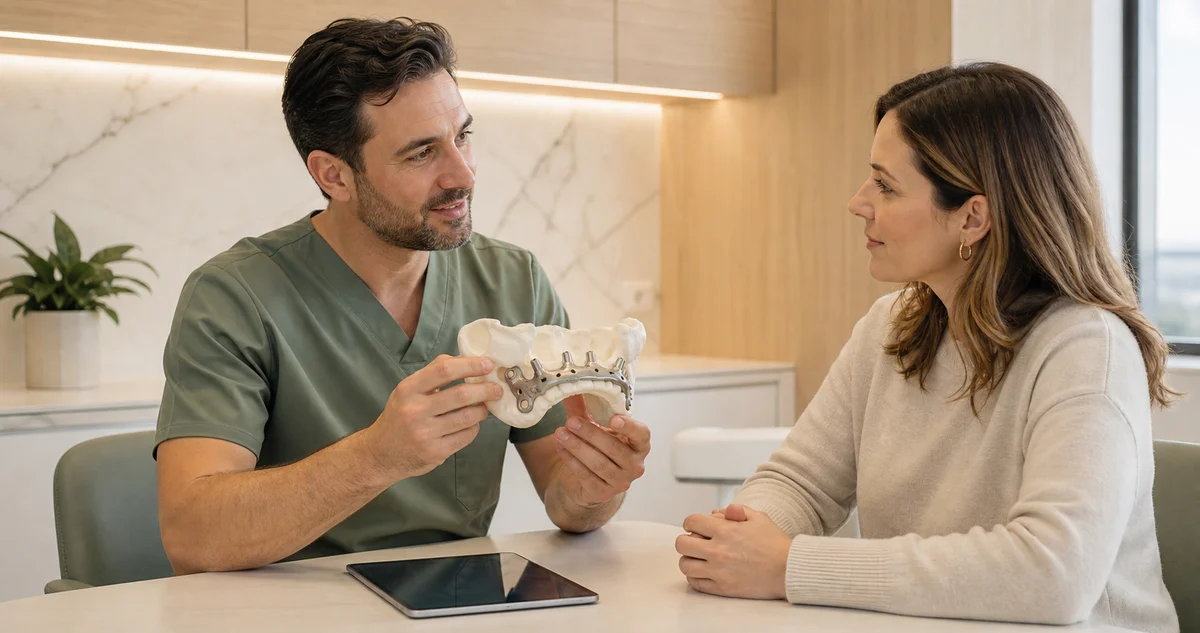
subperiosteal implant cost cannot be reduced to one reliable online number. A modern subperiosteal device is typically designed for a particular jaw, manufactured from three-dimensional imaging, placed by a specialist team, and connected to a multi-unit prosthesis. The quote may therefore combine diagnostic records, virtual planning, engineering, custom manufacturing, surgery, fixation hardware, anesthesia, provisional teeth, the definitive prosthesis, and follow-up. Different providers may include different stages under the same label.
The clinical context matters just as much as the invoice. Subperiosteal implants sit over the bony surface of the maxilla or mandible and beneath the periosteum, rather than being inserted into bone like conventional endosseous implants. Contemporary patient-specific titanium frameworks are mainly discussed for selected people with severe jaw atrophy or complex defects when ordinary implant pathways may be impractical or would require extensive reconstruction. They are not a routine shortcut for every missing tooth.
This guide explains how to compare subperiosteal implant cost without inventing a fixed price or implying guaranteed suitability. It uses current U.S. Food and Drug Administration (FDA) device information, official consumer guidance, and recent clinical studies. A licensed dental or oral and maxillofacial team must assess anatomy, health, alternatives, risks, and long-term maintainability before any financial decision.
Quick answer: subperiosteal implant cost varies because the framework is patient-specific and the full pathway may include CBCT imaging, multidisciplinary planning, custom titanium manufacturing, surgery, fixation, temporary and final teeth, anesthesia, and maintenance. Compare equivalent itemized plans, not headline prices. Confirm candidacy, evidence limits, complication care, insurance terms, and refund rules before paying or financing treatment.
What subperiosteal implant cost is paying for
A subperiosteal implant is not simply a larger version of a conventional implant screw. The National Library of Medicine’s MeSH definition describes subperiosteal implantation as placing an appliance over the surface of the mandible or maxilla beneath the periosteum. The FDA lists “implant, subperiosteal” under regulation 21 CFR 872.3645, product code ELE, as a Class II device category. That regulatory distinction helps explain why a quote should identify the precise device and intended use rather than use “dental implant” as a catch-all term.
Modern systems can use computed tomography or cone-beam computed tomography data, digital segmentation, virtual surgical planning, computer-aided design, and additive manufacturing to create a titanium framework that follows a patient’s bone surface. The framework is surgically positioned beneath the soft tissue and stabilized with fixation screws. Transmucosal posts support a planned prosthesis. Every step requires coordination among imaging, surgical, engineering, laboratory, and restorative teams, so subperiosteal implant cost often reflects a custom service pathway rather than an off-the-shelf device.
The FDA’s K210228 record concerns a patient-specific titanium subperiosteal device intended to provide support for multi-unit prostheses such as dentures. A 510(k) substantial-equivalence decision is important regulatory information, but it is not a promise that every subperiosteal design is cleared, that every patient is a candidate, or that a particular result is assured. Ask for the manufacturer, model, regulatory status in the treatment country, and patient-specific implant record.
Why subperiosteal implant cost varies so widely
The amount can change with jaw anatomy, the size and location of the framework, the number of prosthetic posts, whether one region or a complete arch is treated, and the complexity of the definitive prosthesis. Previous surgery, scarring, infection, a maxillary defect, limited soft tissue, nerve position, sinus anatomy, and remaining teeth may affect planning. Some cases involve a routine outpatient setting; others need hospital resources or additional specialists.
Geography also influences subperiosteal implant cost. Professional fees, laboratory charges, facility costs, anesthesia arrangements, regulatory pathways, taxes, and follow-up models vary across regions and countries. A lower headline figure may exclude travel, accommodation, multiple visits, a provisional prosthesis, restoration delivery, maintenance, or local management of complications. Currency conversion and card or bank fees can change the real total.
Custom manufacturing is a major distinction. The design may require imaging review, segmentation of anatomy, engineering collaboration, surgeon approval, manufacturing, finishing, cleaning or sterilization processes, quality documentation, and delivery. If the clinical situation changes after manufacturing, the device may not be reusable for another person or easily modified. The payment agreement should explain design-lock dates, cancellation rights, remake conditions, and which fees become nonrefundable at each stage.
- Diagnostic scope: examination, photographs, scans, radiographs, medical consultations, and justified three-dimensional imaging.
- Digital workflow: data processing, segmentation, prosthetically driven planning, engineering review, and design approval.
- Custom device: framework manufacturing, fixation components, quality documentation, transport, and sterilization handling.
- Surgery: surgeon and assistant fees, facility, disposables, medications, anesthesia or sedation, and postoperative reviews.
- Prosthodontics: records, provisional teeth, definitive framework or denture, laboratory work, adjustments, and repairs.
- Continuity: hygiene visits, clinical and radiographic monitoring, component replacement, and complication management.
- Travel: transport, lodging, time away from work, companion needs, repeat visits, and local follow-up.
Subperiosteal implant cost and the complete treatment sequence
A financially meaningful quote begins with a diagnosis, not a sales package. The team should document the cause and severity of bone loss, oral and medical history, remaining teeth, occlusion, hygiene capacity, soft-tissue condition, expectations, and available alternatives. Imaging should answer a clinical planning question. The prosthetic goal should be designed before the custom framework because post position and loading depend on the intended teeth.
Once the plan is accepted, imaging data may be converted into a three-dimensional model. The surgeon, restorative dentist or prosthodontist, and manufacturer review the proposed framework, fixation sites, emergence positions, prosthetic space, and relationship to critical anatomy. Manufacturing begins only after design approval. Ask whether a second scan or new design is required if healing, extraction, or anatomy changes before surgery; that possibility can affect subperiosteal implant cost.
Surgery generally requires elevation of soft tissue to expose the bony surface, accurate seating of the custom framework, fixation, verification of stability, and careful closure around the transmucosal posts. The prosthetic pathway may involve immediate or early provisional teeth in some protocols, but loading decisions depend on device design, stability, tissue management, occlusion, and the treating team’s protocol. “Teeth in a day” marketing should never replace a case-specific explanation.
After healing and adjustment, the definitive prosthesis is fabricated and delivered. Maintenance continues beyond that appointment. Patients need instructions for cleaning around posts and beneath the prosthesis, scheduled reviews, evaluation of tissue health and occlusion, and rapid access if mobility, pain, swelling, drainage, exposure, fracture, or biting changes develop. A quote that ends at surgery does not describe the full clinical commitment.
Subperiosteal implant cost decision table
Use the table to compare written proposals for equivalent care. It cannot determine candidacy or replace an examination.
| Check | What the quote should state | Why it matters | Question to ask |
|---|---|---|---|
| 1. Diagnosis | Clinical findings and degree of jaw atrophy or defect | The indication determines whether the custom route is reasonable | Why is this preferable to each alternative? |
| 2. Device | Manufacturer, material, design, intended use, and regulatory status | “Subperiosteal” is a category, not one universal product | Will I receive permanent device records? |
| 3. Imaging | Included scans and any repeat-imaging conditions | Custom fit depends on appropriate, current data | Who interprets the scan and why is it needed? |
| 4. Planning | Surgeon, prosthodontist, engineer, and laboratory roles | Framework and prosthesis must be planned together | Who gives final design approval? |
| 5. Manufacturing | Design, production, fixation parts, and remake policy | Custom fees may become nonrefundable | When is the design locked and what if anatomy changes? |
| 6. Surgery | Professional, facility, materials, and postoperative fees | Headline prices may omit the surgical setting | Which complications create a separate charge? |
| 7. Anesthesia | Local anesthesia, sedation, or general-anesthesia arrangements | Provider and facility requirements differ | Who administers and monitors it? |
| 8. Temporary teeth | Whether a provisional prosthesis is included | Immediate teeth are not automatic | What can I wear during healing? |
| 9. Final prosthesis | Material, design, laboratory, delivery, and adjustment visits | The framework alone does not restore chewing | Is the definitive prosthesis fully included? |
| 10. Maintenance | Hygiene, reviews, imaging, and component service | Long-term monitoring is essential | What is included after delivery and for how long? |
| 11. Complications | Emergency, exposure, infection, fracture, and removal pathways | Revision can be complex and costly | Who pays and who treats me if a problem occurs? |
| 12. Insurance | Codes, predetermination, network status, and patient balance | An estimate is not a payment guarantee | Which services were reviewed individually? |
| 13. Cancellation | Refund milestones before and after manufacturing | Patient-specific devices may not be transferable | How is unused treatment credited? |
| 14. Travel | Required visits and recommended stay | Extra trips change the real total | Who provides local follow-up? |
| 15. Financing | APR, finance charge, fees, term, and total of payments | A monthly payment can hide total borrowing cost | What will I repay if every payment is on time? |
What current evidence means for subperiosteal implant cost
When considering subperiosteal implant cost, modern patient-specific frameworks should not be assumed to have the same design or manufacturing process as historical subperiosteal implants. Digital imaging, virtual planning, and CAD/CAM titanium manufacturing have renewed clinical interest. However, renewed interest does not equal mature long-term evidence. Much of the published literature consists of small cohorts, case series, and relatively short follow-up.
A 2024 retrospective cohort reported 30 custom implants in 17 patients with severe posterior mandibular atrophy and an average follow-up of 22.5 months. The authors reported no exposure, infection, or implant loss in that series, while emphasizing the need for prospective studies with long follow-up. A 2025 randomized trial of 20 patients compared milled and 3D-printed patient-specific mandibular devices over 12 months; outcomes were broadly similar, with one failure reported in the milling group. These studies are informative but too small and short to establish a universal lifetime prediction.
A 2026 single-institution maxillary series included eight patients treated with virtual planning and custom titanium frameworks; follow-up varied and several definitive restorations were still in progress. The authors again called for larger studies. When evaluating subperiosteal implant cost, ask the clinician to distinguish device-specific evidence, team experience, and individual prognosis from general marketing claims. No percentage from a small study guarantees an outcome for a particular patient.
Evidence limitations also affect economic claims. Avoid assuming that a graft-free pathway is always cheaper. It may shorten or simplify some treatment sequences, yet custom engineering, manufacturing, surgical expertise, prosthetics, and follow-up create their own costs. A valid comparison requires complete plans for both strategies, including time, additional procedures, possible complications, maintenance, and the likelihood that the chosen pathway can actually be completed.
Risks that belong in a subperiosteal implant cost discussion
Financial consent is incomplete without clinical risk information. Potential problems described in historical and contemporary literature include wound dehiscence, framework or post exposure, soft-tissue inflammation, infection, pain, sensory changes, fixation-screw issues, mobility, prosthetic fracture or loosening, hygiene difficulty, bone changes, and the need for revision or removal. Exact risk depends on anatomy, design, surgery, tissue closure, loading, health, hygiene, smoking, and follow-up.
The FDA’s general dental implant guidance advises patients to discuss benefits, risks, candidacy, overall health, healing, brand and model, hygiene, and ongoing reviews. It notes that smoking can impair healing and that uncontrolled diabetes, local infection, untreated periodontal disease, and poor hygiene can affect outcomes. Those principles matter even though a subperiosteal framework differs from a root-form endosseous implant.
Revision can substantially change subperiosteal implant cost. If a small exposure is manageable, care may involve hygiene modification, tissue treatment, medication when clinically indicated, adjustment, or local repair. A persistent infection, unstable framework, fracture, or progressive complication may require more extensive surgery or removal. Ask who accepts responsibility for emergencies, what services are included, what warranty exclusions apply, and whether local clinicians will have access to device information.
- Request realistic benefits and limitations without a lifetime or success guarantee.
- Discuss medical conditions, medication, tobacco or nicotine use, and healing risk.
- Ask how the design avoids critical anatomy and how fit will be verified.
- Understand soft-tissue closure, provisional loading, diet, and cleaning instructions.
- Know which symptoms require urgent contact, including increasing swelling, fever, drainage, persistent numbness, mobility, severe pain, or framework exposure.
- Receive the manufacturer, model, material, lot or serial information, and component records when available.
- Plan periodic clinical and radiographic monitoring based on individual need.
- Clarify revision, repair, removal, and prosthetic remake responsibilities before treatment.
Compare subperiosteal implant cost with alternatives
A subperiosteal framework may be considered when severe atrophy makes conventional implants difficult, but the comparison is individual. Alternatives can include a removable denture, conventional endosseous implants with or without augmentation, short or tilted implants, zygomatic implants for selected maxillary cases, staged reconstruction, or choosing not to have a fixed implant-supported restoration. The list of realistic options depends on jaw, soft tissue, medical history, remaining structures, specialist expertise, and patient goals.
For a fair comparison, use the same outcome. A quote for a custom framework plus a fixed full-arch prosthesis cannot be compared directly with the surgical fee for several implant fixtures that excludes grafting and the final bridge. Likewise, a removable denture has different stability, hygiene, repairability, invasiveness, and maintenance. Ask each team to state the intended final prosthesis, treatment stages, time, risk, maintenance, and total included care.
Bone grafting can add a donor-site or graft procedure, healing time, imaging, and later implant placement, but may provide an established endosseous pathway in suitable patients. Zygomatic implants can avoid some grafting in selected severe maxillary atrophy, but involve specialized anatomy and surgery. A custom subperiosteal device can avoid placing multiple fixtures within very limited residual bone, yet it creates a broad framework beneath soft tissue and depends on accurate design and fit. None of these options is automatically safest or cheapest.
If a clinician presents only one solution, consider a second opinion from a team experienced in more than one reconstruction strategy. A second opinion may add an initial fee but can improve decision quality. The goal is not to select the lowest subperiosteal implant cost; it is to select a maintainable, evidence-informed plan whose complete financial and clinical consequences are understood.
Insurance, Medicare, tax accounts and subperiosteal implant cost
Coverage of subperiosteal implant cost depends on country and plan. In the United States, dental policies may exclude implants, classify a custom framework differently, apply waiting periods or annual maximums, require predetermination, or cover only some diagnostic, surgical, or prosthetic lines. Obtain an itemized plan with accurate procedure descriptions and ask the payer for a written, procedure-level estimate. Predetermination and preauthorization are not guarantees of claim payment.
Medicare states that in most cases it does not cover routine dental services or items such as dentures and implants, while certain dental services may be covered when directly connected to specific covered medical treatment. Do not assume severe atrophy alone creates Medicare coverage for subperiosteal implant cost. Medicare Advantage and other plans have their own benefit rules, networks, limits, and documentation requirements.
IRS Publication 502 explains that qualifying medical expenses include dental expenses and artificial teeth, but deduction rules, Health Savings Account rules, Flexible Spending Arrangement rules, payment timing, and reimbursement rules are not identical. Confirm eligibility and documentation with the plan administrator or tax professional. Avoid using the same expense for incompatible reimbursements or deductions.
If financing is needed, compare amount financed, annual percentage rate, finance charge, total of payments, fees, payment term, deferred-interest conditions, prepayment rules, and consequences of default. The Consumer Financial Protection Bureau warns that medical credit products can use deferred interest and may affect credit. Financing approval does not establish that the procedure is appropriate or affordable.
Travel and cross-border subperiosteal implant cost
Travel can widen access to specialized teams, but it also separates surgery from everyday care. Add transport, lodging, companion costs, time away from work, repeat imaging, schedule changes, medication, extra stays, and return trips. Confirm how many visits are required for records, design approval, surgery, provisional delivery, definitive prosthetics, and reviews. A one-trip assumption can make an incomplete quote look artificially low.
Before comparing international subperiosteal implant cost, verify the treating clinicians’ licenses, facility standards, device manufacturer, regulatory status, sterilization pathway, language support, written consent, records, component availability, and complaint or refund process. Ask which clinician near home will provide hygiene and urgent assessment and whether that clinician can obtain compatible parts. Travel insurance and ordinary health insurance may exclude planned dental treatment and related complications.
Patients considering care in Türkiye can review Redent Klinik’s English-language clinic information and send records through the contact page for an individualized assessment. These links do not mean that a subperiosteal device is offered or suitable, and they do not create a price, financing, coverage, timing, or outcome promise. A complete clinical review must come first.
How to request an itemized subperiosteal implant cost quote
- Complete the clinical assessment. Provide medical and dental history, relevant records, and an examination before asking for a final price.
- Confirm the indication. Ask why a surface-fitting custom framework is being considered and why alternatives are less appropriate.
- Define the final result. Identify whether the plan supports a segment, overdenture, or fixed multi-unit prosthesis.
- List every provider. Record the surgeon, restorative dentist or prosthodontist, anesthetist, imaging center, manufacturer, and laboratory.
- Itemize diagnostics. Separate examination, records, imaging, reports, and medical consultations.
- Itemize design and manufacturing. Include segmentation, virtual planning, custom device, fixation parts, shipping, and remake rules.
- Itemize surgery. Include professional, facility, anesthesia, medication, disposables, and scheduled postoperative care.
- Itemize teeth. State provisional and final prosthesis materials, laboratory work, delivery, and adjustment visits.
- Add foreseeable contingencies. Ask about extraction, soft-tissue treatment, grafting if unexpectedly needed, delayed loading, repair, revision, or removal.
- Map the timeline. Note payment dates, design lock, manufacturing, visits, healing, and definitive delivery.
- Verify insurance. Obtain procedure-level information and understand the full balance if claims do not pay.
- Compare total financing. Do not replace subperiosteal implant cost with a monthly-payment advertisement.
- Keep records. Retain signed plans, consent, device information, invoices, images, prescriptions, and follow-up instructions.
Frequently asked questions about subperiosteal implant cost
Why is subperiosteal implant cost usually individualized?
The device can be designed to fit one patient’s jaw surface, so anatomy, framework size, posts, fixation, planning, manufacturing, surgical setting, prosthesis, and follow-up all influence the total. A final quote generally requires a clinical assessment and current imaging. A generic internet number cannot show which stages are included.
Does subperiosteal implant cost include the final teeth?
Not automatically. Some quotes cover the custom framework and surgery but exclude a provisional or definitive prosthesis. Others include a temporary restoration but not the final laboratory work. Ask for separate lines covering records, surgery, provisional teeth, definitive teeth, adjustments, hygiene, maintenance, and repairs.
Is subperiosteal implant cost lower than bone grafting?
It can avoid extensive grafting in selected cases, but that does not prove the complete pathway costs less. Compare equivalent plans that include all diagnostics, surgery, anesthesia, device manufacturing, prosthetics, time, follow-up, and contingencies. Clinical suitability and maintainability should carry more weight than a headline amount.
Does insurance cover subperiosteal implant cost?
Coverage varies and may be limited or excluded. Ask the provider for accurate procedure descriptions and the insurer for a written, line-by-line estimate. Confirm network rules, waiting periods, exclusions, annual or lifetime maximums, authorization, frequency limits, and coordination of benefits. An estimate is not a guarantee of payment.
Does Medicare pay subperiosteal implant cost?
Original Medicare generally does not cover routine dental services or items such as implants. Limited dental services may be covered when directly linked to certain covered medical treatment, but that is not automatic implant coverage. Confirm the exact service with Medicare and any supplemental or Medicare Advantage plan before treatment.
What happens to subperiosteal implant cost if surgery is cancelled?
The contract controls. Because the device is patient-specific, design and manufacturing charges may become nonrefundable after defined milestones. Ask when the design is approved, when manufacturing starts, what medical or anatomical changes cause cancellation, whether a remake is possible, and how unused surgical or prosthetic funds are returned.
Does FDA clearance determine subperiosteal implant cost or success?
Use precise language. The FDA lists subperiosteal implant material as a Class II device category, and its database records a 510(k) substantial-equivalence decision for a patient-specific titanium system. That does not mean every design or provider workflow is cleared, and it does not guarantee individual safety or success. Verify the exact product.
Does subperiosteal implant cost come with a fixed lifespan?
No ethical provider can promise a fixed lifetime. Longevity depends on selection, design, fit, surgery, tissue health, loading, prosthesis, hygiene, medical factors, tobacco use, maintenance, and complications. Modern evidence is still limited by small cohorts and relatively short follow-up, so long-term predictions should be cautious.
Can subperiosteal implant cost rise after surgery?
Yes, if the original quote excludes unexpected treatment, additional facility care, delayed prosthetic stages, repairs, revision, or management of complications. Ask for a written list of included services and foreseeable separate charges. A responsible plan should also explain how a reduced or cancelled stage lowers the patient’s balance.
Which records support subperiosteal implant cost and later care?
To document subperiosteal implant cost, request the diagnosis, imaging and reports, operative note, manufacturer and model, material, lot or serial details when available, fixation information, prosthetic design, prescriptions, invoices, maintenance schedule, and emergency contacts. These records are especially important if a different clinician must evaluate the device later.
Is the lowest subperiosteal implant cost the best value?
Not necessarily. A lower offer may omit the final prosthesis, anesthesia, facility, follow-up, travel, or complication care. Compare equivalent clinical outcomes and complete written scopes. Team experience, device traceability, informed consent, continuity, maintenance, and realistic evidence are part of value even though they cannot guarantee an outcome.
Subperiosteal implant cost: the bottom line
subperiosteal implant cost reflects a customized diagnostic, engineering, surgical, and prosthetic pathway. The most useful quote identifies the indication, device, manufacturer, team, imaging, planning, manufacturing, fixation, anesthesia, provisional and final teeth, reviews, maintenance, complication pathway, and cancellation terms. A monthly payment or surgical fee alone is not a complete comparison.
Modern custom titanium frameworks may offer an alternative for carefully selected patients with severe jaw atrophy or defects, but current evidence remains more limited than marketing can imply. Small cohorts and short follow-up cannot provide a lifetime guarantee. Discuss endosseous implants, augmentation, zygomatic or other specialist options, removable prostheses, and no immediate fixed restoration where relevant.
This educational article was prepared for review by Dentist Esma Çevrük Çakır and prioritizes evidence-based, patient-safe communication. It does not diagnose, provide an individual subperiosteal implant cost, promise availability or insurance payment, or guarantee a result. Current product documentation, local regulation, a complete examination, and signed treatment and financial agreements control.
Sources for subperiosteal implant cost and clinical decisions
- FDA Product Classification — subperiosteal implant material, regulation 872.3645, Class II (page updated July 6, 2026; accessed August 21, 2026).
- FDA 510(k) database — K210228 patient-specific subperiosteal device (accessed August 21, 2026).
- U.S. Food and Drug Administration — Dental Implants: What You Should Know (patient guidance on candidacy, risks, records and maintenance; accessed August 21, 2026).
- U.S. National Library of Medicine — MeSH definition of subperiosteal dental implantation (accessed August 21, 2026).
- Vaira et al. — 2024 cohort of custom-made posterior mandibular subperiosteal implants (accessed August 21, 2026).
- Clinical and radiographic assessment of milled versus 3D-printed patient-specific subperiosteal implants — randomized trial (accessed August 21, 2026).
- Chintalapudi et al. — 2026 single-institution series for severe maxillary atrophy (accessed August 21, 2026).
- Medicare.gov — dental services coverage (accessed August 21, 2026).
- Consumer Financial Protection Bureau — medical credit cards and payment plans (accessed August 21, 2026).
- Internal Revenue Service — Publication 502, Medical and Dental Expenses (2025) (accessed August 21, 2026).
- American Dental Association — professional and oral-health resources (accessed August 21, 2026).
- World Health Organization — oral health fact sheet (accessed August 21, 2026).