
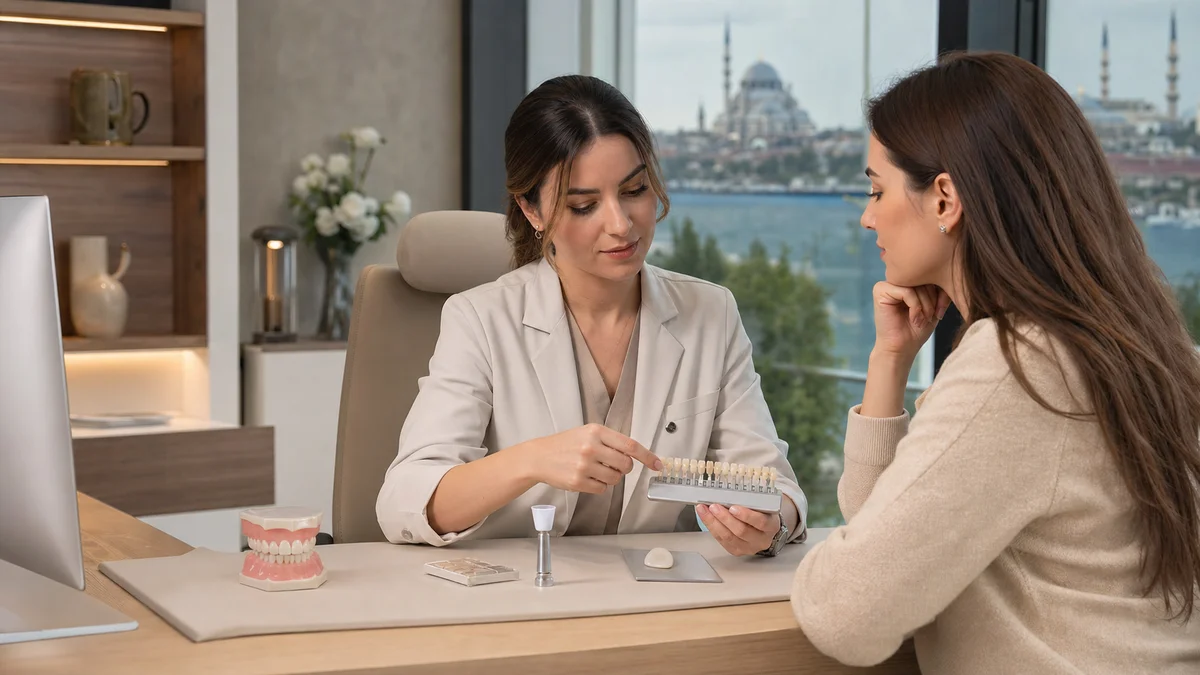
Quick answer: The most suitable teeth whitening alternatives depend on why teeth look darker. Surface stains may respond to professional cleaning and stain-removing toothpaste; selected enamel marks may suit microabrasion or resin infiltration. Bonding or veneers can change colour and shape but require maintenance and may alter tooth structure. A dental examination should first rule out decay, cracks, gum disease or a non-vital tooth.
Wanting a brighter smile does not automatically mean every tooth should be bleached. Colour can be changed by coffee or tobacco on the surface, by the natural thickness and translucency of enamel, by a developmental mark, by a filling or crown, or by a problem inside one tooth. Those causes do not respond to the same solution. The safest discussion of teeth whitening alternatives therefore begins with diagnosis rather than a shade card or a social-media image.
This guide compares conservative stain control, professional cleaning, targeted enamel treatments, repair of restorations, composite bonding, veneers and crowns. It explains what each route can and cannot change, how much tooth tissue may be involved, and what future maintenance can look like. It is educational information, not an individual diagnosis or a promise of a particular shade. A clinician who has examined your teeth, gums, bite and radiographs where indicated can help you choose among teeth whitening alternatives without concealing disease or sacrificing healthy tissue unnecessarily.
1. Start by identifying what changed the colour
The American Dental Association distinguishes between extrinsic stains on the outside of teeth and intrinsic discolouration within tooth structure. Extrinsic staining is often associated with tobacco or strongly pigmented foods and drinks. Intrinsic colour change can relate to development, age, caries, a restoration, medication exposure or changes in the dental pulp. These broad categories are clinically useful because a surface deposit may be removable, while a deep or localised colour change needs a different assessment.
A dental examination can also reveal that the perceived colour issue is actually uneven plaque retention, calculus, dehydration, gum recession, enamel loss or a restoration whose shade no longer matches. Photographs should be taken in consistent light, because phone filters and cool clinical lamps can make comparisons unreliable. Good teeth whitening alternatives address the cause that is visible in the mouth rather than the colour imagined from an edited photograph.
- General yellowing across many natural teeth: consider age, enamel thickness, habits and whether the goal is realistic.
- Brown or dark surface deposits: assess stain, plaque and calculus before discussing cosmetic coverage.
- One dark tooth: investigate trauma, decay, a large restoration, pulpal change or a crack.
- White, cream or brown enamel patches: establish whether they are developmental, post-orthodontic, active caries or another enamel condition.
- A crown or filling that looks different: remember that restorative materials do not lighten like natural enamel.
Seek prompt dental advice for new pain, swelling, a bad taste, trauma, a loose tooth, a crack, a rapidly darkening tooth or a colour change accompanied by sensitivity that lingers. Cosmetic masking should not delay necessary care. If gums bleed or teeth have untreated decay, stabilising oral health is the first step before comparing elective teeth whitening alternatives.
2. Professional cleaning among teeth whitening alternatives
Professional prophylaxis removes plaque and calculus, and polishing may reduce selected extrinsic stains. It does not bleach the internal colour of enamel or dentine. That distinction matters: a patient whose teeth are covered by tea, coffee or tobacco stain may see a cleaner, more even appearance after hygiene care, but a naturally deeper base shade remains a normal feature of the tooth.
Among conservative teeth whitening alternatives, cleaning is often the logical first comparison because it treats deposits rather than covering sound enamel. The clinician can select instruments and polishing methods according to the stain, restorations, gum condition and sensitivity. Excessive polishing is not a harmless beauty treatment; repeated or aggressive abrasion can affect exposed root surfaces and restorations. It should be performed for a clinical reason, not as an unlimited route to a lighter shade.
Cleaning also creates a more reliable baseline for shade assessment. If future bonding, repair or a ceramic restoration is being considered, the team can compare colour after inflammation and surface deposits have been managed. This reduces the risk of choosing a restoration shade around temporary stain. It also lets the patient decide whether a modest, natural improvement already meets the goal without moving to more invasive teeth whitening alternatives.
3. Stain-removing toothpaste among teeth whitening alternatives
Some toothpastes are formulated to remove surface stain through polishing agents or other ingredients. ADA consumer guidance is clear that whitening toothpastes primarily act on extrinsic stain; they do not substantially change the underlying intrinsic colour of a tooth. A fluoride toothpaste accepted for cavity protection can support everyday oral health while any cosmetic benefit should be understood as stain control, not internal whitening.
This is one of the lowest-intervention teeth whitening alternatives when the problem is mild surface staining. More abrasion is not necessarily better. People with exposed roots, enamel wear, sensitive teeth, extensive bonding or delicate ceramic margins should ask a dentist which formulation and technique are appropriate. Brushing harder can traumatise gums and does not make dentine whiter.
- Brush twice daily with fluoride toothpaste using gentle, systematic pressure.
- Clean between teeth every day using an interdental method suited to the spaces.
- Rinse with water after strongly pigmented drinks rather than immediately scrubbing softened surfaces.
- Avoid tobacco and reduce how frequently staining drinks contact the teeth.
- Arrange professional assessment if staining is one-sided, persistent or associated with roughness, a cavity or pain.
Oil pulling, turmeric and similar “natural whitening” claims are not supported by reliable evidence of tooth whitening, according to MouthHealthy, an ADA consumer resource. Charcoal, acidic fruit, vinegar and abrasive powders may produce a temporary change in surface appearance while risking wear or irritation. Sensible daily care is useful prevention, but it should not be sold as a guaranteed colour transformation or as a substitute for diagnosis.
4. Microabrasion among selected teeth whitening alternatives
Enamel microabrasion is a clinician-controlled technique that removes a very shallow surface layer to reduce selected superficial discolourations. It is not appropriate for every white or brown mark. The depth, activity and origin of the lesion matter, and active decay must not be treated as a cosmetic stain. When correctly selected, microabrasion can be one of the targeted teeth whitening alternatives that changes a localised mark without covering the whole front surface with restorative material.
The trade-off is that tissue removal, although intended to be limited, is irreversible. The result can also be incomplete when colour lies deeper than expected. A dentist may use clinical examination, drying, photographs and other diagnostic information to judge whether the mark is superficial. The consent conversation should include the possibility of no treatment, monitoring, resin infiltration, a combination approach or a later restoration if the appearance remains unacceptable.
Microabrasion should not be confused with aggressive home scrubbing. Concentrated acids and controlled abrasives belong in a professional protocol with isolation and tissue protection. Applying household acids or coarse powders is not an equivalent treatment and may create roughness, sensitivity or uneven enamel loss.
5. Resin infiltration among teeth whitening alternatives
Resin infiltration is a minimally invasive procedure used in selected non-cavitated enamel lesions. A low-viscosity resin penetrates porous enamel and can sometimes reduce the optical contrast that makes a white spot conspicuous. Selection is important: it is not a universal cure for every white patch, and it does not rebuild a cavitated area. Disease activity, lesion depth, surface integrity and hygiene must be considered.
For suitable cases, resin infiltration can sit between monitoring and a conventional restoration in a list of teeth whitening alternatives. It aims to preserve more tissue than drilling and covering the area. However, exact colour blending cannot be guaranteed, and the appearance may change over time. Photographs and realistic shade discussions are more useful than promises based on another person’s result.
A white spot after orthodontic treatment can represent mineral change around previous plaque-retentive areas, but superficially similar marks can have different causes. Preventive care and assessment of whether a lesion is active remain central. Cosmetic improvement does not remove the need for fluoride exposure, plaque control and review when those measures are indicated.
6. Diagnose a dark tooth before comparing teeth whitening alternatives
A single tooth that becomes grey, brown or pink is different from general staining. Previous trauma, pulpal bleeding or necrosis, decay, a crack, a large restoration and restorative materials can all affect appearance. There may be no pain even when the pulp has changed. The dentist may need sensibility tests, percussion, transillumination, radiographs or comparison with earlier images, depending on the history and findings.
In this situation, the safest teeth whitening alternatives are not simply whichever cover the dark surface fastest. If there is disease, stabilising or treating the tooth comes first. A non-vital tooth may sometimes be considered for internal bleaching after appropriate endodontic assessment, but that is still a bleaching procedure and not a true non-whitening alternative. In other cases, restoration repair, bonding, a veneer, a crown or observation may be discussed according to structure, prognosis and the patient’s priorities.
Covering an unexplained colour change with composite or ceramic can make future monitoring harder and does not treat infection. Conversely, placing a crown solely for colour on an otherwise intact tooth may remove more tissue than necessary. The decision should integrate biology, restoration quality, bite, gum level and the long-term repair plan rather than colour alone.
7. Restorations and teeth whitening alternatives
Tooth-coloured fillings, crowns, veneers, dentures and implants do not change colour in the same way as natural teeth. Both the ADA and NHS patient guidance highlight this limitation. A smile may therefore look uneven because natural enamel and an older restoration have changed differently, or because surface stain and roughness have accumulated at different rates.
The appropriate teeth whitening alternatives may include professional cleaning, polishing or repair of a restoration, but replacement should not be automatic. A sound restoration has biological value. Removing it can sacrifice additional tooth tissue, irritate the pulp or create a larger future restoration. The clinician should check margins, decay risk, fracture, gum response, shape, surface quality and function before recommending replacement for shade alone.
When replacement is justified, sequence matters. If any change to the natural teeth is planned, the final shade should be stable before selecting new restorative material. Otherwise, a newly made crown or filling may immediately look mismatched. Patients should also know that no material is maintenance-free: polish, edge repair, recementation or replacement may be needed during its service life.
8. Composite bonding in plans for teeth whitening alternatives
Direct composite bonding can alter the colour, contour, length or symmetry of selected teeth. In favourable cases it can be largely additive, with little or no preparation, and it is usually repairable. Those features make bonding one of the commonly discussed teeth whitening alternatives when colour is combined with a shape concern or a local defect.
Bonding is not simply paint for teeth. The dentist must plan thickness and opacity so that a darker area is masked without creating a bulky contour. Moisture control, enamel available for bonding, bite contacts, tooth position and oral habits affect the plan. Composite can stain, chip, lose polish or need maintenance. The expected service pattern varies between patients and cannot be promised from photographs alone.
An additive mock-up may help the patient judge shape before committing. If significant reduction would be needed to prevent over-contouring, the procedure is no longer purely additive. The consent discussion should compare doing nothing, a small repair, orthodontic movement, targeted enamel treatment and ceramic options. Healthy teeth should not be enlarged or over-prepared merely to reach an unnaturally uniform colour.
9. Veneers and crowns among teeth whitening alternatives
A ceramic veneer covers the front and sometimes the sides of a tooth; a crown encircles much more of it. Both can mask colour and change shape, but both are restorations, not wellness treatments. Preparation is irreversible, adhesive interfaces age, and future repair or replacement should be expected as part of lifelong maintenance. Gum position, enamel available for bonding, tooth structure, bite and parafunctional habits all influence suitability.
Veneers may be considered when a durable change in colour and form is needed and conservative options cannot meet an informed goal. Crowns are generally more appropriate when a tooth also needs substantial structural restoration, not merely because a lighter shade is desired. Treating intact teeth with full crowns solely as teeth whitening alternatives can create unnecessary biological cost.
No-preparation or minimal-preparation marketing does not mean every tooth can receive ceramic without reduction. Tooth position and desired contour determine whether adding material would look and feel bulky. A careful plan may combine orthodontics, minor bonding or no treatment rather than preparing multiple healthy teeth for visual symmetry. A second opinion is reasonable when a proposal is extensive or irreversible.
10. Teeth whitening alternatives decision table
The table is a conversation aid, not a prescription. Several findings may coexist, and the examination can change which teeth whitening alternatives are reasonable.
| What you notice | First clinical question | Options to discuss | Main limitation or trade-off |
|---|---|---|---|
| Brown surface stain on several teeth | Is it removable stain, plaque or calculus? | Hygiene care, professional polishing, suitable stain-removing fluoride toothpaste | Does not change the natural internal shade |
| General natural yellow tone | Is the shade healthy and within normal variation? | No treatment, stain prevention, carefully planned restorative masking only for an additional indication | Restorative masking adds maintenance and may alter tissue |
| One white or brown enamel mark | Is it active caries, a superficial defect or a deeper lesion? | Prevention or monitoring, microabrasion, resin infiltration, small bonding | Blending may be incomplete; selection is diagnosis-dependent |
| One newly dark tooth | Has trauma, decay, pulpal disease or a crack been excluded? | Treat disease first; then observe, repair, bond or restore when indicated | Masking does not treat an internal problem |
| Crown or filling does not match | Is the restoration sound and cleanable? | Polish, repair, monitor or replace after shade planning | Replacement can remove more tooth tissue |
| Colour plus shape or edge concern | Can an additive approach work within the bite? | Composite mock-up and bonding; veneer only after alternatives | Composite can stain or chip; ceramic is less repairable and often irreversible |
| Severely restored or structurally weak tooth | What restoration is needed for health and function? | Onlay, veneer or crown according to remaining tissue and load | Colour should not override structural diagnosis |
11. Teeth whitening alternatives: reversibility and biological cost
A treatment that looks simple on the appointment day may create a long maintenance pathway. Surface-stain control is repeatable and usually does not change tooth shape. Microabrasion intentionally removes a small amount of enamel. Resin infiltration alters porous enamel with resin. Bonding adds a repairable material but may need repolishing or repair. Veneers and crowns have laboratory, preparation and replacement cycles. These differences should be explicit when comparing teeth whitening alternatives.
Ask what happens if the result is too opaque, too bright, chipped, stained, uncomfortable or no longer matches neighbouring teeth. Ask whether repair can be localised and how replacement could affect remaining tissue. “Permanent” usually means the tooth is permanently committed to restoration, not that the restoration lasts forever. A conservative plan preserves options for the future.
Cost comparisons should include diagnosis, prevention, provisional stages, maintenance and potential future replacement, not a single advertised fee. Prices vary with the number of teeth, material, disease control, laboratory work and clinical complexity. A responsible clinic provides an itemised plan after examination rather than a fixed universal price or a guarantee of how long a restoration will last.
12. Teeth whitening alternatives, sensitivity and timing
The ADA notes that temporary tooth sensitivity and gingival irritation are common adverse effects associated with bleaching. Avoiding bleach does not make every other procedure risk-free. Polishing can irritate exposed roots if inappropriate; bonding and ceramics can affect contours and gum cleaning; preparation can provoke sensitivity; and untreated gum disease can make cosmetic margins unstable.
Before choosing teeth whitening alternatives, the dental team should record sensitivity, cracks, recession, enamel wear, existing restorations and gum health. Active decay and inflammation should be managed. If a patient clenches or grinds, load management may influence material choice and maintenance. If orthodontic movement is planned, it may be wiser to reassess colour and restorations after positions and gum levels have stabilised.
Timing also matters after cleaning, isolation or prolonged mouth opening because teeth can temporarily dehydrate and look lighter. Final restorative shade decisions should not be based on a dehydrated appearance. Consistent lighting, photographs and more than one shade observation can support a measured choice.
13. Unsafe DIY substitutes are not teeth whitening alternatives
Online recipes often call lemon juice, vinegar, activated charcoal, salt, baking soda mixtures or concentrated peroxide “natural” teeth whitening alternatives. Natural does not mean non-abrasive, non-acidic or safe. Acid can soften mineral, while coarse abrasion can remove surface and increase roughness. A short-lived brighter look may reflect dehydration or surface loss rather than healthier enamel.
Do not file teeth, use household cleaning products, apply unregulated adhesives, or place nail products or craft resin in the mouth. DIY veneers and snap-on products can trap plaque, distort the bite, irritate gums or delay diagnosis. MouthHealthy advises that do-it-yourself aesthetic care may prioritise appearance over health and cause damage. If a home product is being considered, discuss its ingredients, instructions and recognised quality marking with a dental professional.
Stop using a cosmetic product and seek advice if there is persistent pain, gum injury, ulcers, swelling, prolonged sensitivity or a new change in colour. Emergency care is appropriate for facial swelling, difficulty breathing or swallowing, uncontrolled bleeding or severe trauma.
14. A practical consultation checklist
Bring unfiltered photographs if they show when the colour changed, plus a list of medications and relevant dental history. Explain whether the concern is a surface stain, one tooth, a white patch, a mismatched restoration or the overall shade. A good consultation about teeth whitening alternatives should make room for the option of no treatment and should separate health needs from elective appearance changes.
- What is the most likely cause of the colour, and which findings support that view?
- Are the teeth and gums healthy enough for elective treatment?
- Can cleaning, prevention, monitoring or a local repair meet the goal?
- How much enamel or dentine would each option add to, alter or remove?
- What outcome is realistic under ordinary light rather than a filtered image?
- What sensitivity, chipping, staining, gum or pulpal risks apply to this mouth?
- How is the result maintained, repaired and eventually replaced?
- What is included in the written plan, and what could change after examination?
Patients considering treatment in Istanbul can read about the clinic’s approach on the Redent Klinik English website and use the Redent Klinik contact page to request an examination. Remote photographs may help initial communication, but they cannot establish pulpal status, decay, cracks, gum health or bite. A final plan should follow an in-person clinical assessment.
Frequently asked questions about teeth whitening alternatives
What are the least invasive teeth whitening alternatives?
If the issue is superficial stain, appropriate daily oral hygiene, removal of stain-causing habits, professional cleaning and carefully selected stain-removing toothpaste are among the least invasive options. They do not change the natural internal shade. For a local enamel mark, monitoring, microabrasion or resin infiltration may be discussed after diagnosis. “Least invasive” depends on the problem; doing nothing can also be a valid choice.
Can cleaning be one of the teeth whitening alternatives?
Cleaning can remove plaque, calculus and some external stain, so teeth may look cleaner and more even. It does not bleach enamel or dentine. The degree of visible change depends on how much of the darker appearance came from removable deposits. This is why cleaning is a useful baseline before selecting restorative teeth whitening alternatives.
Are stain-removing toothpastes teeth whitening alternatives?
Whitening toothpastes mainly help remove surface stain; ADA guidance says they do not substantially alter intrinsic colour. Choose a suitable fluoride toothpaste and avoid assuming that higher abrasiveness is safer or more effective. People with recession, sensitivity, enamel wear, bonding or ceramic restorations should ask for individual advice.
Are composite veneers safer teeth whitening alternatives than ceramic?
Neither material is automatically safer for every patient. Composite may be more additive and locally repairable, but it can stain, chip or lose polish. Ceramic may offer stable optical properties but often requires a greater long-term restorative commitment. Enamel, bite, tooth position, gum health, the amount of masking required and future repair determine the balance.
Can bonding cover a dark tooth without treatment?
Bonding can mask colour in selected healthy teeth, but a newly dark tooth must first be investigated. Trauma, pulpal disease, decay, cracks and restorations can change colour. Covering the surface does not treat an internal problem. Once health and prognosis are established, bonding can be compared with observation, repair or other teeth whitening alternatives.
Can crowns, fillings or implants be lightened?
Existing restorative materials do not lighten like natural enamel. Surface polishing may improve external stain or roughness in selected cases, but it will not fundamentally change the material’s shade. Repair or replacement may be considered when mismatch is unacceptable and the restoration’s condition justifies intervention; replacing a sound restoration has a tissue cost.
Is charcoal a safe teeth whitening alternative?
Charcoal is not a reliable way to change intrinsic tooth colour, and abrasiveness varies. Repeated use may increase wear or roughness, especially where roots, enamel loss or restorations are present. A product’s “natural” label does not establish safety. Use an evidence-supported fluoride toothpaste and ask a dentist before adding abrasive cosmetic products.
Which teeth whitening alternatives work for white spots?
White spots require diagnosis because early caries, developmental enamel changes and other conditions can look similar. Prevention and monitoring may be appropriate; selected non-cavitated lesions may be considered for resin infiltration, and superficial marks may sometimes suit microabrasion. Deeper or structurally damaged areas may require bonding. Exact blending cannot be guaranteed.
How do I choose between bonding and veneers?
Compare the amount of colour change, desired shape, tooth position, enamel, bite and maintenance preferences. Bonding can be additive and repairable but may need more polishing or repair. A ceramic veneer can mask and reshape but is a greater irreversible commitment. A diagnostic mock-up and a written discussion of teeth whitening alternatives can make the trade-offs clearer.
Conclusion: preserve health and future options
A brighter appearance can come from removing stain, improving oral hygiene, treating a local enamel change, repairing a restoration or adding restorative material. These are not interchangeable. The right starting point is the cause of the colour, the health of the tooth and the smallest intervention that can meet an informed, realistic goal. The most responsible teeth whitening alternatives preserve healthy tissue, acknowledge maintenance and leave room for future care.
If colour changes suddenly, affects one tooth or comes with pain, swelling or trauma, seek an examination rather than a cosmetic shortcut. For elective concerns, ask to compare no treatment, cleaning, targeted enamel care, bonding and ceramic options in the same written plan. No clinician can guarantee an exact shade, lifetime or biological response, but careful diagnosis can reduce avoidable risk.
Evidence and patient-information sources
- American Dental Association: Whitening — types and causes of staining, treatment routes, restoration limitations and common adverse effects.
- American Dental Association: Toothpastes — fluoride toothpaste and cosmetic stain-control ingredients.
- American Dental Association — professional oral-health resources required for the English-language evidence framework.
- MouthHealthy: Natural Teeth Whitening — evidence limitations for oil pulling and turmeric, plus preventive habits.
- MouthHealthy: DIY Dentistry — risks of unsupervised aesthetic procedures.
- NHS: Teeth Whitening — professional assessment, suitability and the fact that crowns, dentures and implants do not whiten.
- US National Institute of Dental and Craniofacial Research: Oral Hygiene — daily brushing, interdental cleaning and preventive care.
- World Health Organization: Oral Health — prevention and the broader burden of oral disease.
Sources were checked on 22 July 2026. Guidance and product information can change; the linked authorities should be consulted for current wording.