
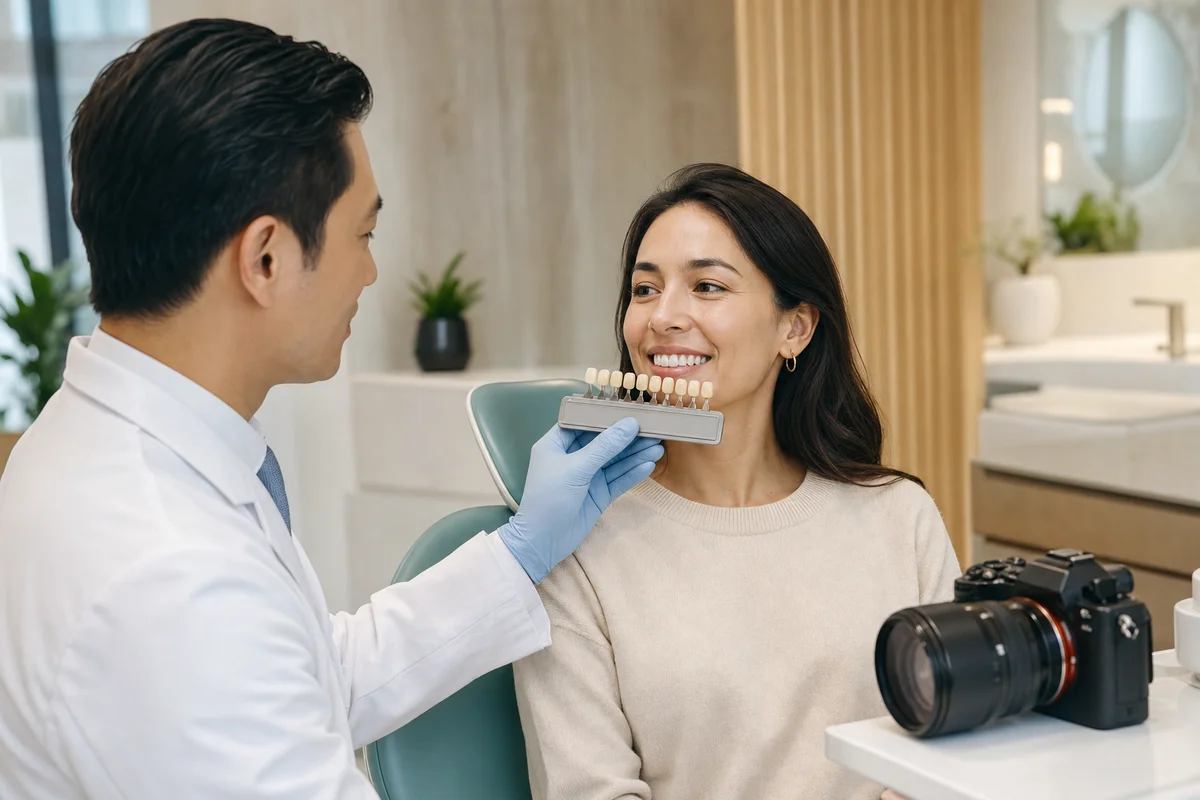
Quick answer: Teeth whitening before and after images can show a possible direction of color change, but they cannot predict your outcome. Compare photos only when lighting, angle, exposure, moisture, and timing are consistent. Natural teeth may lighten; crowns, veneers, implants, and tooth-colored fillings generally do not. A dental examination should come before bleaching when discoloration, sensitivity, decay, or gum problems are present.
Teeth whitening before and after galleries are among the most searched forms of cosmetic dental evidence. They are easy to understand at a glance, yet surprisingly easy to misread. A brighter “after” image can reflect genuine bleaching, removal of surface stain, different lighting, camera processing, tooth dehydration, or several of these factors at once. Even an honest photograph shows one person at one moment; it does not promise that another person will reach the same shade.
This patient guide explains how to interpret teeth whitening before and after comparisons, what changes whitening can and cannot produce, how professional and home options differ, and why a dental assessment matters. It does not diagnose the cause of discoloration or guarantee a degree of whitening. If one tooth has suddenly darkened, or discoloration is accompanied by pain, swelling, a crack, trauma, or temperature sensitivity, arrange a dental examination rather than starting a cosmetic product on your own.
What Teeth Whitening Before and After Photos Actually Show
A useful teeth whitening before and after pair documents change in the same patient under comparable conditions. It may help a dentist and patient discuss how external stains responded, how much natural color shifted, and whether the result remained balanced with visible restorations. It cannot establish that the treatment is suitable for you, reveal every risk, or show how the result will look months later.
Whitening is not painting teeth opaque white. Peroxide-based agents change colored molecules within dental hard tissues, while whitening toothpastes primarily help remove some external surface stain through abrasive or polishing action. Natural enamel and dentin have individual translucency, texture, and color. A realistic teeth whitening before and after result should retain those characteristics rather than resemble a flat white filter.
When viewing teeth whitening before and after content online, first ask whether both photographs are clearly identified as the same patient and whether the provider explains the method and timing. Ethical presentation avoids implying that one featured result is typical for everyone. It also avoids digitally whitening the teeth, smoothing gum tissue, changing lip color, or increasing the exposure only in the “after” frame.
Why Photos Can Make the Change Look Larger
Teeth whitening before and after photography is sensitive to technical variables. Camera white balance, flash output, room light, exposure, lens, distance, image compression, screen brightness, and the angle of the teeth can alter perceived color. Lipstick, clothing, skin tone, background color, and even how widely a person smiles can change visual contrast. This is why casual smartphone selfies are poor tools for measuring a clinical shade change.
Lighting, exposure, and white balance
For a fair teeth whitening before and after comparison, the camera position and settings should be reproduced as closely as possible. The images should use equivalent lighting, background, magnification, and color management. Including the same physical shade tab or calibrated reference can make the comparison more informative. Automatic camera modes may independently brighten the second photograph, so “same phone” does not necessarily mean same exposure.
Tooth dehydration can temporarily change color
Teeth may dehydrate when the mouth is held open or soft tissues are moved away during a procedure. A 2025 clinical study indexed by PubMed found that color change became perceptible as dehydration continued and that rehydration was not always complete at 24 hours after prolonged dehydration. This matters because an immediate teeth whitening before and after photograph can exaggerate lightness if the “after” teeth are drier than the baseline teeth.
That finding does not mean every immediate teeth whitening before and after photograph is misleading. It means timing and moisture should be disclosed. A clinician may record an immediate result for treatment documentation and then reassess after rehydration. For patients, a photograph taken under ordinary conditions after the mouth has recovered may be more useful for judging the settled appearance.
Editing, filters, and selective framing
Consumers cannot always detect image processing. Increased brightness, reduced yellow saturation, selective tooth masking, sharpening, or a beauty filter can create a dramatic difference without a corresponding clinical change. Cropping the “before” image closer or showing more shadow can also affect perception. Trustworthy teeth whitening before and after pages use consistent frames and describe photography as documentation, not proof of a guaranteed shade.
Surface Stain, Internal Color, and the Cause of Discoloration
The American Dental Association distinguishes extrinsic stains on the surface from intrinsic discoloration within enamel or dentin. Coffee, tea, red wine, tobacco, and some other exposures may contribute to external staining. Aging, developmental conditions, certain medications during tooth formation, trauma, pulp changes, decay, and restorative materials can affect internal or localized color. The cause influences what teeth whitening before and after change is realistic, so the baseline diagnosis belongs beside the photographs.
When a cleaning may change the “before”
Professional removal of plaque, calculus, and external stain can brighten the appearance before any bleaching gel is used. Whitening toothpaste may reduce some surface stain but generally cannot produce the same internal color change as a bleaching agent. A responsible plan identifies whether the concern is removable deposit, external pigment, intrinsic color, or a combination rather than selling every patient the same procedure.
When one tooth is darker than the others
A single dark tooth needs diagnosis. Previous trauma, pulp necrosis, root-canal treatment, decay, a large restoration, or cracks may be relevant. External whitening of the whole smile may not correct the underlying problem and can increase the contrast with that tooth. A dentist may discuss a different pathway, including management of disease or carefully selected internal bleaching for a non-vital tooth. Do not use a teeth whitening before and after post to self-diagnose a dark tooth.
What Whitening Can and Cannot Change
In teeth whitening before and after treatment, only natural tooth tissue responds to bleaching in the expected way. Porcelain crowns, veneers, implant crowns, composite fillings, and bonding do not whiten like enamel. If these restorations appear in the smile, natural teeth may become lighter while the restorations stay the same, creating a mismatch that was not obvious before treatment.
- May respond: natural teeth with suitable external or internal discoloration after clinical assessment.
- May respond differently: teeth with varied thickness, translucency, white spots, fluorosis, or medication-related staining.
- Will not bleach like a natural tooth: crowns, veneers, tooth-colored fillings, bonding, bridges, and implant restorations.
- Needs diagnosis first: decay, leaking restorations, gum recession, cracks, erosion, exposed roots, or a single dark tooth.
- Cannot be promised: an exact shade, a perfectly uniform smile, permanent color, or the result shown in another patient’s photographs.
Before teeth whitening before and after documentation begins, the dentist can map visible restorations and discuss whether their color will remain acceptable. Replacing a sound restoration solely for color adds cost and removes tooth structure, so the sequence should be planned carefully. If a new crown or veneer is already needed for clinical reasons, the team may complete whitening first, allow color to stabilize, and then match the restoration; timing is individualized.
Comparing In-Office, Dentist-Supervised Home, and OTC Options
There is no single best route behind every teeth whitening before and after result. The ADA describes three broad approaches: in-office bleaching, dentist-supplied products used at home, and over-the-counter products. Product concentration, contact time, delivery method, baseline shade, stain type, adherence, and sensitivity can all influence the pace and degree of change.
| Option | What it may offer | What to verify | Important limitations |
|---|---|---|---|
| In-office bleaching | Clinician-controlled application and gum protection; visible change may occur in a shorter appointment sequence | Pre-treatment examination, agent and protocol, isolation, sensitivity plan, timing of final photos | Not everyone is suitable; sensitivity and gum irritation can occur; an immediate shade may not be the settled shade |
| Dentist-supervised home trays | Customized plan and controlled use over days or weeks | Tray fit, gel instructions, daily duration, total course, review schedule, what to do if symptoms occur | Requires adherence; overfilling trays or extending wear without advice can increase irritation |
| Over-the-counter strips or gels | Convenient access and lower initial cost for selected adults | Label directions, recognized safety evidence, expiration, authentic seller, compatibility with dental history | Generic fit, slower or less predictable change, risk of misuse, no diagnosis of underlying discoloration |
| Whitening toothpaste | Removal or control of some external surface stain | Abrasivity, sensitivity, ADA Seal where available, realistic expectations | Usually does not bleach the intrinsic color of teeth like peroxide products |
| DIY acidic or abrasive mixtures | No dependable clinical advantage established for popular kitchen remedies | Avoid unverified recipes; ask a dentist about safer alternatives | Acid or uncontrolled abrasion may harm enamel or irritate tissues; online images may hide damage |
The more dramatic teeth whitening before and after image is not automatically evidence of a better protocol. A faster change may come with more sensitivity for some patients, while a slower regimen may fit another person’s preferences and risk profile. Follow the product or professional instructions rather than increasing concentration, quantity, frequency, or wear time to chase a photograph.
Common Side Effects and When to Stop
Temporary tooth sensitivity and gingival inflammation or irritation are the most commonly reported adverse effects behind teeth whitening before and after treatment, according to the ADA. Symptoms may vary with the product, concentration, contact time, and individual patient. A treatment plan should explain what level of transient sensitivity may occur, how it will be managed, and when use should stop.
- Use only the amount and duration instructed; more gel does not establish a safer or better outcome.
- Keep gel off soft tissues as directed and do not swallow it intentionally.
- Report severe, persistent, or worsening sensitivity rather than repeatedly treating through pain.
- Stop and seek advice for tissue burns, pronounced gum whitening, swelling, rash, or an unexpected reaction.
- Ask for an examination if cold sensitivity existed before whitening or is localized to one tooth.
- Do not apply whitening agents to untreated cavities, broken teeth, or visibly inflamed gums without professional guidance.
A teeth whitening before and after result should never be pursued at the expense of pain or tissue health. If you develop facial swelling, difficulty breathing or swallowing, widespread rash, or another severe reaction, seek urgent medical attention. Cosmetic timing can wait; safety cannot.
Who Should Have an Examination Before Whitening?
A dental examination before teeth whitening before and after treatment is valuable for anyone unsure of the cause of discoloration, but it is especially important when symptoms or complex restorations are present. The ADA notes that examination and appropriate diagnostic testing can identify factors contributing to tooth discoloration. A clinician can also assess sensitivity, exposed roots, gum health, cracks, decay, and restoration margins before peroxide is introduced.
Arrange professional advice before trying to recreate a teeth whitening before and after post if you have:
- One tooth that is darker, pink, gray, or changing color
- Recent dental trauma, cracks, cavities, or spontaneous pain
- Significant gum recession, exposed roots, erosion, or severe sensitivity
- Multiple visible crowns, veneers, implants, fillings, or bonding
- White or brown developmental spots that may become more noticeable
- Active gum inflammation, bleeding, mouth ulcers, or poor-fitting trays
- Pregnancy, breastfeeding, childhood or adolescence, complex medical history, or uncertainty about product ingredients
This list is not a diagnosis or a universal prohibition. It identifies situations in which individualized advice is more important than a generic product label. The dentist may recommend treating disease first, choosing another cosmetic approach, modifying the protocol, or postponing whitening.
A Fair Teeth Whitening Before and After Photo Checklist
Use the following checklist before trusting a teeth whitening before and after claim. No single point proves manipulation, but several inconsistencies should lower confidence.
- Same patient: facial features, tooth shapes, alignment, restorations, and gum contours appear consistent.
- Same angle: the camera height, smile position, head position, and magnification are comparable.
- Same light: flash direction, shadows, reflections, and overall exposure look alike.
- Same color balance: skin, lips, gums, clothing, and background have not shifted toward different tones.
- Timing disclosed: the provider states whether the “after” image was immediate, after rehydration, or at follow-up.
- Method disclosed: cleaning, in-office bleaching, home trays, strips, or combined treatment is identified.
- No hidden restoration change: new bonding, crowns, or veneers are not presented as whitening alone.
- No digital enhancement: there is an explicit policy against editing tooth color or selective exposure.
- Limitations visible: natural texture and shade variation remain; the teeth do not look uniformly painted.
- Consent respected: patient images are used with appropriate permission and without unnecessary identifying information.
Clinical photographs may use retractors and standardized equipment for documentation, while a patient-facing portrait may show a natural smile. These are different image types and should not be compared as if they were the same. The strongest teeth whitening before and after documentation combines standardized images with recorded shade information and a clear description of timing.
How Long Does a Whitening Result Last?
No ethical teeth whitening before and after clinician can promise permanent color. Diet, tobacco exposure, oral hygiene, natural aging, product choice, and the original cause of discoloration influence how the appearance changes over time. Some early color shift after treatment may reflect rehydration rather than treatment “failure.” Later external stain can also accumulate.
Ask whether the teeth whitening before and after example shows the immediate result or a later review. A follow-up photograph is more informative about short-term stability, but it still cannot predict your long-term course. Maintenance should be based on professional advice and product instructions; repeated or continuous bleaching without review is not a substitute for routine dental care.
Daily habits can help limit new external stain: brush with fluoride toothpaste as directed, clean between teeth, avoid tobacco, and moderate frequent exposure to strongly pigmented foods and drinks. Do not adopt an extremely restrictive “white diet” without clinical need. Rinsing with water after staining drinks and maintaining regular dental visits are more sustainable than anxiety about every meal.
Planning Whitening Around Crowns, Veneers, and Bonding
A common surprise in teeth whitening before and after treatment is that an old crown or filling becomes more noticeable. The restoration did not darken; the adjacent natural tooth lightened while the restorative material remained the same. This is particularly relevant for front teeth, where small differences may be visible.
Before teeth whitening before and after treatment, ask the dentist to identify every visible restoration and explain potential mismatch. If restorative work is planned for clinical reasons, whitening may be sequenced before final shade selection, with a waiting period determined by the clinician. Do not assume all existing work must be replaced. The costs, benefits, tooth preservation, and expected visual gain should be discussed separately.
When reviewing a clinic gallery, ask whether any “after” frame includes new veneers, crowns, bonding, contouring, or gum treatment. A combined smile makeover may be legitimate, but it should not be labeled as bleaching alone. Transparent labeling helps patients compare like with like.
Questions to Ask at a Whitening Consultation
Bring a list rather than relying on the excitement of a dramatic teeth whitening before and after display:
- What is the likely cause of my discoloration?
- Are my teeth and gums healthy enough for this protocol?
- Which teeth or visible restorations will not change color?
- What degree of change is reasonable without promising an exact shade?
- Which product, active ingredient, concentration, and schedule are proposed?
- What are the expected side effects and my personal sensitivity risks?
- What should I do if sensitivity or gum irritation develops?
- When are photographs and shade measurements taken relative to dehydration and rehydration?
- Does the quoted fee include examination, trays, gel, reviews, and management of sensitivity?
- How might future crowns, veneers, fillings, or bonding be matched?
- What maintenance, if any, is appropriate and how often should it be reviewed?
- May I have written instructions and a copy of my clinical photographs?
Patients exploring care with Redent Klinik can request an individualized evaluation instead of choosing from a gallery alone. Use the clinic’s English contact page to ask how whitening suitability, shade documentation, visible restorations, sensitivity, and aftercare would be assessed. Online images can begin a conversation, but they cannot replace an in-person examination.
Frequently Asked Questions About Teeth Whitening Before and After
How many shades whiter will my teeth become?
A precise number cannot be promised from a photo or remote message. Baseline shade, stain type, natural tooth structure, product, protocol, and adherence all matter. Shade guides and instruments can document change, but another patient’s teeth whitening before and after result is not a forecast for you.
Why do my teeth look whiter immediately after an appointment?
Genuine bleaching may be visible, but temporary dehydration can also make teeth appear lighter. Lighting and contrast affect photographs as well. Ask when the final shade will be reviewed after rehydration and whether the clinic records standardized images rather than relying only on the immediate appearance.
Will whitening change crowns, veneers, fillings, or implant teeth?
These restorative materials generally do not bleach like natural teeth. If nearby enamel lightens, a restoration may become more noticeable. Ask for a restoration map and sequencing plan before treatment, particularly when restorations are visible in the smile.
Are professional whitening results permanent?
No. Natural aging and new surface stain can change the appearance over time. The pace varies. Follow the clinician’s maintenance advice and avoid repeated unsupervised treatment. A teeth whitening before and after image captures a moment, not a lifetime guarantee.
Is tooth sensitivity after whitening normal?
Temporary sensitivity is a commonly reported adverse effect, but severity and duration vary. Persistent, severe, spontaneous, or one-tooth pain deserves professional assessment. Do not extend wear time or add more gel when symptoms occur; follow the supplied stop and review instructions.
Do whitening toothpastes produce the same result as bleaching?
Whitening toothpastes mainly help remove some external surface stain through polishing or abrasive ingredients; they usually do not change intrinsic tooth color like peroxide bleaching. Choose products with credible safety evidence and use them as directed, especially if you have sensitivity or erosion.
Can charcoal, lemon, baking soda, turmeric, or oil pulling whiten teeth?
The ADA’s consumer guidance says reliable evidence does not show oil pulling or turmeric whitens teeth and warns against approaches that can harm enamel. Acids and uncontrolled abrasives are not safe shortcuts. A viral teeth whitening before and after clip may not reveal microscopic wear, sensitivity, or editing.
Can teenagers whiten their teeth?
Age, dental development, cause of discoloration, and local professional guidance matter. The ADA notes that the American Academy of Pediatric Dentistry discourages full-arch cosmetic bleaching in primary and mixed dentitions. A parent or guardian should arrange a pediatric dental assessment rather than using adult influencer protocols.
What if only one tooth needs whitening?
A single discolored tooth requires diagnosis before cosmetic treatment. Previous injury, pulp changes, decay, or a restoration may be involved. Depending on the findings, the treatment may differ from whole-smile external bleaching. Seek assessment promptly if color change follows trauma or comes with pain.
How can I take fair progress photos at home?
Use the same room, time of day, background, camera, distance, angle, and exposure if possible. Turn off beauty filters and avoid comparing a wet baseline with a dry close-up. Home photographs are for personal tracking, not diagnosis, and they are less reliable than standardized shade assessment.
The Safe Takeaway
Teeth whitening before and after content is most useful when it is transparent, standardized, and modest about what it proves. Look for the same patient, equivalent photography, disclosed timing, named treatment, and clear separation between whitening and restorative procedures. Treat dramatic differences without context as marketing, not clinical prediction.
Your safest next step is an assessment of the discoloration, teeth, gums, sensitivity, and visible restorations. Then compare reasonable options, side effects, time, cost, and maintenance. A healthy, natural-looking result suited to your own mouth is a better goal than reproducing another person’s edited shade.
Authoritative Sources and Further Reading
- American Dental Association — Whitening: Evidence, Methods, and Patient Considerations
- ADA MouthHealthy — Natural Teeth Whitening: Fact vs. Fiction
- National Health Service — Teeth Whitening
- PubMed — Clinical Assessment of Dental Color During Dehydration and Rehydration
- PubMed — Randomized Trial of At-Home Carbamide Peroxide Wear Times
- American Dental Association
- World Health Organization — Oral Health