
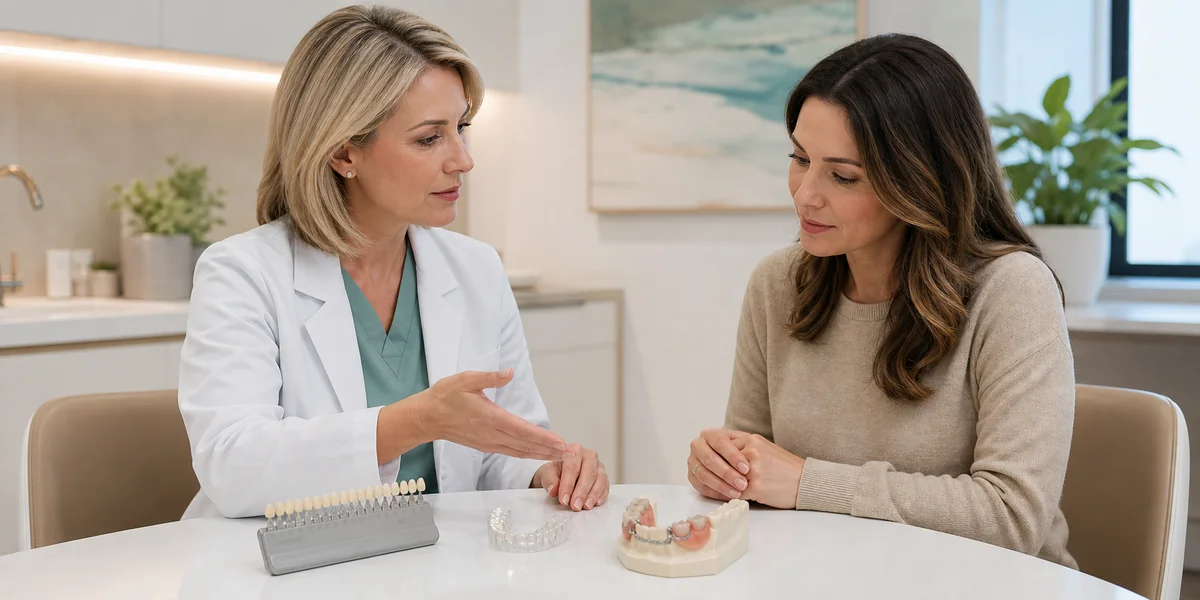
teeth whitening or dentures which is better sounds like a choice between two ways to improve a smile, but the treatments solve fundamentally different problems. Whitening changes the colour of suitable natural teeth. Dentures replace missing teeth and associated oral structures with a removable prosthesis. Whitening cannot replace a lost tooth, and dentures should not be prescribed merely because natural teeth look darker.
Quick answer: teeth whitening or dentures which is better depends on the diagnosis, because they are not alternatives. Whitening may lighten healthy natural teeth but will not change dentures, crowns, fillings, or implants. Dentures replace missing teeth when preservation or fixed replacement is unsuitable. First treat disease, protect restorable teeth, identify functional needs, and then plan colour consistently.
The correct first question is: “Do I have healthy natural teeth that I want to lighten, or do I need to replace teeth that are missing or cannot be predictably retained?” Some patients need neither treatment. Others may use both at different stages—for example, whitening remaining natural teeth before a partial denture is made so that the new denture teeth can be selected to harmonize with the final shade.
This educational guide does not diagnose whether teeth should be extracted, promise a whitening shade, guarantee denture comfort, or provide a fixed price. Examination, medical and dental history, gum assessment, decay and vitality checks, bite analysis, and suitable imaging may be required. Patients can request an individualized assessment through the Redent Klinik contact page; the Redent Klinik English homepage provides general clinic information.
1. Teeth whitening or dentures which is better begins with purpose
Whitening uses bleaching agents such as hydrogen peroxide or carbamide peroxide to make the colour of natural teeth appear lighter. The American Dental Association explains that these agents break stains into smaller pieces, reducing colour concentration. Whitening toothpaste mainly removes surface stain and does not bleach internal tooth colour in the same way.
Dentures are removable appliances that replace some or all missing teeth. A partial denture uses remaining teeth and oral tissues for support and retention; a complete denture replaces an entire dental arch when no natural teeth remain. Implant-retained removable dentures add implant support but still have prosthetic and maintenance needs. This difference answers much of teeth whitening or dentures which is better: colour treatment and tooth replacement are not substitutes.
A patient with intact, healthy teeth and external staining may discuss cleaning and whitening. A patient with multiple missing teeth may need a replacement plan that compares dentures, bridges, implants, and sometimes no immediate replacement. A patient with decayed or loose teeth first needs disease assessment; cosmetic colour should not distract from pain, infection, mobility, or gum breakdown.
2. What teeth whitening or dentures which is better can change
Whitening can lighten many natural teeth, but response varies with the cause and colour of discoloration. The ADA notes that yellow shades often respond differently from brown or grey tones and that injury- or medication-related discoloration may not respond predictably. A single dark tooth may need vitality testing and radiographic assessment rather than applying bleach without diagnosis.
Whitening does not change the colour of fillings, veneers, crowns, bridges, implant crowns, or denture teeth. Both ADA and NHS patient guidance emphasize this limitation. If visible restorations match the original shade, natural teeth may become lighter while restorations remain unchanged. A plan for teeth whitening or dentures which is better must therefore map every visible material before colour treatment.
A reliable discussion of teeth whitening or dentures which is better separates natural enamel from every artificial material.
Professional cleaning can remove plaque, calculus, and some surface stains, sometimes improving appearance without bleaching. Whitening cannot correct missing teeth, severe wear, large shape discrepancies, active decay, fractured teeth, or gum disease. Nor can it guarantee a celebrity-white result. Healthy natural teeth exist in a range of shades.
- May respond: suitable natural enamel and dentin with common age-, food-, drink-, or tobacco-related discoloration.
- Will not bleach: denture acrylic teeth, ceramic crowns, composite fillings, veneers, bridges, and implant crowns.
- Needs diagnosis first: one dark tooth, new colour change, pain, cracks, decay, gum disease, or internal staining.
- Needs realistic planning: mixed natural teeth and restorations in the smile zone.
3. What dentures achieve in teeth whitening or dentures which is better
Dentures replace missing teeth to support appearance, speech, and chewing. The ADA explains that complete dentures can help restore facial profile after total tooth loss and that both dentures and the mouth need daily hygiene. Partial dentures can fill selected spaces while using teeth, clasps, precision attachments, or implants depending on the design.
Dentures are not identical to natural teeth. They can move, require adaptation, reduce chewing efficiency compared with a stable natural dentition, and need periodic review as oral tissues change. They do not stop all ridge remodeling. Adhesive may help in selected situations, but excessive adhesive should not be used to disguise a poorly fitting or damaged denture.
When patients ask teeth whitening or dentures which is better, they should know that a denture is not a cosmetic shortcut for teeth that can be maintained. Extracting restorable teeth to obtain an instantly uniform colour is irreversible and changes sensation, function, bone, and maintenance. Preservation decisions should be based on prognosis, disease burden, patient values, and alternatives—not shade alone.
4. Teeth whitening or dentures which is better for stained natural teeth?
If teeth are healthy, structurally sound, and the main concern is colour, whitening may be the relevant category. The dentist should first assess gums, cavities, cracks, leaking restorations, recession, sensitivity, and the reason for discoloration. Whitening active disease can worsen discomfort or postpone needed treatment.
Options may include stain-removing toothpaste, professionally supplied home trays, or in-office bleaching. Over-the-counter products vary by country and formulation. The ADA recommends discussing products with a dentist and choosing products with recognized evidence and safety evaluation where available. The NHS identifies dentist-provided or dentist-delivered whitening as the safest route within its regulatory context.
Temporary sensitivity and gum irritation are recognized side effects. Overuse can damage teeth or gums. Higher concentration, longer contact, or more frequent application is not automatically better. For stained but otherwise healthy natural teeth, teeth whitening or dentures which is better generally points toward conservative colour management rather than replacement, subject to examination.
5. Teeth whitening or dentures which is better for missing teeth?
Whitening cannot replace a tooth, restore a chewing surface, or close a true edentulous space. Missing teeth call for a replacement discussion if the space affects function, appearance, stability, or patient preference. Options may include a removable partial denture, fixed bridge, implant-supported crown or bridge, orthodontic space management, or monitoring.
A denture may be considered when several teeth are missing, surgery is unsuitable or unwanted, a removable and adaptable option is preferred, finances favor this pathway, or future tooth changes are anticipated. NHS England’s current care-pathway guidance notes the value of retrievable and adaptable removable prostheses in patients whose disease or future tooth loss may require modification.
If only colour is unsatisfactory and teeth are maintainable, dentures are not the logical answer. If many teeth are absent, whitening the few remaining natural teeth may be only one secondary aesthetic step. For missing teeth, teeth whitening or dentures which is better should be reframed as “Which tooth-replacement strategy fits my health, anatomy, maintenance capacity, and priorities?”
6. Disease control before teeth whitening or dentures which is better
Bleeding gums, active decay, infection, loose teeth, oral lesions, uncontrolled dry mouth, and painful cracks need attention before whitening or definitive dentures. Whitening is not a treatment for decay or periodontal disease. A denture made over inflamed, unstable tissues or around untreated teeth may fit poorly as conditions change.
For teeth whitening or dentures which is better, prognosis is more important than colour. Each tooth should be assessed for restorability, periodontal support, pulp or root condition, structural integrity, strategic value, and the patient’s ability to maintain it. A tooth need not be perfect to be valuable, and extraction should not be recommended merely to simplify a prosthetic design.
Disease control may include hygiene instruction, professional cleaning, caries management, periodontal treatment, repair of restorations, endodontic treatment when indicated, smoking support, dry-mouth measures, and medical coordination. Only after stabilization can colour and definitive tooth replacement be planned on a more reliable foundation.
7. Decision table for teeth whitening or dentures which is better
This table directs questions; it does not prescribe treatment.
| Main clinical situation | Relevant pathway to discuss | Essential safety question |
|---|---|---|
| Healthy natural teeth with surface stains | Cleaning, stain-removing toothpaste, or supervised whitening | Is staining external, and are teeth and gums healthy? |
| Natural teeth with internal discoloration | Diagnosis, then case-specific whitening or restorative options | What caused the colour change, especially in a single tooth? |
| Several missing teeth with maintainable remaining teeth | Partial denture, bridge, implants, or combined planning | Which teeth are strategic and predictably retainable? |
| No natural teeth in one arch | Complete denture or implant-assisted alternatives | How will fit, speech, chewing, hygiene, and reviews be managed? |
| Mixed natural teeth and visible restorations | Sequence colour planning before new restorations or denture teeth | Which materials will not change shade? |
| Active decay or gum disease | Disease control before cosmetic or definitive prosthetic care | Can health be stabilized before irreversible treatment? |
| Pressure for extraction based only on colour | Conservative second opinion | Are the teeth restorable, and what preservation alternatives exist? |
8. Whitening safety in teeth whitening or dentures which is better
The dentist should identify exposed roots, enamel defects, cracks, cavities, leaking fillings, gum recession, and sensitivity. Bleaching agents can reach dentin and irritate the tooth’s nerve, which helps explain temporary sensitivity. Poorly fitting trays or excess gel can irritate soft tissues.
The NHS advises that teeth and gums should be checked before whitening and notes restrictions or caution for people who are under the applicable age threshold, pregnant or breastfeeding, or have unhealthy teeth or gums. Regulations and product strengths vary by country, so patients should follow local professional guidance rather than importing a one-size-fits-all protocol.
DIY acids, abrasive powders, household bleach, concentrated chemicals, and unregulated salon treatments can harm enamel or gums. ADA information states that acidic fruits, charcoal-style methods, oil pulling, or turmeric do not provide a safe evidence-based alternative to appropriate care. The safe answer to teeth whitening or dentures which is better never includes damaging natural teeth for a temporary colour effect.
9. Denture types in teeth whitening or dentures which is better
A conventional complete denture is generally made after extraction sites and tissues have had an initial healing period. An immediate denture is inserted around the time remaining teeth are removed, maintaining appearance but often needing adjustment, relining, or replacement as tissues heal. An overdenture may use retained roots or implants for support when suitable.
Acrylic partial dentures can be adaptable and may allow future additions, while metal-framework or other designs can offer different thickness, stiffness, and support. Flexible materials have specific limitations and are not a universal upgrade. Clasps may be visible, and precision attachments or implant retention can add cost, complexity, and maintenance.
New dentures can affect speech, salivation, chewing, and sore spots during adaptation. Follow-up adjustments are part of treatment, not evidence of failure. However, persistent ulceration, rocking, inability to chew, or a sudden fit change needs assessment. In a realistic teeth whitening or dentures which is better comparison, dentures carry ongoing fitting and tissue-review needs that whitening does not.
10. Colour planning for teeth whitening or dentures which is better
Whitening does not lighten denture teeth. If a partial denture or new crown will be visible beside natural teeth, colour sequencing matters. When whitening is suitable, it is often discussed before the final shade of new prosthetic teeth is selected. Teeth should be allowed to settle to a stable shade according to the clinician’s protocol before definitive matching.
An existing denture will not become lighter with bleaching gel. Surface cleaning may remove some stains, but abrasive toothpaste, hot water, or inappropriate household chemicals can scratch, warp, or damage the prosthesis. Replacement of denture teeth or a new denture may be needed if the shade mismatch is unacceptable and the appliance cannot be modified appropriately.
This material difference is central to teeth whitening or dentures which is better whenever natural and prosthetic teeth appear together.
For combined teeth whitening or dentures which is better planning, the team should map natural enamel, composites, crowns, bridges, implants, and denture teeth. Patients should understand which elements can change with bleaching and which may require restoration replacement. Otherwise, whitening can create a mismatch that was not obvious beforehand.
11. Maintenance after teeth whitening or dentures which is better
Whitening results are not permanent. Diet, tobacco, aging, hygiene, and the original cause of discoloration influence future colour. Maintenance should avoid uncontrolled repeated bleaching. Patients with sensitivity need an individualized schedule and may require pauses or desensitizing measures recommended by a dental professional.
Dentures require daily mechanical cleaning with a soft brush and a non-abrasive denture cleanser. The ADA recommends rinsing debris, brushing all denture surfaces gently, cleaning gums, tongue, cheeks, and palate, and storing dentures safely according to professional instructions. Hot water can distort some materials. Denture wearers still need regular oral examinations, even when no natural teeth remain.
- brush natural teeth twice daily with fluoride toothpaste;
- clean between remaining teeth every day;
- follow the prescribed whitening amount, contact time, and frequency;
- clean dentures over a water-filled basin or folded towel to reduce breakage risk;
- remove dentures for the period advised by the clinician to let tissues rest;
- report persistent sensitivity, ulcers, looseness, cracks, or fit changes;
- attend reviews based on tooth, gum, mucosal, and prosthetic risk.
The maintenance answer to teeth whitening or dentures which is better is therefore different: whitening needs colour and sensitivity management, while dentures need prosthesis hygiene, tissue monitoring, and fit review. Neither is maintenance-free.
12. Costs in teeth whitening or dentures which is better
Whitening fees depend on examination, cleaning needs, trays, product, in-office delivery, review, and management of sensitivity. Denture fees depend on partial or complete design, materials, extractions, impressions or scans, jaw records, try-ins, temporary or immediate appliances, laboratory stages, relines, adjustments, and implant components if used. These are not comparable treatment packages.
A fixed online price cannot establish teeth whitening or dentures which is better for an individual. A written plan should separate diagnosis, disease treatment, optional cosmetic care, extractions, temporary prostheses, definitive dentures, repairs, and reviews. Ask what happens if healing changes the fit or a tooth initially planned for retention becomes unsuitable.
Coverage varies by jurisdiction and policy. Cosmetic whitening is commonly excluded, while denture benefits may be limited by frequency, material, network, waiting period, missing-tooth clauses, or annual maximums. A pre-treatment estimate can help, but clinical suitability should remain a dentist–patient decision rather than being dictated solely by the reimbursed option.
Alternatives beyond teeth whitening or dentures which is better
For colour concerns, alternatives or complements include professional cleaning, replacing a mismatched restoration after diagnosis, internal bleaching for selected root-filled teeth, bonding, veneers, or crowns when structurally justified. More invasive restorations should not be chosen solely because whitening response is uncertain; healthy tooth structure has value.
For missing teeth, alternatives include fixed bridges, resin-bonded bridges, implant-supported crowns or bridges, orthodontic space management, and monitored non-replacement. Each option has anatomical, surgical, biological, cost, hygiene, and maintenance implications. A removable denture may be best for one person and unsuitable for another.
Sometimes the best plan is staged: stabilize disease, preserve strategic teeth, provide a temporary denture, reassess healing, and later choose a definitive removable or fixed option. The phrase teeth whitening or dentures which is better should open a shared decision conversation, not force a binary answer.
Red flags in teeth whitening or dentures which is better marketing
Be cautious of providers who recommend extraction from photographs, promise one guaranteed whitening shade, claim dentures will feel exactly like natural teeth, or say whitening changes crowns and denture teeth. Also question “permanent whitening,” painless-for-everyone claims, and a same-day denture price that omits extractions, relines, adjustments, or future replacement.
Do not use chlorine bleach, household cleaners, acidic fruit mixtures, abrasive powders, or unverified chemicals in the mouth or on dentures. Never repair a denture with household glue; it may be toxic, distort the fit, and complicate professional repair. A lost, cracked, or poorly fitting denture should be assessed.
Seek prompt dental care for facial swelling, fever with dental symptoms, pus, uncontrolled bleeding, severe pain, rapidly increasing mobility, persistent ulcers, or a denture that causes injury. Whitening should stop and be reviewed if sensitivity or tissue burns are significant. Safety outranks the cosmetic question of teeth whitening or dentures which is better.
Frequently asked questions: teeth whitening or dentures which is better
Can whitening gel make dentures whiter?
No. Bleaching products are designed to alter the colour of suitable natural teeth and do not whiten denture acrylic or ceramic restorations in the same way. A denture may collect removable surface stain, but it needs material-appropriate cleaning. If its shade no longer matches, professional polishing, repair, tooth replacement, or a new denture may be discussed.
Should stained teeth be removed for dentures?
Colour alone is not a sound reason to extract maintainable teeth. Extraction is irreversible and affects bone, sensation, function, and future prosthetic choices. The dentist should assess decay, periodontal support, cracks, pulp or root condition, restorability, and patient priorities. Conservative colour treatments should be considered when teeth are healthy enough to keep.
Can I whiten my teeth before getting a partial denture?
Possibly, if the natural teeth and gums are suitable. Whitening before final shade selection can help new denture teeth match the settled colour of natural teeth. Timing must allow the shade to stabilize, and existing fillings or crowns may still mismatch. Coordinate the whitening and prosthetic plans rather than treating them independently.
Are dentures only for older adults?
No. Tooth loss can result from decay, gum disease, trauma, congenital conditions, medical factors, or other causes at different ages. Age alone does not determine the best replacement. The condition of remaining teeth, anatomy, health, dexterity, expectations, and alternatives guide whether a partial, complete, implant-assisted, or fixed option is considered.
Does whitening damage enamel?
Appropriately selected and correctly used products can be safe, but overuse or unsuitable DIY methods can harm teeth or gums. Temporary sensitivity and soft-tissue irritation can occur. A dentist should check for decay, cracks, recession, and gum problems and provide instructions on product, dose, contact time, and what to do if symptoms develop.
Do dentures need to be replaced?
Dentures and oral tissues change over time. Tooth wear, fracture, material aging, ridge remodeling, weight or health changes, and altered remaining teeth can affect fit and function. Adjustment, reline, repair, or replacement may be needed. A denture that becomes loose should be evaluated rather than managed indefinitely with increasing adhesive.
Which option gives a more natural smile?
The comparison is not direct. Whitening preserves and lightens suitable natural teeth; dentures replace missing teeth and can be designed to look natural within anatomical limits. A healthy, functional result may include natural colour variation. Material, tooth arrangement, lip support, gum display, shade, and patient preference all influence appearance.
Can I have both whitening and dentures?
Yes, in selected partial-denture cases, but sequencing matters. Remaining natural teeth may be whitened first if appropriate, then denture teeth can be selected to match the stabilized shade. Complete denture teeth cannot be bleached in the mouth. All active disease should be controlled before elective colour treatment or definitive prosthetic work.
How long do whitening and dentures last?
No fixed duration can be promised. Whitening colour changes can fade with diet, tobacco, aging, and stain exposure. Denture service depends on fit, materials, tissues, remaining teeth, use, cleaning, and accidental damage. Both require monitoring, but their maintenance needs and reasons for retreatment are different.
How to decide teeth whitening or dentures which is better safely
Start by listing the actual problem: colour, missing teeth, pain, mobility, chewing, speech, confidence, or several concerns. Ask the dentist which teeth are healthy, which require treatment, and which—if any—have a poor prognosis. Review conservative options before extraction and confirm which materials will or will not respond to whitening.
A safe answer to teeth whitening or dentures which is better may be whitening, a denture, both in sequence, an alternative restoration, or neither. The best plan protects oral health, preserves maintainable tissue, restores function when needed, sets realistic appearance goals, and includes a maintenance pathway the patient can follow.
teeth whitening or dentures which is better ultimately requires diagnosis before cosmetic preference.
Evidence sources for teeth whitening or dentures which is better
- American Dental Association MouthHealthy: Teeth Whitening
- American Dental Association MouthHealthy: Natural Teeth Whitening
- American Dental Association MouthHealthy: Dentures
- NHS: Teeth whitening
- NHS England: Dentistry care pathways guidance
- American Dental Association
- World Health Organization: Oral Health