
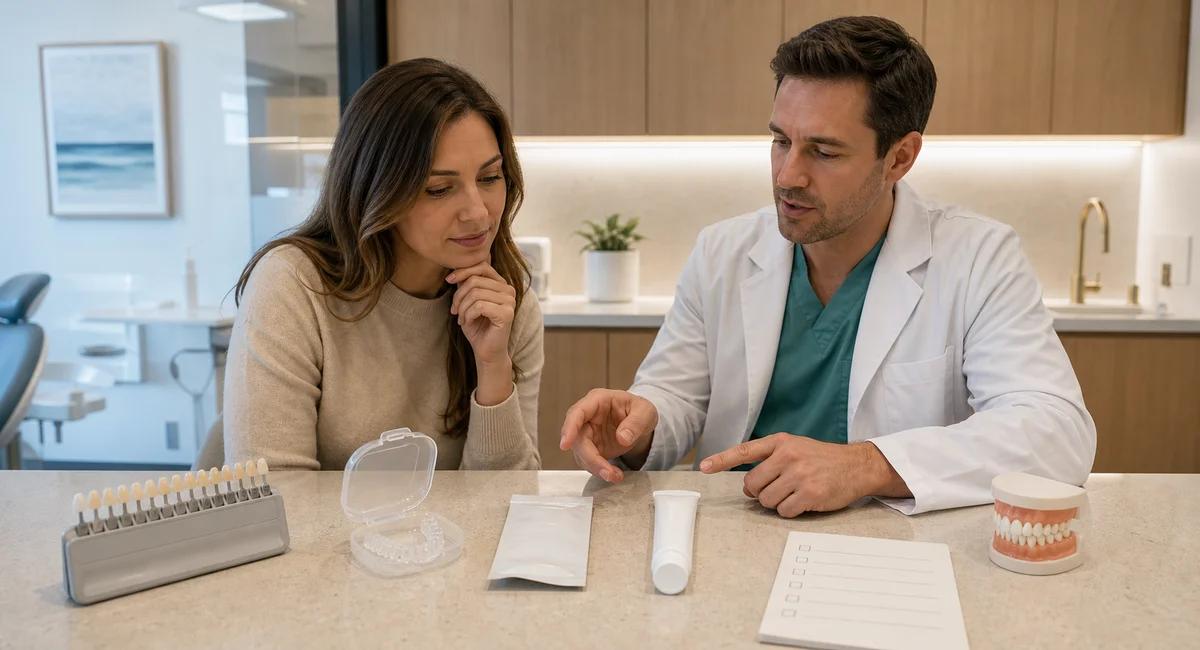
Quick answer: The most useful teeth whitening reviews separate the product from the person using it. Look for the whitening ingredient, delivery method, treatment time, starting stain type, dental examination, sensitivity plan and follow-up period. Ignore guarantees and heavily edited before-and-after photos. A dentist can check whether decay, gum disease or visible restorations make whitening unsuitable or likely to look uneven.
Search results for teeth whitening reviews can feel decisive because they combine dramatic photographs, star ratings and confident personal stories. Yet two sincere reviewers can have very different outcomes from the same product. Natural tooth colour, coffee or tobacco staining, enamel thickness, exposed roots, existing fillings and the way a product fits all affect the experience. Lighting, dehydration immediately after treatment and image editing can also make a colour change appear larger than it is.
This guide does not invent patient stories, rank unverified brands or promise a particular shade. It provides a structured way to assess claims about in-office whitening, dentist-supervised custom trays, over-the-counter strips and surface-stain products. The aim is to help you identify which details in teeth whitening reviews are clinically meaningful, which are missing and when an individual dental assessment matters more than an online score.
1. What teeth whitening reviews can—and cannot—tell you
A review can describe comfort, instructions, tray fit, flavour, packaging and whether the reviewer completed the recommended course. It can also alert you to recurring practical problems, such as strips that slide or a gel that leaks onto the gums. Those observations are useful when the reviewer explains the product and timing clearly. They do not establish that a treatment will be safe or effective for another person.
Good teeth whitening reviews distinguish observation from diagnosis. “My teeth felt sensitive for a day” is an observation. “Sensitivity proves the gel reached deep stains” is a medical interpretation and may be wrong. Reviews also cannot tell whether hidden decay, cracked teeth, leaking restorations or gum recession are present. Those conditions require a dental examination and may change the plan.
Use reviews to form questions, not to replace professional advice. A practical reading sequence is:
- Identify the exact method and active whitening ingredient rather than relying on words such as “professional” or “advanced.”
- Check whether the writer mentions an oral-health examination, current restorations and the type of staining.
- Look for timing: an immediate impression is different from a result described several weeks later.
- Separate shade change from surface cleanliness, gloss, camera exposure or temporary dehydration.
- Note side effects, what the reviewer did about them and whether symptoms resolved.
2. Start with the colour problem before comparing teeth whitening reviews
“Whiter teeth” can mean different things. Extrinsic stains collect on the surface from pigments in food, drinks and tobacco. Cleaning and appropriately abrasive toothpaste may reduce some of them. Intrinsic colour lies within the tooth structure and may respond differently to peroxide-based bleaching. Age-related colour change, medication-associated discolouration, developmental enamel differences and trauma can require different expectations or treatment options.
The American Dental Association explains that whitening approaches may address extrinsic and intrinsic discolouration, but the method matters. Toothpastes that mainly polish surface stains should not be judged by the same standard as peroxide products intended to change intrinsic shade. If teeth whitening reviews never state what the reviewer wanted to change, their outcome is difficult to transfer to your situation.
One more distinction is essential: whitening changes natural tooth tissue, not the colour of porcelain crowns, composite fillings, veneers, bridges, dentures or implants. A front filling that matched before whitening may look darker afterwards. Reviewers who do not mention visible restorations may unintentionally create unrealistic expectations for readers who have them.
3. How to read in-office teeth whitening reviews
In-office whitening is performed under dental supervision, generally using a higher-concentration peroxide system than consumer products, with steps to protect the soft tissues. The appeal is controlled application and a relatively short appointment. That does not mean every patient reaches the same shade, feels no sensitivity or keeps the initial colour indefinitely.
Reliable teeth whitening reviews of clinic treatment explain what happened before the whitening itself: examination, discussion of restorations, baseline shade, gum protection and consent about sensitivity. They also distinguish the shade observed immediately after treatment from the settled appearance later. Teeth can look temporarily brighter after dehydration; rehydration may change the immediate impression.
Ask whether the review identifies the actual system and the clinician’s role. The phrase “laser whitening” is often used loosely. A light may be part of a manufacturer’s protocol, but a glowing device is not, by itself, proof that the chemistry is more effective or suitable for you. The active agent, concentration, contact time, isolation and patient factors remain important.
4. Dentist-supervised custom tray teeth whitening reviews
Custom trays are made to fit a person’s teeth and are supplied with a dentist-directed gel and schedule. Their closer fit can help control where the material sits, but success still depends on correct loading, wear time and follow-up. More gel is not necessarily better; excess material can contact the gums and increase irritation without providing a proportional benefit.
When reading custom-tray teeth whitening reviews, look for details about impressions or scanning, the prescribed gel, how long the trays were worn, how sensitivity was managed and whether the dentist adjusted the schedule. A review that simply says “professional kit” leaves too much unknown. A tray can be professionally supplied, mail-ordered or generic, and those are not interchangeable experiences.
Custom trays may also be useful for planned maintenance, although the interval should be personalised. Frequent unsupervised top-ups can increase cumulative irritation and obscure the reason colour is changing. Teeth whitening reviews should not be treated as a universal dosing schedule.
5. Over-the-counter strip teeth whitening reviews
Whitening strips usually place a peroxide-containing film against the front surfaces of the teeth for a defined time. They can be convenient and less expensive than supervised options, but fit varies with tooth shape and alignment. A strip may contact prominent teeth well while missing recessed or rotated surfaces, producing a less uniform appearance.
Useful strip teeth whitening reviews name the active ingredient, describe adherence and state whether the writer followed the label. Be cautious when a reviewer combines multiple products, doubles wear time or sleeps with a strip intended for shorter use. That experience no longer reflects normal use and may increase sensitivity or gum irritation.
Check whether the product is authentic and intended for the market in which it is sold. Marketplace listings can mix sellers and formulations. Packaging photos and a high rating do not prove provenance. Seek complete manufacturer instructions, an intact seal, lot information and a credible seller. In the United States, the ADA Seal of Acceptance is a voluntary evidence programme for products that meet the programme’s requirements; absence of the Seal does not automatically prove a product is unsafe, and presence should be verified on the ADA’s own directory rather than a seller image.
6. Whitening toothpaste and rinse teeth whitening reviews
Whitening toothpastes commonly work by helping remove extrinsic surface stains. Some formulations may contain additional whitening ingredients, but a paste that polishes stains should not be expected to transform the underlying natural tooth colour like a bleaching gel. This is why reviews that compare toothpaste photographs with in-office results can be misleading.
In toothpaste teeth whitening reviews, look for a realistic goal: cleaner-looking surfaces and control of new staining rather than an unlimited shade change. Also consider the person’s brushing pressure, frequency and sensitivity. Excessive abrasion or aggressive brushing is not a safe shortcut to a lighter colour, particularly around exposed roots.
Rinses have limited contact time, and their role depends on the formulation. A claim such as “works while you swish” requires more context than a star score provides. Review the ingredient list and directions, and do not swallow products intended only for rinsing.
7. LED and light-activated teeth whitening reviews
Blue lights create a powerful visual signal in advertising, but the device should not distract from the whitening agent and protocol. Some professional systems incorporate light as part of a controlled method. Many home devices are sold with vague language that does not explain whether the light adds a clinically meaningful benefit over the accompanying gel.
When LED teeth whitening reviews claim that the light “opens pores,” “kills stains” or permanently changes enamel, look for a source rather than accepting the explanation. Ask what gel was used, whether the comparison used the same gel without the light and whether the outcome was measured after rehydration. A reviewer’s brighter photograph cannot isolate the light’s contribution.
Heat, prolonged exposure and incompatible products are additional concerns. Do not improvise with ultraviolet lamps, tanning equipment or devices not designed for oral use. A premium-looking handset is not a substitute for ingredient transparency and safe instructions.
8. Sensitivity in teeth whitening reviews: common does not mean trivial
Temporary tooth sensitivity and gum irritation are among the most commonly reported adverse effects of peroxide whitening. The risk can vary with concentration, contact time, frequency, tray fit and a person’s existing sensitivity or exposed dentine. Mild, short-lived sensitivity is different from severe pain, swelling, a burning injury or symptoms that persist.
High-quality teeth whitening reviews say when symptoms began, how intense they were, whether use stopped and when the symptoms settled. Low-quality posts present pain as proof that the product is working or encourage readers to “push through.” Pain is not a success metric. Follow product instructions and seek dental advice for significant or persistent symptoms.
A dentist may recommend a modified schedule, a different formulation or a sensitivity strategy after assessing the cause. Do not self-diagnose sharp pain as ordinary whitening sensitivity, especially when it is limited to one tooth or accompanied by biting pain. That pattern can have another cause that whitening will not correct.
9. Restorations and uneven colour in teeth whitening reviews
Crowns, veneers, tooth-coloured fillings, bridges, dentures and implant crowns do not bleach like natural enamel and dentine. Their apparent colour can change slightly when surface deposits are professionally cleaned, but whitening gel does not predictably change the restorative material’s original shade. This limitation is central to planning a smile rather than merely selecting a box.
Before relying on teeth whitening reviews, map which visible teeth contain restorations. If you are considering a new crown or filling for a front tooth, the sequence of whitening and final shade matching may matter. Natural teeth usually need time to settle before a definitive restoration is colour-matched. The appropriate timing is individual and should be planned with the treating dentist.
Uneven colour can also reflect white spots, enamel defects, root exposure or one internally darkened tooth. Stronger or longer bleaching is not automatically the answer. In some situations, local treatment or a restorative approach may be discussed after diagnosis.
10. Twelve credibility checks for teeth whitening reviews
A trustworthy review does not need to be enthusiastic. It needs enough context to evaluate. Use these checks before giving a post, video or product page much weight:
- Method: Does it name in-office care, a custom tray, strips, toothpaste or another defined method?
- Ingredient: Is the active ingredient and concentration stated where the label provides it?
- Starting point: Does the reviewer describe surface staining, natural shade and visible restorations?
- Instructions: Did the reviewer use the product as directed rather than extending time or stacking products?
- Timing: Is the final assessment made after treatment and rehydration, not only immediately?
- Images: Are lighting, camera settings, lipstick, filters and tooth dehydration reasonably controlled?
- Side effects: Are sensitivity and gum reactions reported, not edited out?
- Oral health: Was there a dental examination or at least an acknowledgement that one may be needed?
- Commercial relationship: Are gifted products, affiliate links and sponsorship disclosed?
- Product identity: Is the seller credible and the exact formulation identifiable?
- Maintenance: Does the review say how the colour looked weeks or months later?
- Limits: Does it avoid guarantees and recognise that restorations do not whiten?
No single check proves honesty. Together, they help separate a useful account from a marketing performance. Multiple independent teeth whitening reviews with consistent method details are more informative than dozens of near-identical one-line ratings.
11. Decision table: turn teeth whitening reviews into useful questions
| Method or claim | What may be useful | Question to ask | Important limitation or red flag |
|---|---|---|---|
| In-office whitening | Clinical assessment, controlled isolation and supervised application | Was baseline shade recorded and were restorations discussed? | Immediate photographs may exaggerate change through dehydration or lighting |
| Dentist-supervised custom trays | Individual fit, directed gel and schedule adjustment | Who made the tray and what follow-up is included? | Overfilling or extending wear can irritate gums and teeth |
| Over-the-counter strips | Convenient peroxide delivery when authentic and used as directed | Is the ingredient, seller and wear time clear? | Poor fit can create uneven contact; more time is not automatically better |
| Whitening toothpaste | May help remove and control extrinsic surface stain | Is the goal stain removal or intrinsic shade change? | Abrasive cleaning is not the same as bleaching natural tooth colour |
| Home LED device | May be part of a labelled system | What evidence shows the light adds benefit beyond the gel? | Device appearance does not establish effectiveness; avoid improvised light sources |
| “Natural” remedy | Usually no dependable whitening advantage | Could acidity or abrasion damage enamel or irritate tissue? | Lemon, charcoal and harsh scrubs can be ineffective or damaging |
12. Price and value in teeth whitening reviews
Price varies by country, method, examination needs, product, clinician, number of visits and whether custom trays or maintenance material are included. A fixed online price may not describe the same package in another clinic or market. It can also omit the cost of treating active dental disease before elective whitening.
Value-focused teeth whitening reviews compare like with like. A clinic appointment that includes assessment, gum protection and follow-up is not directly comparable with a tube or a marketplace device. Conversely, a higher price does not prove a greater shade change. The meaningful comparison is the complete method, safety controls, expected longevity and fit with your goal.
Before choosing, request a written explanation of:
- what assessment is included before treatment;
- which teeth and restorations are expected to change or remain unchanged;
- the planned method, number of applications and review point;
- how sensitivity or soft-tissue irritation will be handled;
- whether trays, gel, desensitising products or maintenance are included;
- what happens if whitening is stopped because of symptoms.
This conversation is more informative than choosing the highest star score. At Redent Klinik, treatment suitability and options are considered after an individual dental assessment rather than inferred from another person’s review.
13. When a dental examination should come before teeth whitening reviews
Whitening is elective, so active oral disease should not be ignored to accelerate a cosmetic result. Decay, gum inflammation, cracked teeth, leaking fillings, exposed roots and pronounced sensitivity may need assessment or treatment first. The NHS advises that a dentist should check that teeth and gums are healthy enough before whitening.
An examination is especially important when one tooth has changed colour, there is unexplained pain, gums bleed or recede, restorations are visible in the smile or previous whitening caused a strong reaction. Teeth whitening reviews cannot safely determine the cause of those findings.
Age, pregnancy, breastfeeding and local product rules also matter. The NHS states that whitening is not recommended for people aged 17 or younger or during pregnancy or breastfeeding. Rules and product availability differ by jurisdiction, so use current local guidance and licensed dental advice rather than an international influencer’s routine.
14. Aftercare and colour rebound in teeth whitening reviews
Whitening effects are not permanent. Dietary pigments, tobacco use, oral hygiene, initial stain type and time all influence how colour changes after treatment. Immediate “day zero” reviews cannot answer a question about durability. Look for updates at a defined interval and for a clear description of maintenance.
Aftercare should protect oral health, not enforce an extreme or nutritionally restrictive routine. Follow the clinician’s or manufacturer’s instructions, brush with fluoride toothpaste, clean between the teeth and attend appropriate dental reviews. Avoid tobacco for its broad oral-health risks, not only because it stains.
Be wary of teeth whitening reviews that recommend continuous use to prevent any colour return. Maintenance should be proportionate and compatible with the product directions and individual sensitivity. A settled, natural result can be more realistic than endlessly pursuing the brightest photograph online.
15. DIY and “natural” teeth whitening reviews
Words such as natural, chemical-free and detox do not establish dental safety. Lemon juice and other acids can soften enamel; abrasive charcoal or powders may wear surfaces; concentrated household peroxide can burn soft tissues; and mixtures without controlled dosing are difficult to use safely. Damage is not converted into good care because an ingredient came from a kitchen.
The ADA’s MouthHealthy guidance warns that popular natural whitening approaches can be ineffective and may harm teeth. DIY teeth whitening reviews often measure a temporary cleaner or drier appearance rather than true, safe shade change. If a remedy has no clear ingredient standard, directions, testing or adverse-effect information, a testimonial is weak reassurance.
Never use household bleach, cleaning products or non-oral peroxide preparations in the mouth. Do not scrape stains with sharp objects. Persistent spots, dark areas or surface changes deserve assessment rather than stronger experimentation.
16. A patient-safe shortlist built from teeth whitening reviews
After screening reviews, reduce the decision to methods that are identifiable, authentic and compatible with current oral health. Then compare the probable benefits with limits that matter to you: sensitivity, treatment time, uniformity, visible restorations and maintenance. “Best” is not a universal product; it is a reasonable method for a defined goal after avoidable risks have been considered.
A useful shortlist should contain no more than a few genuinely different options. Record the active ingredient, delivery, supervision, duration, side-effect plan and evidence source for each. If these fields cannot be completed, the marketing may be clearer than the product itself.
For a personalised discussion, you can contact Redent Klinik. An appointment does not commit you to whitening; it allows the team to evaluate tooth and gum health, existing dental work and realistic alternatives before an elective procedure.
Frequently asked questions about teeth whitening reviews
Are five-star teeth whitening reviews reliable?
A five-star score may reflect a genuine experience, but the number alone is not clinically transferable. Check whether the writer identifies the method, product, wear time, starting stains, restorations, side effects and follow-up. Reviews hosted by sellers may also combine incentivised and independent posts. A consistent, detailed pattern across independent sources is more useful than the average score by itself.
Why do teeth whitening reviews show different results for the same product?
People start with different natural shades, stain types, tooth shapes, restorations and levels of sensitivity. Application fit and adherence also vary. Photographs add further variation through lighting, exposure, white balance, lipstick and temporary dehydration. A result that is honest for one reviewer can therefore be a poor prediction for another.
Can teeth whitening reviews predict how many shades I will gain?
No review can guarantee an individual number of shades. Even formal shade guides depend on consistent conditions, and different guide systems are not directly interchangeable. A dental assessment can establish a baseline and discuss a reasonable goal, but responsible care still avoids a guaranteed result because biological response varies.
Do teeth whitening reviews prove that LED kits work better?
Not by themselves. Most home LED reviews evaluate a package containing both a light and a gel, so they cannot show which component produced the change. Look for comparative evidence using the same gel with and without the light, plus measurements after rehydration. The light’s appearance or colour is not proof of added benefit.
What do teeth whitening reviews say about sensitivity?
Many reviews mention temporary sensitivity, which is consistent with recognised adverse effects of peroxide whitening. The useful details are severity, timing, duration, gel concentration, contact time and response. Severe, localised or persistent pain should not be dismissed as routine, and whitening should not be continued merely to complete a review.
Can I trust before-and-after photos in teeth whitening reviews?
Treat them as illustrations, not measurements, unless lighting, camera settings, angle and timing are controlled. Immediately dehydrated teeth may appear temporarily lighter. Filters and changes in lipstick or skin exposure can alter perceived contrast. A shade guide recorded under consistent clinical conditions provides better context, though it still cannot promise your result.
Do teeth whitening reviews apply if I have crowns, veneers or fillings?
Only partly. Reviews may describe comfort or convenience, but natural teeth and restorative materials respond differently. Crowns, veneers, fillings, bridges and implant crowns do not bleach like natural tooth tissue, so the smile may become uneven. A dentist can identify visible restorations and plan the sequence of whitening and any later shade matching.
Should teeth whitening reviews replace a dental consultation?
No. Reviews can help you ask better questions but cannot check for decay, cracks, gum disease, root exposure or restoration problems. They also cannot diagnose why a single tooth is dark. Consultation is particularly important for symptoms, significant sensitivity, visible front restorations or a history of adverse reactions.
How should I compare price claims in teeth whitening reviews?
First confirm what the price includes: examination, professional cleaning when indicated, gum protection, treatment sessions, custom trays, gel, sensitivity support and follow-up. Currency, taxes and local rules differ. Compare complete care pathways, not just headline figures, and request current written information from the provider.
What is the safest conclusion to draw from teeth whitening reviews?
The safest conclusion is whether a method deserves further investigation, not whether it is automatically right for you. Prefer authentic products with transparent ingredients and directions, realistic limits, side-effect information and appropriate professional oversight. If key information is missing—or claims promise permanent, painless or universal results—keep looking.
Conclusion: use teeth whitening reviews as a filter, not a forecast
The strongest teeth whitening reviews make the method visible: they identify the product, describe the starting point, follow directions, disclose commercial relationships, report sensitivity and revisit the result after time. The weakest rely on dramatic images, permanent-result promises or a star score without context.
Your decision should begin with oral health and a clearly defined colour concern. Natural teeth, restorations, surface stains and intrinsic shade do not respond in the same way. Once those differences are understood, reviews can help compare convenience and user experience while official guidance and professional assessment supply the safety framework.
Evidence and official sources
- American Dental Association — Whitening
- American Dental Association — official website
- ADA MouthHealthy — Natural Teeth Whitening
- American Dental Association — Seal of Acceptance
- NHS — Teeth whitening
- World Health Organization — Oral health fact sheet
- FDI World Dental Federation — Tooth whitening materials
- American Academy of Pediatric Dentistry — Dental bleaching for child and adolescent patients