
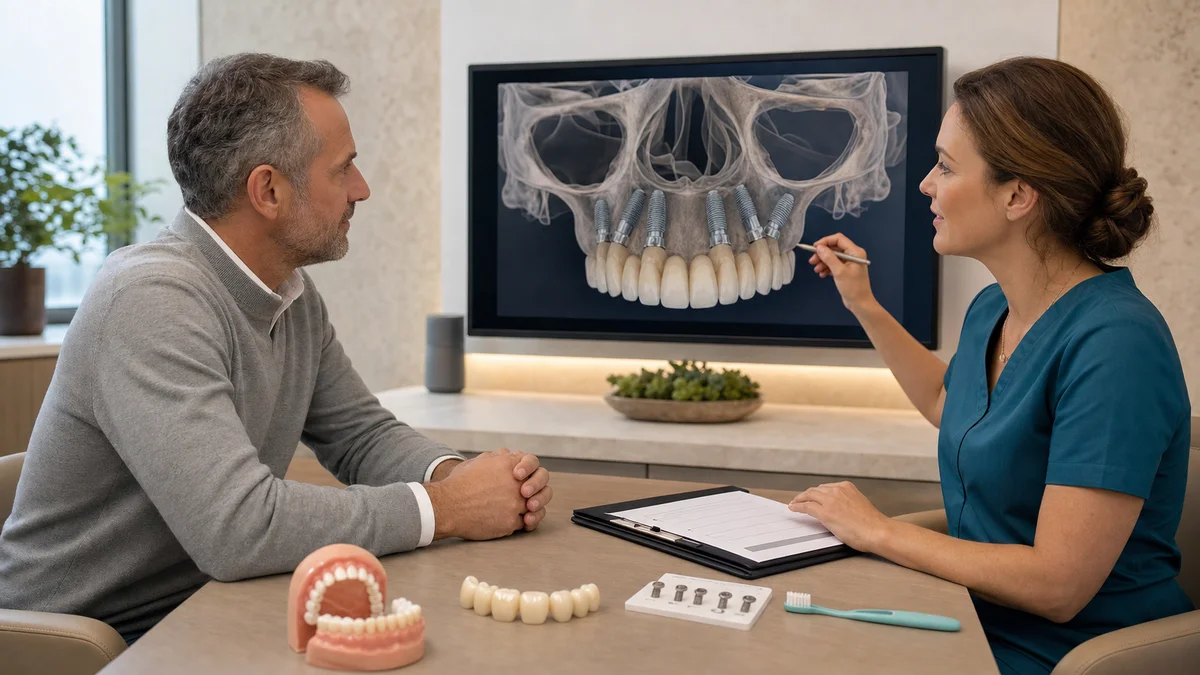
Quick answer: upper jaw dental implants cost cannot be estimated safely from implant count alone. It may include diagnosis, extractions, sinus or ridge augmentation, implants, sedation, temporary teeth, abutments, the definitive restoration and follow-up. Compare itemized plans after examination, confirm which stages are conditional, and budget for maintenance rather than relying on a package headline.
People searching upper jaw dental implants cost may be comparing one missing front tooth, several implants supporting a bridge, an overdenture, or a fixed full-arch restoration. These are different clinical endpoints. The upper jaw also has site-specific planning issues: the maxillary sinuses sit above the back teeth, visible front-tooth areas may require careful gum and bone management, and bone volume can change after tooth loss. A meaningful estimate begins with diagnosis, not a universal price.
This guide explains the cost structure without quoting a fixed fee, promising coverage or deciding whether implants are suitable for you. Upper jaw dental implants cost varies by anatomy, health, treatment scope, location, clinician and laboratory. An in-person examination and appropriate imaging are required. Use the questions below to compare the same endpoint, identify excluded stages and protect continuity of care.
1. Define what the quote is replacing
The first reason upper jaw dental implants cost varies is the size and type of the problem. Replacing one tooth with an implant crown is not equivalent to replacing three teeth with an implant bridge. A removable implant overdenture is not the same as a fixed full-arch bridge. “All-on-X,” “teeth in a day” and similar phrases may describe a concept, but they do not state the complete device, material, timing or maintenance plan.
Ask the clinician to name the intended endpoint in plain language. Is the restoration fixed or removable? Does “upper jaw” mean a small area, the entire arch, or a mixed plan that preserves some natural teeth? Who removes the prosthesis for service? The answer changes surgery, components, laboratory work and hygiene. Two advertisements for upper jaw dental implants cost are not comparable until these details match.
- Single implant crown: one implant, its connection parts and one crown, if anatomy and neighbouring teeth allow.
- Implant-supported bridge: two or more implants may support several replacement teeth according to prosthetic planning.
- Implant overdenture: a patient-removable denture retained by implant attachments or a bar.
- Fixed full-arch bridge: a clinician-removable prosthesis supported by multiple implants.
- Tooth-preserving or mixed plan: maintainable teeth are treated while implants replace selected missing or non-restorable teeth.
Extraction is irreversible. A proposal should explain the periodontal, endodontic and structural prognosis of each remaining tooth rather than removing teeth merely to fit a fast package. Sometimes extraction is appropriate; sometimes treatment, monitoring or a mixed approach is reasonable. The most defensible upper jaw dental implants cost estimate includes alternatives and the reasons they were accepted or rejected.
2. Why upper-jaw anatomy can change the plan
The upper jaw, or maxilla, differs from the lower jaw in bone form and relationship to nearby structures. Behind the cheekbones, the maxillary sinuses can extend above the premolar and molar regions. After tooth loss, ridge dimensions may reduce and the sinus can occupy more of the available vertical space. This does not mean every patient needs grafting. It means upper jaw dental implants cost should be based on site-specific assessment.
The American Academy of Periodontology notes that the upper back jaw may be challenging because of bone quantity, quality and proximity to the sinus. Sinus augmentation is one possible way to develop bone for implants when indicated. Technique and timing vary, and implants may be placed at the same appointment in selected circumstances or after graft healing. An online quote cannot determine which sequence applies.
Check 1: Does the estimate distinguish front and back sites?
In the front upper jaw, tooth position, gum contour, smile line and lip support may make aesthetic planning demanding. In the back, sinus proximity and access can dominate. A single label for upper jaw dental implants cost can hide these differences. Ask which sites are included, what findings drive the technique and whether the final restoration can be cleaned.
Check 2: Is sinus augmentation assumed or conditional?
A sinus lift should not appear automatically in every estimate. The dentist should explain the available bone, proposed implant position, relevant sinus findings and why augmentation may help. The fee may change with a small site-specific elevation, a lateral approach, graft material, membranes, imaging and staged surgery. For upper jaw dental implants cost, label this line as expected, optional or only confirmable during treatment.
Check 3: Is ridge grafting a separate procedure?
Ridge augmentation may address width, height or contour outside the sinus region. It is not identical to sinus augmentation. Graft source, volume, membrane use, fixation, surgical setting and healing time influence complexity. The written upper jaw dental implants cost should state whether grafting is included, what material category is proposed and what happens if the required procedure differs from the estimate.
3. Diagnosis comes before the price
A safe estimate normally follows a medical and dental history, clinical examination and imaging selected for the question. The team evaluates gum health, decay, infection, the condition of remaining teeth, bite, jaw relationship, restorative space, soft tissues and hygiene ability. Three-dimensional imaging may be appropriate for implant planning, particularly near the sinus, but it does not replace a physical examination. Upper jaw dental implants cost based only on a selfie or one image is provisional at best.
Overall health can affect candidacy and healing. The FDA advises patients to discuss benefits, risks and health factors with the dental provider, notes that smoking may affect healing, and recommends keeping the implant brand and model for personal records. Diabetes control, medicines affecting bleeding or bone metabolism, immune conditions, previous head-and-neck radiation and active disease may change sequencing. Do not alter prescribed medicine because of online advice.
Prosthetic planning should guide implant placement. The team considers the desired tooth position, bite, smile, speech and cleaning access before selecting implant positions. Diagnostic models, scans or trial tooth setups can support this process. A quote that starts and ends with “price per screw” leaves out the restoration that determines function. An evidence-based upper jaw dental implants cost conversation connects surgery to the intended teeth.
- Clinical examination, periodontal charting and tooth-by-tooth prognosis
- Two-dimensional or three-dimensional imaging when clinically justified
- Diagnostic models, scans, photographs and bite records as needed
- Medical consultation or laboratory tests when individual health requires coordination
- Prosthetic design, temporary-tooth plan and a documented backup pathway
4. The cost map: every stage that may appear
The most useful way to understand upper jaw dental implants cost is to map the complete pathway. Not every patient needs every line, and some stages cannot be finalized until diagnostic work is complete. A transparent proposal separates included care from conditional care. It also identifies which clinician, facility or laboratory bills each item.
Diagnostic and planning fees
Consultations, imaging, models, digital planning and specialist opinions may be charged separately or bundled. Ask whether the estimate includes the radiology report, surgical guide if used, and additional records needed for the final prosthesis. Diagnostic spending is not wasted overhead; it reduces avoidable uncertainty. When comparing upper jaw dental implants cost, verify that both providers have budgeted for the same level of planning.
Disease control, extraction and grafting
Active gum disease, decay or infection may need treatment before or alongside implant therapy. Extraction complexity, socket preservation, ridge grafting or sinus augmentation can change the number of appointments and healing time. A proposal should explain whether graft material, membranes, fixation devices and follow-up imaging are included. Upper jaw dental implants cost can rise when anatomy requires additional surgery, but the procedure should be justified rather than automatically sold.
Implants, abutments and surgical setting
The implant body is only one component. Healing abutments, definitive abutments, screws and other connection parts may be separate lines. Fees also reflect surgical time, sterile supplies, clinician expertise, facility needs and the type of anaesthesia or sedation. Ask who provides sedation and how monitoring and recovery are handled. The implant brand and model should be recorded, because future component compatibility affects long-term value.
Temporary and definitive teeth
A temporary tooth, removable denture or fixed provisional bridge may be needed during healing. Immediate loading is conditional on anatomy, implant stability, bite and prosthetic design; it is not safe for everyone. The definitive crown, bridge or overdenture requires additional records, trials, manufacture and delivery. A headline upper jaw dental implants cost may include implants but omit the final teeth, so these stages must be named separately.
Review, hygiene and repair
Early surgical checks, prosthetic adjustments, professional hygiene and longer-term reviews may have different fee arrangements. Attachments, screws and restorative materials can wear or break. Ask what is covered during the first year, what counts as maintenance, and how urgent repairs are priced. A complete upper jaw dental implants cost plan looks beyond delivery day.
5. Decision table: compare the same endpoint
This table does not recommend a treatment. It helps translate labels into comparable scopes. Your diagnosis, preferences and ability to maintain the restoration determine which options deserve discussion.
| Potential plan | Main cost components | Possible advantages to discuss | Important trade-offs |
|---|---|---|---|
| Preserve and restore selected teeth | Periodontal, root canal or restorative care; crowns or bridges where indicated | May avoid unnecessary extraction and preserve useful natural teeth | Prognosis and future maintenance vary tooth by tooth |
| Single implant crown | Planning, one implant, connection parts, temporary if needed, final crown | Replaces one missing tooth without using adjacent teeth as bridge supports | Aesthetic tissue management or grafting may be needed at some sites |
| Implant-supported bridge | Multiple implants, abutments, provisional and definitive bridge | Can replace several teeth without one implant for every tooth | Implant distribution, span, bite and cleaning access are critical |
| Implant overdenture | Implants, attachments or bar, removable denture, relines and replacement inserts | Patient can remove it for direct cleaning; may improve retention | Attachments wear and denture maintenance continues |
| Fixed full-arch bridge | Multiple implants, extensive provisional and definitive laboratory work, maintenance | Fixed teeth with planned arch form | Higher surgical and prosthetic scope; hygiene and future repairs must be planned |
| Conventional removable denture | Records, try-ins, denture, adjustments and future relines | No implant surgery; valid alternative for some patients | Retention, movement, adaptation and changing ridge form can affect comfort |
For a fair upper jaw dental implants cost comparison, circle the same row in each proposal. Then match the number of teeth or arches, provisional stage, final material, augmentation, review period and repair policy. A lower total for an overdenture is not a like-for-like alternative to a fixed bridge unless removability is acceptable to you.
6. How many implants—and why price per implant misleads
There is no implant count that fits every upper jaw. Number and distribution depend on anatomy, bone, the planned restoration, bite forces, opposing teeth, available space and the consequences if one implant is lost. More implants are not automatically better, and fewer are not automatically more efficient. Upper jaw dental implants cost should follow a prosthetic and surgical rationale rather than a predetermined package.
A “per implant” price may omit the abutment, crown, bridge, temporary teeth, grafting, sedation and follow-up. Conversely, a full-arch price may include components that would be unnecessary for a small gap. Ask for the total clinical endpoint and the unit price only as supporting detail. This approach prevents upper jaw dental implants cost from being distorted by one inexpensive component.
If a clinic changes the implant number after examination, ask why. The explanation might involve sinus position, ridge shape, cantilever control, restorative space or the possibility of preserving teeth. A change can be clinically reasonable, but it should be documented. If every person receives exactly the same design, seek clarification or an independent opinion.
7. Immediate teeth, staged care and timeline costs
“Teeth in a day” usually refers to a provisional restoration, not the definitive prosthesis. Immediate placement after extraction and immediate loading are separate decisions. Each requires suitable clinical conditions. If implant stability or anatomy is insufficient, a removable temporary or delayed approach may be safer. The estimate should include that backup, because upper jaw dental implants cost can change when the initial pathway is not possible.
Staged treatment may require more visits, temporary appliances and time away from work, but speed alone is not a quality measure. Graft healing and implant integration can take months. The AAP describes sinus augmentation healing that may occur before implant placement, although simultaneous treatment is possible in some cases. Do not book travel or commit to a final bridge date until the treating team has explained biological milestones and contingencies.
Ask which visits are clinical necessities, which can be combined safely, and whether remote reviews are appropriate. Include accommodation, transport, companion support and lost work time in your personal budget. The clinic’s upper jaw dental implants cost is only part of the patient’s total cost.
8. Materials, laboratory work and repairability
Final restorations may use different frameworks, polymers, ceramics or combinations. Material choice depends on span, support, restorative space, bite, aesthetics, repair pathway and laboratory design. A material name alone does not guarantee performance. Ask whether the quoted restoration is provisional or definitive, monolithic or layered, and how it can be repaired. These details can explain differences in upper jaw dental implants cost.
Digital impressions and computer-guided steps can improve workflow in appropriate cases, but “digital” is not a complete diagnosis or a quality seal. Accuracy must be verified clinically. Laboratory experience, trial stages and communication also matter. A cheaper proposal that omits a try-in may not be equivalent to one that tests tooth position, speech and cleaning access before final manufacture.
Ask about component availability in the country where you live. Keep the manufacturer, model, dimensions and connection records. Proprietary parts may be difficult to source later, and mixing incompatible components can create risk. Repairability and records are part of long-term upper jaw dental implants cost, even when they do not appear in the initial total.
9. Insurance and public coverage are contract-specific
No clinic or article can promise that insurance will pay upper jaw dental implants cost. Dental plans may have exclusions, waiting periods, annual maximums, missing-tooth clauses, network limits or separate rules for surgery and prosthetics. The ADA’s patient guidance notes that some plans exclude dental implants. HealthCare.gov also states that adult dental coverage is not an essential Marketplace health benefit and warns that stand-alone dental plans can have waiting periods.
For U.S. Medicare, the official Medicare page says routine dental services, dentures and implants are not covered in most cases. Limited dental services may be covered when directly linked to specified Medicare-covered medical care, and some Medicare Advantage plans may offer additional dental benefits. That narrow exception should not be generalized. Ask the plan—not only the clinic—for a written benefit explanation tied to the proposed codes.
Pre-authorization is useful but may not guarantee final payment. Confirm the deductible, co-insurance, annual or lifetime maximum, exclusions, frequency limitations, network status and whether grafting, sedation, temporary teeth and the final restoration are reviewed separately. Save the treatment plan and insurer correspondence. Insurance uncertainty belongs in the financial discussion of upper jaw dental implants cost.
- Request procedure codes and narrative justification after diagnosis.
- Ask whether pre-treatment imaging or specialist review is required.
- Confirm whether a missing-tooth rule or waiting period applies.
- Check in-network and out-of-network reimbursement separately.
- Ask who submits claims and who appeals a denial.
- Budget for non-covered maintenance, travel and emergency care.
10. Financing and written quote safeguards
Financing can spread payment but does not reduce the clinical scope or total obligation. Review interest, fees, deferred-interest conditions, refund terms and what happens if the treatment plan changes. Avoid signing under an expiring discount before examination. A responsible upper jaw dental implants cost discussion gives you time to understand irreversible treatment and alternatives.
The written quote should identify who holds any deposit, which milestones trigger payment and what is refundable if a medical finding prevents surgery. It should distinguish estimated conditional work from agreed work. Ask how complications, remakes, missed appointments and treatment interruption are handled. “Warranty” terms should be written, limited and consistent with required maintenance; they are not guarantees of biological success.
For extensive elective treatment, consider an independent second opinion. Give both clinicians the same records and compare diagnosis first, totals second. Different recommendations may reflect different assumptions or valid approaches. The question is not merely which upper jaw dental implants cost is lower, but which plan is supported by findings, consent and a workable long-term pathway.
11. Treatment abroad: calculate continuity as part of cost
Travel may change fees, but it adds transport, accommodation, time, communication and follow-up considerations. The CDC’s 2026 Yellow Book advises medical travellers to research the facility and clinician, understand included services, arrange local follow-up before travel and obtain complete records. Complications and revisions can add costs. Compare total upper jaw dental implants cost, not the surgical invoice alone.
For treatment in Türkiye, check whether the provider appears on the current Ministry of Health list for international health tourism. Authorization is an administrative safety check, not a substitute for evaluating the individual dentist, sterilization, diagnosis, implant system, consent and emergency arrangements. Ask which clinician performs each stage and how to reach them after hours.
Before returning home, obtain imaging, clinical findings, implant brand and dimensions, graft material details, surgical notes, prescriptions, laboratory information and maintenance instructions in a language you understand. Confirm flight timing with the treating team and your physician where relevant. If a later repair requires travel, include that possibility when deciding whether the apparent upper jaw dental implants cost saving is durable.
12. Risks and maintenance costs that continue after delivery
The FDA lists possible implant complications including damage to nearby teeth or tissues, sinus perforation, infection, inadequate bite, screw loosening, implant failure, cleaning difficulty and post-surgical numbness. Risk varies by site and patient. No fee, material or technique removes uncertainty. A clinically honest upper jaw dental implants cost proposal explains risk management and the cost pathway if additional care is needed.
Implants do not decay, but tissues around them can become inflamed and prosthetic components can wear. Daily care may involve a toothbrush, interdental brushes, floss threaders or irrigation aids selected for the design and dexterity. Professional review can assess tissues, cleaning, bite, screws and the restoration. If the bridge cannot be cleaned, its initial appearance does not make it a successful design.
Plan for hygiene visits, attachment replacement, screw service, chip repair, relines or eventual prosthesis replacement. Frequency is individualized. Smoking cessation support, periodontal care and management of clenching may be relevant. Maintenance is not evidence that treatment “failed”; it is part of caring for a complex device. Include it in lifetime upper jaw dental implants cost.
After surgery, follow the treating team’s instructions. Seek urgent professional help for breathing or swallowing difficulty, uncontrolled bleeding, rapidly increasing swelling, severe or worsening pain, fever, allergic symptoms, persistent altered sensation or a loose restoration. Online information cannot assess an individual complication.
13. Red flags in low-cost or premium proposals
A low price can omit essential stages; a high price is not proof of quality. Red flags include a definitive quote from photographs alone, the same implant number for everyone, no rationale for extracting restorable teeth, guaranteed lifetime results, refusal to name the clinician or implant system, and no maintenance or emergency plan. Evaluate evidence and scope, not luxury décor.
Another warning is a final restoration promised before the team has assessed healing and bite. Equally concerning is a quote that cannot state whether grafting, temporary teeth, final teeth, abutments or sedation are included. Ask for corrections in writing. If the explanation remains unclear, pause. An understandable upper jaw dental implants cost proposal is part of informed consent.
- No clinical examination before a non-refundable commitment
- No tooth-by-tooth diagnosis or discussion of alternatives
- No distinction between temporary and definitive teeth
- No plan if immediate loading or simultaneous grafting is unsuitable
- No implant identification card or component availability information
- No demonstration of cleaning access under a bridge
- No named route for complications after travel or outside office hours
14. Consultation checklist for upper jaw dental implants cost
Bring your medicine list, medical history, tobacco or nicotine history, previous dental records and a description of your priorities. Ask the clinician to show which teeth are maintainable, where the sinus and ridge affect planning, and how the proposed teeth will support appearance, speech, bite and hygiene. The goal is not the cheapest implant; it is the least irreversible plan that reasonably addresses diagnosed needs.
Request an itemized plan with expected and conditional lines, the temporary pathway, definitive material, visit schedule, payment milestones and maintenance responsibilities. At Redent Clinic, individual assessment can clarify the clinical scope; the contact page can help organize an appointment and secure record transfer. Online estimates remain educational until examination.
Frequently asked questions about upper jaw dental implants cost
Why is upper jaw dental implants cost different from the lower jaw?
Upper jaw dental implants cost may differ because maxillary bone form, sinus proximity, front-tooth aesthetic demands and the planned prosthesis can change imaging, grafting, surgical and laboratory needs. The difference is individual, not automatic.
Does every upper-jaw implant need a sinus lift?
No. Sinus augmentation is considered when available bone and the planned implant position make it appropriate, especially in posterior areas. Examination and imaging guide the decision. A quote should label the procedure as expected or conditional rather than adding it to every upper jaw dental implants cost.
Is a price per implant a complete price?
Usually not. It may exclude the abutment, crown or bridge, imaging, grafting, sedation, temporary teeth and follow-up. Ask for the complete treatment endpoint. A unit figure can supplement but should not replace a total upper jaw dental implants cost proposal.
How many implants are needed for the whole upper jaw?
There is no universal number. Anatomy, bone, prosthetic design, bite, implant distribution, opposing teeth and risk factors matter. The plan must follow diagnosis. A fixed implant count advertised beside upper jaw dental implants cost is not an individualized recommendation.
Are temporary teeth included?
It depends on the quote. Ask whether the temporary is removable or fixed, when it is delivered, how many adjustments are included and what happens if immediate loading is unsuitable. Upper jaw dental implants cost should list temporary and definitive teeth separately.
Can grafting and implants be done together?
Sometimes, but not always. The decision depends on defect size, anatomy, implant stability, infection status and technique. Staging can be safer in some cases. The written upper jaw dental implants cost should show the planned sequence and backup route.
Will insurance cover upper-jaw implants?
Coverage is contract-specific. Dental implants may be excluded or limited, and public programs have narrow rules. Confirm codes, waiting periods, annual limits, network status and written pre-treatment review directly with the payer. Pre-authorization may not guarantee payment of upper jaw dental implants cost.
Is the cheapest quote unsafe?
Price alone cannot establish safety or quality. A lower total may reflect location or scope, but it may also omit final teeth, grafting or follow-up. Compare credentials, diagnosis, materials, emergency planning and identical endpoints when evaluating upper jaw dental implants cost.
How long does upper-jaw implant treatment take?
Timing varies with disease control, extraction, grafting, implant stability, healing and prosthetic stages. A same-day temporary does not end biological healing. Ask for a range and decision points; timeline changes can affect travel and upper jaw dental implants cost.
What records should I receive?
Request diagnostic findings, relevant imaging, surgical notes, implant manufacturer and model, dimensions, graft details, component information, prescriptions, prosthesis material and maintenance instructions. These records preserve continuity and future value beyond the initial upper jaw dental implants cost.
What does a warranty usually cover?
Terms vary. A written warranty may address selected mechanical parts or laboratory work under specified maintenance conditions, but it cannot guarantee healing or lifelong biological success. Review exclusions, travel and repair responsibility before accepting an upper jaw dental implants cost package.
When should I get a second opinion?
Consider one for extensive irreversible treatment, all-tooth extraction, major grafting, unclear alternatives, pressure tactics or large differences between plans. Share the same records with both clinicians and compare diagnoses before comparing upper jaw dental implants cost.
Key takeaways
Upper jaw dental implants cost is a pathway, not a price per screw. Define the restoration, diagnose the front and back upper-jaw sites, separate sinus and ridge augmentation, and list implants, components, temporary teeth, final teeth, reviews and repairs. Insurance, travel and maintenance belong in the total.
Ask for a written, itemized and conditional plan after examination. Preserve maintainable teeth when clinically reasonable, understand the backup if immediate loading is unsuitable, keep device records and arrange long-term care. A careful upper jaw dental implants cost comparison protects both health and budget better than a headline package.
Sources and further reading
- American Dental Association — Professional oral-health resources
- American Dental Association, MouthHealthy — Dental implants
- American Dental Association, MouthHealthy — Choosing a dental plan
- U.S. Food and Drug Administration — Dental Implants: What You Should Know
- American Academy of Periodontology — Sinus augmentation
- Medicare.gov — Dental services coverage
- HealthCare.gov — Marketplace dental coverage
- U.S. Centers for Disease Control and Prevention — Medical Tourism, Yellow Book 2026
- World Health Organization — Oral health fact sheet
- Republic of Türkiye Ministry of Health — Authorized healthcare providers
Educational information reviewed for patient safety. It does not replace an individual examination, diagnosis or treatment plan.