
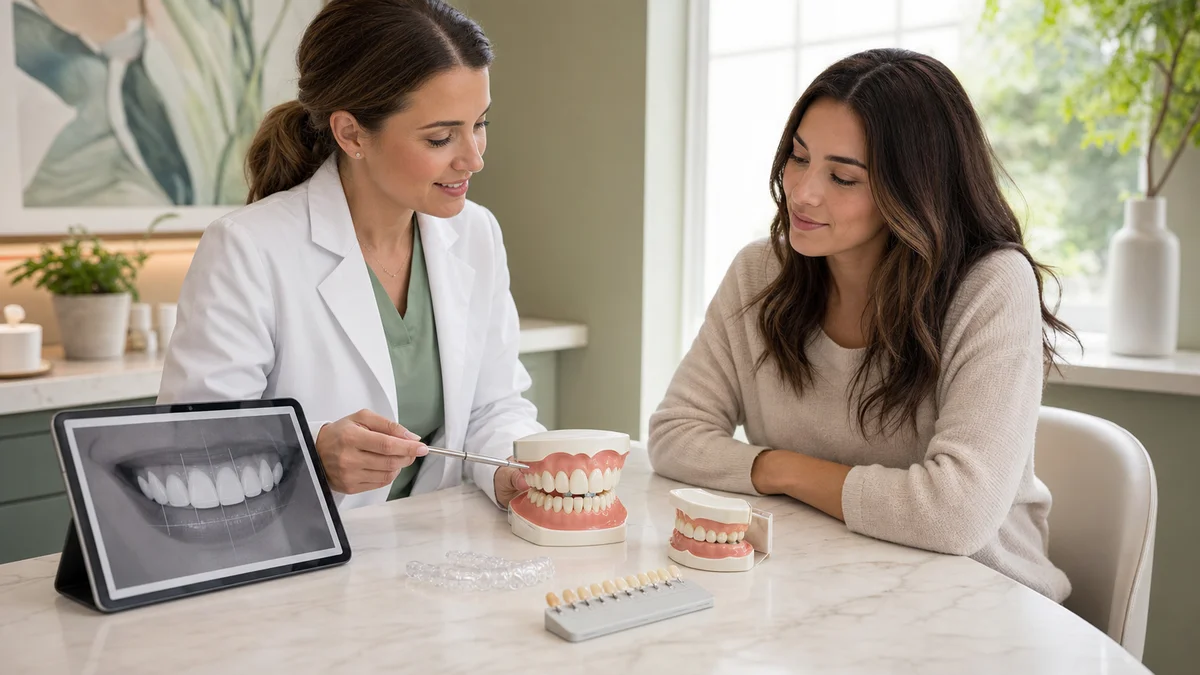
Quick answer: veneers alternatives depend on what you want to change. Professional cleaning or whitening may address colour; composite bonding can repair selected chips or reshape edges; orthodontics can move crowded or spaced teeth; and monitoring may preserve healthy enamel when treatment is unnecessary. A crown is not a conservative cosmetic swap—it is considered when a tooth needs broader structural coverage. Examination comes before choice.
People searching for veneers alternatives are often trying to solve several different problems with one phrase: darker colour, a small chip, uneven edges, a gap, crowding, a tooth that looks short, or an old restoration that no longer blends. Each problem has a different cause. The option that conserves the most healthy tooth tissue while meeting a realistic goal can therefore differ from tooth to tooth.
The American Dental Association explains that veneers cover the front surface of teeth and that traditional placement involves removing some enamel. Because enamel removal makes treatment irreversible, a licensed dentist should first identify oral disease, bite risk, tooth structure, gum health, existing restorations, and the patient’s priorities. Good veneers alternatives are not shortcuts; they are diagnosis-led ways to address the actual concern with proportionate treatment.
This guide compares monitoring, cleaning, whitening, composite repair, bonding, conservative contouring, orthodontics, restorative care, and other pathways. It does not promise a particular appearance, declare one method universally superior, or replace an examination. You can review Redent Klinik’s English dental information before requesting an individualized discussion.
1. Why veneers alternatives begin with a diagnosis
A veneer can mask colour, shape, minor damage, or the visual effect of a gap, but it does not treat every underlying condition. Safe veneers alternatives must address that distinction. Decay, gum inflammation, erosion, grinding, a deep bite, an unstable tooth position, or an infected pulp may need attention first. The ADA cautions that placing veneers over unhealthy teeth can worsen existing problems and notes that clenching, grinding, or a deep overbite may make veneers unsuitable for some patients.
A responsible consultation separates the patient’s visual goal from the clinical finding before ranking veneers alternatives. “I want straighter-looking teeth” could mean rotation, crowding, a narrow tooth, an uneven gum level, or simply a dark line created by an old filling. “I want whiter teeth” could involve surface stain, natural dentine colour, enamel thinning, trauma, medication-related colour, decay, or an artificial crown that bleaching cannot lighten.
That is why veneers alternatives should be selected only after the dentist asks what the patient dislikes, examines the teeth and gums, reviews medical and dental history, assesses the bite, and takes diagnostic records when indicated. Photographs and a digital scan can support communication, but they do not replace tests for tooth vitality, decay, cracks, periodontal health, or occlusion.
Sometimes the best veneers alternatives form a staged plan. Disease is controlled first; then colour, alignment, and shape are reassessed. A tooth may look more harmonious after professional cleaning or orthodontic movement, reducing the amount of restorative work needed. Staging also gives the patient time to understand what is reversible, repairable, or likely to require future maintenance.
2. No treatment, monitoring, and better communication
Healthy teeth do not automatically need cosmetic treatment because their shapes, shades, or spacing differ from social-media images. Natural variation is normal. If the concern is mild and the teeth are healthy and functional, no active procedure can be one of the most protective veneers alternatives. Monitoring avoids material cost, sensitivity, repair cycles, and irreversible removal of enamel.
“Do nothing” should not mean dismissing the patient or avoiding a discussion of veneers alternatives. A useful monitoring plan documents the concern, explains the findings, establishes photographs or scans when appropriate, and names signs that would justify review. A clinician may also use a removable mock-up, digital simulation, or temporary material to help a patient evaluate proportion before committing to a permanent change. Simulations are communication aids, not outcome guarantees.
Patients should be cautious when a consultation creates urgency around normal anatomy or promises a single ideal smile. A complete explanation of veneers alternatives should not rely on pressure. A second opinion may be valuable when many healthy teeth are being considered for irreversible preparation, when the proposed number of veneers changes without explanation, or when alternatives are not discussed. The ADA specifically advises that veneer treatment be performed by a licensed dentist and warns about unsupervised services from unlicensed “veneer technicians.”
Monitoring can also be appropriate after orthodontics, whitening, or restoration repair. The final decision need not be made on the first day. Among veneers alternatives, time is often the only option that preserves every remaining micrometre of healthy enamel.
3. Professional cleaning for external stain and surface deposits
Tea, coffee, tobacco, plaque, calculus, and other surface deposits can alter how teeth reflect light. Cleaning is one of the simplest veneers alternatives when the finding is external stain. A professional dental cleaning may improve appearance while also allowing the clinician to assess gum health and detect decay. Cleaning does not change the intrinsic colour or shape of enamel and dentine, so it should not be advertised as equivalent to whitening or restorative treatment.
For patients considering veneers alternatives mainly because of dullness or patchy surface stain, the sequence may be examination, hygiene care, home-care review, and reassessment under consistent lighting. This can prevent choosing a permanent restoration to solve a removable stain problem. It may also reveal that an apparent colour mismatch comes from an old composite filling or crown, which will not respond like natural tooth tissue.
Daily brushing twice with fluoride toothpaste, cleaning between teeth, limiting frequent sugar exposure, avoiding tobacco, and attending advised dental visits support oral health. These habits support every discussion of veneers alternatives. Products with the ADA Seal of Acceptance have been evaluated for their intended claims. Abrasive household powders, acidic fruit, or unregulated “polishing” methods can wear enamel and should not be treated as safe home substitutes.
Cleaning is not a cure for internal discolouration, developmental enamel differences, decay, a dead or root-treated tooth, or erosion. Those conditions require different veneers alternatives or disease treatment. If a colour change is new, localised, painful, or associated with swelling or trauma, a diagnostic assessment is more important than cosmetic polishing.
4. Dentist-supervised whitening for natural-tooth colour
Professional whitening can be one of the conservative veneers alternatives when the primary concern is the shade of healthy natural teeth. It changes colour without covering the front surface. The NHS explains that bleaching lightens natural teeth and that crowns, dentures, and implants do not lighten in the same way. Fillings, bonding, and veneers may also remain their existing shade, creating a mismatch that must be anticipated.
When comparing veneers alternatives, whitening is relevant only if colour—not position, width, edge form, a large fracture, or structural weakness—is the main issue. It cannot close a gap, straighten a rotation, replace missing enamel, or rebuild a broken corner. Results vary with the type and depth of discolouration, and whitening is not permanent.
The safest way to compare whitening with other veneers alternatives is an oral-health check followed by a product and protocol appropriate to the patient. Unhealthy teeth or gums need attention first. Sensitivity and gum irritation can occur, and a dentist may modify concentration, wear time, frequency, or the plan. Existing restorations should be mapped before treatment because they may need later adjustment or replacement if the target shade changes.
DIY acids, charcoal, bleach, concentrated peroxide of uncertain origin, and abrasive mixtures are not equivalent veneers alternatives. MouthHealthy notes that natural-sounding methods can damage enamel and that whitening may not work on every tooth. A licensed professional can also investigate a single dark tooth, where trauma, pulpal disease, previous root canal treatment, or decay may require a specific diagnosis.
5. Composite bonding and direct composite repair
Composite resin supports several direct veneers alternatives because it is a tooth-coloured restorative material that can be bonded and sculpted. In selected cases it can repair a small chip, add to a worn edge, alter contour, reduce the visual effect of a small space, or replace a defective composite. It often requires less tooth preparation than a laboratory-made porcelain veneer, although “no drilling” cannot be promised for every case.
Composite bonding is one of the most discussed veneers alternatives because it can be additive and repairable. The dentist can sometimes preview the shape with a mock-up, add material in stages, and polish or locally repair it later. Yet additive does not automatically mean risk-free or indefinitely reversible. Bonding can stain, chip, wear, debond, change surface texture, collect plaque at an overcontoured margin, or require replacement.
Moisture control, enamel availability, bite forces, tooth position, the size of the addition, colour matching, and finishing all affect which composite veneers alternatives are suitable. A tooth that projects outward may need reduction to avoid excessive bulk. A deep bite or grinding pattern can overload a new edge. A wide gap may produce unnaturally broad teeth if it is closed with composite alone. Orthodontic movement may create a better foundation before bonding.
When comparing veneers alternatives, distinguish a small direct repair from a full composite veneer that covers most of the front surface. Both use resin, but the amount of material, preparation, maintenance, colour stability, and failure pattern differ. Ask how much enamel is expected to be altered, how the bite will be checked, and what repair or repolishing may be needed.
6. Fragment reattachment or a small filling for a chipped tooth
A chipped front tooth does not automatically need a veneer, and local repair may provide targeted veneers alternatives. The NHS lists reattaching the broken fragment, a filling, or a crown among possible treatments for chipped, broken, or cracked teeth, depending on severity. If a fragment is available after a recent injury, it should be kept in milk or saliva and taken promptly to a dentist. The clinician must first rule out deeper fracture, pulp injury, root damage, and bite trauma.
For a small uncomplicated chip, smoothing a sharp edge or using a local composite repair may preserve more tooth than covering the whole facial surface. These are targeted veneers alternatives, not cosmetic compromises. Their suitability depends on how much tissue is missing, whether the crack extends, whether the pulp is affected, and whether the bite repeatedly loads the area.
A badly broken or structurally weak tooth may need broader protection, root canal treatment, or another restorative approach rather than cosmetic veneers alternatives. A crown covers more of the tooth than a veneer and usually requires more shaping; it should not be promoted as the “stronger cosmetic alternative” for an intact tooth. The restoration should match the biological and structural need.
After trauma, seek urgent assessment for displacement, severe pain, bleeding that does not stop, facial swelling, loss of consciousness, or breathing difficulty. Appearance comes after emergency and pulp care. A delayed veneer decision may be appropriate while the tooth’s vitality and healing are monitored.
7. Conservative enamel recontouring for very small shape differences
Selective enamel recontouring can be among very limited veneers alternatives when it smooths a tiny rough area or balances a minor edge discrepancy and enough healthy enamel is present. It removes a limited amount of enamel, so it is still irreversible. It cannot safely correct major crowding, a large fracture, substantial length difference, thin enamel, decay, or an unfavourable bite.
Among veneers alternatives, recontouring is deliberately modest. The dentist should identify the intended change, assess enamel thickness and occlusion, and stop within safe limits. Removing too much can expose dentine, increase sensitivity, weaken an edge, alter contact, or create a new shape problem.
Sometimes recontouring is combined with small additive bonding: minimal high points are refined while deficient areas receive composite. This can distribute the change rather than forcing all correction through subtraction. A preview or marked photograph can make consent more specific.
At-home filing with a nail file, rotary tool, or abrasive product is not one of the safe veneers alternatives. The patient cannot reliably assess enamel thickness, symmetry, bite contacts, crack risk, or heat generation. DIY filing can cause permanent damage and make later restoration more complex.
8. Orthodontics when the concern is position, spacing, or bite
Braces or clear aligners are positional veneers alternatives because they move teeth rather than covering them. They may be suitable when the visual concern is crowding, rotation, spacing, prominence, or the relationship between upper and lower teeth. The AAO emphasizes that orthodontic treatment aims for a healthy, functional bite as well as appearance and that not every problem can be treated with every appliance.
For position problems, orthodontics can be one of the most tissue-preserving veneers alternatives because it can align intact teeth without preparing their front surfaces. However, it requires diagnostic records, time, patient cooperation, hygiene, reviews, and long-term retention. It does not automatically change tooth colour, repair a chip, or make a naturally narrow tooth wider.
Clear aligners, metal braces, ceramic braces, and lingual systems can serve as different veneers alternatives, but each has indications and limitations. Appliance visibility should not be the sole decision factor. Root position, gum and bone support, bite complexity, missing teeth, restorations, growth, and adherence affect planning. The AAO notes that some—but not all—orthodontic problems can be treated with clear aligners.
Orthodontics and restorative treatment are sometimes sequenced. Teeth can be positioned first to reduce veneer preparation, make spaces symmetrical for conservative bonding, improve gum-level relationships, or create room for a missing-tooth replacement. This combined approach can be more complex, but it may protect tissue and improve serviceability.
9. Decision table: match veneers alternatives to the actual goal
The table below is a consultation framework, not a diagnosis or ranking. Several concerns may coexist, and one option may solve only part of the problem.
| Main concern | Conservative option to discuss first | What it can address | Important limitation |
|---|---|---|---|
| External stain or deposits | Professional cleaning and home-care review | Removable surface deposits and plaque control | Does not change intrinsic tooth colour or restoration shade |
| General natural-tooth discolouration | Dentist-supervised whitening | Lightens suitable natural tooth tissue | Does not lighten crowns, veneers, implants, or many fillings |
| Small chip or worn edge | Fragment reattachment, smoothing, or local composite repair | Restores a limited defect while preserving surrounding enamel | Suitability depends on fracture depth, pulp, and bite |
| Minor shape difference | Additive composite bonding or cautious recontouring | Adds or selectively refines contour | Composite needs maintenance; enamel removal is irreversible |
| Gap, rotation, or crowding | Orthodontic assessment | Moves teeth and can improve bite relationships | Requires time, retention, hygiene, and suitable biology |
| Old discoloured restoration | Polish, repair, or replace the defective restoration | Targets the material causing the mismatch | Whitening will not change restorative material |
| Short-looking teeth caused by gum position | Periodontal diagnosis before cosmetic restoration | Identifies inflammation, altered eruption, or tissue proportions | Gum procedures have biological limits and are not routine cosmetic add-ons |
| Weak, badly broken, or heavily restored tooth | Structural restorative assessment | Determines whether an onlay, crown, repair, or other care is indicated | A crown is more extensive than a veneer, not a conservative cosmetic default |
| Healthy tooth with a mild aesthetic concern | Monitoring, photography, or a reversible mock-up | Preserves all tissue and clarifies expectations | Does not create a permanent physical change |
A person may combine several veneers alternatives from more than one row. Cleaning and whitening can establish a stable shade; orthodontics can improve position; small composite additions can then refine shape. This sequence may reduce the number or extent of restorations. It may also reveal that no further procedure is needed.
10. Repairing or replacing an existing restoration
Sometimes the tooth is not the main source of the visual mismatch. An old composite filling can stain at the margin, lose polish, chip, or differ from the surrounding tooth after whitening. A crown or veneer on one tooth can remain unchanged while natural neighbours lighten. Surface roughness can also collect stain and alter light reflection.
Targeted polishing, local repair, or replacement of a defective restoration can be rational veneers alternatives when the rest of the tooth is healthy. The clinician should determine whether discoloration is superficial, whether the margin has decay, whether the restoration is leaking or fractured, and how much sound tissue would be affected by removal.
Replacement is not automatically better than repair. Removing a bonded restoration can sacrifice additional tooth structure and start a cycle of progressively larger restorations. When a local repair can be isolated, bonded, contoured, and monitored, it may be more conservative. Conversely, repair may be unsuitable if the defect is extensive, decay is inaccessible, the material is unsupported, or the bite problem remains.
Ask which part of the restoration is failing, how that finding was established, what tissue will be removed, and how the repaired shade will be matched. A guarantee that a repair will remain invisible forever is unrealistic because teeth, gums, and restorative surfaces change over time.
11. Crowns, onlays, and fillings are not interchangeable cosmetic options
A crown covers the entire visible portion of a tooth, while a veneer covers mainly the front. The ADA explains that crowns can strengthen a weak tooth, protect one at risk of breaking, restore a broken tooth, cover a large filling, or improve shape and colour. That structural role is different from using a veneer on a largely intact surface.
When a tooth is heavily restored, cracked, decayed, or weakened, a crown or partial-coverage restoration may be considered because of structural findings. These are not automatically more conservative veneers alternatives. They generally involve more tooth coverage and can require greater preparation. A filling or onlay may preserve more tissue in selected situations, but suitability depends on defect size, remaining walls, bite, isolation, and material.
The phrase “strongest option” is incomplete without a diagnosis. Excessive preparation can weaken a tooth, while inadequate coverage of a seriously compromised tooth can also fail. The goal is appropriate protection with the least necessary intervention, not the most extensive material.
Root canal treatment is not a routine prerequisite for veneers, crowns, or cosmetic work. It is performed when pulpal or apical diagnosis supports it. Likewise, a post is not a universal reinforcement. These procedures should appear on a plan only when clinical findings justify them.
12. Gum health and tooth proportion
Inflamed, swollen, or receding gums can make tooth shapes and margins look uneven. Placing a veneer does not treat gingivitis or periodontitis. The ADA advises that decay and gum disease be treated before veneer placement. Periodontal stability also matters for bonding, margin placement, cleansability, and long-term appearance.
When teeth look short, the cause might be their natural shape, wear, gum position, incomplete eruption, or a combination. Gum contouring or crown-lengthening surgery is not a simple cosmetic substitute and can affect attachment, root exposure, sensitivity, and proportions. A periodontal diagnosis is required before changing tissue.
For some patients, hygiene treatment and time for inflammation to resolve are sufficient veneers alternatives at the first stage. In other cases, orthodontics can influence tooth and gum relationships. Restorative lengthening may be considered only after the biological and bite limits are understood.
Any treatment that creates bulky, overhanging, or deeply placed margins can make cleaning harder. A cosmetic plan should preserve access for brushing and interdental care. Healthy gums frame the teeth, but their health should not be traded for a symmetrical photograph.
13. Combining veneers alternatives in a staged plan
The most conservative plan may combine small interventions rather than asking one material to solve colour, position, and shape at once. Staging also allows each step to be judged before the next. It can lower the amount of enamel preparation, but it may increase planning time, visits, and coordination.
A common diagnostic sequence to discuss is:
- clarify the patient’s priorities and identify the specific teeth or features involved;
- treat decay, gum inflammation, erosion, infection, or unstable bite findings first;
- complete professional cleaning and establish consistent photographs;
- consider whitening if natural-tooth colour is a concern and the patient is suitable;
- assess orthodontic movement when position, spacing, or bite drives appearance;
- re-evaluate proportions after tissues and tooth positions are stable;
- use local composite repair, bonding, recontouring, or restoration replacement only where still indicated;
- reserve porcelain veneers or broader restorations for teeth whose goals and clinical conditions justify them.
This is not a mandatory recipe. Whitening may be inappropriate, orthodontics may be unnecessary, and a patient may choose monitoring after understanding the trade-offs. The value of staged veneers alternatives is that each decision has a clear purpose and can reduce premature irreversible work.
Ask for a written treatment sequence, the expected change from each stage, the maintenance burden, and the contingency if the result differs from the simulation. Consent should be updated when the plan changes. A digital smile image is not consent for enamel removal and is not a guarantee of final colour, symmetry, texture, or longevity.
14. Risks and maintenance across the options
Every intervention has a maintenance profile. Whitening can cause temporary sensitivity and does not permanently fix shade. Composite can stain, wear, chip, or need repolishing. Orthodontics requires hygiene, attendance, and retention; teeth can move after treatment. Recontouring permanently removes enamel. Crowns and veneers can loosen, fracture, wear, or develop decay around margins.
That does not mean treatment should be avoided. It means veneers alternatives should be compared by biological cost, predictability for the specific problem, reversibility, repairability, treatment time, appearance, patient effort, future replacement, and total maintenance—not by a single “best” label.
Useful consent questions include:
- What diagnosis explains the colour, shape, space, or damage?
- What happens if I choose monitoring?
- How much healthy enamel or dentine will each option alter?
- Which parts are reversible, repairable, or likely to need replacement?
- How could the treatment affect bite, sensitivity, gums, and cleaning?
- Will existing crowns, fillings, or implants match after whitening?
- What result is realistic without a guarantee?
- What home care, reviews, retainers, or protective appliances may be needed?
- What is included in the written estimate and aftercare policy?
Seek prompt dental advice for pain, swelling, a new dark tooth, a crack, mobility, trauma, bleeding gums, or a restoration that feels loose. Rapid facial swelling, difficulty breathing or swallowing, uncontrolled bleeding, or serious trauma requires urgent medical assessment.
15. How to compare providers and plans
A high-quality consultation should examine the mouth, ask about goals, explain findings, and present reasonable options—including no treatment where appropriate. It should identify which clinician performs each stage, whether a dental laboratory is involved, and what records support the plan.
For veneers alternatives, request a tooth-by-tooth plan. “Smile makeover” packages can obscure whether every tooth needs the same procedure. A central tooth with a large old filling, a rotated healthy lateral incisor, and a stained canine may each call for a different approach.
Check professional licensing and be wary of unlicensed veneer application, remote enamel filing, unsupervised tooth movement, and products that promise permanent whitening or instant correction without diagnosis. The ADA states that direct-to-consumer services can remove the dentist’s role in diagnosis, treatment planning, and management, creating potential for irreversible complications.
If considering care abroad, include travel, accommodation, recovery time, return visits, record transfer, and local follow-up. Ask how whitening, orthodontics, bonding, or restoration repair will be coordinated after you return. For an individualized records discussion, use the Redent Klinik English contact page.
Veneers alternatives: frequently asked questions
Are composite bonding and composite veneers the same?
The terms can overlap, but scope matters. Bonding may describe a small local addition or edge repair, while a composite veneer covers much of the front surface. The latter usually uses more material and may need broader preparation and maintenance. Ask the dentist to mark exactly which surfaces will be altered or covered.
Can whitening replace veneers for discoloured teeth?
Whitening may be suitable for some natural-tooth discolouration, but it cannot change tooth shape or position and does not lighten crowns, veneers, implants, or most fillings. A single dark tooth may need diagnostic tests. The cause of colour, existing restorations, sensitivity, gum health, and realistic shade response determine suitability.
Can clear aligners close gaps instead of veneers?
Clear aligners can move teeth in selected spacing cases, but not every gap has the same cause. Tooth-size differences, missing teeth, gum attachment, bite, root position, and bone support matter. Orthodontics may close, redistribute, or deliberately preserve space for later bonding or replacement. An orthodontic assessment is needed.
Is bonding completely reversible?
Not always. Some additive bonding can be removed with limited impact when boundaries are clear, but removal can still alter enamel, and preparation may have been performed. Composite also needs maintenance and may stain or chip. Ask how much tooth alteration is planned and what future removal or repair would involve.
Is enamel recontouring safer than veneers?
It can be more limited, but it permanently removes enamel and is suitable only for small refinements with adequate tissue and a favourable bite. It cannot correct major shape, position, colour, or structural problems. “Minimal” does not mean appropriate without measurement and diagnosis.
Are crowns good veneers alternatives for healthy teeth?
Usually not as a conservative cosmetic default. A crown covers more of a tooth and generally requires broader preparation. It may be indicated when a tooth is weak, badly broken, heavily restored, or otherwise needs full coverage. Healthy intact teeth deserve a careful discussion of less invasive choices.
What if I dislike only one small chip?
The dentist may consider smoothing, fragment reattachment, or a local composite repair after checking fracture depth, pulp health, and bite. Covering multiple healthy teeth merely to match one chip may be unnecessary. Trauma symptoms, mobility, or pain require prompt assessment.
Do veneers alternatives last forever?
No. Whitening fades, composite can stain or chip, orthodontic results need retention, and restorations may require repair or replacement. Natural teeth and gums also change. Longevity depends on diagnosis, technique, bite, hygiene, habits, materials, attendance, and biology; no ethical plan guarantees a lifetime result.
Which veneers alternatives are best for me?
The best discussion begins with the specific goal and clinical findings. Colour, position, shape, damage, gum level, old restorations, and bite are managed differently. A licensed dentist—and an orthodontist or other specialist when indicated—can compare monitoring, whitening, bonding, movement, repair, and restorative options for your situation.
16. Final perspective: preserve options as well as enamel
The strongest way to compare veneers alternatives is to ask what problem each option solves, what healthy tissue it changes, what it cannot do, and what maintenance follows. Cleaning or whitening may be enough for colour. Bonding may repair a local defect. Orthodontics may improve position and bite. Repair may correct an old restoration. Monitoring may be the most proportionate choice for healthy teeth.
Veneers can still be a reasonable option for selected patients after disease control, risk assessment, realistic planning, and informed consent. A fair comparison with veneers alternatives should identify the trade-offs clearly. Veneers should not be presented as the automatic answer to every shade, gap, chip, or rotation. Nor should more extensive crowns be presented as an easier cosmetic substitute for intact teeth.
This article provides general education, not diagnosis or a personal treatment recommendation. Arrange a clinical assessment before choosing veneers alternatives or before whitening, moving, filing, bonding, or covering teeth. Patient safety, healthy tissue preservation, function, cleansability, repairability, and informed choice belong in every aesthetic plan.
Authoritative sources
- American Dental Association, MouthHealthy: Veneers — veneer indications, irreversible enamel removal, disease control, material differences, maintenance, and licensed-provider warning.
- American Dental Association, MouthHealthy: Ways to Improve Your Smile — whitening, bonding, crowns, veneers, and orthodontic options.
- American Dental Association: Direct-to-Consumer Dental Services — professional diagnosis, treatment planning, supervision, and irreversible-risk concerns.
- American Association of Orthodontists: Orthodontic Treatment Myths — current specialist guidance on diagnosis, bite, braces, and clear aligners.
- NHS: Teeth whitening — natural-tooth whitening, safety, existing restorations, and patient suitability.
- NHS: Chipped, broken or cracked tooth — fragment reattachment, filling, crown, and urgent-care pathways.
- American Dental Association — professional oral-health and patient-safety information.
- World Health Organization: Oral health fact sheet — prevention, oral-disease burden, risk factors, and access to care.