
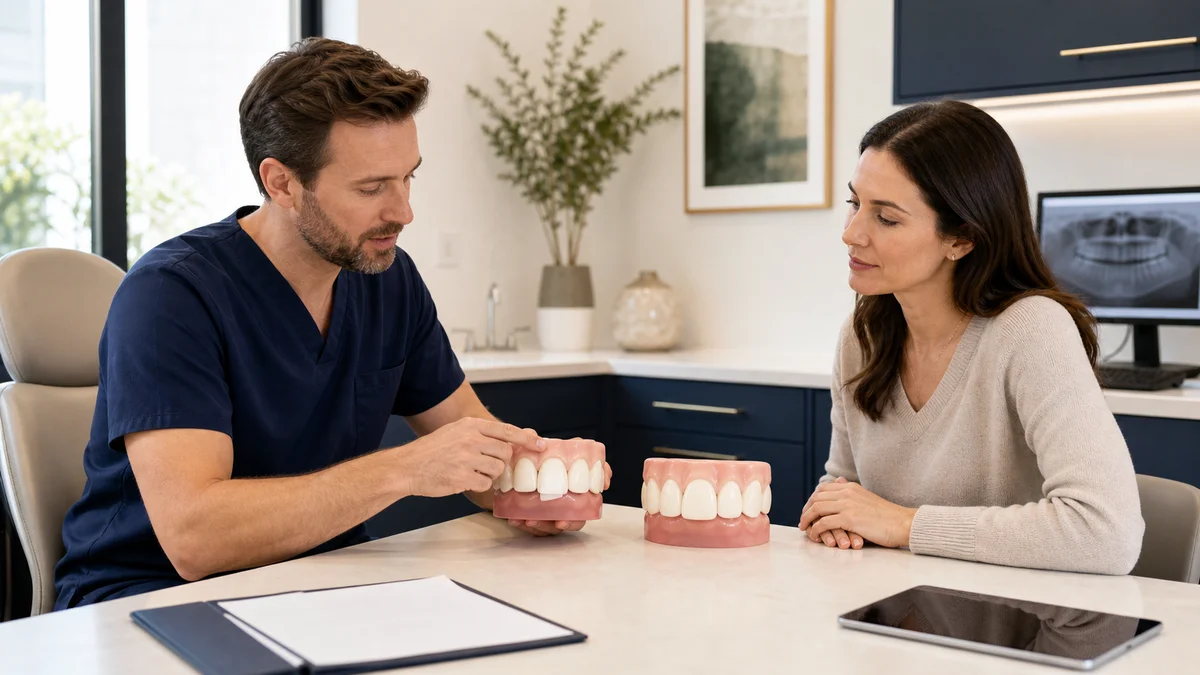
Quick answer: veneers replacement cost depends on why the veneer failed, the health of the tooth and gums, how many units need treatment, material, laboratory work, temporaries, bite management, and aftercare. A loose or chipped veneer may sometimes be repaired or rebonded; replacement should follow an examination and an itemized written plan, not a cosmetic package quote.
Searching for veneers replacement cost usually begins with a practical concern: an older veneer looks different, feels rough, has loosened, or no longer matches nearby teeth. Yet the visible veneer is only part of the clinical question. The dentist must assess the restoration, the bonding surface, remaining enamel, the underlying tooth, the gum margin, and the way the teeth meet.
That assessment matters because replacement is not always the only option. Some composite veneers can be polished or repaired. A porcelain veneer that has debonded intact may, in selected circumstances, be suitable for rebonding. Other cases require a new veneer, a crown, treatment of decay, gum care, or a pause while the cause of failure is addressed. No safe recommendation can be made from a photograph alone.
This guide explains the clinical and financial decisions that create a responsible estimate. It does not provide a fixed fee, diagnose a tooth, promise longevity, or guarantee a cosmetic result. It is designed to help patients compare like-for-like plans while protecting natural tooth structure.
1. What veneers replacement cost should include
A complete plan may include examination, photographs, scans or impressions, medically justified imaging, removal of the old veneer, management of the remaining tooth, a temporary restoration, laboratory fabrication, fitting, bonding, bite adjustment, and review. Not every patient needs every step, but each proposed item should have a clinical reason.
The veneers replacement cost is therefore more than a fee for a ceramic shell. It may reflect whether the old veneer comes off easily, whether adhesive or cement must be removed, whether decay is present, whether the margin needs redesign, and whether neighboring restorations must be color-matched. A quote that lists only “one veneer” hides these variables.
Ask the practice to separate definite services from contingencies. For example, a new veneer may be planned, while a root canal or crown is only a possibility if hidden damage is discovered. You should know how such a change would be diagnosed, explained, and approved before work continues.
- Reason for failure and health of the underlying tooth
- Repair, rebonding, replacement, or alternative restoration
- Removal, temporary protection, and laboratory stages
- Material, shade strategy, and number of teeth involved
- Review, bite protection, maintenance, and possible future care
2. Diagnosis before veneers replacement cost
The American Dental Association explains that veneers can chip, crack, wear, or loosen over time. The appropriate response depends on the cause. A clinician should inspect the veneer and tooth, test the bite, assess gum health, and ask about sensitivity, trauma, grinding, previous bonding, and changes in appearance.
Decay or gum disease should be treated before a new veneer is placed. Covering an unhealthy tooth can worsen an existing problem. If symptoms suggest pulpal or structural damage, additional tests may be appropriate. Imaging should answer a clinical question; it should not be repeated automatically because a package includes it.
Before discussing veneers replacement cost, ask for a plain-language diagnosis: Did the veneer fracture, did the bond fail, did the tooth decay, did the gum recede, or did the bite overload the restoration? Replacing the shell without correcting the cause can recreate the same problem.
3. Repair versus veneers replacement cost
A small defect does not always require complete replacement. Composite may sometimes be smoothed, polished, or repaired with additional resin. A minor porcelain chip may have conservative options, although repair appearance and durability depend on location, size, bonding surface, and bite. An intact debonded veneer may occasionally be rebonded after careful evaluation.
Repair can preserve tooth structure and reduce treatment, but it is not automatically the best choice. If a margin leaks, decay is present, the veneer is extensively fractured, or the tooth-restoration relationship has changed, replacement may be safer. A repair also may remain visible or require future maintenance.
Compare repair and veneers replacement cost over the same time horizon. Ask what each option can reasonably achieve, what limitations remain, how failure would be managed, and whether repair affects a future replacement. The lowest immediate fee is not necessarily the most conservative long-term plan.
4. Underlying enamel and veneers replacement cost
Many veneer procedures require removal of some enamel, and the ADA describes veneer treatment as irreversible when enamel is removed. During replacement, the clinician must preserve as much remaining tooth structure as possible while creating a clean, stable surface and adequate space. Repeated aggressive preparation can weaken the tooth.
The National Institute of Dental and Craniofacial Research notes that repeated replacement of restorations can increase tooth-loss risk because natural structure may be removed during refitting. This does not mean that every replacement is harmful or avoidable. It means the reason, preparation design, and alternatives deserve careful review.
A responsible veneers replacement cost plan documents how much enamel appears to remain and whether the new restoration can bond predictably. If support is inadequate or the tooth is heavily restored, a crown might be discussed, but it removes more circumferential structure and should not be presented as a routine cosmetic upgrade.
5. Porcelain, composite, and veneers replacement cost
Porcelain veneers are generally laboratory-made shells bonded to the front surfaces of teeth. Composite veneers are sculpted from tooth-colored resin, often directly in the mouth. Porcelain may offer color stability and surface properties that differ from composite, while composite can be easier to repair and may require less enamel removal in selected cases.
Material names alone do not predict clinical success. Preparation, moisture control, adhesive protocol, thickness, laboratory design, finishing, bite, and patient habits all matter. “Premium ceramic” is a marketing phrase unless the exact material, manufacturer, indication, and design are documented.
The veneers replacement cost may differ because porcelain commonly involves scanning or impressions, temporary coverage, laboratory fabrication, and a separate bonding visit. Composite may involve more chairside artistry and future maintenance. Compare the complete pathway rather than assuming one material is universally better.
6. One tooth or a smile zone: veneers replacement cost
Replacing one visible veneer can be technically demanding because it must match adjacent natural teeth and aged restorations under different lighting. Replacing several veneers may make shade coordination easier, but healthy or serviceable veneers should not be removed merely to create a larger package. Tissue preservation remains the priority.
Ask the dentist to show which units are clinically defective and which are being considered only for visual harmony. A diagnostic mock-up, photographs, or provisional stage may help communicate shape and proportion. No digital simulation can guarantee the final biological or visual result.
When comparing veneers replacement cost, verify the exact number of teeth, whether temporary veneers are included for each unit, and what happens if the single replacement does not match at the try-in. A new consent and fee discussion should precede any expansion of scope.
7. Removal complexity and veneers replacement cost
Old veneers vary in thickness, material, bond, and preparation design. Removal may be straightforward or time-consuming. The dentist must distinguish restoration from natural tooth and limit unnecessary damage. Specialized magnification or removal methods may be used, but technology does not eliminate risk.
Hidden findings can change the plan. Once the veneer is removed, the clinician may discover caries, a crack, a large old filling, limited enamel, or a different preparation than expected. A temporary restoration can protect the tooth while options are reviewed or a laboratory veneer is made.
Ask whether removal and temporization are included in veneers replacement cost, how unexpected findings will be documented, and whether you can pause before a more invasive treatment. A consent form should explain reasonably foreseeable risks without using them as a blanket authorization for any procedure.
8. Gum health and veneers replacement cost
Bleeding, swelling, gum recession, and uneven margins can affect both health and appearance. A new veneer placed while inflammation is active may have compromised impressions, bonding conditions, or margin design. Cleaning and periodontal care may need to occur first, followed by reassessment.
Not every uneven gum line requires surgery. Soft-tissue procedures have indications, healing time, risks, and separate fees. If crown lengthening or contouring is recommended, ask what health or restorative problem it solves and whether a non-surgical or no-treatment option exists.
The veneers replacement cost should list gum treatment separately from the veneer. It should also state how healing changes the schedule. Rushing from tissue surgery to final impressions to meet a travel date can compromise decision-making.
9. Bite, grinding, and veneers replacement cost
Clenching, grinding, a deep overbite, or unfavorable tooth contacts may overload veneers. The ADA advises that veneers may not be suitable for some people who clench, grind, or have a deep overbite. This is not a diagnosis based on symptoms alone; the dentist must evaluate the bite and failure pattern.
Possible management may include adjusting the design, treating an underlying functional issue, selecting another restoration, or providing a protective appliance. A night guard is not a guarantee against fracture and needs maintenance. It should be prescribed for a clinical reason, not added automatically to every package.
Include bite analysis, adjustments, and any guard in the veneers replacement cost comparison. Ask whether the guard is made before or after final restorations, how fit is checked, and what replacement or review schedule is proposed.
10. Temporaries and veneers replacement cost
Temporary veneers protect prepared teeth, support appearance, and allow limited evaluation of shape and speech while laboratory work is completed. They are not identical to the final ceramic in strength, surface, or color. Patients should receive instructions about cleaning, food, and what to do if a temporary loosens.
The provisional stage can reveal whether length, contour, or bite needs adjustment. It should not be treated only as a waiting period. Changes requested after the laboratory has completed the final veneers may require new work, so communication checkpoints should be explicit.
A detailed veneers replacement cost estimate states whether temporaries, repairs, relining, and emergency reattachment are included. If you are traveling, ask who can help locally and whether intervention by another dentist affects the practice’s warranty terms.
11. Laboratory work and veneers replacement cost
Indirect veneers may be designed from impressions or digital scans and fabricated by a dental laboratory using ceramics and processes selected for the case. NIDCR recognizes veneers as indirect restorations commonly custom-made in a laboratory through techniques such as digital design and milling. Laboratory skill and communication influence fit, shape, texture, and shade.
Ask where the veneer is made, which material is prescribed, how shade information is transferred, and how many try-ins or remakes the estimate allows. A low laboratory fee is not proof of poor quality, just as a high fee is not proof of excellent fit. Documentation and clinical quality control are more meaningful.
For veneers replacement cost, distinguish the dentist’s services, laboratory fee, material surcharge, and possible remake conditions. If a remake is required because the patient changes the agreed shade or shape after approval, financial responsibility may differ from a remake for a technical misfit.
12. Insurance and veneers replacement cost
Veneers are commonly considered cosmetic. The ADA notes that insurance may not cover them unless they are considered medically necessary, while the NHS states that veneers are generally private unless a clinical need is demonstrated. Coverage varies by country, plan, diagnosis, and contract; no clinic can guarantee an insurer’s decision.
Submit the diagnosis, radiographs if relevant, narrative, and itemized pretreatment estimate before care. Ask the insurer whether replacement is excluded by a frequency limitation, cosmetic exclusion, missing-tooth or pre-existing-condition clause, or network rule. A predetermination can still be conditional rather than a promise of payment.
Plan veneers replacement cost based on the written benefit response and your ability to pay, not on an assumed reimbursement. Financing terms should disclose the full amount, fees, interest, schedule, and consequences of a treatment-plan change.
13. Choosing a provider for veneers replacement cost
Veneer replacement should be carried out by a licensed dentist. The ADA warns that unsupervised treatment by unlicensed “veneer technicians” can lead to infection, nerve damage, and veneers placed over unhealthy teeth. Verify the professional’s license and the clinic’s legal status through the relevant regulator.
Experience can be discussed without relying on staged testimonials or guaranteed before-and-after images. Ask how the clinician evaluates failed veneers, manages limited enamel, communicates with the laboratory, and handles complications. You may request anonymized examples, but they cannot predict your result.
A provider’s veneers replacement cost should be understandable and itemized. Pressure to sign immediately, refusal to name the treating dentist, a blanket lifetime guarantee, or an irreversible plan based only on messaging are reasons to pause.
14. Decision table for veneers replacement cost
| Decision point | What should be documented | Warning sign | Safer next step |
|---|---|---|---|
| Reason for failure | Fracture, debonding, decay, gum or bite finding | Replacement recommended from a selfie | Clinical examination and diagnosis |
| Treatment choice | Repair, rebond, replace, crown, or observation | Only one package offered | Ask for conservative alternatives |
| Tooth preservation | Remaining enamel and planned preparation | More removal described as an upgrade | Seek a second opinion |
| Scope | Exact teeth, material, temporaries, and laboratory | Only a total package amount | Request itemization |
| Failure prevention | Bite, grinding, hygiene, and gum strategy | Cause is not investigated | Treat risk factors first |
| Aftercare | Review, repairs, warranty conditions, emergency route | No plan after bonding | Add written follow-up terms |
Use the table for every proposal. It turns veneers replacement cost from a headline number into a comparison of diagnosis, tooth preservation, treatment scope, and future responsibility.
15. Second opinions on veneers replacement cost
A second opinion is especially valuable if several veneers are being removed, healthy adjacent teeth are being added for symmetry, crowns are proposed, or hidden decay is suspected. Ask the first practice for relevant records and images so unnecessary tests can be avoided. The second dentist will decide whether the records are diagnostically adequate.
Different recommendations do not automatically mean one dentist is wrong. Repairability, esthetic compromise, remaining enamel, and risk tolerance can produce more than one reasonable path. Ask each clinician what assumptions lead to the proposed treatment and what would make the plan change.
If veneers replacement cost estimates differ widely, compare the exact teeth, removal, temporaries, material, laboratory, gum care, bite appliance, reviews, and remake policy. The lower estimate may simply omit important phases.
16. Traveling for veneers replacement cost
Cross-border treatment can combine dental care with flights, accommodation, time off work, translation, and return visits. Veneer replacement may require diagnosis, removal, temporization, laboratory fabrication, try-in, bonding, and review. A travel schedule should follow clinical needs rather than force every case into the same number of days.
Before traveling, clarify who handles a loose temporary, shade change, bite discomfort, or urgent symptoms after you return home. A local dentist is not automatically responsible for another clinic’s work or warranty. Obtain records, material details, radiographs, treatment notes, invoices, and an aftercare plan before departure.
Compare total veneers replacement cost, including travel, possible return visits, and local care. Insurance rules for treatment abroad vary; written confirmation from your insurer is more reliable than a clinic’s general statement.
17. Maintenance after veneers replacement cost
Veneers still require brushing with fluoride toothpaste, daily cleaning between teeth, and regular professional assessment. Cavities can develop around or beneath veneer margins, and gums can become inflamed. Avoid using veneered teeth to open packages or bite hard objects; use a sports mouthguard when appropriate.
Report a bite that feels wrong, new sensitivity, movement, a rough edge, swelling, or pain promptly. A chipped veneer is usually not a medical emergency, but significant trauma, facial swelling, fever, uncontrolled bleeding, or breathing difficulty needs urgent assessment. Do not glue a veneer back with household adhesive.
Maintenance is part of the long-term veneers replacement cost picture. Reviews reduce avoidable risk but cannot guarantee an indefinite lifespan. Teeth, gums, adhesives, and restorative materials all change over time.
18. Checklist before accepting veneers replacement cost
- What exactly caused the current veneer to fail?
- Can it be observed, polished, repaired, or rebonded safely?
- How much enamel remains, and what additional preparation is planned?
- Why is a veneer preferred over bonding, a crown, or no treatment?
- Which teeth are clinically defective and which are cosmetic additions?
- What material, laboratory process, temporary, and try-in are included?
- How will gum inflammation, decay, bite, or grinding be managed?
- What does insurance say in writing, and what remains your responsibility?
- What are the review, repair, remake, and warranty conditions?
- Who provides urgent and routine care after you leave the clinic?
If an answer is missing, request clarification before consent or payment. A safe veneers replacement cost decision protects natural tissue and makes possible changes visible before irreversible treatment begins.
Frequently asked questions about veneers replacement cost
Why does veneers replacement cost vary so much?
The cause of failure, tooth health, number of veneers, remaining enamel, material, removal difficulty, temporary restorations, laboratory work, gum treatment, bite management, location, and aftercare all affect the estimate. Compare itemized plans with the same scope rather than headline prices.
Can repair reduce veneers replacement cost?
Sometimes. Composite can often be repaired more readily, and selected small porcelain defects may have conservative options. Repair may have visible or durability limitations and is unsuitable when decay, extensive fracture, poor margins, or an unresolved bite problem exists. Examination is essential.
Does insurance cover veneers replacement cost?
Coverage depends on the policy and clinical reason. Veneers are often classified as cosmetic, though a documented medical or restorative need may be reviewed differently. Ask for a written predetermination and check cosmetic, frequency, network, and pre-existing-condition provisions.
Is one-tooth veneers replacement cost always lower?
Not necessarily in direct proportion. One veneer may demand complex shade matching to natural teeth and older restorations, while examination and laboratory communication still apply. It may nevertheless preserve more sound treatment than replacing neighboring veneers solely for symmetry.
Does veneers replacement cost include removing the old veneer?
Only if the estimate says so. Removal, adhesive cleanup, temporary protection, imaging, decay treatment, and laboratory fees may be separate. Ask how unexpected findings are approved and priced before the clinician proceeds.
Are crowns part of veneers replacement cost?
A crown is a different restoration that covers much more tooth structure. It may be considered when a tooth lacks support for another veneer, but it should not be an automatic upgrade. The clinical reason, alternatives, added preparation, risks, and separate fee should be explained.
Do temporaries add to veneers replacement cost?
They may. Temporary veneers can protect prepared teeth and help assess shape, speech, and bite while the laboratory works. Confirm whether fabrication, adjustment, repair, and reattachment are included, especially if you will travel between visits.
Can a night guard protect veneers replacement cost investment?
A professionally prescribed guard may reduce some mechanical stresses for selected patients, but it cannot guarantee that veneers will not chip or debond. The dentist should diagnose grinding or bite risk, design the appliance for the final restorations, and review its fit.
When is a second opinion worth the veneers replacement cost consultation?
Seek one when many veneers are proposed, additional healthy teeth would be prepared, crowns or gum surgery are recommended, the cause of failure is unclear, or the fee is substantial. The goal is independent diagnosis and tissue preservation, not simply finding a cheaper package.
Can any clinic guarantee veneers replacement cost will be the last expense?
No. Veneers, teeth, gums, and adhesive interfaces can change, and repair or replacement may be needed later. A clinic can define limited material or workmanship terms, but it cannot guarantee a permanent biological or cosmetic result.
Planning veneers replacement cost with Redent Klinik
Patients considering treatment in Türkiye can review the English-language information on the Redent Klinik website and use the Redent Klinik contact page to ask how existing records can be shared securely. Remote review can support preliminary orientation, but a definitive plan requires an in-person examination.
Ask for the treating dentist’s findings, the reason each veneer needs intervention, conservative alternatives, material, laboratory stages, temporaries, schedule, and aftercare in writing. Confirm your insurer’s rules independently; the clinic cannot promise reimbursement on the insurer’s behalf.
The best veneers replacement cost plan is not the one with the most units or the fastest package. It is the plan that addresses the cause of failure, preserves sound tooth structure, documents uncertainty, and provides realistic follow-up.
Sources and further reading
- American Dental Association, MouthHealthy: Veneers
- American Dental Association: Professional and patient-safety resources
- NHS: Dental treatments, including veneers
- National Institute of Dental and Craniofacial Research: Dental materials
- National Institute of Dental and Craniofacial Research: Plaque and gum health
- U.S. Centers for Disease Control and Prevention: Oral health
- World Health Organization: Oral health fact sheet
Updated August 15, 2026. This article provides general education, not diagnosis or a personal quotation. Clinical findings, fees, regulations, and insurance terms can change and should be verified for the individual case.